
Immobilising Enzymes 6 4 Cloning Biotechnology Learning Objectives
Immobilising Enzymes 6. 4 Cloning & Biotechnology
Learning Objectives • Understand the methods used for immobilising enzymes. • Understand the advantages of using immobilised enzymes.
Enzymes as Catalysts Enzymes are used to speed up chemical (metabolic) reactions e. g. respiration or photosynthesis- so why use enzymes in industry? • They are specific. • Can catalyse reactions between specific chemicals, even in a large mixture. • Form fewer bi-products. • Less purification needed. • Function well at relatively low temperatures saving money on fuel costs. • Enzymes from thermophilic bacteria can be extracted and used at high temperatures.
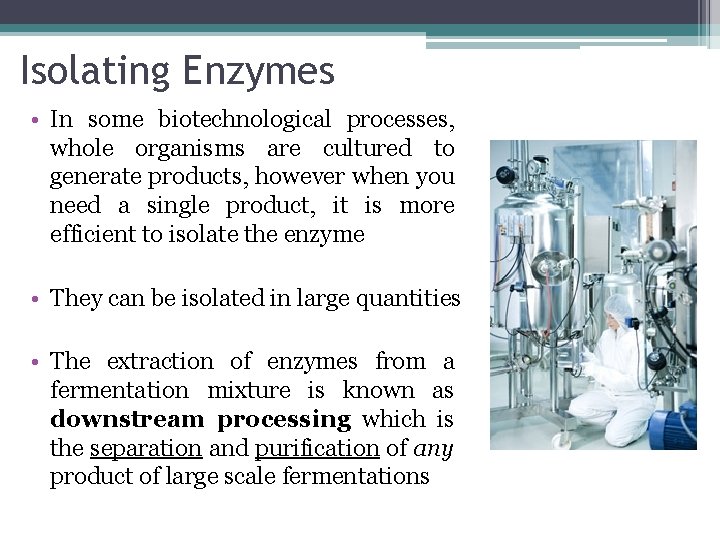
Isolating Enzymes • In some biotechnological processes, whole organisms are cultured to generate products, however when you need a single product, it is more efficient to isolate the enzyme • They can be isolated in large quantities • The extraction of enzymes from a fermentation mixture is known as downstream processing which is the separation and purification of any product of large scale fermentations

Immobilising Enzymes • Enzyme-substrate complexes must be formed in order to gain the products. • The easiest way is to mix the isolated enzyme with the substrate, however the product must then be separated which can be a costly process. • It is therefore possible to immobilise enzymes so they can catalyse the reaction without mixing freely.
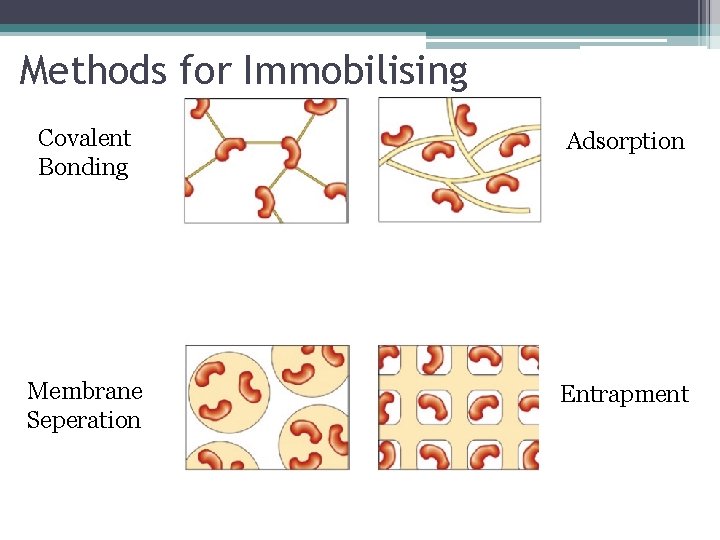
Methods for Immobilising Covalent Bonding Adsorption Membrane Seperation Entrapment
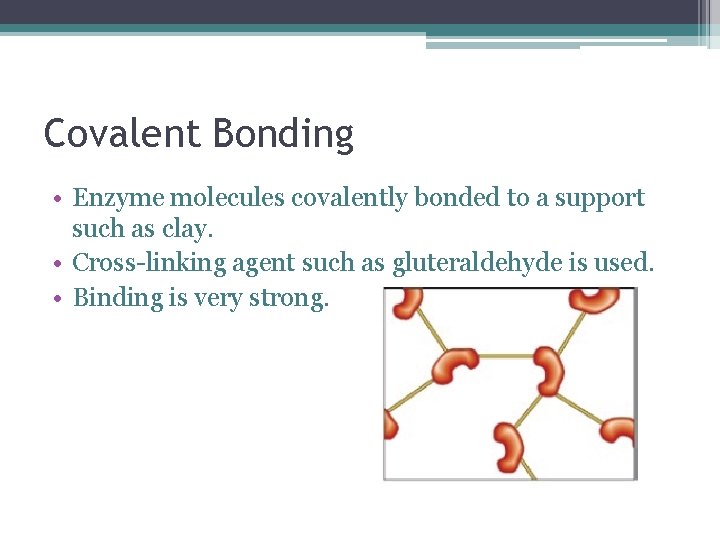
Covalent Bonding • Enzyme molecules covalently bonded to a support such as clay. • Cross-linking agent such as gluteraldehyde is used. • Binding is very strong.
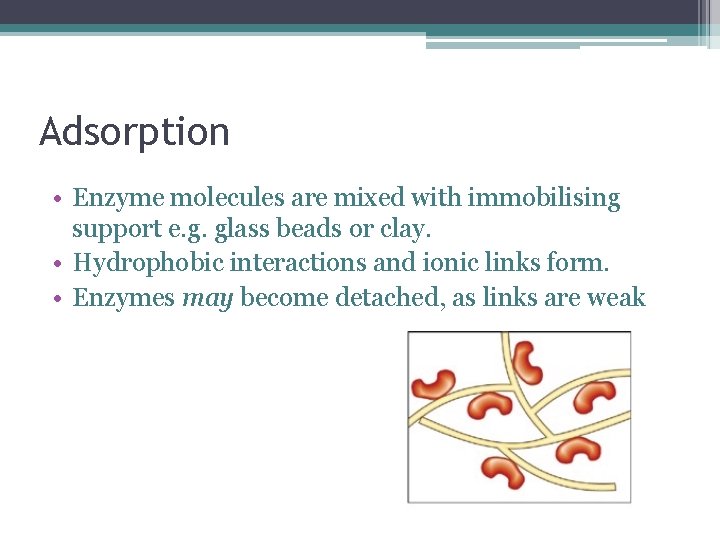
Adsorption • Enzyme molecules are mixed with immobilising support e. g. glass beads or clay. • Hydrophobic interactions and ionic links form. • Enzymes may become detached, as links are weak
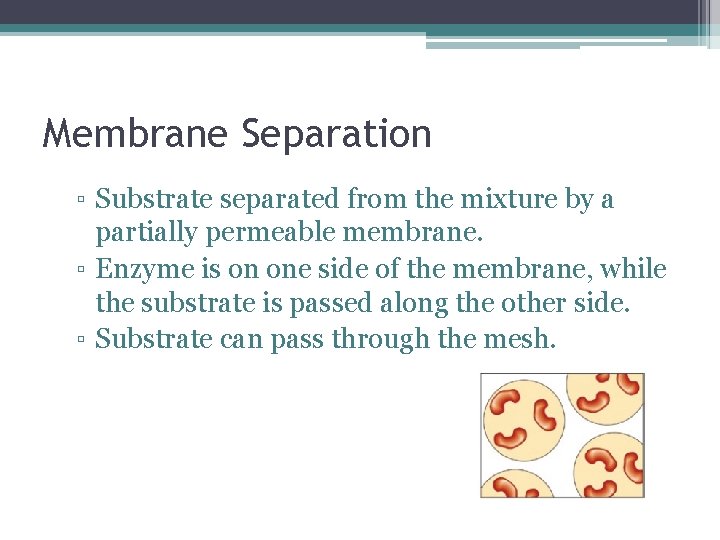
Membrane Separation ▫ Substrate separated from the mixture by a partially permeable membrane. ▫ Enzyme is on one side of the membrane, while the substrate is passed along the other side. ▫ Substrate can pass through the mesh.
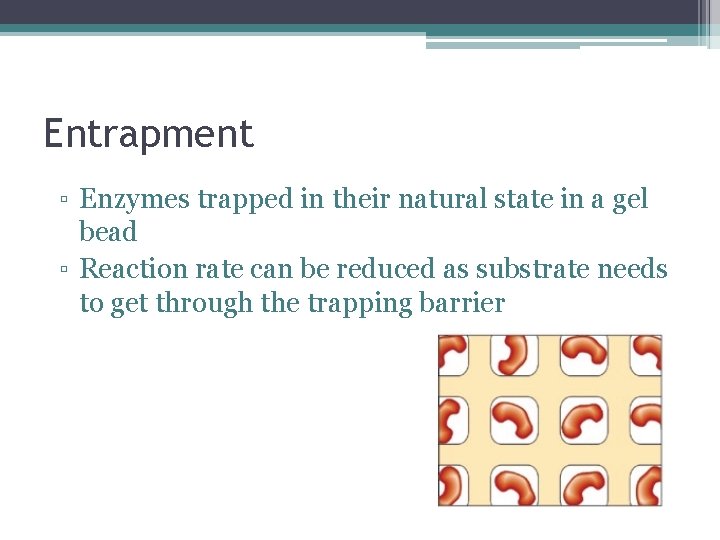
Entrapment ▫ Enzymes trapped in their natural state in a gel bead ▫ Reaction rate can be reduced as substrate needs to get through the trapping barrier
Advantages • Immobilised enzymes can be reused. • Product is enzyme free. • Immobilised enzymes are more tolerant to p. H and temperature changes. • Enzyme not mixed with products so purification/ downstream processing costs are low. • Enzymes available immediately for re-use which is good for continuous processes. • The enzymes are more stable as the immobilising matrix protects the enzyme molecules – less likely to denature in extreme conditions.
Disadvantages • Additional time, equipment and materials needed, so expensive to set up. • Can be less active as they do not mix freely with the substrate. • Contamination can be costly if it occurs as the whole system needs to be stopped.
Examples of Immobilised Enzymes • Page 263 of the textbook has many examples of enzymes that immobilise for use in industry. • Write about 3 of them and how they are immobilised. Mention what reaction they catalyse.
Plenary • Why might bonding enzymes to a surface reduce their rate of activity? • Suggest why some immobilised enzyme processes can be carried out at temperatures well above the normal optimum for that enzyme.
- Slides: 14