
Immigration Update Brexit and the UKs new immigration
Immigration Update: Brexit and the UK’s new immigration system 12 November 2020

Chetal Patel Partner, Immigration – Bates Wells • Chetal is a Partner at Bates Wells. She regularly advises charitable organisations and specialises in corporate immigration matters. Chetal has substantial experience on immigration compliance, Brexit, sponsorship matters, the prevention of illegal working and the impact of the “hostile environment”. In the current COVID-19 pandemic, she is providing high level strategic advice on managing UK workforces. • She is widely recognised as a leader in her field and is listed in a number of legal directories, including Who’s Who Legal, Chambers and Partners and Legal 500. T +44 (0)20 7551 7741 E c. patel@bateswells. co. uk L https: //www. linkedin. com/in/chetal-patel-9540 b 180/

Matthew James Solicitor, Immigration – Bates Wells • Matthew is a Solicitor in the Immigration Department. He has advise on all aspects of personal and business immigration. A main area of his work is helping EEA nationals and their family members with their status in the UK. This includes advising on naturalisation and registrations for British citizenship. The last year has also seen him advise on points based system, family and Human Rights applications. • Before Matthew joined the Immigration team, he worked for four years with Bates Wells’ Charity and Social Enterprise department. So he has a strong background in advising charities and social enterprises on their immigration needs as well. T +44 (0)20 7551 7659 E m. james@bateswells. co. uk L https: //uk. linkedin. com/in/matthew-james-9799931 a 9
Agenda • Brexit • The new immigration system § What are the changes to sponsorship? § Sponsor licence – if you don’t have one. • Q&A
Brexit • Brexit on 31 January 2020 • Currently in a transition period • Free movement continues until 11 pm 31 December 2020 • No ‘legal’ consequences until that date • No ‘need’ to do anything now • Irish nationals have separate rights
Current (transition) position
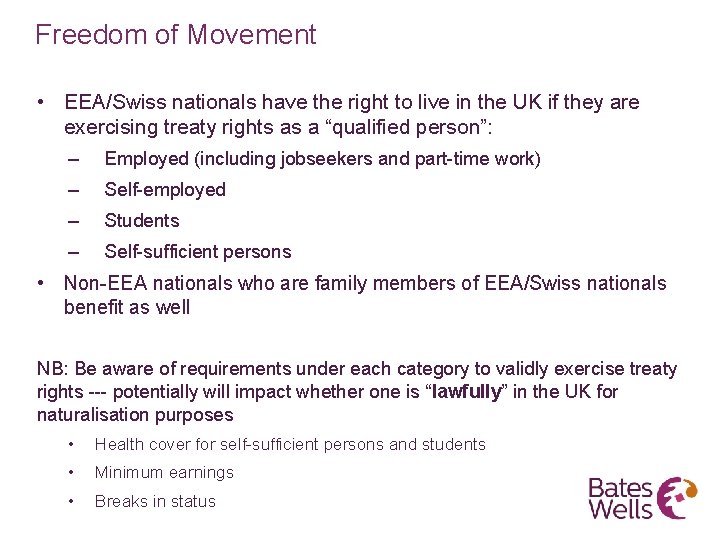
Freedom of Movement • EEA/Swiss nationals have the right to live in the UK if they are exercising treaty rights as a “qualified person”: – Employed (including jobseekers and part-time work) – Self-employed – Students – Self-sufficient persons • Non-EEA nationals who are family members of EEA/Swiss nationals benefit as well NB: Be aware of requirements under each category to validly exercise treaty rights --- potentially will impact whether one is “lawfully” in the UK for naturalisation purposes • Health cover for self-sufficient persons and students • Minimum earnings • Breaks in status
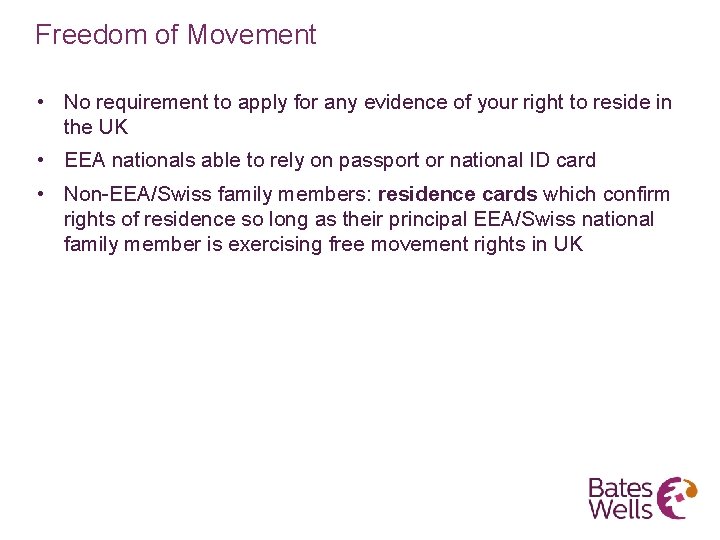
Freedom of Movement • No requirement to apply for any evidence of your right to reside in the UK • EEA nationals able to rely on passport or national ID card • Non-EEA/Swiss family members: residence cards which confirm rights of residence so long as their principal EEA/Swiss national family member is exercising free movement rights in UK
Status of EEA nationals from January 2021
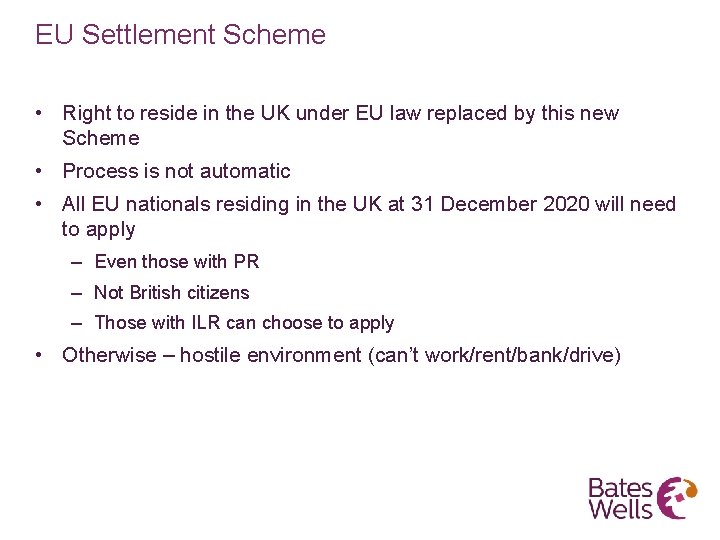
EU Settlement Scheme • Right to reside in the UK under EU law replaced by this new Scheme • Process is not automatic • All EU nationals residing in the UK at 31 December 2020 will need to apply – Even those with PR – Not British citizens – Those with ILR can choose to apply • Otherwise – hostile environment (can’t work/rent/bank/drive)
EU Settlement Scheme • Scheme opened on 30 March 2019 • All EU nationals (and family members) will need to have applied by 30 June 2021 to continue living in the UK • Will be able to travel and work in the UK on EEA passport until that date • Simple, streamlined application process (online, app) • Free • Three main requirements: – Identity (fall within its scope); – UK residence (national insurance number); and – Criminality (suitability)
Who can apply? • EEA citizen resident in UK by 11 pm 31 December 2020 • Family members of EEA citizens – Spouses, civil partners, durable partners – Children under 21 or who are dependent – Parents, grandparents – Other dependant relatives (if in UK under the Regulations) • Family members can join EEA citizen in UK after 31 December 2020 provided the relationship: – Existed on 31 December 2020; and – Continues to exist when family members comes to the UK
Residence • Applicant holds PR document and has not been absent for more than five consecutive years since being granted PR • Applicant holds ILR document • Applicant has resided in the UK for continuous period of five years and has not been absent for more than five consecutive years since completing the five years residence – Exceptions including children (under 21) of EEA citizen who are granted settled status at the same time – Continuity is broken if absent from UK for more than six months in any 12 month period (are exceptions) • Impact of imprisonment and/or exclusion/removal/deportation order
Residence • Minimal documentation intended – just national insurance number • Proof of UK residence obtained via HMRC/DWP where possible • If checks not conclusive given the opportunity to provide further evidence • If application would be eligible for settled status except for their continuous residence is less than five years • Granted Pre-settled status – Granted for five years to enable applicant to become eligible for settled status – However, can’t extend so don’t break continuity
EU Settlement Scheme – Suitability • Deportation/exclusion/removal orders • Criminal conduct occurs before 31 December 2020, EU law applies to deportation threshold • False/misleading information
What about employers? • How you check EEA or Swiss citizens’ right to work in the UK has not changed • EEA/Swiss nationals can still use their passport or National Identity Card until 30 June 2021 • You cannot require them to show EUSS status (even for new hires) • After 30 June 2021, the new immigration rules for recruiting people from outside the UK will apply • You will not need to make retrospective checks for existing employees • So will continue to have statutory excuse if they later do not have the right to work
Future problems • Until July 2021, you can rely on passport of national ID card as a right to work document – won’t be able to identify whether or not they are a 2021 ‘new arrival’ • If employee does not apply before 30 June 2021 deadline, they may lose the right to work • Employer will continue to have statutory excuse (unless you know they don’t have the right to work and continue to employ them ) – but doesn’t give them the right to work • Employer will need a sponsor licence to employ EEA and Swiss citizens coming to the UK to work from 1 January 2021 who do not have status through EUSS or another route • However, should not be making it mandatory for current employees to show you their EUSS status • May be able to ask for a legitimate reason but cannot discriminate against those who have not yet applied before the deadline
What are the changes to sponsorship?
Key changes to sponsorship • New sponsored routes are opening from 09: 00 H on 1 December 2020 – Tier 2 (General) Skilled Worker – Tier 2 (ICT) Intra Company • Fundamental criteria remains largely similar but some key changes that should benefit sponsors and streamline the process • EEA nationals from outside of the UK will require sponsorship from 1 January 2021
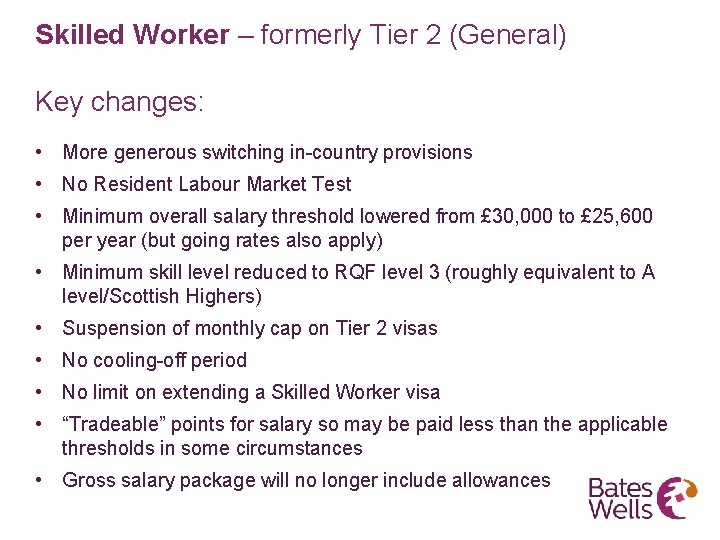
Skilled Worker – formerly Tier 2 (General) Key changes: • More generous switching in-country provisions • No Resident Labour Market Test • Minimum overall salary threshold lowered from £ 30, 000 to £ 25, 600 per year (but going rates also apply) • Minimum skill level reduced to RQF level 3 (roughly equivalent to A level/Scottish Highers) • Suspension of monthly cap on Tier 2 visas • No cooling-off period • No limit on extending a Skilled Worker visa • “Tradeable” points for salary so may be paid less than the applicable thresholds in some circumstances • Gross salary package will no longer include allowances
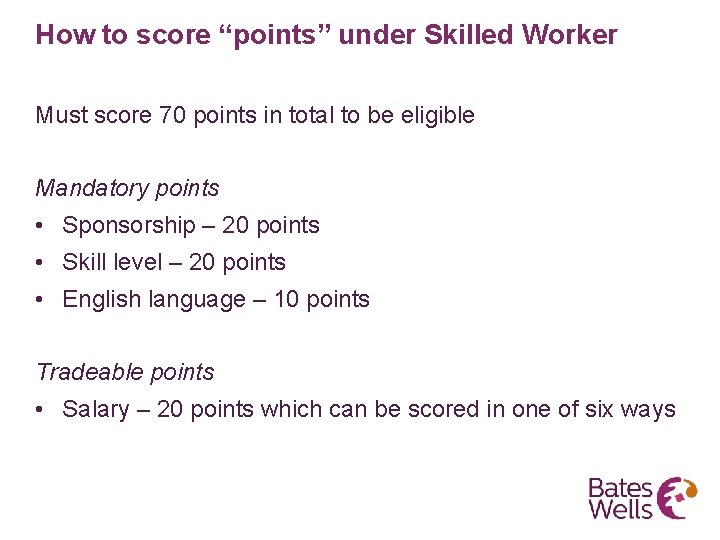
How to score “points” under Skilled Worker Must score 70 points in total to be eligible Mandatory points • Sponsorship – 20 points • Skill level – 20 points • English language – 10 points Tradeable points • Salary – 20 points which can be scored in one of six ways
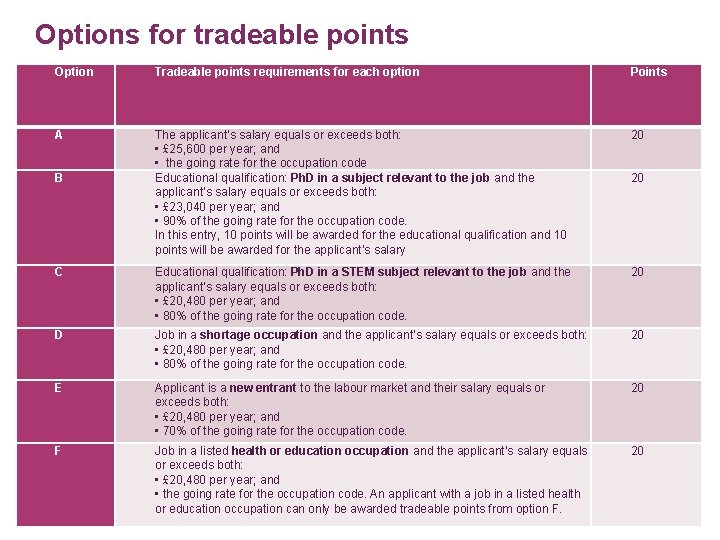
Options for tradeable points Option Tradeable points requirements for each option Points A The applicant’s salary equals or exceeds both: • £ 25, 600 per year; and • the going rate for the occupation code Educational qualification: Ph. D in a subject relevant to the job and the applicant’s salary equals or exceeds both: • £ 23, 040 per year; and • 90% of the going rate for the occupation code. In this entry, 10 points will be awarded for the educational qualification and 10 points will be awarded for the applicant’s salary 20 C Educational qualification: Ph. D in a STEM subject relevant to the job and the applicant’s salary equals or exceeds both: • £ 20, 480 per year; and • 80% of the going rate for the occupation code. 20 D Job in a shortage occupation and the applicant’s salary equals or exceeds both: • £ 20, 480 per year; and • 80% of the going rate for the occupation code. 20 E Applicant is a new entrant to the labour market and their salary equals or exceeds both: • £ 20, 480 per year; and • 70% of the going rate for the occupation code. 20 F Job in a listed health or education occupation and the applicant’s salary equals or exceeds both: • £ 20, 480 per year; and • the going rate for the occupation code. An applicant with a job in a listed health or education occupation can only be awarded tradeable points from option F. 20 B 20
Intra-Company – formerly Tier 2 (Intra-Company Transfer) Long Term Staff Key changes: • More generous switching in-country provisions • Changes to cooling-off period – Can hold leave for up to 5 years in any 6 year rolling period; or – Can hold leave for up to 9 years in any 10 year rolling period for high earners. • High earner threshold changing to £ 73, 900 • N. B. many occupation codes on the new list not eligible and no tradeable points
Grounds for refusal - genuineness • Under both Skilled Worker and Intra-Company routes, the decision maker “must not have reasonable grounds to believe” that the job: – “Does not exist; or – Is a sham; or – Has been created mainly so the applicant can apply for entry clearance or permissions to stay. ” • How will this be assessed?
Points to note • Suspension of Tier 2 cap – what does this mean? • Evidence of recruitment to be kept • Quicker timeframe for skilled worker • Co. S process will be similar: – introduction of Defined Co. S for EC – Co. S allocation will automatically be replaced by UKVI – In year requests can be made – aim: 1 working day • Transitional arrangements: – All Skilled Worker and Intra-Company applications made on or after 1 December 2020 to be decided under new rules, even if Co. S issued under current rules – sponsor note – PAYE / tradeable points? – As allowances will no longer count towards the gross salary package under Skilled Worker, there will be transitional arrangements for those extending their leave from Tier 2 (General) with same sponsor under Skilled Worker.
Key considerations • Plan ahead • EEA nationals – can they arrive by 31 December to avoid sponsorship? • Can existing employees without a route to settlement benefit from switching? • Costs of sponsorship • Training your team on the new routes • Be aware of covid-19 concessions ending
What if you don’t have a sponsor licence?
Why do I need a sponsor licence? • From 1 January 2021, EEA nationals will be subject to the new immigration system. • You will need a sponsor licence to hire anyone who is not British or Irish, unless they already have the necessary permission to work in the UK. • Now is the time …
Sponsor licence – eligibility What do you need to show? • Genuine organisation and operating or trading lawfully in the UK • Systems in place to comply with your sponsor duties • You can offer genuine employment which meets the criteria under the relevant route(s) • Key Personnel who will be oversee the sponsor licence
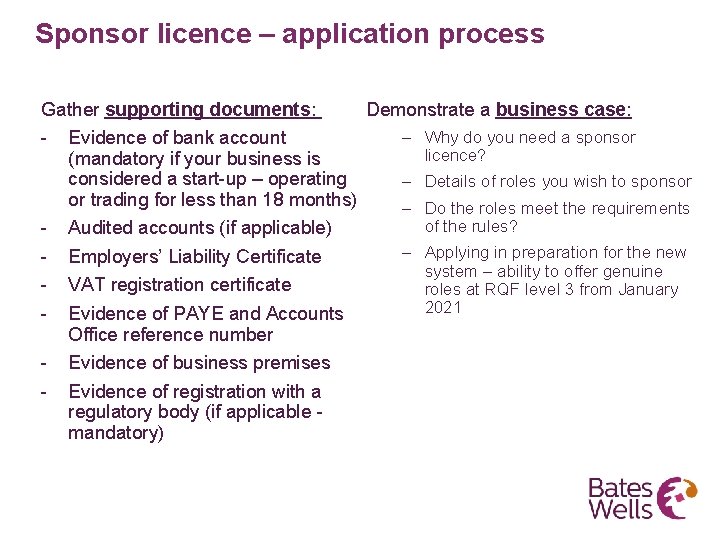
Sponsor licence – application process Gather supporting documents: - Evidence of bank account (mandatory if your business is considered a start-up – operating or trading for less than 18 months) - Audited accounts (if applicable) - Evidence of business premises Employers’ Liability Certificate VAT registration certificate Evidence of PAYE and Accounts Office reference number Evidence of registration with a regulatory body (if applicable mandatory) Demonstrate a business case: – Why do you need a sponsor licence? – Details of roles you wish to sponsor – Do the roles meet the requirements of the rules? – Applying in preparation for the new system – ability to offer genuine roles at RQF level 3 from January 2021
Meeting sponsor duties – Record keeping duties – Reporting duties – Complying with the law – Genuine vacancy – Cooperating with the Home Office – Meeting any duties specific to the categories on the sponsor licence
Key considerations • Plan ahead • Carefully consider the structure of your sponsor licence • Processing times for applications • Get your house in order – compliance visits taking place

Questions? We use the word ‘partner’ to refer to a member of the LLP or an employee or consultant with equivalent standing and qualifications.

Contact us Chetal Patel, Partner, Immigration c. patel@bateswells. co. uk Matthew James, Solicitor, Immigration m. james@bateswells. co. uk
- Slides: 34