
Immigration to the Americas IB History Nation Building
Immigration to the Americas IB History: Nation Building
Immigrant • Immigration is the movement of people from one country or region to another in order to make a new home. • Immigrate- Enter • Emigrate- Leave
Immigration 1770 -1830 • Immigration to Canada picks up – Following the American revolution, many loyalists left the U. S. to go to Canada. • 75, 000 loyalists and Germans looking for better farms • Immigration to the United States slows – Many loyalists did not want to be apart of the newly formed country.
Immigration 1830 -1849 • Immigration picks up again – Primary groups include • Germans • British • Irish – Attracted by cheap farmland
Conditions • Conditions were generally better in the U. S. than what immigrants were leaving. – Irish Potato Famine – Fleeing revolutions – Rough times and poor living conditions in Europe • Arriving many experienced – Freedom – Land
Nativism • Policy of protecting native-born interests. • Starts as a political anti-Catholicism movement against mainly Irish.
Act Prohibiting Importation of Slaves • 1807 - Same year British – Slave Trade Act of 1807 • Ban of the international slave trade in the U. S. took effect in 1808 (when Constitution allowed) • Existing African immigrants became more of a lucrative commodity as new slaves could not be brought in. • Domestic trade increased within the states.
Conditions of Mestizos
Caste System • A caste system developed in Latin America • Mestizos were generally liberal because they sought for more equality, freedom, and parliaments. • Creoles were generally conservative and wanted to protect the Catholic church and upperclasses.
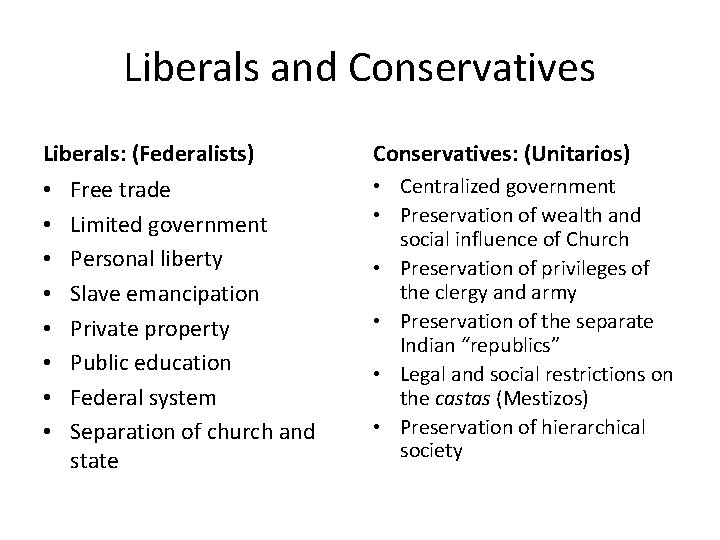
Liberals and Conservatives Liberals: (Federalists) • • Free trade Limited government Personal liberty Slave emancipation Private property Public education Federal system Separation of church and state Conservatives: (Unitarios) • Centralized government • Preservation of wealth and social influence of Church • Preservation of privileges of the clergy and army • Preservation of the separate Indian “republics” • Legal and social restrictions on the castas (Mestizos) • Preservation of hierarchical society
Caudillos • A few problems in Latin America – Political instability – Social differences (Castes) – Centralists/federalist tendencies • Federalists preferred a confederation • Centralists preferred a strong central government – Discipline maintained by Spanish had gone – Poverty/inequality of wealth (No significant middle class) • Caudillos come to power – Charismatic leader who advanced his interests through a combination of military and political skills.
Conditions for Mestizos • Creoles are a minority but have most of the power – They own land • Mexico – Benito Juarez • Redistributes land • Limits power of the church • Brings Mestizos & natives into the government – Mestizo descent makes up most of Mexico’s population today
- Slides: 12