
IMMIGRANT WORKERS RIGHTS ADVOCACY Sean Lai Mc Mahon

- Slides: 51
IMMIGRANT WORKERS’ RIGHTS ADVOCACY Sean Lai Mc. Mahon, Community Development Project, Urban Justice Center Alice Davis, Immigrant Workers’ Rights Project, Catholic Migration Services Anamaria Segura, Workplace Justice Project, MFY Legal Services Ernie Collette, Government Benefits Project, MFY Legal Services IMMIGRATION AND EMPLOYMENT LAW RELIEF for IMMIGRANT WORKERS
INTRODUCTION Goals for this Presentation § To give guidance to advocates who work with immigrant workers and who have questions about their clients’ immigration and employment law rights § To provide a basic overview of employment laws that protect workers regardless of immigration status, while flagging limitations on remedies available to undocumented workers § To provide basic information about T and U Visas, including the benefits they confer, basic eligibility criteria, the application process, and potential barriers to successful applications § To analyze hypos based on real cases raising immigration and employment law issues, practice issue-spotting, and work through practical considerations
INTRODUCTION PRESENTATION OVERVIEW (1) Immigrant Workers’ Employment Rights (2) Introduction to T & U Visas (3) T Visas – Definitions, Screening Tips, Eligibility Requirements, and the Application Process (4) T Visas – Definitions, Screening Tips, Eligibility Requirements, and the Application Process (5) Hypotheticals and Case Studies for Discussion (6) Q&A
IMMIGRANT WORKERS’ EMPLOYMENT RIGHTS § Employment at Will § Basic Protections Against Discrimination § Basics of Wage and Hour Law § Employment Law Remedies § Considerations for Undocumented Workers
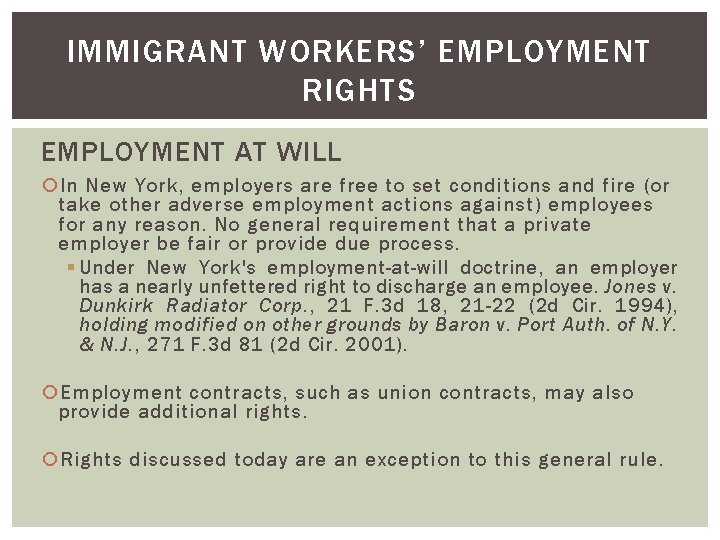
IMMIGRANT WORKERS’ EMPLOYMENT RIGHTS EMPLOYMENT AT WILL In New York, employers are free to set conditions and fire (or take other adverse employment actions against) employees for any reason. No general requirement that a private employer be fair or provide due process. § Under New York's employment-at-will doctrine, an employer has a nearly unfettered right to discharge an employee. Jones v. Dunkirk Radiator Corp. , 21 F. 3 d 18, 21 -22 (2 d Cir. 1994), holding modified on other grounds by Baron v. Port Auth. of N. Y. & N. J. , 271 F. 3 d 81 (2 d Cir. 2001). Employment contracts, such as union contracts, may also provide additional rights. Rights discussed today are an exception to this general rule.
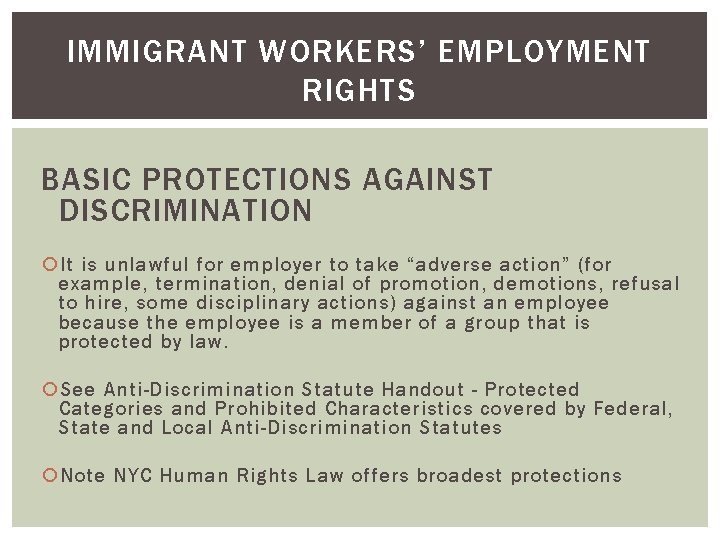
IMMIGRANT WORKERS’ EMPLOYMENT RIGHTS BASIC PROTECTIONS AGAINST DISCRIMINATION It is unlawful for employer to take “adverse action” (for example, termination, denial of promotion, demotions, refusal to hire, some disciplinary actions) against an employee because the employee is a member of a group that is protected by law. See Anti-Discrimination Statute Handout - Protected Categories and Prohibited Characteristics covered by Federal, State and Local Anti-Discrimination Statutes Note NYC Human Rights Law offers broadest protections
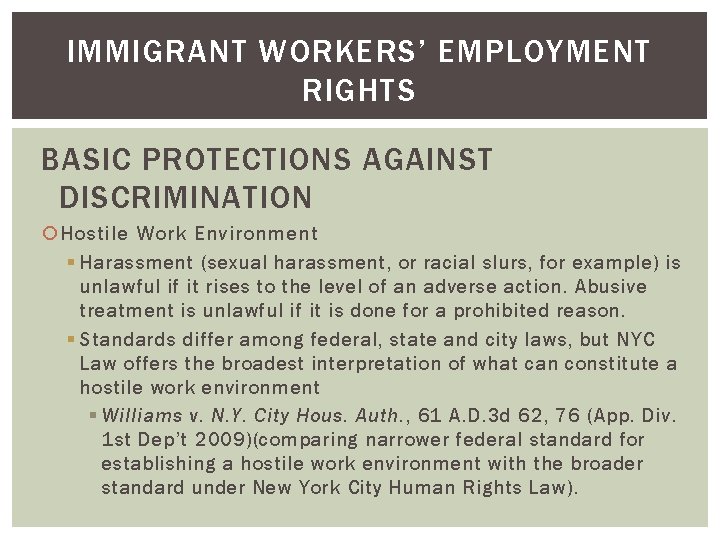
IMMIGRANT WORKERS’ EMPLOYMENT RIGHTS BASIC PROTECTIONS AGAINST DISCRIMINATION Hostile Work Environment § Harassment (sexual harassment, or racial slurs, for example) is unlawful if it rises to the level of an adverse action. Abusive treatment is unlawful if it is done for a prohibited reason. § Standards differ among federal, state and city laws, but NYC Law offers the broadest interpretation of what can constitute a hostile work environment § Williams v. N. Y. City Hous. Auth. , 61 A. D. 3 d 62, 76 (App. Div. 1 st Dep’t 2009)(comparing narrower federal standard for establishing a hostile work environment with the broader standard under New York City Human Rights Law).
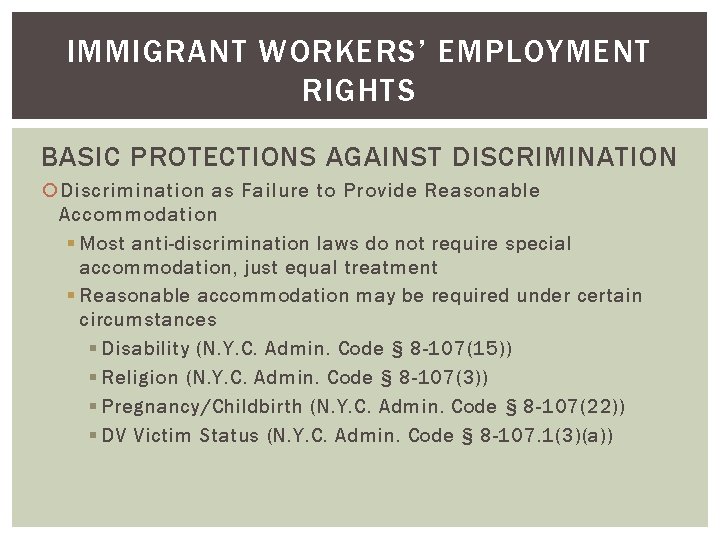
IMMIGRANT WORKERS’ EMPLOYMENT RIGHTS BASIC PROTECTIONS AGAINST DISCRIMINATION Discrimination as Failure to Provide Reasonable Accommodation § Most anti-discrimination laws do not require special accommodation, just equal treatment § Reasonable accommodation may be required under certain circumstances § Disability (N. Y. C. Admin. Code § 8 -107(15)) § Religion (N. Y. C. Admin. Code § 8 -107(3)) § Pregnancy/Childbirth (N. Y. C. Admin. Code § 8 -107(22)) § DV Victim Status (N. Y. C. Admin. Code § 8 -107. 1(3)(a))
IMMIGRANT WORKERS’ EMPLOYMENT RIGHTS BASICS OF WAGE AND HOUR LAW The Fair Labor Standards Act (“FLSA”) protects employees’ rights to wages for hours worked. 29 U. S. C. § 201 et seq. New York Labor Law covers most FLSA protections, offers additional protections & applies to broader array of employers than FLSA. N. Y. Lab. Law § 650 et seq. New York State minimum wage is $8. 75 per hour, but special rules exist for other industries. See N. Y. Lab. Law § 652; 12 N. Y. C. R. R. §§ 141, 142, 143, 146. Overtime: Covered workers must be paid time and a half for hours worked over 40. 29 U. S. C. § 207; 12 N. Y. C. R. R. § 1422. 2 Unlawful deductions: N. Y. Lab. Law § 193
IMMIGRANT WORKERS’ EMPLOYMENT RIGHTS RETALIATION It is illegal to retaliate against workers who assert, or who assist other workers asserting, their wage and hour rights. § 29 U. S. C. § 215(a)(3) § Anti-retaliation protections are triggered by complaints (oral and written) made to a supervisor, as well as by filing formal complaints, testifying, or instituting a proceeding. § See Greathouse v. JHS Sec. Inc. , 784 F. 3 d 105, 115 -18 (2 d Cir. 2015) (extending § 215(a)(3) prohibition to include oral complaints made to employer, so long as complaint is “sufficiently clear and detailed for a reasonable employer to understand it, in light of both content and context, as an assertion of rights protected by the statute and a call for their protection. ”) § N. Y. Lab. Law § 215 § Employee must make a complaint about a specific violation of the New York Labor Law, or show she was retaliated against for participating in a proceeding related to the Labor Law
IMMIGRANT WORKERS’ EMPLOYMENT RIGHTS RETALIATION New York City Law offers the broadest protection § N. Y. C. Admin. Code § 8 -107(7) states that the “retaliation or discrimination complained of. . . need not result in an ultimate action with respect to employment. . . or in a materially adverse change in the terms and conditions of employment. . . provided, however, that the retaliatory or discriminatory act or acts complained of must be reasonably likely to deter a person from engaging in protected activity. ” § See Williams v. N. Y. City Hous. Auth. , 61 A. D. 3 d 62, 71 (App. Div. 1 st Dep’t 2009)(Assessment of retaliation claim should be made “with a keen sense of workplace realities, of the fact that the ‘chilling effect’ of particular conduct is context-dependent, and of the fact that a jury is generally best suited to evaluate the impact of retaliatory conduct in light of those realities. ”) Title VII of Civil Rights Act of 1964, 42 U. S. C § 2000 e– 3(a) Americans with Disabilities Act, 42 U. S. C. § 12203 Age Discrimination in Employment Act, 29 U. S. C. § 623(d) New York State Human Rights Law, N. Y. Exec. Law § 296(7)
IMMIGRANT WORKERS’ EMPLOYMENT RIGHTS WORKERS’ RIGHTS OVERVIEW: EMPLOYMENT LAW REMEDIES Wage and Hour Laws, 29 U. S. C. § 216(b), N. Y. Lab. Law § 198 § Unpaid minimum wage and overtime wages § Liquidated damages of up to 100% of wages due § Pre-judgment interest § Statutory Penalties for failure to provide wage statements § Attorney’s fees and costs Discrimination Laws § Available remedies vary among statutes, but victims can recover lost wages (back and front pay) and benefits, equitable relief, compensatory damages, punitive damages, costs and attorney’s fees.
IMMIGRANT WORKERS’ EMPLOYMENT RIGHTS CONSIDERATIONS FOR UNDOCUMENTED WORKERS Workers have rights to unpaid wages regardless of status, but undocumented workers’ rights to certain remedies are limited In Hoffman Plastic Compounds, Inc. v. NLRB, 535 U. S. 137 (2002), the U. S. Supreme Court found that the NLRA award of post-termination back pay to remedy an unlawful firing is not available to undocumented workers who obtained their jobs using false papers, because the employer was required under federal law to fire the worker once she discovered that the worker is undocumented.
IMMIGRANT WORKERS’ EMPLOYMENT RIGHTS CONSIDERATIONS FOR UNDOCUMENTED WORKERS New York Court of Appeals has distinguished Hoffman and found that undocumented workers may recover future lost earnings due to an on-the-job injury. Balbuena v. IDR Realty LLC, 6 N. Y. 3 d 338, 362 (2006)(allowing plaintiff to pursue lost wages under New York Labor Law § 240, New York’s “scaffolding law”). Lower courts have limited Balbuena’s holding to cases where workers have not submitted false documents in order to gain employment. See, e. g. , Gomez v. F & T Int'l (Flushing, NY) LLC, 16 Misc. 3 d 867, 873 (Sup. Ct. N. Y. Cty. 2007)(holding that federal law did not bar undocumented workers’ claims for wages lost due to injuries absent proof that they used false documents to obtain employment).
IMMIGRANT WORKERS’ EMPLOYMENT RIGHTS CONSIDERATIONS FOR UNDOCUMENTED WORKERS A few issues to raise in counseling clients about filing an employment claim as undocumented worker § It is unlawful retaliation to report employee to immigration authorities because of employee’s efforts to enforce her legal rights. However, no guarantee an employer won’t retaliate § It has been U. S. government policy that immigration authorities should consider whether information is being provided in attempt to retaliate against worker seeking to enforce rights, and take no action without special review. Still no guarantee that authorities will not act. § If worker files a lawsuit and chooses to seek back pay, there is significant possibility that immigration status will be held relevant to litigation.
IMMIGRANT WORKERS’ EMPLOYMENT RIGHTS CONSIDERATIONS FOR UNDOCUMENTED WORKERS Helpful Resources For Advocates Considering Employment Litigation on Behalf of Undocumented Workers: ACLU, NELP, No Free Pass to Harass: Protecting the Rights of Undocumented Immigrant Women Workers in Sexual Harassment Cases (2007), available at https: //www. aclu. org/sites/default/files/pdfs/womensrights/ no_free_pass_20071119. pdf Cho, Eunice, U-Visas For Victims of Crimes in the Workplace: A Practice Manual (May 2014), available at http: //nelp. org/content/uploads/2015/03/U-Visas-for-Victims -of-Workplace-Crime-Practice-Manual-NELP. pdf
I NTRODUCTIONTO T AND U V ISAS What are T and U Visas? Immigration status for victims of certain crimes, including: § Severe forms of trafficking § Serious crimes § Violent crimes § Crimes involving the justice system
I NTRODUCTION T O T & U V ISAS Benefits of a T or U Visa: Legal immigration status to live in U. S. Work authorization Path to lawful Permanent Residence (Green Card) & Citizenship Eligible For Medicaid and other government benefits Can apply for “Derivatives” (spouses & unmarried children under 21)
T V ISA Eligibility Requirements to Apply for a T Visa: 1) Victim of a “severe form of trafficking” 2) Physically present in U. S. due to trafficking 3) Cooperation with law enforcement 4) Extreme hardship if returned to home country 5) Admissible (or eligible for Waiver Of Inadmissibility)
T V ISA D EFINITIONS 1) What is Labor Trafficking for T Visa Purposes? § Labor or Services Obtained by: § Force § Fraud, or § Coercion § For the Purpose of: v Involuntary Servitude; v Peonage, Debt Bondage; or v Slavery.
T V ISA D EFINITIONS 1) Labor or Services Obtained by: v Force v Fraud Deceit regarding work conditions (e. g. , wages, hours, freedom of movement); Visa fraud v Coercion Includes non-violent coercion, such as: - Threats of a scheme designed to make a person feel threatened - Creating climate of fear - Abuse of legal process (Improper use of the legal system to exert pressure on another person)
T V ISA S CREENING T IPS Red Flags for Non-Violent Coercion and Abuse of the Legal Process: § Threats of arrest § Threats of deportation or canceling a visa § Threats of a lawsuit or legal action § Withholding a worker’s documents (e. g. Passport, Work Permit) § Empty promises of immigration benefit § Threatening to cut off legal remedies § Retaliation § Isolation factors (language barriers, housing and access to community, financial resources, medical attention, etc. )
T V ISA D EFINITIONS 1) For the Purpose of Involuntary Servitude/Slavery: § Involuntary Servitude Is: § A scheme, pattern or plan designed to make a person feel threatened by serious harm § Serious Harm includes psychological and reputational harm § Abuse of the legal process
T V ISA S CREENING T IPS Red Flags For Involuntary Servitude/Slavery: § Verbal, physical, or sexual abuse (including threats) § Restricting mobility § Threats to reputation § Threats of economic ruin (e. g. , becoming homeless, stranded in U. S. without support, unable to pay debt) § Threats to family or friends
T V ISA 1) For the Purpose of Peonage or Debt Bondage: § When the worker is compelled to perform service to pay off debt, and can never meaningfully reduce the debt
T V ISA R EQUIREMENTS 2) Physical Presence: The principal applicant has to be in the U. S. when applying Must be present “On account of” trafficking Does not have to be brought into U. S. by trafficking -e. g. , one can be trafficked within the U. S.
T V ISA R EQUIREMENTS 3) Cooperation With Law Enforcement: Willingness To Cooperate Includes: § Reporting a crime, identifying places/people, interviews, testifying at Grand Jury or trial, making a written Statement Certification from a Law Enforcement Agency (LEA) is not necessary for a successful application Only “reasonable” cooperation is required
T V ISA P RACTICE T IPS 3) Cooperation With Law Enforcement: Examples of Law Enforcement Agencies: § Police Department § District Attorneys’ Office § U. S. Attorney General § U. S. and New York State Department of Labor § U. S. Department of State Diplomatic Security Services § Immigration and Customs Enforcement § FBI
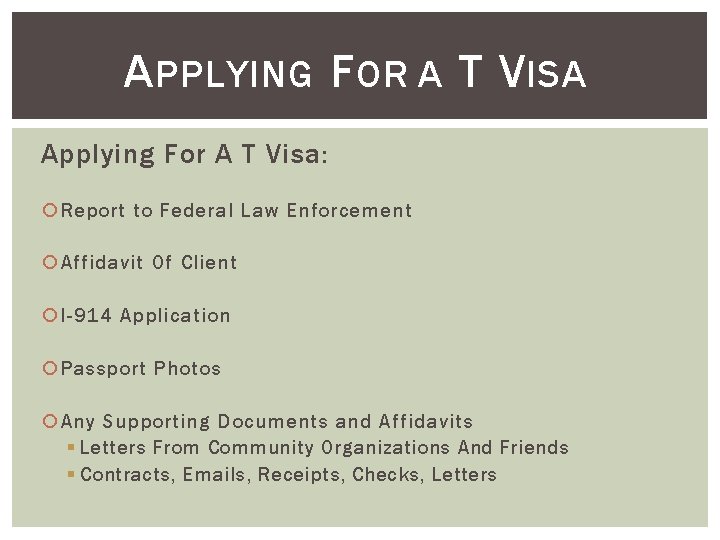
A PPLYING F OR A T V ISA Applying For A T Visa: Report to Federal Law Enforcement Affidavit Of Client I-914 Application Passport Photos Any Supporting Documents and Affidavits § Letters From Community Organizations And Friends § Contracts, Emails, Receipts, Checks, Letters
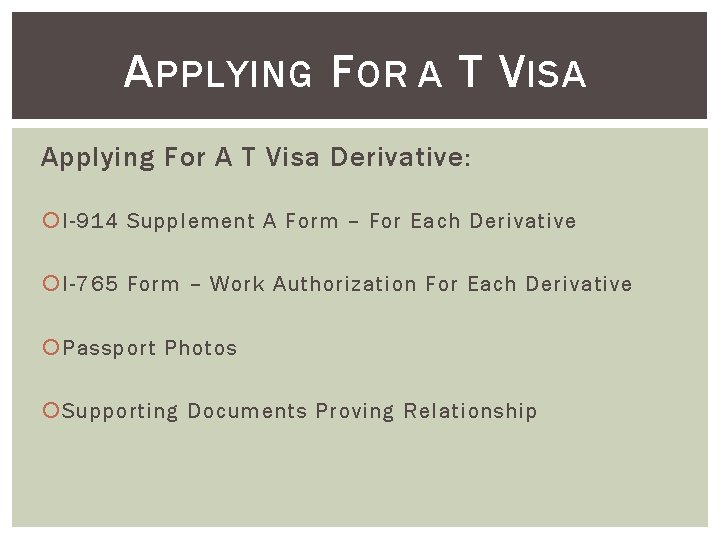
A PPLYING F OR A T V ISA Applying For A T Visa Derivative: I-914 Supplement A Form – For Each Derivative I-765 Form – Work Authorization For Each Derivative Passport Photos Supporting Documents Proving Relationship
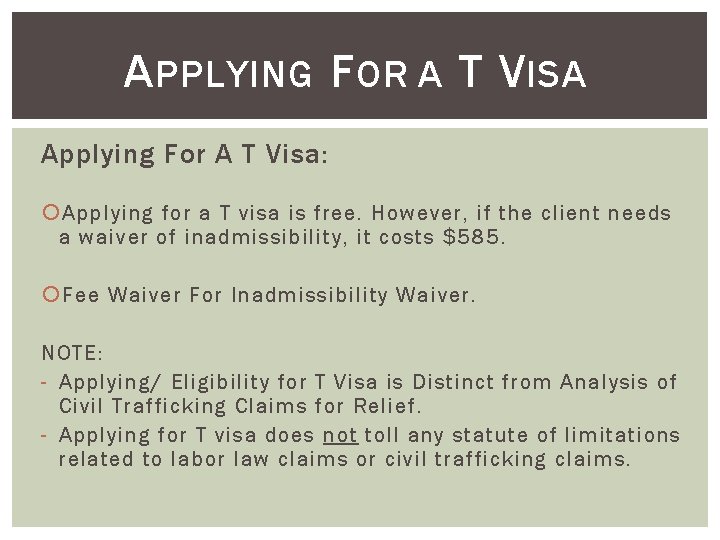
A PPLYING F OR A T V ISA Applying For A T Visa: Applying for a T visa is free. However, if the client needs a waiver of inadmissibility, it costs $585. Fee Waiver For Inadmissibility Waiver. NOTE: - Applying/ Eligibility for T Visa is Distinct from Analysis of Civil Trafficking Claims for Relief. - Applying for T visa does not toll any statute of limitations related to labor law claims or civil trafficking claims.
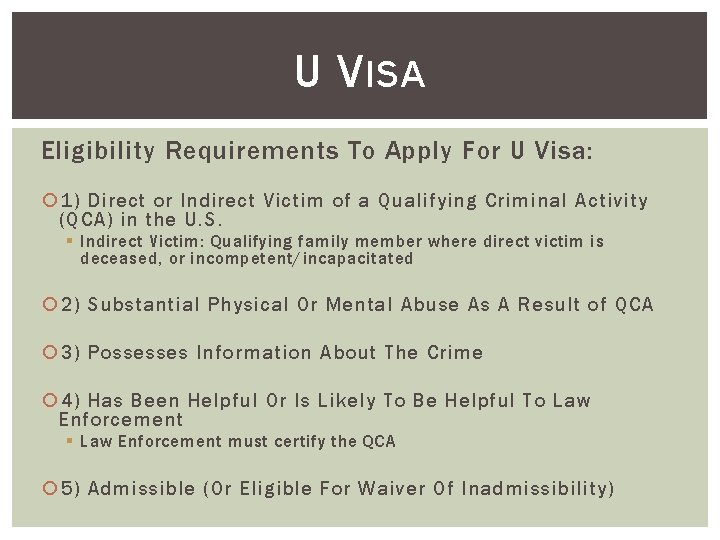
U V ISA Eligibility Requirements To Apply For U Visa: 1) Direct or Indirect Victim of a Qualifying Criminal Activity (QCA) in the U. S. § Indirect Victim: Qualifying family member where direct victim is deceased, or incompetent/incapacitated 2) Substantial Physical Or Mental Abuse As A Result of QCA 3) Possesses Information About The Crime 4) Has Been Helpful Or Is Likely To Be Helpful To Law Enforcement § Law Enforcement must certify the QCA 5) Admissible (Or Eligible For Waiver Of Inadmissibility)
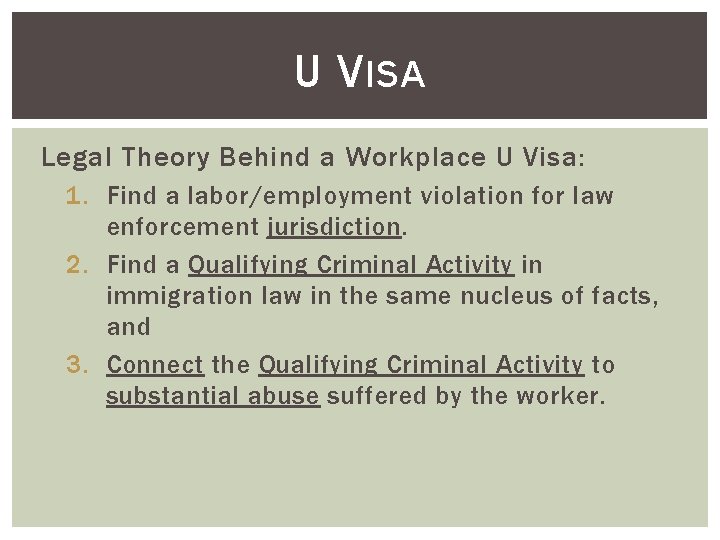
U V ISA Legal Theory Behind a Workplace U Visa: 1. Find a labor/employment violation for law enforcement jurisdiction. 2. Find a Qualifying Criminal Activity in immigration law in the same nucleus of facts, and 3. Connect the Qualifying Criminal Activity to substantial abuse suffered by the worker.
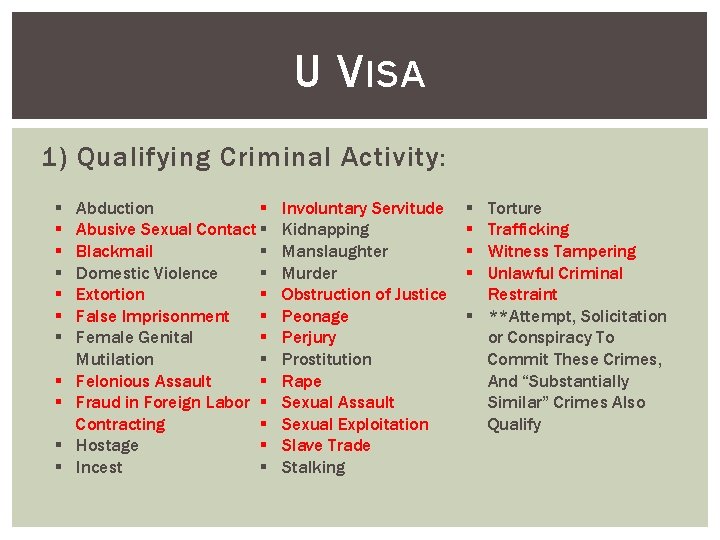
U V ISA 1) Qualifying Criminal Activity: § § § Abduction Abusive Sexual Contact § § Blackmail § Domestic Violence § Extortion § False Imprisonment § Female Genital § Mutilation § Felonious Assault Fraud in Foreign Labor § § Contracting § Hostage § Incest Involuntary Servitude Kidnapping Manslaughter Murder Obstruction of Justice Peonage Perjury Prostitution Rape Sexual Assault Sexual Exploitation Slave Trade Stalking § § Torture Trafficking Witness Tampering Unlawful Criminal Restraint § **Attempt, Solicitation or Conspiracy To Commit These Crimes, And “Substantially Similar” Crimes Also Qualify
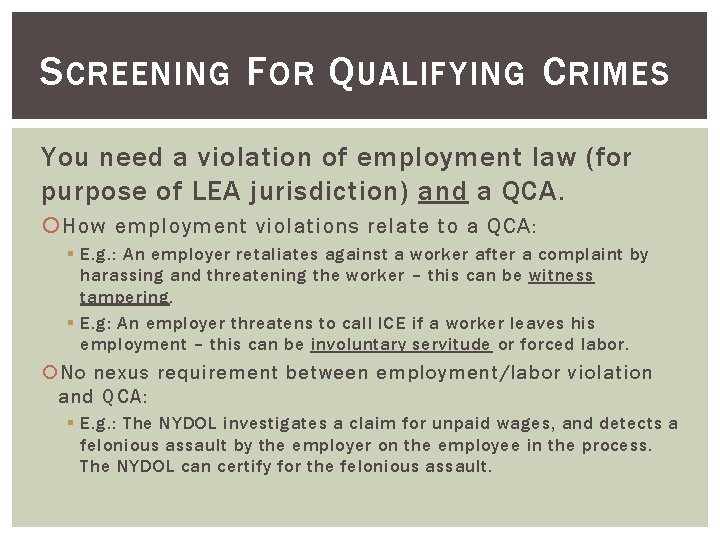
S CREENING F OR Q UALIFYING C RIMES You need a violation of employment law (for purpose of LEA jurisdiction) and a QCA. How employment violations relate to a QCA: § E. g. : An employer retaliates against a worker after a complaint by harassing and threatening the worker – this can be witness tampering. § E. g: An employer threatens to call ICE if a worker leaves his employment – this can be involuntary servitude or forced labor. No nexus requirement between employment/labor violation and QCA: § E. g. : The NYDOL investigates a claim for unpaid wages, and detects a felonious assault by the employer on the employee in the process. The NYDOL can certify for the felonious assault.
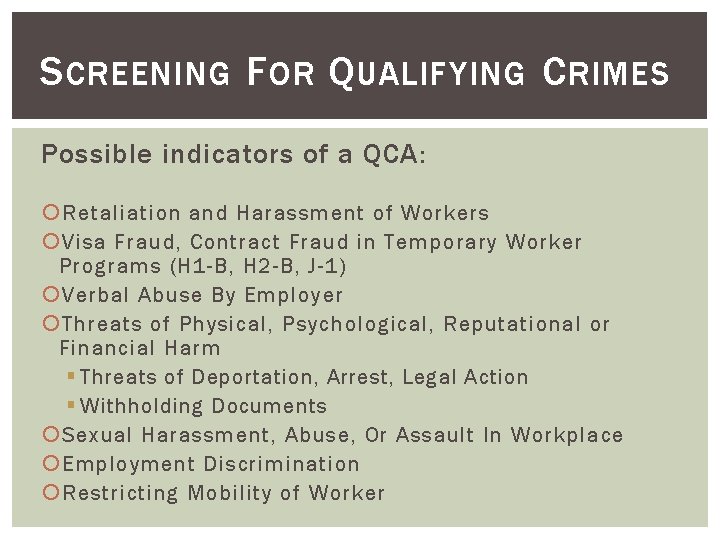
S CREENING F OR Q UALIFYING C RIMES Possible indicators of a QCA: Retaliation and Harassment of Workers Visa Fraud, Contract Fraud in Temporary Worker Programs (H 1 -B, H 2 -B, J-1) Verbal Abuse By Employer Threats of Physical, Psychological, Reputational or Financial Harm § Threats of Deportation, Arrest, Legal Action § Withholding Documents Sexual Harassment, Abuse, Or Assault In Workplace Employment Discrimination Restricting Mobility of Worker
S UBSTANTIAL A BUSE 2) Substantial Abuse: “Injury or harm to the victim’s physical person, or harm to or impairment of the emotional soundness of the victim. ” § 8 C. F. R. § 214. 14(a)(8) Nexus to Qualifying Criminal Activity USCIS Determines, Not Certifying Agency Supporting Psych Report Virtually Required
S UBSTANTIAL A BUSE 2) Factors of Substantial Abuse: Nature Of The Injury Severity Of The Perpetrator’s Conduct Severity Of The Harm Duration Of The Infliction Of The Harm Permanent Or Serious Harm To Appearance, Health, Or Physical/Mental Soundness, Including Aggravation Of Pre -Existing Conditions.
S UBSTANTIAL A BUSE Examples of Symptoms of Substantial Abuse for Workplace U Visas: § Depression § Anxiety § Significant Stress § PTSD § Worsening Of Pre-existing Conditions § Sleep Deprivation § Headaches, Nausea, Hypertension § Impact on Relationships
S UBSTANTIAL A BUSE Proof of Substantial Abuse & Nexus: § Non-precedent decisions from the Administrative Appeals Office (AAO): § § In In re re L- T-, AAO (Jan. 5, 2015). C- A-, AAO (Dec. 19, 2014). F- G-, AAO (Dec. 19, 2014). Y- A- G-, AAO (Dec. 19, 2014). § Express statement by mental health professional of a nexus between the worker’s mental/psychological harm and the abuse they suffered from the employer is required. § Witness tampering: intimidation and coercive practices to prevent reporting of violations could cause, exacerbate, or act as the “tipping point” for a client’s mental health problems. § Cases at: nipnlg. org/Workplace. Crimes. html
S UBSTANTIAL A BUSE Managing Client Expectations: § Recently, USCIS has been delaying and denying workplace U visa claims for (1) lack of substantial abuse and (2) lack of nexus between substantial abuse and QCA. Currently (fall 2015), it is likely that many clients will not be successful with a workplace U visa claim. § Think about seriousness of the harm the client has suffered when considering U eligibility. Compare: § Example 1: A worker suffers retaliation by her employer for filing a DOL complaint. The employer physically expels the worker from the workplace, calls her at all hours, makes threats about legal action, calling immigration, calling the IRS. § Example 2: A worker suffers retaliation by her employer for filing a DOL complaint. The employer reduces the worker’s hours. § HOWEVER! Make sure to explore facts fully. Contact us if you need guidance.
L AW E NFORCEMENT C ERTIFICATION 3) Helpful To Law Enforcement: § Federal or State Law Enforcement Agencies § Law Enforcement Agency (LEA) Must Certify That Applicant Has Been, Is Being, Or Is Likely To Be Helpful § Each LEA Has Different Criteria For Certifying U Visas
L AW E NFORCEMENT C ERTIFICATION Examples of LEAs For U Visa Workplace Crimes: § U. S. and N. Y. Departments of Labor § US Equal Employment Opportunities Commission (EEOC) § National Labor Relations Board (NLRB) § New York City Commission on Human Rights § New York State Attorney General’s Office § District Attorney’s Office § Brooklyn DA Labor Fraud Bureau
L AW E NFORCEMENT C ERTIFICATION You need a violation of employment law (for purpose of law enforcement jurisdiction) and a QCA. See handout for explanation of when law enforcement agencies will certify. § E. g. : U. S. Department of Labor requires that a FLSA wage and hour claim or a guest worker claims is present in order to certify. When in doubt, contact the agencies directly: some aspects of U certification policy are confusing. § E. g. : U. S. Department of Labor will not certify during the course of an OSHA investigation; only Wage and Hour Division investigations and investigations of guest worker programs.
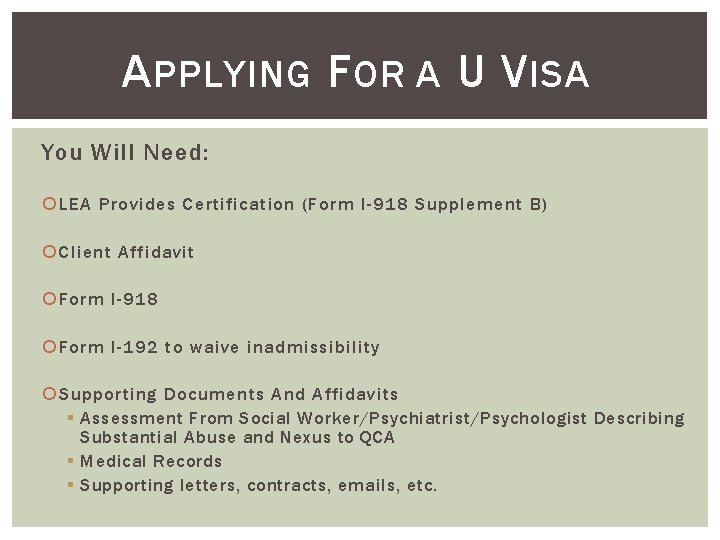
A PPLYING F OR A U V ISA You Will Need: LEA Provides Certification (Form I-918 Supplement B) Client Affidavit Form I-918 Form I-192 to waive inadmissibility Supporting Documents And Affidavits § Assessment From Social Worker/Psychiatrist/Psychologist Describing Substantial Abuse and Nexus to QCA § Medical Records § Supporting letters, contracts, emails, etc.
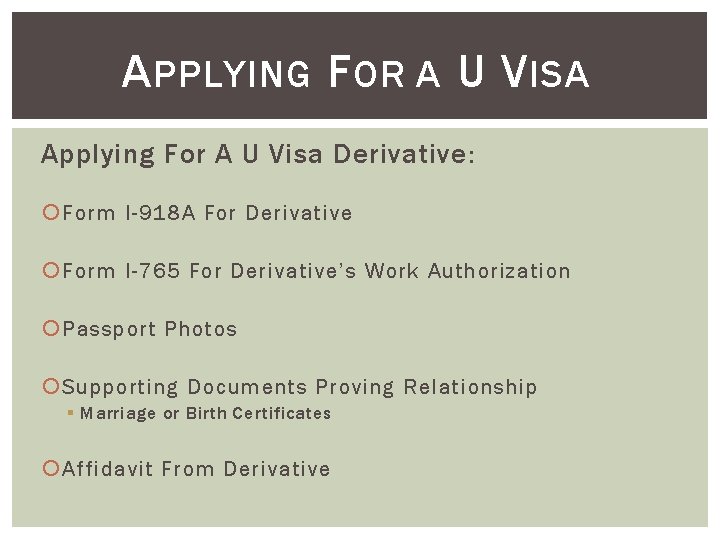
A PPLYING F OR A U V ISA Applying For A U Visa Derivative: Form I-918 A For Derivative Form I-765 For Derivative’s Work Authorization Passport Photos Supporting Documents Proving Relationship § Marriage or Birth Certificates Affidavit From Derivative
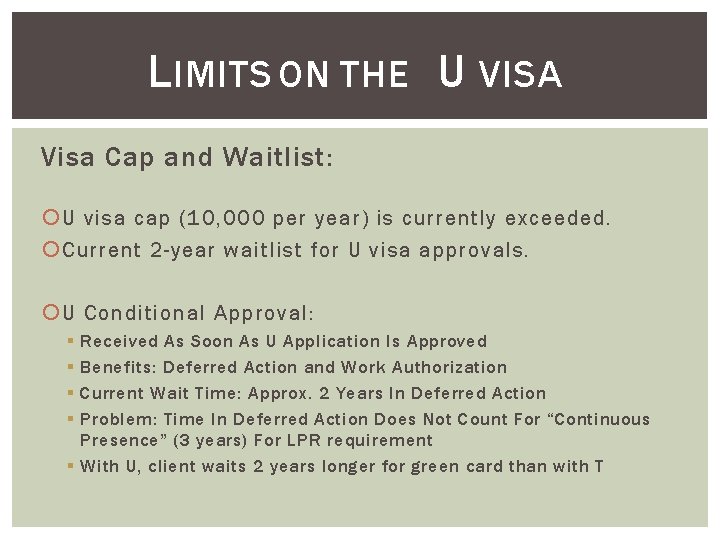
L IMITS ON THE U VISA Visa Cap and Waitlist: U visa cap (10, 000 per year) is currently exceeded. Current 2 -year waitlist for U visa approvals. U Conditional Approval: § § Received As Soon As U Application Is Approved Benefits: Deferred Action and Work Authorization Current Wait Time: Approx. 2 Years In Deferred Action Problem: Time In Deferred Action Does Not Count For “Continuous Presence” (3 years) For LPR requirement § With U, client waits 2 years longer for green card than with T
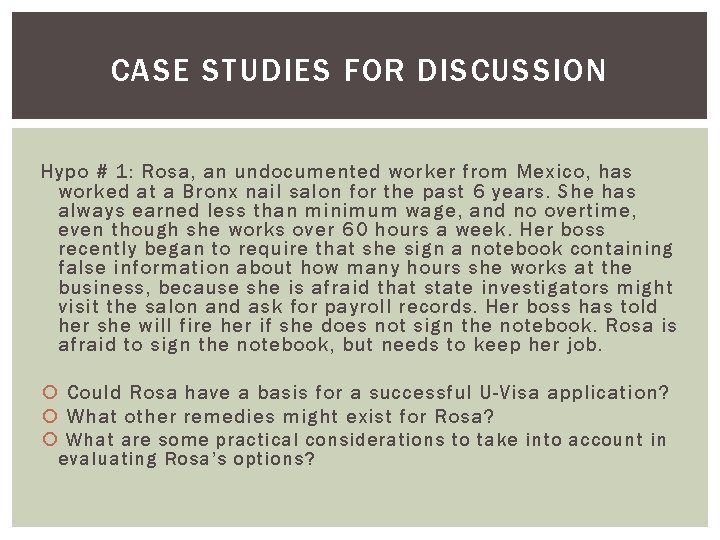
CASE STUDIES FOR DISCUSSION Hypo # 1: Rosa, an undocumented worker from Mexico, has worked at a Bronx nail salon for the past 6 years. She has always earned less than minimum wage, and no overtime, even though she works over 60 hours a week. Her boss recently began to require that she sign a notebook containing false information about how many hours she works at the business, because she is afraid that state investigators might visit the salon and ask for payroll records. Her boss has told her she will fire her if she does not sign the notebook. Rosa is afraid to sign the notebook, but needs to keep her job. Could Rosa have a basis for a successful U-Visa application? What other remedies might exist for Rosa? What are some practical considerations to take into account in evaluating Rosa’s options?
CASE STUDIES FOR DISCUSSION Hypo # 2: Erica, an undocumented worker from Mexico, worked at a Brooklyn laundromat until a year ago. Over the course of her job, the owner of the laundromat repeatedly sexually assaulted her. She stayed at the job out of fear that he would make good on his promise to fire her and to have her deported if she ever complained, but one day she could not take it anymore and left the job, filing a criminal complaint in her local precinct. The criminal case is ongoing, though she is unsure of its status. She has come to you to find out what she can do to protect herself. Could Erica have a basis for a successful U-Visa application? What other remedies might exist for Erica? What are some practical considerations to take into account in evaluating Erica’s options?
CASE STUDIES FOR DISCUSSION Hypo # 3: Wilson came to the United States on an H 1 agricultural work visa. In order to pay for his flight, he borrowed money from a recruiter, who is now his supervisor on the farm. The recruiter is charging him a high interest rate and Wilson is struggling to pay back his debt. Wilson complained to the owner of the farm that he was not earning enough to repay the recruiter. The owner explained to Wilson that he would not pay him more, and if he quit, he would lose his H 1 visa and be out of lawful immigration status. What red flags does Wilson’s story raise? What do we need to know in order to determine if Wilson is a good candidate for a T visa? What facts might help Wilson’s claim?
QUESTIONS & ANSWERS