
Immersion Education in Canada Stability and Change Peter

Immersion Education in Canada: Stability and Change Peter Mac. Intyre Cape Breton University Presented in Graz, Austria Sept 24, 2008 at the European Centre for Modern Languages
Outline n The language map of Canada Describe French Immersion Approach Support and Criticism of Immersion State of Immersion in Canada Report n Recent Controversy in New Brunswick n n n (2006) n n Canadian Parents for French Conclusions
Languages in Canada n n English: 21. 8 million speakers French: 7. 2 million speakers n n Approximately 5. 5 million English - French bilingual (17% of population) Much more common for L 1 French (43%) to be bilingual than L 1 English (9%)
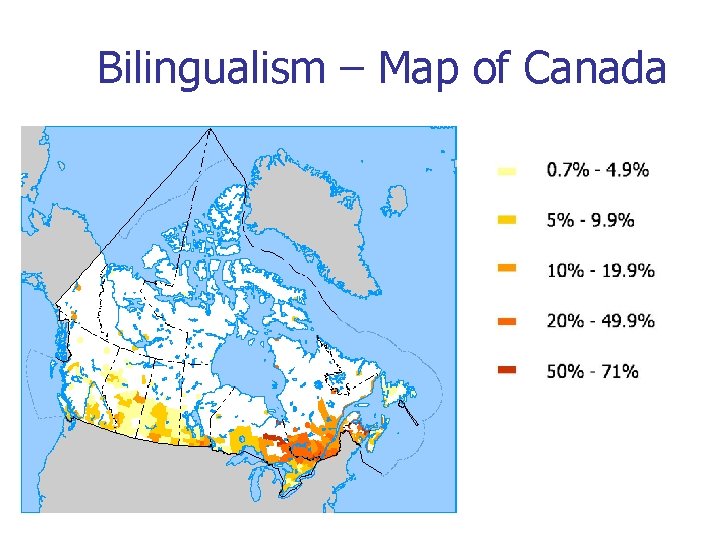
Bilingualism – Map of Canada
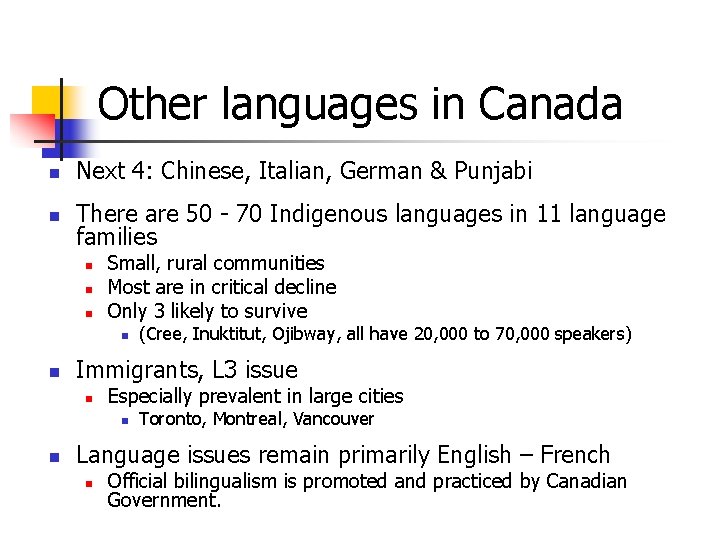
Other languages in Canada n Next 4: Chinese, Italian, German & Punjabi n There are 50 - 70 Indigenous languages in 11 language families n n n Small, rural communities Most are in critical decline Only 3 likely to survive n n Immigrants, L 3 issue n Especially prevalent in large cities n n (Cree, Inuktitut, Ojibway, all have 20, 000 to 70, 000 speakers) Toronto, Montreal, Vancouver Language issues remain primarily English – French n Official bilingualism is promoted and practiced by Canadian Government.

Immersion Education in Canada
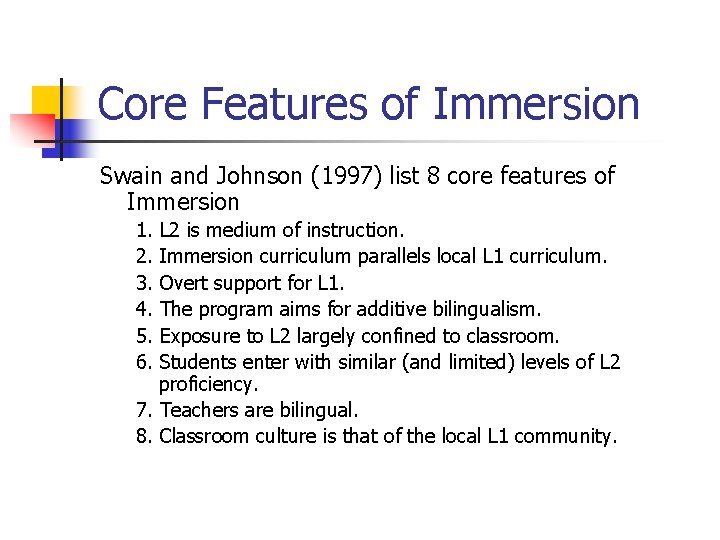
Core Features of Immersion Swain and Johnson (1997) list 8 core features of Immersion 1. 2. 3. 4. 5. 6. L 2 is medium of instruction. Immersion curriculum parallels local L 1 curriculum. Overt support for L 1. The program aims for additive bilingualism. Exposure to L 2 largely confined to classroom. Students enter with similar (and limited) levels of L 2 proficiency. 7. Teachers are bilingual. 8. Classroom culture is that of the local L 1 community.
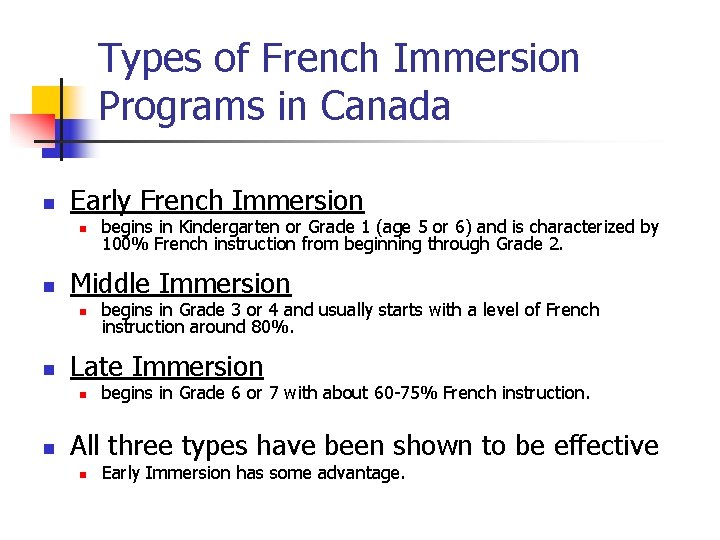
Types of French Immersion Programs in Canada n Early French Immersion n n Middle Immersion n n begins in Grade 3 or 4 and usually starts with a level of French instruction around 80%. Late Immersion n n begins in Kindergarten or Grade 1 (age 5 or 6) and is characterized by 100% French instruction from beginning through Grade 2. begins in Grade 6 or 7 with about 60 -75% French instruction. All three types have been shown to be effective n Early Immersion has some advantage.
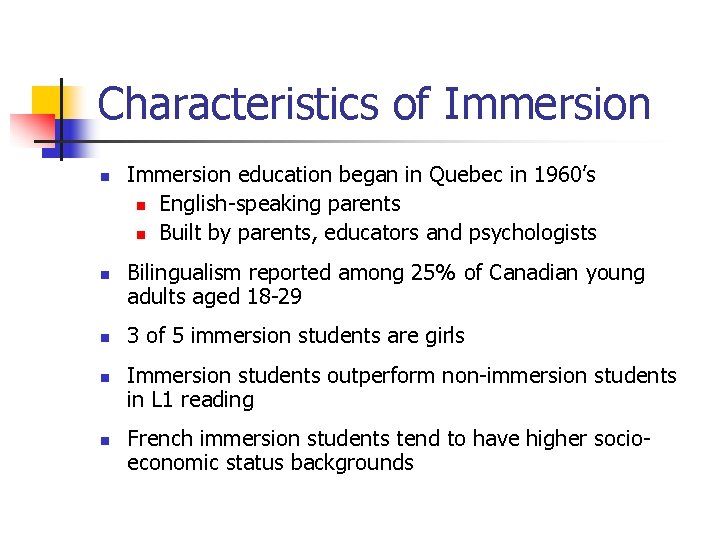
Characteristics of Immersion n n Immersion education began in Quebec in 1960’s n English-speaking parents n Built by parents, educators and psychologists Bilingualism reported among 25% of Canadian young adults aged 18 -29 3 of 5 immersion students are girls Immersion students outperform non-immersion students in L 1 reading French immersion students tend to have higher socioeconomic status backgrounds
Additional Factors n Immersion programs are more easily available n n n in more affluent communities and in Eastern Canada Self-selection of students n n less-skilled students may be transferring out of immersion programs enriched learning environments, positive peer effects
Support and Criticisms of French Immersion n Immersion supports bilingualism n n but not native-like fluency Public sometimes complains about use of federal funds - education is a provincial responsibility in Canada n Support - skill in the French language n n n eligibility for future jobs helps to promote French culture Criticism – perceived as having limited access n n voluntary nature of program Immersion students not completely fluent
STATE OF IMMERSION (2006) Report from the Canadian Council on Learning
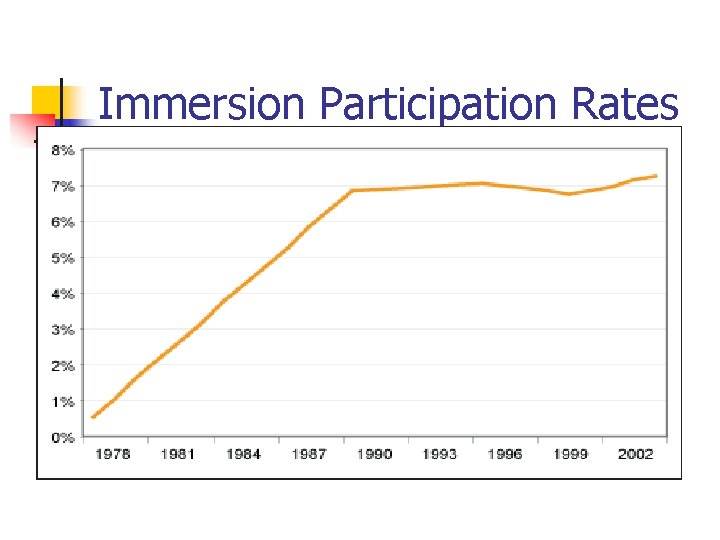
Immersion Participation Rates
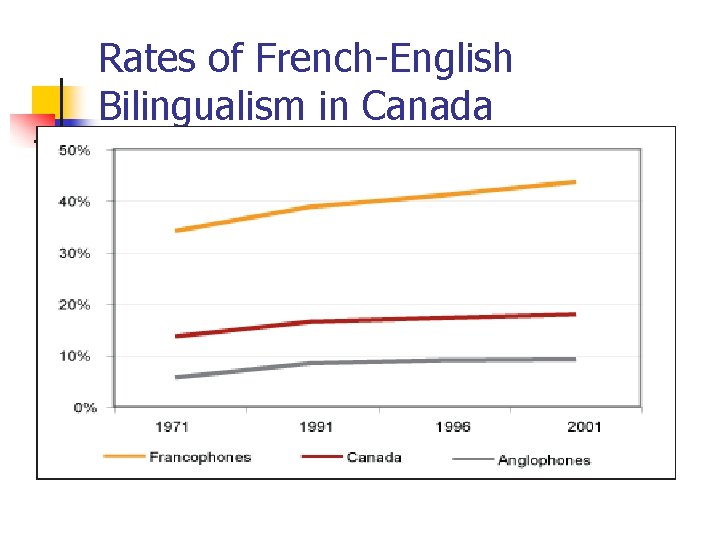
Rates of French-English Bilingualism in Canada
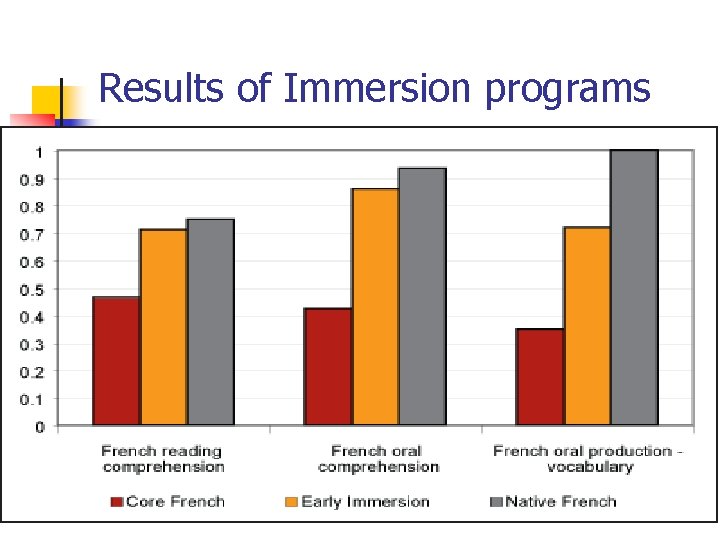
Results of Immersion programs
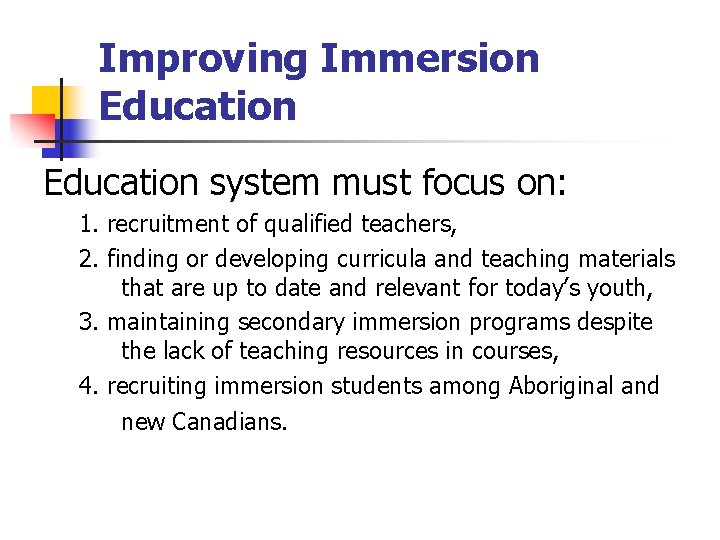
Improving Immersion Education system must focus on: 1. recruitment of qualified teachers, 2. finding or developing curricula and teaching materials that are up to date and relevant for today’s youth, 3. maintaining secondary immersion programs despite the lack of teaching resources in courses, 4. recruiting immersion students among Aboriginal and new Canadians.
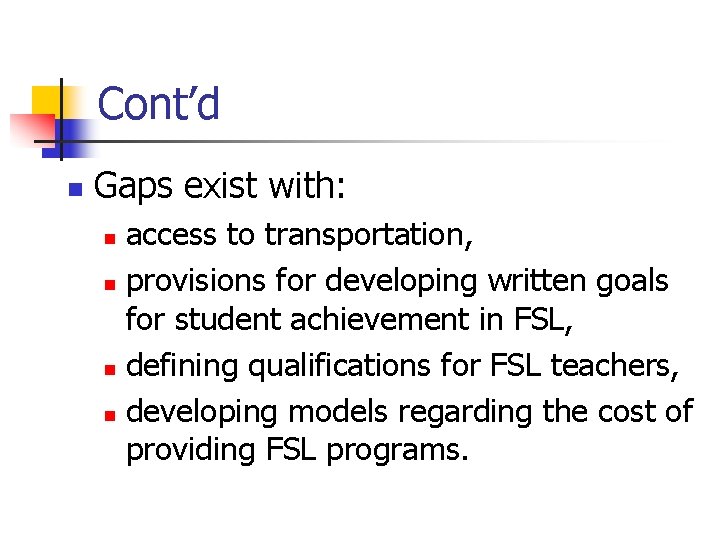
Cont’d n Gaps exist with: access to transportation, n provisions for developing written goals for student achievement in FSL, n defining qualifications for FSL teachers, n developing models regarding the cost of providing FSL programs. n
Suggestions for Immersion in Canada n Increase the supply of qualified Frenchimmersion teachers n n n Need French + Specialty (e. g. , Sciences) Work to reduce attrition rates among students, especially after grade 8 Increase participation rates among immigrant students
Controversy in New Brunswick Canada’s only officially bilingual province
Controversy in New Brunswick n n n March 2008 NB Education Minister Kelly Lamrock announced that the province would be eliminating its early immersion program. Dr. James Croll and Patricia Lee released their review of the programs, including 18 recommendations. NB branch of Canadian Parents for French called for one-year moratorium on changes to early immersion and early core French.
Croll and Lee Report (2008) 7 of their 18 Recommendations 1) French programming for Anglophone children begins at Grade 5 with Intensive French. 2) Late Immersion first offered beginning in Gr. 6 6) All academic materials for classroom use be available in French and English at the same time. 7) That comprehensive evaluations be carried out. 14) University training courses be reviewed. 17) Parents be informed of the L 2 employment criteria for both the Provincial and Federal governments. 18) Retain target of 70% of high school graduates function effectively in speaking their 2 nd official language.
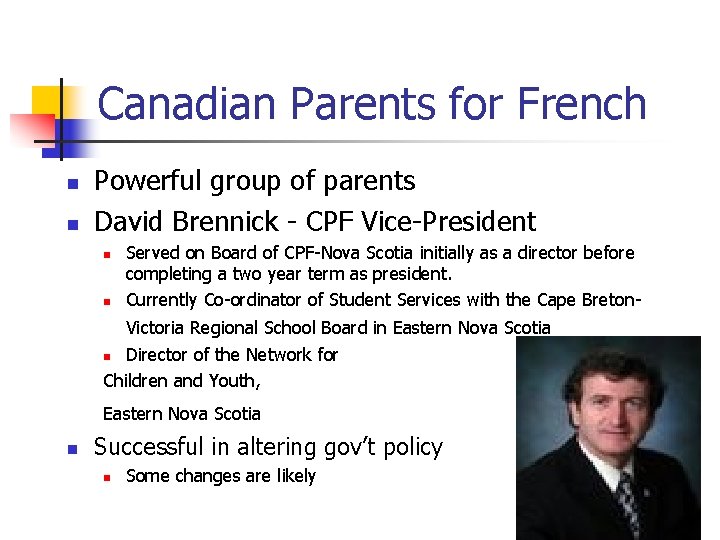
Canadian Parents for French n n Powerful group of parents David Brennick - CPF Vice-President n n Served on Board of CPF-Nova Scotia initially as a director before completing a two year term as president. Currently Co-ordinator of Student Services with the Cape Breton. Victoria Regional School Board in Eastern Nova Scotia Director of the Network for Children and Youth, n Eastern Nova Scotia n Successful in altering gov’t policy n Some changes are likely
A Challenge for Canada: Languages other than English and French Swain and Johnson (1997) note the rapid growth of highly diverse populations in large Canadian urban centers. n n Increase in L 3 learners programming needs to change to recognize home languages other than English.
Conclusions n Immersion is well respected in Canada n n Enrollments are stable, slightly increasing n n Some locations are better than others Qualified teaching staff & materials are issues n n n Especially if goals are realistic ones Especially in higher grades Attrition is a concern Some challenges remain n Provincial vs Federal roles

Immersion Education in Canada: Stability and Change Peter Mac. Intyre Cape Breton University Presented in Graz, Austria Sept 24, 2008 at the European Centre for Modern Languages
- Slides: 26