
IMMEDIATE JEOPARDY THINKING LIKE A SURVEYOR YOUR CONTROL

- Slides: 149
IMMEDIATE JEOPARDY THINKING LIKE A SURVEYOR
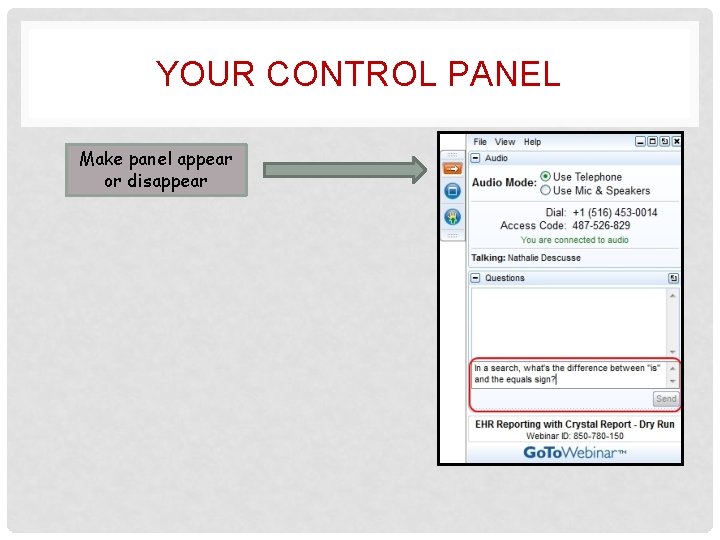
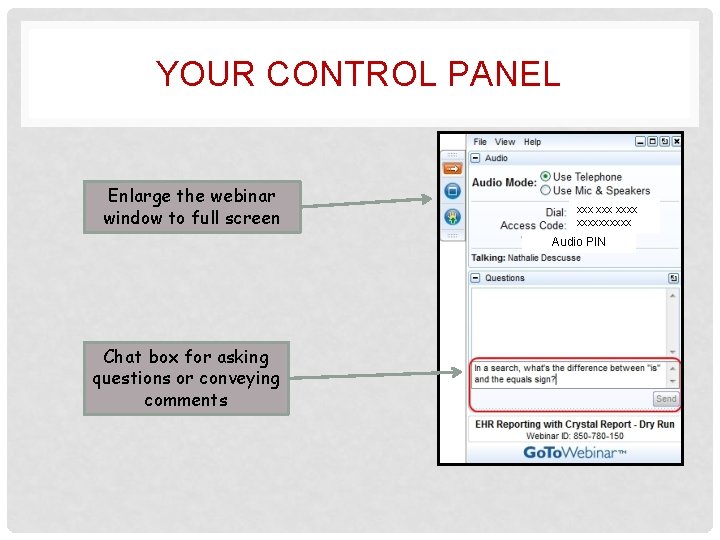
YOUR CONTROL PANEL Make panel appear or disappear
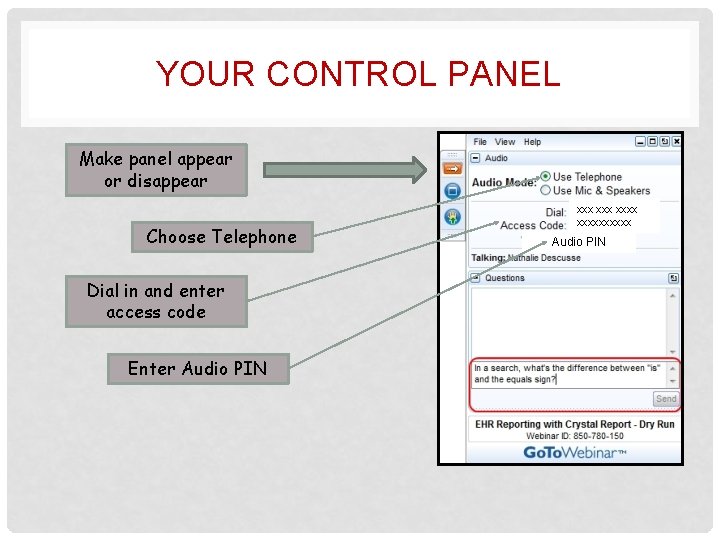
YOUR CONTROL PANEL Make panel appear or disappear Choose Telephone Dial in and enter access code Enter Audio PIN xxx xxxxxxxxxx Audio PIN
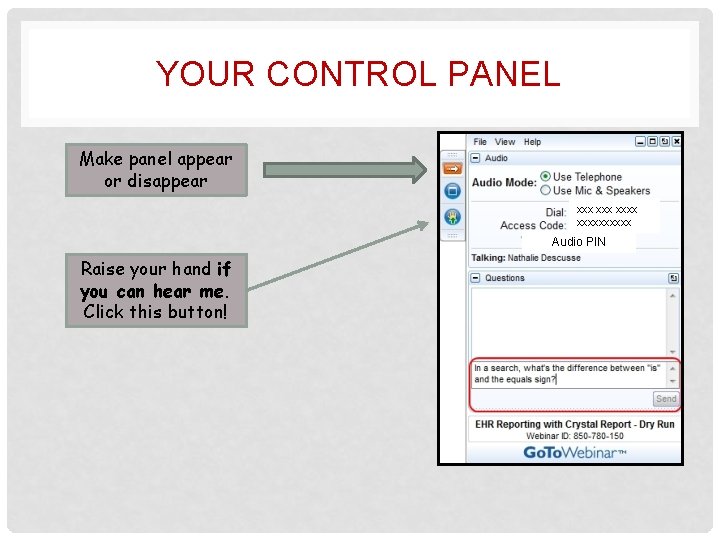
YOUR CONTROL PANEL Make panel appear or disappear xxx xxxxxxxxxx Audio PIN Raise your hand if you can hear me. Click this button!
YOUR CONTROL PANEL Enlarge the webinar window to full screen xxx xxxxxxxxxx Audio PIN Chat box for asking questions or conveying comments
IMMEDIATE JEOPARDY THINKING LIKE A SURVEYOR
Surveyor ? How many of you would like to know what Surveyors are thinking when they enter your facility to conduct a survey?
INTRODUCTION Focus of this presentation includes: • Immediate Jeopardy (IJ); • Triggers; • Determining Factors; • Decision Making; • Avoiding an IJ; and • Removing an IJ.
THE GOAL Today, you will: • explore the ramifications of an Immediate Jeopardy (IJ) being called in your facility; • consider ways to avoid having an IJ called; and • review steps to take if an IJ is called in your facility.
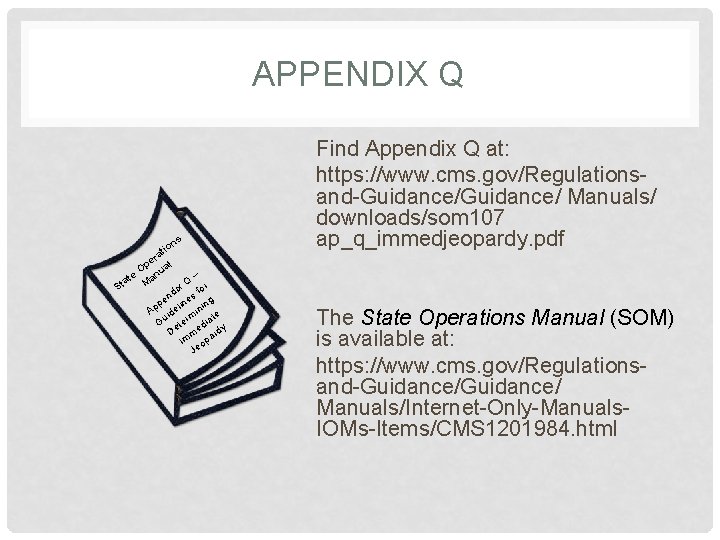
APPENDIX Q ns io t a er l p a O e anu – t a M Q r St x fo di en ines ng p i l Ap ide min te u r G ete edia y D m ard Im op Je Find Appendix Q at: https: //www. cms. gov/Regulationsand-Guidance/ Manuals/ downloads/som 107 ap_q_immedjeopardy. pdf The State Operations Manual (SOM) is available at: https: //www. cms. gov/Regulationsand-Guidance/ Manuals/Internet-Only-Manuals. IOMs-Items/CMS 1201984. html
REQUIREMENTS OF PARTICIPATION
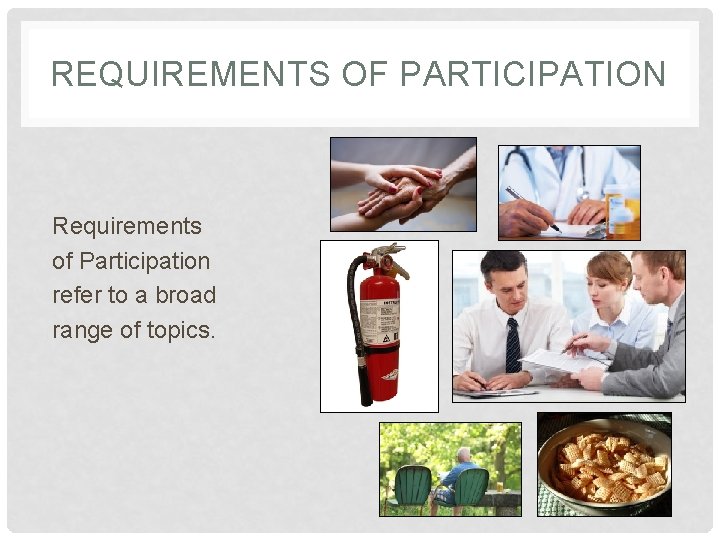
REQUIREMENTS OF PARTICIPATION Requirements of Participation refer to a broad range of topics.
REQUIREMENTS OF PARTICIPATION a situation in which the provider's noncompliance with one or more Immediate requirements of participation has Jeopardy caused, or is likely to cause, serious injury, harm, impairment or death to a resident or patient 42 CFR Part 489. 3 Appendix Q, Section II
REQUIREMENTS OF PARTICIPATION An IJ is a form of noncompliance that is especially serious. When an IJ is called, "The threat of probable harm is real and important and could be perceived as something that will result in potentially severe temporary or permanent injury, disability, or death. " (SOM § 3010 A)
REQUIREMENTS OF PARTICIPATION Immediate Jeopardy
POSSIBLE CAUSES
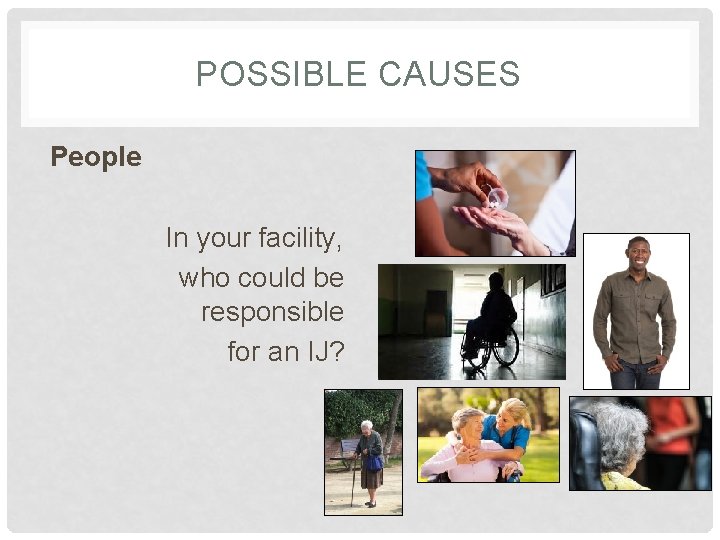
POSSIBLE CAUSES People In your facility, who could be responsible for an IJ?
POSSIBLE CAUSES Individuals must not be subjected to abuse by anyone including, but Appendix Q, not limited to, entity staff, Section III consultants or volunteers, family members or visitors.
POSSIBLE CAUSES A failure in one or more of these areas usually causes most IJs: • managing operations and staff; • planning delivery of services; • implementing care plans correctly;
POSSIBLE CAUSES Poll Question How might managing operations and/or Staff fail to comply with the Requirements of Participation? A. failing to conduct a background check on a new Employee B. running out of time-sensitive medications before they are delivered C. not providing specialized care and services to Residents D. All of the above.
POSSIBLE CAUSES More areas where failures occur that could cause IJs are: • monitoring and evaluating staff performance; • ensuring contractors honor their contracts ; or • ensuring staff’s knowledge base is current or updated.
LUCILLE
POSSIBLE CAUSES Case Study #1 On 9/3/15, staff determined that Lucille was at high risk for pressure ulcers. On 12/29/15, Lucille fractured her right leg. At the hospital an immobilizer was placed on her leg from her knee to the ankle.
POSSIBLE CAUSES Case Study #1 Lucille’s 1/3/16 care plan identified “skin breakdown” as a problem and stated, “Check under immobilizer brace every shift for breakdown. ” On 1/4/16, her physician ordered a weekly skin assessment for Lucille. However, from 1/4/16 until 1/20/16, staff only checked Lucille’s exposed skin around the edges of the immobilizer.
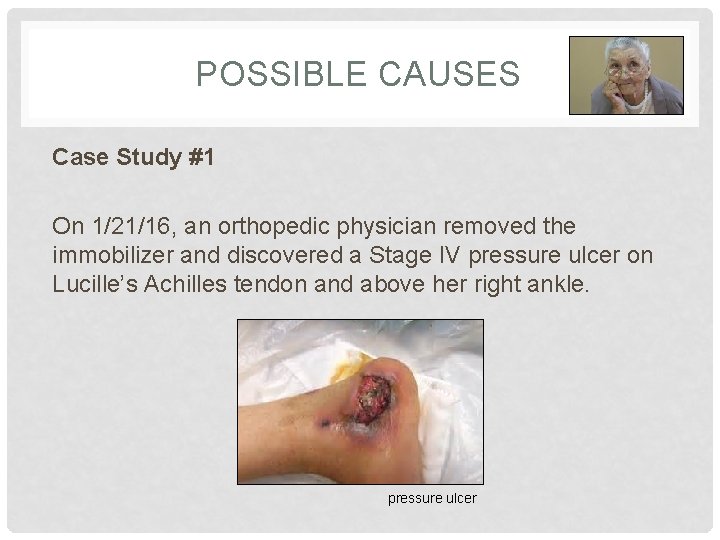
POSSIBLE CAUSES Case Study #1 On 1/21/16, an orthopedic physician removed the immobilizer and discovered a Stage IV pressure ulcer on Lucille’s Achilles tendon and above her right ankle. pressure ulcer
POSSIBLE CAUSES Chat Question Given only the information we have here, what questions do you think the Surveyor would ask?
POSSIBLE CAUSES Chat Question (follow up) How could the facility have prevented this situation from being called an IJ?
LUCILLE
POSSIBLE CAUSES Unexpected Changes Unexpected changes that could contribute to an IJ include but are not limited to: • a Resident accidentally falling when walking to the dining room; • management changing a policy and failing effectively to monitor staff; and • two roommates who previously got along starting to curse at and hit each other.
POSSIBLE CAUSES Chat Question What other examples of unexpected changes can you think of?
POSSIBLE CAUSES A Resident accidentally falls when walking to the dining room.
POSSIBLE CAUSES meriting condemnation or blame culpable esp. as wrong or harmful syn. blameworthy Webster’s Ninth New Collegiate Dictionary 1989
PRINCIPLES OF IJ
PRINCIPLES OF IJ One Person A condition could exist that threatens many Residents, or just one. One person is the extent by which protection is measured for all Residents in similar situations. Appendix Q, Section III
PRINCIPLES OF IJ High Potential Serious harm, injury, impairment and/or death do not actually have to occur before a Surveyor will consider calling an IJ. If conditions exist with a high potential for these outcomes to occur in the very near future, these conditions could be regarded as a component of an Immediate Jeopardy.
PRINCIPLES OF IJ Universal Protection Residents must not be subjected to abuse by anyone including, but not limited to: • entity Staff; • Consultants or Volunteers; • other Residents; • Family Members; or • Visitors.
PRINCIPLES OF IJ Nature of Serious Harm Serious harm can result from both abuse and neglect.
PRINCIPLES OF IJ Nature of Psychological Harm Psychological harm can be as serious as physical harm.
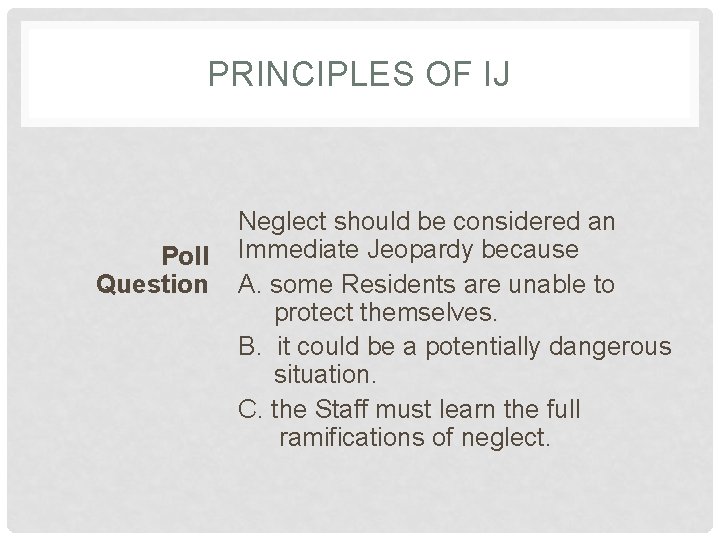
PRINCIPLES OF IJ Neglect is failure to provide a Resident the care and services necessary to avoid physical harm, mental anguish or mental illness.
PRINCIPLES OF IJ neglect failure to provide goods and services necessary to avoid physical harm, mental anguish, or mental illness (42 CFR Part 488. 301) (Appendix PP, F 224)
PRINCIPLES OF IJ Poll Question Neglect should be considered an Immediate Jeopardy because A. some Residents are unable to protect themselves. B. it could be a potentially dangerous situation. C. the Staff must learn the full ramifications of neglect.
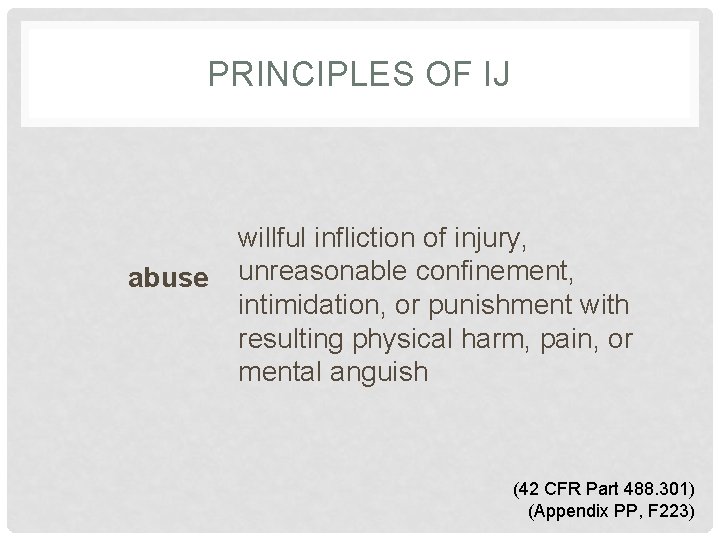
PRINCIPLES OF IJ abuse willful infliction of injury, unreasonable confinement, intimidation, or punishment with resulting physical harm, pain, or mental anguish (42 CFR Part 488. 301) (Appendix PP, F 223)
IJ PARAMETERS
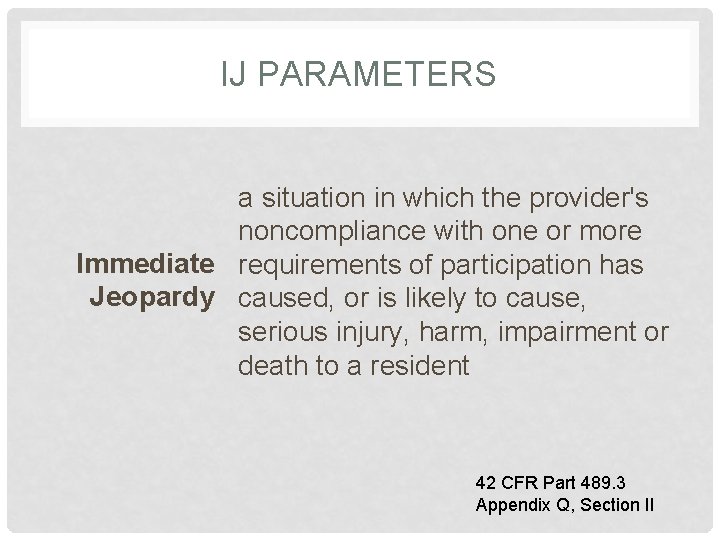
IJ PARAMETERS a situation in which the provider's noncompliance with one or more Immediate requirements of participation has Jeopardy caused, or is likely to cause, serious injury, harm, impairment or death to a resident 42 CFR Part 489. 3 Appendix Q, Section II
IJ PARAMETERS The serious harm, injury, impairment or death may have occurred in the past, may be occurring at present, or may be likely to occur in the very near future as a result of the jeopardy situation.
IJ PARAMETERS After determining that a situation is harmful, the Surveyor(s) will consider the following points regarding the entity’s compliance: • The entity either created a situation or allowed a situation to continue which resulted in serious harm or a potential for serious harm, injury, impairment or death to individuals. • The entity had an opportunity to implement corrective or preventive measures.
IJ PARAMETERS If a Surveyor(s) recognizes a situation that may constitute IJ, he/she must investigate the condition until he/she confirms or rules out the immediacy of the situation and whether the facility is culpable. interview record review observation
TRIGGERS
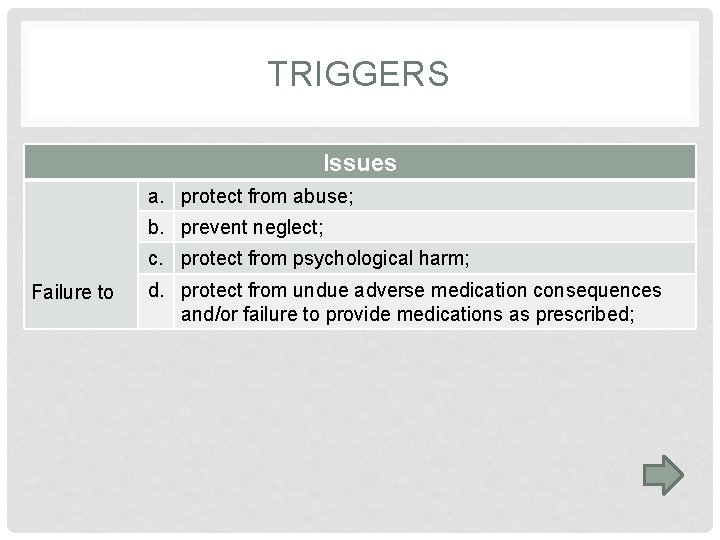
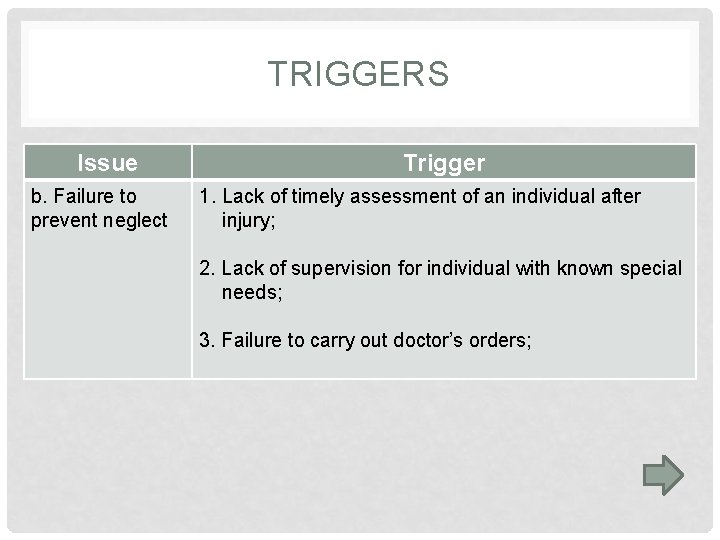
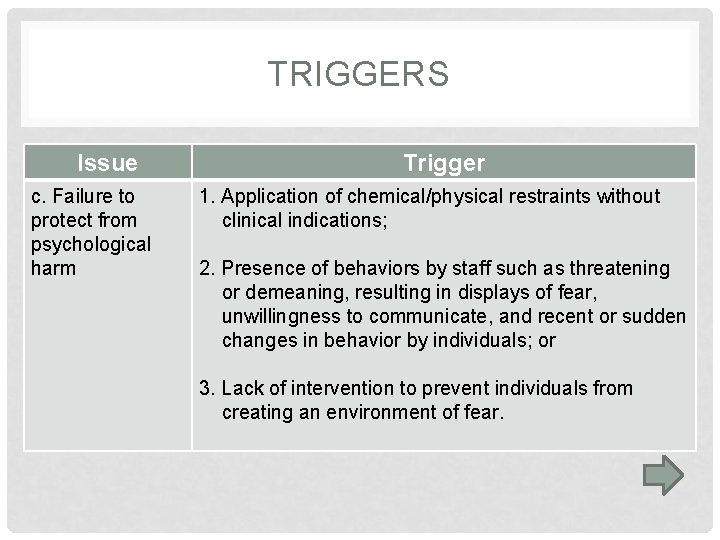
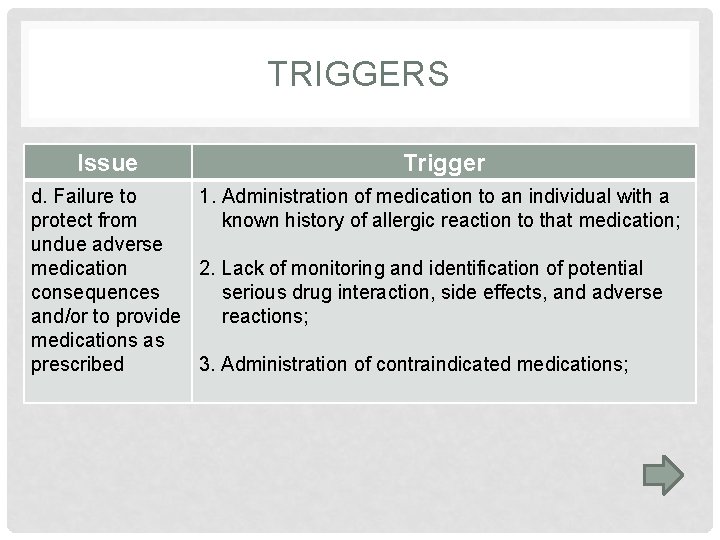
TRIGGERS Issues a. protect from abuse; b. prevent neglect; c. protect from psychological harm; Failure to d. protect from undue adverse medication consequences and/or failure to provide medications as prescribed;
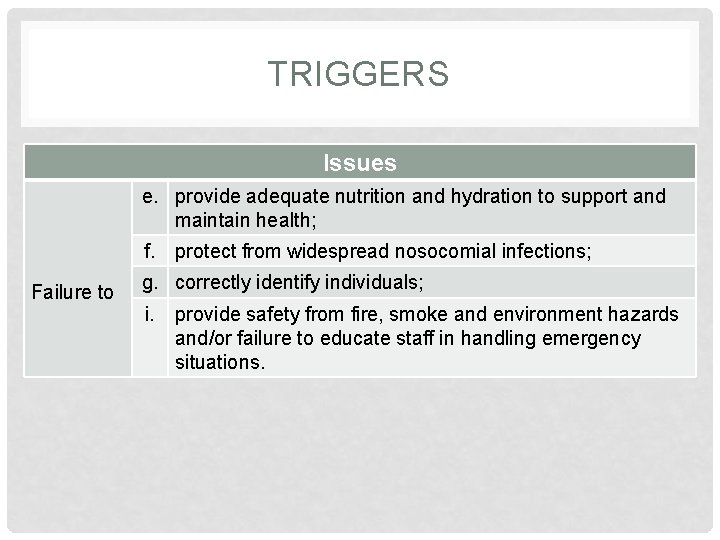
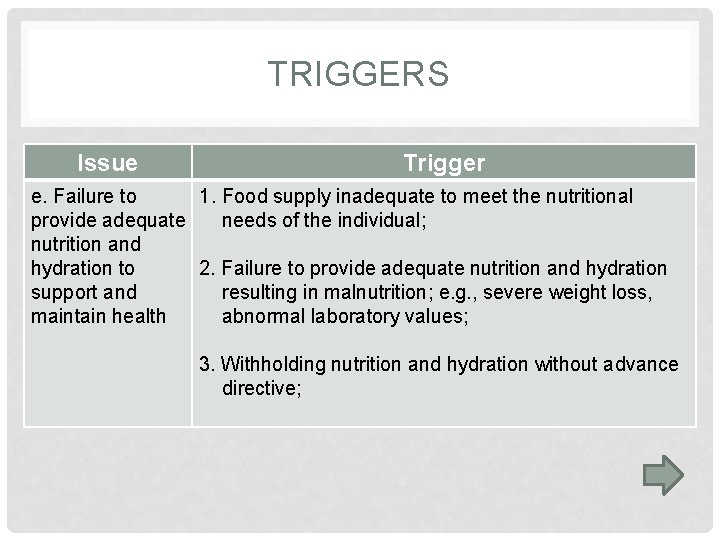
TRIGGERS Issues e. provide adequate nutrition and hydration to support and maintain health; f. protect from widespread nosocomial infections; Failure to g. correctly identify individuals; i. provide safety from fire, smoke and environment hazards and/or failure to educate staff in handling emergency situations.
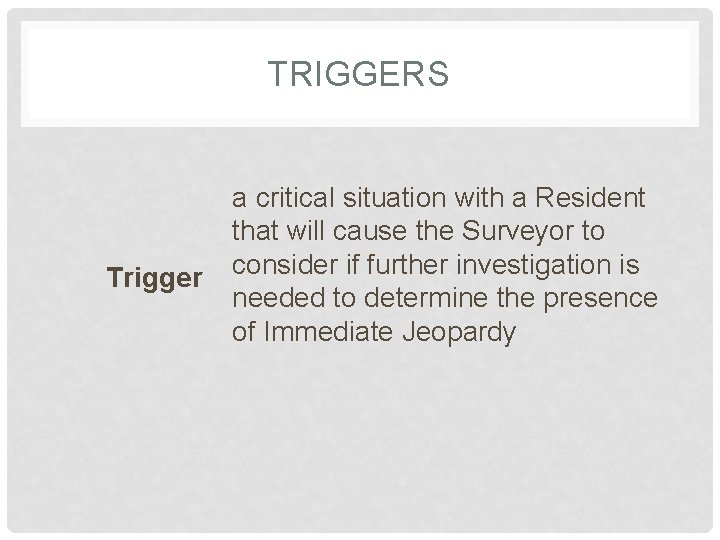
TRIGGERS Trigger a critical situation with a Resident that will cause the Surveyor to consider if further investigation is needed to determine the presence of Immediate Jeopardy
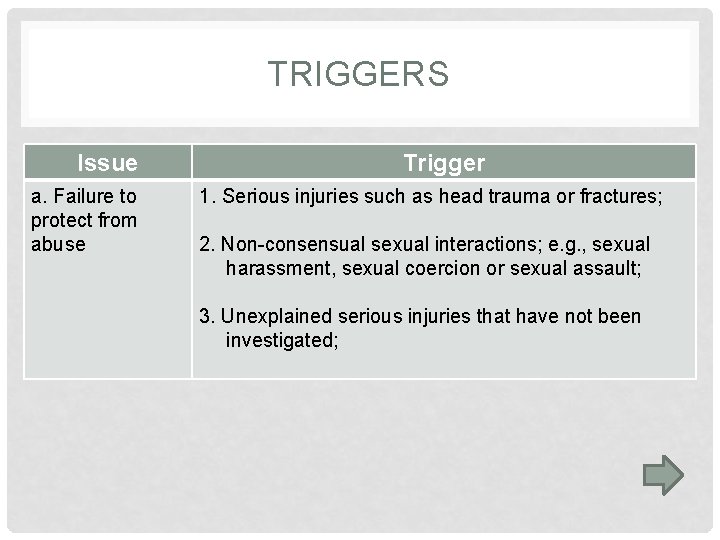
TRIGGERS Issue a. Failure to protect from abuse Trigger 1. Serious injuries such as head trauma or fractures; 2. Non-consensual sexual interactions; e. g. , sexual harassment, sexual coercion or sexual assault; 3. Unexplained serious injuries that have not been investigated;
TRIGGERS Issue b. Failure to prevent neglect Trigger 1. Lack of timely assessment of an individual after injury; 2. Lack of supervision for individual with known special needs; 3. Failure to carry out doctor’s orders;
TRIGGERS Issue c. Failure to protect from psychological harm Trigger 1. Application of chemical/physical restraints without clinical indications; 2. Presence of behaviors by staff such as threatening or demeaning, resulting in displays of fear, unwillingness to communicate, and recent or sudden changes in behavior by individuals; or 3. Lack of intervention to prevent individuals from creating an environment of fear.
TRIGGERS Issue Trigger d. Failure to 1. Administration of medication to an individual with a protect from known history of allergic reaction to that medication; undue adverse medication 2. Lack of monitoring and identification of potential consequences serious drug interaction, side effects, and adverse and/or to provide reactions; medications as prescribed 3. Administration of contraindicated medications;
TRIGGERS Issue Trigger e. Failure to 1. Food supply inadequate to meet the nutritional provide adequate needs of the individual; nutrition and hydration to 2. Failure to provide adequate nutrition and hydration support and resulting in malnutrition; e. g. , severe weight loss, maintain health abnormal laboratory values; 3. Withholding nutrition and hydration without advance directive;
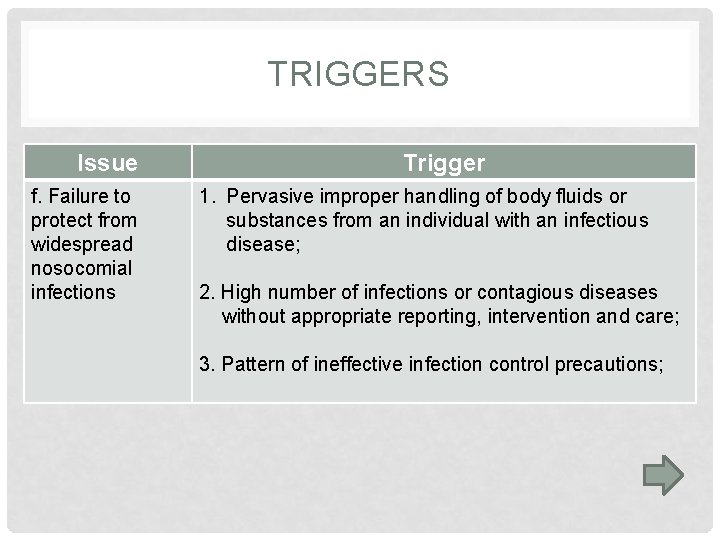
TRIGGERS Issue f. Failure to protect from widespread nosocomial infections Trigger 1. Pervasive improper handling of body fluids or substances from an individual with an infectious disease; 2. High number of infections or contagious diseases without appropriate reporting, intervention and care; 3. Pattern of ineffective infection control precautions;
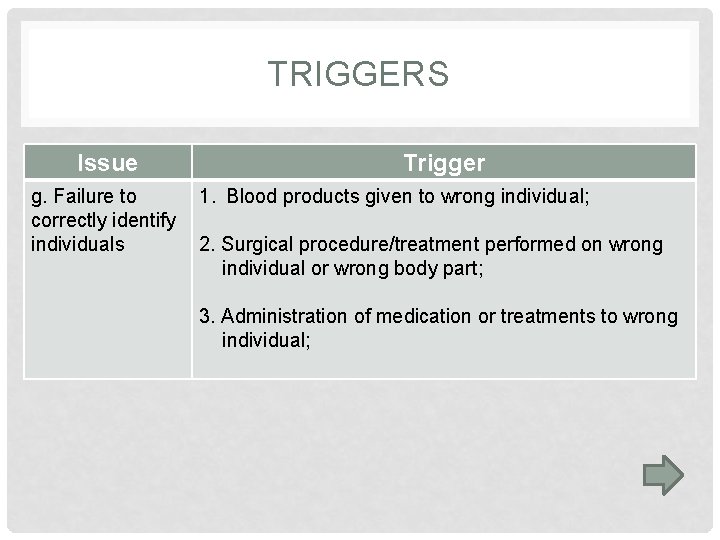
TRIGGERS Issue g. Failure to correctly identify individuals Trigger 1. Blood products given to wrong individual; 2. Surgical procedure/treatment performed on wrong individual or wrong body part; 3. Administration of medication or treatments to wrong individual;
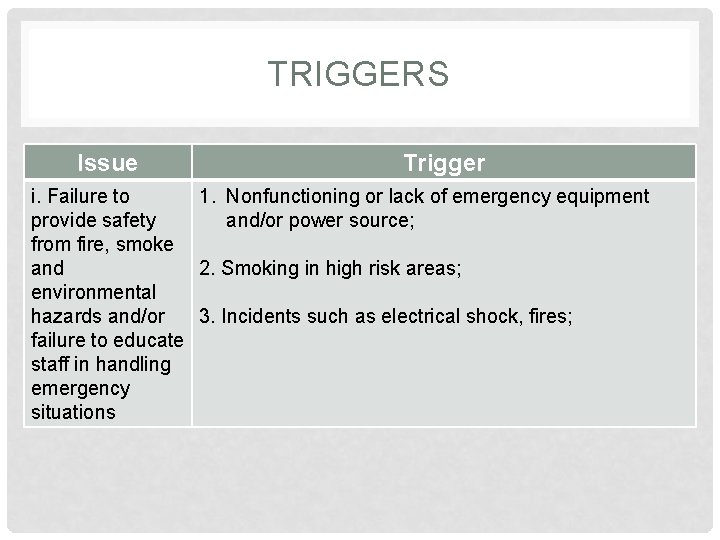
TRIGGERS Issue Trigger i. Failure to 1. Nonfunctioning or lack of emergency equipment provide safety and/or power source; from fire, smoke and 2. Smoking in high risk areas; environmental hazards and/or 3. Incidents such as electrical shock, fires; failure to educate staff in handling emergency situations
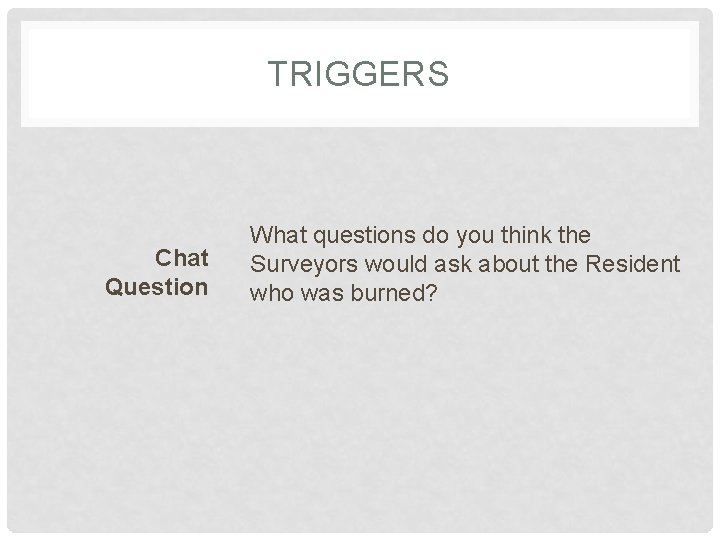
TRIGGERS Chat Question What questions do you think the Surveyors would ask about the Resident who was burned?
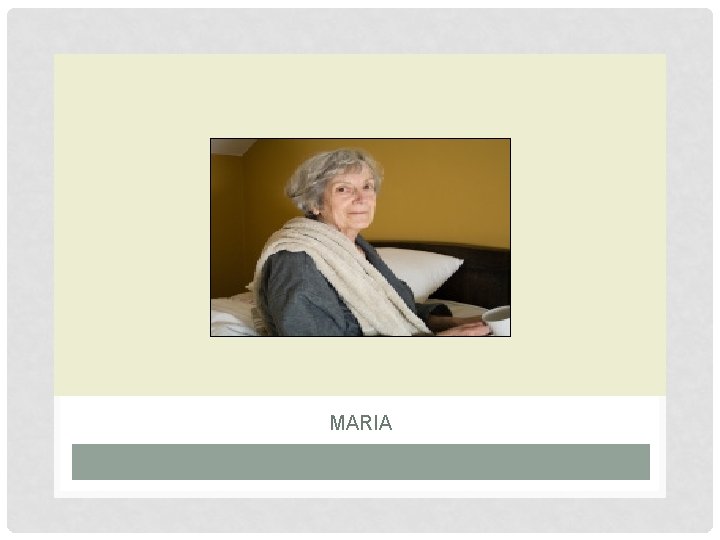
MARIA
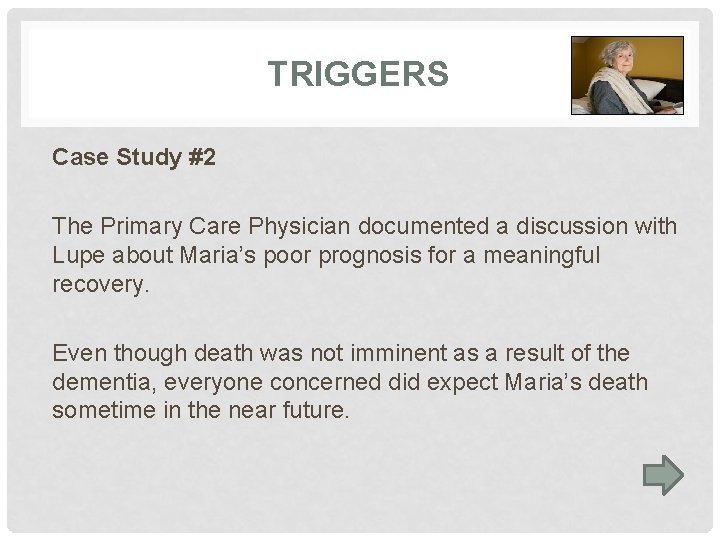
TRIGGERS Case Study #2 While living in the long-term care facility, Maria had a diagnosis of advance dementia with a documented history of refusal to eat. Maria was often confused and debilitated because of her continued weight loss and dehydration related to her refusal to eat or drink. The staff Primary Care Physician wrote orders to discontinue all of Maria’s nutrition and hydration support. She died three days later.
TRIGGERS Case Study #2 During the investigation, the Surveyor found that Maria’s chart did not include a copy of an advance directive. Nor did the progress notes contain documentation of her ever expressing a wish to have nutrition and hydration withdrawn at the end of her life.
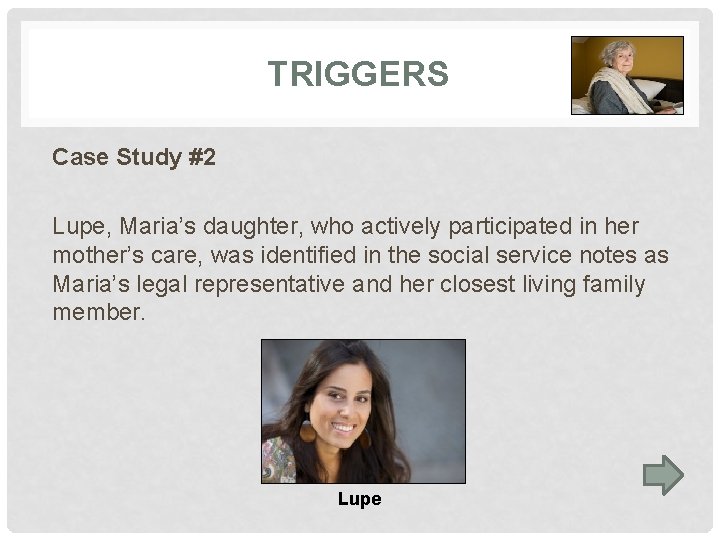
TRIGGERS Case Study #2 Lupe, Maria’s daughter, who actively participated in her mother’s care, was identified in the social service notes as Maria’s legal representative and her closest living family member. Lupe
TRIGGERS Case Study #2 The Primary Care Physician documented a discussion with Lupe about Maria’s poor prognosis for a meaningful recovery. Even though death was not imminent as a result of the dementia, everyone concerned did expect Maria’s death sometime in the near future.
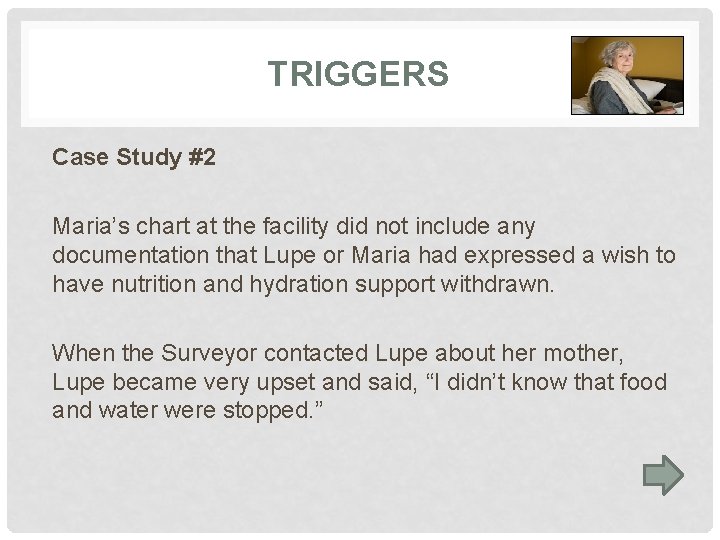
TRIGGERS Case Study #2 Maria’s chart at the facility did not include any documentation that Lupe or Maria had expressed a wish to have nutrition and hydration support withdrawn. When the Surveyor contacted Lupe about her mother, Lupe became very upset and said, “I didn’t know that food and water were stopped. ”
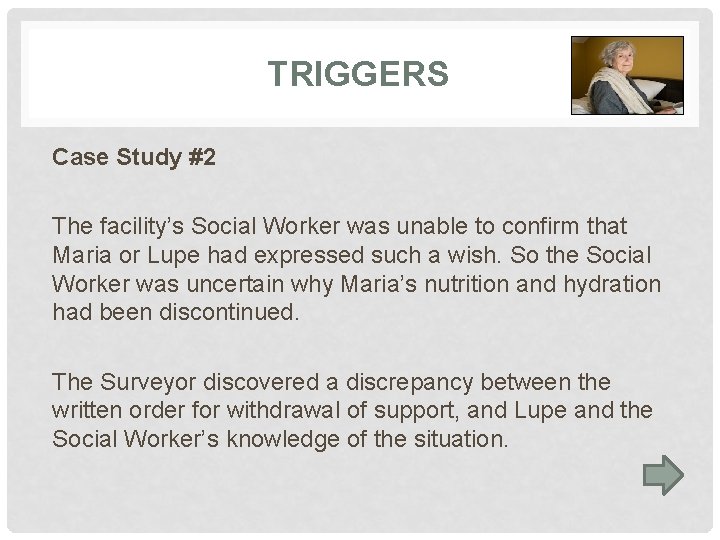
TRIGGERS Case Study #2 The facility’s Social Worker was unable to confirm that Maria or Lupe had expressed such a wish. So the Social Worker was uncertain why Maria’s nutrition and hydration had been discontinued. The Surveyor discovered a discrepancy between the written order for withdrawal of support, and Lupe and the Social Worker’s knowledge of the situation.
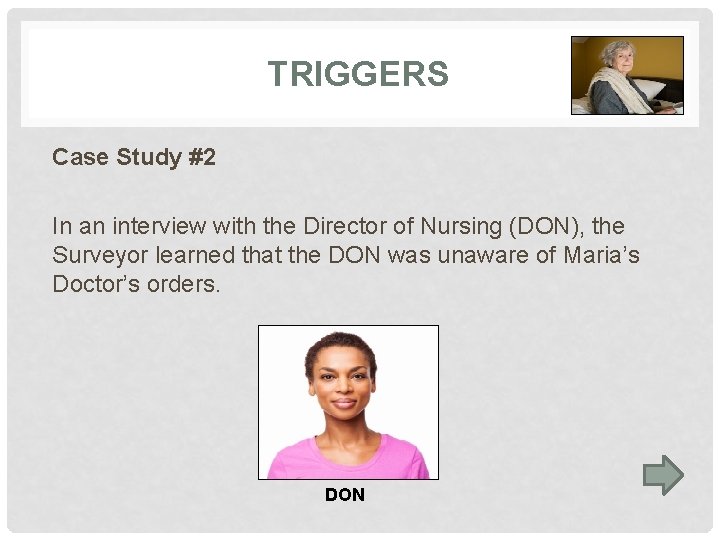
TRIGGERS Case Study #2 In an interview with the Director of Nursing (DON), the Surveyor learned that the DON was unaware of Maria’s Doctor’s orders. DON
TRIGGERS Case Study #2 The Surveyor could not find in Maria’s plan of care any evidence that the facility had discussed the Doctor’s orders in a care plan meeting. Nor could the Surveyor locate documentation supporting the facility’s investigation or the implementation of corrective measures following Maria’s death.
MARIA AND LUPE
TRIGGERS Poll Question Did actual harm occur to Maria?
TRIGGERS Poll Question Does the harm meet the definition of Immediate Jeopardy, e. g. , serious injury, harm, impairment, or death?
TRIGGERS Poll Question Was the harm likely to occur in the very near future, if immediate action was not taken?
TRIGGERS Poll Question Did the facility have knowledge of the situation or should they have known Maria refused to eat?
TRIGGERS Poll Question Did the facility thoroughly investigate the circumstances?
TRIGGERS Poll Question How do we know the facility did not thoroughly investigate the circumstances? A. There was no documentation in the files and nothing was revealed during the interviews. B. The DON revealed this information during an interview. C. A Staff member showed the Surveyor the documentation explaining why there was no investigation.
TRIGGERS Poll Question Did the facility implement corrective measures?
TRIGGERS Poll Question Does this situation meet the definition of Immediate Jeopardy?
DETERMINING FACTORS
DETERMINING FACTORS Failure to meet the Requirements of Participation cause a wide range of negative effects. In some situations, these effects are minimal. In other situations, a deficiency can cause or have the potential to cause the Resident: • serious injury; • harm; • impairment; or • death.
DETERMINING FACTORS As soon as a facility becomes aware of a critical situation that could result in an IJ, the administration must immediately put a plan of action/intervention into place and monitor its effectiveness. plan of removal
DETERMINING FACTORS Think like a Surveyor
DETERMINING FACTORS Five Senses In your practice of thinking like a Surveyor, use your five senses.
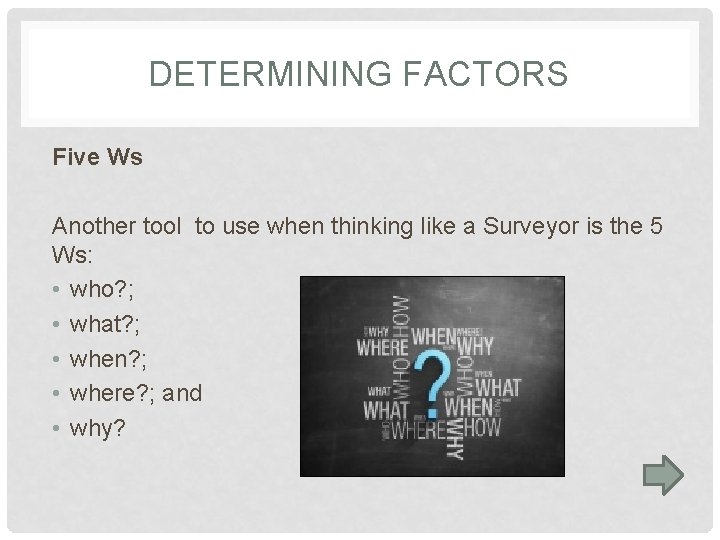
DETERMINING FACTORS Five Ws Another tool to use when thinking like a Surveyor is the 5 Ws: • who? ; • what? ; • when? ; • where? ; and • why?
DETERMINING FACTORS Who? Who was involved in the potential IJ situation: Was it Staff, Family Members or others? Which Resident was involved? Examples questions • Which Resident was missing? • Which Staff Member administered the medication? • Who should have tested the generator?
DETERMINING FACTORS What? What harm has occurred, is occurring, or most likely will occur? Examples questions • What was the sequence of events? • What did your facility do to avoid the situation in the first place? • What was the hazard? • What was the outcome?
DETERMINING FACTORS When? When did the situation first occur? How long has the situation existed? Has a similar occurrence happened before? If so, when did it happen? Is there a pattern or trend? Examples questions • When did the situation (or each event) occur? • How long did it take for your facility to notice the situation? • When did the local Fire Marshal do his/her last inspection?
DETERMINING FACTORS Where? Where did the potential or actual harm occur? Where is the facility located (urban or rural)? What hazards are present in the vicinity of the facility? Examples questions • Where did the incident occur? • Where does the Resident reside? • Does the situation impact only a wing or the entire facility?
DETERMINING FACTORS Why? Why did the potential or actual harm occur? Examples questions • Was the care plan followed? If so, why did it fail? • Why did Staff notice the elopement? • Were Staff put in a position where they would fail? • Why was there only one exit?
MARIA
DETERMINING FACTORS 5 W Questions – Who? Chat Question What Who questions do you think the Surveyor would ask about Maria’s case?
DETERMINING FACTORS 5 W Questions – What? Chat Question Which, What questions would the Surveyor ask?
DETERMINING FACTORS 5 W Questions – When? Chat Question What about the When questions? What would the Surveyor ask?
DETERMINING FACTORS 5 W Questions – Where? Chat Question What Where questions would the Surveyor ask?
DETERMINING FACTORS 5 W Questions – Why? Chat Question And finally, what Why questions would the Surveyor ask for Maria?
DECISION MAKING
DECISION MAKING Before Surveyors conclude that there is an IJ, they collect evidence of the three components of an IJ. Surveyors ask, “Was there: • harm (actual or potential); • immediacy; and • culpability? ”
DECISION MAKING a situation in which the provider's noncompliance with one or more Immediate requirements of participation has Jeopardy caused, or is likely to cause, serious injury, harm, impairment or death to a resident or patient See 42 CFR Part 489. 3 Appendix Q, Section II
DECISION MAKING a situation in which the provider's noncompliance with one or more Immediate requirements of participation has Jeopardy caused, or is likely to cause, serious injury, harm, impairment or death to a resident 42 CFR Part 489. 3 Appendix Q, Section II
DECISION MAKING Actual Harm “Was there an outcome of harm? Does the harm meet the definition of Immediate Jeopardy, e. g. , has the provider’s noncompliance caused or is likely to cause serious injury, harm, impairment, or death to an individual? ”
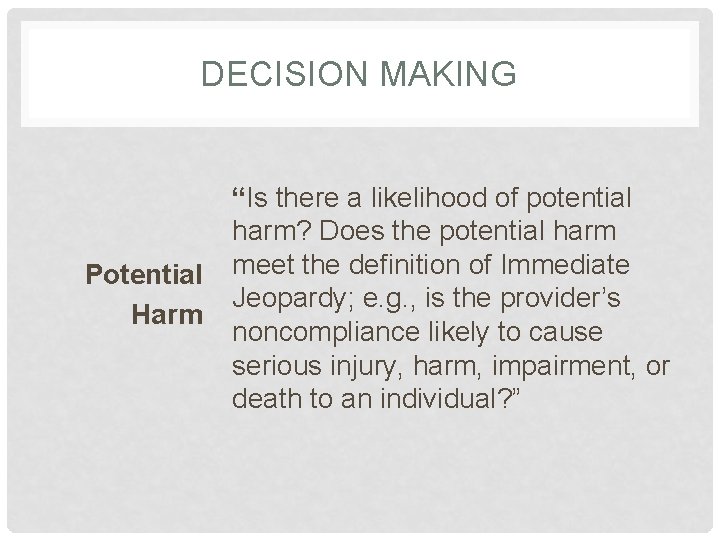
DECISION MAKING Potential Harm “Is there a likelihood of potential harm? Does the potential harm meet the definition of Immediate Jeopardy; e. g. , is the provider’s noncompliance likely to cause serious injury, harm, impairment, or death to an individual? ”
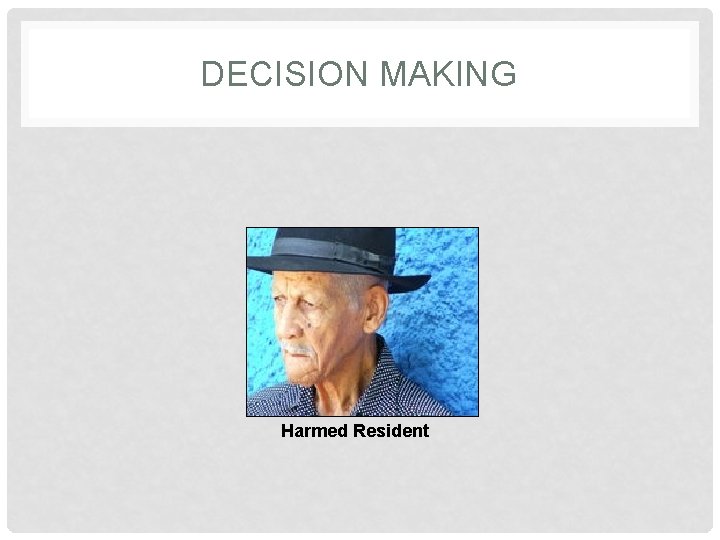
DECISION MAKING Harmed Resident
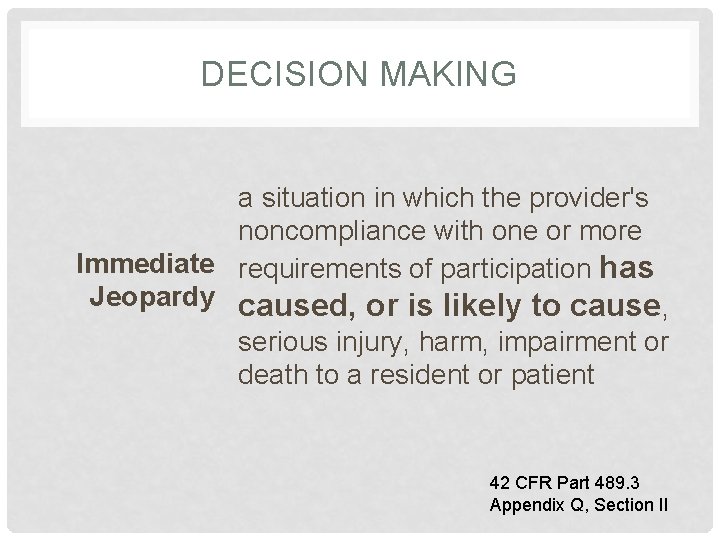
DECISION MAKING a situation in which the provider's noncompliance with one or more Immediate requirements of participation has Jeopardy caused, or is likely to cause, serious injury, harm, impairment or death to a resident or patient 42 CFR Part 489. 3 Appendix Q, Section II
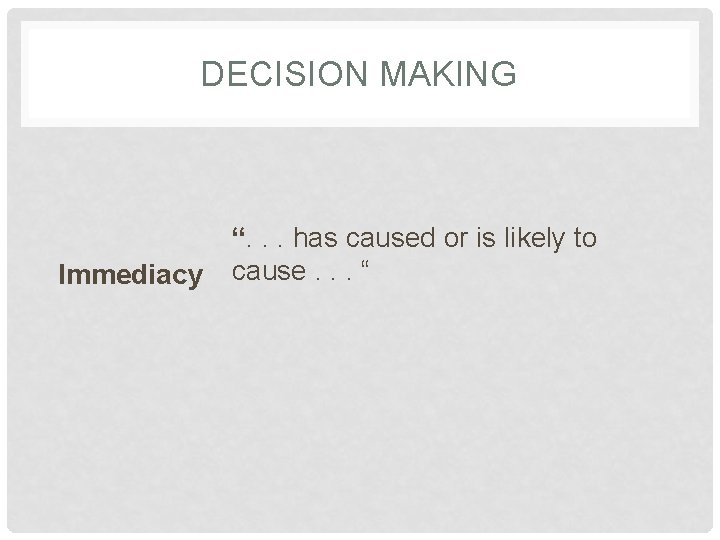
DECISION MAKING Immediacy “. . . has caused or is likely to cause. . . “
DECISION MAKING Immediacy As soon as a facility becomes aware of a critical situation, it must immediately put a plan of action into place.
DECISION MAKING Chat Question Do you have a question about DADS’ decision-making process?
DECISION MAKING a situation in which the provider's noncompliance Immediate with one or more Jeopardy requirements of participation has caused, or is likely to cause, serious injury, harm, impairment or death to a resident 42 CFR Part 489. 3 Appendix Q, Section II
DECISION MAKING Culpability A lack of knowledge about a particular situation does not excuse a facility from knowing about and preventing an IJ. A crisis situation without early warning signs or indications of potential serious harm, are very rare. 42 CFR Part 489. 3 Appendix Q, Section II
DECISION MAKING Culpability documentation
DECISION MAKING Culpability Awareness of the Situation
DECISION MAKING Culpability Assessment
DECISION MAKING Culpability Implementation
DECISION MAKING Culpability Outcome
DECISION MAKING Chat Question Do you have a question about Culpability?
DECISION MAKING Plan of Removal Strategy for corrective action
DECISION MAKING Corrective Action for Individual How the corrective action will be accomplished for individuals found to have been affected by the deficient practice;
DECISION MAKING Identify all Individuals How the facility will identify other individuals who have the potential to be affected by the same deficient practice, and how the facility will act to protect individuals in similar situations;
DECISION MAKING Measures/C hanges What measures will be put into place or systemic changes made to ensure that the deficient practice will not recur;
DECISION MAKING Monitoring System How the facility will monitor its corrective actions/ performance to ensure that the deficient practice is being corrected and will not recur; i. e. , what program will be put in place to monitor the continued effectiveness of the system change to ensure that solutions are permanent; and
DECISION MAKING Final Date When corrective action must be accomplished.
DECISION MAKING Writing Acceptable Po. Cs for Nursing Facilities http: //www. dads. state. tx. us/providers/training/ jointtraining. cfm
PRINCIPLES OF IJ Poll Question An effective Plan of Removal includes: A. a description of how to accomplish the corrective action. B. ways of identifying affected Residents. C. actions to take to prevent the deficient practice from happening again. D. ways of monitoring the changes. E. a deadline for accomplishing the corrective action. F. All the above.
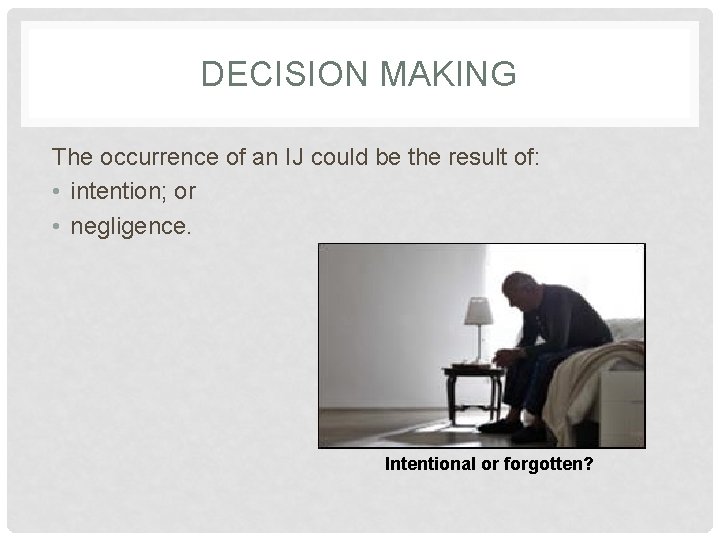
DECISION MAKING The occurrence of an IJ could be the result of: • intention; or • negligence. Intentional or forgotten?
DECISION MAKING Survey Team
DECISION MAKING Program Manager
TEAM ACTIONS
TEAM ACTIONS When the Survey Team and their PM decide that an IJ exists, they will notify the facility’s Administrator of the specific details, including the Resident(s) who are at risk. This verbal notification will be given to the administration before the Survey Team leaves the facility.
TEAM ACTIONS Two Immediate Actions for the Facility 1. Immediate removal of the risk to Residents 2. Immediate implementation of corrective measures to prevent repeated Jeopardy
TEAM ACTIONS A notice describing the Immediate Jeopardy will be delivered to the entity: • within two days of the end of the survey; or • on Form CMS-2567 on the tenth working day.
ENFORCEMENT
7 KEY COMPONENTS
7 KEY COMPONENTS Find the Seven Key Components at som 107 ap_q_immedjeopardy. pdf
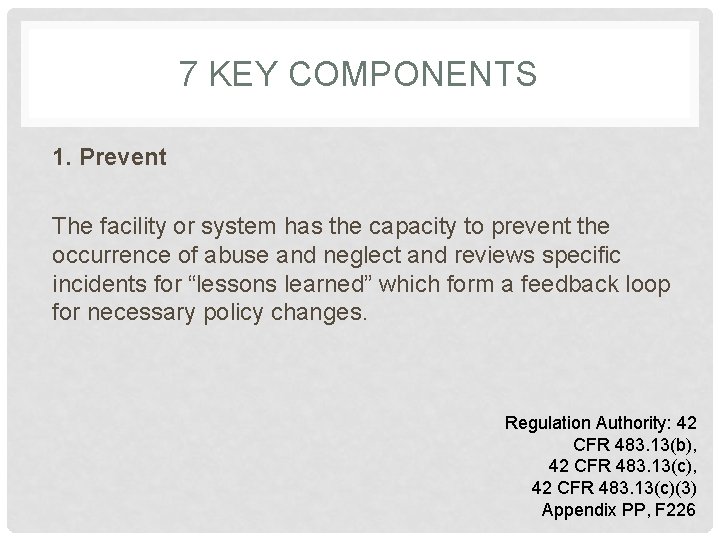
7 KEY COMPONENTS 1. Prevent The facility or system has the capacity to prevent the occurrence of abuse and neglect and reviews specific incidents for “lessons learned” which form a feedback loop for necessary policy changes. Regulation Authority: 42 CFR 483. 13(b), 42 CFR 483. 13(c)(3) Appendix PP, F 226
7 KEY COMPONENTS 2. Screen The facility or system provides evidence and maintains efforts to determine if persons hired have records of abuse or neglect. Regulation Authority 483. 13(c)(1)(ii) (A)&(B) Appendix PP, F 226
7 KEY COMPONENTS 3. Identify The facility or system creates and maintains a proactive approach to identify events and occurrences that may constitute or contribute to abuse and neglect. Regulation Authority – 42 CFR 483. 13(c)(2) Appendix PP, F 226
7 KEY COMPONENTS 4. Train The facility or system, during its orientation program, and through an ongoing training program, provides all employees with information regarding abuse and neglect and related reporting requirements, including prevention, intervention and detection. Regulation Authority – 42 CFR 483. 74(e) Appendix PP, F 226
7 KEY COMPONENTS 5. Protect The facility or system must protect individuals from abuse and neglect during investigation of any allegations of abuse or neglect. Regulation Authority – 42 CFR 483. 13(c)(3) Appendix PP, F 226
7 KEY COMPONENTS 6. Investigate The facility or system ensures, in a timely and thorough manner, objective investigation of allegations of abuse, neglect, or mistreatment. Regulation Authority 42 CFR 483. 13(c)(2)(3)&(4) Appendix PP, F 226
7 KEY COMPONENTS 7. Report/ Respond The facility or system must assure that any incidents of substantiated abuse and neglect are reported analyzed, and the appropriate corrective, remedial or disciplinary action occurs, in accordance with applicable local, State or Federal law. Regulation Authority 42 CFR 483. 13(c)(1)(iii) 42 CFR 483. 13(c)(2) 42 CFR 483. 13(c)(4) Appendix PP, F 226
7 KEY COMPONENTS Develop and implement written policies and procedures that include: • prevention; • screening; • identification; • training; • protection; • investigation; and • reporting/response.
7 KEY COMPONENTS Chat Question Do you have a question about the Seven Key Components of avoiding abuse and neglect?
REMOVAL OF AN IJ
REMOVAL OF AN IJ Confirmation of Removal of Immediate Jeopardy
REMOVAL OF AN IJ Immediate Jeopardy Removed Deficient Practice Corrected
REMOVAL OF AN IJ Find CMS-2567 B at http: //cms. hhs. gov/forms/cms 2567 b. pdf
REMOVAL OF AN IJ Immediate Jeopardy Removed Deficient Practice Present
REMOVAL OF AN IJ Immediate Jeopardy Not Removed
SUMMARY
Q/A