
iMIMOS Capacity Estimation of MIMO Systems via Support


- Slides: 19
i-MIMOS Capacity Estimation of MIMO Systems via Support Vector Regression Xiaolin Hu Supervisor : Nicholas E. Buris School of Communication and Information Engineering Shanghai University APMC 19’ – Xiaolin Hu 1
Outline i-MIMOS v Background and Motivation v System Model v Fundamentals of Support Vector Regression v Capacity Estimation of MIMO Systems Ø Effect of Interference Power Ø Effect of Propagation Model v Comparison of SVR and Gaussian Process Regression v Conclusions APMC 19’ – Xiaolin Hu 2
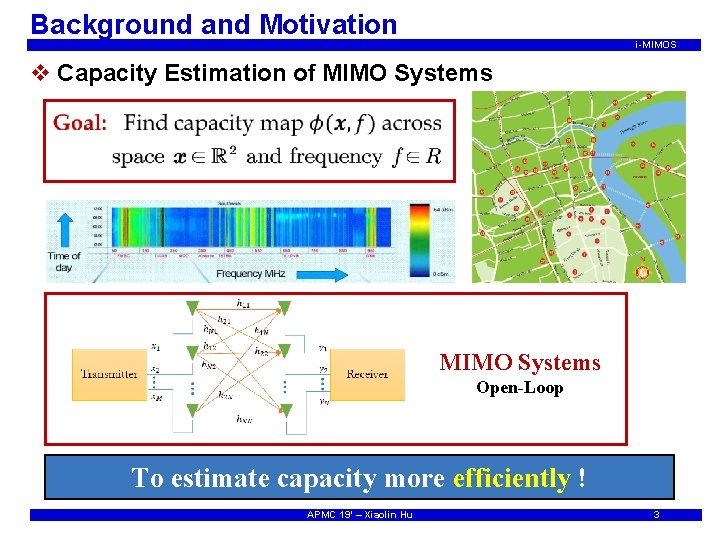
Background and Motivation i-MIMOS v Capacity Estimation of MIMO Systems Open-Loop To estimate capacity more efficiently ! APMC 19’ – Xiaolin Hu 3
Background and Motivation i-MIMOS v Existing work Ø MAY 15, 2017 APMC 19’ – Xiaolin Hu 4
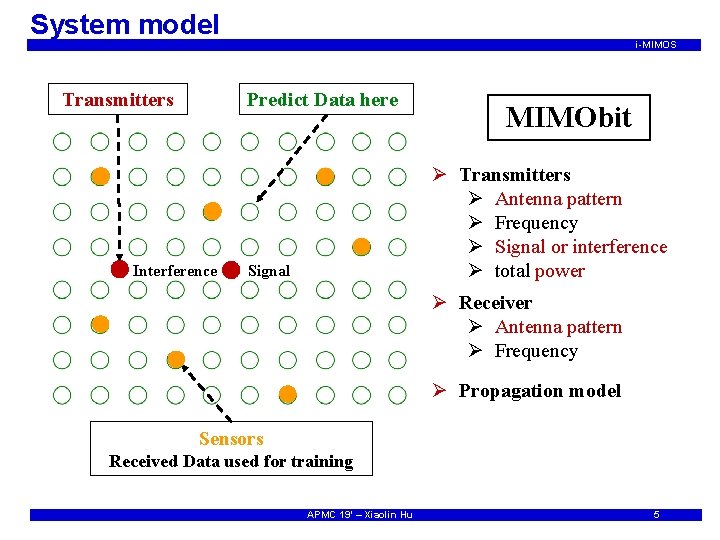
System model Transmitters i-MIMOS Predict Data here Interference MIMObit Ø Transmitters Ø Antenna pattern Ø Frequency Ø Signal or interference Ø total power Signal Ø Receiver Ø Antenna pattern Ø Frequency Ø Propagation model Sensors Received Data used for training APMC 19’ – Xiaolin Hu 5
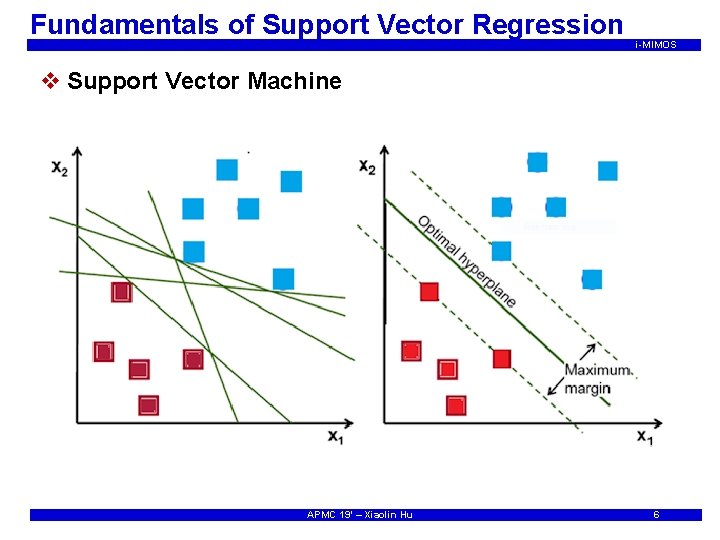
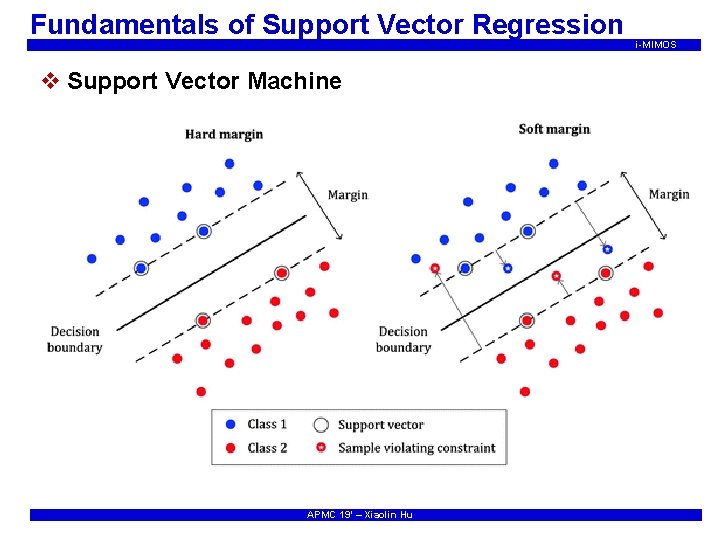
Fundamentals of Support Vector Regression i-MIMOS v Support Vector Machine APMC 19’ – Xiaolin Hu 6
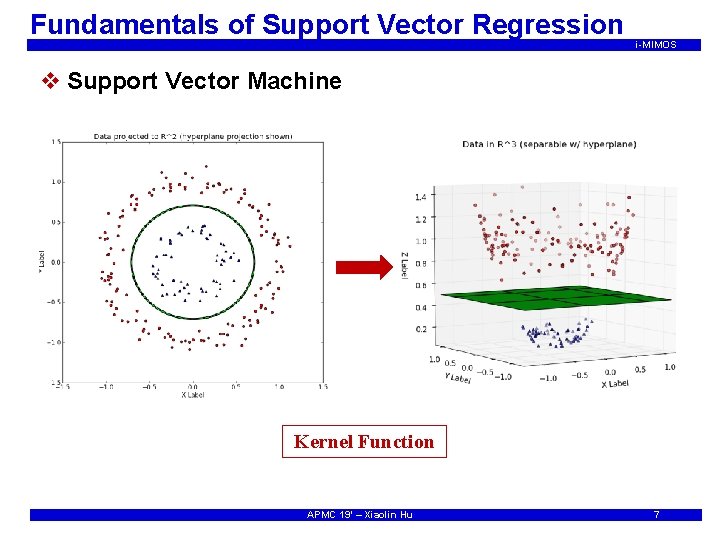
Fundamentals of Support Vector Regression i-MIMOS v Support Vector Machine Kernel Function APMC 19’ – Xiaolin Hu 7
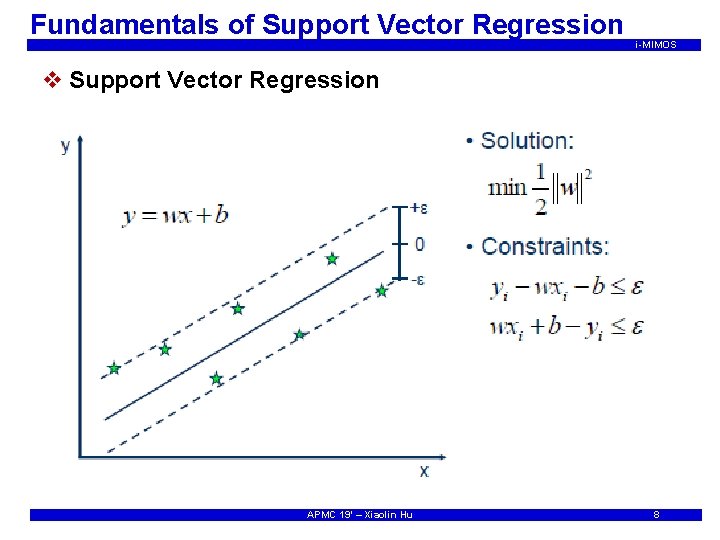
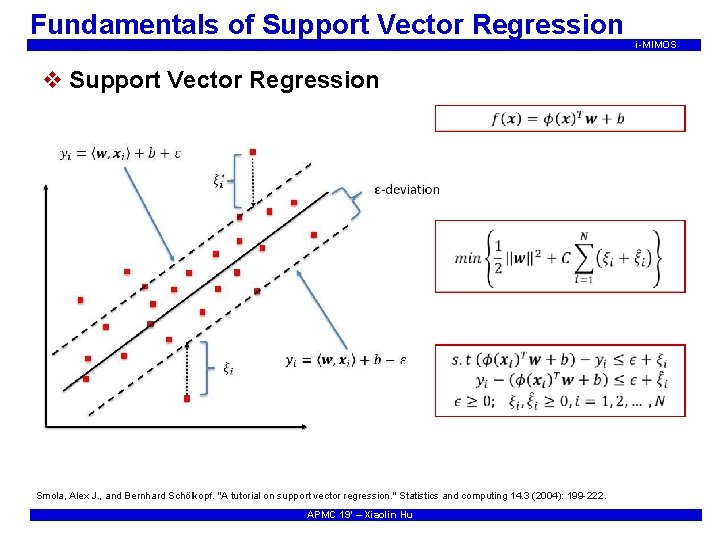
Fundamentals of Support Vector Regression i-MIMOS v Support Vector Regression APMC 19’ – Xiaolin Hu 8
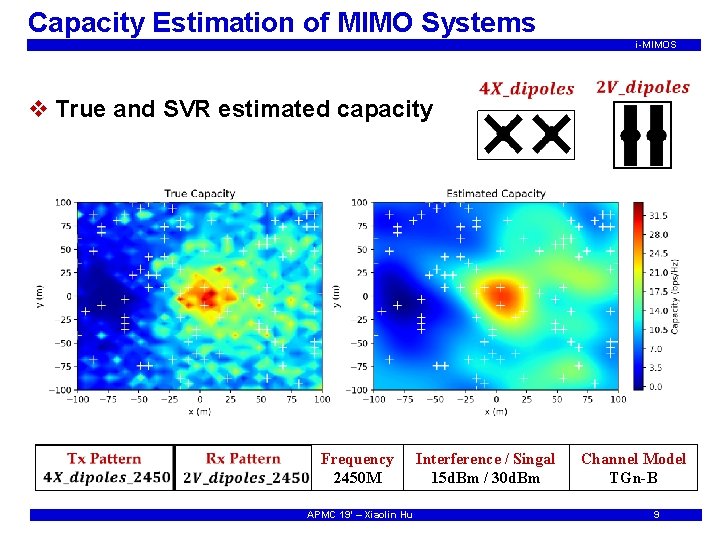
Capacity Estimation of MIMO Systems i-MIMOS v True and SVR estimated capacity Frequency 2450 M Interference / Singal 15 d. Bm / 30 d. Bm Channel Model TGn-B APMC 19’ – Xiaolin Hu 9
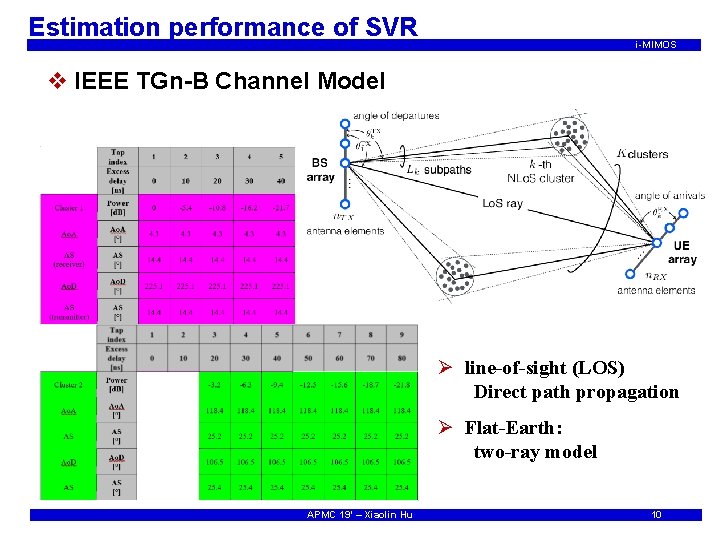
Estimation performance of SVR i-MIMOS v IEEE TGn-B Channel Model Ø line-of-sight (LOS) Direct path propagation Ø Flat-Earth: two-ray model APMC 19’ – Xiaolin Hu 10
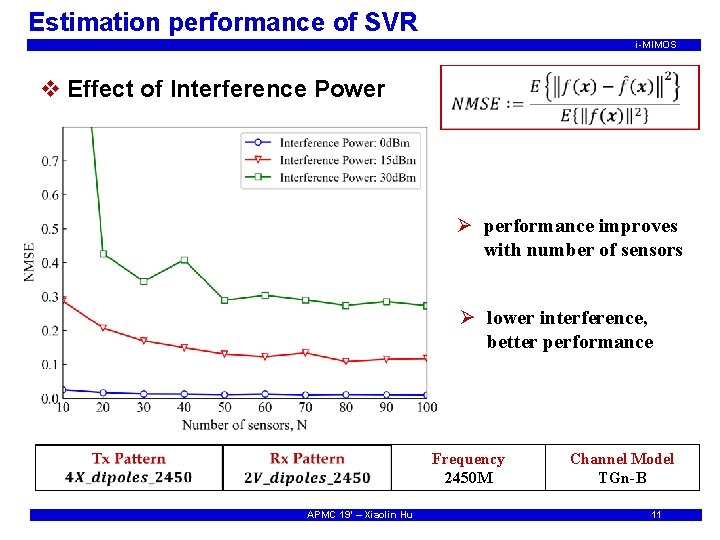
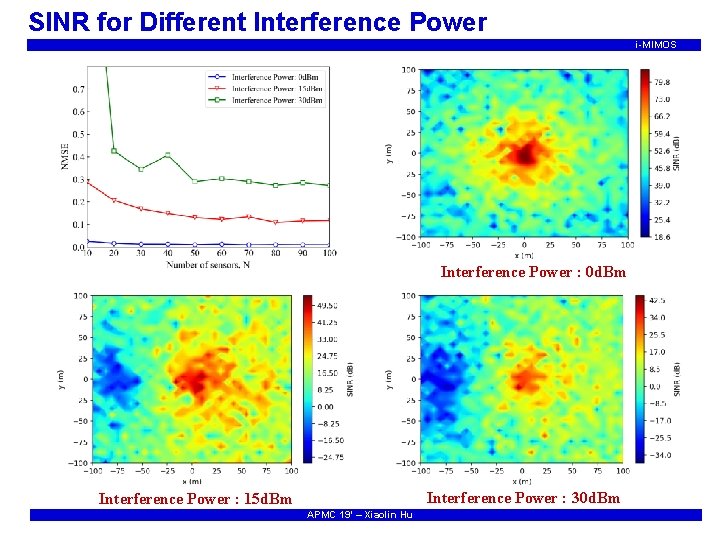
Estimation performance of SVR i-MIMOS v Effect of Interference Power Ø performance improves with number of sensors Ø lower interference, better performance Frequency 2450 M Channel Model TGn-B APMC 19’ – Xiaolin Hu 11
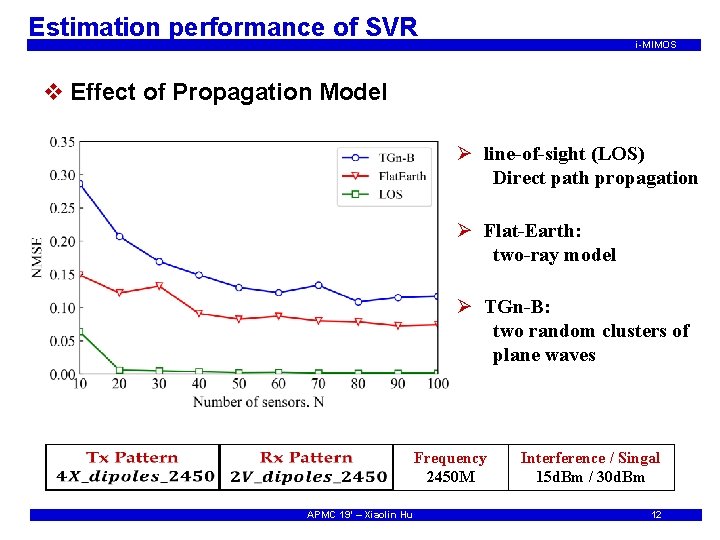
Estimation performance of SVR i-MIMOS v Effect of Propagation Model Ø line-of-sight (LOS) Direct path propagation Ø Flat-Earth: two-ray model Ø TGn-B: two random clusters of plane waves Frequency 2450 M Interference / Singal 15 d. Bm / 30 d. Bm APMC 19’ – Xiaolin Hu 12
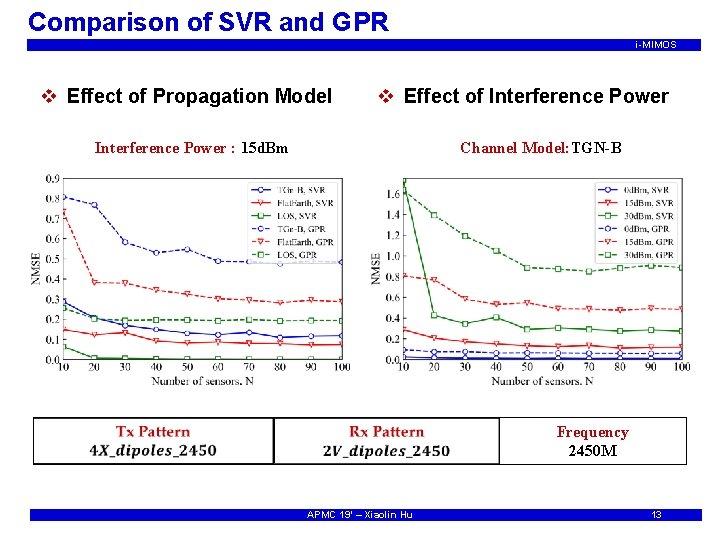
Comparison of SVR and GPR i-MIMOS v Effect of Propagation Model v Effect of Interference Power : 15 d. Bm Channel Model: TGN-B Frequency 2450 M APMC 19’ – Xiaolin Hu 13
Conclusions i-MIMOS v The cartography of capacity for such a MIMO link is feasible even when using just 10% of data for training v The performances of the estimator are tested from different aspects Ø Performance improves with number of sensors Ø Lower interference, better performance Ø The SVR run better when the actual model is simple APMC 19’ – Xiaolin Hu 14
i-MIMOS THANK YOU !!! DISCUSSION & FEEDBACK APMC 19’ – Xiaolin Hu
SINR for Different Interference Power i-MIMOS Interference Power : 0 d. Bm Interference Power : 15 d. Bm Interference Power : 30 d. Bm APMC 19’ – Xiaolin Hu
Fundamentals of Support Vector Regression v Support Vector Machine APMC 19’ – Xiaolin Hu i-MIMOS
Fundamentals of Support Vector Regression v Support Vector Regression Smola, Alex J. , and Bernhard Schölkopf. "A tutorial on support vector regression. " Statistics and computing 14. 3 (2004): 199 -222. APMC 19’ – Xiaolin Hu i-MIMOS
Open Loop mismatched capacity i-MIMOS v Open Loop: Ø The Tx does NOT know the channel. Therefore, the Tx creates as many orthogonal signals as there are transmitter chains and allocates the same power to each such signal. The SVR run better when the actual model is simple v Mismatched: Ø this pertains to the case where the source impedances driving the antenna system are in the mix for the input power. That is, the mismatches between these source impedances and the antenn APMC 19’ – Xiaolin Hu