
IMGD 1001 Game Development Timeline by Mark Claypool
IMGD 1001: Game Development Timeline by Mark Claypool (claypool@cs. wpi. edu) Robert W. Lindeman (gogo@wpi. edu) Claypool and Lindeman, WPI, CS and IMGD
Outline o Game Timeline (next) o Team Sizes Claypool and Lindeman, WPI, CS and IMGD 2
Game Development Timeline (1 of 5) o Inspiration n getting the global idea of the game n duration: 1 month (for a professional game) n people: lead designer, team discussion n result: treatment document, decision to continue o Conceptualization n preparing the "complete" design of the game n duration: 3 months n people: designer + prototype programmers/artists n result: complete design document n (continued next slide) Claypool and Lindeman, WPI, CS and IMGD 3 Based on notes from Mark Overmars
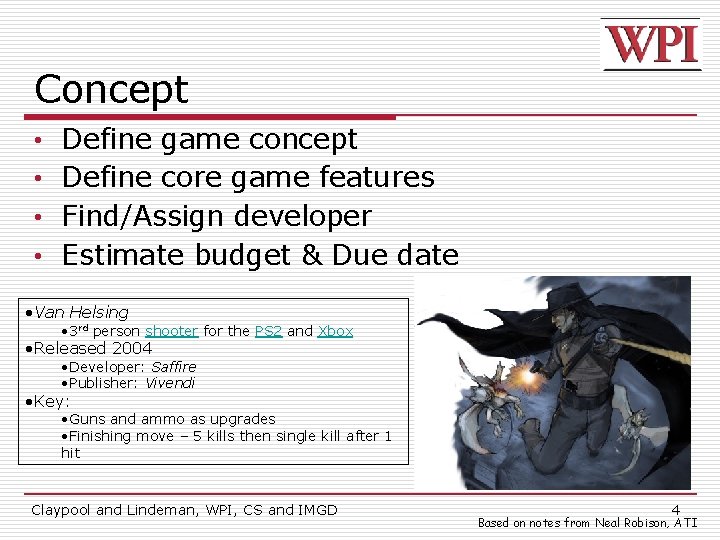
Concept • Define game concept • Define core game features • Find/Assign developer • Estimate budget & Due date • Van Helsing • 3 rd person shooter for the PS 2 and Xbox • Released 2004 • Developer: Saffire • Publisher: Vivendi • Key: • Guns and ammo as upgrades • Finishing move – 5 kills then single kill after 1 hit Claypool and Lindeman, WPI, CS and IMGD 4 Based on notes from Neal Robison, ATI
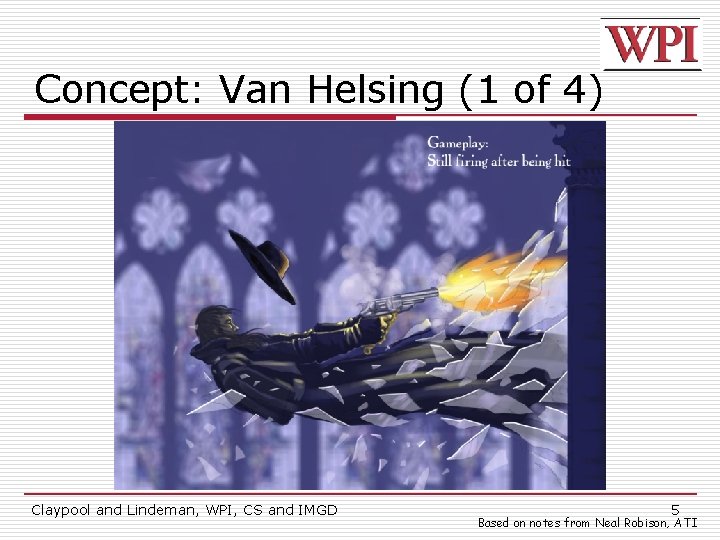
Concept: Van Helsing (1 of 4) Claypool and Lindeman, WPI, CS and IMGD 5 Based on notes from Neal Robison, ATI
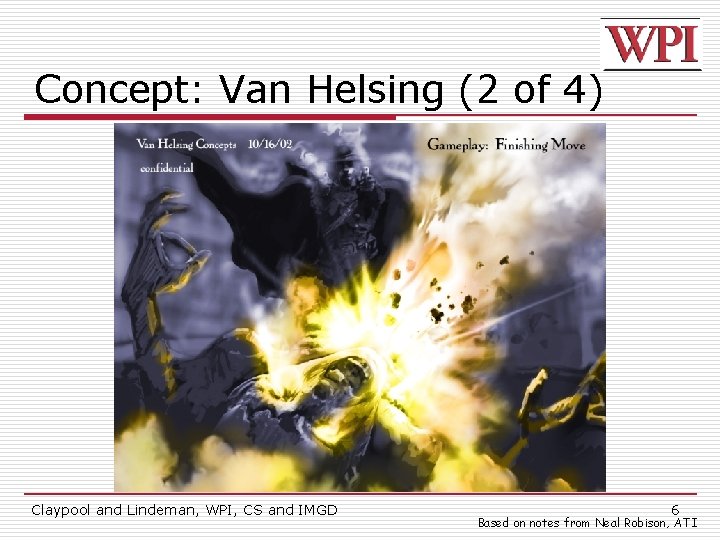
Concept: Van Helsing (2 of 4) Claypool and Lindeman, WPI, CS and IMGD 6 Based on notes from Neal Robison, ATI
Concept: Van Helsing (3 of 4) Van Helsing Pre-Production Video Claypool and Lindeman, WPI, CS and IMGD 7 Based on notes from Neal Robison, ATI
Concept: Van Helsing (4 of 4) Van Helsing Finished Concept Video Claypool and Lindeman, WPI, CS and IMGD 8 Based on notes from Neal Robison, ATI
Game Development Timeline (2 of 5) o Prototypes n Build prototypes as proof of concept • Can take 2 -3 months (or more) • Typically done a few months after project start n n In particular, used to test game play Throw prototype away afterwards • Don't expect it to evolve into game! • The Pancake Principle (Fred Brooks) n “Plan to throw one away, you will anyway. ” n Pitch to Publisher o (Continued next slide) Claypool and Lindeman, WPI, CS and IMGD 9 Based on notes from Mark Overmars
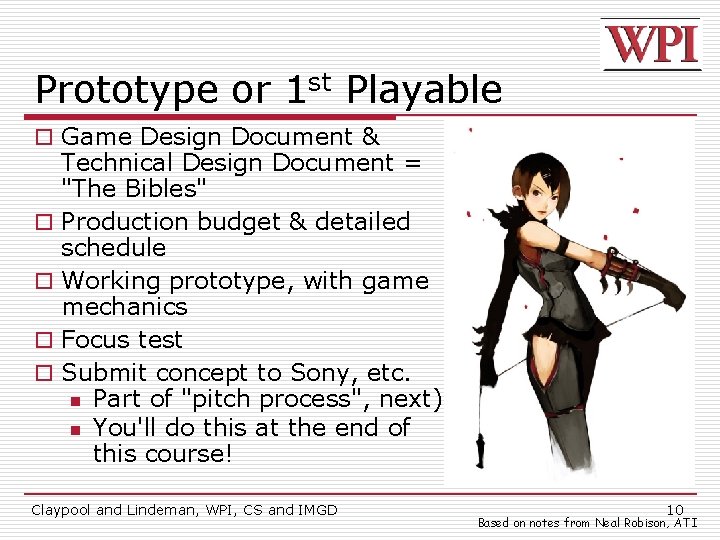
Prototype or 1 st Playable o Game Design Document & o o Technical Design Document = "The Bibles" Production budget & detailed schedule Working prototype, with game mechanics Focus test Submit concept to Sony, etc. n Part of "pitch process", next) n You'll do this at the end of this course! Claypool and Lindeman, WPI, CS and IMGD 10 Based on notes from Neal Robison, ATI
The Pitch Process: Presentation o Key pitch presentation content: n Concept overview & genre profile n Unique selling points • What makes it stand out from its competitors n n n Proposed technology & target platform/s Team biographies & heritage Outline marketing information, including potential licensing opportunities Claypool and Lindeman, WPI, CS and IMGD 11 Chapter 7. 3, Introduction to Game Development
The Pitch Process: Prototype o Key game prototype features: n Core gameplay mechanic n Game engine / technological proficiency n Artistic / styling guide n Demonstration of control / camera system n Example gameplay goals Claypool and Lindeman, WPI, CS and IMGD 12 Chapter 7. 3, Introduction to Game Development
The Pitch Process: Project Schedule & Budget o Schedule & budget must: n Be detailed and transparent n Allow for contingency scenarios n Have several sets of outcomes for different size publishers n Be realistic Claypool and Lindeman, WPI, CS and IMGD 13 Chapter 7. 3, Introduction to Game Development
The Deal: Choosing a Publisher Research o Publishers screen Developers o But Developers should also research prospective Publishers: n n n Are they financially stable? Do they have appropriate reach for target? Do they market / PR their games well? Is there a history of non-payment of milestones or royalties? Have they produced many titles? o Sometimes you take what you can get! Claypool and Lindeman, WPI, CS and IMGD 14 Chapter 7. 3, Introduction to Game Development
The Deal: IP Rights o Intellectual Property Rights include: n Game n Logos n Unique game mechanics & storyline n Unique characters, objects & settings n Game Source Code including artwork & associated assets n Unique sounds and music o Developers may not have much power n And it probably doesn't matter as many games don’t succeed, anyway Claypool and Lindeman, WPI, CS and IMGD 15 Chapter 7. 3, Introduction to Game Development
The Deal: Payment Negotiation (1 of 2) o Current approximate development costs: n n n $4 -5 million for AAA multi-platform $2 -3 million for AAA Play. Station 2 only $1 million for A-quality single platform o Royalties n n Percentage payments of profits made after recoup of development costs Developer royalties range 0% ("work for hire") to 40% o Other considerations: n n Rising-rate royalty: more units sold = higher percentage Clear royalty definition of 'wholesale price' (i. e. , including cost of goods etc. ) Right to audit publishers books Currency/exchange rate/VAT figures Claypool and Lindeman, WPI, CS and IMGD 16 Chapter 7. 3, Introduction to Game Development
Moving Projects Forward o Most Publishers have a "Green-Light Process" n Used to determine which projects go forward o Developers submit to committee at five, mostly independent stages: n n n o Concept Assessment Prototype First Playable Alpha At each stage, committee: n Decides whether or not to continue funding o Developers then get next "lump" of money Evaluates market potential n Adjusts unit forecasts accordingly Then, additional stages: n o n n Beta Gold Master Claypool and Lindeman, WPI, CS and IMGD 17 Chapter 7. 3, Introduction to Game Development
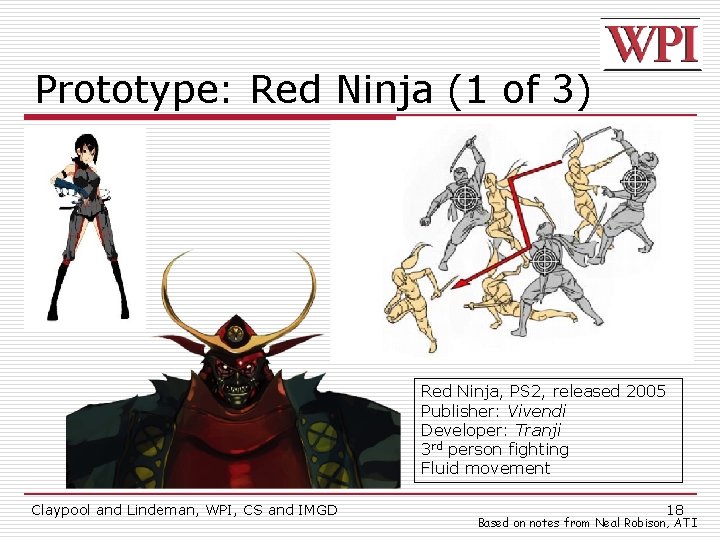
Prototype: Red Ninja (1 of 3) Red Ninja, PS 2, released 2005 Publisher: Vivendi Developer: Tranji 3 rd person fighting Fluid movement Claypool and Lindeman, WPI, CS and IMGD 18 Based on notes from Neal Robison, ATI
Prototype: Red Ninja (2 of 3) Red Ninja Pre-Production Video Claypool and Lindeman, WPI, CS and IMGD 19 Based on notes from Neal Robison, ATI
Prototype: Red Ninja (3 of 3) Red Ninja Final Production Video Claypool and Lindeman, WPI, CS and IMGD 20 Based on notes from Neal Robison, ATI
Game Development Timeline (3 of 5) o Blueprint separate the project into different tiers n duration: 2 months n people: lead designer, software planner n result: several mini-specifications o Architecture n creating a technical design that specifies tools and technology used n duration: 2 months n people: project leader, software planner, lead architect n result: full technical specification n Claypool and Lindeman, WPI, CS and IMGD 21 Based on notes from Mark Overmars
Game Development Timeline (4 of 5) o Tool building n n create a number of (preferably reusable) tools, like 3 D graphics engine, level builder, or unit builder duration: 4 months people: project leader and 4 (tool) programmers result: set of functional tools (maybe not yet feature complete) o Assembly n n create the game based on the design document using the tools; update design document and tools as required (consulting the lead designer) duration: 12 months people: project leader, 4 programmers, 4 artists result: the complete game software and toolset Claypool and Lindeman, WPI, CS and IMGD 22 Based on notes from Mark Overmars
Other Milestones: Alpha Definition o At Alpha stage, a game should: n Have all of the required features of the design implemented, but not necessarily working correctly n Be tested thoroughly by QA to eliminate any critical gameplay flaws n Still likely contains a certain amount of placeholder assets n (Continued next slide) Claypool and Lindeman, WPI, CS and IMGD 23
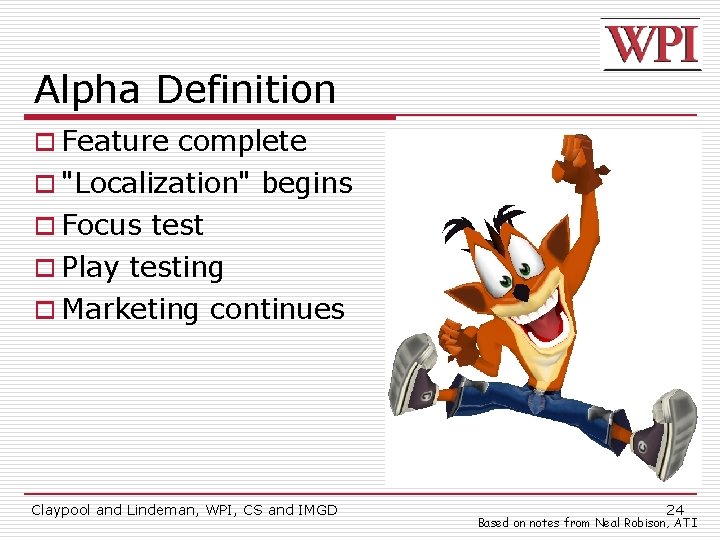
Alpha Definition o Feature complete o "Localization" begins o Focus test o Play testing o Marketing continues Claypool and Lindeman, WPI, CS and IMGD 24 Based on notes from Neal Robison, ATI
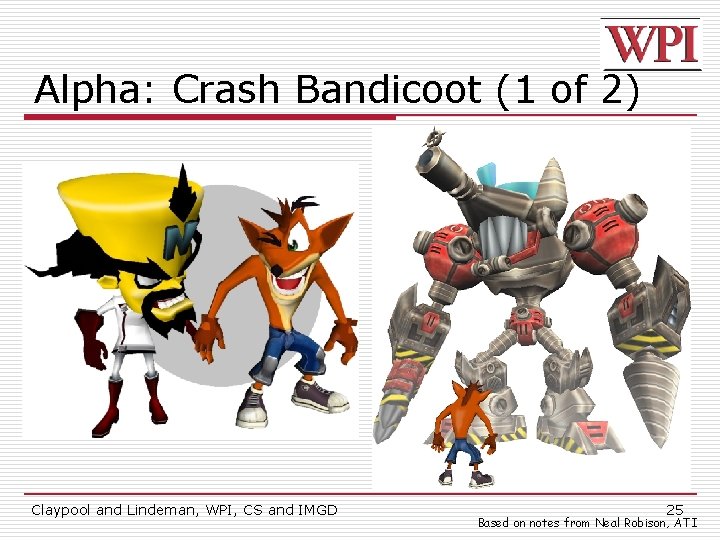
Alpha: Crash Bandicoot (1 of 2) Claypool and Lindeman, WPI, CS and IMGD 25 Based on notes from Neal Robison, ATI
Alpha: Crash Bandicoot (2 of 2) Crash Bandicoot Video Claypool and Lindeman, WPI, CS and IMGD 26
Game Development Timeline (5 of 5) o Level design n n create the levels for the game duration: 4 months people: project leader, 3 level designers result: finished game with all levels, in-game tutorials, manuals o Review n testing the code, the gameplay, and the levels n duration: 3 months (partially overlapping level design) n people: 4 testers n result: the gold master Claypool and Lindeman, WPI, CS and IMGD 27 Based on notes from Mark Overmars
Other Milestones: Beta Definition o At Beta stage, a game should: n Have all content complete n Be tested thoroughly for bugs and gameplay tweaks n Be shown to press for preview features n (Continued next slide) Claypool and Lindeman, WPI, CS and IMGD 28
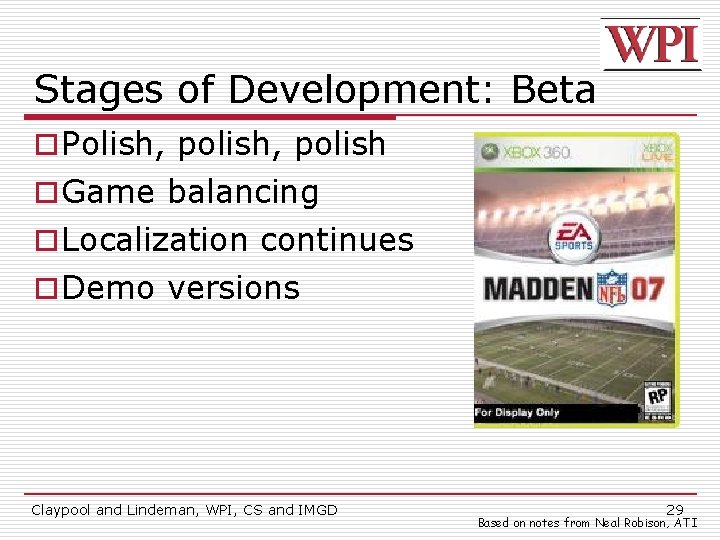
Stages of Development: Beta o Polish, polish o Game balancing o Localization continues o Demo versions Claypool and Lindeman, WPI, CS and IMGD 29 Based on notes from Neal Robison, ATI
Other Milestones: Gold Master Definition o At Gold Master stage, a game should: n Be sent to the platform holder/s (where applicable) for TRC (Technical Requirements Checklist) testing n Be sent to press for review n Be sent to duplication for production n Be backed up and stored n (Continued next slide) Claypool and Lindeman, WPI, CS and IMGD 30 Based on notes from Mark Overmars
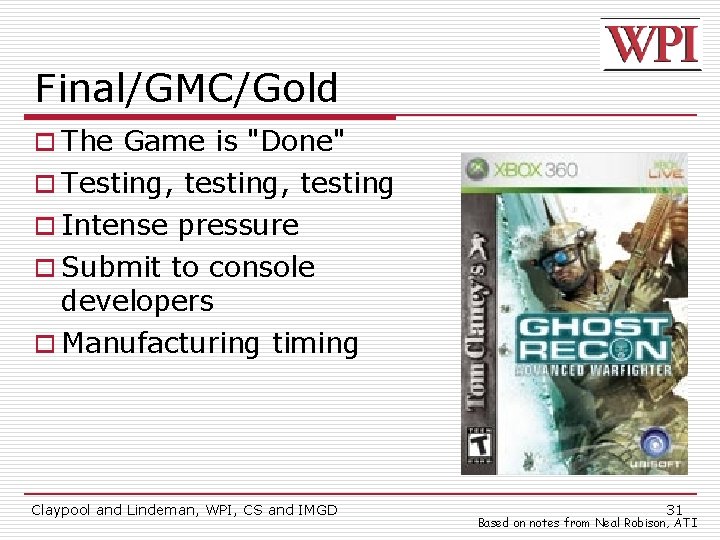
Final/GMC/Gold o The Game is "Done" o Testing, testing o Intense pressure o Submit to console developers o Manufacturing timing Claypool and Lindeman, WPI, CS and IMGD 31 Based on notes from Neal Robison, ATI
Post-Mortem o Analysis of PR, marketing o Analysis of production, source Code o What went right o What went wrong o Archive all assets o Kick-off the Sequel! Claypool and Lindeman, WPI, CS and IMGD 32 Based on notes from Neal Robison, ATI
Outline o Game Timeline o Team Sizes Claypool and Lindeman, WPI, CS and IMGD (next) 33
Development Team Size o As late as the mid-80's teams as small as one person o Today, teams ranging from 10 -60 people o Programming now a proportionally smaller part of any project, artistic content creation proportionally larger o See Gamasutra, (www. gamasutra. com) n Search for "post mortem" n Game data at bottom includes team size and composition o But it depends a lot on the genre Claypool and Lindeman, WPI, CS and IMGD 34 Laird and Jamin, EECS 494, Umich, Fall 2003
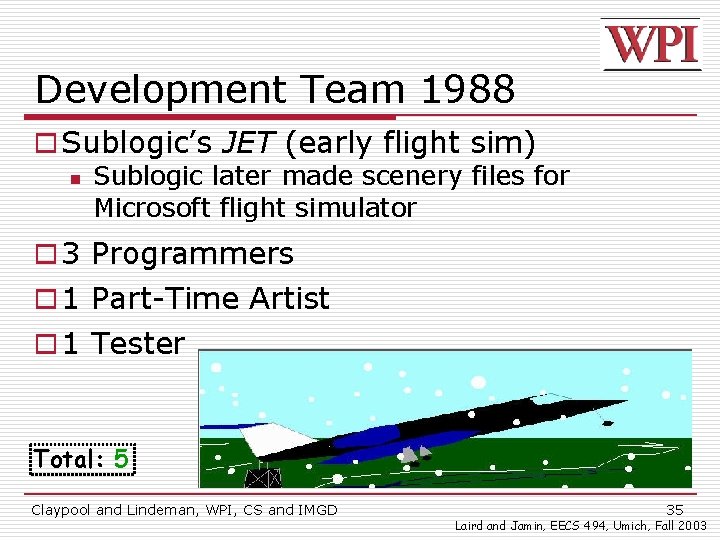
Development Team 1988 o Sublogic’s JET (early flight sim) n Sublogic later made scenery files for Microsoft flight simulator o 3 Programmers o 1 Part-Time Artist o 1 Tester Total: 5 Claypool and Lindeman, WPI, CS and IMGD 35 Laird and Jamin, EECS 494, Umich, Fall 2003
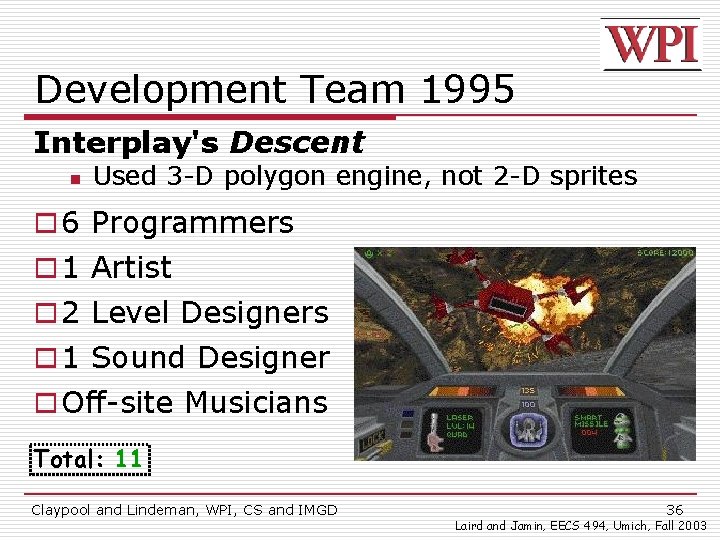
Development Team 1995 Interplay's Descent n Used 3 -D polygon engine, not 2 -D sprites o 6 Programmers o 1 Artist o 2 Level Designers o 1 Sound Designer o Off-site Musicians Total: 11 Claypool and Lindeman, WPI, CS and IMGD 36 Laird and Jamin, EECS 494, Umich, Fall 2003
Development Team 2002 THQ’s Alter. Echo o 1 Executive Producer o 1 Producer o 4 Programmers o 2 Game Designers o 1 Writer o 3 Level Designers o 3 Character Modelers and o o Animators 1 2 d and Texture Artist 1 Audio Designer 1 Cinematic Animator 1 QA Lead and Testers Total: 19+ Claypool and Lindeman, WPI, CS and IMGD 37 Laird and Jamin, EECS 494, Umich, Fall 2003
Development Team 2007 2 K’s Bioshock o Boston: n n n Programmer: 1 Artists and Animators: 15, plus 2 borrowed from Firaxis Designers: 6 in-house, 1 contract Audio Developers: 2 in-house, 7 contract Producers: 3 in-house, 2 contract Testers: 13 contract, plus 8 on-site publisher testers o Australia: n n n Programmers: 12 Artists And Animators: 10 Designers: 5 Audio Developer: 1 Producers: 2 Testers: 1 in-house, 7 contract o Shanghai: n Artists And Animators: 12 n Designers: 3 o At peak: ~90 developers, 30 contractors, 8 on-site publisher testers http: //www. gamasutra. com/view/feature/3774/postmortem_2 k_boston 2 k_. php Claypool and Lindeman, WPI, CS and IMGD 38
Development Teams for Online Games o Star Wars online (~2003) o Development team: 44 people n n n 50% Artists 25% Designers 25% Programmers o 3 Producers o "Live" Team (starting at Beta, 6 months before done) n n n 8 Developers 50 -60 Customer support (for 200 K users) 1000 Volunteer staff (for 200 K users) Claypool and Lindeman, WPI, CS and IMGD 39 Laird and Jamin, EECS 494, Umich, Fall 2003
A (Larger) Developer Company Today o Designing and creating computer games is serious business n n n Large budgets ($10 million+) Large number of people involved Large risk o Wisdom n n Use modern software development techniques • And maybe not the ones we just talked about Keep creativity where it belongs • In the design • Not during the programming Claypool and Lindeman, WPI, CS and IMGD 40
- Slides: 40