
Imaging the HighEnergy Neutrino Universe from the South
- Slides: 26
Imaging the High-Energy Neutrino Universe from the South Pole Results from AMANDA and Status of Ice. Cube Kurt Woschnagg University of California - Berkeley Les Rencontres de Physique de la Vallée d’Aoste La Thuile, Feb 27 – Mar 5, 2005 Results and Perspectives in Particle Physics http: //amanda. uci. edu http: //icecube. wisc. edu
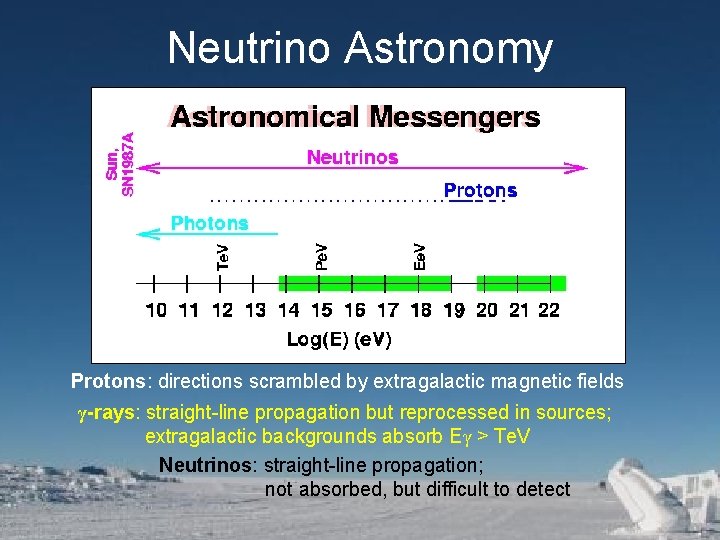
Neutrino Astronomy Protons: directions scrambled by extragalactic magnetic fields γ rays: straight-line propagation but reprocessed in sources; extragalactic backgrounds absorb Eγ > Te. V Neutrinos: straight-line propagation; not absorbed, but difficult to detect
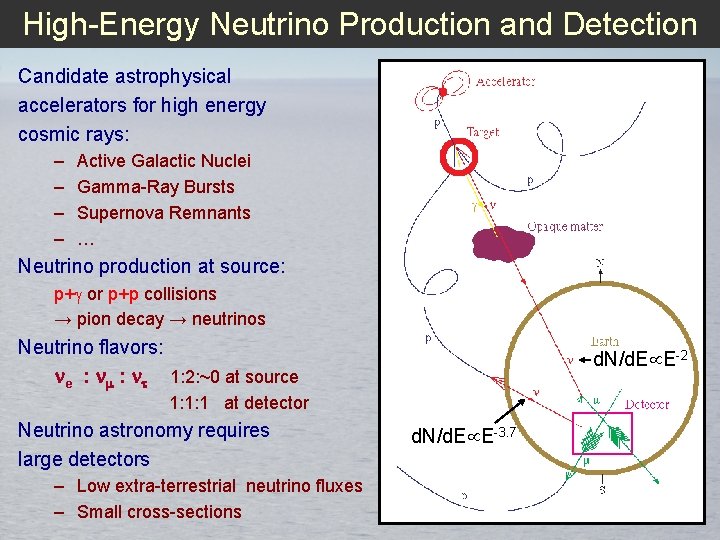
High-Energy Neutrino Production and Detection Candidate astrophysical accelerators for high energy cosmic rays: – – Active Galactic Nuclei Gamma-Ray Bursts Supernova Remnants … Neutrino production at source: p+ or p+p collisions → pion decay → neutrinos Neutrino flavors: e : : 1: 2: ~0 at source d. N/d. E E-2 1: 1: 1 at detector Neutrino astronomy requires large detectors – Low extra-terrestrial neutrino fluxes – Small cross-sections d. N/d. E E-3. 7
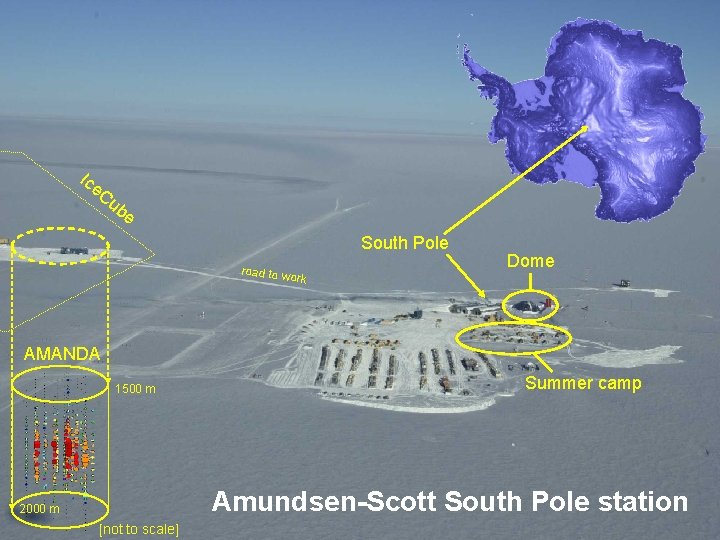
Ic e. C ub e South Pole road to w ork Dome AMANDA 1500 m Summer camp Amundsen Scott South Pole station 2000 m [not to scale]
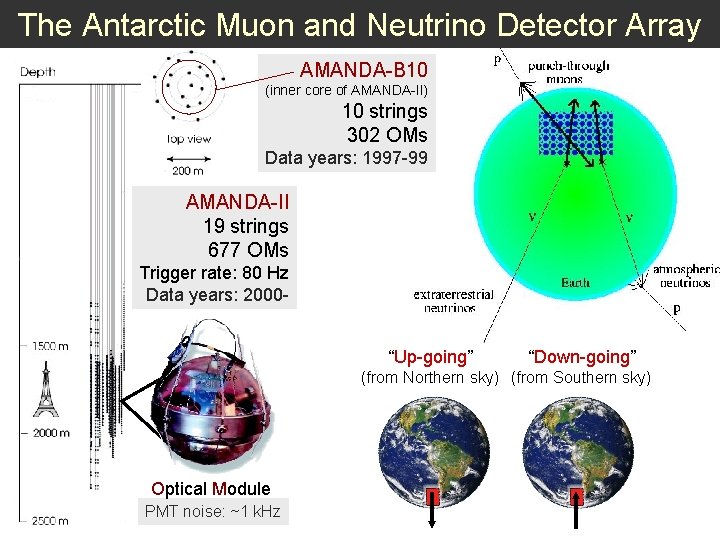
The Antarctic Muon and Neutrino Detector Array AMANDA-B 10 (inner core of AMANDA-II) 10 strings 302 OMs Data years: 1997 -99 AMANDA-II 19 strings 677 OMs Trigger rate: 80 Hz Data years: 2000“Up-going” “Down-going” (from Northern sky) (from Southern sky) Optical Module PMT noise: ~1 k. Hz
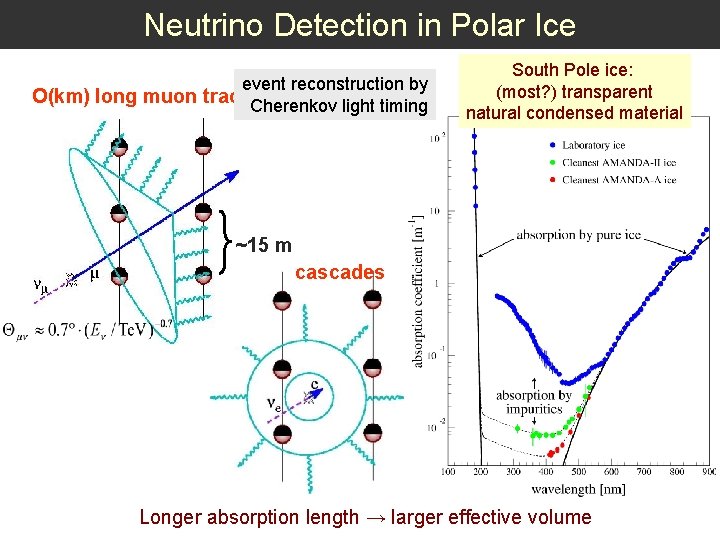
Neutrino Detection in Polar Ice event reconstruction by O(km) long muon tracks Cherenkov light timing South Pole ice: (most? ) transparent natural condensed material ~15 m cascades Longer absorption length → larger effective volume
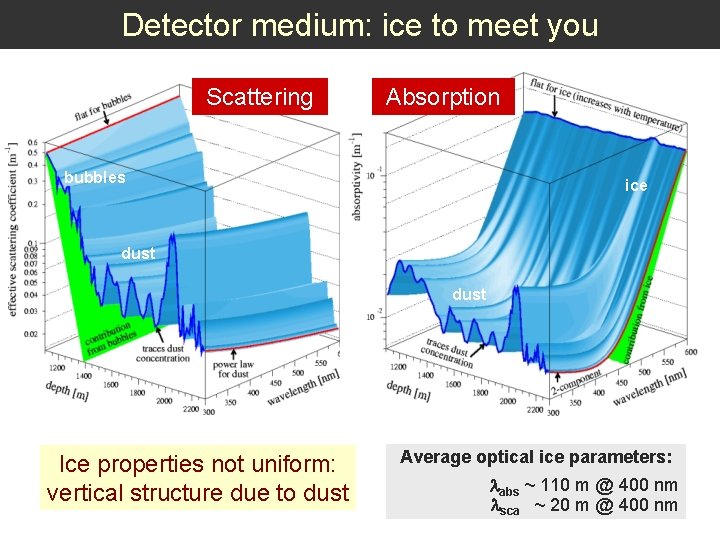
Detector medium: ice to meet you Scattering Absorption bubbles ice dust Ice properties not uniform: vertical structure due to dust Average optical ice parameters: labs ~ 110 m @ 400 nm lsca ~ 20 m @ 400 nm
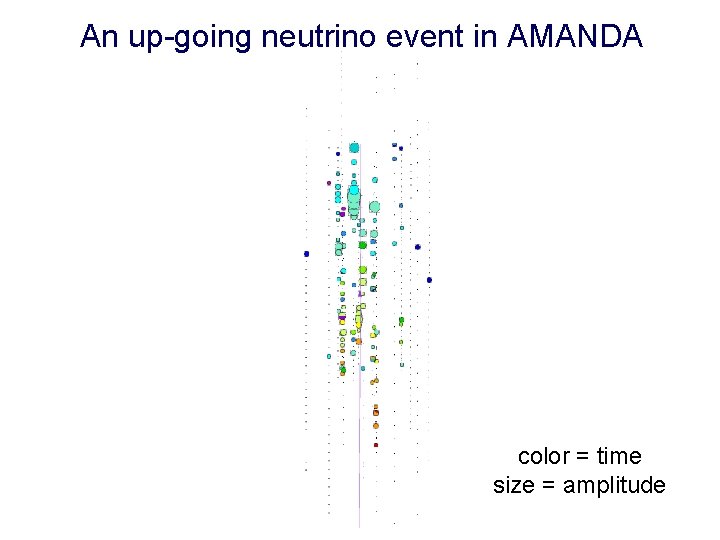
An up-going neutrino event in AMANDA color = time size = amplitude
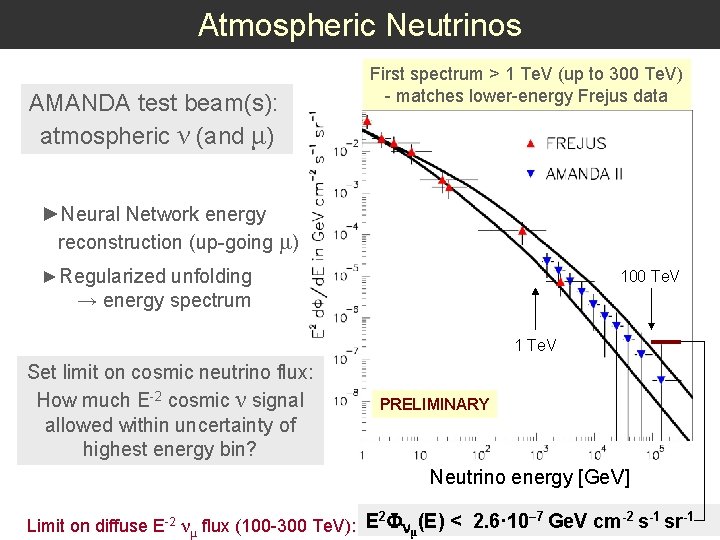
Atmospheric Neutrinos AMANDA test beam(s): atmospheric ν (and μ) First spectrum > 1 Te. V (up to 300 Te. V) - matches lower-energy Frejus data ►Neural Network energy reconstruction (up-going μ) ►Regularized unfolding 100 Te. V → energy spectrum 1 Te. V Set limit on cosmic neutrino flux: How much E-2 cosmic ν signal allowed within uncertainty of highest energy bin? PRELIMINARY Neutrino energy [Ge. V] 2 – 7 2 1 1 Limit on diffuse E-2 νμ flux (100 -300 Te. V): E μ(E) < 2. 6· 10 Ge. V cm s sr
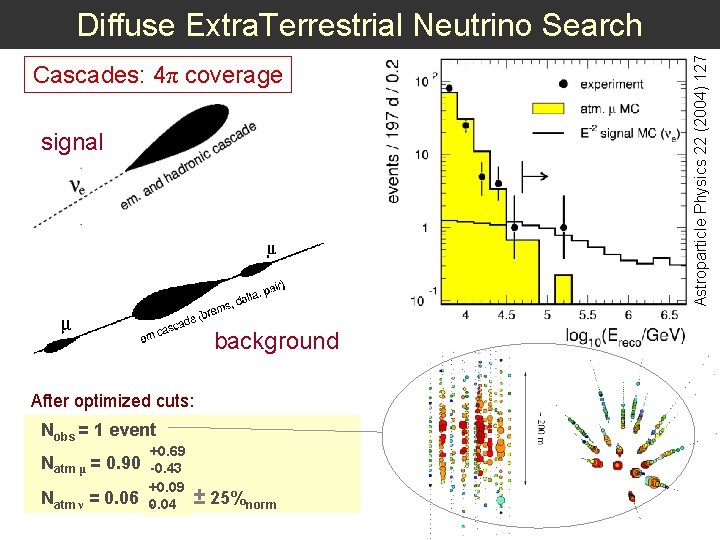
Cascades: 4π coverage signal background After optimized cuts: Nobs = 1 event Natm μ = 0. 90 Natm ν = 0. 06 +0. 69 0. 43 +0. 09 0. 04 ± 25%norm Astroparticle Physics 22 (2004) 127 Diffuse Extra. Terrestrial Neutrino Search
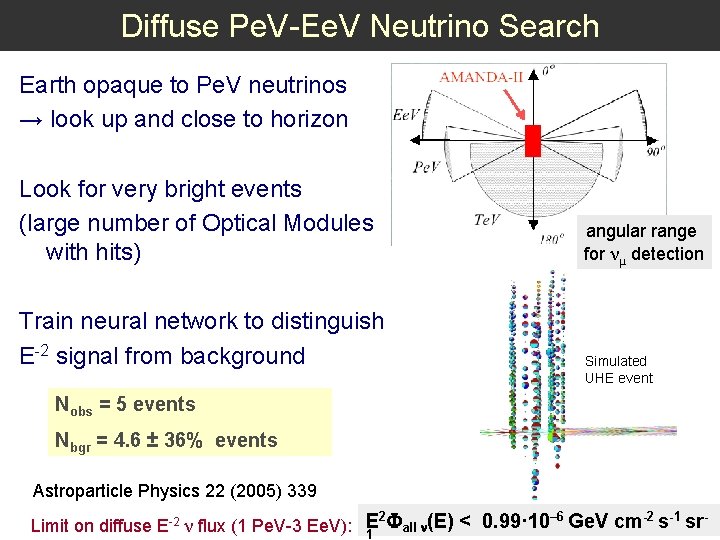
Diffuse Pe. V-Ee. V Neutrino Search Earth opaque to Pe. V neutrinos → look up and close to horizon Look for very bright events (large number of Optical Modules with hits) Train neural network to distinguish E-2 signal from background angular range for νμ detection Simulated UHE event Nobs = 5 events Nbgr = 4. 6 ± 36% events Astroparticle Physics 22 (2005) 339 2 all (E) < 0. 99· 10– 6 Ge. V cm 2 s 1 sr Limit on diffuse E-2 ν flux (1 Pe. V-3 Ee. V): E 1
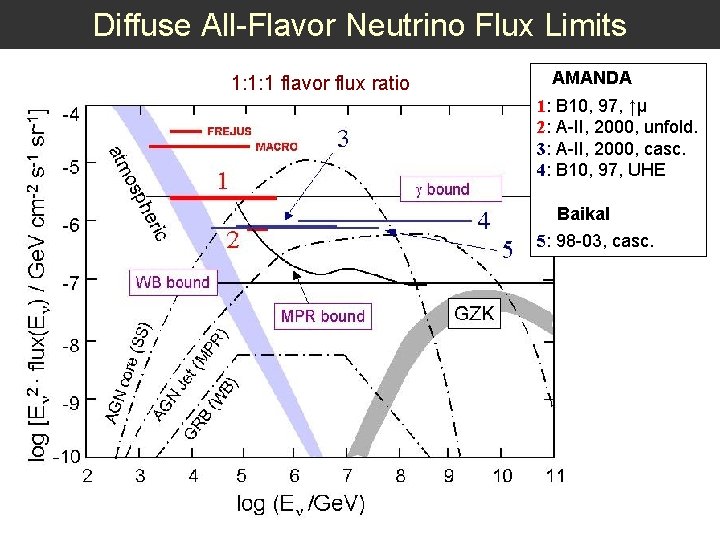
Diffuse All-Flavor Neutrino Flux Limits 1: 1: 1 flavor flux ratio AMANDA 1: B 10, 97, ↑μ 2: A-II, 2000, unfold. 3: A-II, 2000, casc. 4: B 10, 97, UHE Baikal 5: 98 -03, casc.
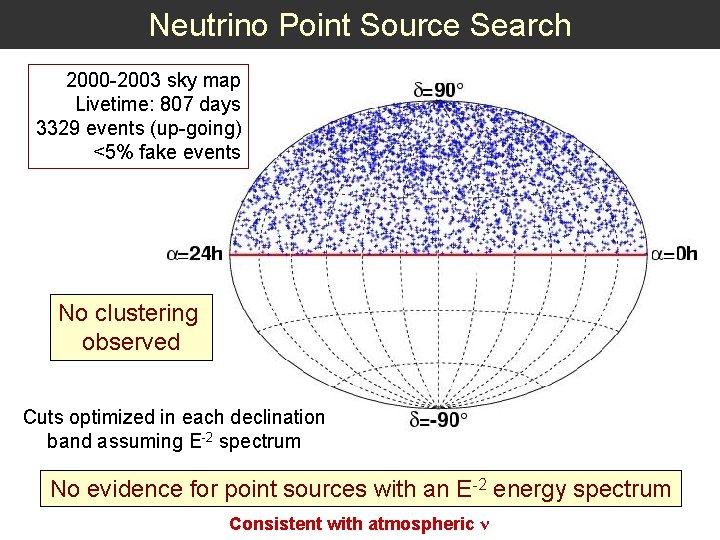
Neutrino Point Source Search 2000 -2003 sky map Livetime: 807 days 3329 events (up-going) <5% fake events No clustering observed Cuts optimized in each declination band assuming E-2 spectrum No evidence for point sources with an E-2 energy spectrum Consistent with atmospheric ν
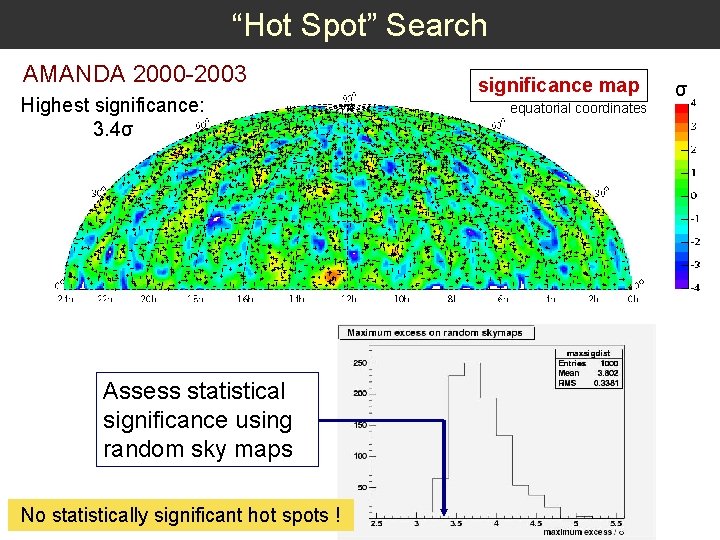
“Hot Spot” Search AMANDA 2000 -2003 Highest significance: 3. 4σ significance map equatorial coordinates Significance Map: Largest excess is 3. 35 Assess statistical significance using random sky maps No statistically significant hot spots ! σ
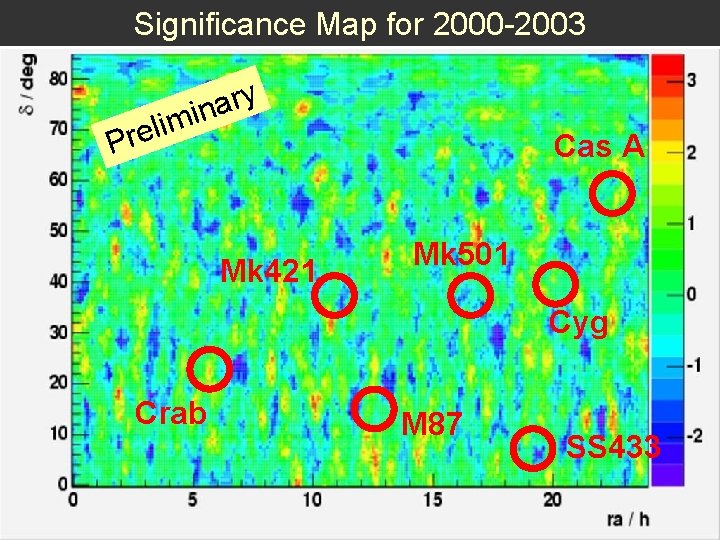
Significance Map for 2000 -2003 y r a in m i l e Pr Mk 421 Cas A Mk 501 Cyg Crab M 87 SS 433
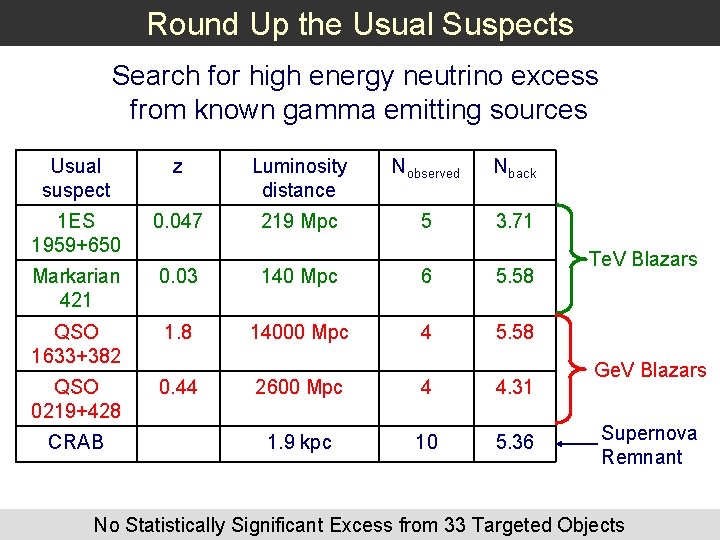
Round Up the Usual Suspects Search for high energy neutrino excess from known gamma emitting sources Usual suspect z Luminosity distance Nobserved Nback 1 ES 1959+650 0. 047 219 Mpc 5 3. 71 Markarian 421 0. 03 140 Mpc 6 5. 58 QSO 1633+382 1. 8 14000 Mpc 4 5. 58 QSO 0219+428 0. 44 CRAB 2600 Mpc 4 4. 31 1. 9 kpc 10 5. 36 Te. V Blazars Ge. V Blazars Supernova Remnant No Statistically Significant Excess from 33 Targeted Objects
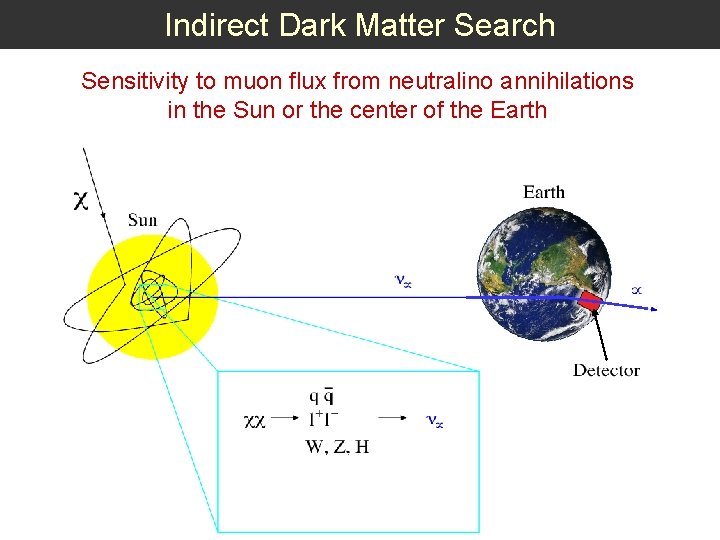
Indirect Dark Matter Search Sensitivity to muon flux from neutralino annihilations in the Sun or the center of the Earth
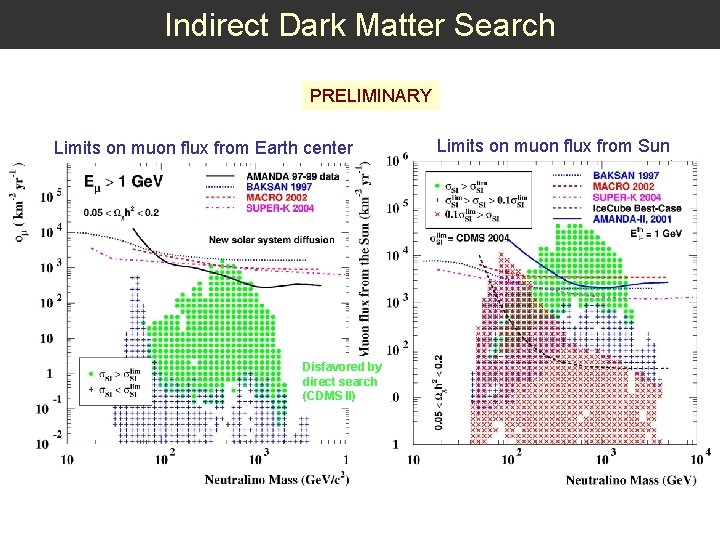
Indirect Dark Matter Search PRELIMINARY Limits on muon flux from Earth center Disfavored by direct search (CDMS II) Limits on muon flux from Sun
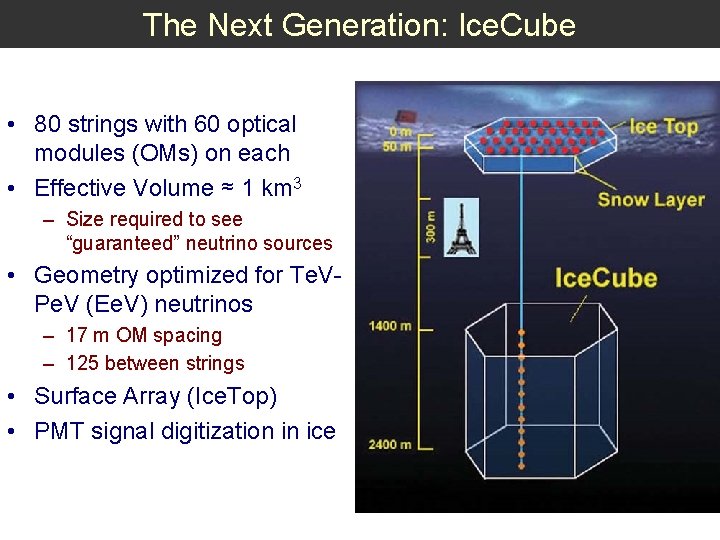
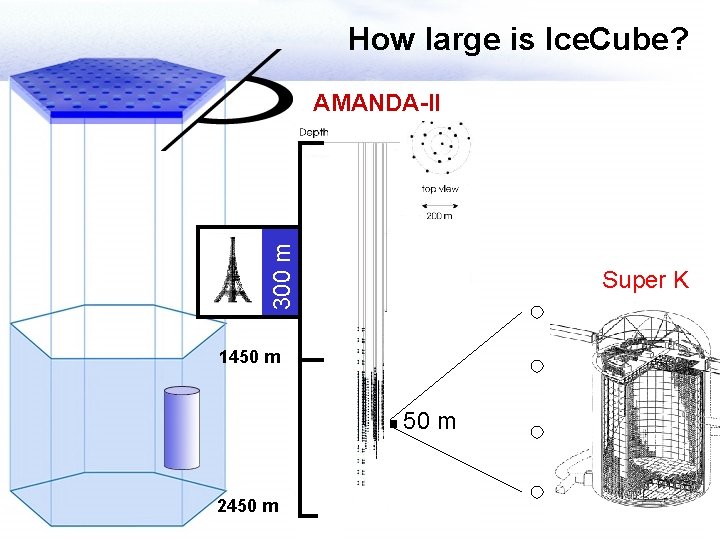
The Next Generation: Ice. Cube • 80 strings with 60 optical modules (OMs) on each • Effective Volume ≈ 1 km 3 – Size required to see “guaranteed” neutrino sources • Geometry optimized for Te. VPe. V (Ee. V) neutrinos – 17 m OM spacing – 125 between strings • Surface Array (Ice. Top) • PMT signal digitization in ice
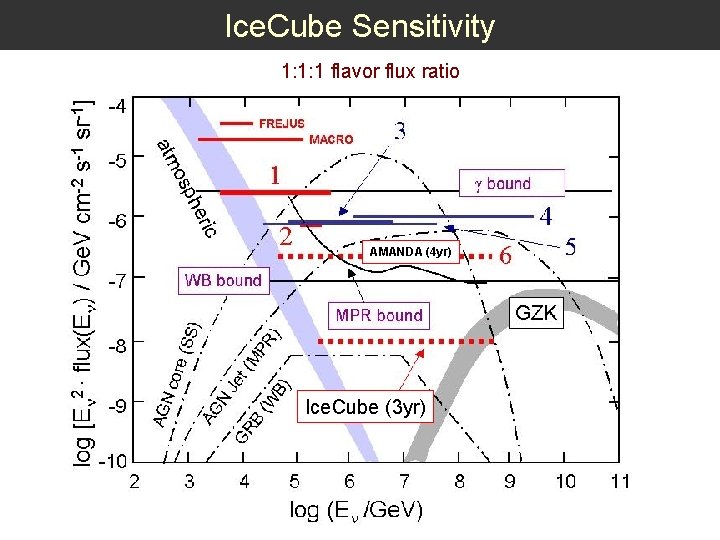
Ice. Cube Sensitivity 1: 1: 1 flavor flux ratio AMANDA (4 yr) Ice. Cube (3 yr)
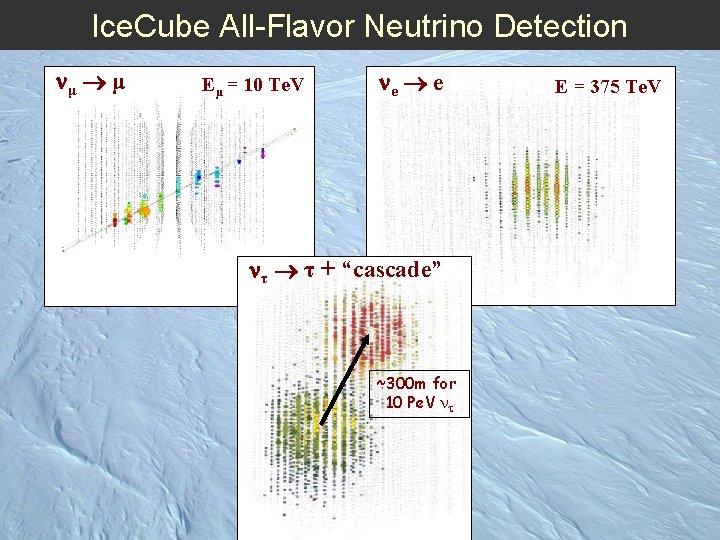
Ice. Cube All-Flavor Neutrino Detection μ μ Eµ = 10 Te. V e e τ τ + “cascade” ~300 m for 10 Pe. V t E = 375 Te. V
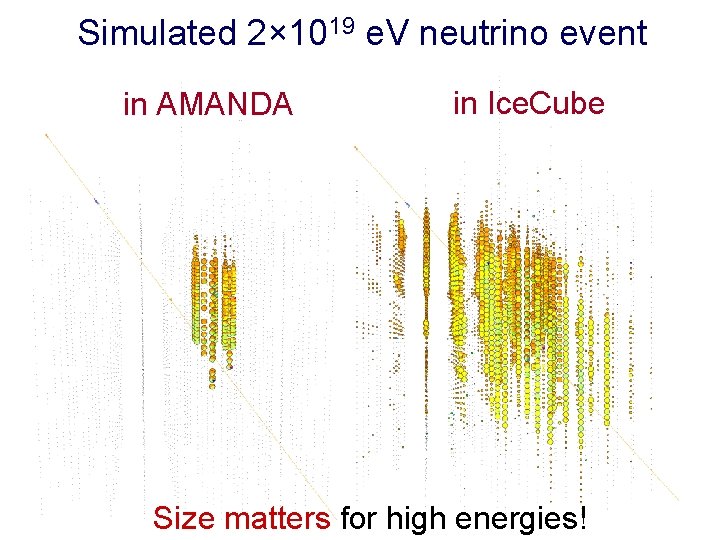
Simulated 2× 10¹⁹ e. V neutrino event in AMANDA in Ice. Cube Size matters for high energies!
How large is Ice. Cube? 300 m AMANDA II Super K 1450 m 2450 m
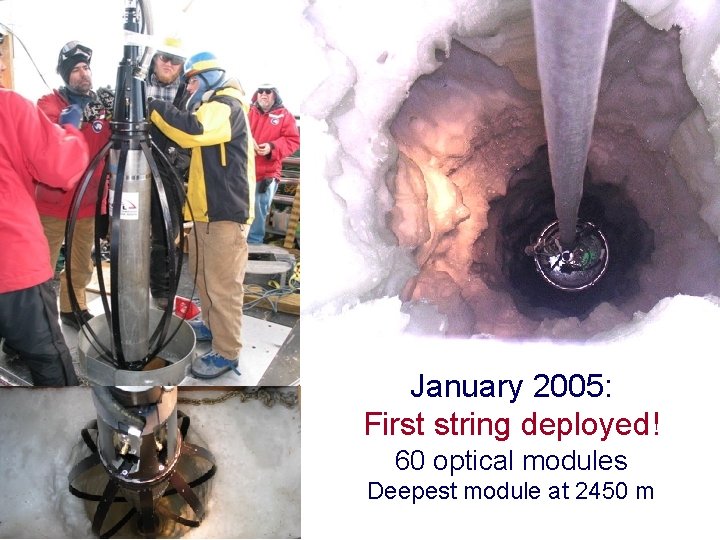
January 2005: First string deployed! 60 optical modules Deepest module at 2450 m
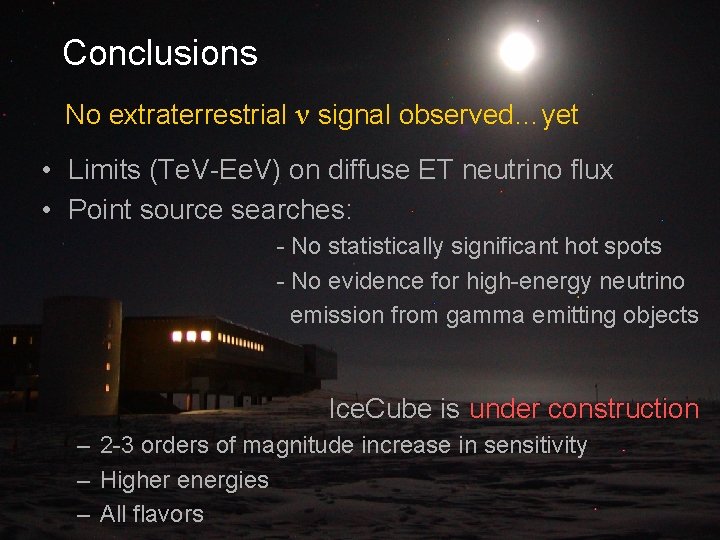
Conclusions No extraterrestrial ν signal observed…yet • Limits (Te. V-Ee. V) on diffuse ET neutrino flux • Point source searches: - No statistically significant hot spots - No evidence for high-energy neutrino emission from gamma emitting objects Ice. Cube is under construction – 2 -3 orders of magnitude increase in sensitivity – Higher energies – All flavors
The AMANDA Collaboration United States Bartol Research Institute UC Berkeley UC Irvine Pennsylvania State UW Madison UW River Falls LBNL Berkeley Europe VUB IIHE, Brussel ULB IIHE, Bruxelles Université de Mons Hainaut Imperial College, London Antarctica DESY, Zeuthen South Pole Station Mainz Universität Wuppertal Universität Dortmund Stockholms Universitet ~150 Uppsala members Universitet Kalmar Universitet