
Imaging of the pelvic floor Ultrasound and MRI

- Slides: 32
Imaging of the pelvic floor: Ultrasound and MRI Dr Bruce Allen Horizon Radiology Acknowledgement to Dr Hans Dietz and Dr Jenny Kruger
Clinical application of Pelvic floor imaging �Pelvic floor muscles involved in: �Maintenance of continence �Support of the organs of the pelvis �Vaginal delivery �Failure of these muscles increases risk of: �Urinary and fecal incontinence, �Prolapse of the organs of the pelvis, �Perineal pain and dyspareunia.
�Ultrasound imaging �Cost effective � Do not need expensive machines to do basic imaging �Ultrasound is highly operator dependant � Not difficult to learn �Real time, functional studies easy �MRI �Expensive �Images are easier to understand �Functional studies difficult.
2 D imaging - Ultrasound �Until recently 2 D ultrasound scanning only methodology used define pathology and normal function of pelvic floor �Abdominally, transvaginal or translabial �Descent of bladder neck, uterus and rectal ampulla during a valsalva �Transperineal ultrasound useful biofeedback measure for patients �Image is in mid-sagittal plane �$12, 000 machine.
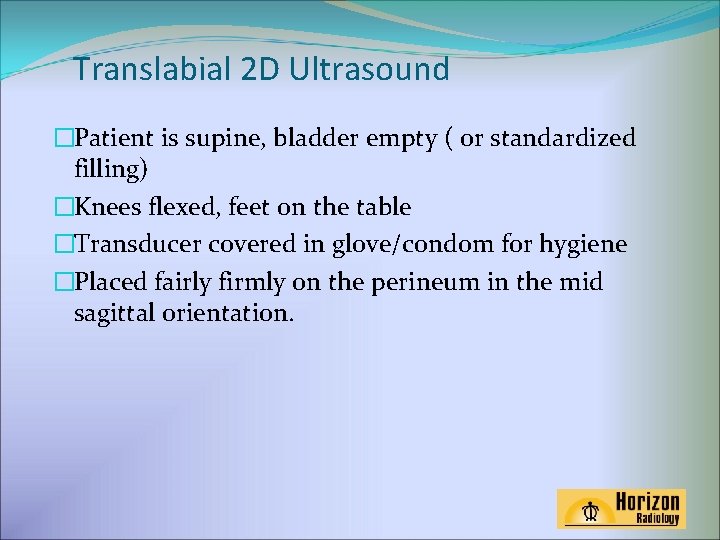
Translabial 2 D Ultrasound �Patient is supine, bladder empty ( or standardized filling) �Knees flexed, feet on the table �Transducer covered in glove/condom for hygiene �Placed fairly firmly on the perineum in the mid sagittal orientation.
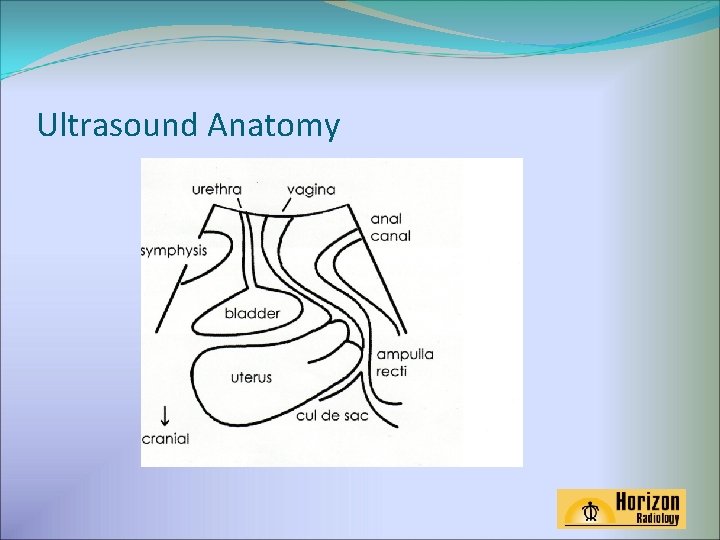
Ultrasound Anatomy
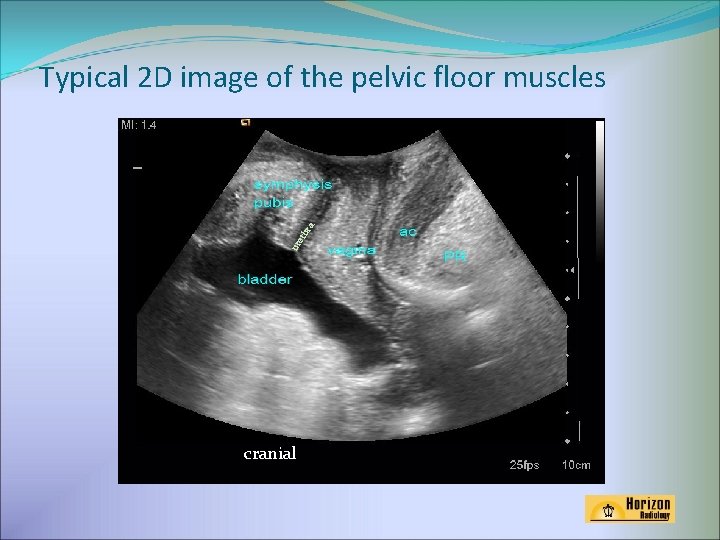
ur eth ra Typical 2 D image of the pelvic floor muscles cranial
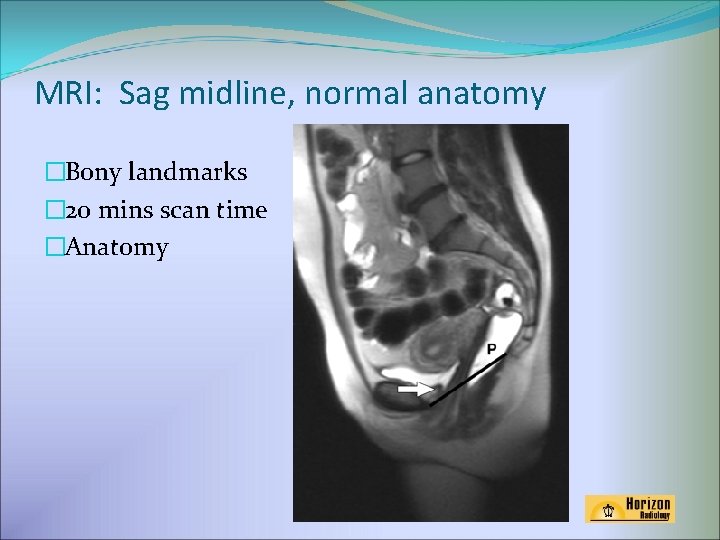
MRI: Sag midline, normal anatomy �Bony landmarks � 20 mins scan time �Anatomy
Pelvic floor functional assessment �Training �Contraction �Valsalva
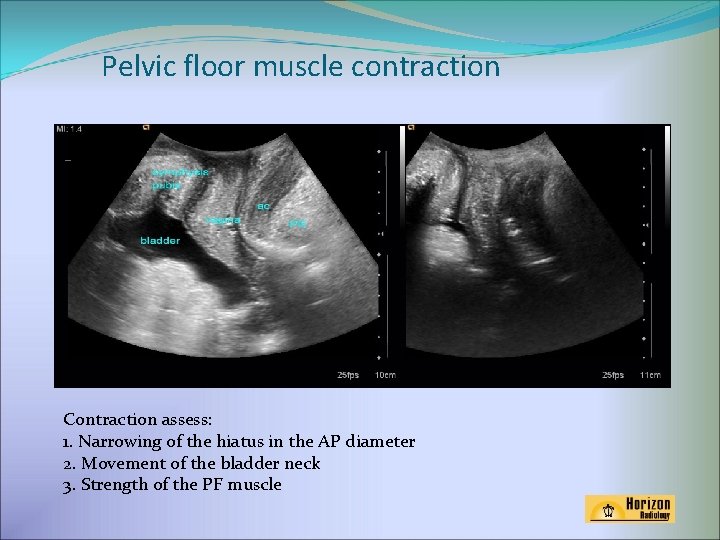
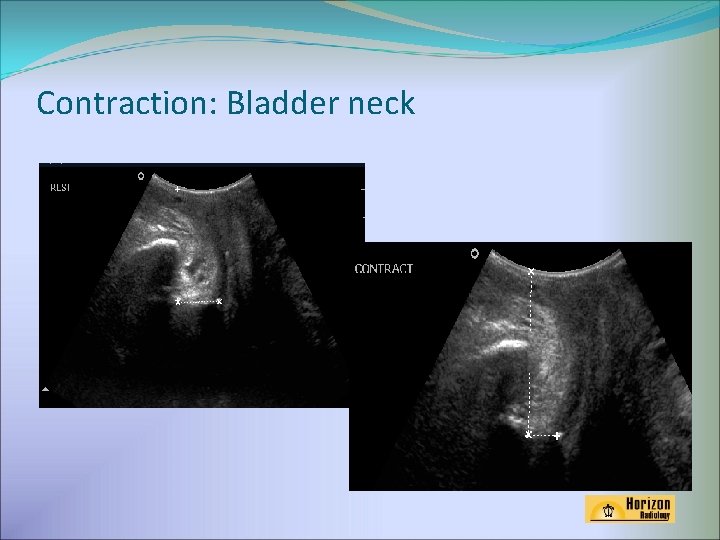
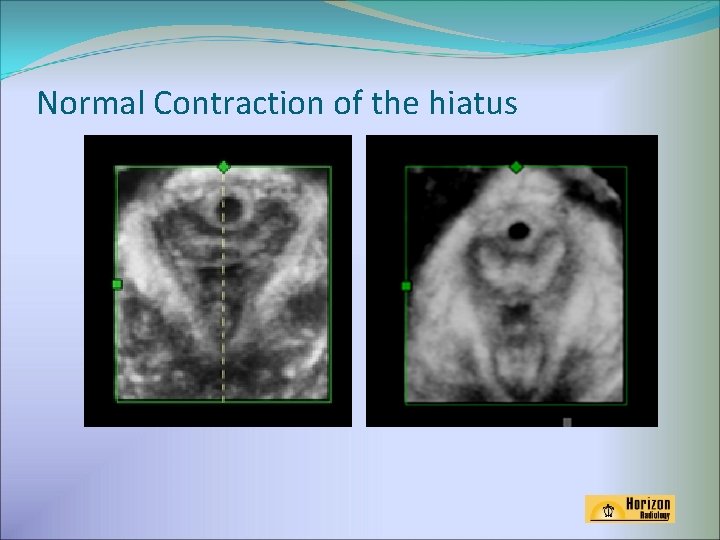
Pelvic floor muscle contraction Contraction assess: 1. Narrowing of the hiatus in the AP diameter 2. Movement of the bladder neck 3. Strength of the PF muscle
Contraction: Bladder neck
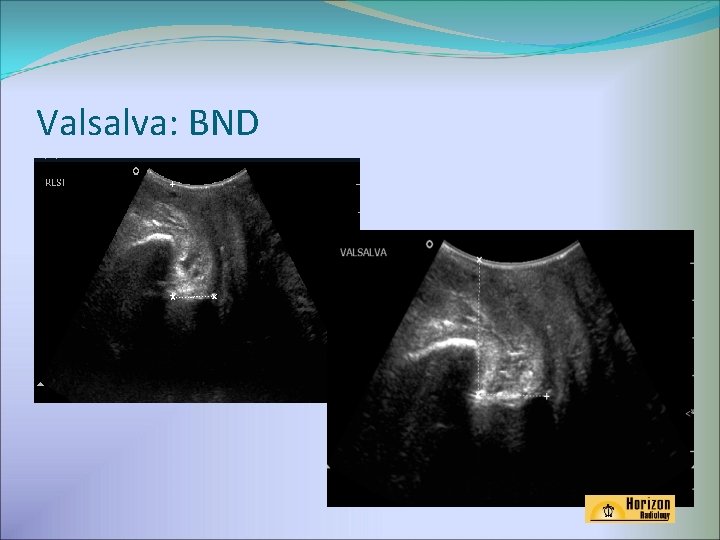
Valsalva: BND
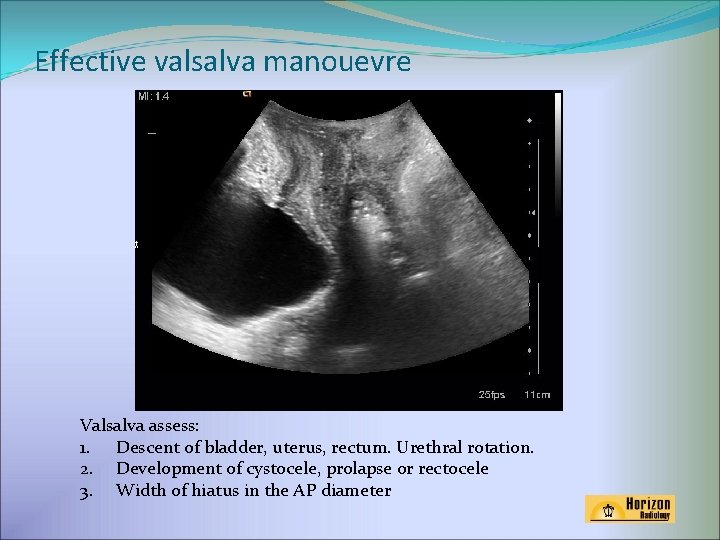
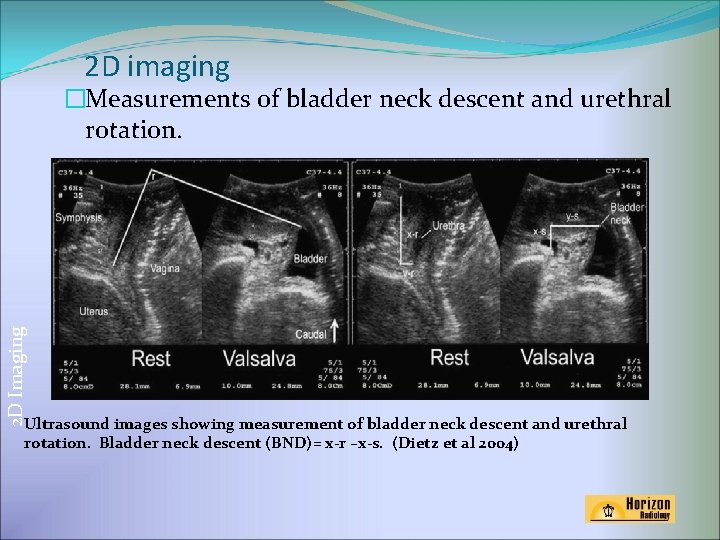
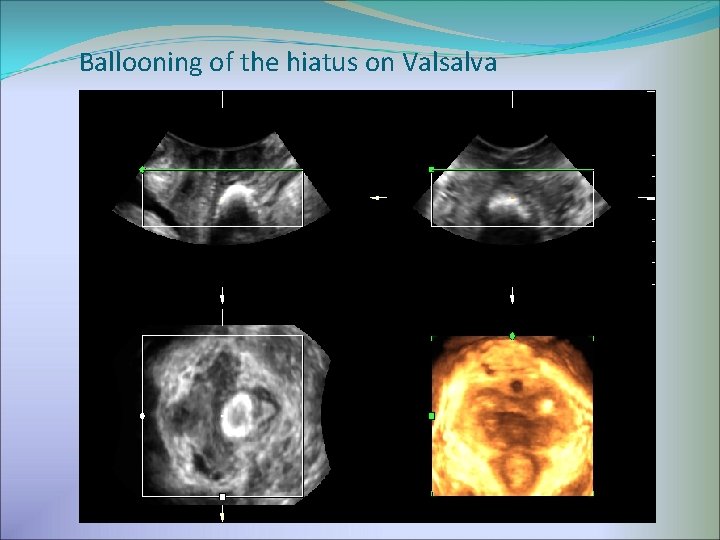
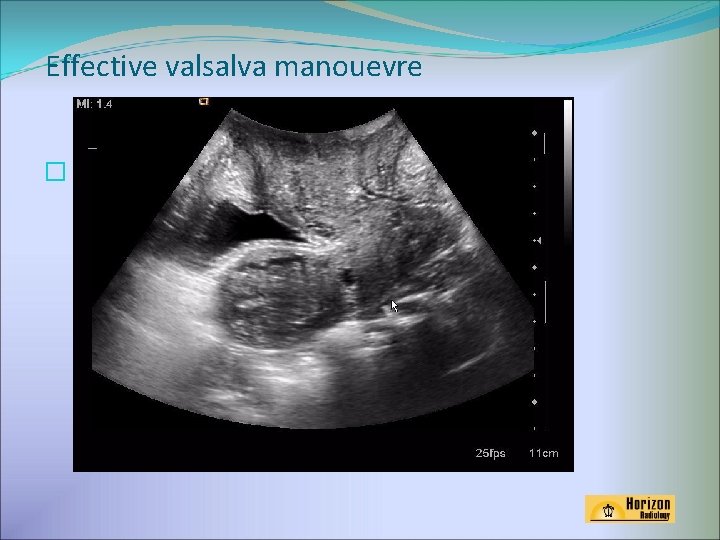
Effective valsalva manouevre Valsalva assess: 1. Descent of bladder, uterus, rectum. Urethral rotation. 2. Development of cystocele, prolapse or rectocele 3. Width of hiatus in the AP diameter
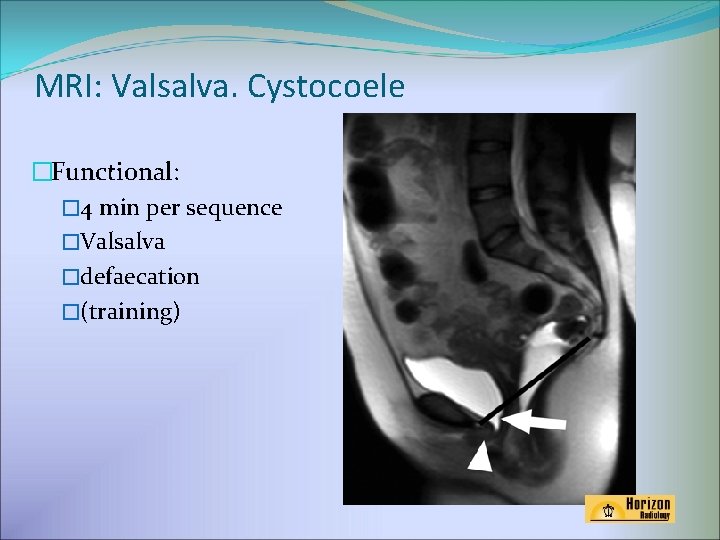
MRI: Valsalva. Cystocoele �Functional: � 4 min per sequence �Valsalva �defaecation �(training)
2 D imaging 2 D Imaging �Measurements of bladder neck descent and urethral rotation. Ultrasound images showing measurement of bladder neck descent and urethral rotation. Bladder neck descent (BND)= x-r –x-s. (Dietz et al 2004)
Clinical use of 2 D ultrasound �Still widely used �Bladder, uterine and rectal descent. � Bo, K. and M. Sherburn, Evaluation of female pelvic-floor muscle function and strength. Physical therapy, 2005. 85(3): p. 269 -82, Mar. � Abdominal ultrasound � Athanasiou, S. , et al. , Direct imaging of the pelvic floor muscles using twodimensional ultrasound: a comparison of women with urogenital prolapse versus controls. BJOG: An International Journal of Obstetrics and Gynaecology, 2007. 114(7): p. 882 -888. � Endovaginal probe � Costantini, S. , et al. , Perineal ultrasound evaluation of the urethrovesical junction angle and urethral mobility in nulliparous women and women following vaginal delivery. Int Urogynecol J Pelvic Floor Dysfunct, 2005. 16(6): p. 455 -9. � Transperineal ultrasound � Dietz, H. , Pelvic Floor Ultrasound. Current Medical Imaging Reviews, 2006. 2: p. 271 -290. � Dietz, H. , B. Haylen, and J. Broome, Ultrasound in the quantification of female pelvic organ prolapse. Ultrasound in Obstetrics and Gynecology, 2001. 18: p. 511
3 D ultrasound imaging � 3 D ultrasound widely used in obstetric scanning so equipment is now readily available � $100, 000 – $250, 000 �Acquisition of volume images allow access to the ‘axial’ plane – previously domain of magnetic resonance imaging.
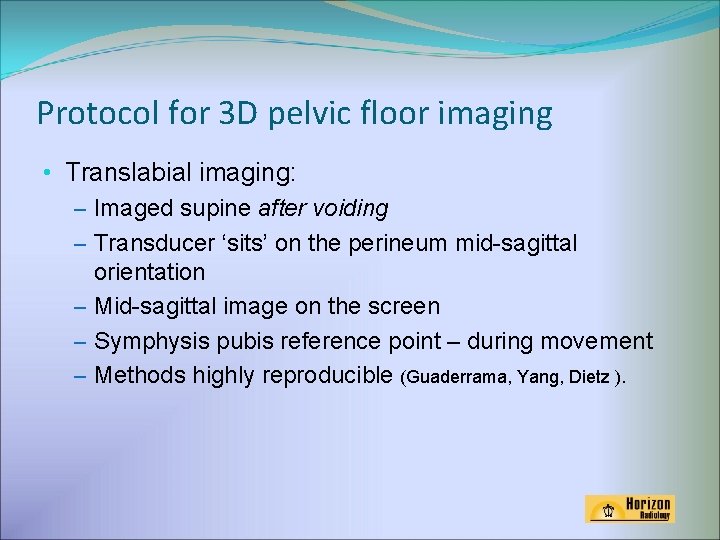
Protocol for 3 D pelvic floor imaging • Translabial imaging: – Imaged supine after voiding – Transducer ‘sits’ on the perineum mid-sagittal orientation – Mid-sagittal image on the screen – Symphysis pubis reference point – during movement – Methods highly reproducible (Guaderrama, Yang, Dietz ).
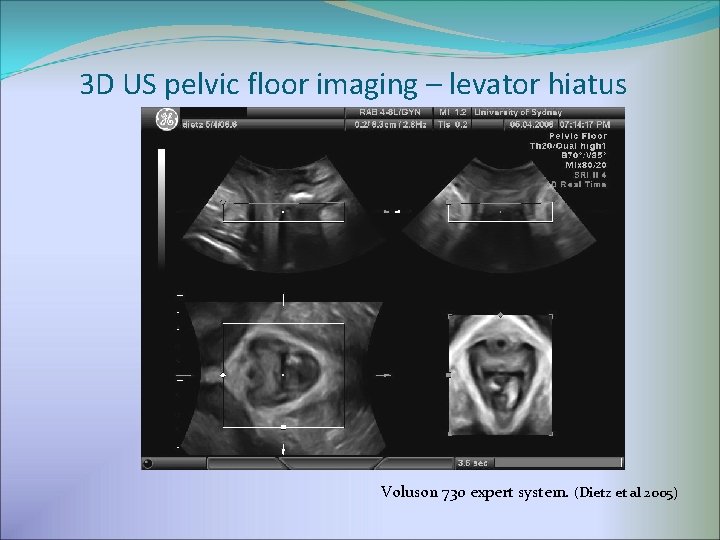
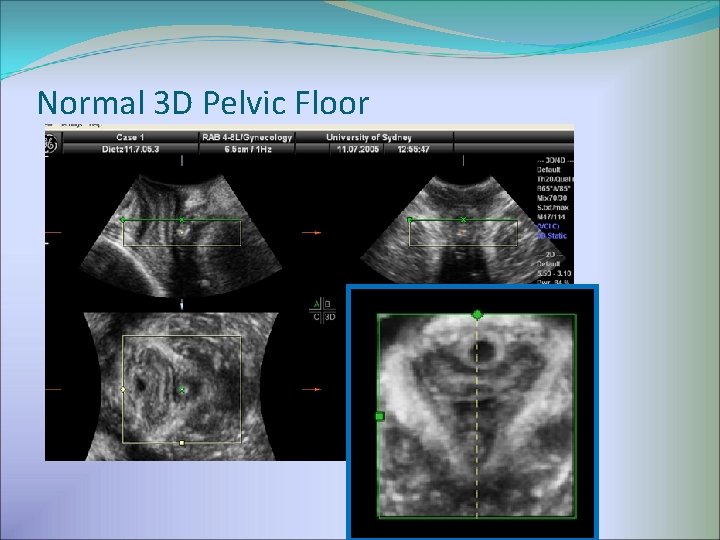
3 D US pelvic floor imaging – levator hiatus Voluson 730 expert system. (Dietz et al 2005)
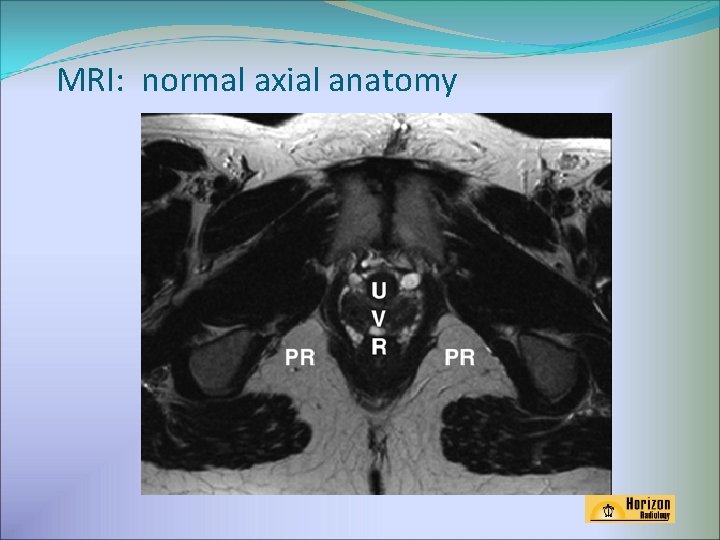
MRI: normal axial anatomy
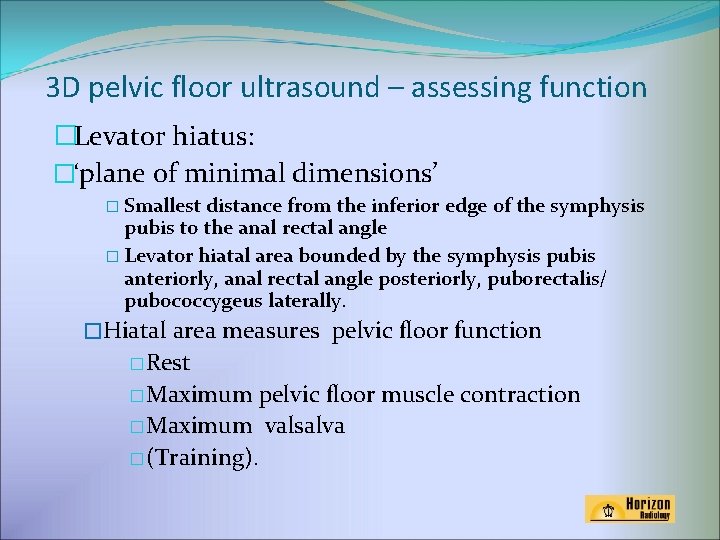
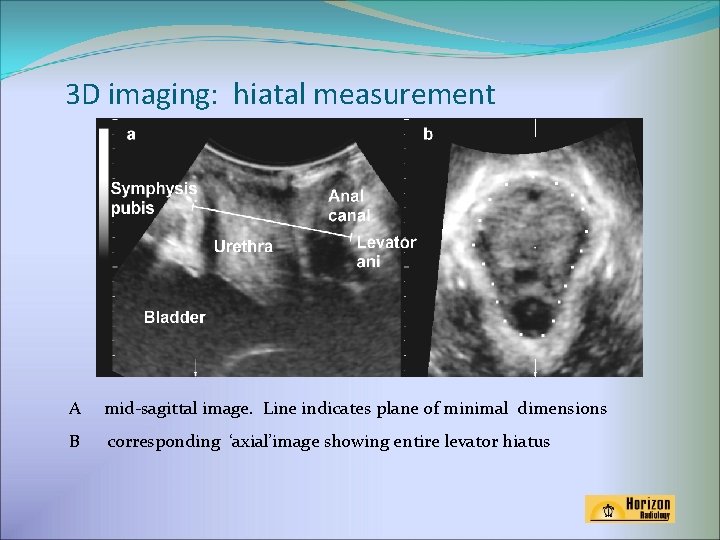
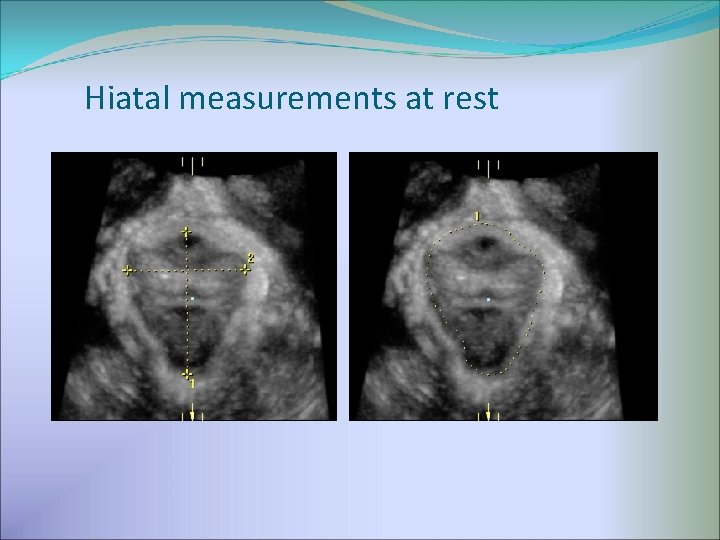
3 D pelvic floor ultrasound – assessing function �Levator hiatus: �‘plane of minimal dimensions’ � Smallest distance from the inferior edge of the symphysis pubis to the anal rectal angle � Levator hiatal area bounded by the symphysis pubis anteriorly, anal rectal angle posteriorly, puborectalis/ pubococcygeus laterally. �Hiatal area measures pelvic floor function �Rest �Maximum pelvic floor muscle contraction �Maximum valsalva �(Training).
Normal 3 D Pelvic Floor
3 D imaging: hiatal measurement A mid-sagittal image. Line indicates plane of minimal dimensions B corresponding ‘axial’image showing entire levator hiatus
Normal Contraction of the hiatus
Ballooning of the hiatus on Valsalva
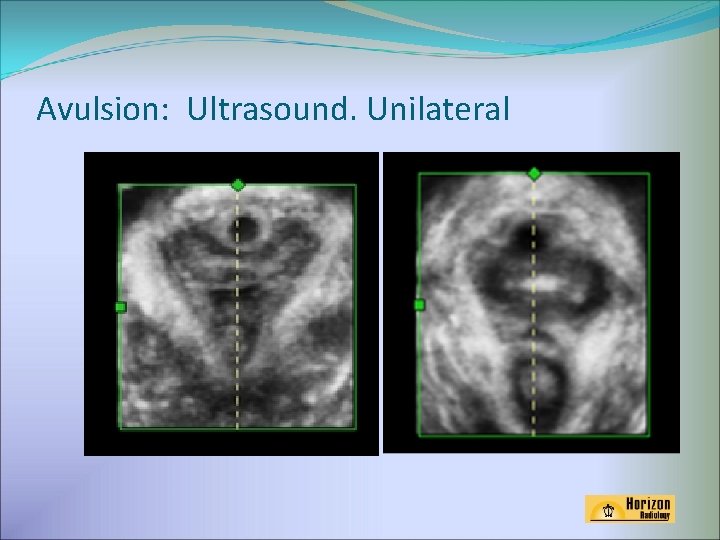
Avulsion: Ultrasound. Unilateral
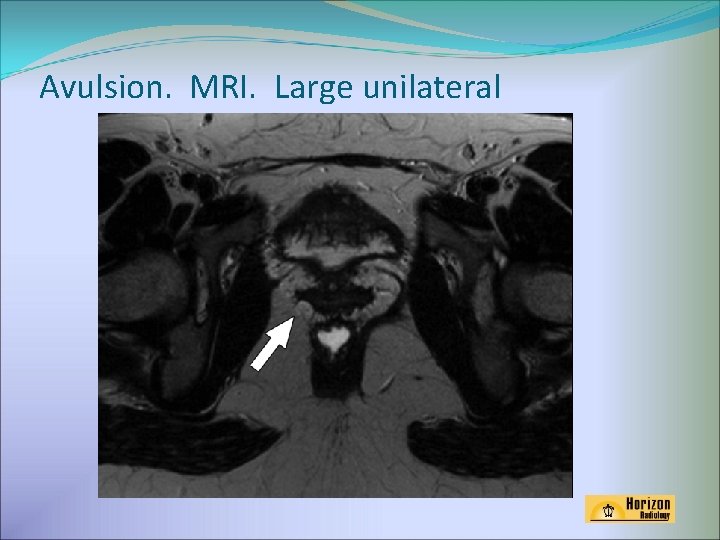
Avulsion. MRI. Large unilateral
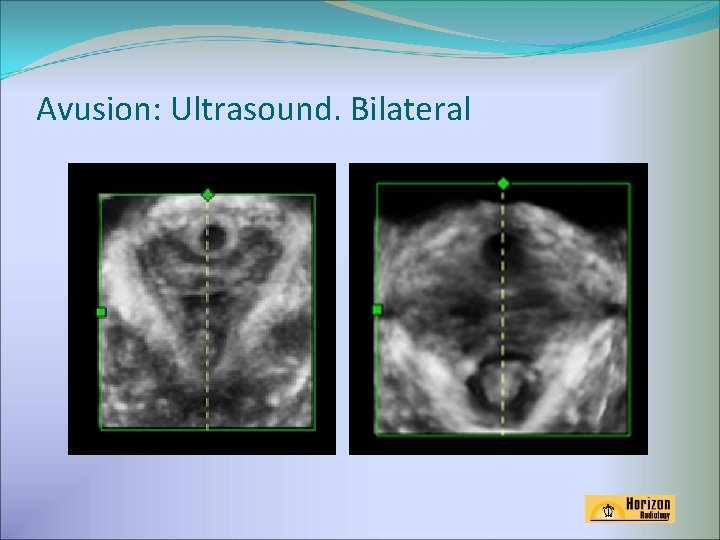
Avusion: Ultrasound. Bilateral
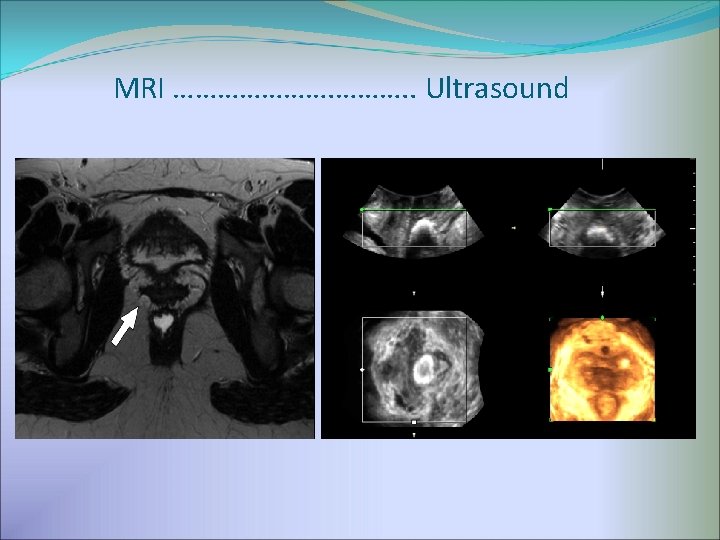
MRI …………………. . Ultrasound
Conclusions �Translabial ultrasound 2 D / 3 D /4 D �Function and anatomy � effective, easy, low cost method for assessment of the PF � Used to confirm/or not the digital diagnosis of PF dysfunction �Biofeedback training �MRI �Anatomy (and function)
Effective valsalva manouevre �
Hiatal measurements at rest