
Imaging of fragmented fireball and in noncentral collisions
Imaging of fragmented fireball and in non-central collisions Boris Tomášik Univerzita Mateja Bela, Banská Bystrica, Slovakia Czech Technical University, Prague, Czech Republic in collaboration with Paul Chung Nuclear Physics Institute ASCR, Řež/Prague, Czech Republic 5 th Workshop on Particle Correlations and Femtoscopy October 16, 2009 1
Fragmentation at the phase transition Possible at non-equilibrium phase transition spinodal decomposition at the first order phase transition bulk viscosity driven at the crossover - hadrons are emitted from droplets of hot matter - from this argument it is not clear whether hadrons reinteract after emission 2

Spinodal decomposition First order phase transition ry : ion jecto ns pa tra ex m w riu slo uilib eq ion ans may be relevant for nuclear collisions observed in multifragmentation exp Scenario possible if nucleation rate < expansion rate fast Rapid passage through the phase transition leads to spinodal decomposition (known also in classical physics) Example: van der Waals isotherm p spinodal V 3
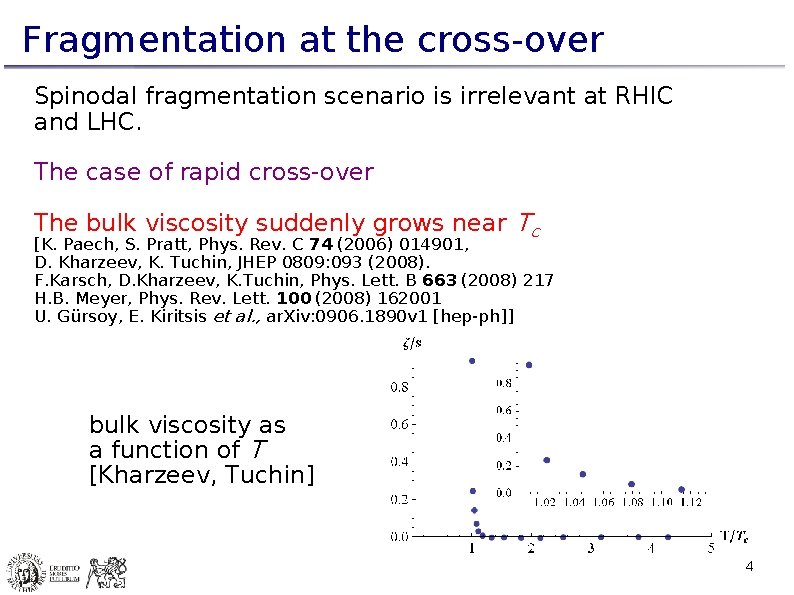
Fragmentation at the cross-over Spinodal fragmentation scenario is irrelevant at RHIC and LHC. The case of rapid cross-over The bulk viscosity suddenly grows near Tc [K. Paech, S. Pratt, Phys. Rev. C 74 (2006) 014901, D. Kharzeev, K. Tuchin, JHEP 0809: 093 (2008). F. Karsch, D. Kharzeev, K. Tuchin, Phys. Lett. B 663 (2008) 217 H. B. Meyer, Phys. Rev. Lett. 100 (2008) 162001 U. Gürsoy, E. Kiritsis et al. , ar. Xiv: 0906. 1890 v 1 [hep-ph]] bulk viscosity as a function of T [Kharzeev, Tuchin] 4
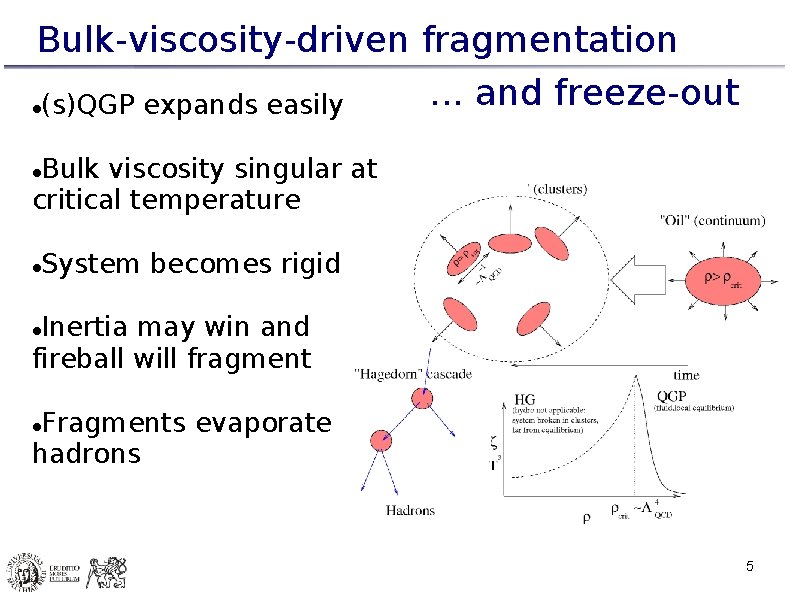
Bulk-viscosity-driven fragmentation. . . and freeze-out (s)QGP expands easily Bulk viscosity singular at critical temperature System becomes rigid Inertia may win and fireball will fragment Fragments evaporate hadrons 5
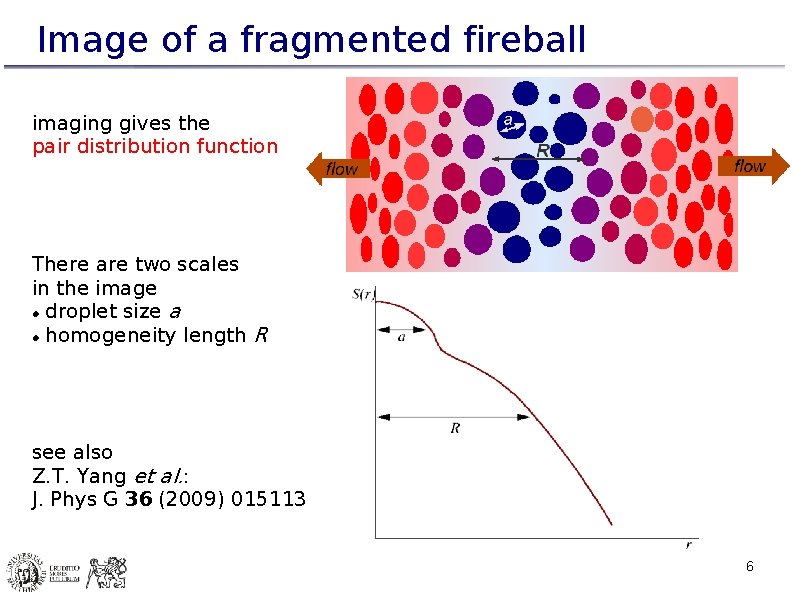
Image of a fragmented fireball imaging gives the pair distribution function There are two scales in the image droplet size a homogeneity length R see also Z. T. Yang et al. : J. Phys G 36 (2009) 015113 6
The tool: DRAGON DRoplet and h. Adron Generat. Or for Nuclear collisions MC generator of (momenta and positions of) particles [BT: Computer Physics Communications 180 (2009) 1642, ar. Xiv: 0806. 4770 [nucl-th]] some particles are emitted from droplets and some directly if no droplet formation is assumed, then similar to THERMINATOR droplets are generated from a blast-wave source (tunable parameters) also non-central fireballs: asymmetry in transverse flow and shape chemical composition: equilibrium resonance decays included tunable size of droplets: Gamma-distributed or fixed droplets decay exponentially in time (tunable time) rapidity distribution: uniform or Gaussian possible OSCAR output 7
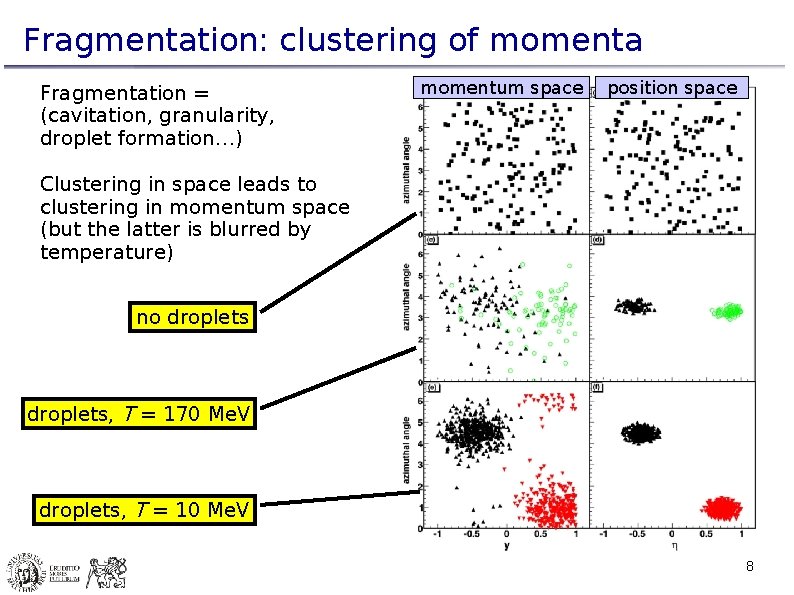
Fragmentation: clustering of momenta Fragmentation = (cavitation, granularity, droplet formation…) momentum space position space Clustering in space leads to clustering in momentum space (but the latter is blurred by temperature) no droplets, T = 170 Me. V droplets, T = 10 Me. V 8
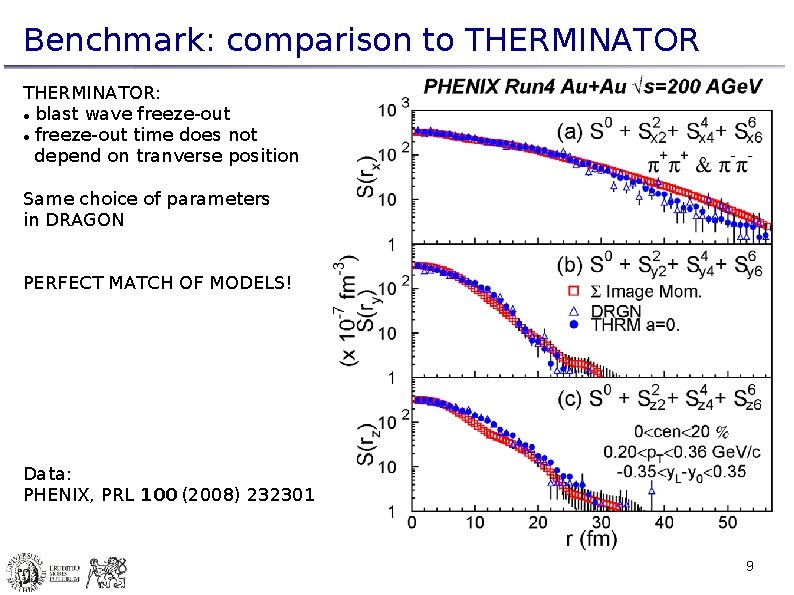
Benchmark: comparison to THERMINATOR: blast wave freeze-out time does not depend on tranverse position Same choice of parameters in DRAGON PERFECT MATCH OF MODELS! Data: PHENIX, PRL 100 (2008) 232301 9
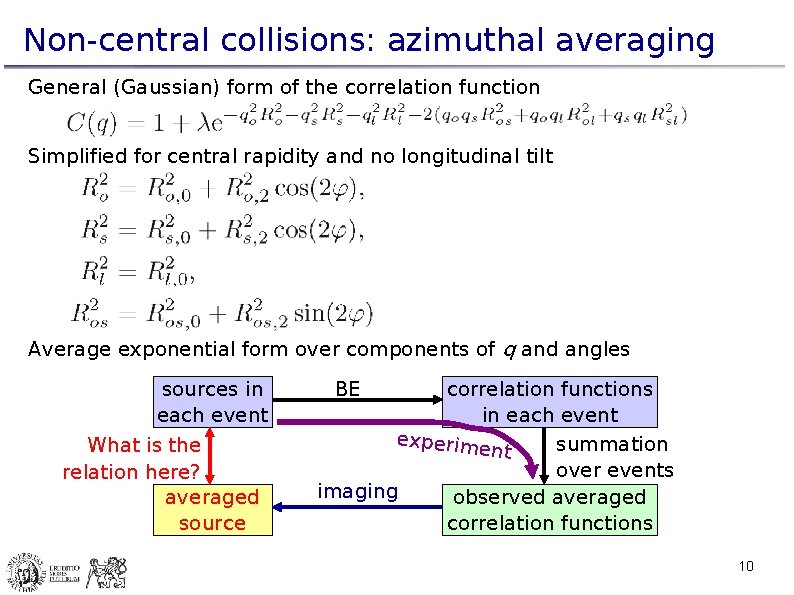
Non-central collisions: azimuthal averaging General (Gaussian) form of the correlation function Simplified for central rapidity and no longitudinal tilt Average exponential form over components of q and angles sources in each event What is the relation here? averaged source BE correlation functions in each event experim summation ent over events imaging observed averaged correlation functions 10
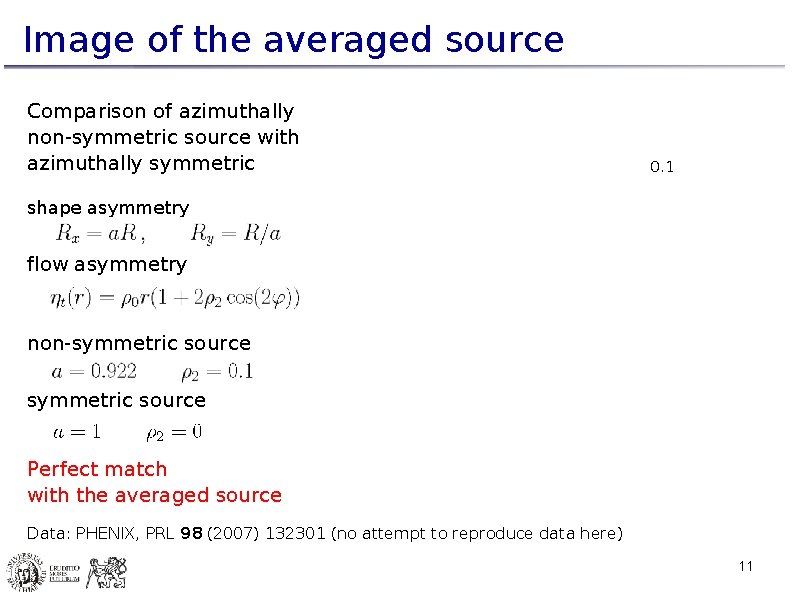
Image of the averaged source Comparison of azimuthally non-symmetric source with azimuthally symmetric 0. 1 shape asymmetry flow asymmetry non-symmetric source Perfect match with the averaged source Data: PHENIX, PRL 98 (2007) 132301 (no attempt to reproduce data here) 11
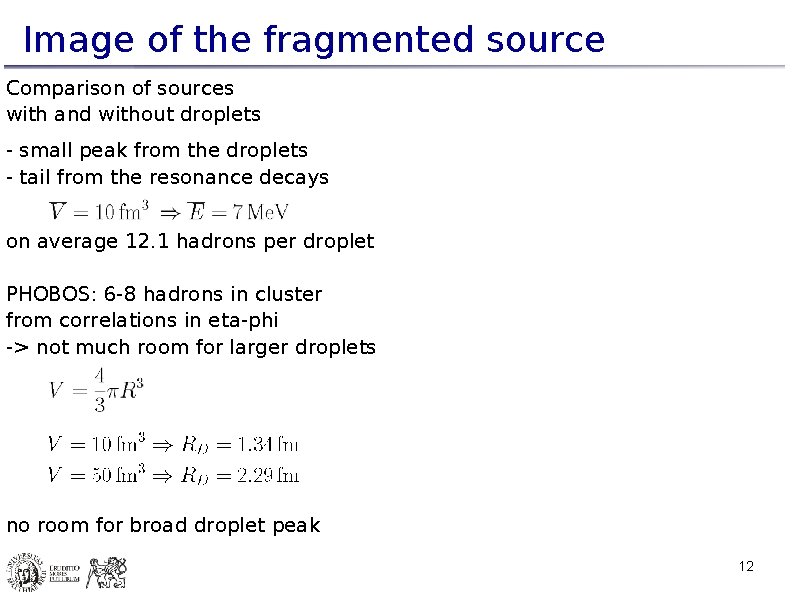
Image of the fragmented source Comparison of sources with and without droplets - small peak from the droplets - tail from the resonance decays on average 12. 1 hadrons per droplet PHOBOS: 6 -8 hadrons in cluster from correlations in eta-phi -> not much room for larger droplets no room for broad droplet peak 12
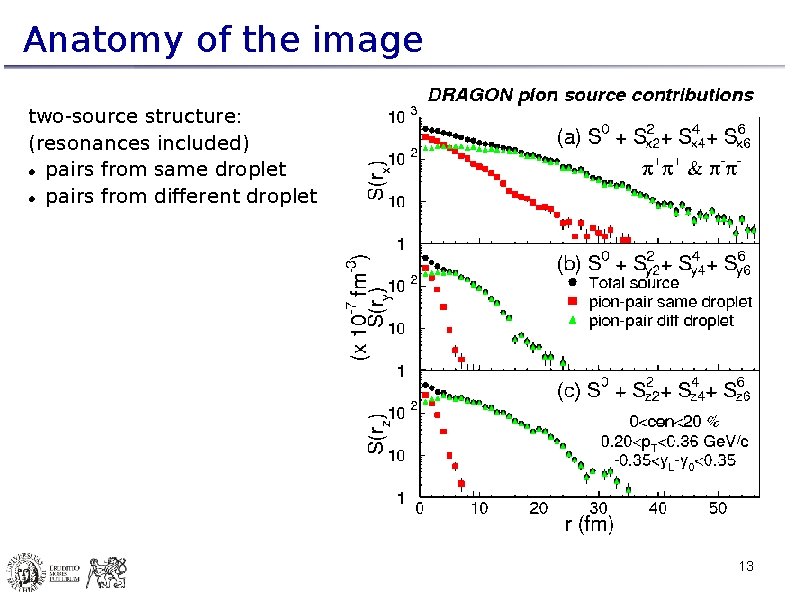
Anatomy of the image two-source structure: (resonances included) pairs from same droplet pairs from different droplet 13
Summary Fragmentation is a realistic scenario for heavy ion collisions A tool for generating the final state: DRAGON Azimuthal averaging yields the source with (geometric) mean size and no azimuthal flow variation Droplets lead to small peak at r = 0 Are there any droplets seen in data? Is there rescattering after fragmentation? Is the fireball shape different than tested here? 14
- Slides: 14