
Imaging cryogenic detectors for space based astronomy J
Imaging cryogenic detectors for space based astronomy J. van der Kuur 1, L. Gottardi 2, H. Akamatsu 2, P. Khosropanah 2, R. den Hartog 2, R. Hijmering 2, D. Audley 2, B. Jackson 1 1) SRON Netherlands Institute for Space Research, Landleven 12, 9747 AD Groningen 2) SRON Netherlands Institute for Space Research, Sorbonnelaan 2, 3584 CA Utrecht
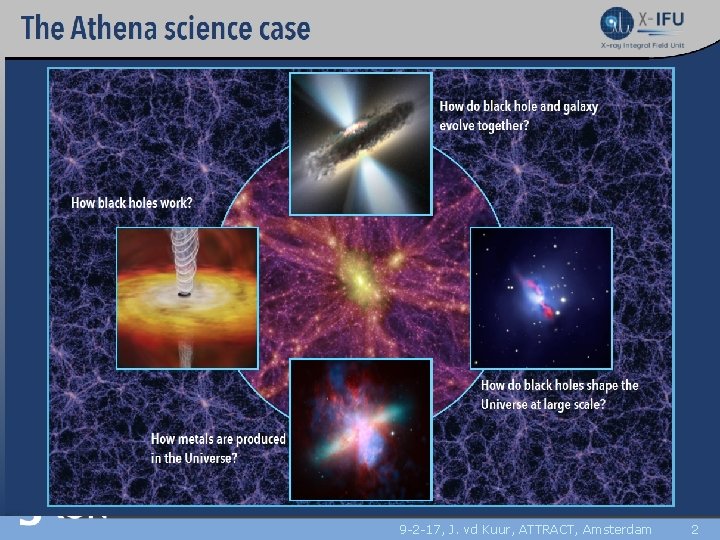
9 -2 -17, J. vd Kuur, ATTRACT, Amsterdam 2
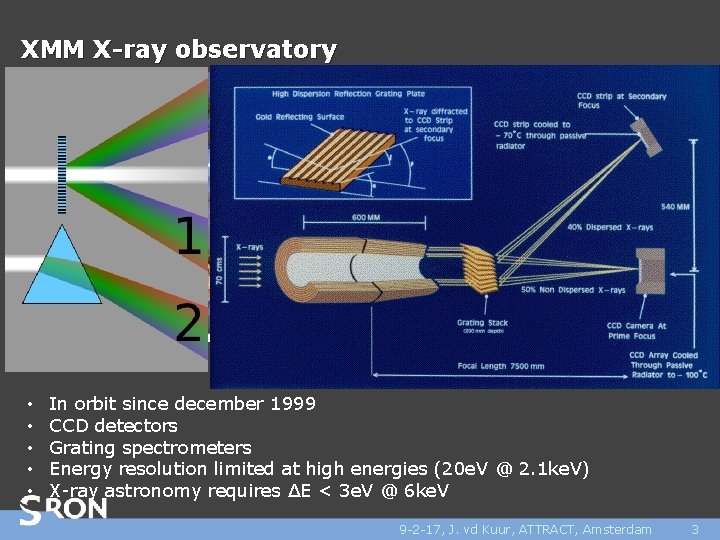
XMM X-ray observatory • • • In orbit since december 1999 CCD detectors Grating spectrometers Energy resolution limited at high energies (20 e. V @ 2. 1 ke. V) X-ray astronomy requires ΔE < 3 e. V @ 6 ke. V 9 -2 -17, J. vd Kuur, ATTRACT, Amsterdam 3
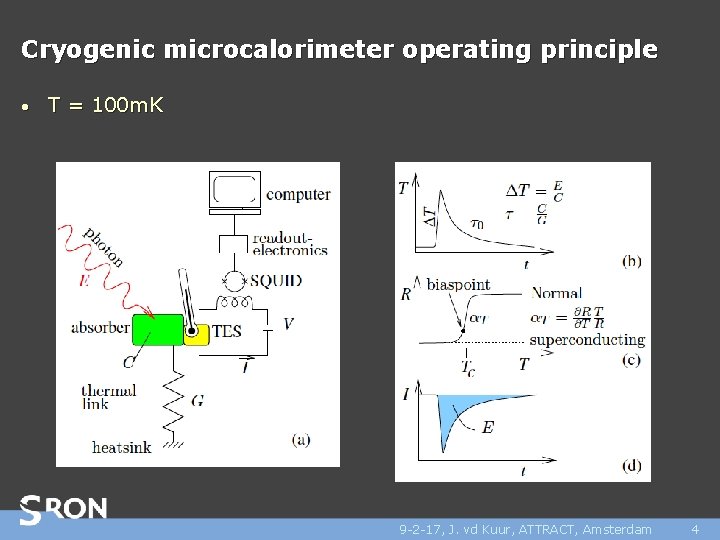
Cryogenic microcalorimeter operating principle • T = 100 m. K 9 -2 -17, J. vd Kuur, ATTRACT, Amsterdam 4
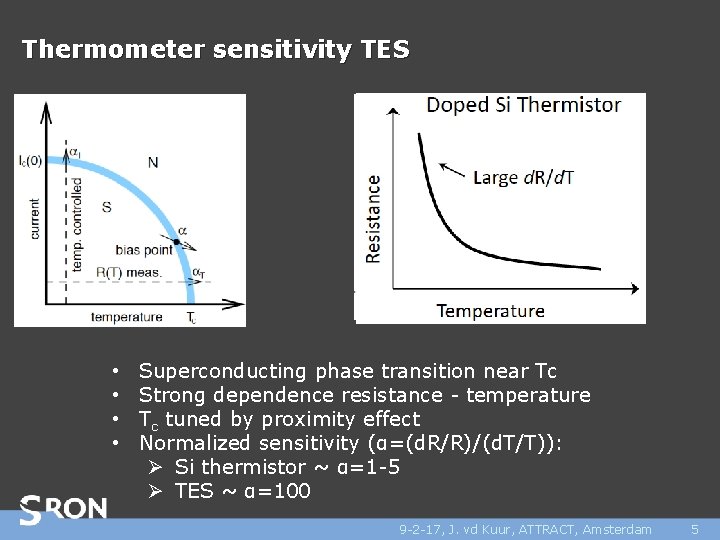
Thermometer sensitivity TES • • Superconducting phase transition near Tc Strong dependence resistance - temperature Tc tuned by proximity effect Normalized sensitivity (α=(d. R/R)/(d. T/T)): Ø Si thermistor ~ α=1 -5 Ø TES ~ α=100 9 -2 -17, J. vd Kuur, ATTRACT, Amsterdam 5
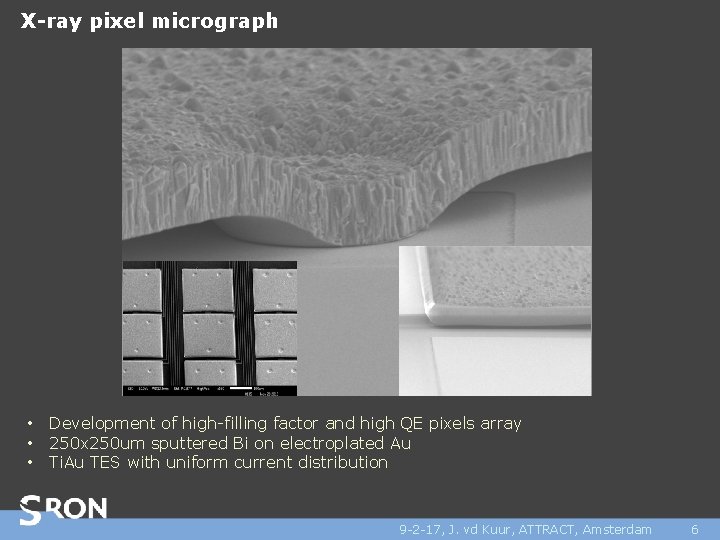
X-ray pixel micrograph • • • Development of high-filling factor and high QE pixels array 250 x 250 um sputtered Bi on electroplated Au Ti. Au TES with uniform current distribution 9 -2 -17, J. vd Kuur, ATTRACT, Amsterdam 6
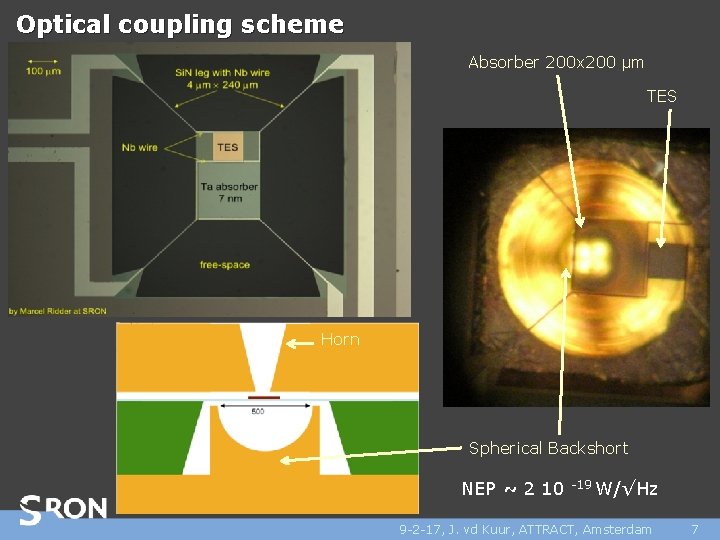
Optical coupling scheme Absorber 200 x 200 μm TES Horn Spherical Backshort NEP ~ 2 10 -19 W/√Hz 9 -2 -17, J. vd Kuur, ATTRACT, Amsterdam 7
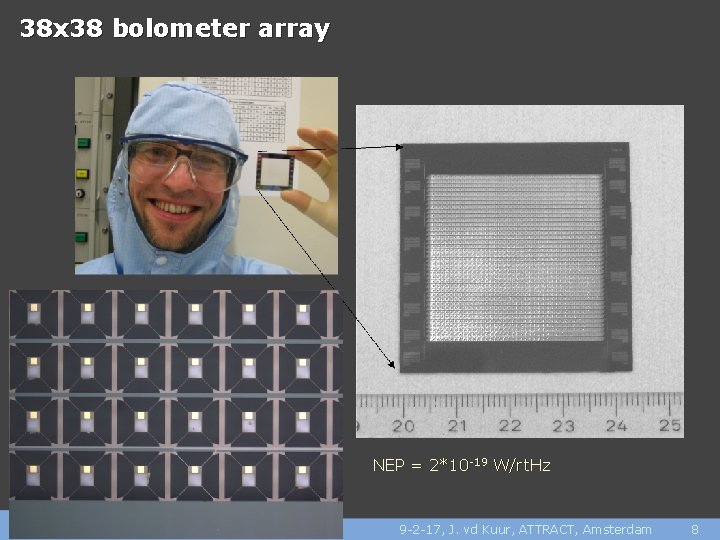
38 x 38 bolometer array NEP = 2*10 -19 W/rt. Hz 9 -2 -17, J. vd Kuur, ATTRACT, Amsterdam 8
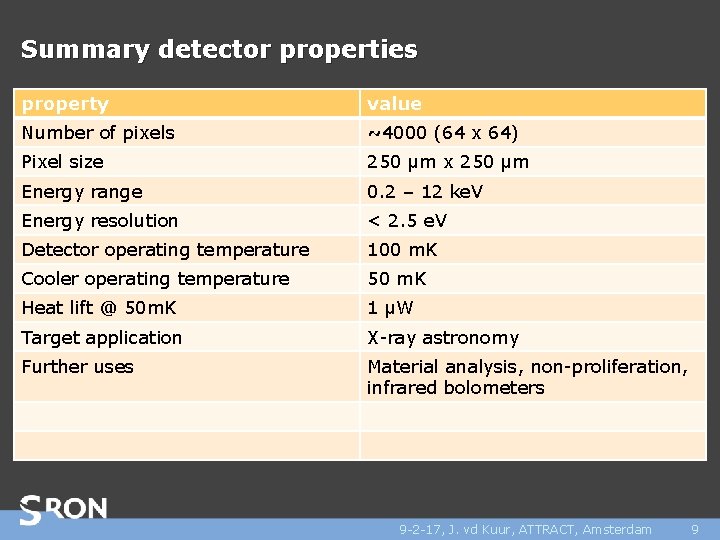
Summary detector properties property value Number of pixels ~4000 (64 x 64) Pixel size 250 μm x 250 μm Energy range 0. 2 – 12 ke. V Energy resolution < 2. 5 e. V Detector operating temperature 100 m. K Cooler operating temperature 50 m. K Heat lift @ 50 m. K 1 μW Target application X-ray astronomy Further uses Material analysis, non-proliferation, infrared bolometers 9 -2 -17, J. vd Kuur, ATTRACT, Amsterdam 9

Thank you 9 -2 -17, J. vd Kuur, ATTRACT, Amsterdam 10
- Slides: 10