
Imaging Cosmic Dawn The Atacama Large Millimeter Array

- Slides: 50
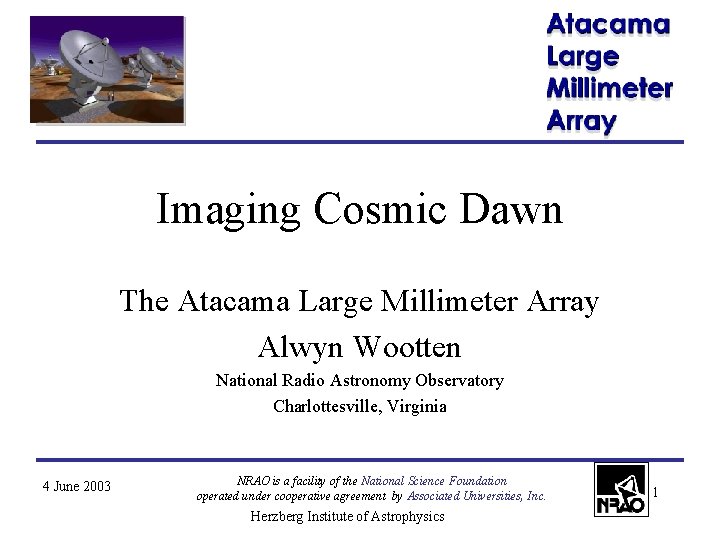
Imaging Cosmic Dawn The Atacama Large Millimeter Array Alwyn Wootten National Radio Astronomy Observatory Charlottesville, Virginia 4 June 2003 NRAO is a facility of the National Science Foundation operated under cooperative agreement by Associated Universities, Inc. Herzberg Institute of Astrophysics 1
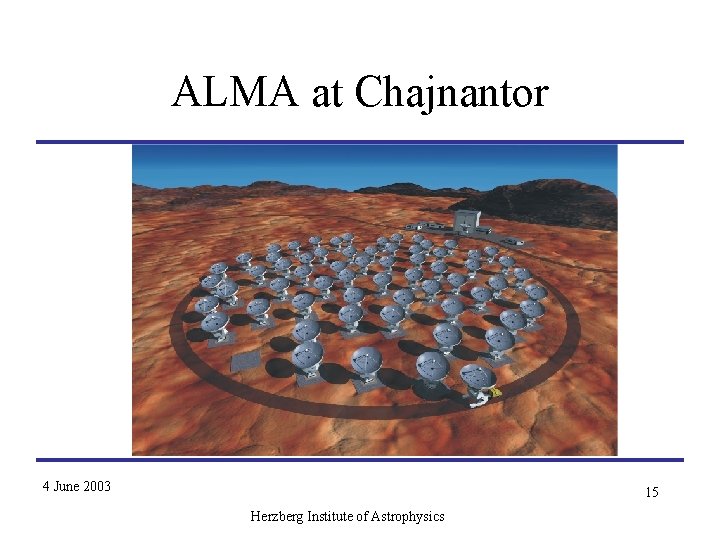
Atacama Large Millimeter Array A project of the National Science Foundation through Associated Universities, Inc. and the National Radio Astronomy Observatory, Caltech, Berkeley, Illinois and Maryland in cooperation with the National Research Council of Canada, and the European Southern Observatory and its partners The Centre National de la Recherche Scientifique (CNRS), France; Max Planck Gesellschaft (MPG), Germany; The Netherlands Foundation for Research in Astronomy, (NFRA); Nederlandse Onderzoekschool Voor Astronomie, (NOVA); The United Kingdom Particle Physics and Astronomy Research Council, (PPARC); The Swedish Natural Science Research Council, (NFR); and the Ministry de Ciencia y Tecnologia and Instituto Geografico Nacional (IGN, )(Spain). The Science Ministry of Japan (MEXT) through the National Astronomical Observatory of Japan participates in an affiliated role. CONICYT Chile participates through holding the concession on the land its seat on the ALMA Board • • ECC The Atacama Large Millimeter Array, or ALMA, is an array of precision engineered antennas each 12 meters in diameter which will work together to make detailed images of astronomical objects. The scope of the ALMA Project is an array of 64 antennas that can be positioned as needed over an area up to 14 kilometers in diameter so as to give the array a zoom-lens capability, with resolution reaching 10 milliarcseconds. The faintest millimeter/submillimeter source yet detected shines at about 1 m. Jy; ALMA will reach this sensitivity in seconds. ALMA's great sensitivity and resolution make it ideal for medium scale deep investigations of the structure of the submillimeter sky. ALMA has been endorsed as the highest priority project for the next decade by the astronomical communities of the United States, Canada, the United Kingdom, France, the Netherlands and Japan (the latter as LMSA). Al Wootten, ALMA/US Project Scientist 4 June 2003 2 Herzberg Institute of Astrophysics
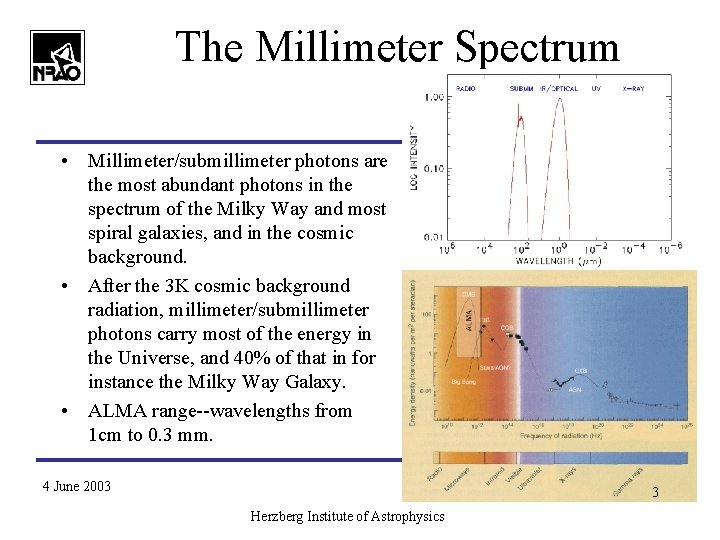
The Millimeter Spectrum • Millimeter/submillimeter photons are the most abundant photons in the spectrum of the Milky Way and most spiral galaxies, and in the cosmic background. • After the 3 K cosmic background radiation, millimeter/submillimeter photons carry most of the energy in the Universe, and 40% of that in for instance the Milky Way Galaxy. • ALMA range--wavelengths from 1 cm to 0. 3 mm. 4 June 2003 3 Herzberg Institute of Astrophysics
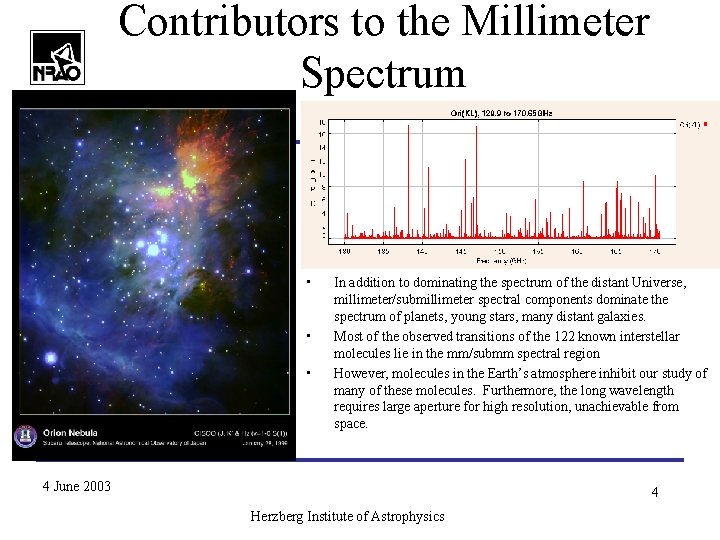
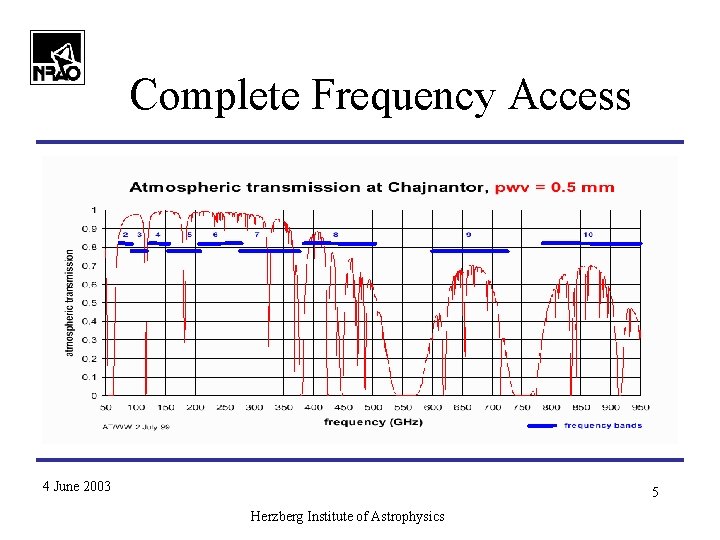
Contributors to the Millimeter Spectrum • • • In addition to dominating the spectrum of the distant Universe, millimeter/submillimeter spectral components dominate the spectrum of planets, young stars, many distant galaxies. Most of the observed transitions of the 122 known interstellar molecules lie in the mm/submm spectral region However, molecules in the Earth’s atmosphere inhibit our study of many of these molecules. Furthermore, the long wavelength requires large aperture for high resolution, unachievable from space. 4 June 2003 4 Herzberg Institute of Astrophysics
Complete Frequency Access 4 June 2003 5 Herzberg Institute of Astrophysics
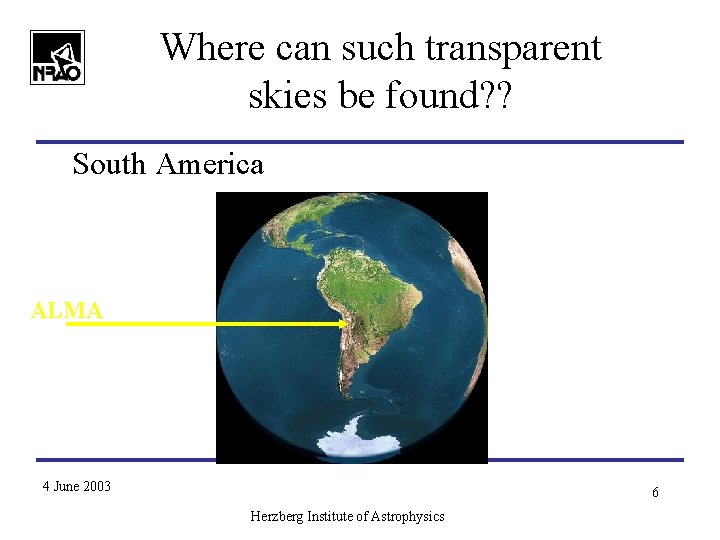
Where can such transparent skies be found? ? South America ALMA 4 June 2003 6 Herzberg Institute of Astrophysics Living Earth
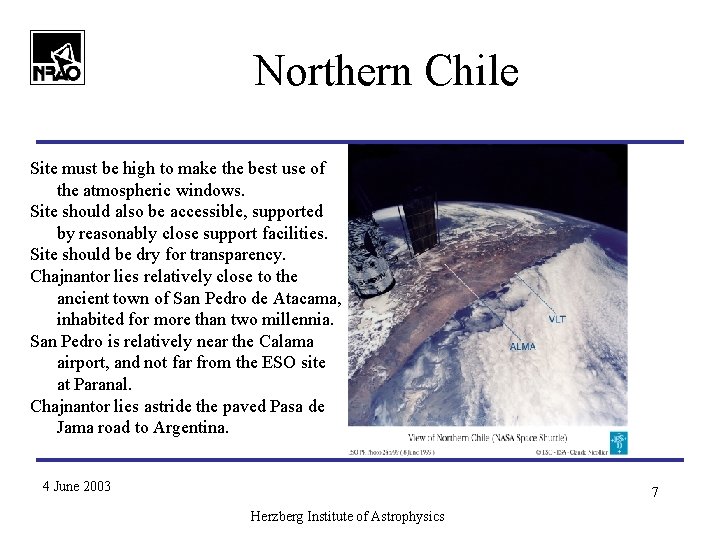
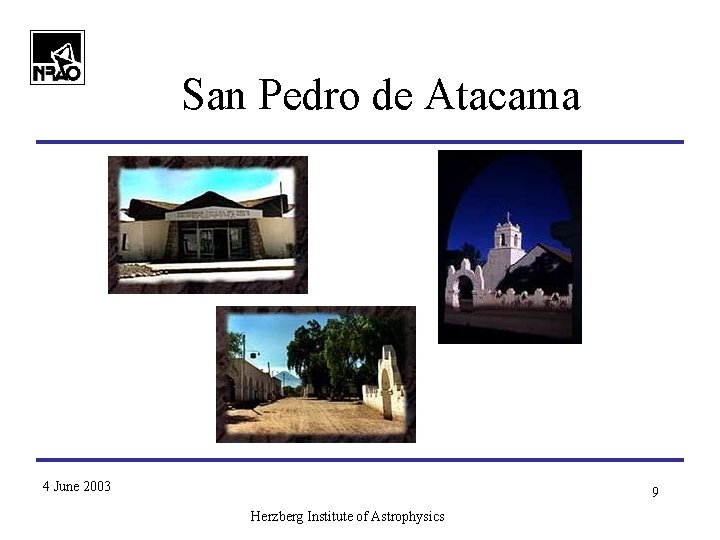
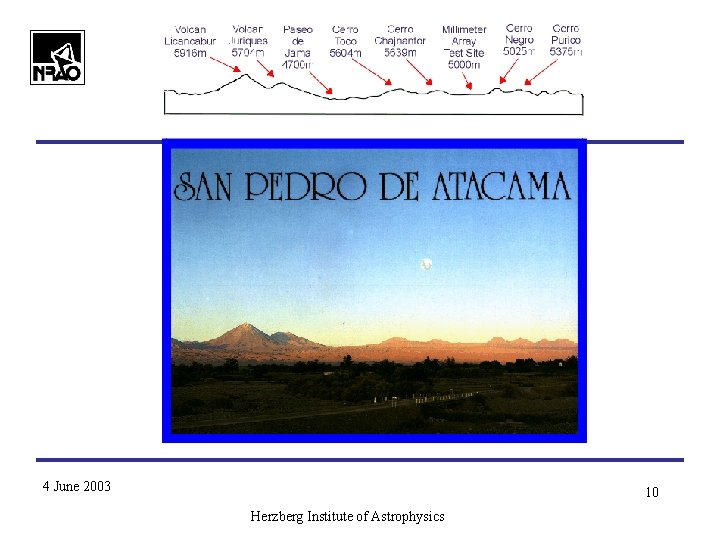
Northern Chile Site must be high to make the best use of the atmospheric windows. Site should also be accessible, supported by reasonably close support facilities. Site should be dry for transparency. Chajnantor lies relatively close to the ancient town of San Pedro de Atacama, inhabited for more than two millennia. San Pedro is relatively near the Calama airport, and not far from the ESO site at Paranal. Chajnantor lies astride the paved Pasa de Jama road to Argentina. 4 June 2003 7 Herzberg Institute of Astrophysics
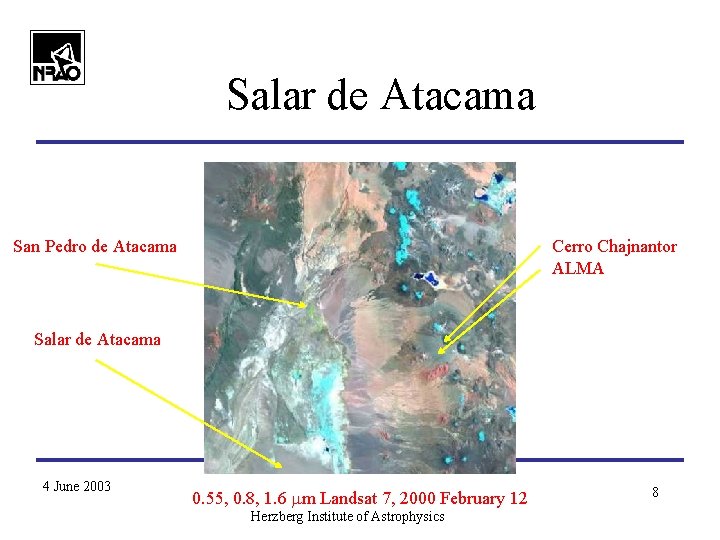
Salar de Atacama San Pedro de Atacama Cerro Chajnantor ALMA Salar de Atacama 4 June 2003 0. 55, 0. 8, 1. 6 mm Landsat 7, 2000 February 12 Herzberg Institute of Astrophysics 8 NASA/GSFC
San Pedro de Atacama 4 June 2003 9 Herzberg Institute of Astrophysics Hostaria San Pedro Casa de Don Tómas
4 June 2003 10 Herzberg Institute of Astrophysics
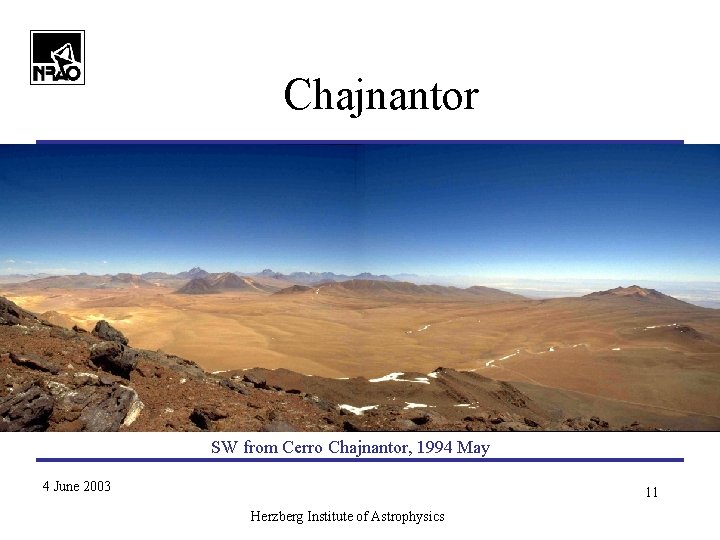
Chajnantor SW from Cerro Chajnantor, 1994 May 4 June 2003 AUI/NRAO S. Radford 11 Herzberg Institute of Astrophysics
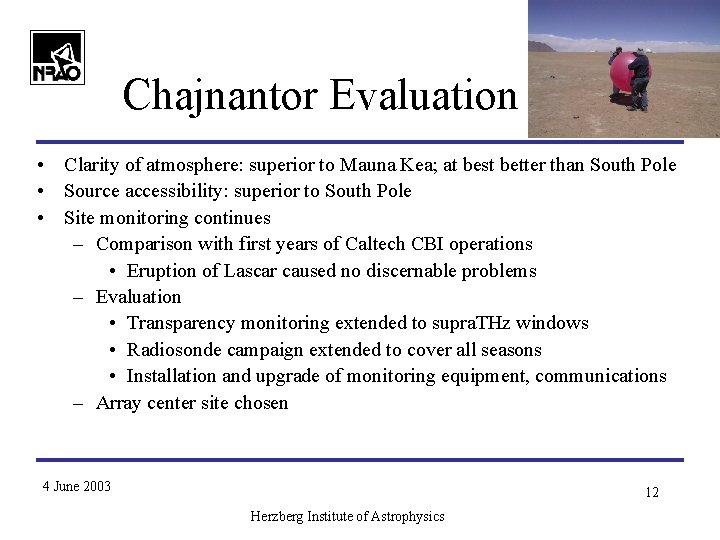
Chajnantor Evaluation • Clarity of atmosphere: superior to Mauna Kea; at best better than South Pole • Source accessibility: superior to South Pole • Site monitoring continues – Comparison with first years of Caltech CBI operations • Eruption of Lascar caused no discernable problems – Evaluation • Transparency monitoring extended to supra. THz windows • Radiosonde campaign extended to cover all seasons • Installation and upgrade of monitoring equipment, communications – Array center site chosen 4 June 2003 12 Herzberg Institute of Astrophysics
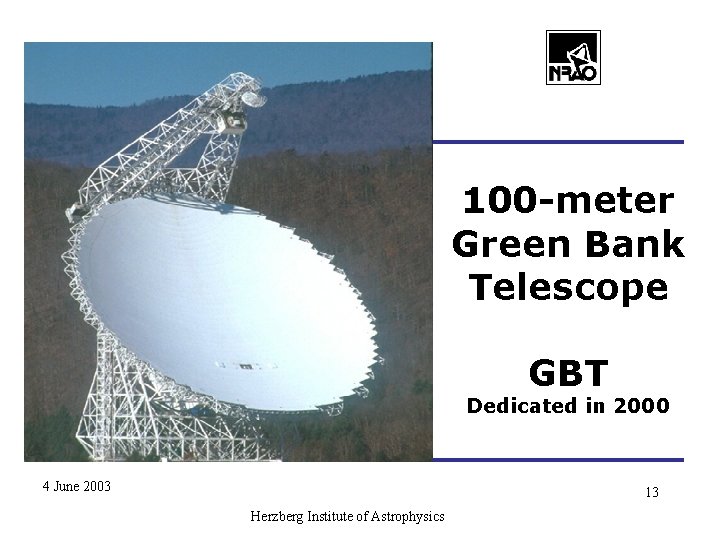
100 -meter Green Bank Telescope GBT Dedicated in 2000 4 June 2003 13 Herzberg Institute of Astrophysics
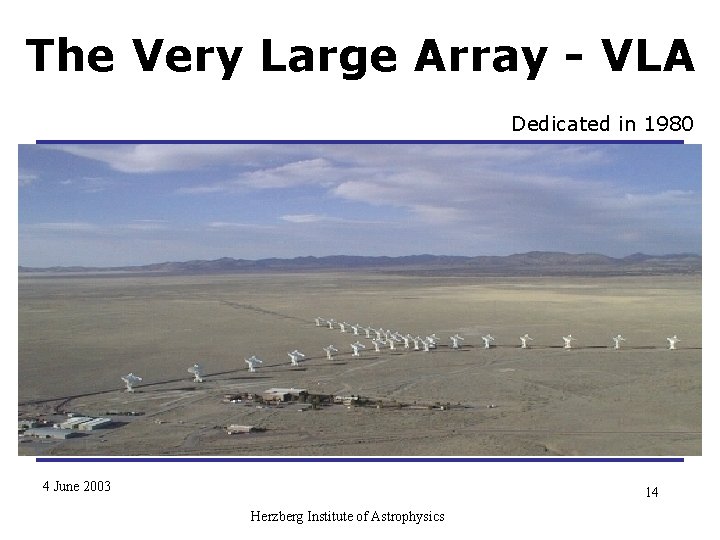
The Very Large Array - VLA Dedicated in 1980 4 June 2003 14 Herzberg Institute of Astrophysics
ALMA at Chajnantor 4 June 2003 15 Herzberg Institute of Astrophysics ESO
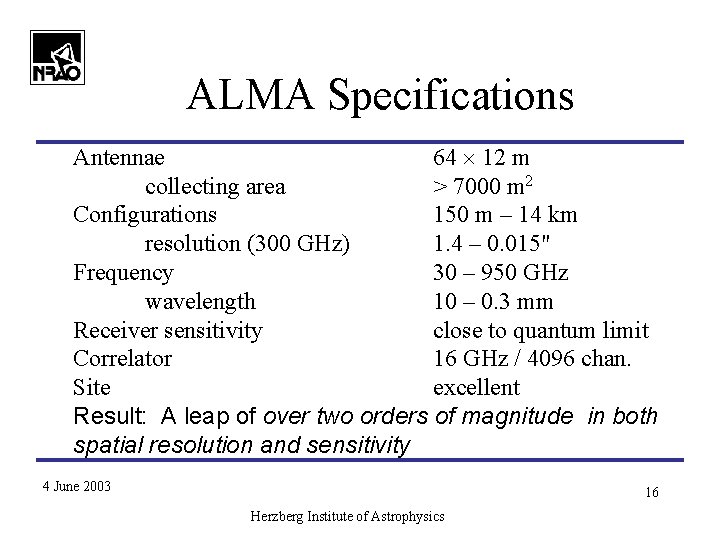
ALMA Specifications Antennae 64 ´ 12 m collecting area > 7000 m 2 Configurations 150 m – 14 km resolution (300 GHz) 1. 4 – 0. 015" Frequency 30 – 950 GHz wavelength 10 – 0. 3 mm Receiver sensitivity close to quantum limit Correlator 16 GHz / 4096 chan. Site excellent Result: A leap of over two orders of magnitude in both spatial resolution and sensitivity 4 June 2003 16 Herzberg Institute of Astrophysics
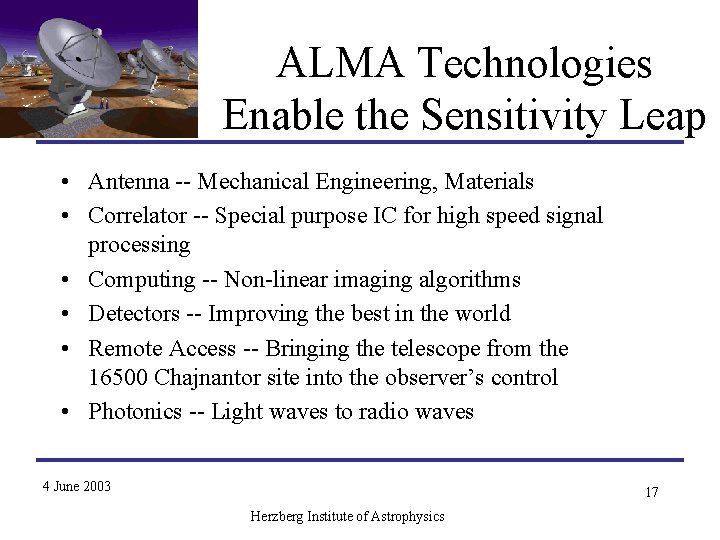
ALMA Technologies Enable the Sensitivity Leap • Antenna -- Mechanical Engineering, Materials • Correlator -- Special purpose IC for high speed signal processing • Computing -- Non-linear imaging algorithms • Detectors -- Improving the best in the world • Remote Access -- Bringing the telescope from the 16500 Chajnantor site into the observer’s control • Photonics -- Light waves to radio waves 4 June 2003 17 Herzberg Institute of Astrophysics
The ALMA Antenna Mechanical Engineering at the Heart of the Array • • Must maintain accuracy at 16, 500 foot Llano de Chajnantor – Surface accuracy better than 20 microns – Pointing accuracy better than 0. 6 arcseconds Despite – high winds (50 percentile 6. 5 m/s) – no vegetation - windblown grit and dust – annual median temperature -2. 5 C (range -20 to +20 C) – pressure 55% of sea level--UV radiation (170% of sea level) Three designs – ALMA/NA Vertex, of Santa Clara, CA much carbon fiber of a novel sort – ALMA/EU Alcatel Space, EIE, of Venice and Castamasagna , Italy considerable carbon fiber – ALMA/JP refinement of ASTE pre-prototype soon to be open bid Final design after 1. 5 yrs of tests in New Mexico (Jan 2004) 4 June 2003 18 Herzberg Institute of Astrophysics
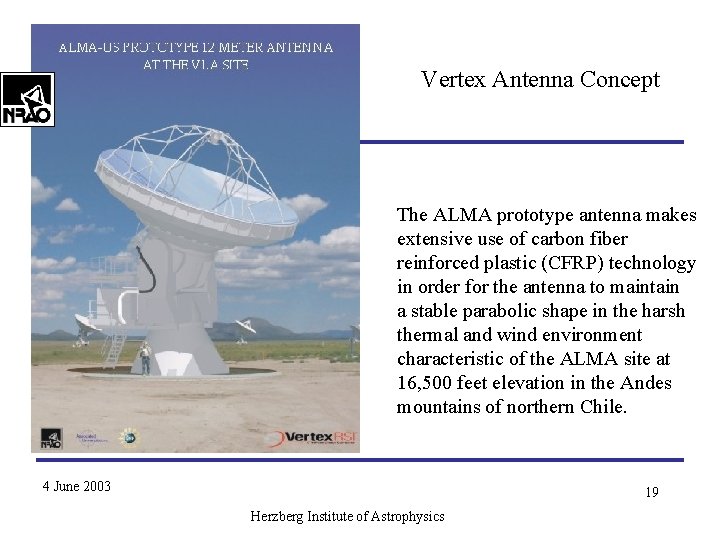
Vertex Antenna Concept The ALMA prototype antenna makes extensive use of carbon fiber reinforced plastic (CFRP) technology in order for the antenna to maintain a stable parabolic shape in the harsh thermal and wind environment characteristic of the ALMA site at 16, 500 feet elevation in the Andes mountains of northern Chile. 4 June 2003 19 Herzberg Institute of Astrophysics
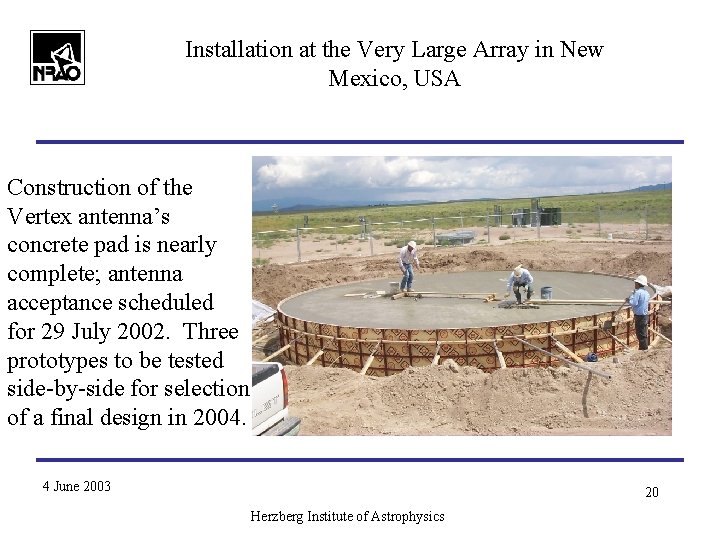
Installation at the Very Large Array in New Mexico, USA Construction of the Vertex antenna’s concrete pad is nearly complete; antenna acceptance scheduled for 29 July 2002. Three prototypes to be tested side-by-side for selection of a final design in 2004. 4 June 2003 20 Herzberg Institute of Astrophysics
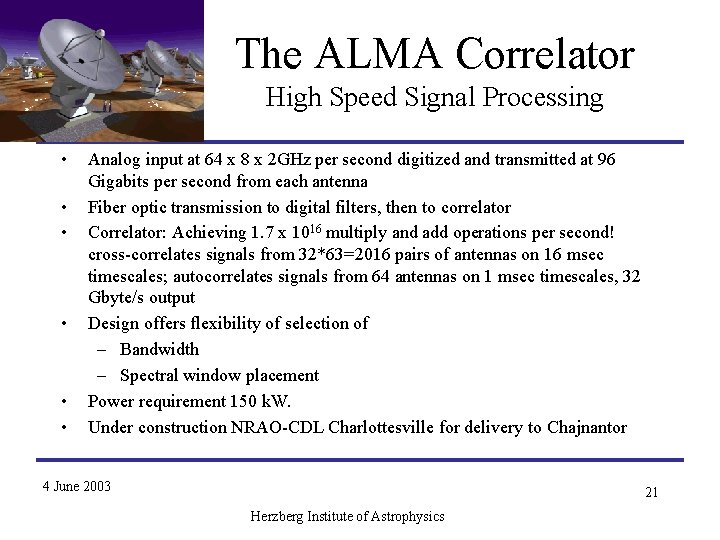
The ALMA Correlator High Speed Signal Processing • • • Analog input at 64 x 8 x 2 GHz per second digitized and transmitted at 96 Gigabits per second from each antenna Fiber optic transmission to digital filters, then to correlator Correlator: Achieving 1. 7 x 10¹⁶ multiply and add operations per second! cross-correlates signals from 32*63=2016 pairs of antennas on 16 msec timescales; autocorrelates signals from 64 antennas on 1 msec timescales, 32 Gbyte/s output Design offers flexibility of selection of – Bandwidth – Spectral window placement Power requirement 150 k. W. Under construction NRAO-CDL Charlottesville for delivery to Chajnantor 4 June 2003 21 Herzberg Institute of Astrophysics
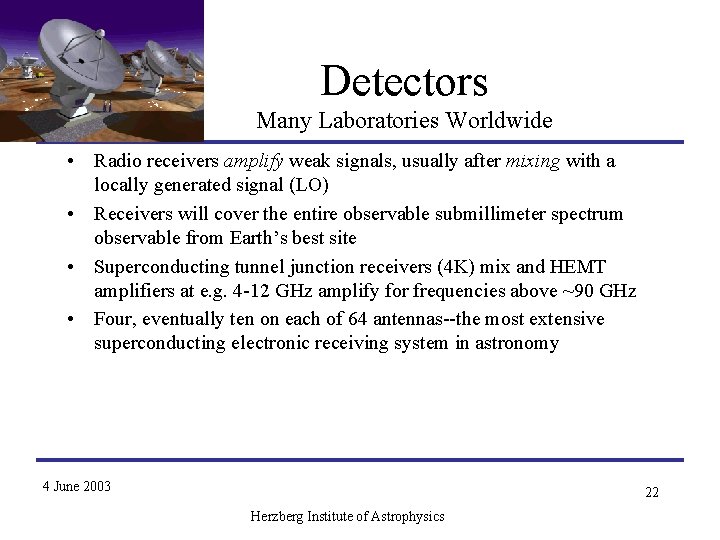
Detectors Many Laboratories Worldwide • Radio receivers amplify weak signals, usually after mixing with a locally generated signal (LO) • Receivers will cover the entire observable submillimeter spectrum observable from Earth’s best site • Superconducting tunnel junction receivers (4 K) mix and HEMT amplifiers at e. g. 4 -12 GHz amplify for frequencies above ~90 GHz • Four, eventually ten on each of 64 antennas--the most extensive superconducting electronic receiving system in astronomy 4 June 2003 22 Herzberg Institute of Astrophysics
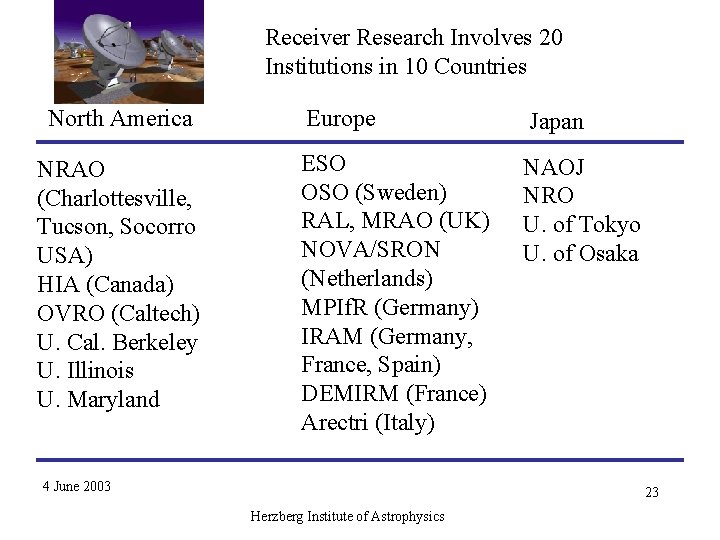
Receiver Research Involves 20 Institutions in 10 Countries North America NRAO (Charlottesville, Tucson, Socorro USA) HIA (Canada) OVRO (Caltech) U. Cal. Berkeley U. Illinois U. Maryland Europe Japan ESO OSO (Sweden) RAL, MRAO (UK) NOVA/SRON (Netherlands) MPIf. R (Germany) IRAM (Germany, France, Spain) DEMIRM (France) Arectri (Italy) NAOJ NRO U. of Tokyo U. of Osaka 4 June 2003 23 Herzberg Institute of Astrophysics
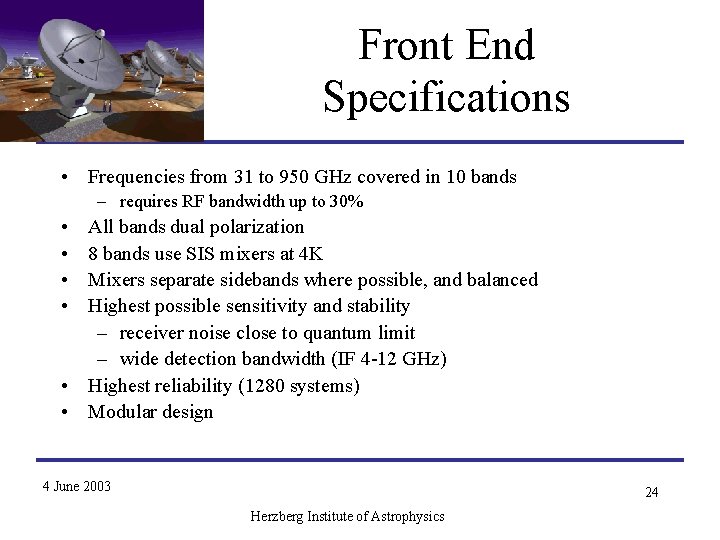
Front End Specifications • Frequencies from 31 to 950 GHz covered in 10 bands – requires RF bandwidth up to 30% • • All bands dual polarization 8 bands use SIS mixers at 4 K Mixers separate sidebands where possible, and balanced Highest possible sensitivity and stability – receiver noise close to quantum limit – wide detection bandwidth (IF 4 -12 GHz) • Highest reliability (1280 systems) • Modular design 4 June 2003 24 Herzberg Institute of Astrophysics
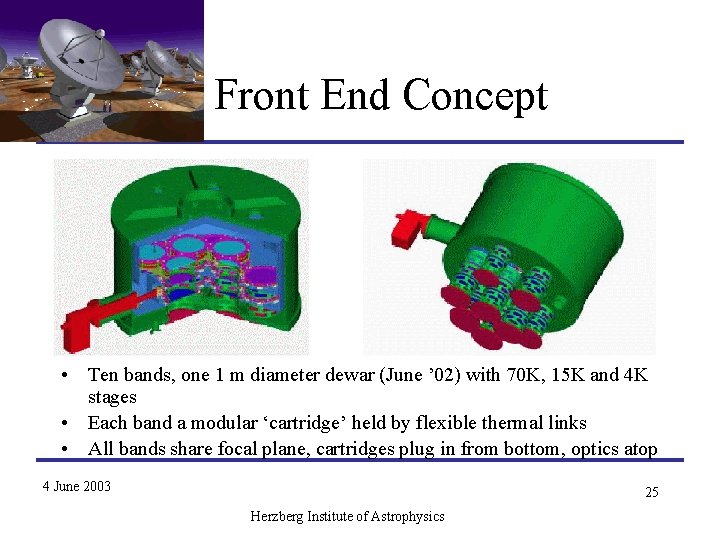
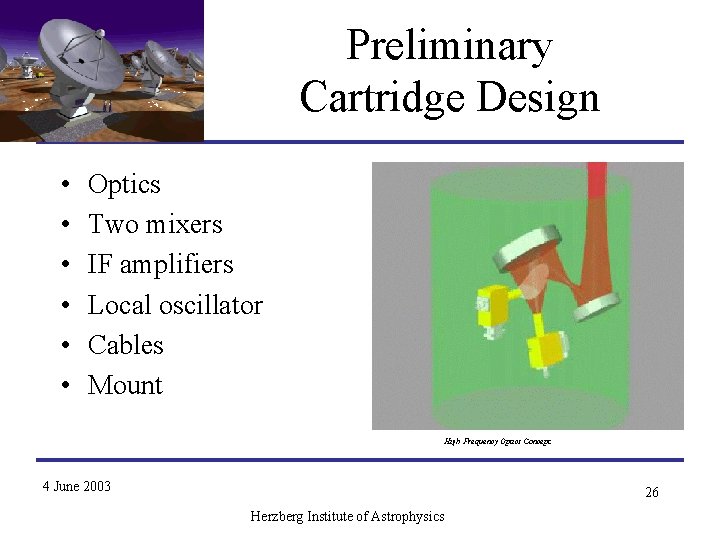
Front End Concept • Ten bands, one 1 m diameter dewar (June ’ 02) with 70 K, 15 K and 4 K stages • Each band a modular ‘cartridge’ held by flexible thermal links • All bands share focal plane, cartridges plug in from bottom, optics atop 4 June 2003 25 Herzberg Institute of Astrophysics
Preliminary Cartridge Design • • • Optics Two mixers IF amplifiers Local oscillator Cables Mount High Frequency Optics Concept 4 June 2003 26 Herzberg Institute of Astrophysics
Remote Access • Astronomers anywhere can interact with the system, and receive interim images in real time • Requires high speed communication 4 June 2003 27 Herzberg Institute of Astrophysics
Photonics • LO - IR lasers beat together produce reference frequency for mixing, distributed to all antennas over fiber optics • Key technology is high frequency (>100 GHz) photodiodes--developed by NTT Japan to >300 GHz, HHT tests at 650 GHz • After mixing and amplification, signal is digitized and transmitted over fiber optics to correlator • Current problem: noise 4 June 2003 28 Herzberg Institute of Astrophysics
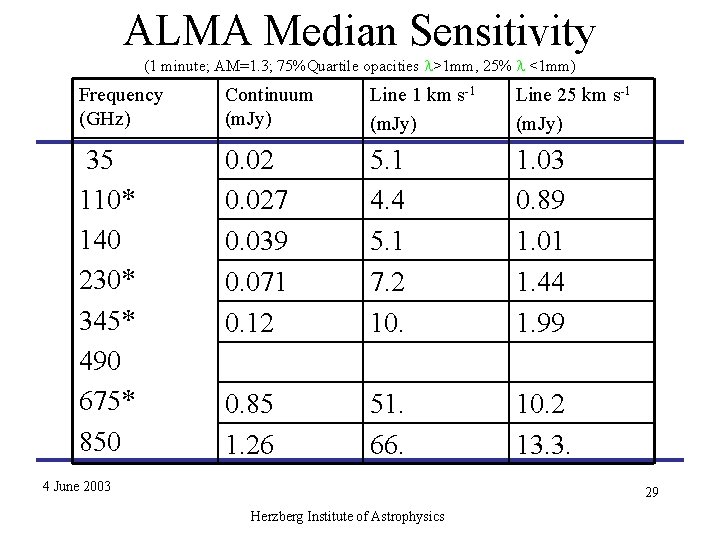
ALMA Median Sensitivity (1 minute; AM=1. 3; 75%Quartile opacities l>1 mm, 25% l <1 mm) Frequency (GHz) Continuum (m. Jy) Line 1 km s-1 (m. Jy) Line 25 km s-1 (m. Jy) 35 110* 140 230* 345* 490 675* 850 0. 027 0. 039 0. 071 0. 12 5. 1 4. 4 5. 1 7. 2 10. 1. 03 0. 89 1. 01 1. 44 1. 99 0. 85 1. 26 51. 66. 10. 2 13. 3. 4 June 2003 * First light band 29 Herzberg Institute of Astrophysics
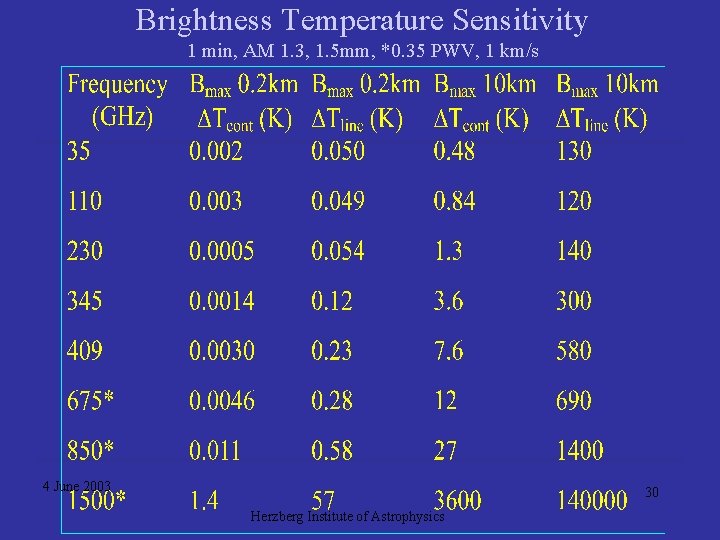
Brightness Temperature Sensitivity 1 min, AM 1. 3, 1. 5 mm, *0. 35 PWV, 1 km/s 4 June 2003 30 Herzberg Institute of Astrophysics
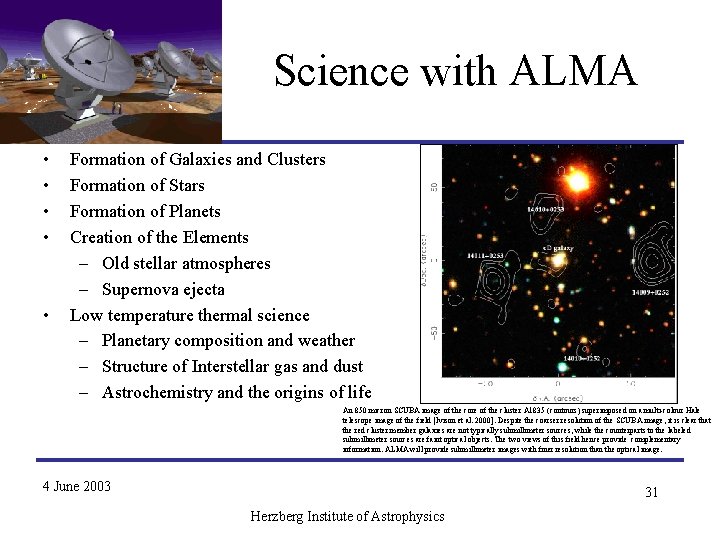
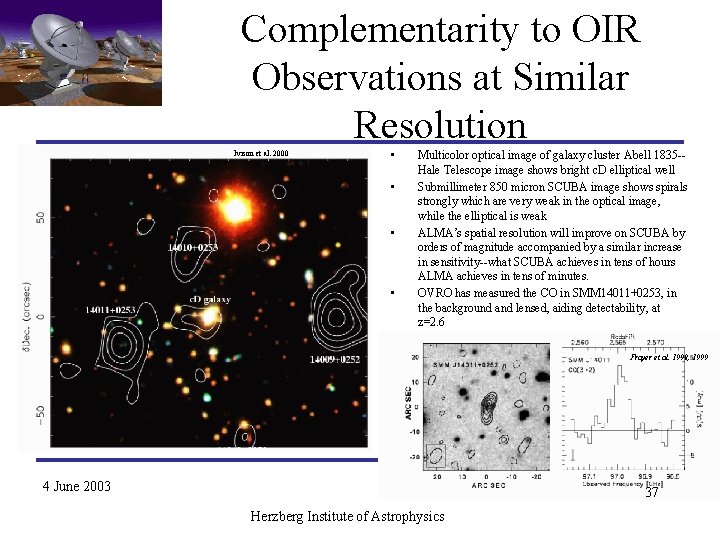
Science with ALMA • • • Formation of Galaxies and Clusters Formation of Stars Formation of Planets Creation of the Elements – Old stellar atmospheres – Supernova ejecta Low temperature thermal science – Planetary composition and weather – Structure of Interstellar gas and dust – Astrochemistry and the origins of life An 850 micron SCUBA image of the core of the cluster A 1835 (contours) superimposed on a multi-colour Hale telescope image of the field [Ivison et al. 2000]. Despite the coarser resolution of the SCUBA image, it is clear that the red cluster member galaxies are not typically submillimeter sources, while the counterparts to the labeled submillimeter sources are faint optical objects. The two views of this field hence provide complementary information. ALMA will provide submillimeter images with finer resolution than the optical image. 4 June 2003 31 Herzberg Institute of Astrophysics
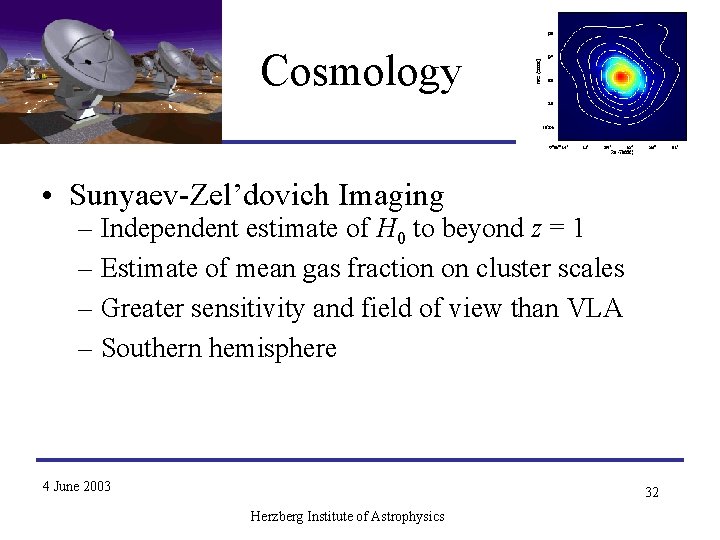
Cosmology • Sunyaev-Zel’dovich Imaging – Independent estimate of H 0 to beyond z = 1 – Estimate of mean gas fraction on cluster scales – Greater sensitivity and field of view than VLA – Southern hemisphere 4 June 2003 32 Herzberg Institute of Astrophysics
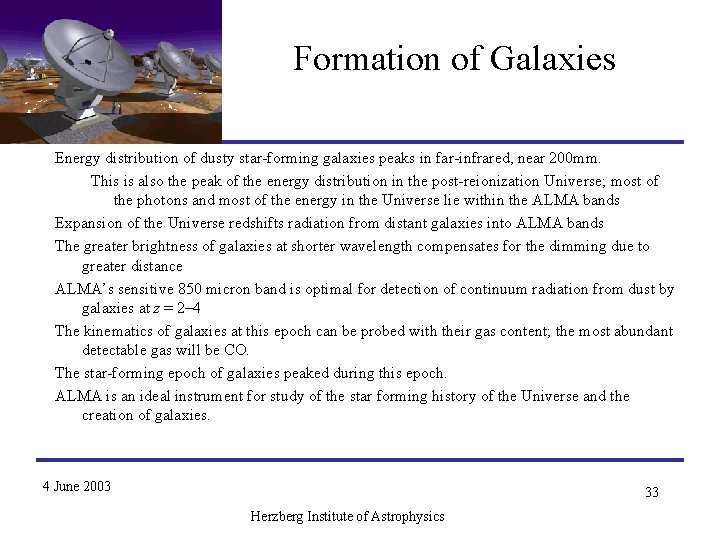
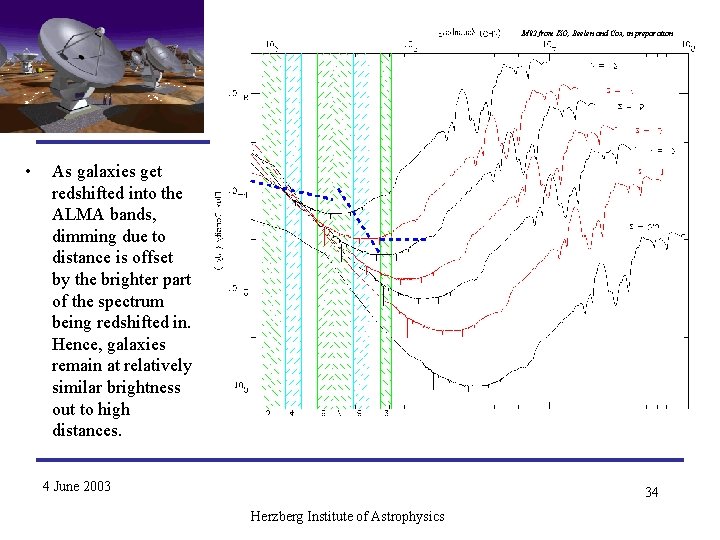
Formation of Galaxies Energy distribution of dusty star-forming galaxies peaks in far-infrared, near 200 mm. This is also the peak of the energy distribution in the post-reionization Universe; most of the photons and most of the energy in the Universe lie within the ALMA bands Expansion of the Universe redshifts radiation from distant galaxies into ALMA bands The greater brightness of galaxies at shorter wavelength compensates for the dimming due to greater distance ALMA’s sensitive 850 micron band is optimal for detection of continuum radiation from dust by galaxies at z = 2– 4 The kinematics of galaxies at this epoch can be probed with their gas content; the most abundant detectable gas will be CO. The star-forming epoch of galaxies peaked during this epoch. ALMA is an ideal instrument for study of the star forming history of the Universe and the creation of galaxies. 4 June 2003 33 Herzberg Institute of Astrophysics
M 82 from ISO, Beelen and Cox, in preparation • As galaxies get redshifted into the ALMA bands, dimming due to distance is offset by the brighter part of the spectrum being redshifted in. Hence, galaxies remain at relatively similar brightness out to high distances. 4 June 2003 34 Herzberg Institute of Astrophysics
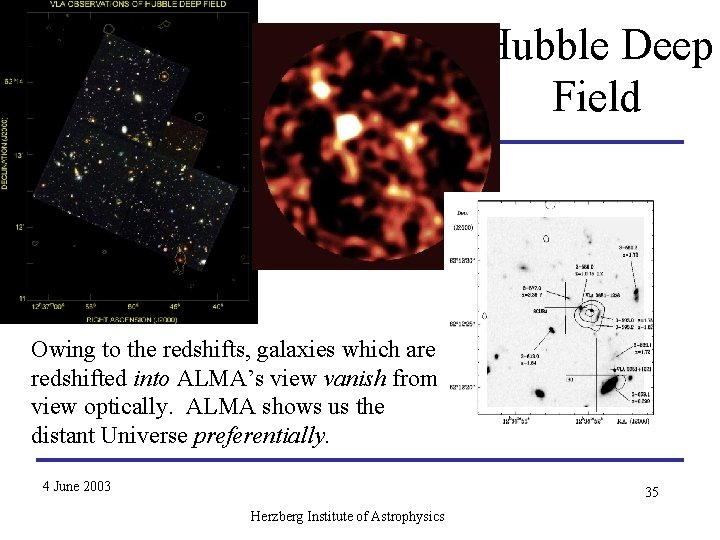
Hubble Deep Field Owing to the redshifts, galaxies which are redshifted into ALMA’s view vanish from view optically. ALMA shows us the distant Universe preferentially. 4 June 2003 Optical and radio, submm Herzberg Institute of Astrophysics 35 VLA/JCMT
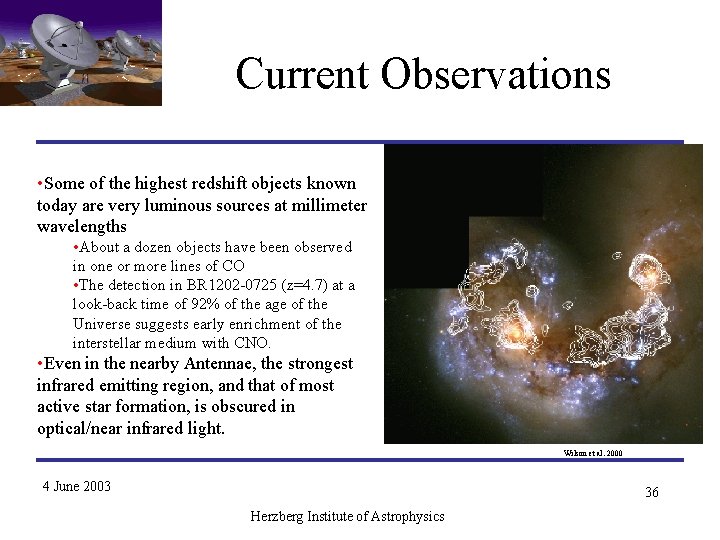
Current Observations • Some of the highest redshift objects known today are very luminous sources at millimeter wavelengths • About a dozen objects have been observed in one or more lines of CO • The detection in BR 1202 -0725 (z=4. 7) at a look-back time of 92% of the age of the Universe suggests early enrichment of the interstellar medium with CNO. • Even in the nearby Antennae, the strongest infrared emitting region, and that of most active star formation, is obscured in optical/near infrared light. Wilson et al. 2000 4 June 2003 36 Herzberg Institute of Astrophysics
Complementarity to OIR Observations at Similar Resolution Ivison et al. 2000 • • Multicolor optical image of galaxy cluster Abell 1835 -Hale Telescope image shows bright c. D elliptical well Submillimeter 850 micron SCUBA image shows spirals strongly which are very weak in the optical image, while the elliptical is weak ALMA’s spatial resolution will improve on SCUBA by orders of magnitude accompanied by a similar increase in sensitivity--what SCUBA achieves in tens of hours ALMA achieves in tens of minutes. OVRO has measured the CO in SMM 14011+0253, in the background and lensed, aiding detectability, at z=2. 6 Frayer et al. 1998, 1999 4 June 2003 37 Herzberg Institute of Astrophysics
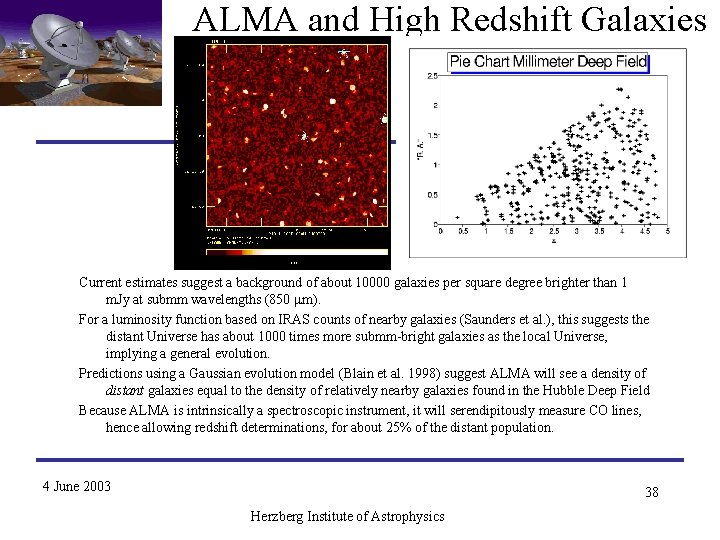
ALMA and High Redshift Galaxies Current estimates suggest a background of about 10000 galaxies per square degree brighter than 1 m. Jy at submm wavelengths (850 mm). For a luminosity function based on IRAS counts of nearby galaxies (Saunders et al. ), this suggests the distant Universe has about 1000 times more submm-bright galaxies as the local Universe, implying a general evolution. Predictions using a Gaussian evolution model (Blain et al. 1998) suggest ALMA will see a density of distant galaxies equal to the density of relatively nearby galaxies found in the Hubble Deep Field Because ALMA is intrinsically a spectroscopic instrument, it will serendipitously measure CO lines, hence allowing redshift determinations, for about 25% of the distant population. 4 June 2003 38 Herzberg Institute of Astrophysics
An ALMA Redshift Survey in a 4’× 4’ Field Step 1 A continuum and line survey at 300 GHz, down to 0. 1 m. Jy (5 sigma). This requires 140 pointings, each with 30 minutes of observation, for a total of 3 days. Such a survey should find about 100 -300 sources, of which 30 -100 sources will be brighter than 0. 4 m. Jy. This field is twice the size of the HDF. Step 2 A continuum and line survey in the 3 mm band down to a sensitivity of 7. 5 m. Jy (at 5 sigma). This requires 16 pointings, each with 12 hours of observation, so a total of 8 days. The survey is done with 4 tunings covering the 84116 GHz frequency range. The 300 to 100 GHz flux density ratio gives the photometric redshift distribution for redshifts z > 3 -4. For expected line widths of 300 km/s, the line sensitivity of this survey is 0. 02 Jy. km/s at 5 s. Using the typical SED presented earlier this should detect CO lines in all sources detected in Step 1. At least one CO line would be detected for all sources above z = 2, and two for all sources above z = 6. The only ``blind'' redshift regions are 0. 4 -1. 0 and 1. 7 -2. 0. Step 3 A continuum and line survey in the 210 -274 GHz band down to a sensitivity of 50 m. Jy (at 5 sigma). 8 adjacent frequency tunings would be required. On average, 90 pointings would be required, each with 1. 5 hours, giving a total of 6 days. Together with Step 2, this would allow detection of at least one CO line for all redshifts, and two lines for redshifts greater than 2. 4 June 2003 39 Herzberg Institute of Astrophysics
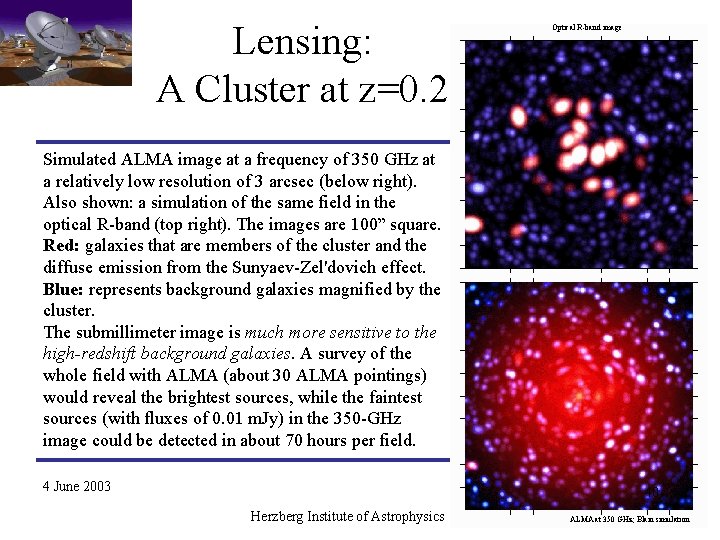
Lensing: A Cluster at z=0. 2 Optical R-band image Simulated ALMA image at a frequency of 350 GHz at a relatively low resolution of 3 arcsec (below right). Also shown: a simulation of the same field in the optical R-band (top right). The images are 100” square. Red: galaxies that are members of the cluster and the diffuse emission from the Sunyaev-Zel'dovich effect. Blue: represents background galaxies magnified by the cluster. The submillimeter image is much more sensitive to the high-redshift background galaxies. A survey of the whole field with ALMA (about 30 ALMA pointings) would reveal the brightest sources, while the faintest sources (with fluxes of 0. 01 m. Jy) in the 350 -GHz image could be detected in about 70 hours per field. 4 June 2003 40 Herzberg Institute of Astrophysics ALMA at 350 GHz; Blain simulation
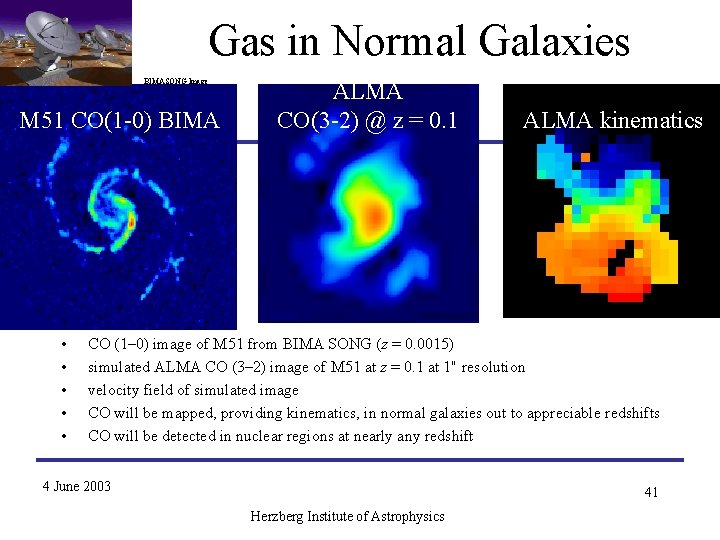
Gas in Normal Galaxies BIMASONG Image M 51 CO(1 -0) BIMA • • • ALMA CO(3 -2) @ z = 0. 1 ALMA kinematics CO (1– 0) image of M 51 from BIMA SONG (z = 0. 0015) simulated ALMA CO (3– 2) image of M 51 at z = 0. 1 at 1" resolution velocity field of simulated image CO will be mapped, providing kinematics, in normal galaxies out to appreciable redshifts CO will be detected in nuclear regions at nearly any redshift 4 June 2003 41 Herzberg Institute of Astrophysics
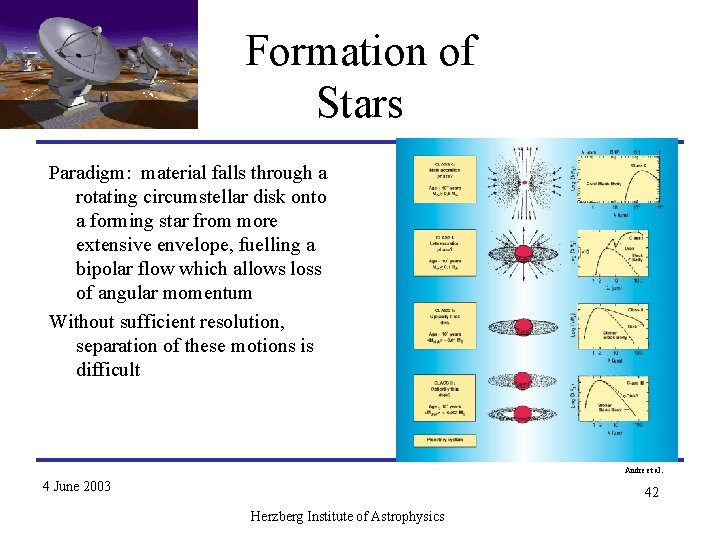
Formation of Stars Paradigm: material falls through a rotating circumstellar disk onto a forming star from more extensive envelope, fuelling a bipolar flow which allows loss of angular momentum Without sufficient resolution, separation of these motions is difficult Andre et al. 4 June 2003 42 Herzberg Institute of Astrophysics
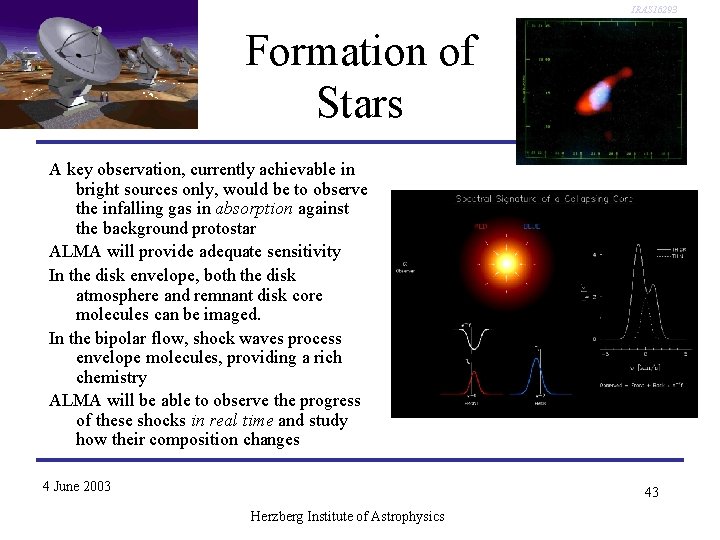
IRAS 16293 Formation of Stars A key observation, currently achievable in bright sources only, would be to observe the infalling gas in absorption against the background protostar ALMA will provide adequate sensitivity In the disk envelope, both the disk atmosphere and remnant disk core molecules can be imaged. In the bipolar flow, shock waves process envelope molecules, providing a rich chemistry ALMA will be able to observe the progress of these shocks in real time and study how their composition changes 4 June 2003 43 Herzberg Institute of Astrophysics
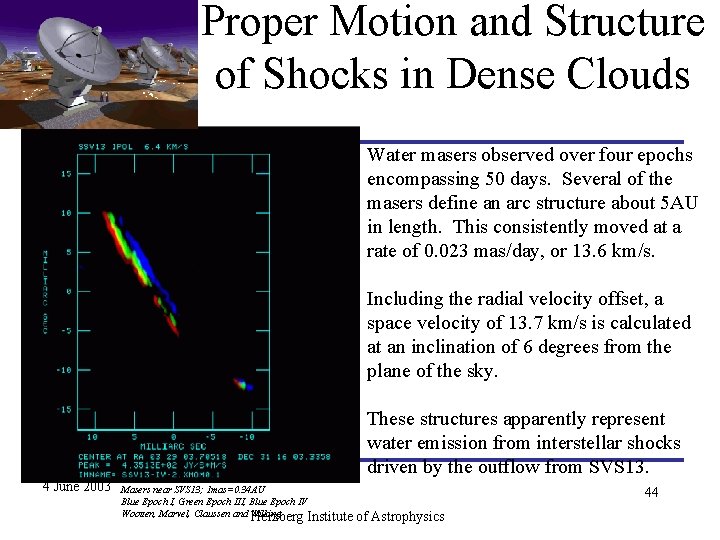
Proper Motion and Structure of Shocks in Dense Clouds Water masers observed over four epochs encompassing 50 days. Several of the masers define an arc structure about 5 AU in length. This consistently moved at a rate of 0. 023 mas/day, or 13. 6 km/s. Including the radial velocity offset, a space velocity of 13. 7 km/s is calculated at an inclination of 6 degrees from the plane of the sky. These structures apparently represent water emission from interstellar shocks driven by the outflow from SVS 13. 4 June 2003 Masers near SVS 13; 1 mas=0. 34 AU Blue Epoch I, Green Epoch III, Blue Epoch IV Wootten, Marvel, Claussen and Wilking Herzberg Institute 44 of Astrophysics
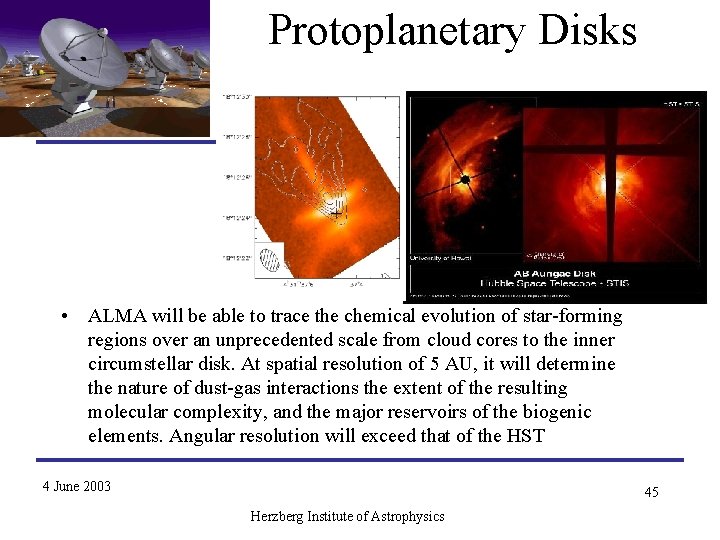
Protoplanetary Disks • ALMA will be able to trace the chemical evolution of star-forming regions over an unprecedented scale from cloud cores to the inner circumstellar disk. At spatial resolution of 5 AU, it will determine the nature of dust-gas interactions the extent of the resulting molecular complexity, and the major reservoirs of the biogenic elements. Angular resolution will exceed that of the HST 4 June 2003 45 Herzberg Institute of Astrophysics
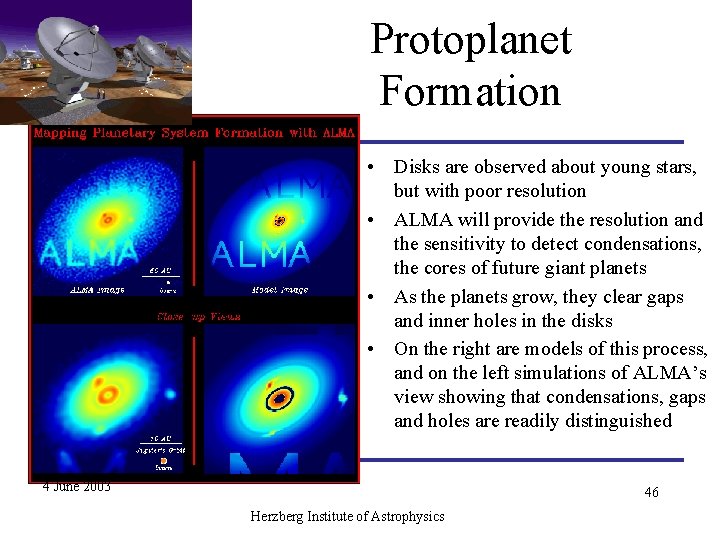
Protoplanet Formation • Disks are observed about young stars, but with poor resolution • ALMA will provide the resolution and the sensitivity to detect condensations, the cores of future giant planets • As the planets grow, they clear gaps and inner holes in the disks • On the right are models of this process, and on the left simulations of ALMA’s view showing that condensations, gaps and holes are readily distinguished 4 June 2003 Simulation and Model courtesy Lee Mundy, U. Md. Herzberg Institute of Astrophysics 46
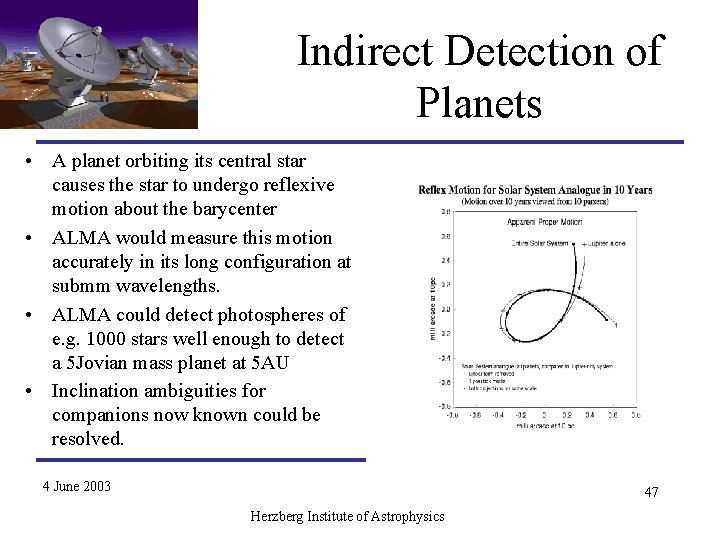
Indirect Detection of Planets • A planet orbiting its central star causes the star to undergo reflexive motion about the barycenter • ALMA would measure this motion accurately in its long configuration at submm wavelengths. • ALMA could detect photospheres of e. g. 1000 stars well enough to detect a 5 Jovian mass planet at 5 AU • Inclination ambiguities for companions now known could be resolved. 4 June 2003 47 Herzberg Institute of Astrophysics
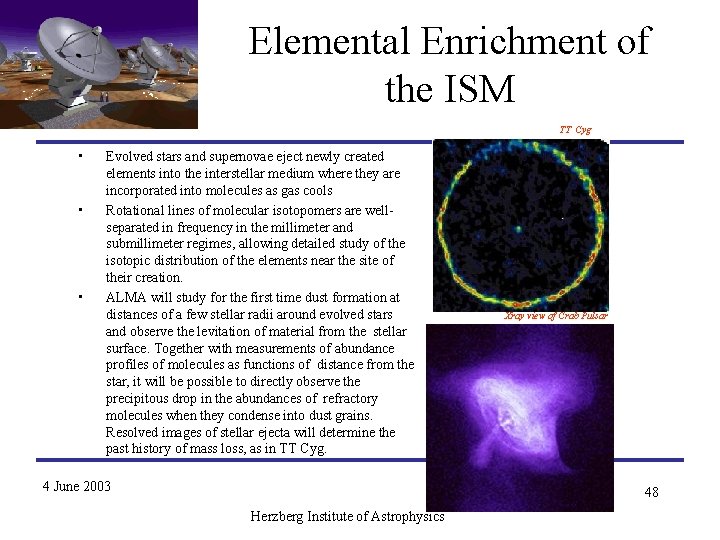
Elemental Enrichment of the ISM TT Cyg • • • Evolved stars and supernovae eject newly created elements into the interstellar medium where they are incorporated into molecules as gas cools Rotational lines of molecular isotopomers are wellseparated in frequency in the millimeter and submillimeter regimes, allowing detailed study of the isotopic distribution of the elements near the site of their creation. ALMA will study for the first time dust formation at distances of a few stellar radii around evolved stars and observe the levitation of material from the stellar surface. Together with measurements of abundance profiles of molecules as functions of distance from the star, it will be possible to directly observe the precipitous drop in the abundances of refractory molecules when they condense into dust grains. Resolved images of stellar ejecta will determine the past history of mass loss, as in TT Cyg. 4 June 2003 Xray view of Crab Pulsar 48 Herzberg Institute of Astrophysics
ALMA Schedule 1998 – 2001 Design and Development 1999 International partnership established 2002 Construction begins first year for NA partner, ESO follows, then NA remainder Prototype antennae--an end product of design and development 2000 February contracts awarded (US, Europe (latter rev. 12/2001)) 2002 1 Q delivery to VLA site of Vertex Antenna 2003 1 Q delivery of EIE, Japanese prototype antennas 2004 Prototype interferometer; Japanese entry? 2002 – 2011 Construction Production antennae 2004 contract award 2005 4 Q initial delivery to Chajnantor 4 Q 2006 Initial Commissioning Operations 4 Q 2007 Early Science Operations 4 Q 2011 Completion of construction phase 4 June 2003 49 Herzberg Institute of Astrophysics
ALMA on the WWW http: //www. alma. nrao. edu Instrument description Project book Memo series Workshop reports Newsletter Meeting minutes Links to partners Science Case: http: //iram. fr/guillote (construction proposal to ESO) and PASP Conference Series Vol. No. 235, a conference held at the Carnegie Institution 4 June 2003 50 Herzberg Institute of Astrophysics