
Imaging Cognitive States and Traits with BOLD and
Imaging Cognitive States and Traits with BOLD and Perfusion f. MRI John A. Detre, M. D. Director, Center for Functional Neuroimaging University of Pennsylvania

Neuroimaging • Allows noninvasive assessment of brain structure and function • Is the primary means of assessing regional brain function in humans • Provides a critical link between animal models and human brain • Complements lesion-based inferences on brain-behavior correlations
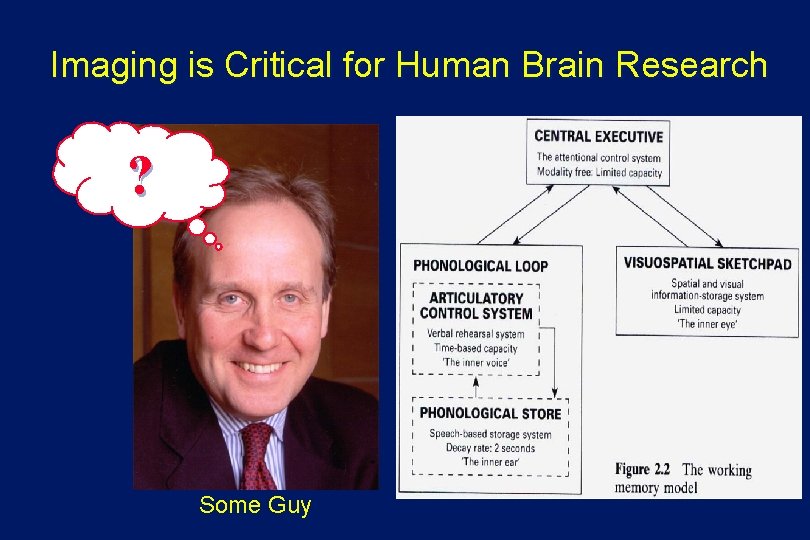
Imaging is Critical for Human Brain Research ? Some Guy
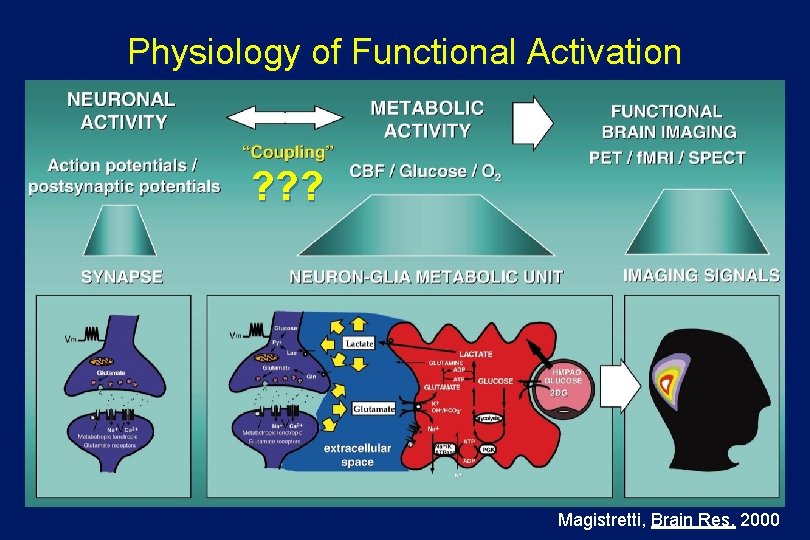
Physiology of Functional Activation ? ? ? Magistretti, Brain Res. 2000
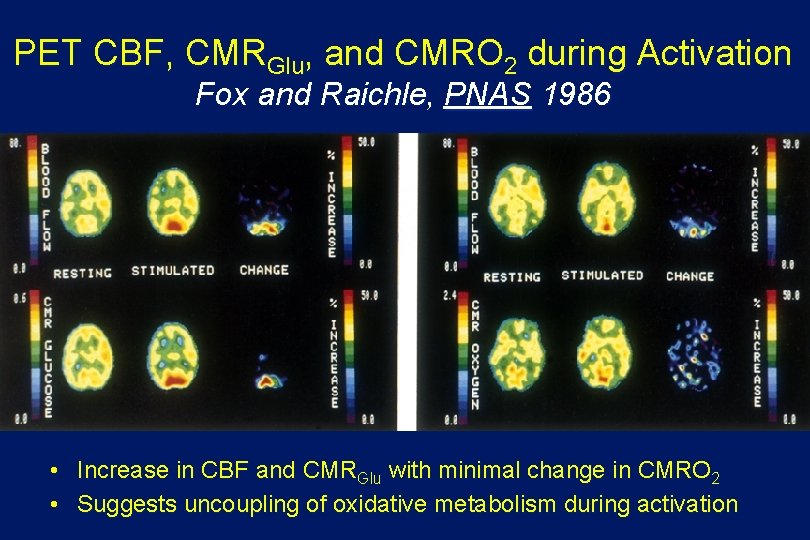
PET CBF, CMRGlu, and CMRO 2 during Activation Fox and Raichle, PNAS 1986 • Increase in CBF and CMRGlu with minimal change in CMRO 2 • Suggests uncoupling of oxidative metabolism during activation
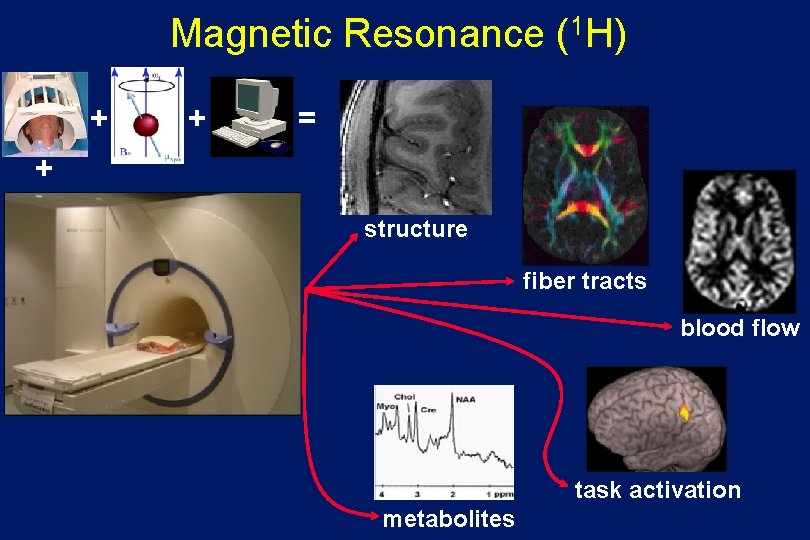
Magnetic Resonance (1 H) + + = + structure fiber tracts blood flow task activation metabolites
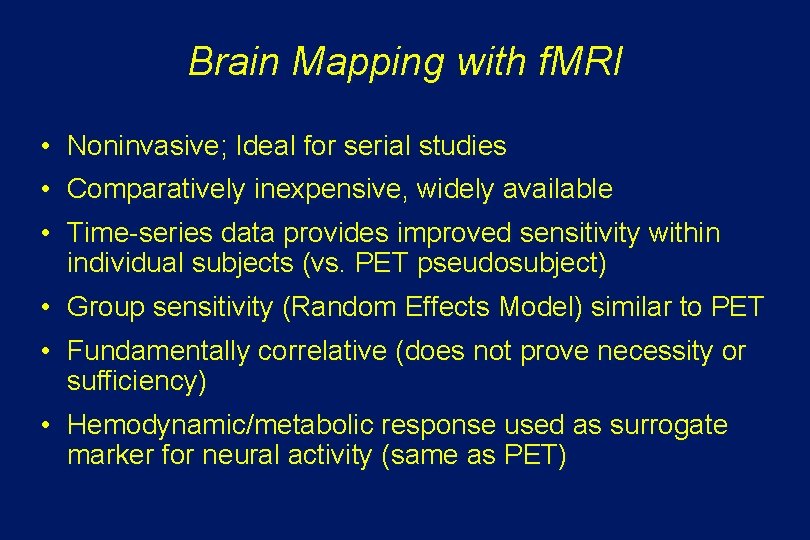
Brain Mapping with f. MRI • Noninvasive; Ideal for serial studies • Comparatively inexpensive, widely available • Time-series data provides improved sensitivity within individual subjects (vs. PET pseudosubject) • Group sensitivity (Random Effects Model) similar to PET • Fundamentally correlative (does not prove necessity or sufficiency) • Hemodynamic/metabolic response used as surrogate marker for neural activity (same as PET)

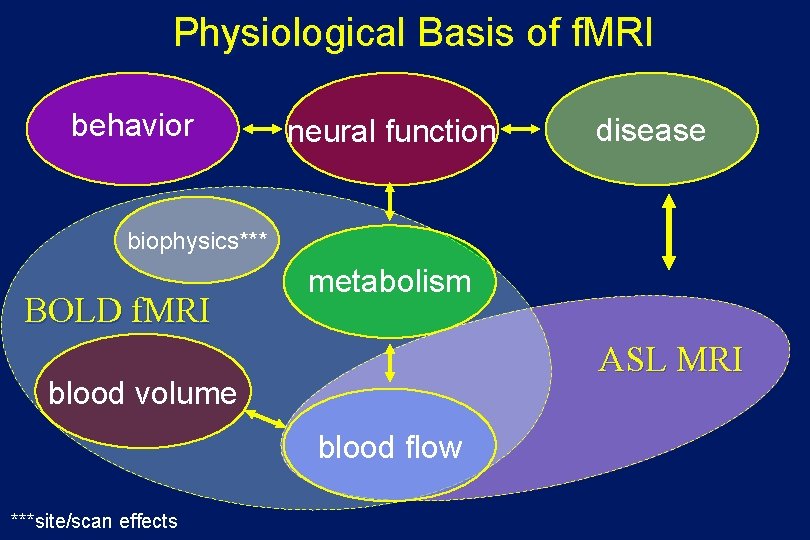
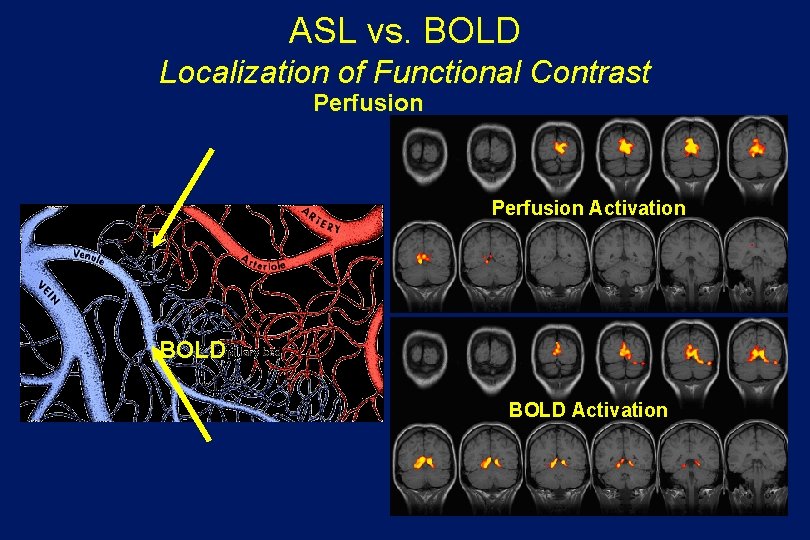
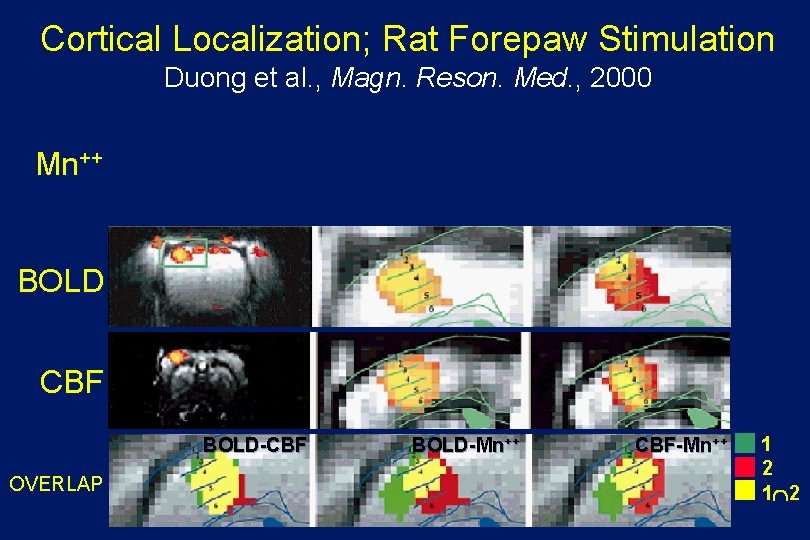
Contrast Mechanisms for f. MRI • Blood Oxygenation Level Dependent (BOLD) f. MRI – represents a complex interaction between CBF, CBV, CMRO 2 – CBF >> CMRO 2 less deoxyhemoglobin with activation – Qualitative: only differences between conditions can be measured • Arterial spin labeling (ASL) provides an endogenous flow tracer for perfusion MRI • – – – Directly analogous to 15 O-H 2 O in PET Allow both resting CBF and CBF changes to be measured Quantitative: provides CBF in ml/100 g/min CBF obtained by modeling image intensity with and without ASL § § § CBF changes may be better localized than BOLD CBF changes may be more linearly coupled with neural activity than BOLD ASL/Control scheme yields “white” noise, provides temporal stability and other benefits
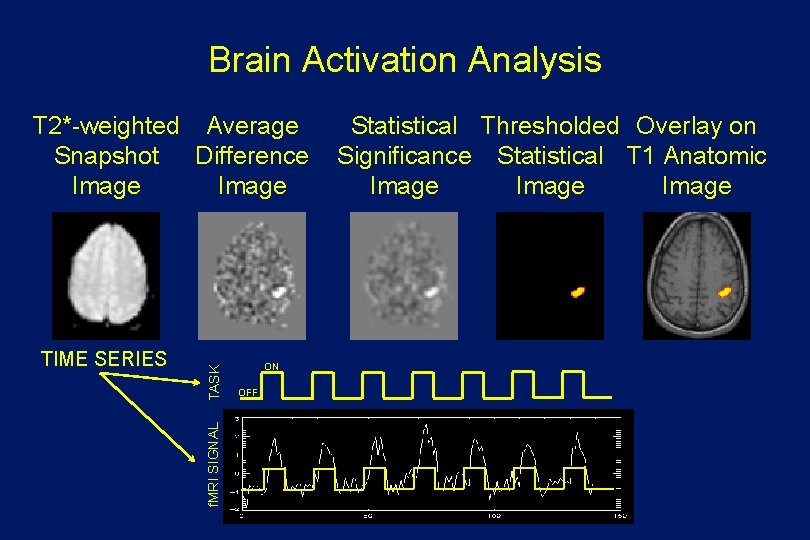
Brain Activation Analysis f. MRI SIGNAL TIME SERIES TASK T 2*-weighted Average Snapshot Difference Image ON OFF Statistical Thresholded Overlay on Significance Statistical T 1 Anatomic Image

FMRI with BOLD Contrast task activation Photic Stimulation calcarine cortex Verbal Fluency Task Broca’s area Wernicke’s area

Perfusion MRI with Arterial Spin Labeling (ASL) • Uses magnetically labeled arterial blood water as an endogenous flow tracer • Provides quantifiable CBF in classical units (ml/g/min) • Effects of ASL are measured by interleaved subtractive comparison with control labeling • ASL effects can be measured with any imaging sequence • CBF calculated using model (diffusible tracer)
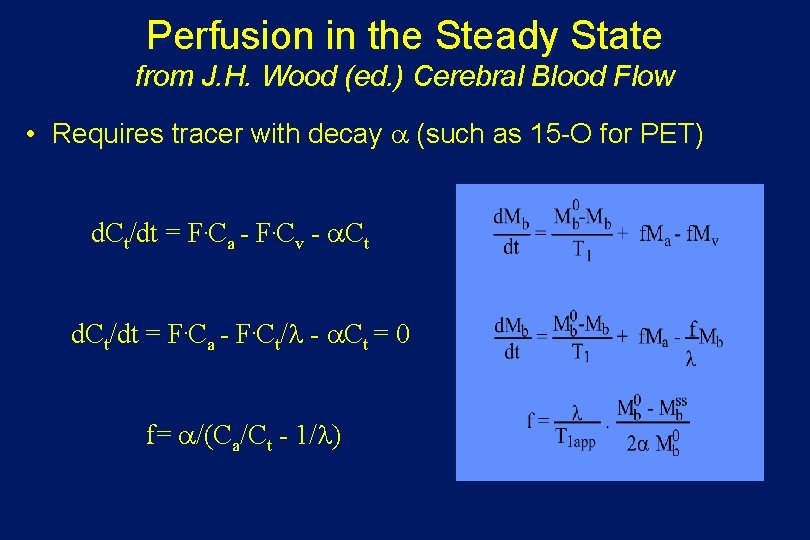
Perfusion in the Steady State from J. H. Wood (ed. ) Cerebral Blood Flow • Requires tracer with decay (such as 15 -O for PET) d. Ct/dt = F. Ca - F. Cv - Ct d. Ct/dt = F. Ca - F. Ct/ - Ct = 0 f= /(Ca/Ct - 1/ )

Quantification of regional CBF with ASL • Requires a model for determining CBF from measured signals • Other key parameters are T 1 blood, T 1 brain, arterial transit time, – Some models also require (blood: brain partition coefficient) • Single compartment model (Detre 1992) – Assumes ASL in well-mixed equilibrium with brain (Kety-Schmidt) • Two compartment model (Alsop 1996) – Includes arterial blood water compartment with arterial transit time • Modified two compartment model (Chalela 2000) – *Assumes labeled spins remain in vasculature (relax with T 1 blood) • Three compartment model (Parkes 2002) – Includes limited diffusion and venous component • Identical results with kinetic model (Buxton 1998) • Microsphere analogy (Buxton 2005) – Emphasizes rapid tracer decay
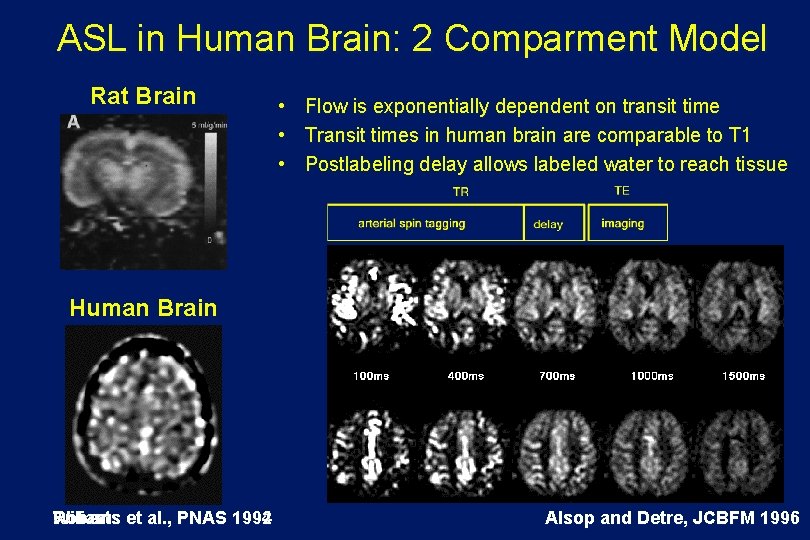
ASL in Human Brain: 2 Comparment Model Rat Brain • Flow is exponentially dependent on transit time • Transit times in human brain are comparable to T 1 • Postlabeling delay allows labeled water to reach tissue Human Brain Roberts Wiliams et al. , PNAS 1994 1992 Alsop and Detre, JCBFM 1996
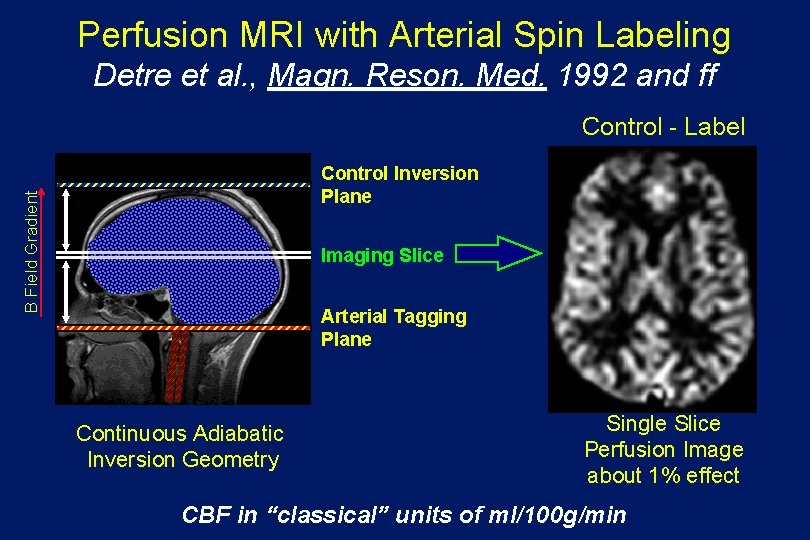
Perfusion MRI with Arterial Spin Labeling Detre et al. , Magn. Reson. Med. 1992 and ff Control - Label B Field Gradient Control Inversion Plane Imaging Slice Arterial Tagging Plane Continuous Adiabatic Inversion Geometry Single Slice Perfusion Image about 1% effect CBF in “classical” units of ml/100 g/min
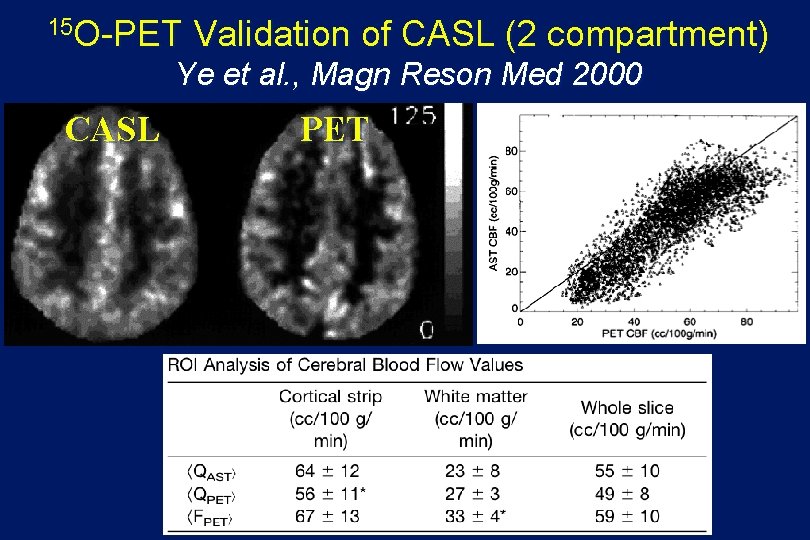
15 O-PET Validation of CASL (2 compartment) Ye et al. , Magn Reson Med 2000 CASL PET
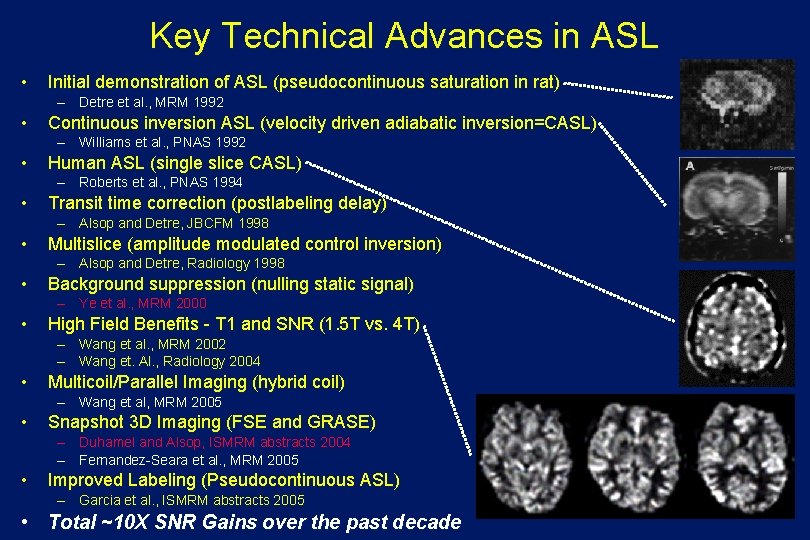
Key Technical Advances in ASL • Initial demonstration of ASL (pseudocontinuous saturation in rat) – Detre et al. , MRM 1992 • Continuous inversion ASL (velocity driven adiabatic inversion=CASL) – Williams et al. , PNAS 1992 • Human ASL (single slice CASL) – Roberts et al. , PNAS 1994 • Transit time correction (postlabeling delay) – Alsop and Detre, JBCFM 1998 • Multislice (amplitude modulated control inversion) – Alsop and Detre, Radiology 1998 • Background suppression (nulling static signal) – Ye et al. , MRM 2000 • High Field Benefits - T 1 and SNR (1. 5 T vs. 4 T) – Wang et al. , MRM 2002 – Wang et. Al. , Radiology 2004 • Multicoil/Parallel Imaging (hybrid coil) – Wang et al, MRM 2005 • Snapshot 3 D Imaging (FSE and GRASE) – Duhamel and Alsop, ISMRM abstracts 2004 – Fernandez-Seara et al. , MRM 2005 • Improved Labeling (Pseudocontinuous ASL) – Garcia et al. , ISMRM abstracts 2005 • Total ~10 X SNR Gains over the past decade
Physiological Basis of f. MRI behavior neural function disease biophysics*** BOLD f. MRI metabolism ASL MRI blood volume blood flow ***site/scan effects
ASL vs. BOLD Localization of Functional Contrast Perfusion Activation BOLD Activation
Cortical Localization; Rat Forepaw Stimulation Duong et al. , Magn. Reson. Med. , 2000 Mn++ BOLD CBF BOLD-CBF OVERLAP BOLD-Mn++ CBF-Mn++ 1 2
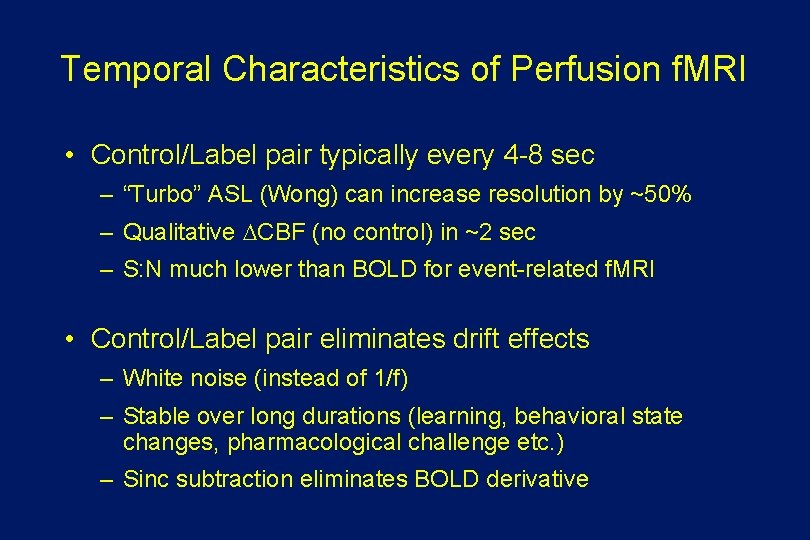
Temporal Characteristics of Perfusion f. MRI • Control/Label pair typically every 4 -8 sec – “Turbo” ASL (Wong) can increase resolution by ~50% – Qualitative CBF (no control) in ~2 sec – S: N much lower than BOLD for event-related f. MRI • Control/Label pair eliminates drift effects – White noise (instead of 1/f) – Stable over long durations (learning, behavioral state changes, pharmacological challenge etc. ) – Sinc subtraction eliminates BOLD derivative
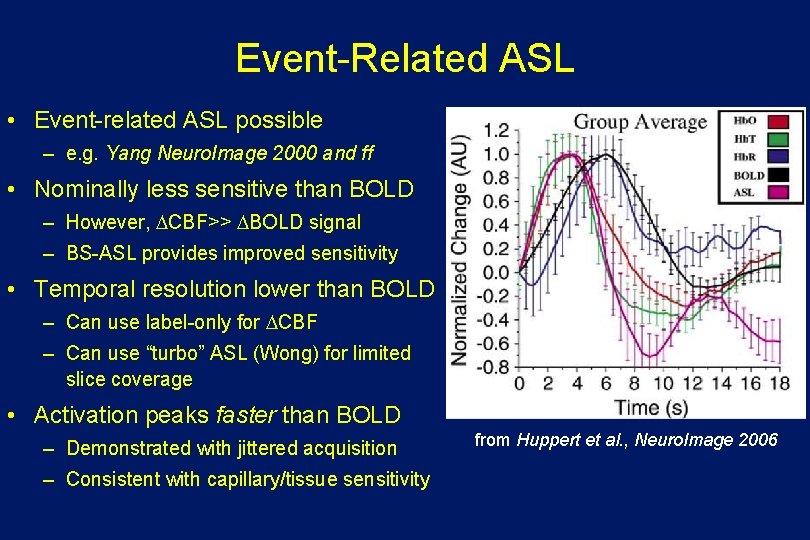
Event-Related ASL • Event-related ASL possible – e. g. Yang Neuro. Image 2000 and ff • Nominally less sensitive than BOLD – However, CBF>> BOLD signal – BS-ASL provides improved sensitivity • Temporal resolution lower than BOLD – Can use label-only for CBF – Can use “turbo” ASL (Wong) for limited slice coverage • Activation peaks faster than BOLD – Demonstrated with jittered acquisition – Consistent with capillary/tissue sensitivity from Huppert et al. , Neuro. Image 2006
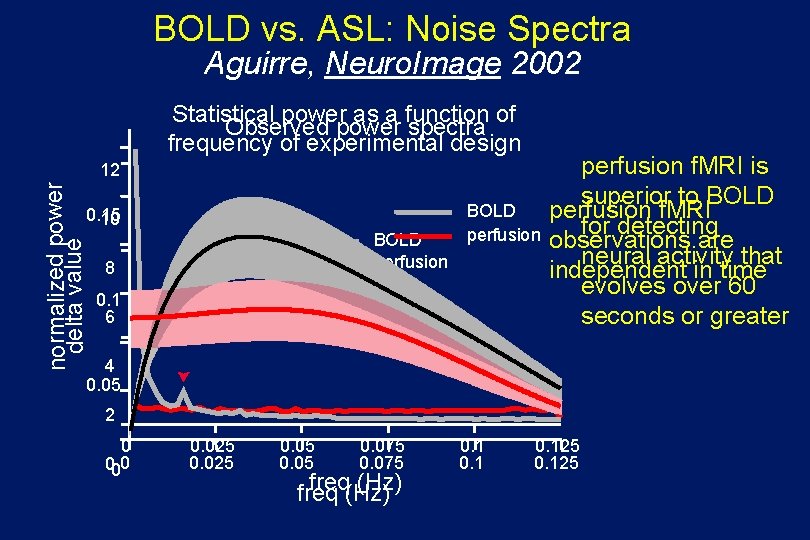
BOLD vs. ASL: Noise Spectra Aguirre, Neuro. Image 2002 Statistical power as a function of Observed power spectra frequency of experimental design normalized power delta value 12 0. 15 10 BOLD perfusion 8 BOLD perfusion 0. 1 6 perfusion f. MRI is superior to BOLD perfusion f. MRI for detecting observations are neural activity that independent in time evolves over 60 seconds or greater 4 0. 05 2 0 000 0. 025 0. 05 0. 075 freq(Hz) freq 0. 125
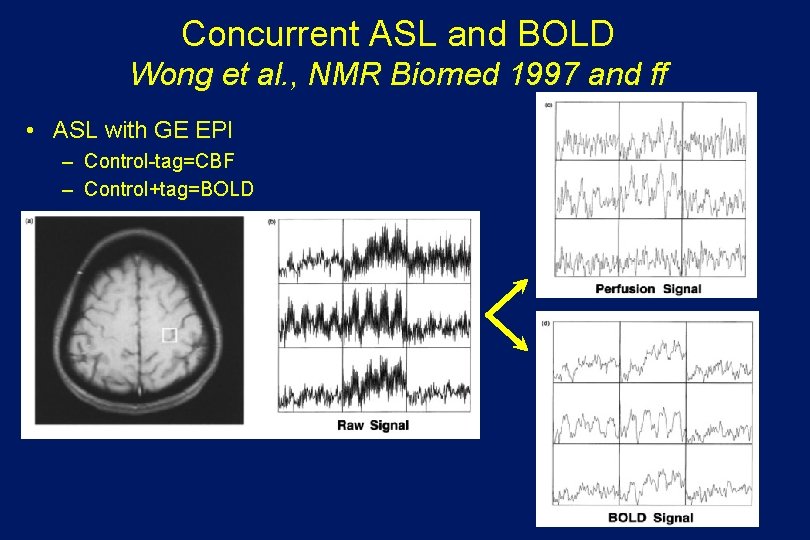
Concurrent ASL and BOLD Wong et al. , NMR Biomed 1997 and ff • ASL with GE EPI – Control-tag=CBF – Control+tag=BOLD
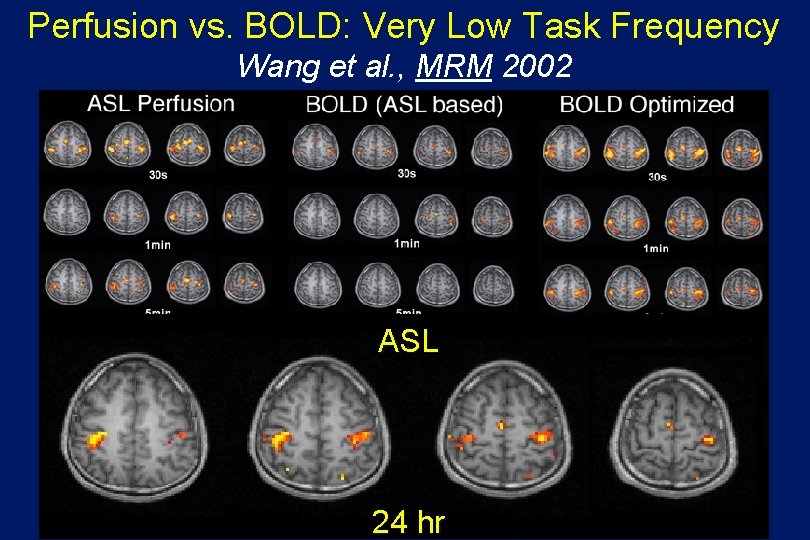
Perfusion vs. BOLD: Very Low Task Frequency Wang et al. , MRM 2002 ASL 24 hr
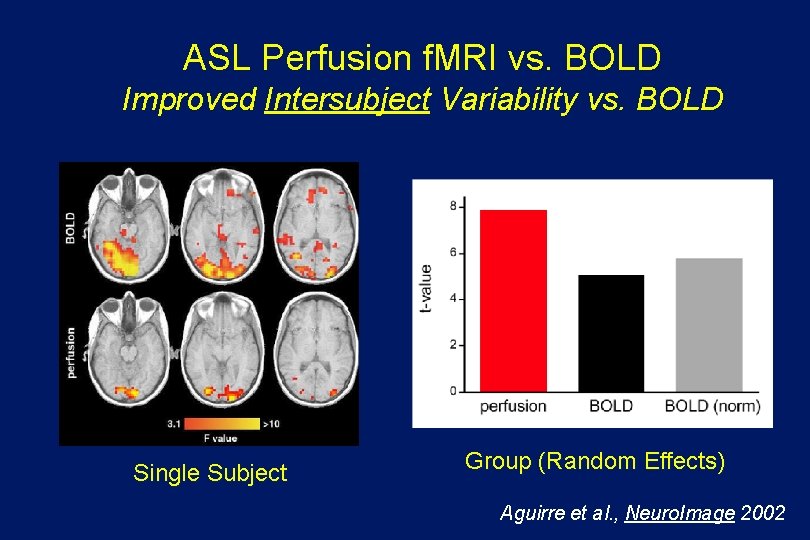
ASL Perfusion f. MRI vs. BOLD Improved Intersubject Variability vs. BOLD Single Subject Group (Random Effects) Aguirre et al. , Neuro. Image 2002
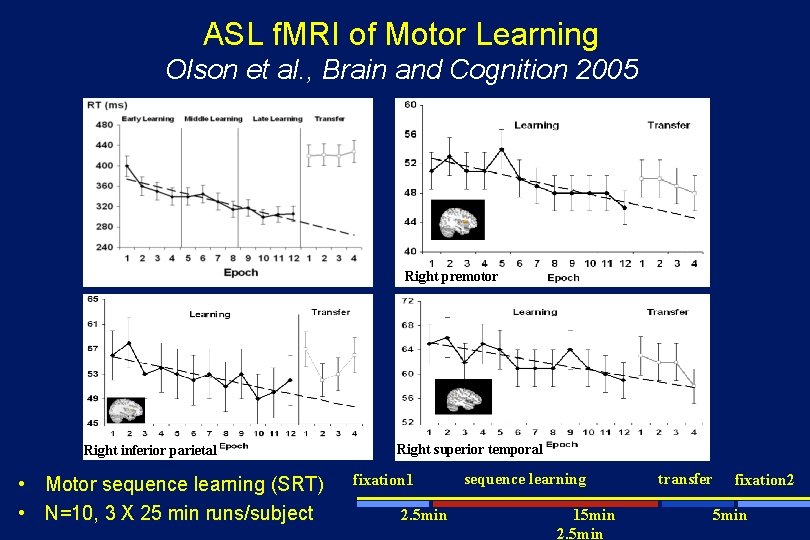
ASL f. MRI of Motor Learning Olson et al. , Brain and Cognition 2005 Right premotor Right inferior parietal • Motor sequence learning (SRT) • N=10, 3 X 25 min runs/subject Right superior temporal fixation 1 2. 5 min sequence learning 15 min 2. 5 min transfer fixation 2 5 min
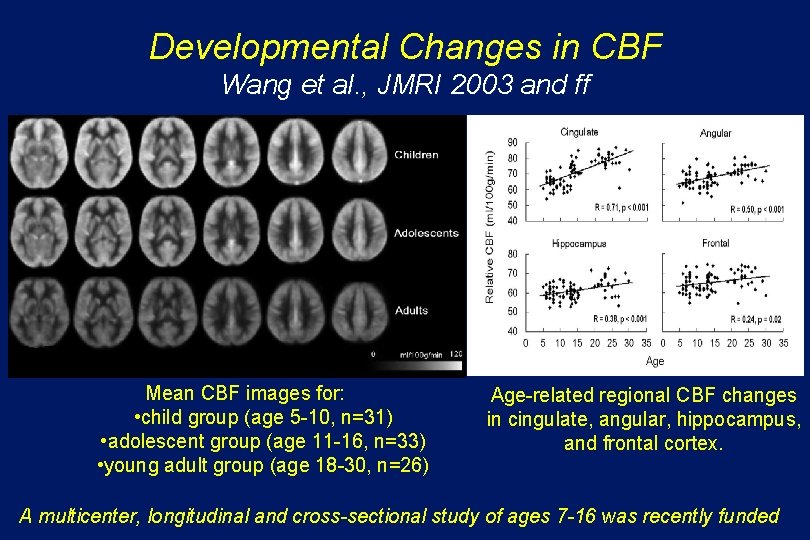
Developmental Changes in CBF Wang et al. , JMRI 2003 and ff Mean CBF images for: • child group (age 5 -10, n=31) • adolescent group (age 11 -16, n=33) • young adult group (age 18 -30, n=26) Age-related regional CBF changes in cingulate, angular, hippocampus, and frontal cortex. A multicenter, longitudinal and cross-sectional study of ages 7 -16 was recently funded
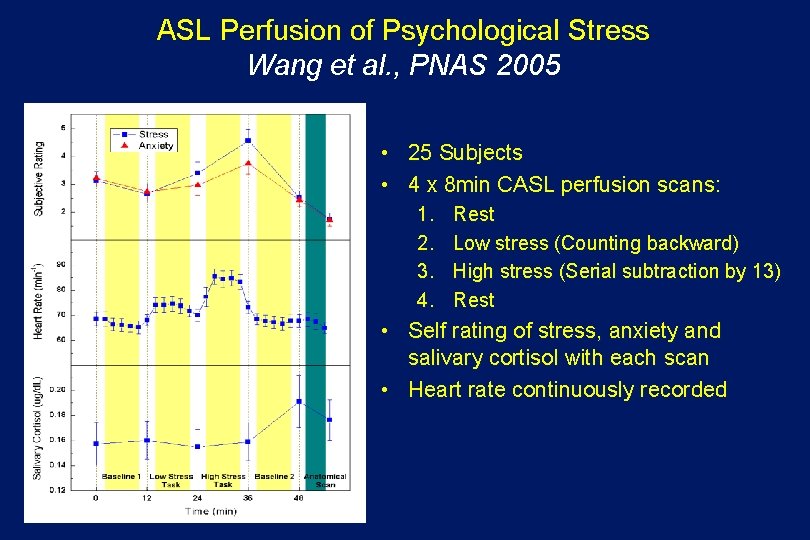
ASL Perfusion of Psychological Stress Wang et al. , PNAS 2005 • • 25 Subjects 4 x 8 min CASL perfusion scans: 1. 2. 3. 4. Rest Low stress (Counting backward) High stress (Serial subtraction by 13) Rest • Self rating of stress, anxiety and salivary cortisol with each scan • Heart rate continuously recorded
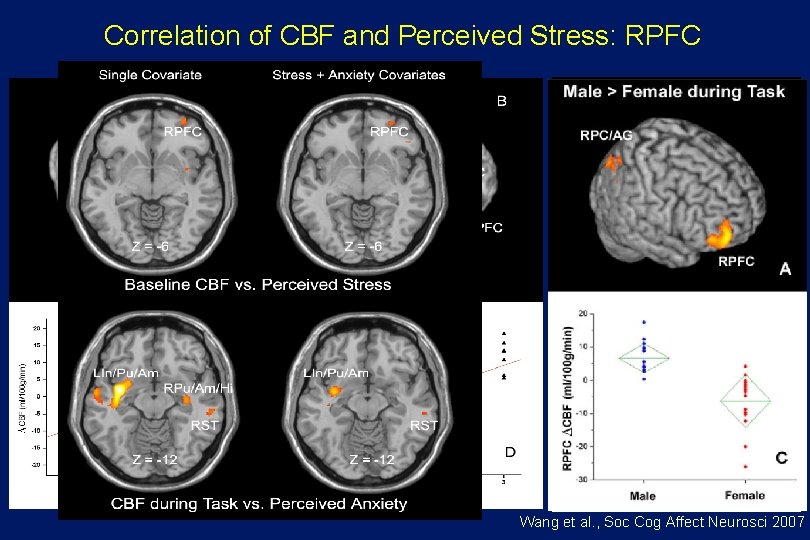
Correlation of CBF and Perceived Stress: RPFC Wang et al. , Soc Cog Affect Neurosci 2007
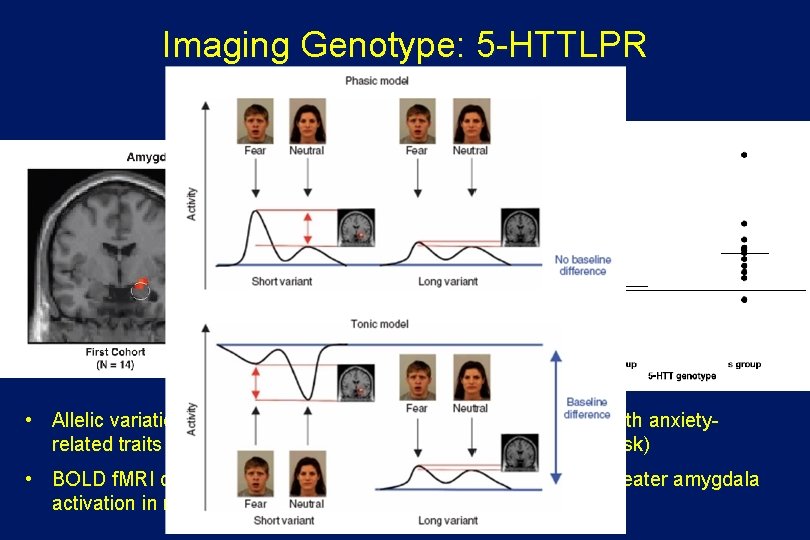
Imaging Genotype: 5 -HTTLPR Hariri et al. , Science 2002 • Allelic variations in serotonin transporter genes are associated with anxietyrelated traits and risk of depression (short allele carries greater risk) • BOLD f. MRI demonstrates that carriers of s allele (vs. l/l) show greater amygdala activation in response to fearful faces
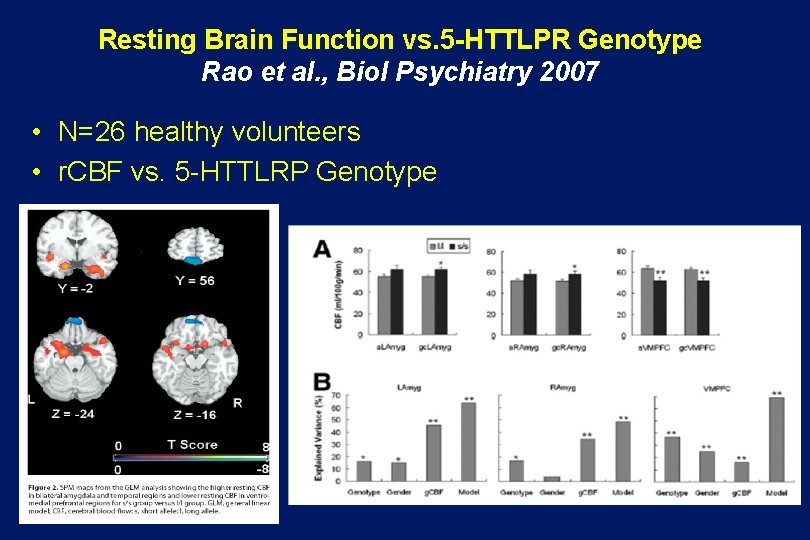
Resting Brain Function vs. 5 -HTTLPR Genotype Rao et al. , Biol Psychiatry 2007 • N=26 healthy volunteers • r. CBF vs. 5 -HTTLRP Genotype
f. MRI Studies of the Neural Substrate for Risk • Risk is a ubiquitous phenomenon – Risk may be assumed or environmental • Some amount of risk-taking is likely beneficial to advancement – Excessive risk-taking may underlie impulse-control disorders such as drug abuse and gambling • Behavioral economics is a “hot” area in social neurobiology that considers human decisionmaking according to principles of risk and reward.
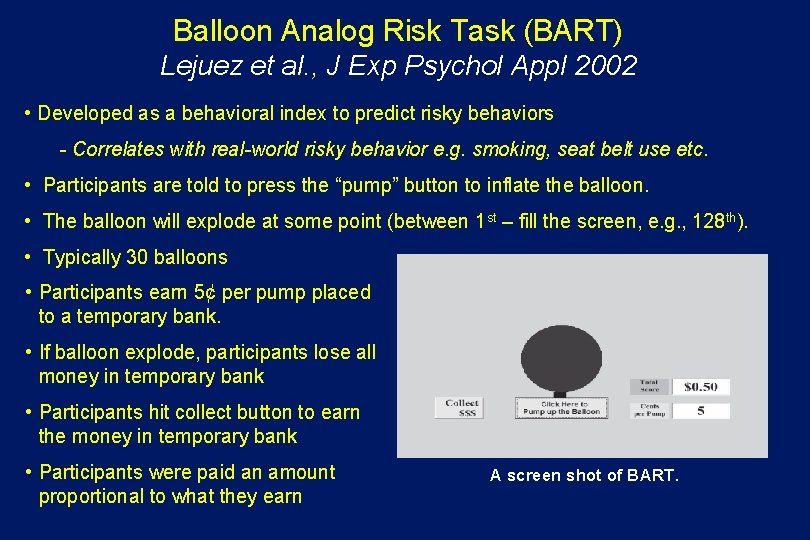
Balloon Analog Risk Task (BART) Lejuez et al. , J Exp Psychol Appl 2002 • Developed as a behavioral index to predict risky behaviors - Correlates with real-world risky behavior e. g. smoking, seat belt use etc. • Participants are told to press the “pump” button to inflate the balloon. • The balloon will explode at some point (between 1 st – fill the screen, e. g. , 128 th). • Typically 30 balloons • Participants earn 5¢ per pump placed to a temporary bank. • If balloon explode, participants lose all money in temporary bank • Participants hit collect button to earn the money in temporary bank • Participants were paid an amount proportional to what they earn A screen shot of BART.
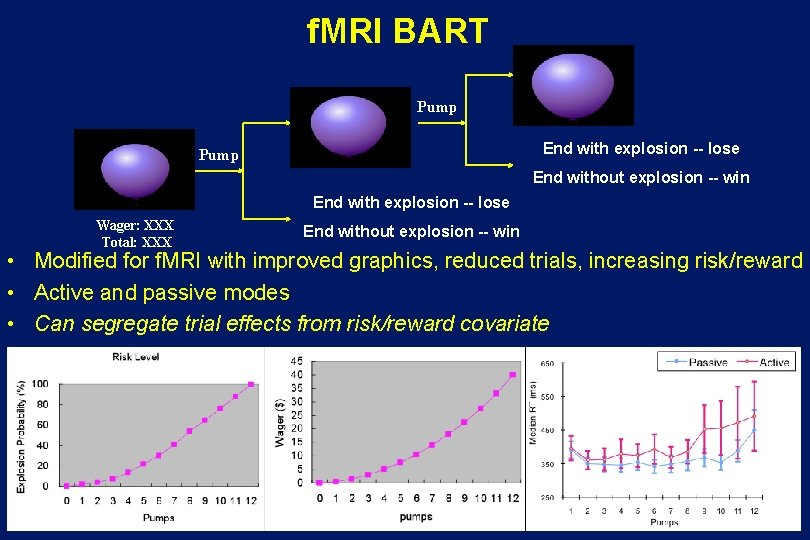
f. MRI BART Pump End with explosion -- lose Pump End without explosion -- win End with explosion -- lose • • • Wager: XXX Total: XXX End without explosion -- win Modified for f. MRI with improved graphics, reduced trials, increasing risk/reward Active and passive modes Can segregate trial effects from risk/reward covariate
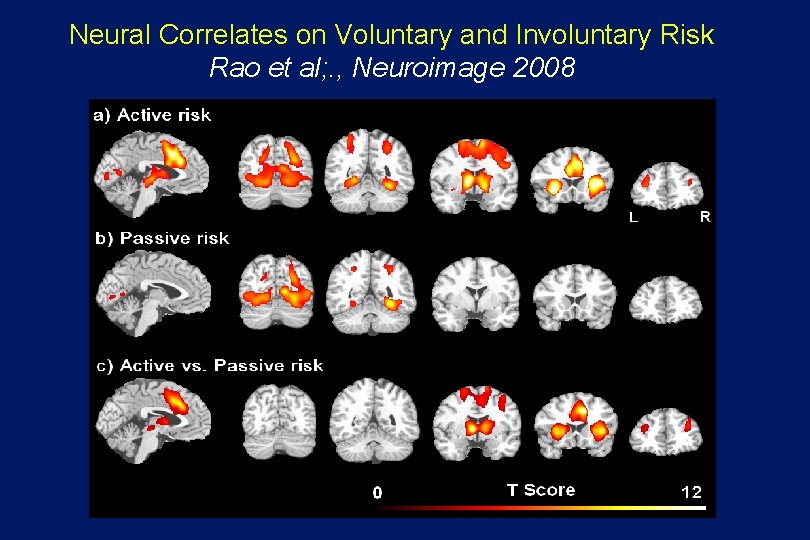
Neural Correlates on Voluntary and Involuntary Risk Rao et al; . , Neuroimage 2008
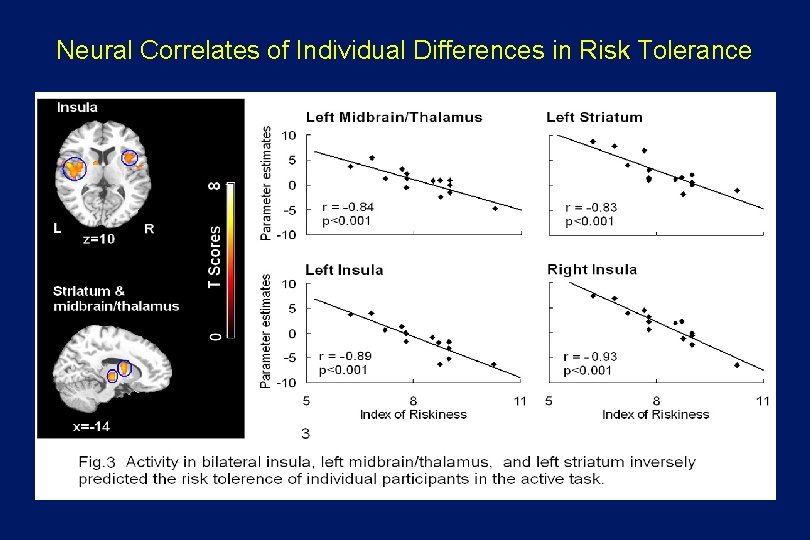
Neural Correlates of Individual Differences in Risk Tolerance R L
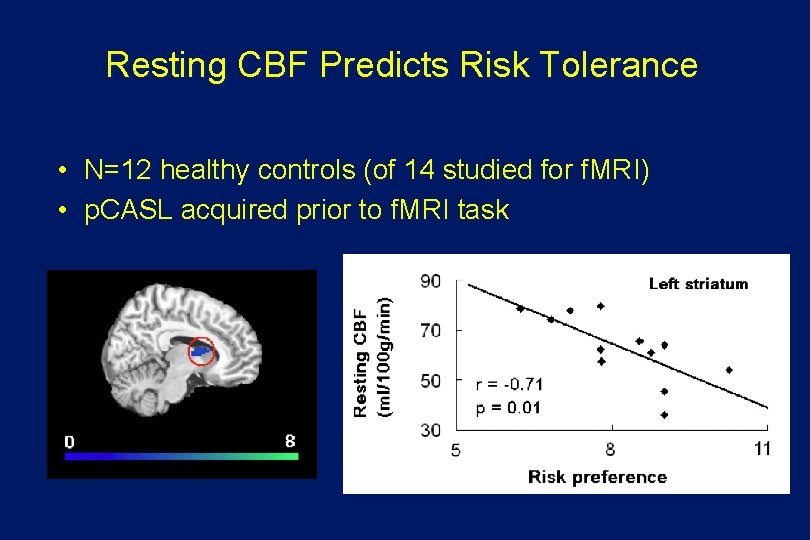
Resting CBF Predicts Risk Tolerance • N=12 healthy controls (of 14 studied for f. MRI) • p. CASL acquired prior to f. MRI task
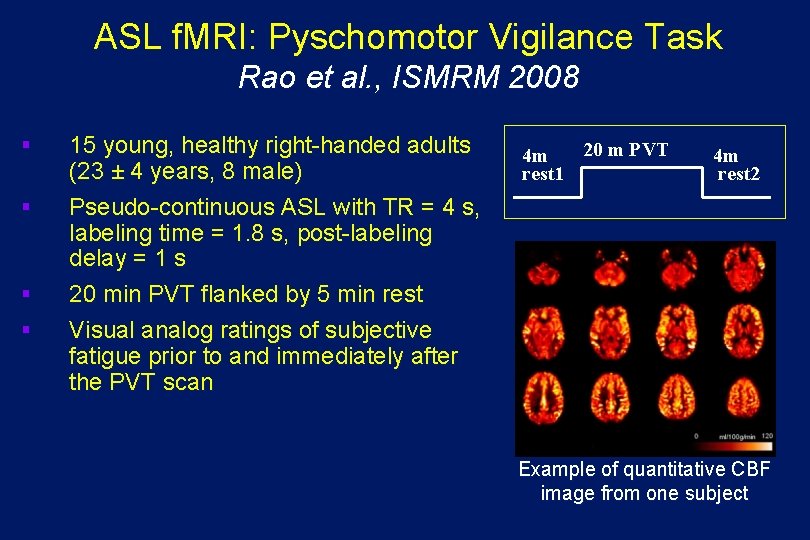
ASL f. MRI: Pyschomotor Vigilance Task Rao et al. , ISMRM 2008 § § 15 young, healthy right-handed adults (23 ± 4 years, 8 male) Pseudo-continuous ASL with TR = 4 s, labeling time = 1. 8 s, post-labeling delay = 1 s 20 min PVT flanked by 5 min rest Visual analog ratings of subjective fatigue prior to and immediately after the PVT scan 20 m PVT 4 m rest 1 4 m rest 2 Example of quantitative CBF image from one subject
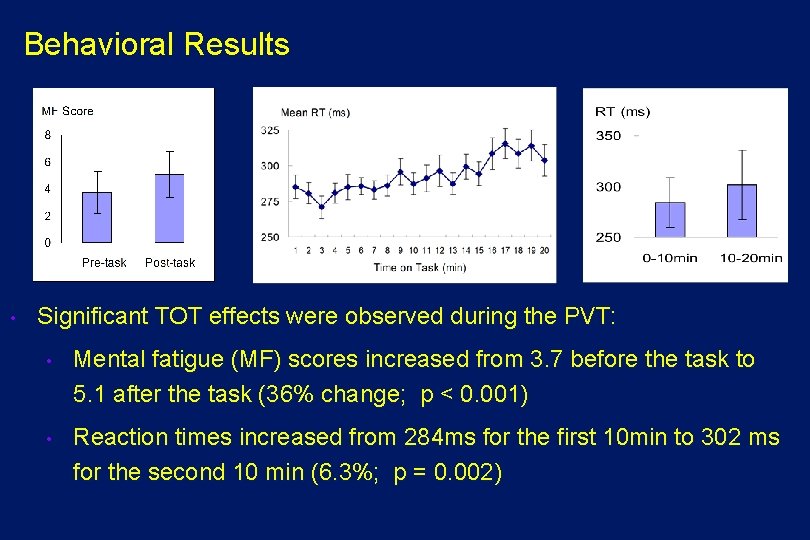
Behavioral Results • Significant TOT effects were observed during the PVT: • Mental fatigue (MF) scores increased from 3. 7 before the task to 5. 1 after the task (36% change; p < 0. 001) • Reaction times increased from 284 ms for the first 10 min to 302 ms for the second 10 min (6. 3%; p = 0. 002)
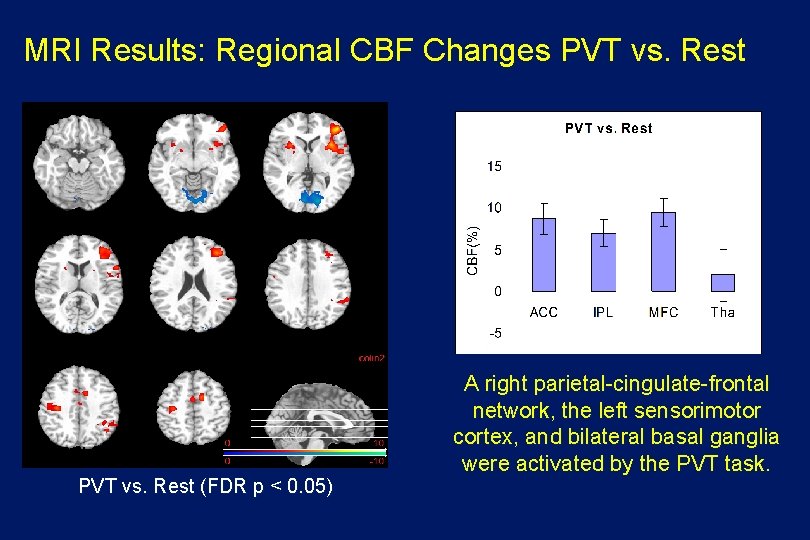
MRI Results: Regional CBF Changes PVT vs. Rest (FDR p < 0. 05) A right parietal-cingulate-frontal network, the left sensorimotor cortex, and bilateral basal ganglia were activated by the PVT task.
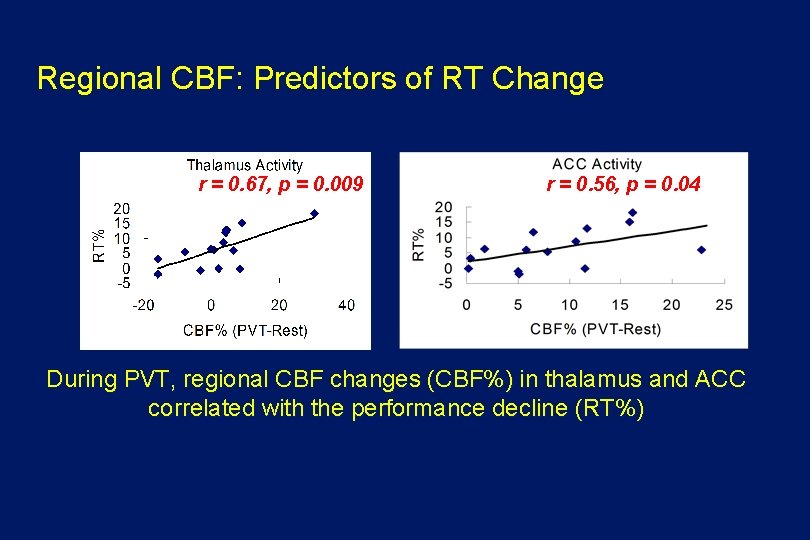
Regional CBF: Predictors of RT Change r = 0. 67, p = 0. 009 r = 0. 56, p = 0. 04 During PVT, regional CBF changes (CBF%) in thalamus and ACC correlated with the performance decline (RT%)
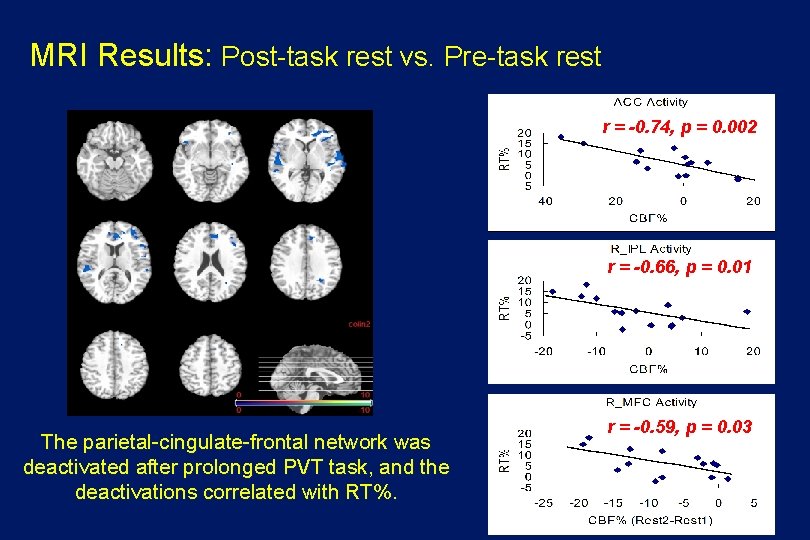
MRI Results: Post-task rest vs. Pre-task rest r = -0. 74, p = 0. 002 r = -0. 66, p = 0. 01 The parietal-cingulate-frontal network was deactivated after prolonged PVT task, and the deactivations correlated with RT%. r = -0. 59, p = 0. 03
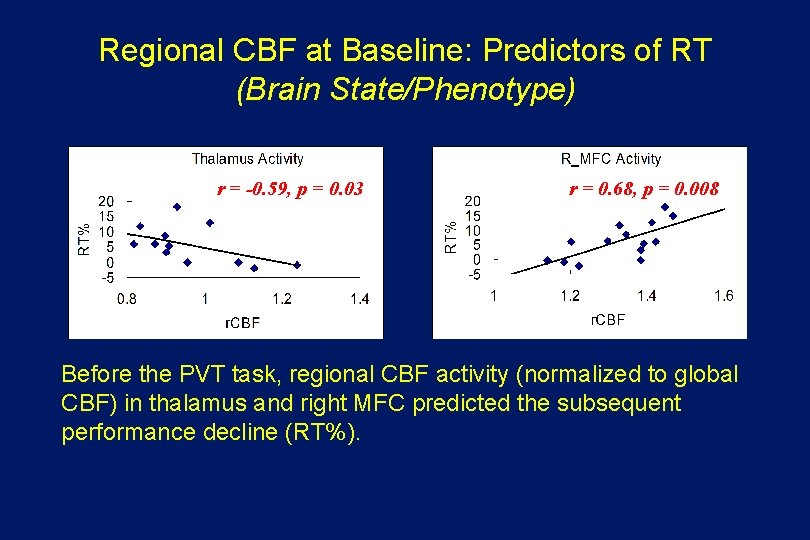
Regional CBF at Baseline: Predictors of RT (Brain State/Phenotype) r = -0. 59, p = 0. 03 r = 0. 68, p = 0. 008 Before the PVT task, regional CBF activity (normalized to global CBF) in thalamus and right MFC predicted the subsequent performance decline (RT%).
ASL CBF as a Biomarker of Brain Function • Can measure “function” during rest, state, or task – Can measure cognitive, affective, or pharmacological state – Also shows correlations with genotype/phenotype (traits) – Complementary to BOLD f. MRI studies of “events” • Quantifies a biological parameter (CBF) – CBF coupled to neural activity (both magnitude and location) – CBF is better localized than BOLD (so far only for animal studies) – Theoretically insensitive to scanning parameters, scanner platform, and field strength - should be ideal for multisite or longitudinal studies • Future Directions – Optimization of the “resting” state – Ultra-high field ASL to improve sensitivity
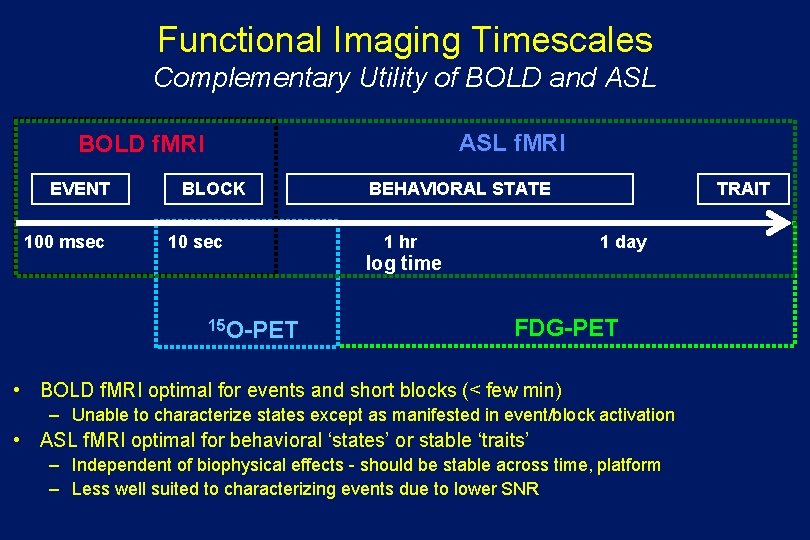
Functional Imaging Timescales Complementary Utility of BOLD and ASL f. MRI BOLD f. MRI EVENT 100 msec BLOCK 10 sec 15 O-PET BEHAVIORAL STATE 1 hr TRAIT 1 day log time FDG-PET • BOLD f. MRI optimal for events and short blocks (< few min) – Unable to characterize states except as manifested in event/block activation • ASL f. MRI optimal for behavioral ‘states’ or stable ‘traits’ – Independent of biophysical effects - should be stable across time, platform – Less well suited to characterizing events due to lower SNR
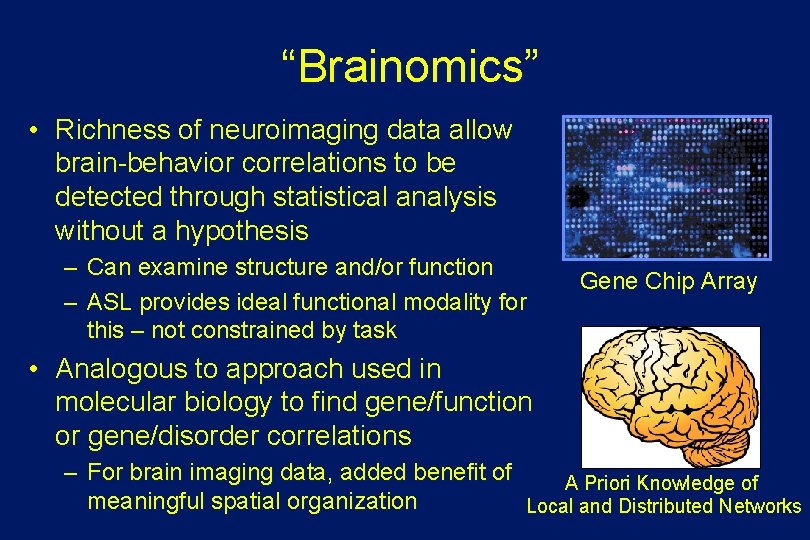
“Brainomics” • Richness of neuroimaging data allow brain-behavior correlations to be detected through statistical analysis without a hypothesis – Can examine structure and/or function – ASL provides ideal functional modality for this – not constrained by task Gene Chip Array • Analogous to approach used in molecular biology to find gene/function or gene/disorder correlations – For brain imaging data, added benefit of A Priori Knowledge of meaningful spatial organization Local and Distributed Networks
- Slides: 47