
Imagery Rescripting and Dual Representation Theory Chris R
- Slides: 32
Imagery Rescripting and Dual Representation Theory Chris R. Brewin Traumatic Stress Clinic Camden & Islington Mental Health and Social Care Trust Subdepartment of Clinical Health Psychology, UCL November 2005 © Chris R. Brewin©
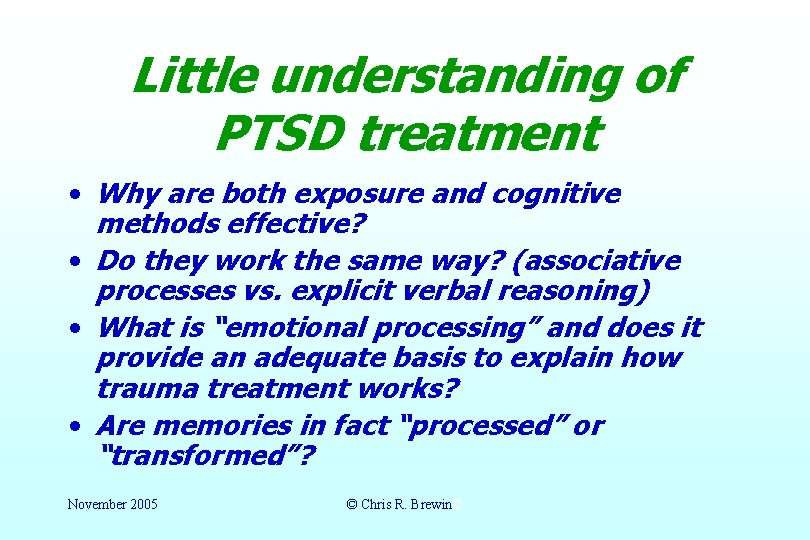
Little understanding of PTSD treatment • Why are both exposure and cognitive methods effective? • Do they work the same way? (associative processes vs. explicit verbal reasoning) • What is “emotional processing” and does it provide an adequate basis to explain how trauma treatment works? • Are memories in fact “processed” or “transformed”? November 2005 © Chris R. Brewin©
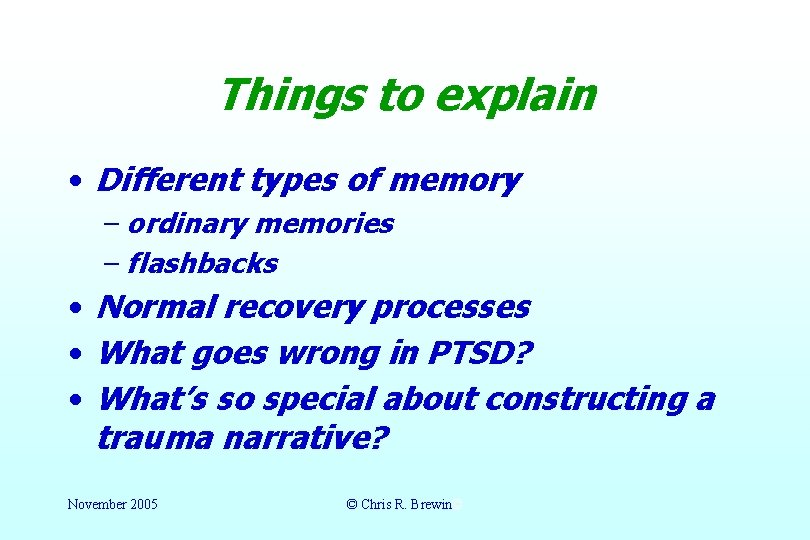
Things to explain • Different types of memory – ordinary memories – flashbacks • Normal recovery processes • What goes wrong in PTSD? • What’s so special about constructing a trauma narrative? November 2005 © Chris R. Brewin©
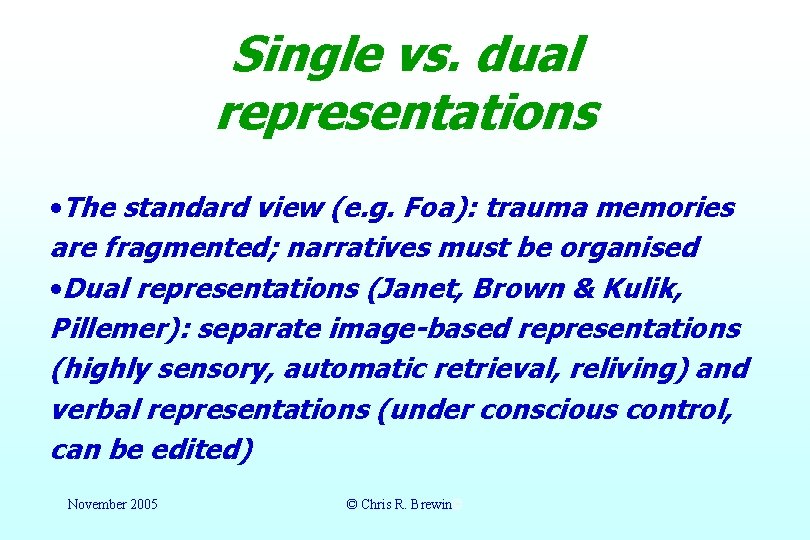
Single vs. dual representations • The standard view (e. g. Foa): trauma memories are fragmented; narratives must be organised • Dual representations (Janet, Brown & Kulik, Pillemer): separate image-based representations (highly sensory, automatic retrieval, reliving) and verbal representations (under conscious control, can be edited) November 2005 © Chris R. Brewin©
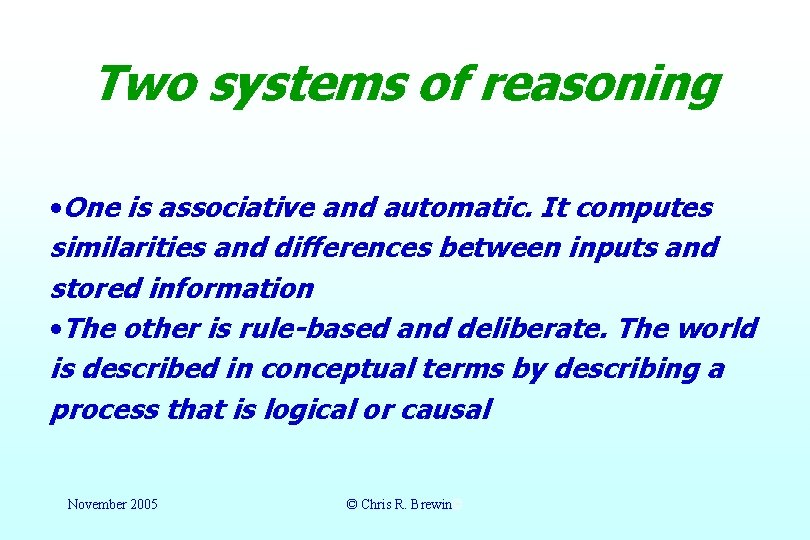
Two systems of reasoning • One is associative and automatic. It computes similarities and differences between inputs and stored information • The other is rule-based and deliberate. The world is described in conceptual terms by describing a process that is logical or causal November 2005 © Chris R. Brewin©
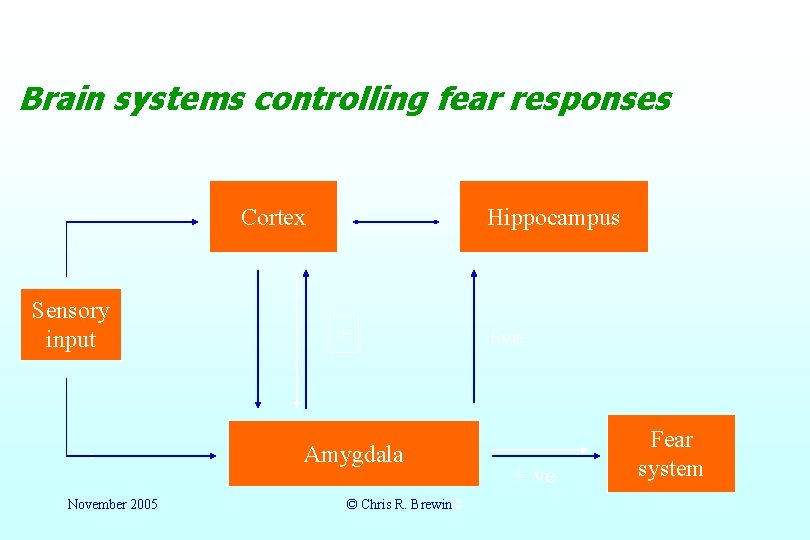
Brain systems controlling fear responses Cortex Sensory input Hippocampus + Amygdala November 2005 © Chris R. Brewin© +ve + ve Fear system
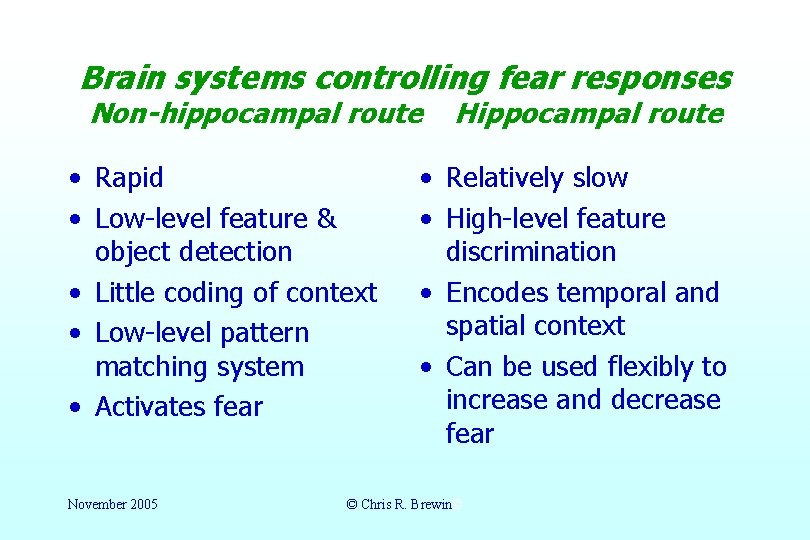
Brain systems controlling fear responses Non-hippocampal route • Rapid • Low-level feature & object detection • Little coding of context • Low-level pattern matching system • Activates fear November 2005 Hippocampal route • Relatively slow • High-level feature discrimination • Encodes temporal and spatial context • Can be used flexibly to increase and decrease fear © Chris R. Brewin©
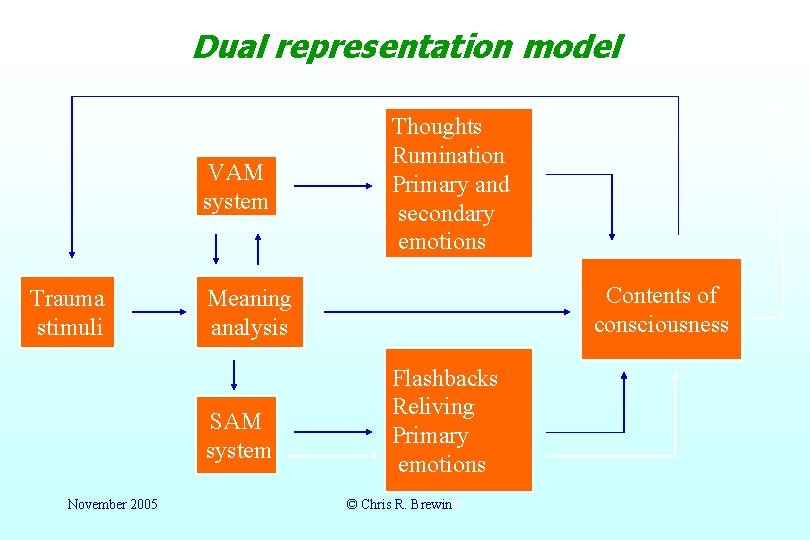
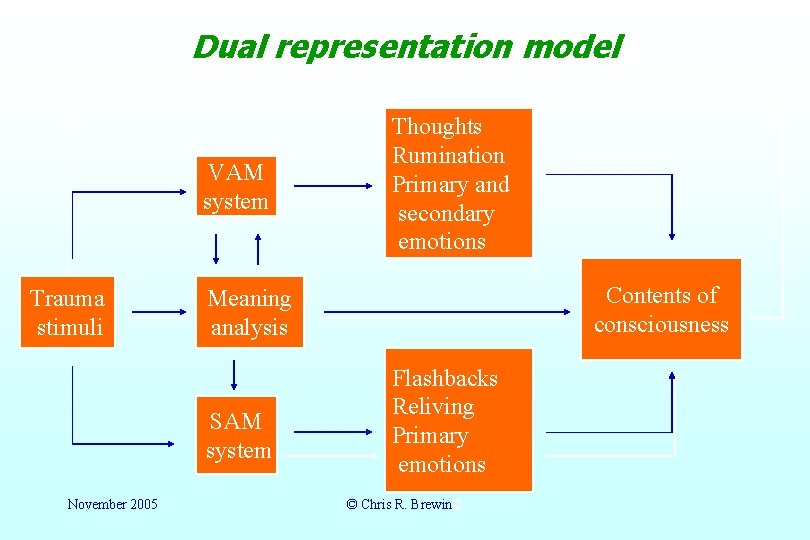
Dual representation model VAM system Trauma stimuli Contents of consciousness Meaning analysis SAM system November 2005 Thoughts Rumination Primary and secondary emotions Flashbacks Reliving Primary emotions © Chris R. Brewin©
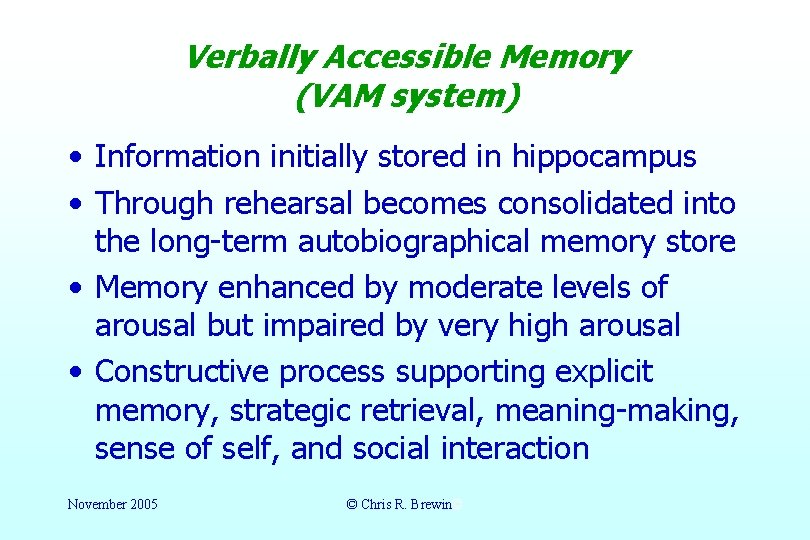
Verbally Accessible Memory (VAM system) • Information initially stored in hippocampus • Through rehearsal becomes consolidated into the long-term autobiographical memory store • Memory enhanced by moderate levels of arousal but impaired by very high arousal • Constructive process supporting explicit memory, strategic retrieval, meaning-making, sense of self, and social interaction November 2005 © Chris R. Brewin©
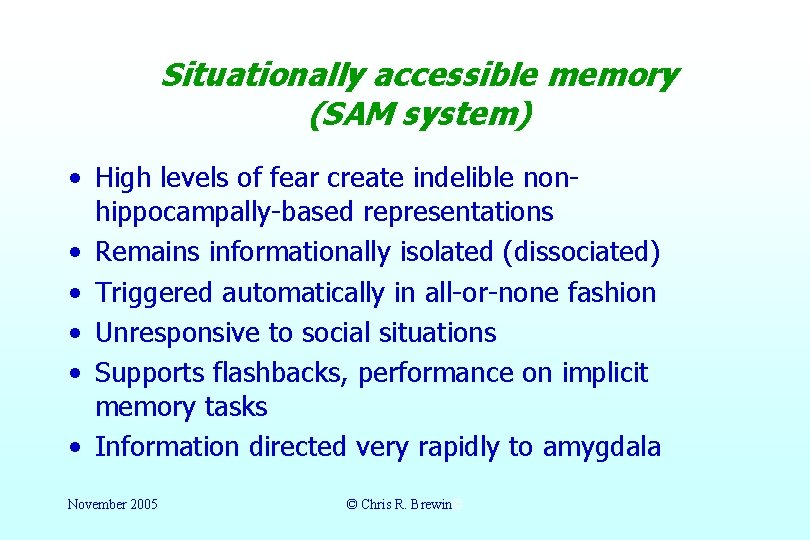
Situationally accessible memory (SAM system) • High levels of fear create indelible nonhippocampally-based representations • Remains informationally isolated (dissociated) • Triggered automatically in all-or-none fashion • Unresponsive to social situations • Supports flashbacks, performance on implicit memory tasks • Information directed very rapidly to amygdala November 2005 © Chris R. Brewin©
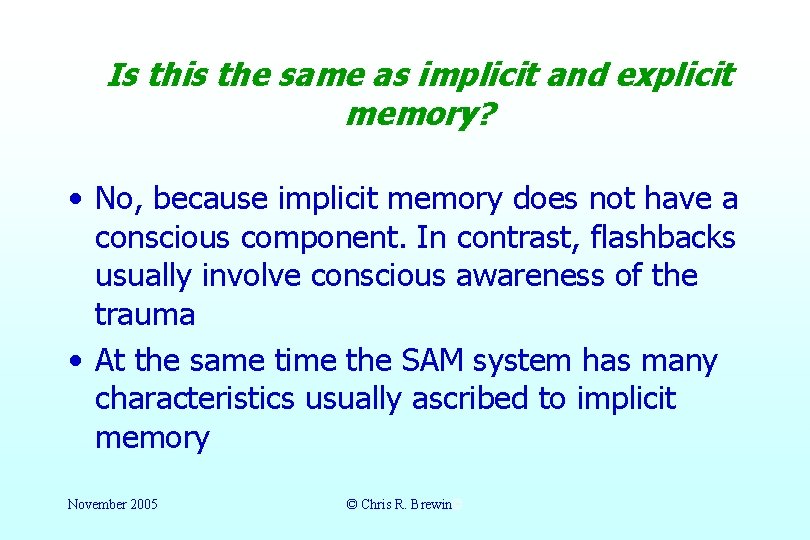
Is this the same as implicit and explicit memory? • No, because implicit memory does not have a conscious component. In contrast, flashbacks usually involve conscious awareness of the trauma • At the same time the SAM system has many characteristics usually ascribed to implicit memory November 2005 © Chris R. Brewin©
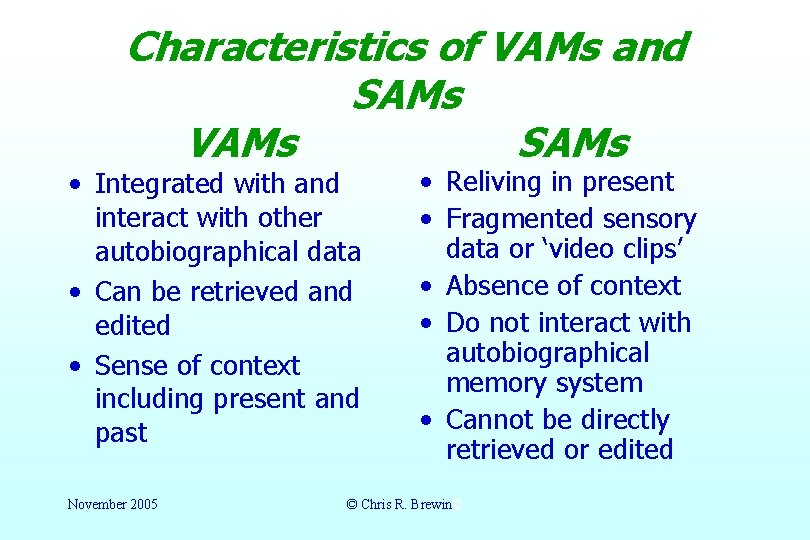
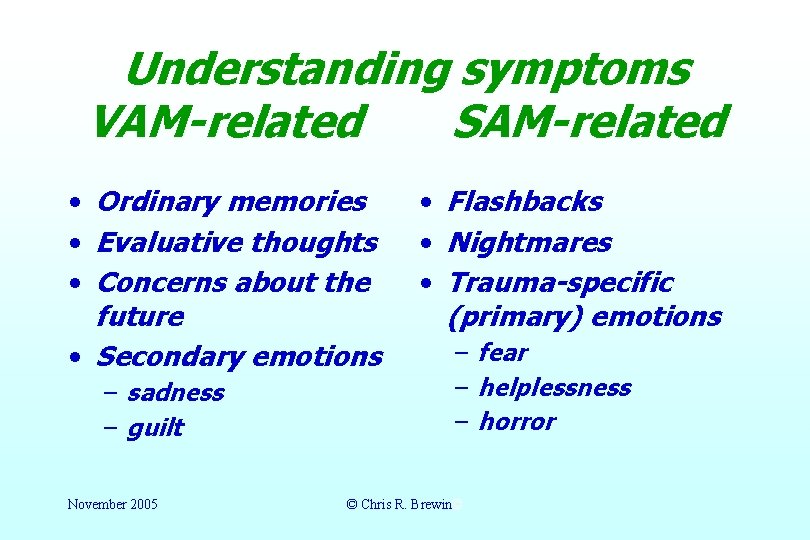
Characteristics of VAMs and SAMs VAMs SAMs • Integrated with and interact with other autobiographical data • Can be retrieved and edited • Sense of context including present and past November 2005 • Reliving in present • Fragmented sensory data or ‘video clips’ • Absence of context • Do not interact with autobiographical memory system • Cannot be directly retrieved or edited © Chris R. Brewin©
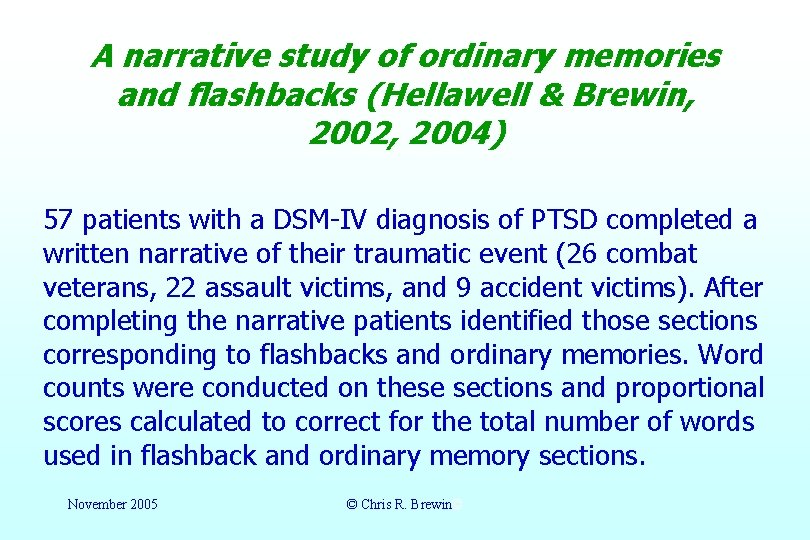
A narrative study of ordinary memories and flashbacks (Hellawell & Brewin, 2002, 2004) 57 patients with a DSM-IV diagnosis of PTSD completed a written narrative of their traumatic event (26 combat veterans, 22 assault victims, and 9 accident victims). After completing the narrative patients identified those sections corresponding to flashbacks and ordinary memories. Word counts were conducted on these sections and proportional scores calculated to correct for the total number of words used in flashback and ordinary memory sections. November 2005 © Chris R. Brewin©
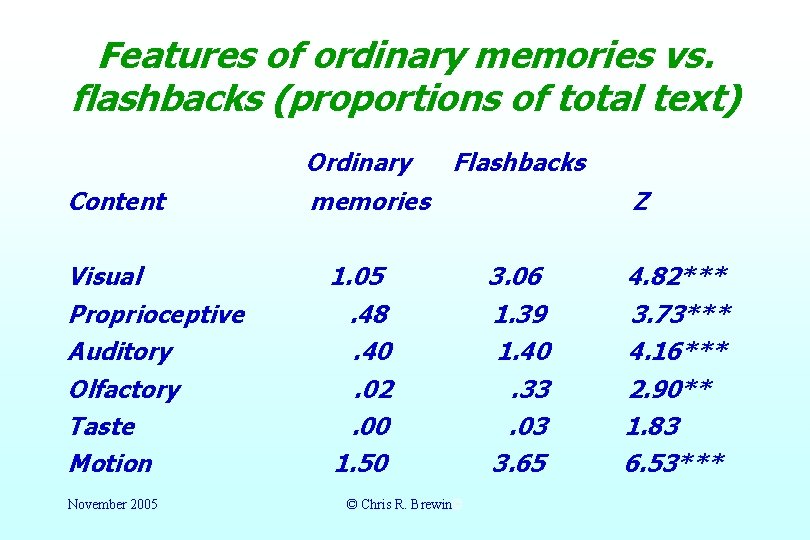
Features of ordinary memories vs. flashbacks (proportions of total text) Ordinary Content Visual Proprioceptive Auditory Olfactory Taste Motion November 2005 Flashbacks memories 1. 05. 48. 40. 02. 00 1. 50 © Chris R. Brewin© Z 3. 06 1. 39 1. 40. 33. 03 3. 65 4. 82*** 3. 73*** 4. 16*** 2. 90** 1. 83 6. 53***
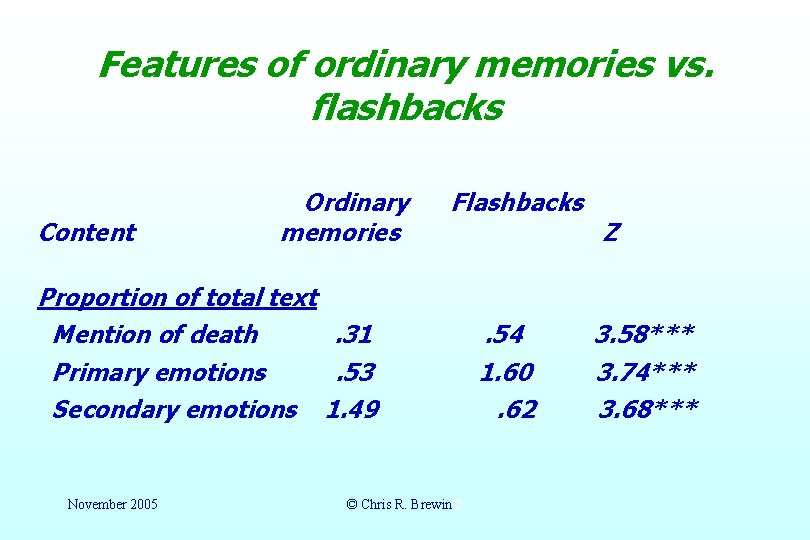
Features of ordinary memories vs. flashbacks Ordinary Content memories Flashbacks Proportion of total text Mention of death. 31 Primary emotions. 53 Secondary emotions 1. 49 November 2005 © Chris R. Brewin© . 54 1. 60. 62 Z 3. 58*** 3. 74*** 3. 68***
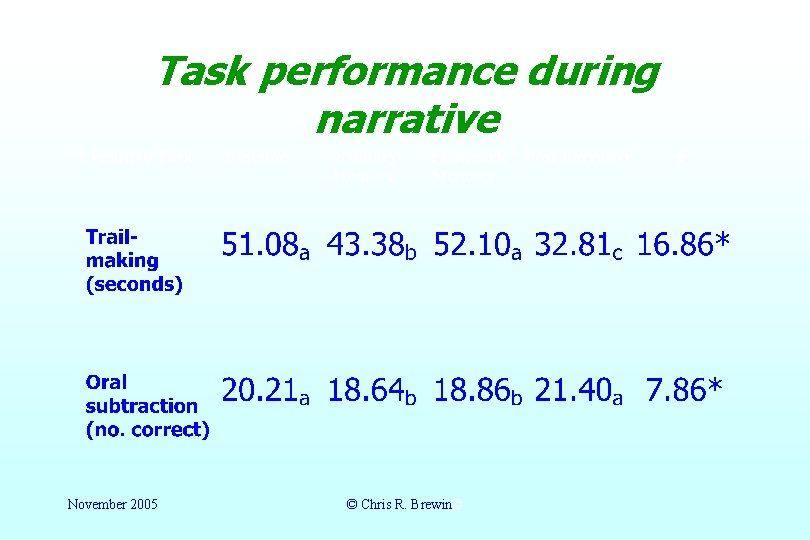
Task performance during narrative November 2005 © Chris R. Brewin©
Understanding symptoms VAM-related SAM-related • Ordinary memories • Evaluative thoughts • Concerns about the future • Secondary emotions – sadness – guilt November 2005 • Flashbacks • Nightmares • Trauma-specific (primary) emotions – fear – helplessness – horror © Chris R. Brewin©
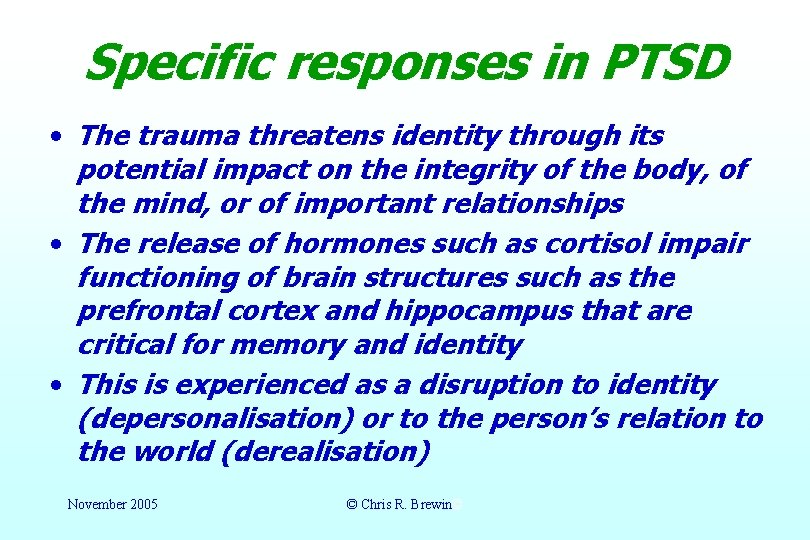
Specific responses in PTSD • The trauma threatens identity through its potential impact on the integrity of the body, of the mind, or of important relationships • The release of hormones such as cortisol impair functioning of brain structures such as the prefrontal cortex and hippocampus that are critical for memory and identity • This is experienced as a disruption to identity (depersonalisation) or to the person’s relation to the world (derealisation) November 2005 © Chris R. Brewin©
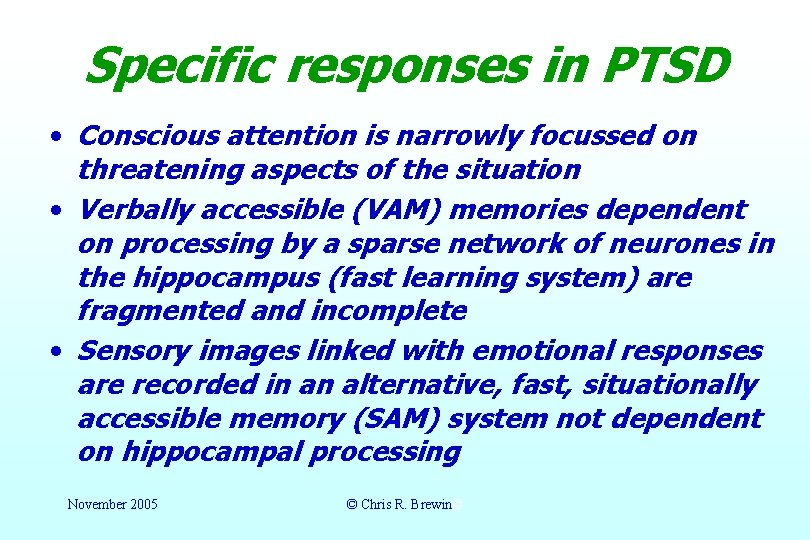
Specific responses in PTSD • Conscious attention is narrowly focussed on threatening aspects of the situation • Verbally accessible (VAM) memories dependent on processing by a sparse network of neurones in the hippocampus (fast learning system) are fragmented and incomplete • Sensory images linked with emotional responses are recorded in an alternative, fast, situationally accessible memory (SAM) system not dependent on hippocampal processing November 2005 © Chris R. Brewin©
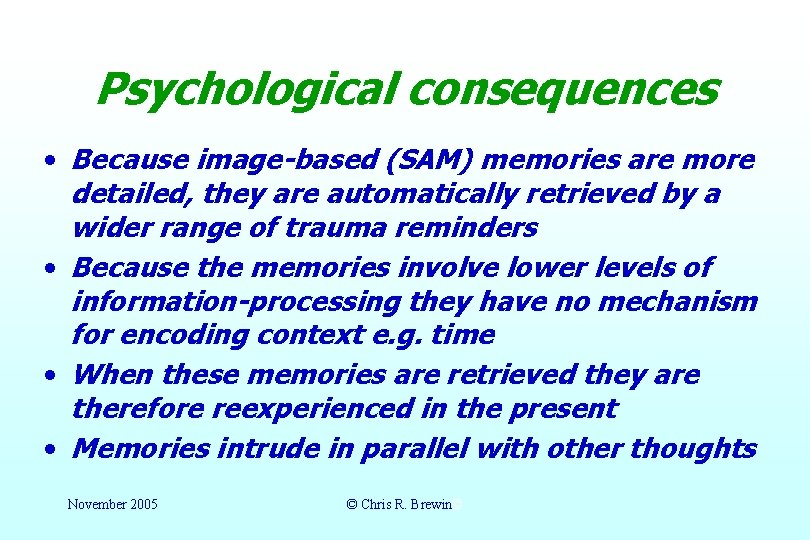
Psychological consequences • Because image-based (SAM) memories are more detailed, they are automatically retrieved by a wider range of trauma reminders • Because the memories involve lower levels of information-processing they have no mechanism for encoding context e. g. time • When these memories are retrieved they are therefore reexperienced in the present • Memories intrude in parallel with other thoughts November 2005 © Chris R. Brewin©
Normal recovery process - 1 • Traumatic information laid down in VAM (limited) and SAM memory systems • Over next few days flashbacks lead to copying of extra information from the SAM to the VAM system • Limited capacity system means little information transferred at one time November 2005 © Chris R. Brewin©
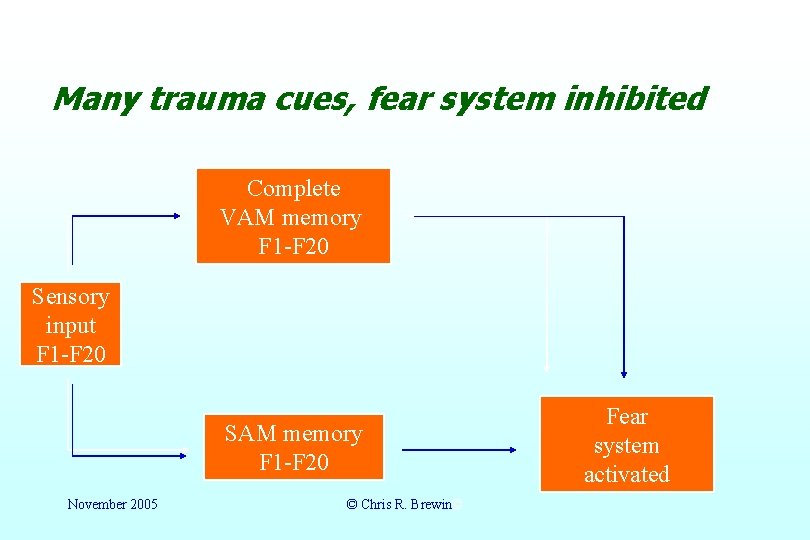
Normal recovery process - 2 • VAM memory creates copies locating context and time • Trauma reminders lead to retrieval competition between SAM memories and VAM copies • If good match to SAM memories, VAM copies begin to inhibit amygdala from responding inappropriately November 2005 © Chris R. Brewin©
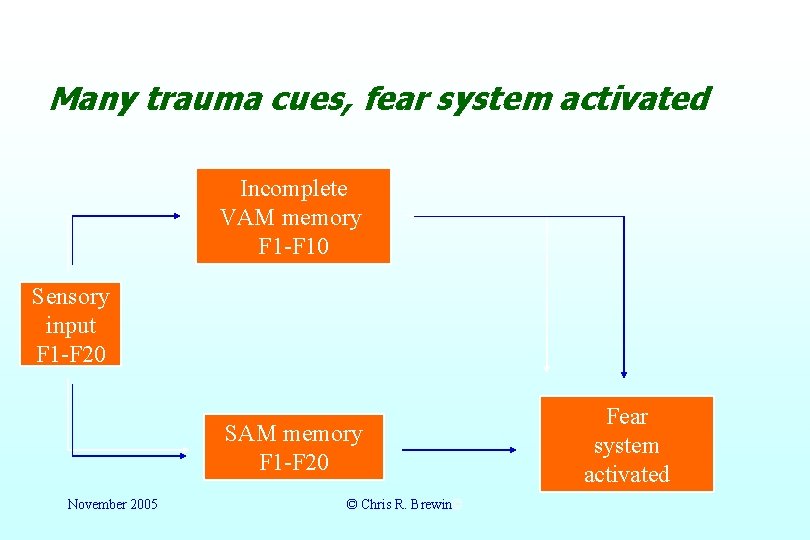
Many trauma cues, fear system activated Incomplete VAM memory F 1 -F 10 Sensory input F 1 -F 20 SAM memory F 1 -F 20 November 2005 © Chris R. Brewin© Fear system activated
Dual representation model VAM system Trauma stimuli Contents of consciousness Meaning analysis SAM system November 2005 Thoughts Rumination Primary and secondary emotions Flashbacks Reliving Primary emotions © Chris R. Brewin©
Many trauma cues, fear system inhibited Complete VAM memory F 1 -F 20 Sensory input F 1 -F 20 SAM memory F 1 -F 20 November 2005 © Chris R. Brewin© Fear system activated
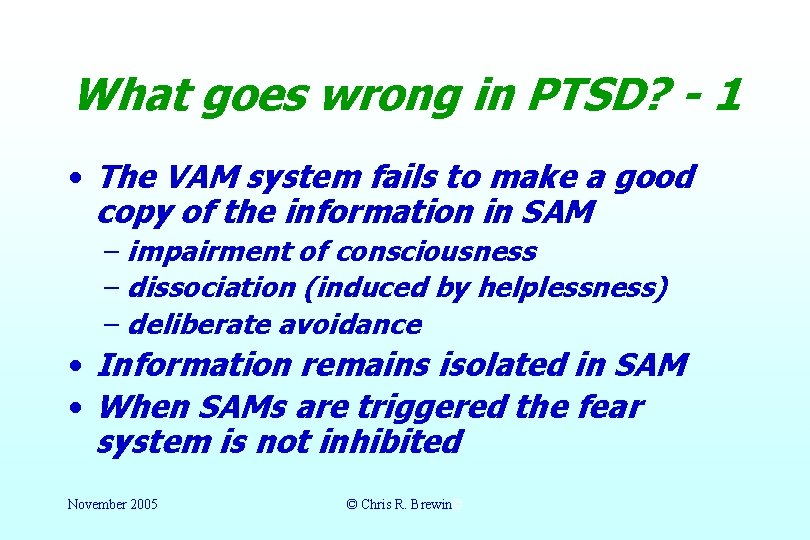
What goes wrong in PTSD? - 1 • The VAM system fails to make a good copy of the information in SAM – impairment of consciousness – dissociation (induced by helplessness) – deliberate avoidance • Information remains isolated in SAM • When SAMs are triggered the fear system is not inhibited November 2005 © Chris R. Brewin©
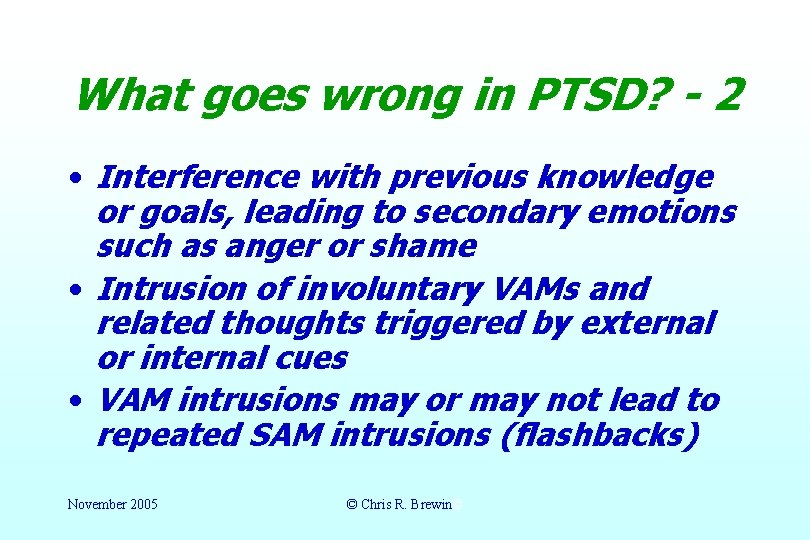
What goes wrong in PTSD? - 2 • Interference with previous knowledge or goals, leading to secondary emotions such as anger or shame • Intrusion of involuntary VAMs and related thoughts triggered by external or internal cues • VAM intrusions may or may not lead to repeated SAM intrusions (flashbacks) November 2005 © Chris R. Brewin©
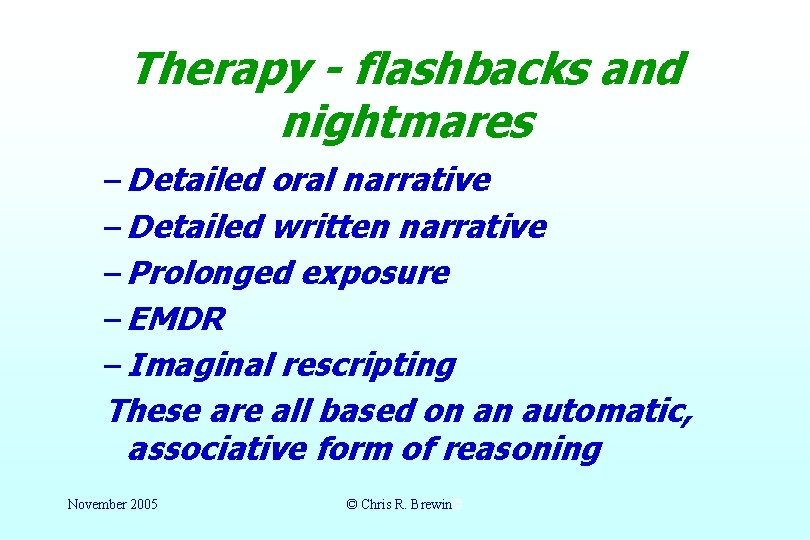
Therapy - flashbacks and nightmares – Detailed oral narrative – Detailed written narrative – Prolonged exposure – EMDR – Imaginal rescripting These are all based on an automatic, associative form of reasoning November 2005 © Chris R. Brewin©
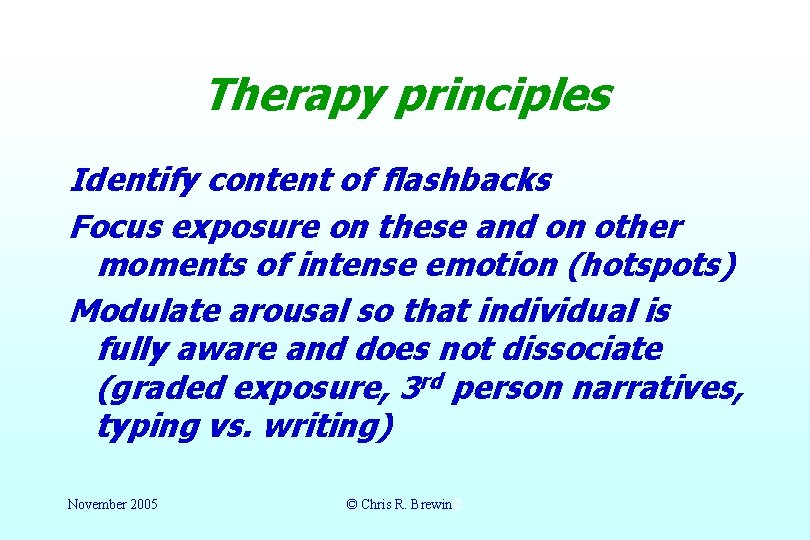
Therapy principles Identify content of flashbacks Focus exposure on these and on other moments of intense emotion (hotspots) Modulate arousal so that individual is fully aware and does not dissociate (graded exposure, 3 rd person narratives, typing vs. writing) November 2005 © Chris R. Brewin©
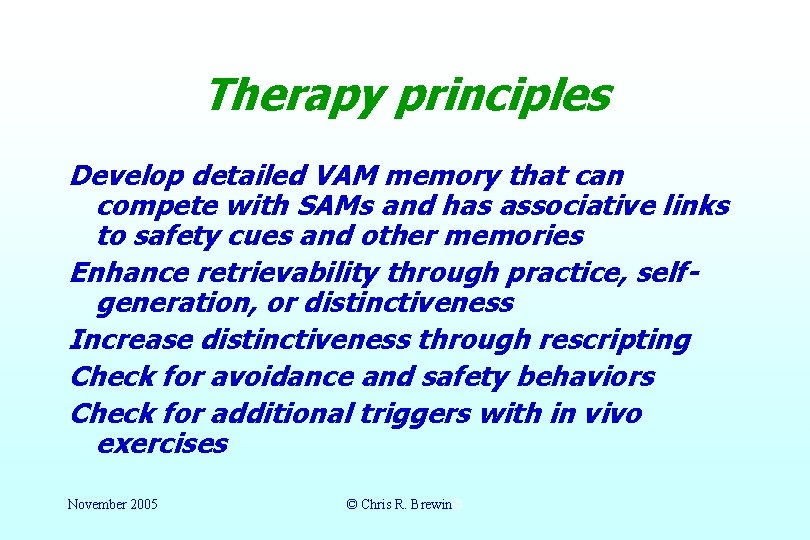
Therapy principles Develop detailed VAM memory that can compete with SAMs and has associative links to safety cues and other memories Enhance retrievability through practice, selfgeneration, or distinctiveness Increase distinctiveness through rescripting Check for avoidance and safety behaviors Check for additional triggers with in vivo exercises November 2005 © Chris R. Brewin©
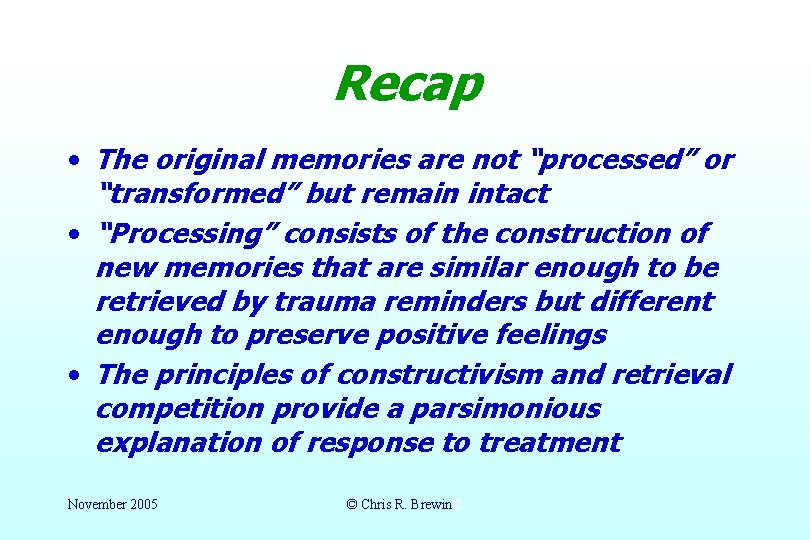
Recap • The original memories are not “processed” or “transformed” but remain intact • “Processing” consists of the construction of new memories that are similar enough to be retrieved by trauma reminders but different enough to preserve positive feelings • The principles of constructivism and retrieval competition provide a parsimonious explanation of response to treatment November 2005 © Chris R. Brewin©
“ Bibliography Brewin, C. R. (2003). Posttraumatic stress disorder: Malady or myth? New Haven: Yale University Press. Brewin, C. R. (2001). A cognitive neuroscience account of posttraumatic stress disorder and its treatment. Behaviour Research and Therapy, 39, 373 -393. Hellawell, S. J. & Brewin, C. R. (2002). A comparison of flashbacks and ordinary autobiographical memories of trauma: Cognitive resources and behavioural observations. Behaviour Research and Therapy, 40, 1139 -1152. Hellawell, S. J. & Brewin, C. R. (2004). A comparison of flashbacks and ordinary autobiographical memories of trauma: Content and language. Behaviour Research and Therapy, 42, 1 -12. Holmes, E. A. , Brewin, C. R. , & Hennessy, R. G. (2004). Trauma films, information processing, and intrusive memory development. Journal of Experimental Psychology: General, 133, 3 -22. November 2005 © Chris R. Brewin©