
Image Quilting for Texture Synthesis Transfer Alexei Efros




- Slides: 34
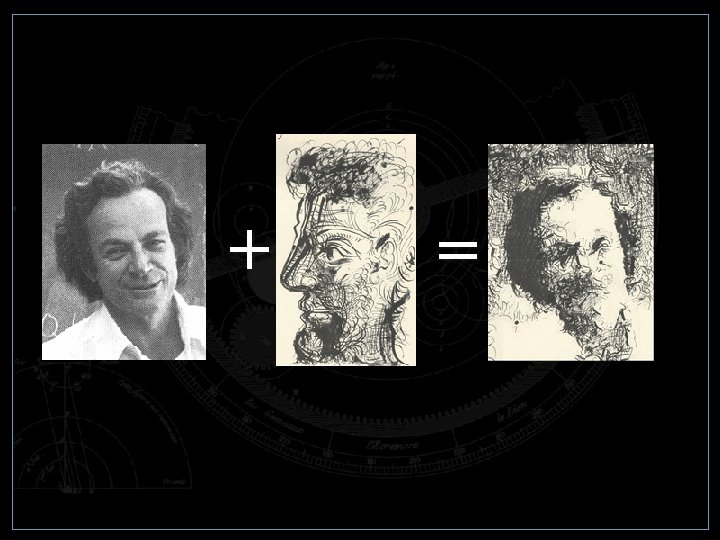
+ = Image Quilting for Texture Synthesis & Transfer Alexei Efros (UC Berkeley) Bill Freeman (MERL)
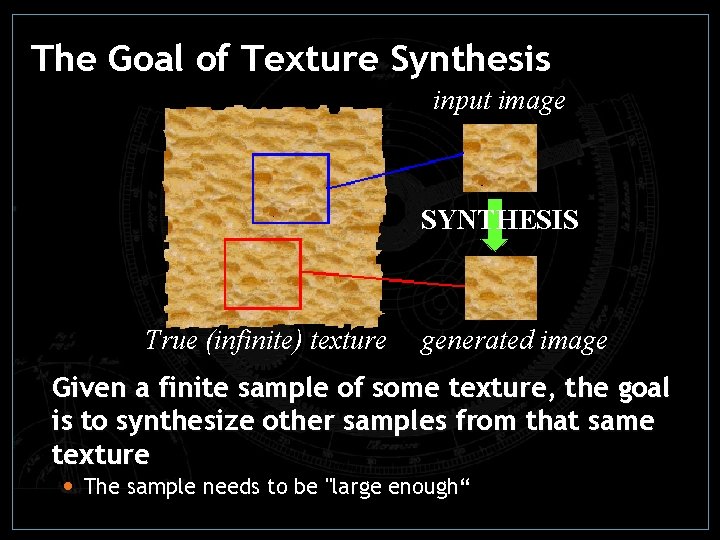
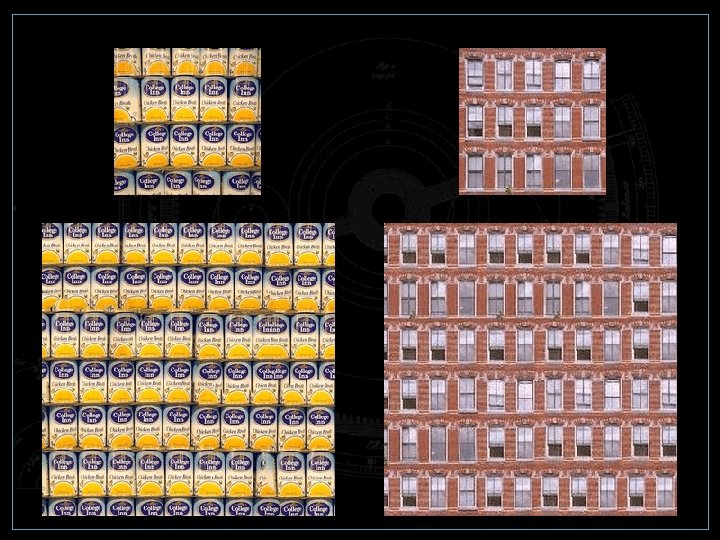
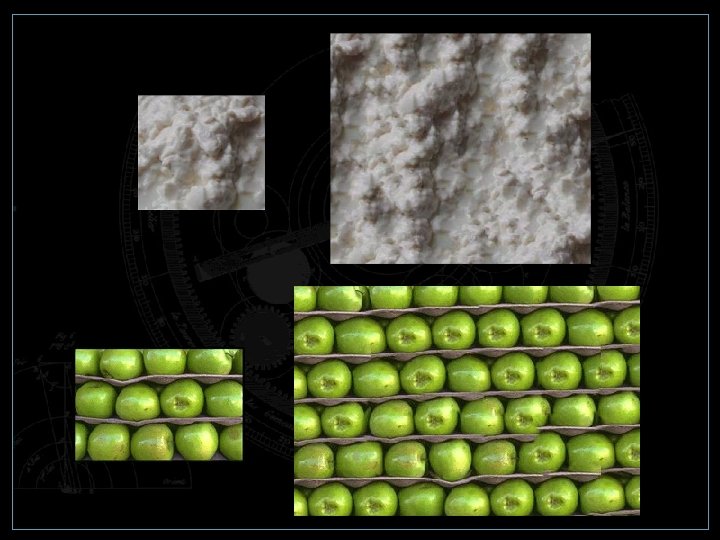
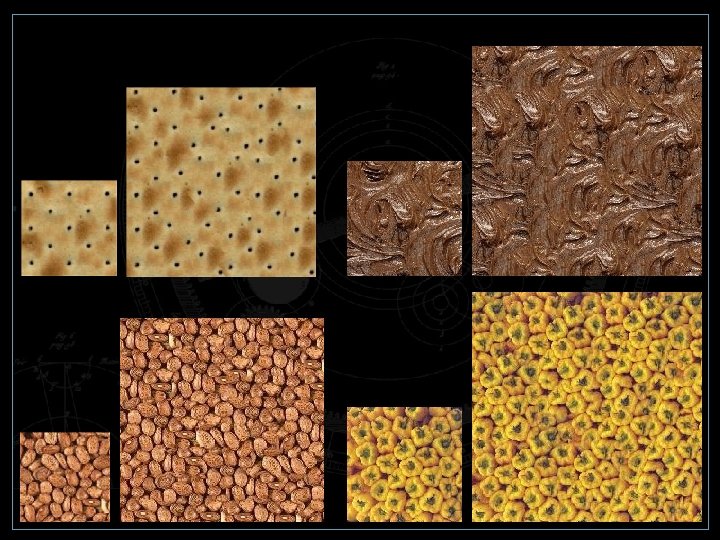
The Goal of Texture Synthesis input image SYNTHESIS True (infinite) texture generated image Given a finite sample of some texture, the goal is to synthesize other samples from that same texture • The sample needs to be "large enough“
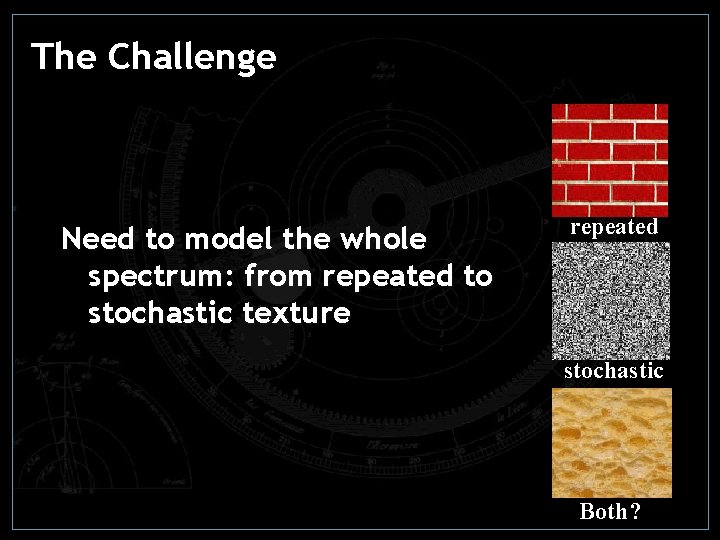
The Challenge Need to model the whole spectrum: from repeated to stochastic texture repeated stochastic Both?
Texture Synthesis for Graphics Inspired by Texture Analysis and Psychophysics • [Heeger & Bergen, ’ 95] • [De. Bonet, ’ 97] • [Portilla & Simoncelli, ’ 98] …but didn’t work well for structured textures • [Efros & Leung, ’ 99] • (originally proposed by [Garber, ’ 81])
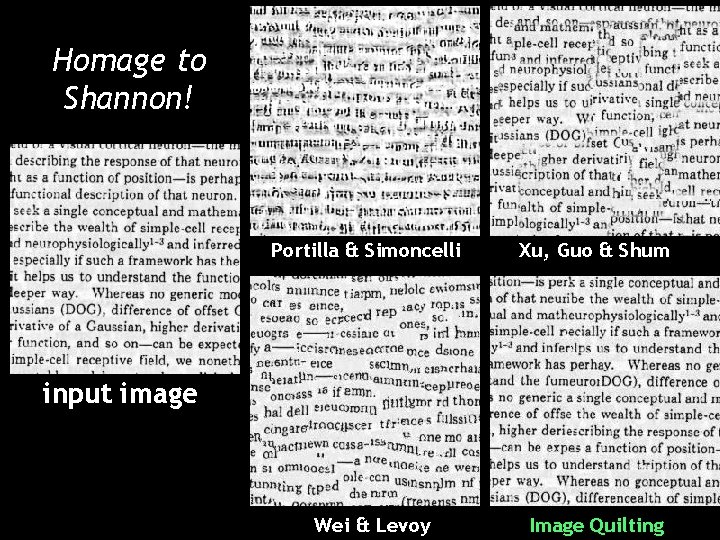
Efros & Leung ’ 99 [Shannon, ’ 48] proposed a way to generate English-looking text using N-grams: • Assume a generalized Markov model • Use a large text to compute prob. distributions of each letter given N-1 previous letters • Starting from a seed repeatedly sample this Markov chain to generate new letters • Also works for whole words WE NEED TO EAT CAKE
Mark V. Shaney (Bell Labs) Results (using alt. singles corpus): • “As I've commented before, really relating to someone involves standing next to impossible. ” • “One morning I shot an elephant in my arms and kissed him. ” • “I spent an interesting evening recently with a grain of salt” Notice how well local structure is preserved! • Now, instead of letters let’s try pixels…
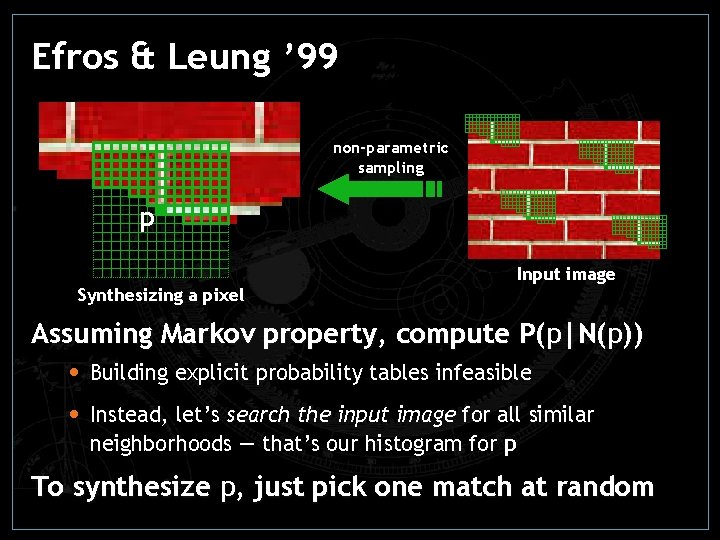
Efros & Leung ’ 99 non-parametric sampling p Input image Synthesizing a pixel Assuming Markov property, compute P(p|N(p)) • Building explicit probability tables infeasible • Instead, let’s search the input image for all similar neighborhoods — that’s our histogram for p To synthesize p, just pick one match at random
Efros & Leung ’ 99 The algorithm • Very simple • Surprisingly good results • Synthesis is easier than analysis! • …but very slow Optimizations and Improvements • [Wei & Levoy, ’ 00] (based on [Popat & Picard, ’ 93]) • [Harrison, ’ 01] • [Ashikhmin, ’ 01]
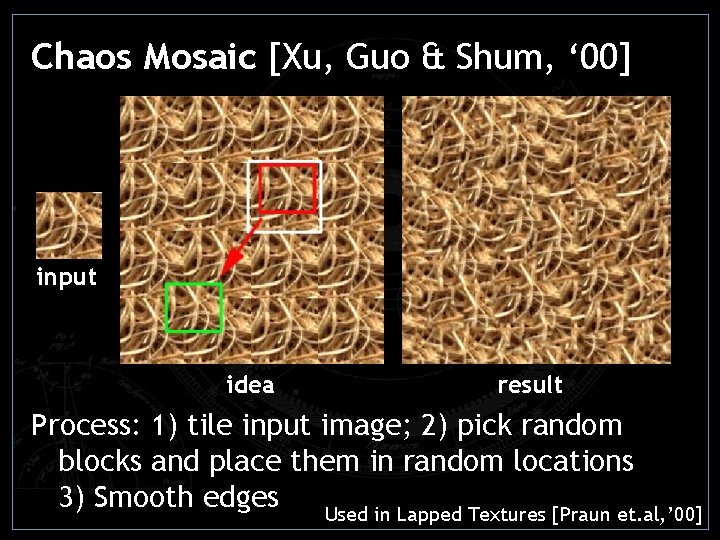
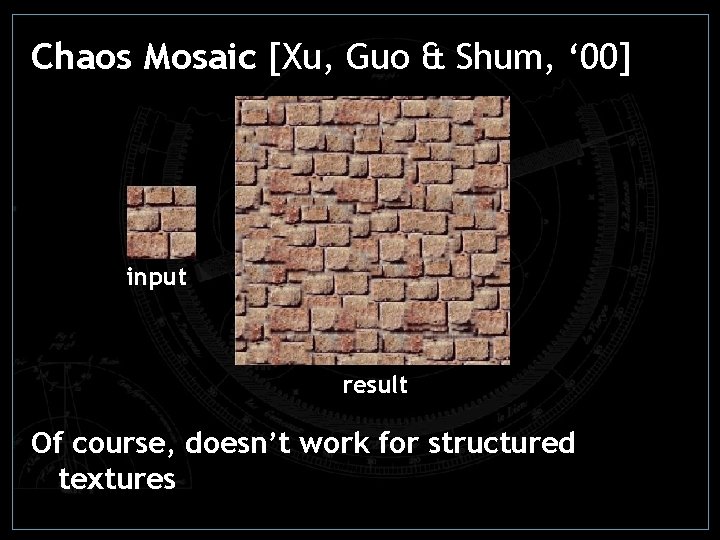
Chaos Mosaic [Xu, Guo & Shum, ‘ 00] input idea result Process: 1) tile input image; 2) pick random blocks and place them in random locations 3) Smooth edges Used in Lapped Textures [Praun et. al, ’ 00]
Chaos Mosaic [Xu, Guo & Shum, ‘ 00] input result Of course, doesn’t work for structured textures
Image Quilting Idea: • let’s combine random block placement of Chaos Mosaic with spatial constraints of Efros & Leung Related Work (concurrent): • Real-time patch-based sampling [Liang et. al. ’ 01] • Image Analogies [Hertzmann et. al. ’ 01]
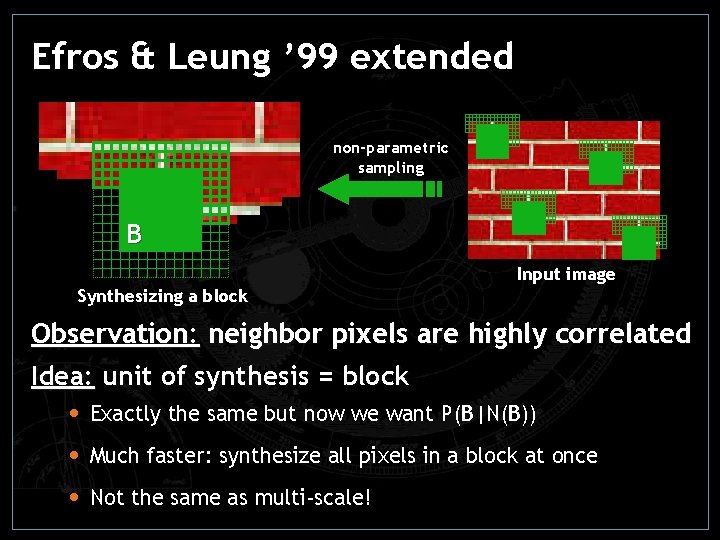
Efros & Leung ’ 99 extended non-parametric sampling p B Input image Synthesizing a block Observation: neighbor pixels are highly correlated Idea: unit of synthesis = block • Exactly the same but now we want P(B|N(B)) • Much faster: synthesize all pixels in a block at once • Not the same as multi-scale!
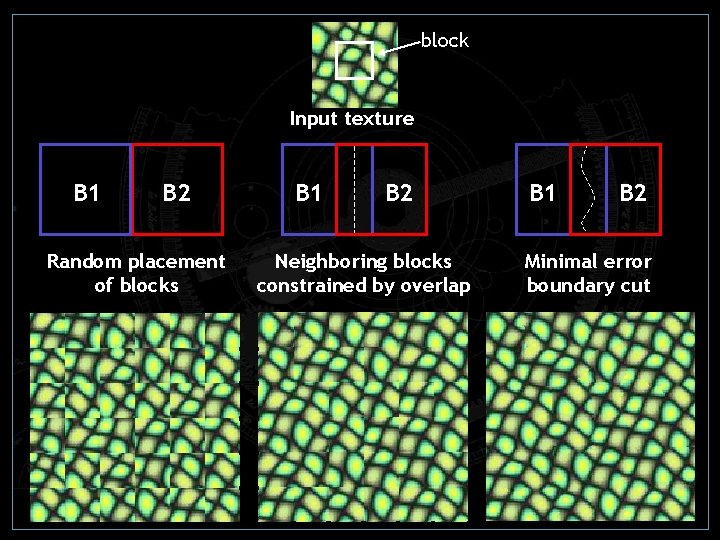
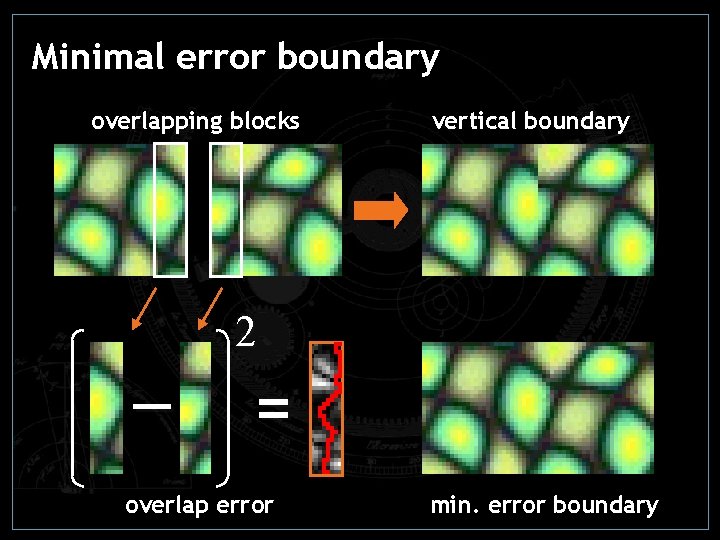
block Input texture B 1 B 2 Random placement of blocks B 1 B 2 Neighboring blocks constrained by overlap B 1 B 2 Minimal error boundary cut
Minimal error boundary overlapping blocks _ vertical boundary 2 = overlap error min. error boundary
Our Philosophy The “Corrupt Professor’s Algorithm”: • Plagiarize as much of the source image as you can • Then try to cover up the evidence Rationale: • Texture blocks are by definition correct samples of texture so problem only connecting them together
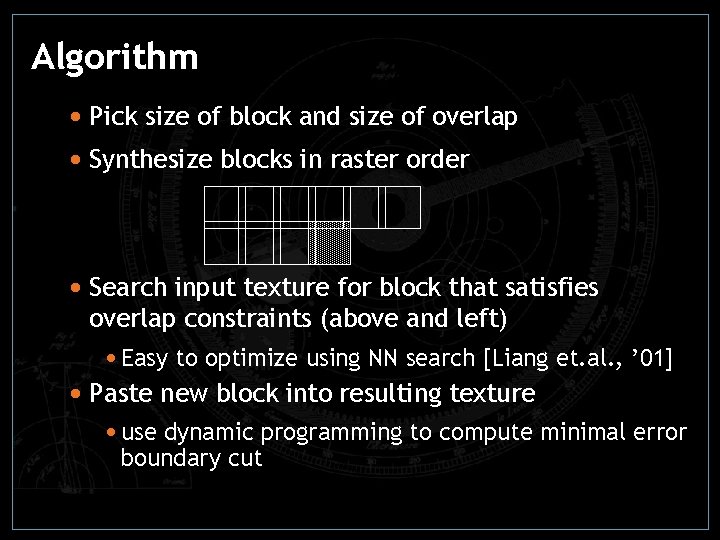
Algorithm • Pick size of block and size of overlap • Synthesize blocks in raster order • Search input texture for block that satisfies overlap constraints (above and left) • Easy to optimize using NN search [Liang et. al. , ’ 01] • Paste new block into resulting texture • use dynamic programming to compute minimal error boundary cut
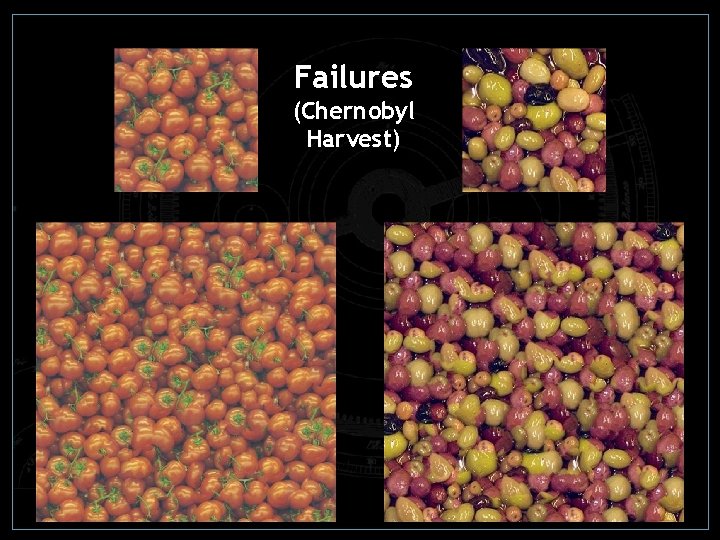
Failures (Chernobyl Harvest)
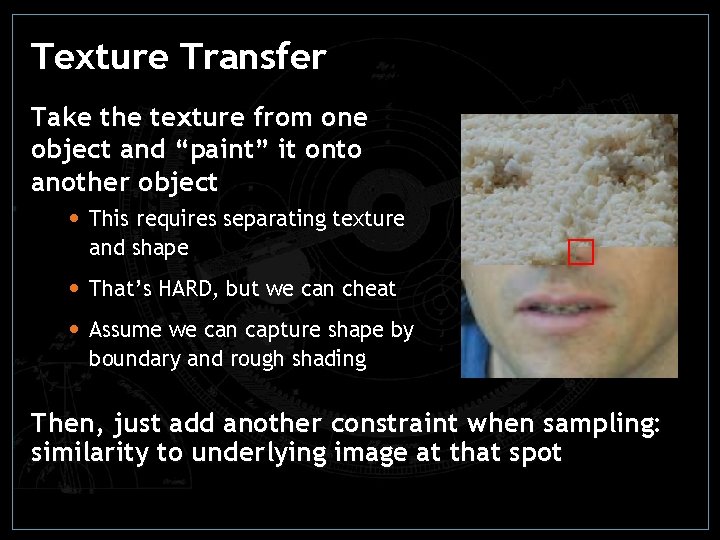
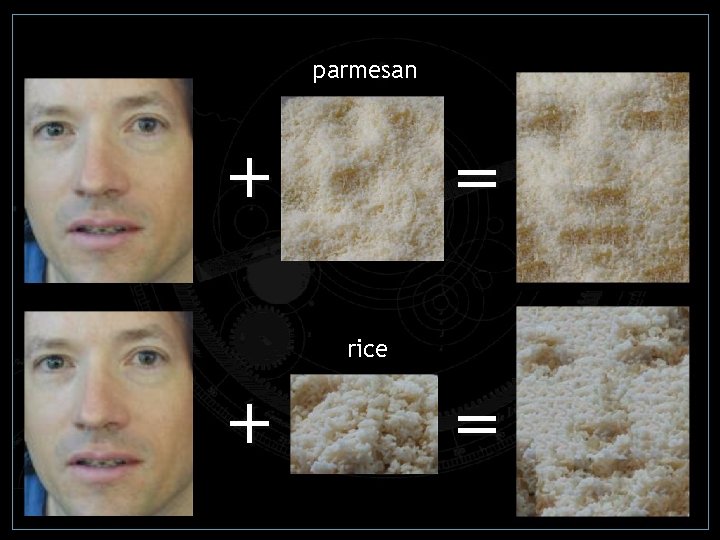
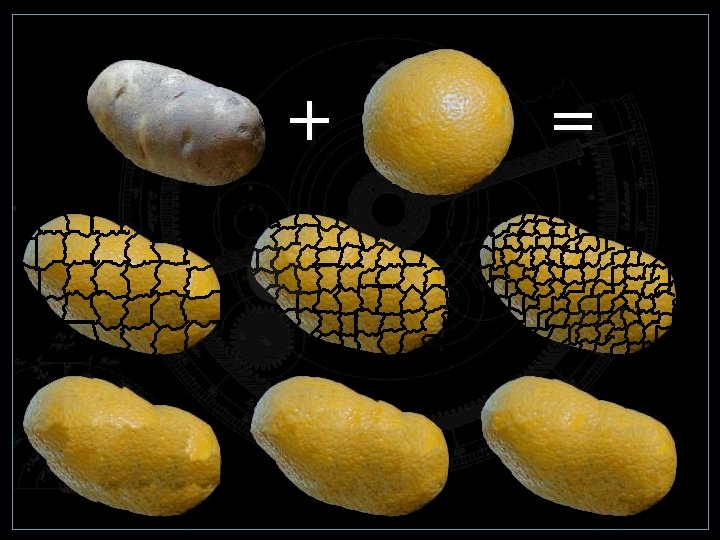
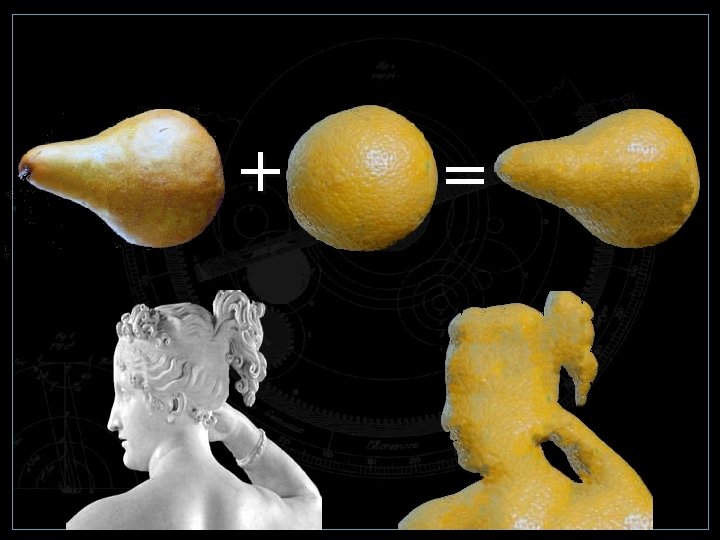
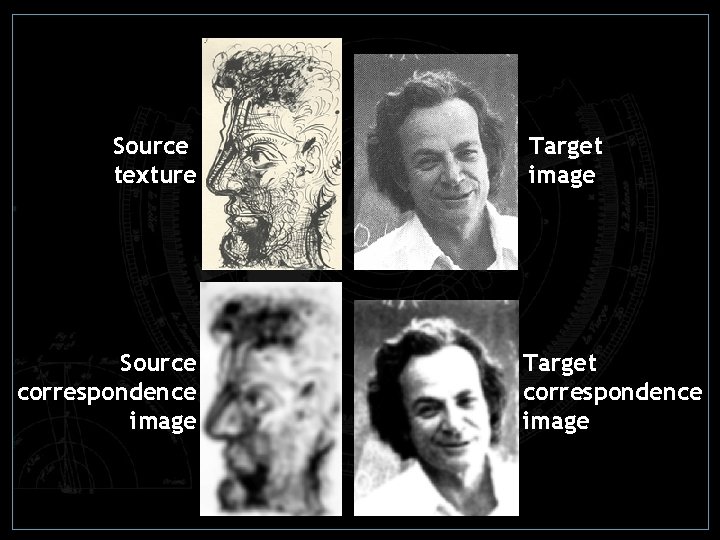
Texture Transfer Take the texture from one object and “paint” it onto another object • This requires separating texture and shape • That’s HARD, but we can cheat • Assume we can capture shape by boundary and rough shading Then, just add another constraint when sampling: similarity to underlying image at that spot
parmesan + = rice + =
Source texture Source correspondence image Target correspondence image
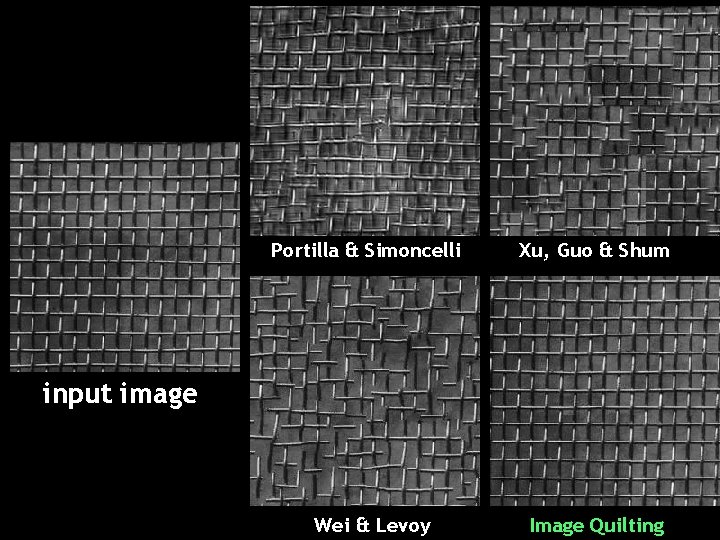
Portilla & Simoncelli Xu, Guo & Shum input image Wei & Levoy Image Quilting
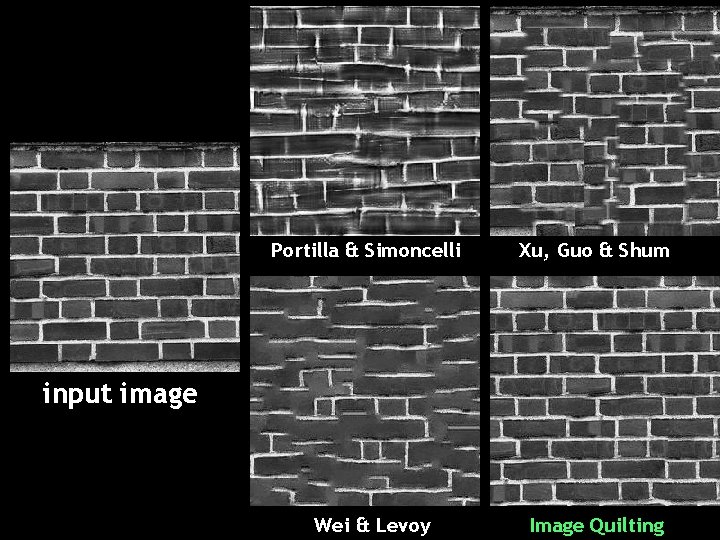
Portilla & Simoncelli Xu, Guo & Shum input image Wei & Levoy Image Quilting
Homage to Shannon! Portilla & Simoncelli Xu, Guo & Shum input image Wei & Levoy Image Quilting
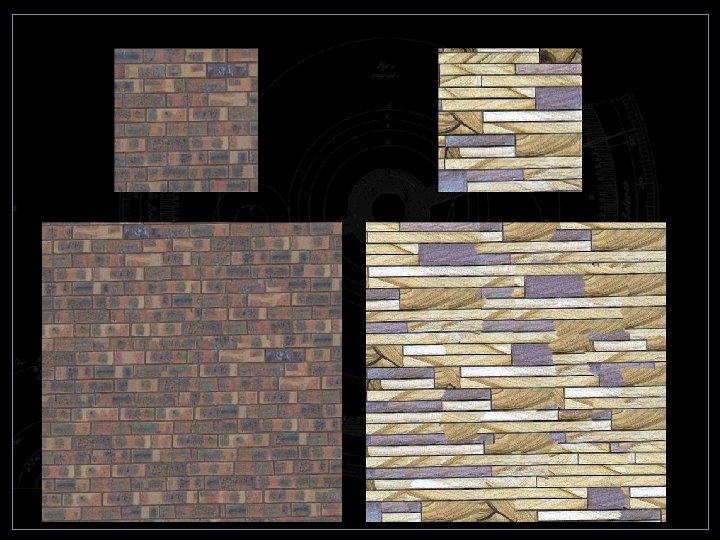
Conclusion Quilt together patches of input image • randomly (texture synthesis) • constrained (texture transfer) Image Quilting • No filters, no multi-scale, no one-pixel-at-a-time! • fast and very simple • Results are not bad