
Image neighborhoods and SIFT features D A Forsyth

Image neighborhoods and SIFT features D. A. Forsyth, UIUC
Image neighborhoods • • • We want to find patches that are “worth representing” • • • to match from image to represent textures to represent objects Requirements • Covariant to translation, rotation, scale i. e. if the image is translated, rotated, scaled, so are the neighborhoods important to ensure that the representation of the patch is stable Localizable in translation, rotation, scale we can estimate the position, orientation and size of the patch and get the answer about right • • • Methods exist for richer sets of requirements Slides to accompany Forsyth and Ponce “Computer Vision - A Modern Approach” 2 e by D. A. Forsyth
Finding image neighborhoods - I • Corner finding strategy • • • Find centers At each center, estimate scale Now from center, scale, estimate orientation Slides to accompany Forsyth and Ponce “Computer Vision - A Modern Approach” 2 e by D. A. Forsyth
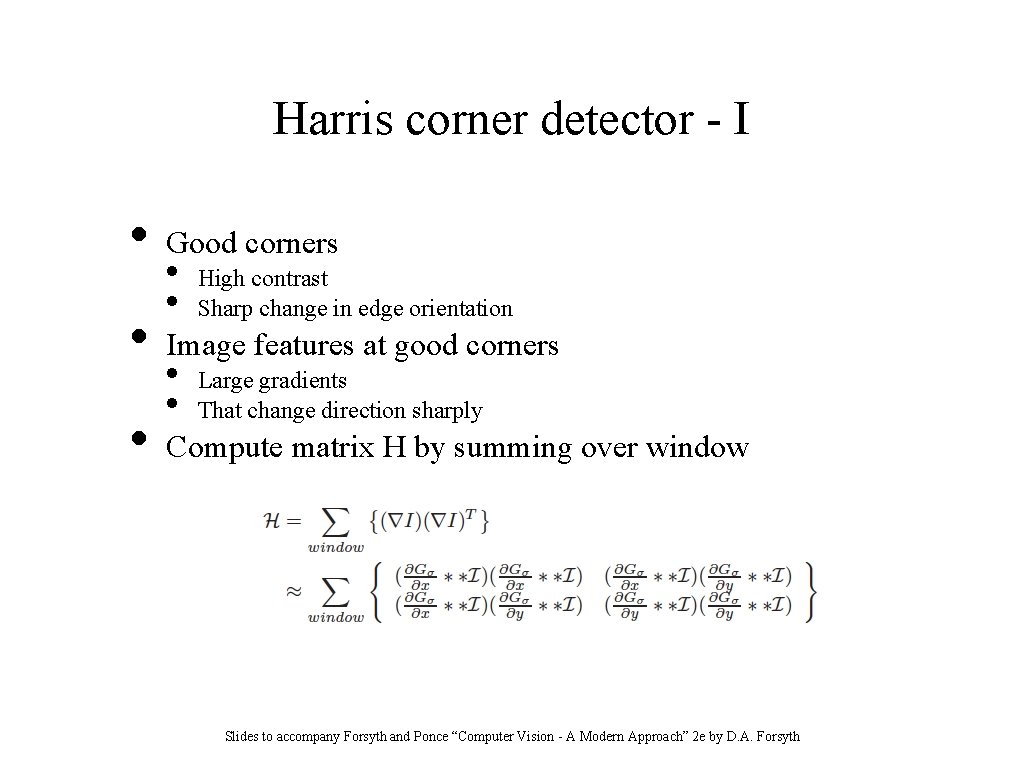
Harris corner detector - I • • • Good corners • • High contrast Sharp change in edge orientation Image features at good corners • • Large gradients That change direction sharply Compute matrix H by summing over window Slides to accompany Forsyth and Ponce “Computer Vision - A Modern Approach” 2 e by D. A. Forsyth
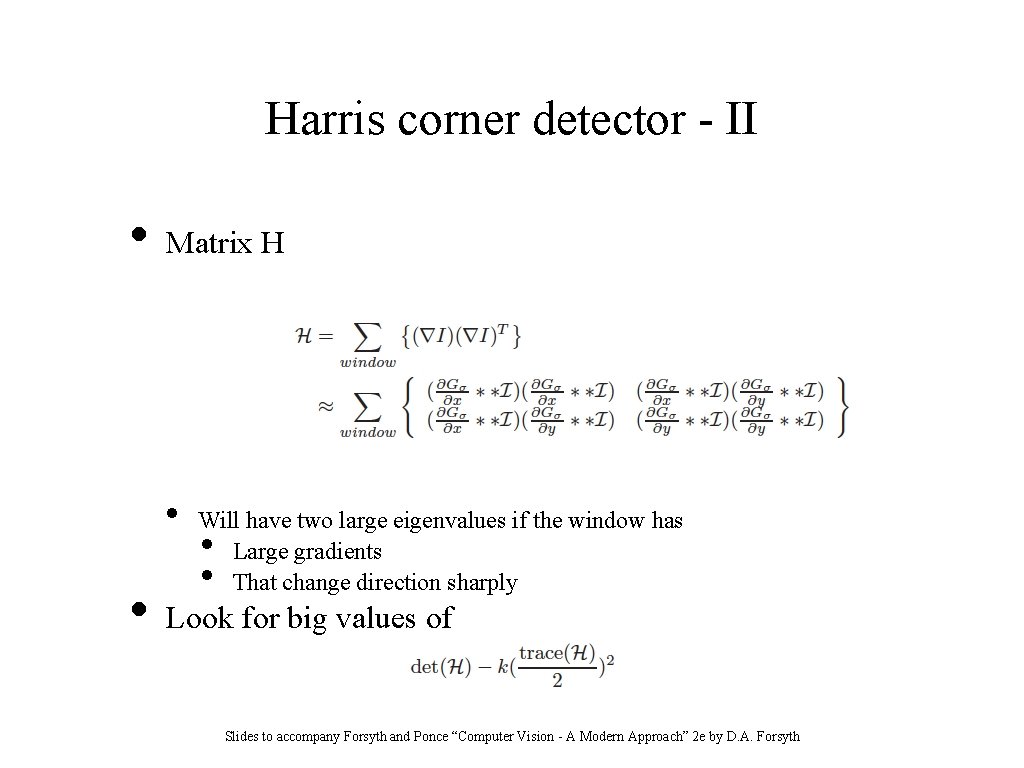
Harris corner detector - II • Matrix H • • Will have two large eigenvalues if the window has Large gradients That change direction sharply • • Look for big values of Slides to accompany Forsyth and Ponce “Computer Vision - A Modern Approach” 2 e by D. A. Forsyth
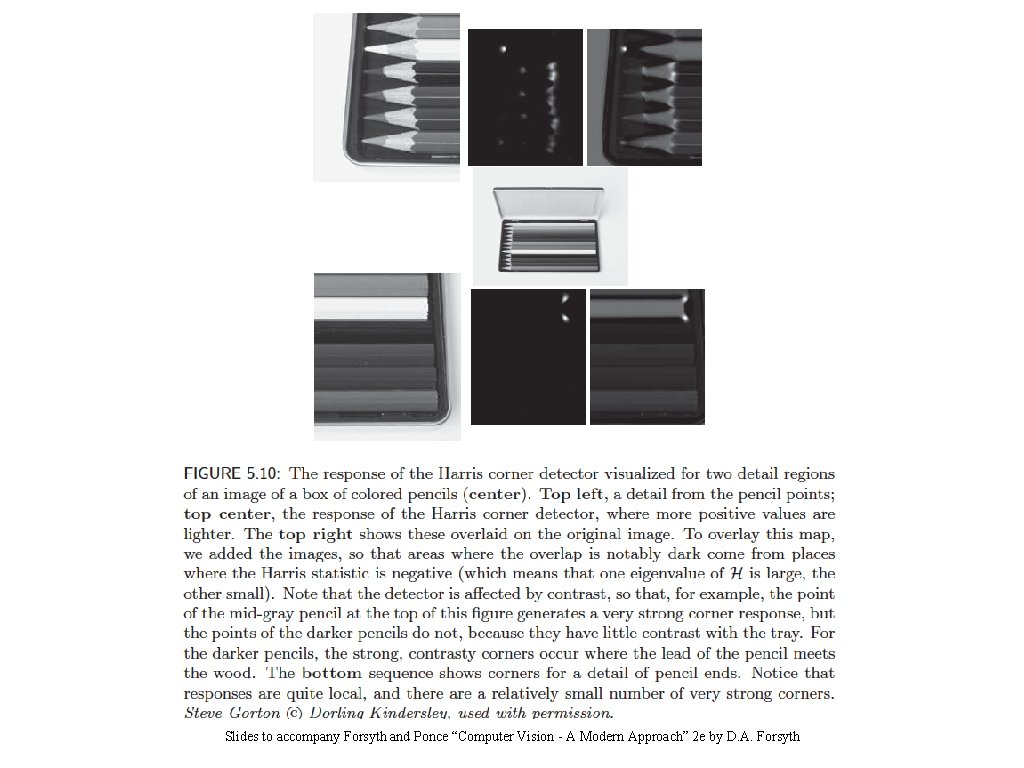
Slides to accompany Forsyth and Ponce “Computer Vision - A Modern Approach” 2 e by D. A. Forsyth

Slides to accompany Forsyth and Ponce “Computer Vision - A Modern Approach” 2 e by D. A. Forsyth
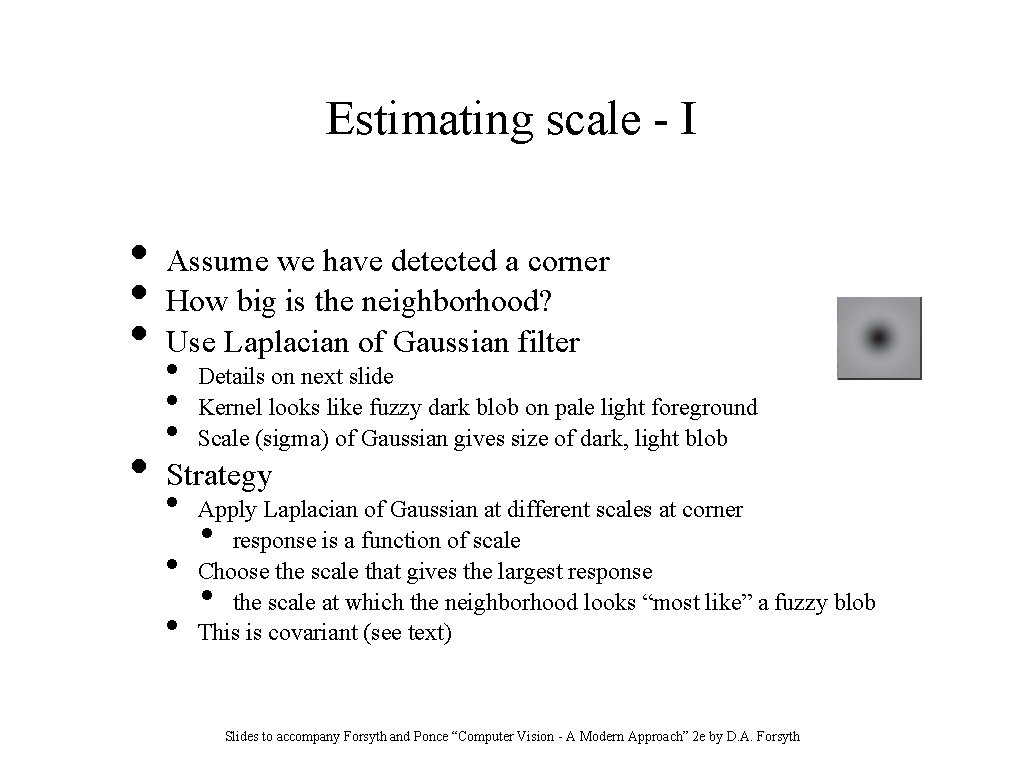
Estimating scale - I • • Assume we have detected a corner How big is the neighborhood? Use Laplacian of Gaussian filter • • • Details on next slide Kernel looks like fuzzy dark blob on pale light foreground Scale (sigma) of Gaussian gives size of dark, light blob Strategy • Apply Laplacian of Gaussian at different scales at corner • response is a function of scale • Choose the scale that gives the largest response • the scale at which the neighborhood looks “most like” a fuzzy blob • This is covariant (see text) Slides to accompany Forsyth and Ponce “Computer Vision - A Modern Approach” 2 e by D. A. Forsyth
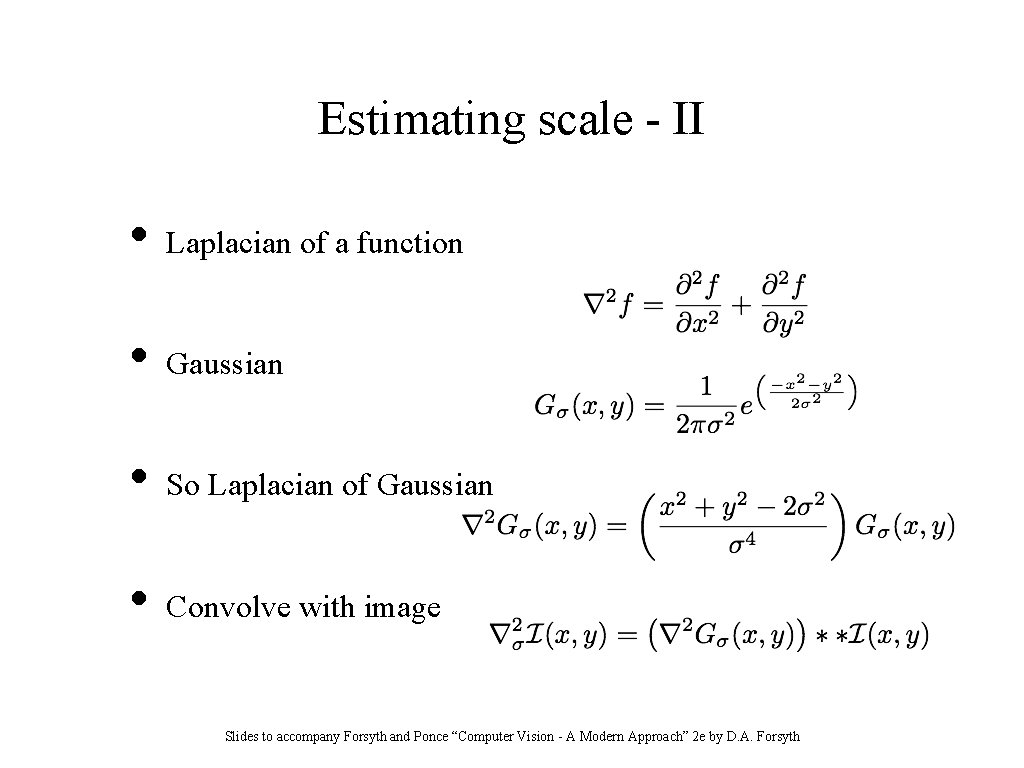
Estimating scale - II • Laplacian of a function • Gaussian • So Laplacian of Gaussian • Convolve with image Slides to accompany Forsyth and Ponce “Computer Vision - A Modern Approach” 2 e by D. A. Forsyth

Extremal scale Slides to accompany Forsyth and Ponce “Computer Vision - A Modern Approach” 2 e by D. A. Forsyth
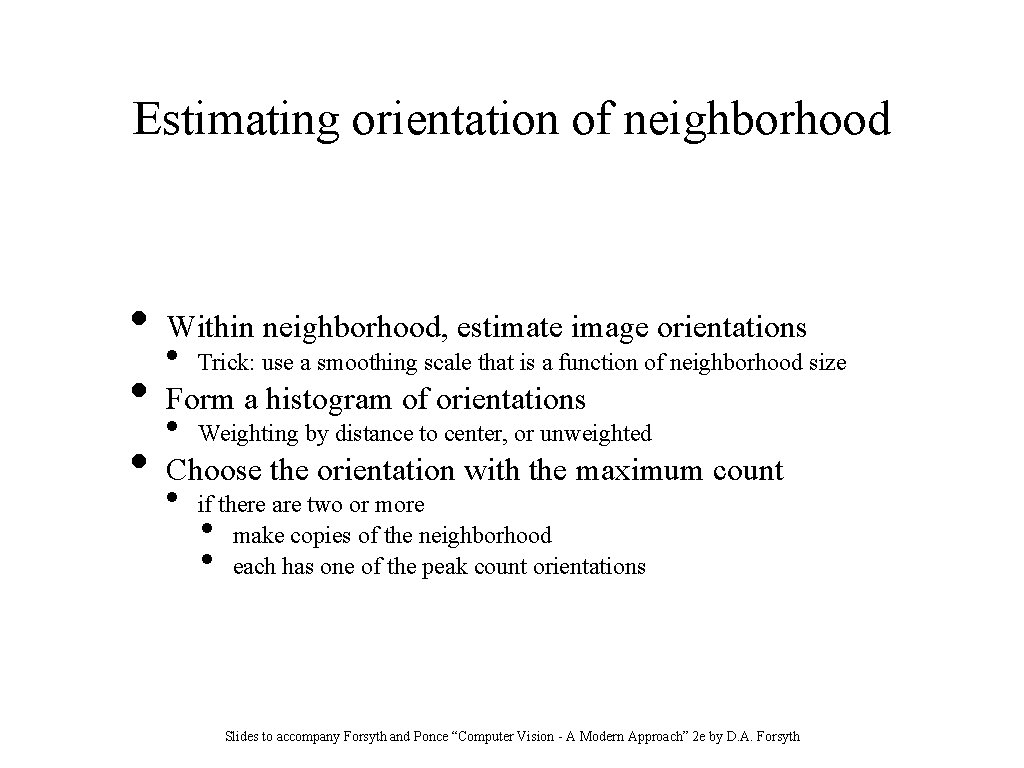
Estimating orientation of neighborhood • • • Within neighborhood, estimate image orientations • Trick: use a smoothing scale that is a function of neighborhood size Form a histogram of orientations • Weighting by distance to center, or unweighted Choose the orientation with the maximum count • if there are two or more make copies of the neighborhood each has one of the peak count orientations • • Slides to accompany Forsyth and Ponce “Computer Vision - A Modern Approach” 2 e by D. A. Forsyth

Slides to accompany Forsyth and Ponce “Computer Vision - A Modern Approach” 2 e by D. A. Forsyth
Finding image neighborhoods - II • Fuzzy blob strategy • • Find locations and scales where image looks more like fuzzy blobs than their immediate neighbors in location in scale Then estimate orientation • • • Slides to accompany Forsyth and Ponce “Computer Vision - A Modern Approach” 2 e by D. A. Forsyth
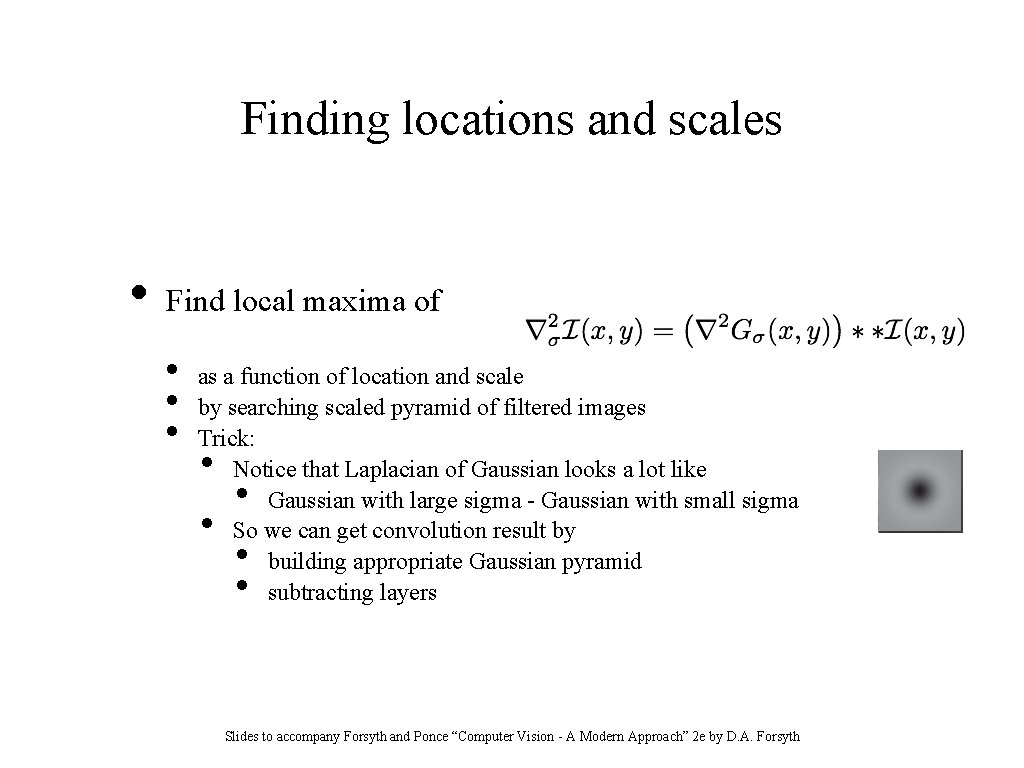
Finding locations and scales • Find local maxima of • • • as a function of location and scale by searching scaled pyramid of filtered images Trick: Notice that Laplacian of Gaussian looks a lot like Gaussian with large sigma - Gaussian with small sigma So we can get convolution result by building appropriate Gaussian pyramid subtracting layers • • • Slides to accompany Forsyth and Ponce “Computer Vision - A Modern Approach” 2 e by D. A. Forsyth
Estimating orientation of neighborhood • • (Fuzzy blobs use the same strategy as corners) Within neighborhood, estimate image orientations • Trick: use a smoothing scale that is a function of neighborhood size Form a histogram of orientations • Weighting by distance to center, or unweighted Choose the orientation with the maximum count • if there are two or more make copies of the neighborhood each has one of the peak count orientations • • Slides to accompany Forsyth and Ponce “Computer Vision - A Modern Approach” 2 e by D. A. Forsyth
Slides to accompany Forsyth and Ponce “Computer Vision - A Modern Approach” 2 e by D. A. Forsyth
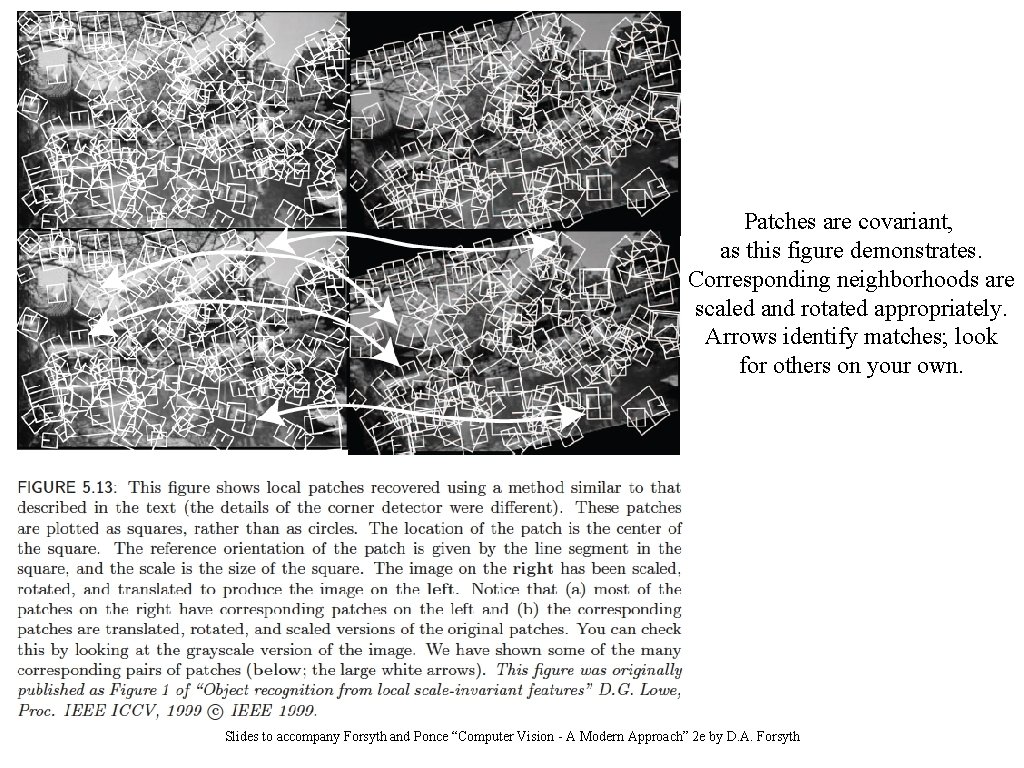
Patches are covariant, as this figure demonstrates. Corresponding neighborhoods are scaled and rotated appropriately. Arrows identify matches; look for others on your own. Slides to accompany Forsyth and Ponce “Computer Vision - A Modern Approach” 2 e by D. A. Forsyth
Describing Neighborhoods • • We could just compute HOG features and use them Alternative: SIFT features • • • SIFT=Scale Invariant Feature Transform Very strong record of effectiveness in matching applications Similar underlying principles to HOG use orientations to suppress intensity change effects use histograms so neighborhood need not be exactly localized weight large gradients higher than small gradients Weighting processes are different SIFT features behave very well using nearest neighbors matching i. e. the nearest neighbor to a query patch is usually a matching patch • • Slides to accompany Forsyth and Ponce “Computer Vision - A Modern Approach” 2 e by D. A. Forsyth
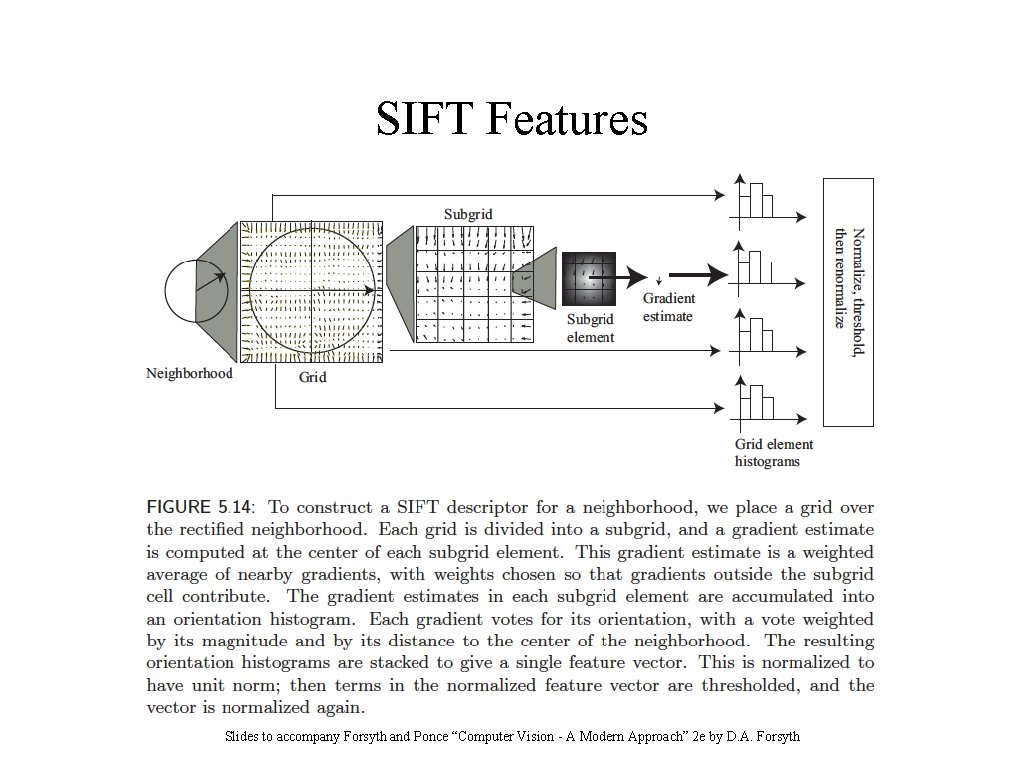
SIFT Features Slides to accompany Forsyth and Ponce “Computer Vision - A Modern Approach” 2 e by D. A. Forsyth
Neighborhoods and SIFT - Key Points • • Algorithms to find neighborhoods • • • Represented by location, scale and orientation Neighborhood is covariant If image is translated, scaled, rotated Neighborhood is translated, scaled, rotated Important property for matching Affine covariant constructions are available • • • Once found, describe with SIFT features • • A representation of local orientation histograms, comparable to HOG Normalized differently Slides to accompany Forsyth and Ponce “Computer Vision - A Modern Approach” 2 e by D. A. Forsyth
- Slides: 20