
Image Characteristics RADIOGRAPHIC DENSITY AND CONTRAST Film Screen
- Slides: 49
Image Characteristics RADIOGRAPHIC DENSITY AND CONTRAST
Film Screen Characteristics �Photographic Properties Visibility of the recorded detail (in film screen) � Achieved through a balance of Density and Contrast �Geometric Properties (Sharpness) How accurately the structural lines are recorded This is achieved by maximizing the amount of recorded detail and minimizing the amount of distortion Factors that affect the degree of divergence of x-ray beam and the information recorded on the film
Density �The amount of overall blackness produced on the processed image �Due to small deposits of black metallic silver on the processed film �Important to visualize the anatomic area of interest
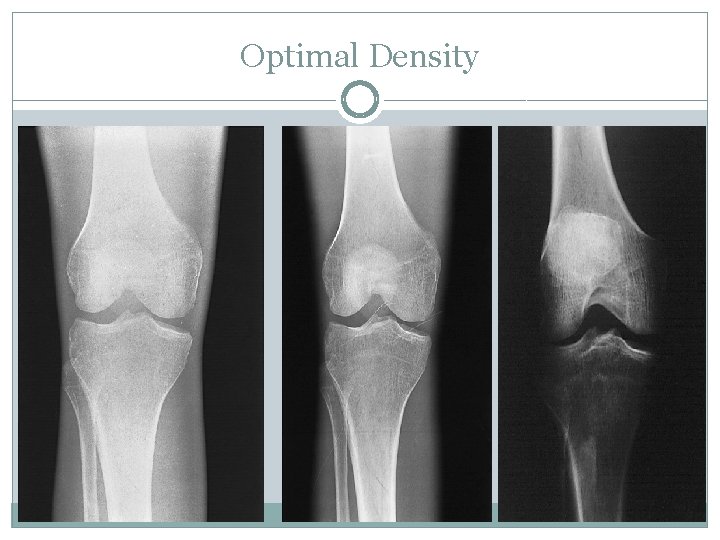
Optimal Density
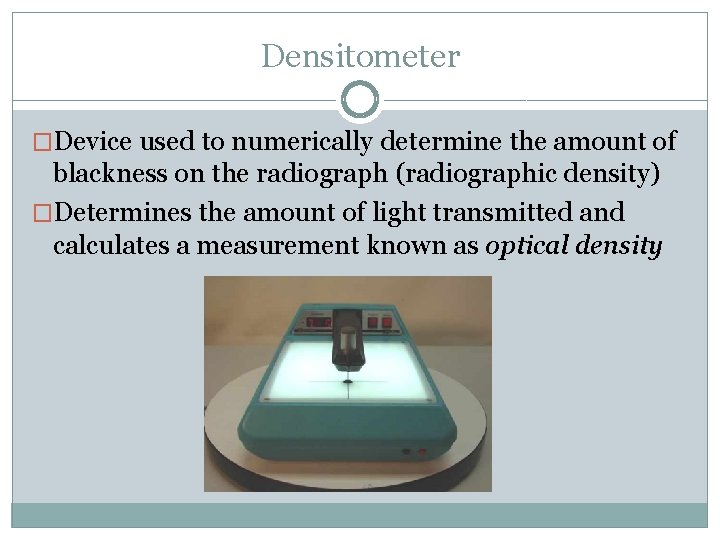
Densitometer �Device used to numerically determine the amount of blackness on the radiograph (radiographic density) �Determines the amount of light transmitted and calculates a measurement known as optical density
Exposure Intensity �Measurement of the amount and energy of the x-rays reaching an area of film �Increasing the exposure intensity to the film-screen image receptor, increases the optical density
Density Photographic Factors �m. As �SID �k. Vp �Film-Screen combo �Grids �Filtration �Anatomic and Pathologic Factors
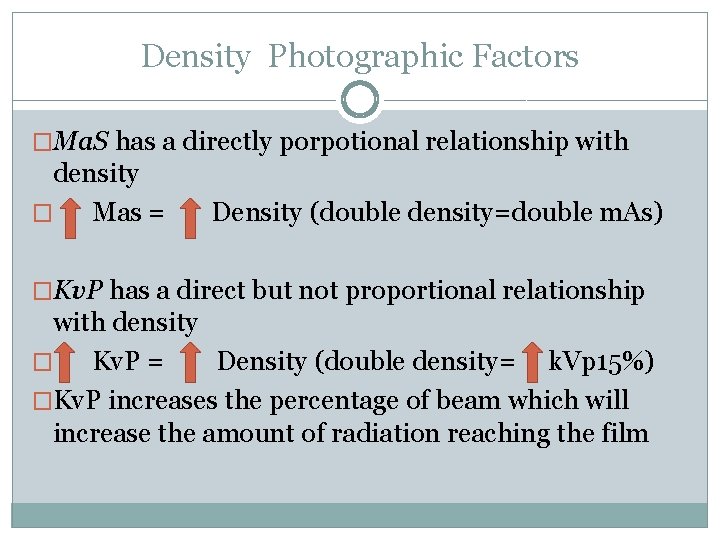
Density Photographic Factors �Ma. S has a directly porpotional relationship with density � Mas = Density (double density=double m. As) �Kv. P has a direct but not proportional relationship with density � Kv. P = Density (double density= k. Vp 15%) �Kv. P increases the percentage of beam which will increase the amount of radiation reaching the film
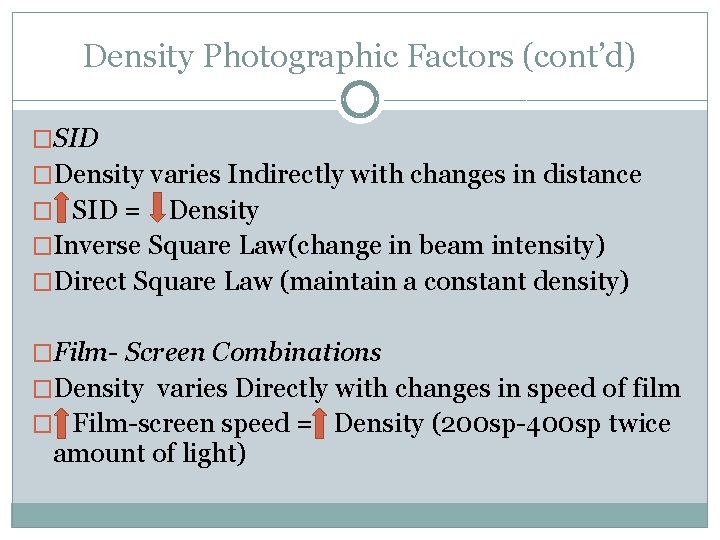
Density Photographic Factors (cont’d) �SID �Density varies Indirectly with changes in distance � SID = Density �Inverse Square Law(change in beam intensity) �Direct Square Law (maintain a constant density) �Film- Screen Combinations �Density varies Directly with changes in speed of film � Film-screen speed = Density (200 sp-400 sp twice amount of light)
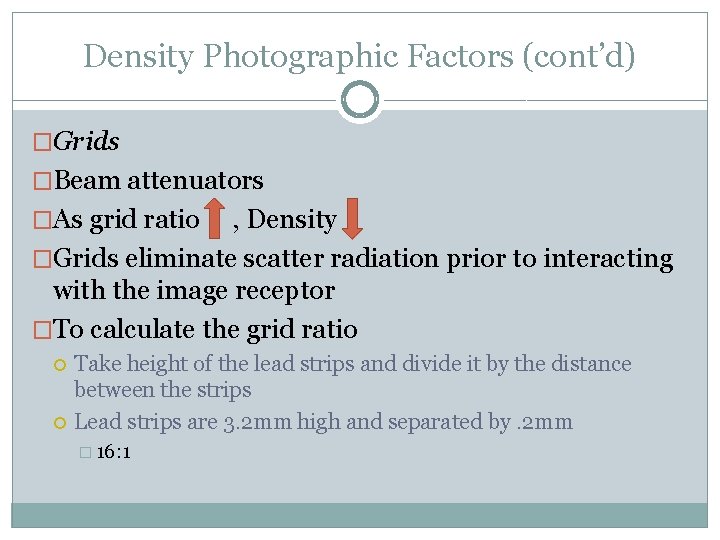
Density Photographic Factors (cont’d) �Grids �Beam attenuators �As grid ratio , Density �Grids eliminate scatter radiation prior to interacting with the image receptor �To calculate the grid ratio Take height of the lead strips and divide it by the distance between the strips Lead strips are 3. 2 mm high and separated by. 2 mm � 16: 1
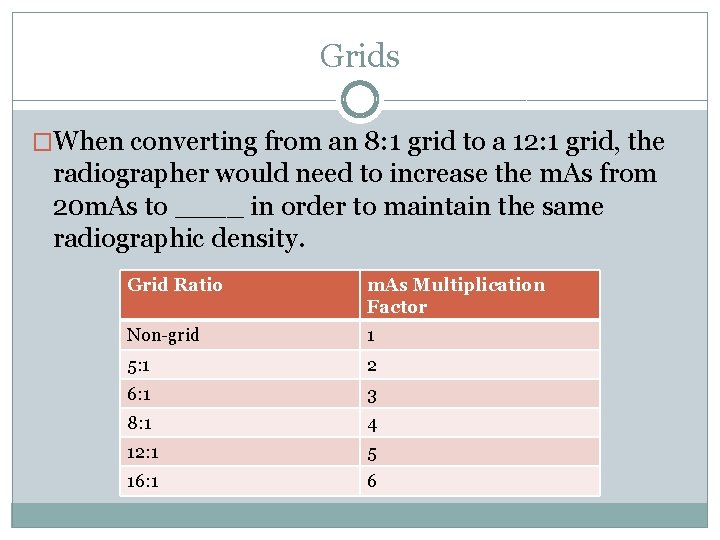
Grids �When converting from an 8: 1 grid to a 12: 1 grid, the radiographer would need to increase the m. As from 20 m. As to ____ in order to maintain the same radiographic density. Grid Ratio m. As Multiplication Factor Non-grid 1 5: 1 2 6: 1 3 8: 1 4 12: 1 5 16: 1 6
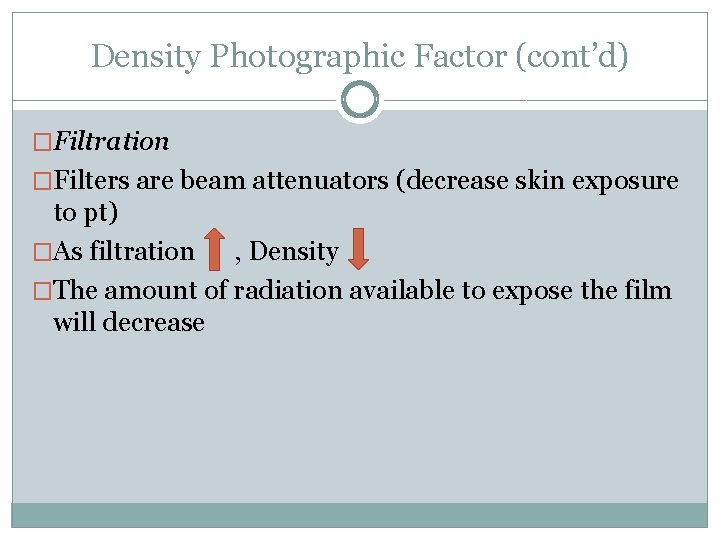
Density Photographic Factor (cont’d) �Filtration �Filters are beam attenuators (decrease skin exposure to pt) �As filtration , Density �The amount of radiation available to expose the film will decrease
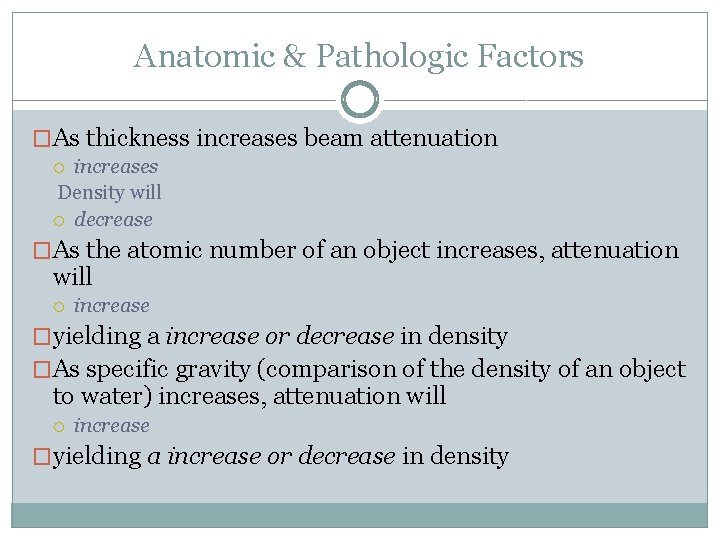
Anatomic & Pathologic Factors �As thickness increases beam attenuation increases Density will decrease �As the atomic number of an object increases, attenuation will increase �yielding a increase or decrease in density �As specific gravity (comparison of the density of an object to water) increases, attenuation will increase �yielding a increase or decrease in density
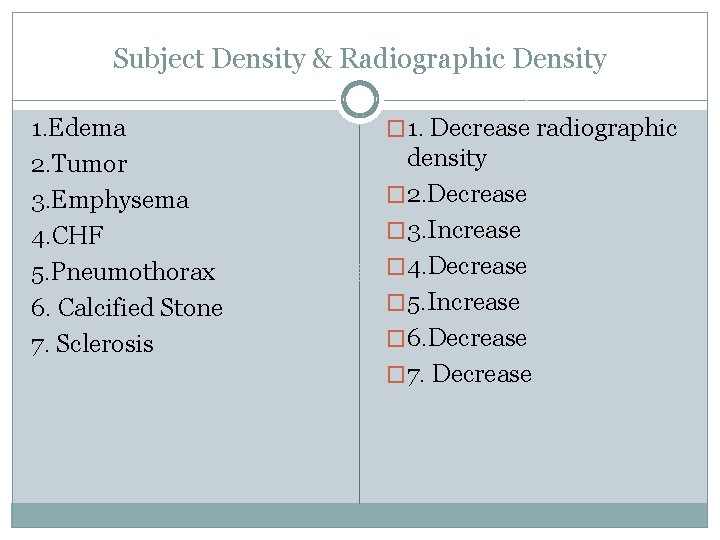
Subject Density & Radiographic Density 1. Edema 2. Tumor 3. Emphysema 4. CHF 5. Pneumothorax 6. Calcified Stone 7. Sclerosis � 1. Decrease radiographic density � 2. Decrease � 3. Increase � 4. Decrease � 5. Increase � 6. Decrease � 7. Decrease
Radiographic Contrast �Result of Subject Contrast Film Contrast Developer Contrast
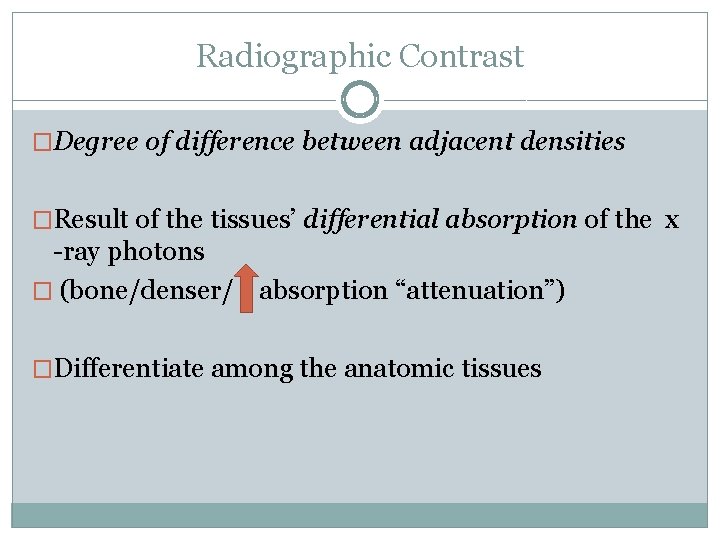
Radiographic Contrast �Degree of difference between adjacent densities �Result of the tissues’ differential absorption of the x -ray photons � (bone/denser/ absorption “attenuation”) �Differentiate among the anatomic tissues
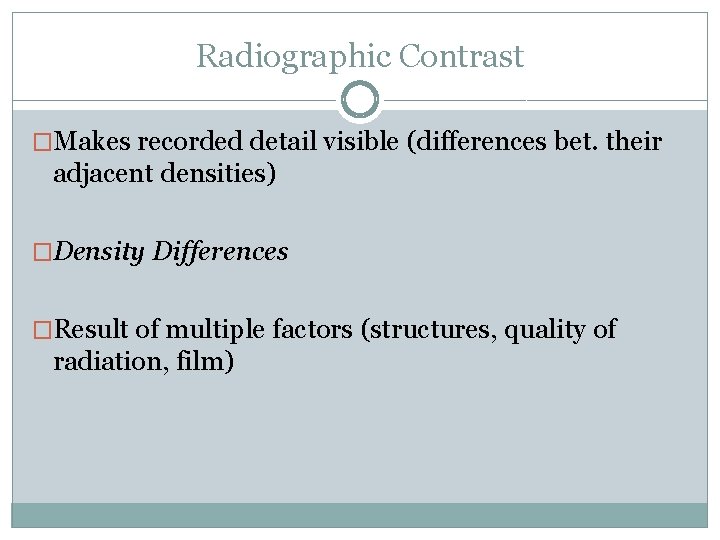
Radiographic Contrast �Makes recorded detail visible (differences bet. their adjacent densities) �Density Differences �Result of multiple factors (structures, quality of radiation, film)
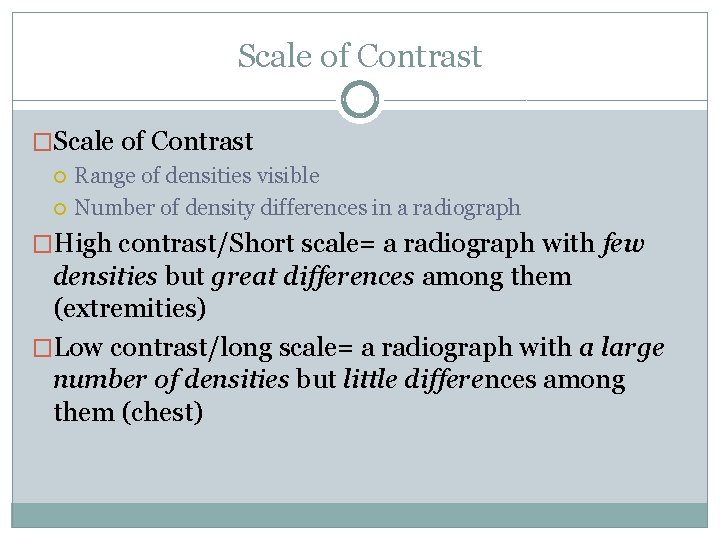
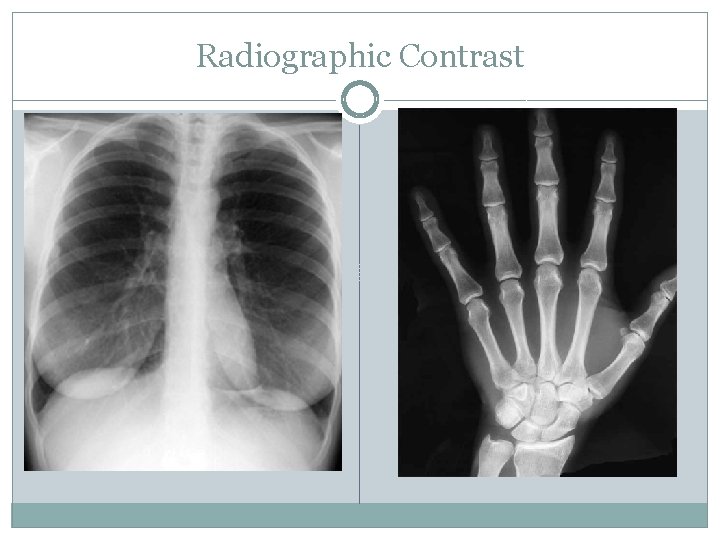
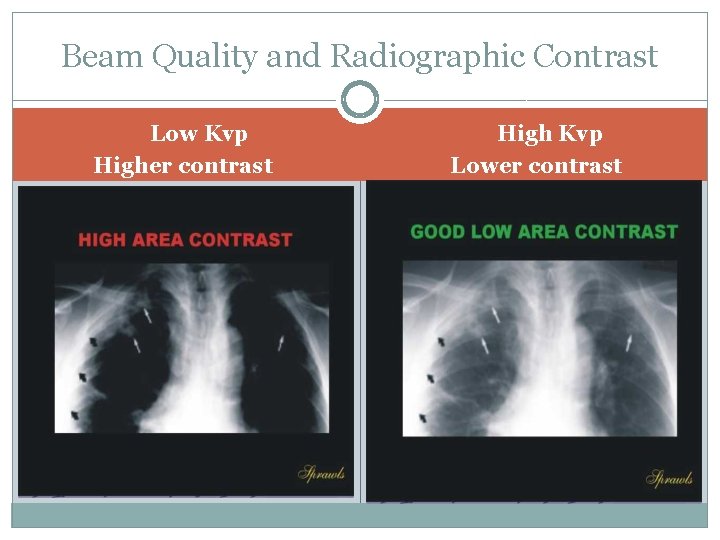
Scale of Contrast �Scale of Contrast Range of densities visible Number of density differences in a radiograph �High contrast/Short scale= a radiograph with few densities but great differences among them (extremities) �Low contrast/long scale= a radiograph with a large number of densities but little differences among them (chest)
Radiographic Contrast
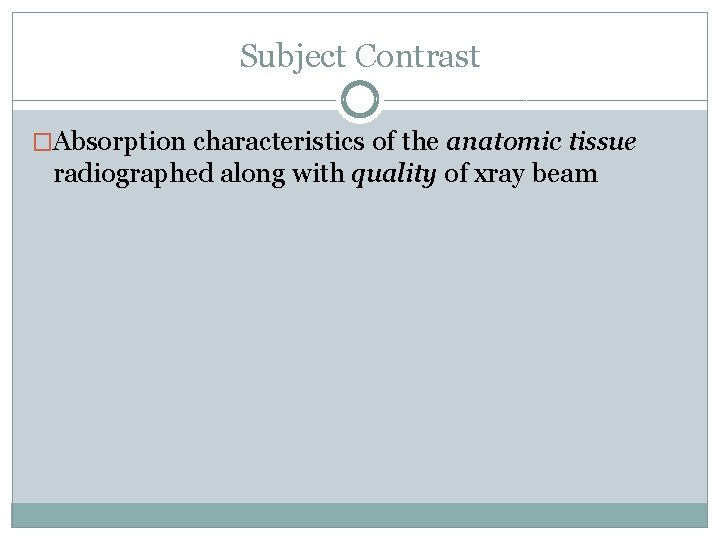
Subject Contrast �Absorption characteristics of the anatomic tissue radiographed along with quality of xray beam
Subject Contrast �Affected by Differences in tissue thickness Density Effective atomic number �Quality of beam affects attenuation which in turn affects subject contrast
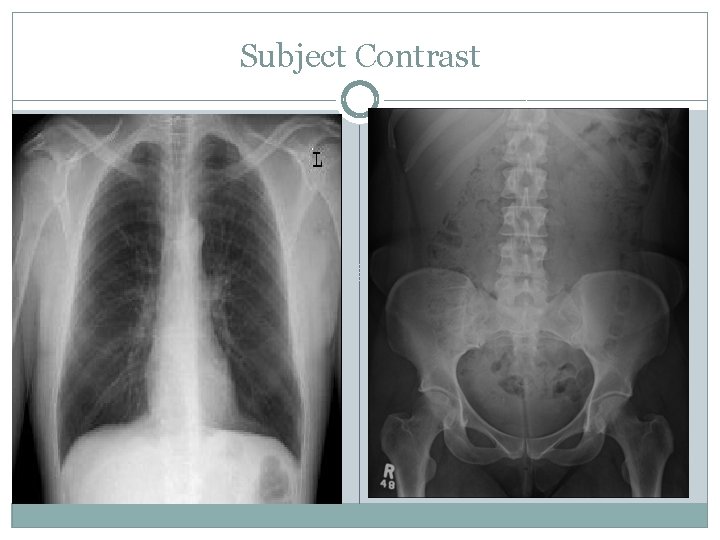
Subject Contrast
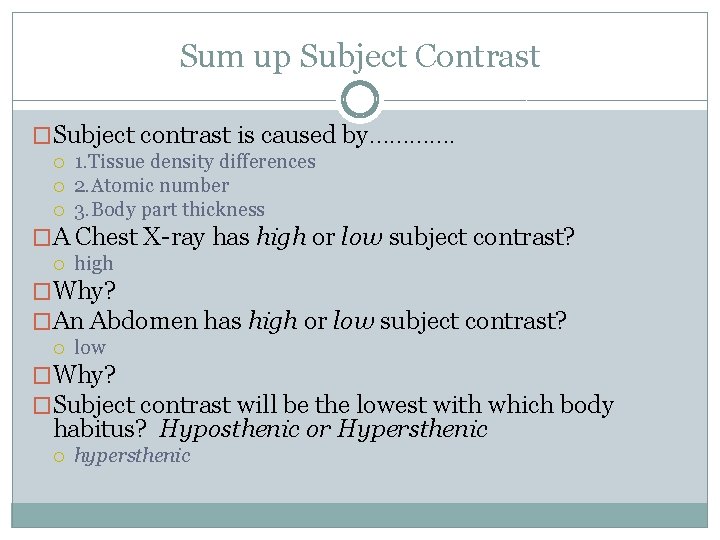
Sum up Subject Contrast �Subject contrast is caused by…………. 1. Tissue density differences 2. Atomic number 3. Body part thickness �A Chest X-ray has high or low subject contrast? high �Why? �An Abdomen has high or low subject contrast? low �Why? �Subject contrast will be the lowest with which body habitus? Hyposthenic or Hypersthenic hypersthenic
Tissue Density differences �Adding iodine or barium to a body part increases /decreases its tissue density compared to the other tissues Increases �What does it do to film density? Decreases
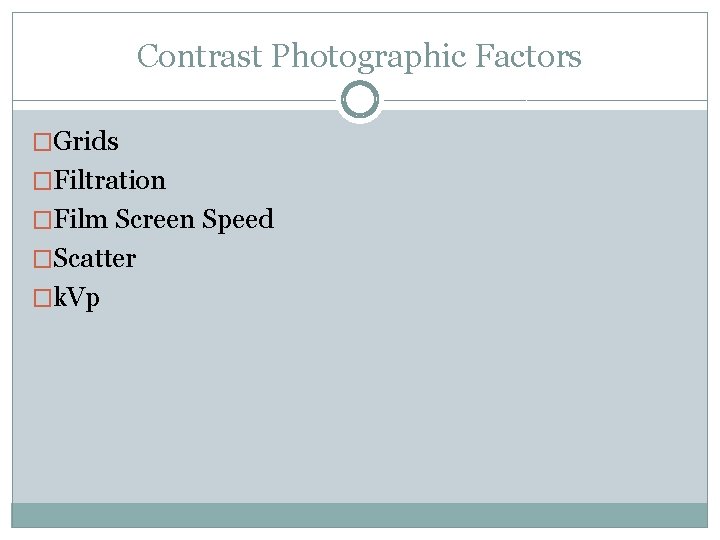
Contrast Photographic Factors �Grids �Filtration �Film Screen Speed �Scatter �k. Vp
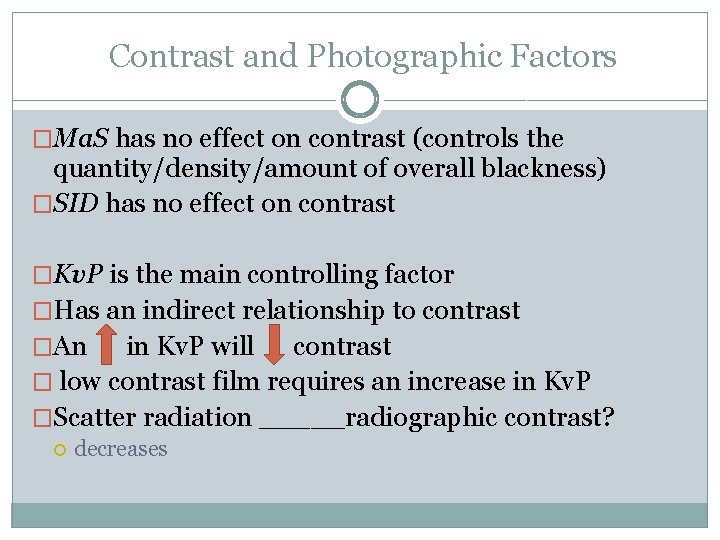
Contrast and Photographic Factors �Ma. S has no effect on contrast (controls the quantity/density/amount of overall blackness) �SID has no effect on contrast �Kv. P is the main controlling factor �Has an indirect relationship to contrast �An in Kv. P will contrast � low contrast film requires an increase in Kv. P �Scatter radiation _____radiographic contrast? decreases
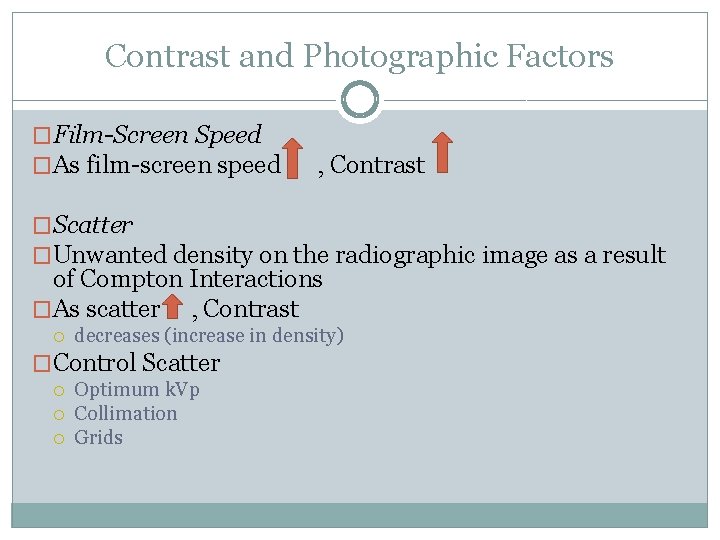
Contrast and Photographic Factors �Film-Screen Speed �As film-screen speed , Contrast �Scatter �Unwanted density on the radiographic image as a result of Compton Interactions �As scatter , Contrast decreases (increase in density) �Control Scatter Optimum k. Vp Collimation Grids
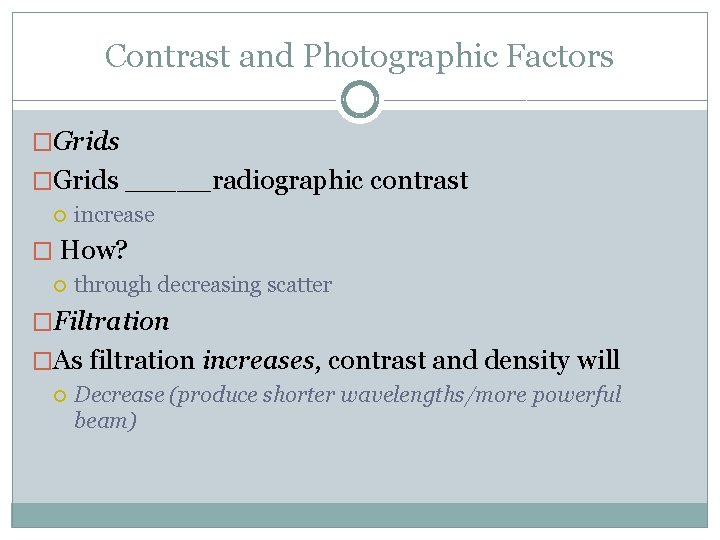
Contrast and Photographic Factors �Grids _____radiographic contrast increase � How? through decreasing scatter �Filtration �As filtration increases, contrast and density will Decrease (produce shorter wavelengths/more powerful beam)
Beam Quality and Radiographic Contrast Low Kvp Higher contrast High Kvp Lower contrast
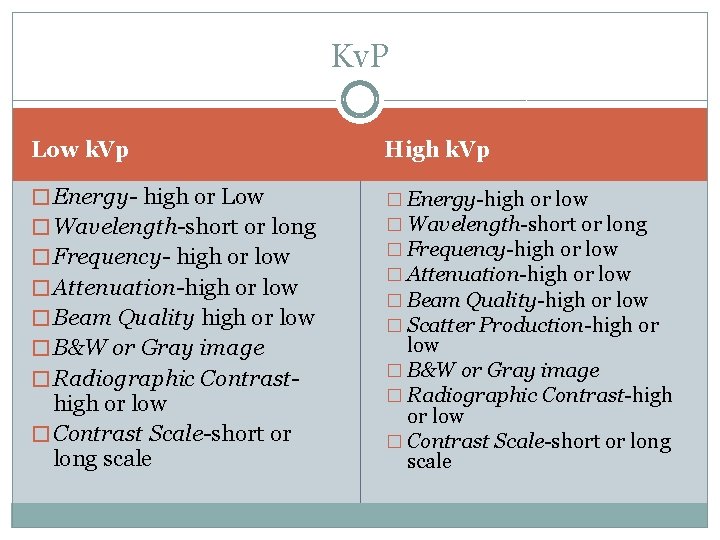
Kv. P Low k. Vp High k. Vp � Energy- high or Low � Energy-high or low � Wavelength-short or long � Frequency-high or low � Attenuation-high or low � Beam Quality-high or low � Scatter Production-high or � Wavelength-short or long � Frequency- high or low � Attenuation-high or low � Beam Quality high or low � B&W or Gray image � Radiographic Contrast- high or low � Contrast Scale-short or long scale low � B&W or Gray image � Radiographic Contrast-high or low � Contrast Scale-short or long scale
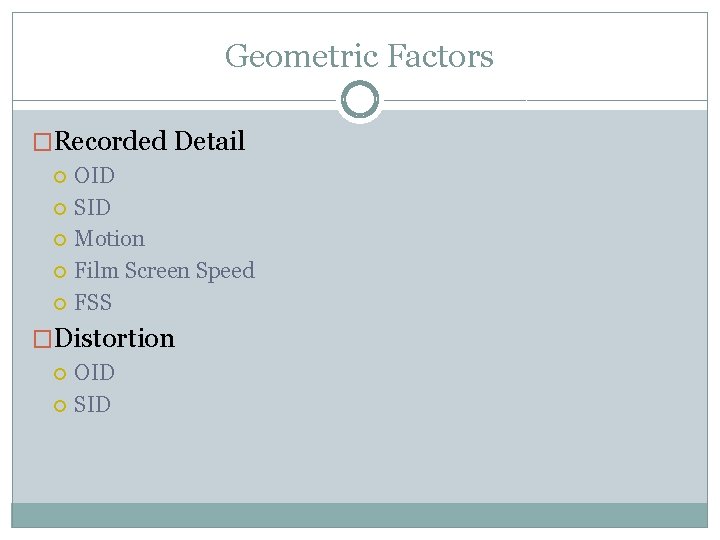
Geometric Factors �Recorded Detail OID SID Motion Film Screen Speed FSS �Distortion OID SID
Recorded Detail �The ability to perceive structures on the radiographic film as being separate and distinct. �Dependent upon how well the edges of objects are recorded on the film
Recorded Detail �Geometric factor/Sharpness �Umbra= area of image sharpness �Blur or Penumbra= area of unsharpness surrounding the image �Reduce the divergence of the beam reaching the film
Recorded Detail �OID Object to Image Receiver Distance �Effects recorded detail and distortion (magnification) by allowing an increase in divergence of the remnant beam prior to reaching the film �As OID increases, �Distortion increases �Recorded detail decreases
Recorded Detail �SID Source to Image Receiver Distance �Effects detail and distortion �As SID increases, � Magnification decreases � Recorded Detail increases
Recorded Detail �Motion �What are the 2 types of motion? �Involuntary peristalsis �Voluntary respiration �How can you reduce the motion? Adjustments in exposure time Proper pt instructions
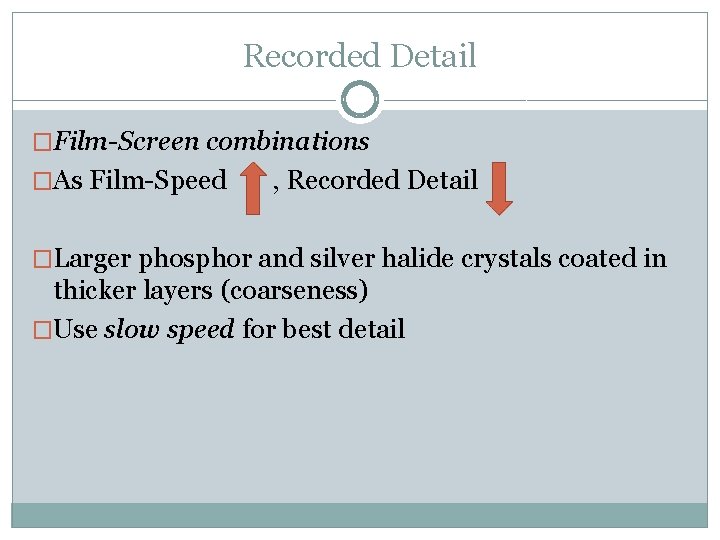
Recorded Detail �Film-Screen combinations �As Film-Speed , Recorded Detail �Larger phosphor and silver halide crystals coated in thicker layers (coarseness) �Use slow speed for best detail
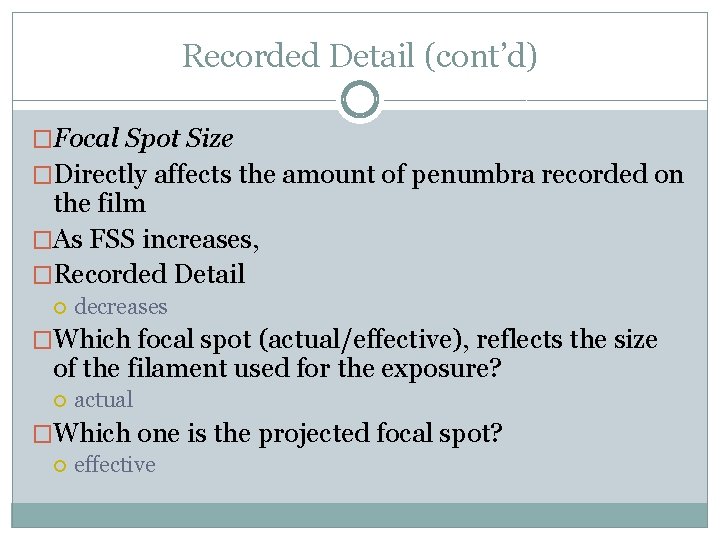
Recorded Detail (cont’d) �Focal Spot Size �Directly affects the amount of penumbra recorded on the film �As FSS increases, �Recorded Detail decreases �Which focal spot (actual/effective), reflects the size of the filament used for the exposure? actual �Which one is the projected focal spot? effective
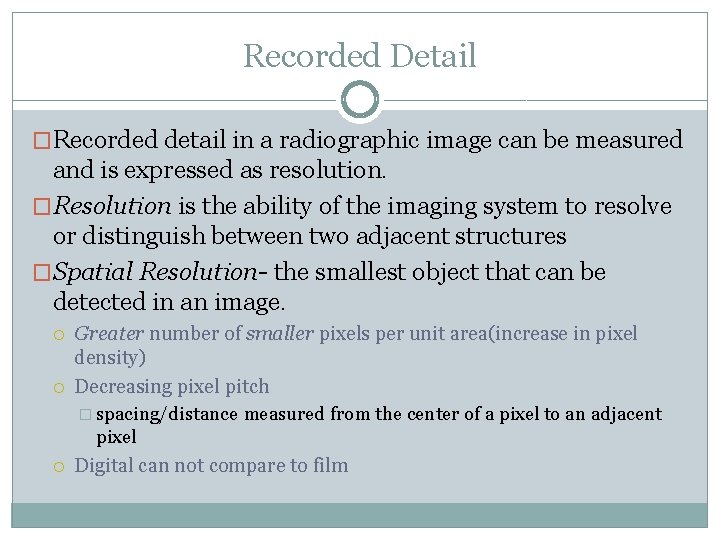
Recorded Detail �Recorded detail in a radiographic image can be measured and is expressed as resolution. �Resolution is the ability of the imaging system to resolve or distinguish between two adjacent structures �Spatial Resolution- the smallest object that can be detected in an image. Greater number of smaller pixels per unit area(increase in pixel density) Decreasing pixel pitch � spacing/distance measured from the center of a pixel to an adjacent pixel Digital can not compare to film
Recorded Detail (cont’d) �Increasing the amount of unsharpness, decreases the contrast between the area of interest and its surrounding background
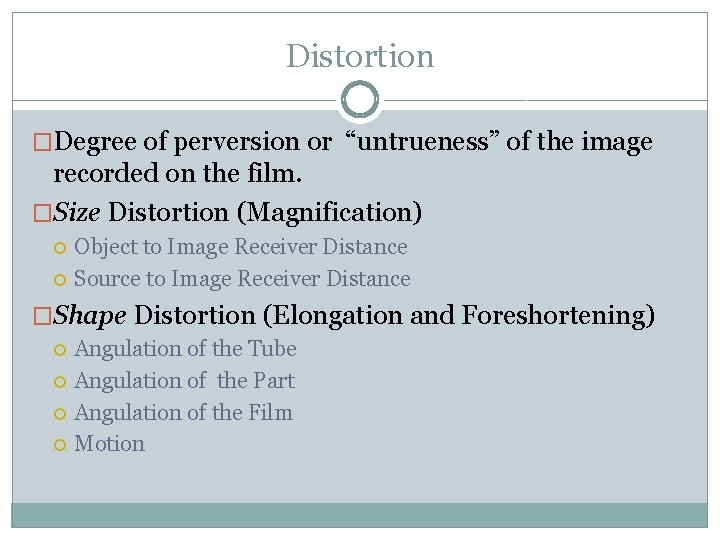
Distortion �Degree of perversion or “untrueness” of the image recorded on the film. �Size Distortion (Magnification) Object to Image Receiver Distance Source to Image Receiver Distance �Shape Distortion (Elongation and Foreshortening) Angulation of the Tube Angulation of the Part Angulation of the Film Motion
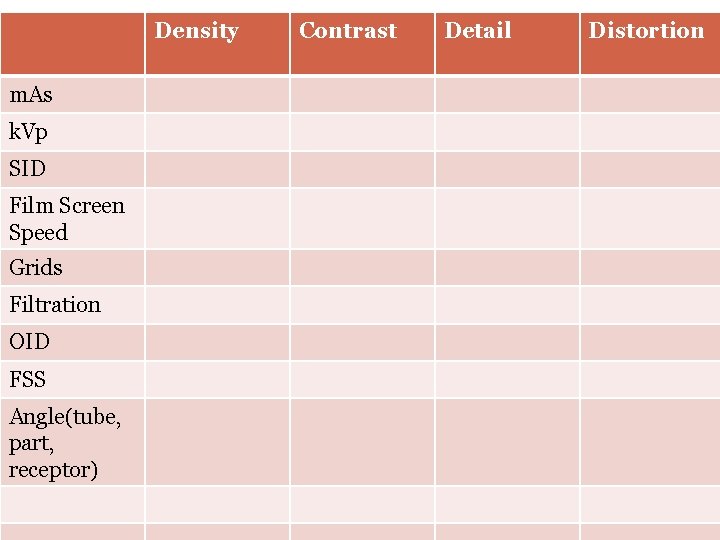
Density m. As k. Vp SID Film Screen Speed Grids Filtration OID FSS Angle(tube, part, receptor) Contrast Detail Distortion
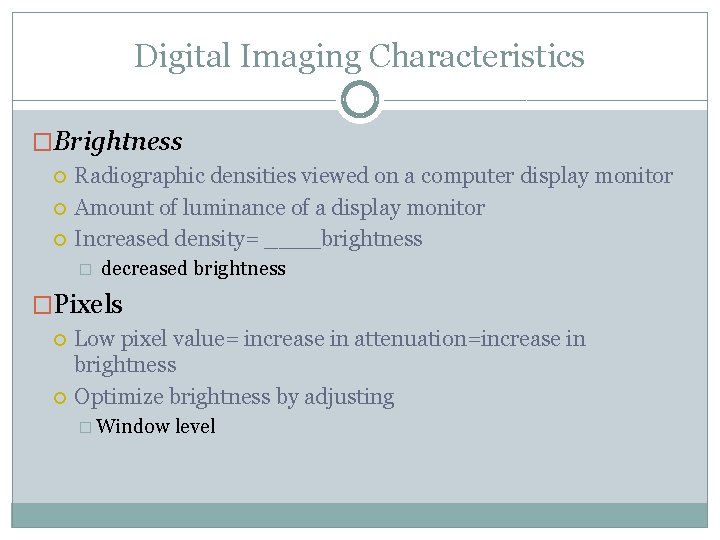
Digital Imaging Characteristics �Brightness Radiographic densities viewed on a computer display monitor Amount of luminance of a display monitor Increased density= ____brightness � decreased brightness �Pixels Low pixel value= increase in attenuation=increase in brightness Optimize brightness by adjusting � Window level
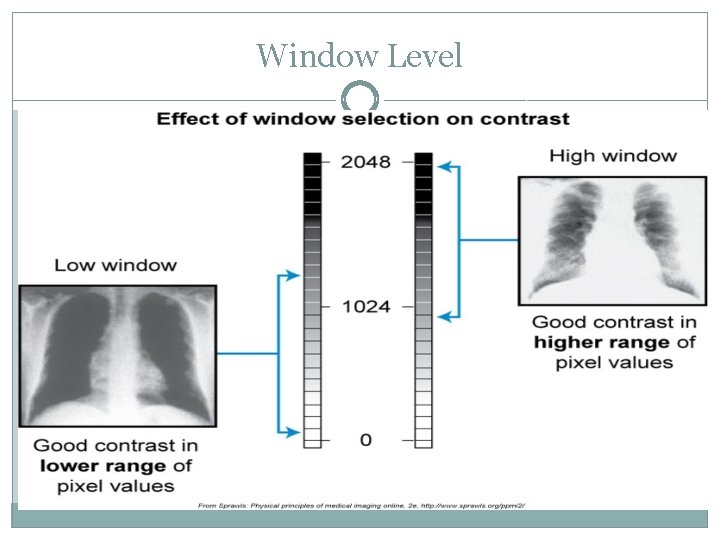
Window Level
Digital Imaging Characteristics �Window level �Center �Sets the midpoint of the range of densities visible in the image �Increases/decreases image brightness �Increase the window level=_____brightness Increase the brightness
Digital Imaging Characteristics �Contrast �Shades of gray �Grayscale- number of shades of gray that can be stored and displayed by a computer system �Contrast Resolution- the ability of the imaging system to distinguish between small objects that attenuate the xray beam similarly �Increasing the number of shades of gray, increases the contrast resolution Increase visibility of recorded detail & ability to distinguish among small anatomic areas of interest
Digital Imaging Characteristics �Window width Adjust contrast (adjusting the range of densities displayed) �When the entire range of densities is displayed Wide (increase) window width, decreases contrast � More shades of gray Narrow (decrease) window width, increases contrast � B&W
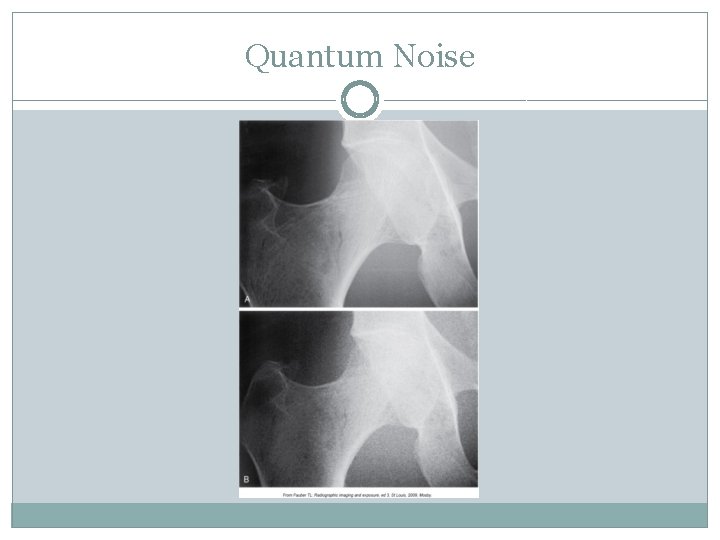
Digital Imaging Characteristics �Image Noise �Quantum Noise Fewer photons reaching the image receptor Density fluctuations on the image
Quantum Noise