
Image Attribute Classification using Disentangled Embeddings on Multimodal
Image Attribute Classification using Disentangled Embeddings on Multimodal Data Introduction ● Many visual domains (housing, vehicle surroundings) require mapping images to the attributes they contain. Goal ● Represent images as disentangled attribute vectors. ○ For example, the first k dimensions of an image embedding could represent tree, the next k could represent house etc. Applications ● ● Verify attributes of houses based on images. For example, we could use this model to answer the question: do renters’ homes really have the attributes (ie. hardwood floors, closets, etc) that they claim to have? Another example lies in the space of autonomous driving. ○ We can find attributes of images that contain a cars’ surroundings.
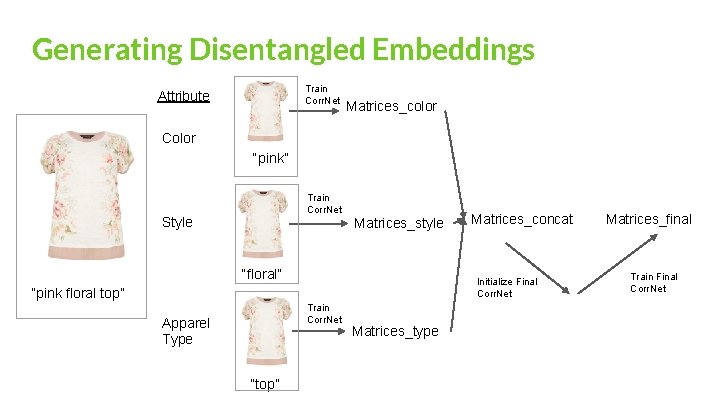
Generating Disentangled Embeddings Train Corr. Net Attribute Matrices_color Color “pink” Train Corr. Net Style Matrices_style “floral” Initialize Final Corr. Net “pink floral top” Train Corr. Net Apparel Type “top” Matrices_concat Matrices_type Matrices_final Train Final Corr. Net
Research Areas/Extensions ● When considering a large number of attributes, many images may not contain all of these attributes. ○ For example, in a housing domain, if our attribute space consists of “bed”, “lamp” and “dresser”, one particular image may only have a “bed” and a “lamp”. ○ We can explore what value for the text component we would give the Corr. Net for an image (a bedroom) where the attribute is not present (no dresser) ○ Ideas: we could use a vector of 0’s, or use vector orthogonal to the attribute that is not contained in the image. ● Can we feed in (attribute, image) pairs and the whole image, or can we experiment with image segmentation and feed in (attribute, segmented image) -- which performs better?
- Slides: 3