
IMA Minneapolis January 2008 Computational Experiments in coarse

- Slides: 55
IMA, Minneapolis, January 2008 Computational Experiments in coarse graining atomistic simulations (Equation-free -& Variable Free- Framework For Complex/Multiscale Systems) I. G. Kevrekidis -C. W. Gear, G. Hummer, R. Coifman and several other good people. Department of Chemical Engineering, PACM & Mathematics Princeton University, Princeton, NJ 08544 Princeton University
SIAM– July, 2004 Clustering and stirring in a plankton model Young, Roberts and Stuhne, Nature 2001 Princeton University
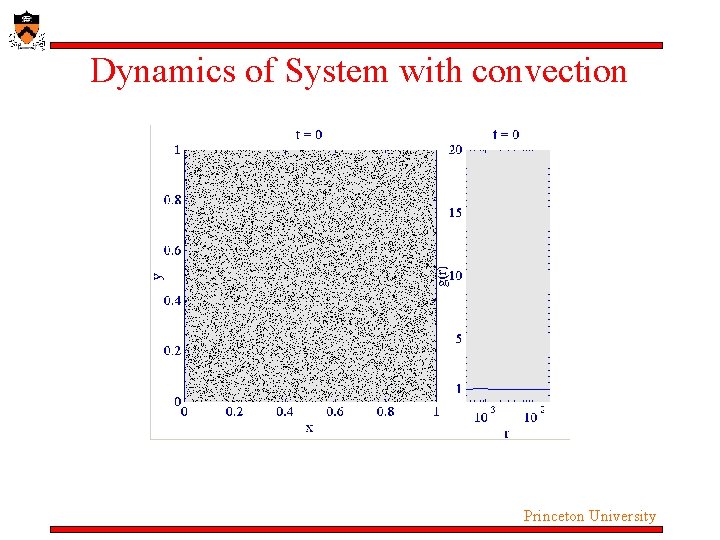
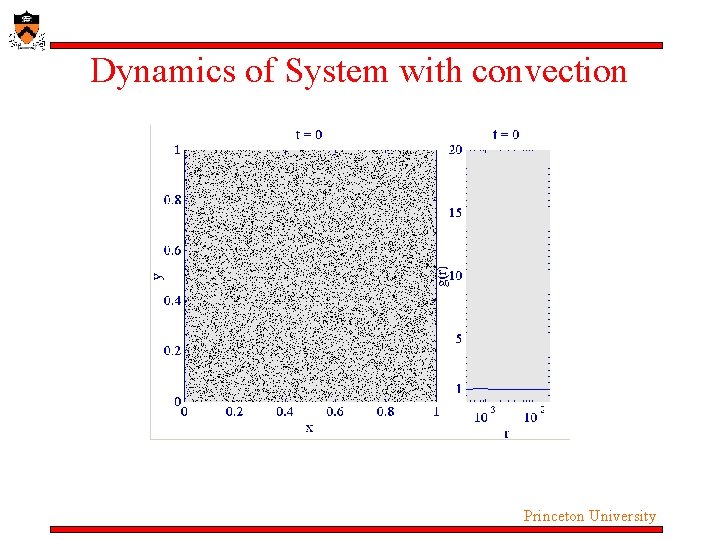
Dynamics of System with convection Princeton University
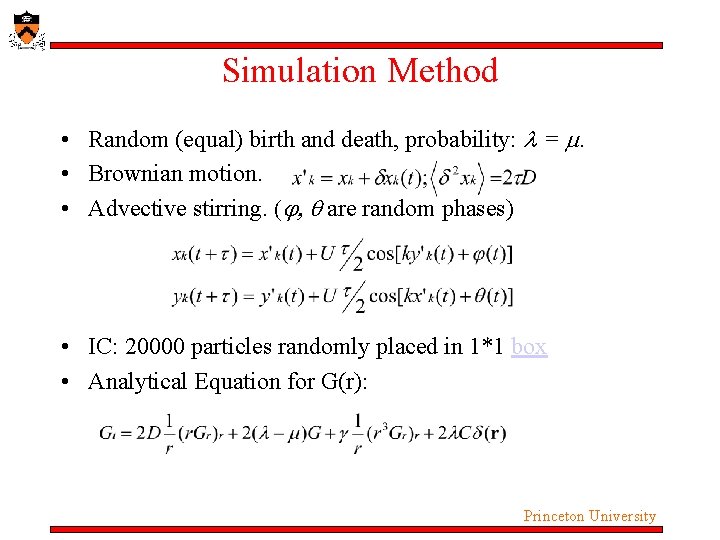
Simulation Method • Random (equal) birth and death, probability: l = m. • Brownian motion. • Advective stirring. (j, q are random phases) • IC: 20000 particles randomly placed in 1*1 box • Analytical Equation for G(r): Princeton University
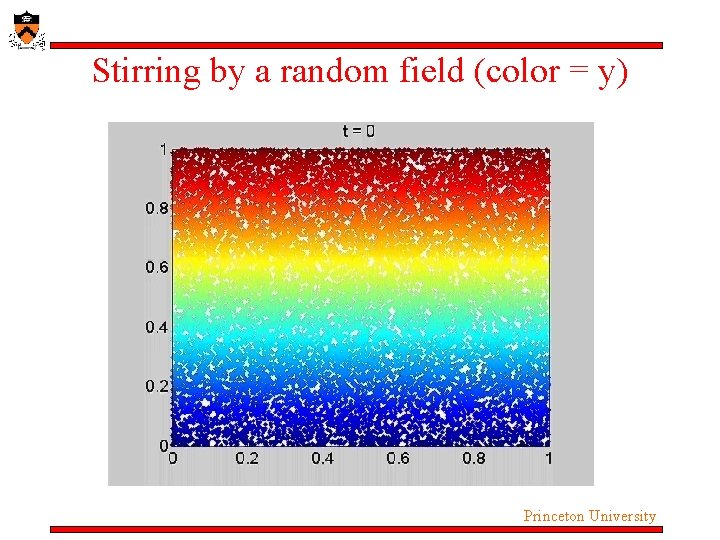
Stirring by a random field (color = y) Princeton University
Dynamics of System with convection Princeton University
Princeton University
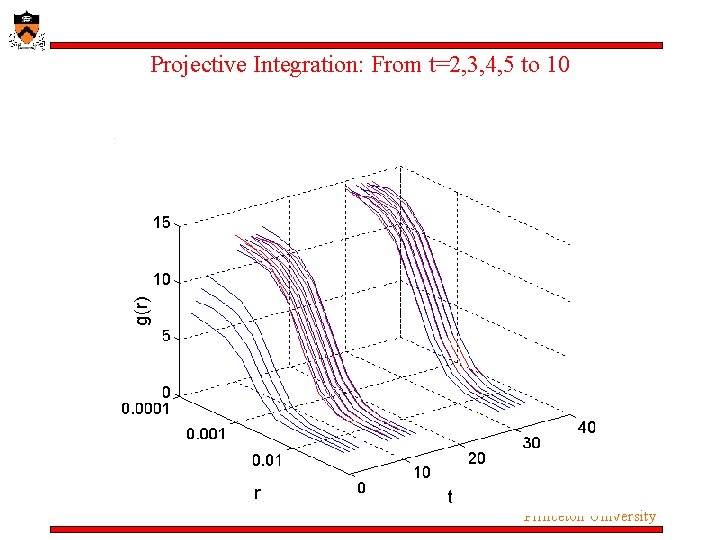
Projective Integration: From t=2, 3, 4, 5 to 10 Princeton University
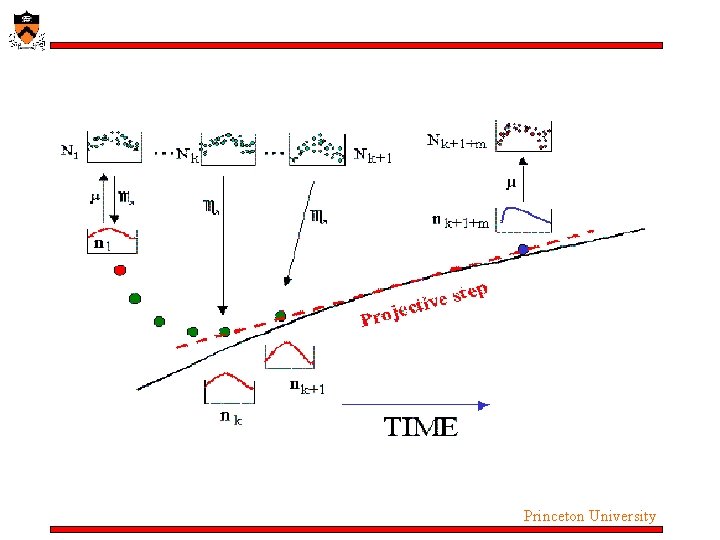
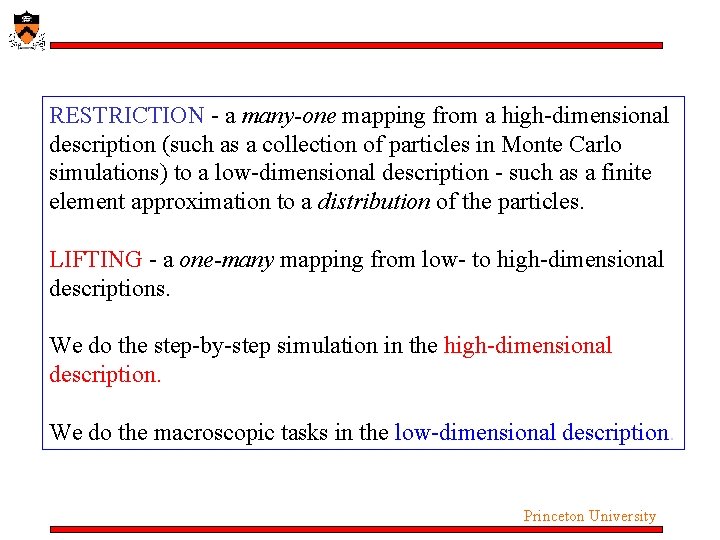
RESTRICTION - a many-one mapping from a high-dimensional description (such as a collection of particles in Monte Carlo simulations) to a low-dimensional description - such as a finite element approximation to a distribution of the particles. LIFTING - a one-many mapping from low- to high-dimensional descriptions. We do the step-by-step simulation in the high-dimensional description. We do the macroscopic tasks in the low-dimensional description. Princeton University
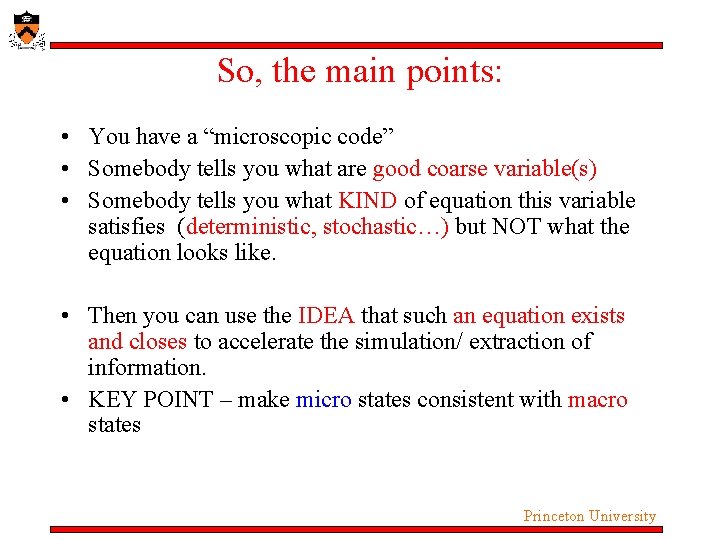
So, the main points: • You have a “microscopic code” • Somebody tells you what are good coarse variable(s) • Somebody tells you what KIND of equation this variable satisfies (deterministic, stochastic…) but NOT what the equation looks like. • Then you can use the IDEA that such an equation exists and closes to accelerate the simulation/ extraction of information. • KEY POINT – make micro states consistent with macro states Princeton University
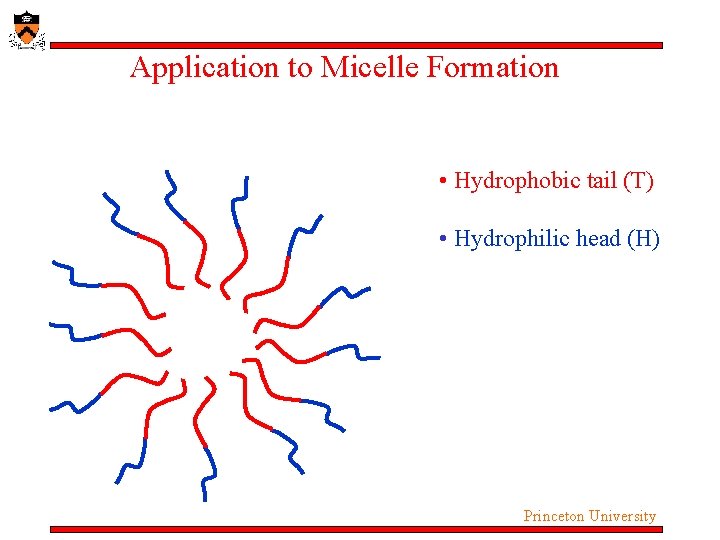
Application to Micelle Formation • Hydrophobic tail (T) • Hydrophilic head (H) Princeton University
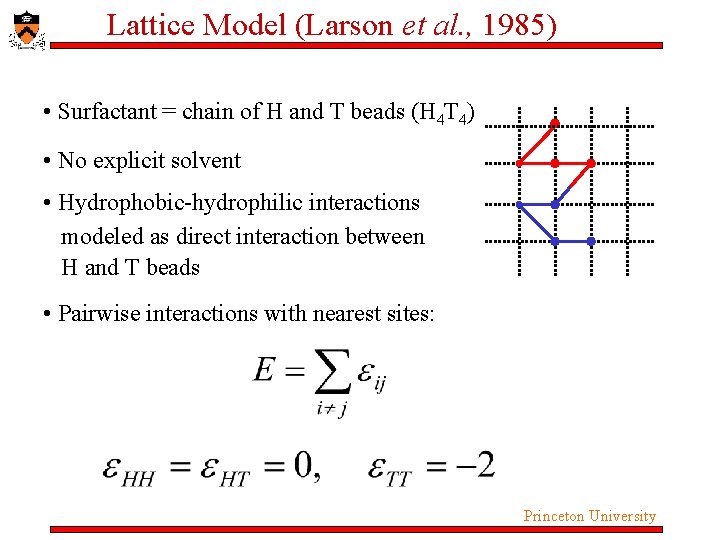
Lattice Model (Larson et al. , 1985) • Surfactant = chain of H and T beads (H 4 T 4) • No explicit solvent • Hydrophobic-hydrophilic interactions modeled as direct interaction between H and T beads • Pairwise interactions with nearest sites: Princeton University
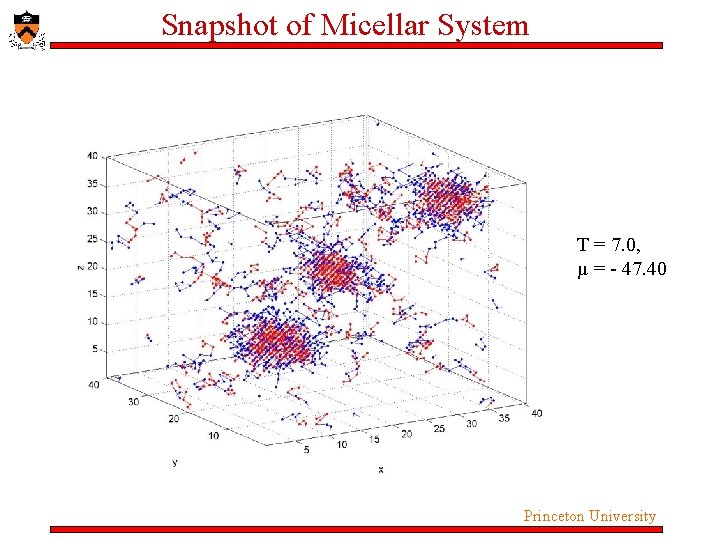
Snapshot of Micellar System T = 7. 0, µ = - 47. 40 Princeton University
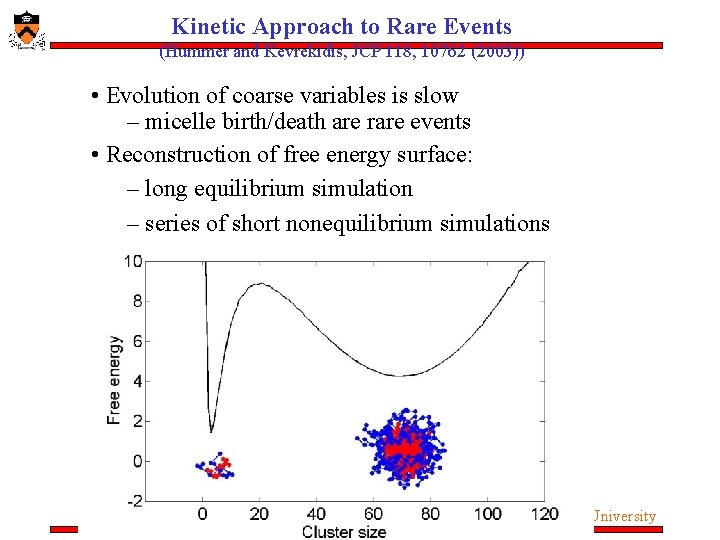
Kinetic Approach to Rare Events (Hummer and Kevrekidis, JCP 118, 10762 (2003)) • Evolution of coarse variables is slow – micelle birth/death are rare events • Reconstruction of free energy surface: – long equilibrium simulation – series of short nonequilibrium simulations Princeton University
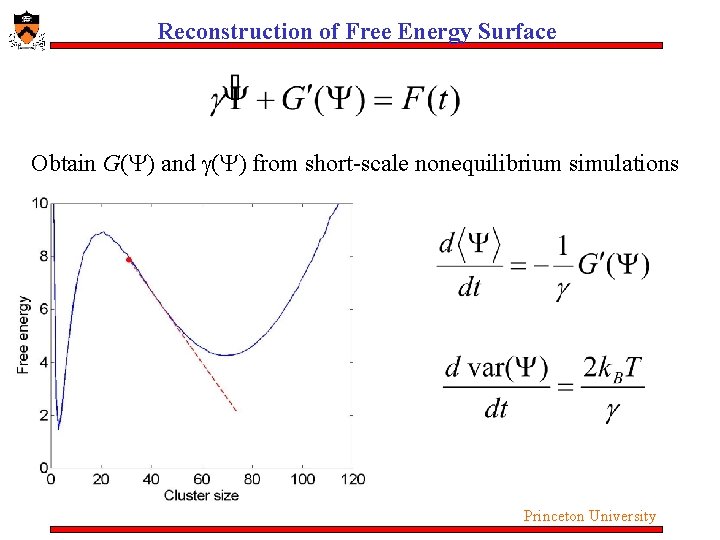
Reconstruction of Free Energy Surface Obtain G( ) and ( ) from short-scale nonequilibrium simulations Princeton University
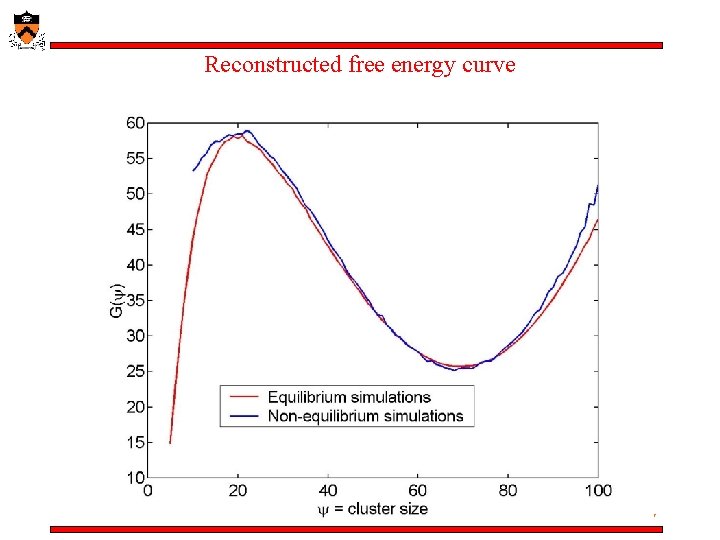
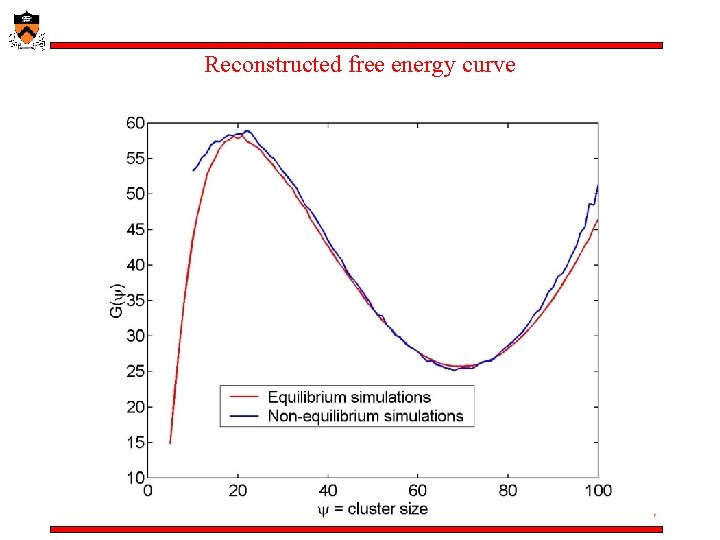
Reconstructed free energy curve Princeton University
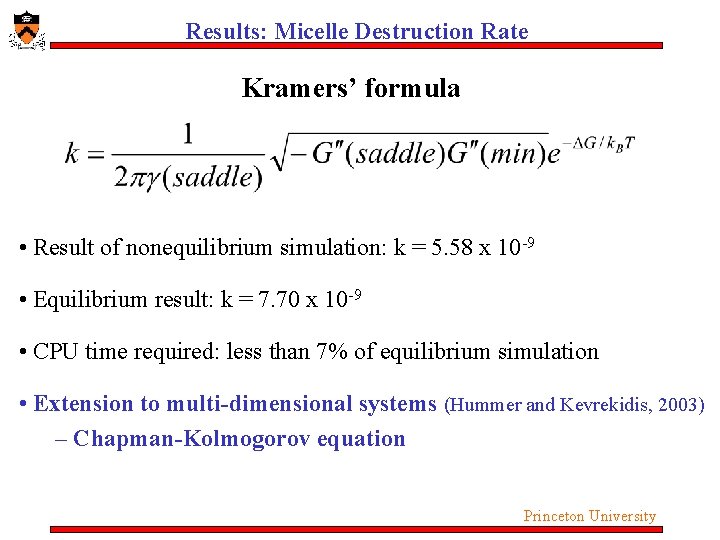
Results: Micelle Destruction Rate Kramers’ formula • Result of nonequilibrium simulation: k = 5. 58 x 10 -9 • Equilibrium result: k = 7. 70 x 10 -9 • CPU time required: less than 7% of equilibrium simulation • Extension to multi-dimensional systems (Hummer and Kevrekidis, 2003) – Chapman-Kolmogorov equation Princeton University
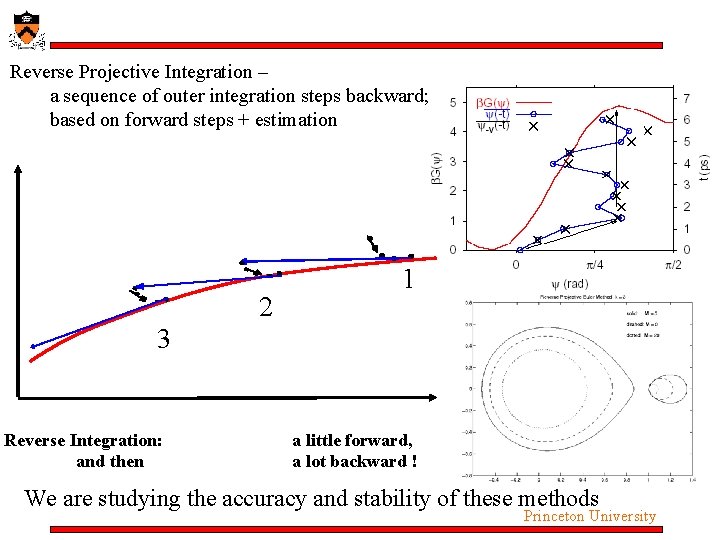
Reverse Projective Integration – a sequence of outer integration steps backward; based on forward steps + estimation 2 1 3 Reverse Integration: and then a little forward, a lot backward ! We are studying the accuracy and stability of these methods Princeton University
Reverse coarse integration from both sides Princeton University
Reconstructed free energy curve Princeton University
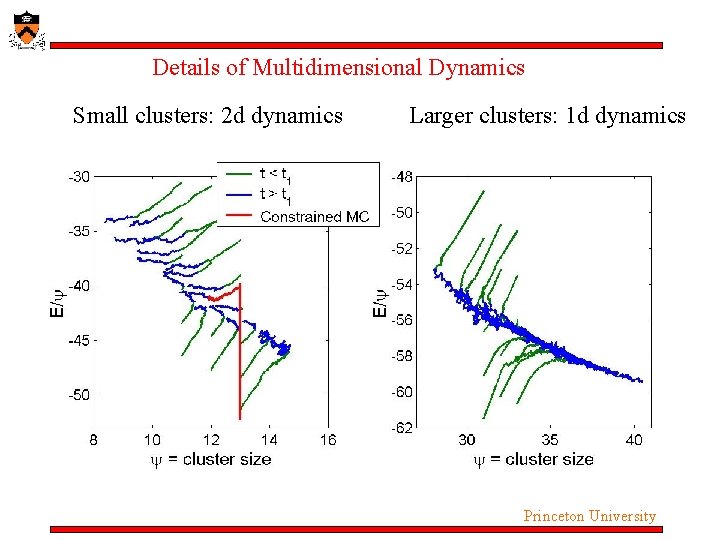
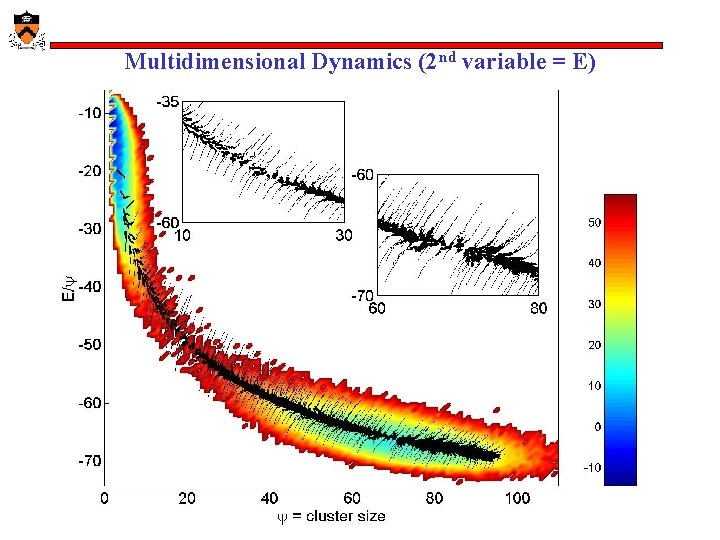
Details of Multidimensional Dynamics Small clusters: 2 d dynamics Larger clusters: 1 d dynamics Princeton University
Multidimensional Dynamics (2 nd variable = E) Princeton University
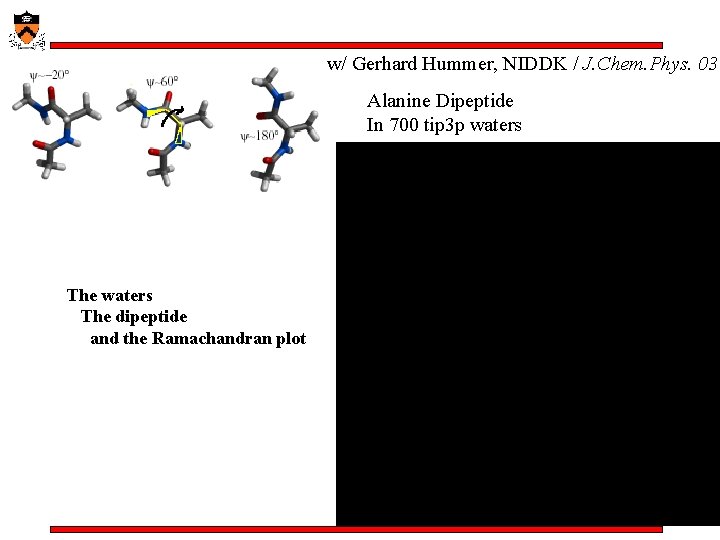
w/ Gerhard Hummer, NIDDK / J. Chem. Phys. 03 Alanine Dipeptide In 700 tip 3 p waters The dipeptide and the Ramachandran plot Princeton University
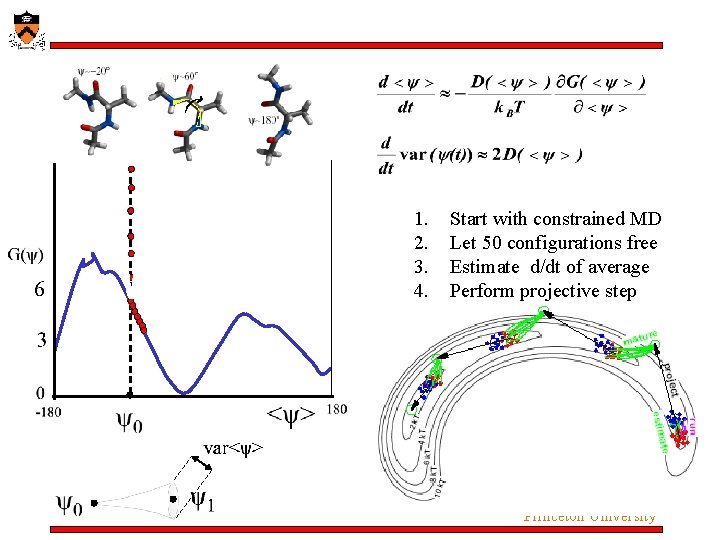
1. 2. 3. 4. Start with constrained MD Let 50 configurations free Estimate d/dt of average Perform projective step Princeton University
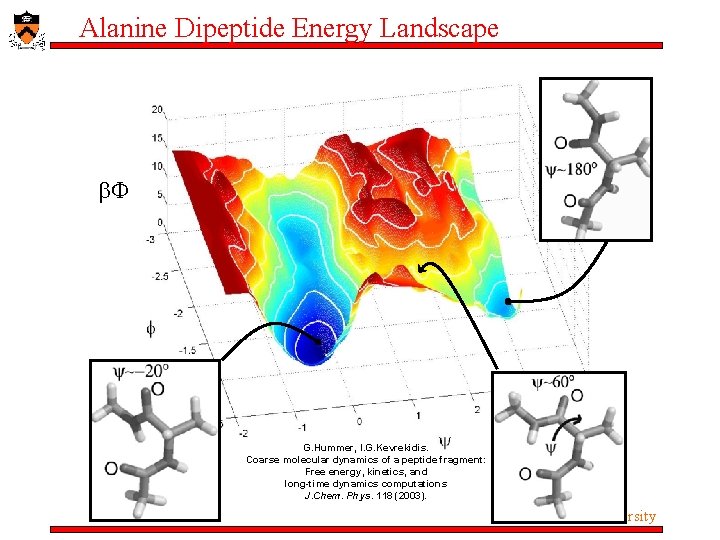
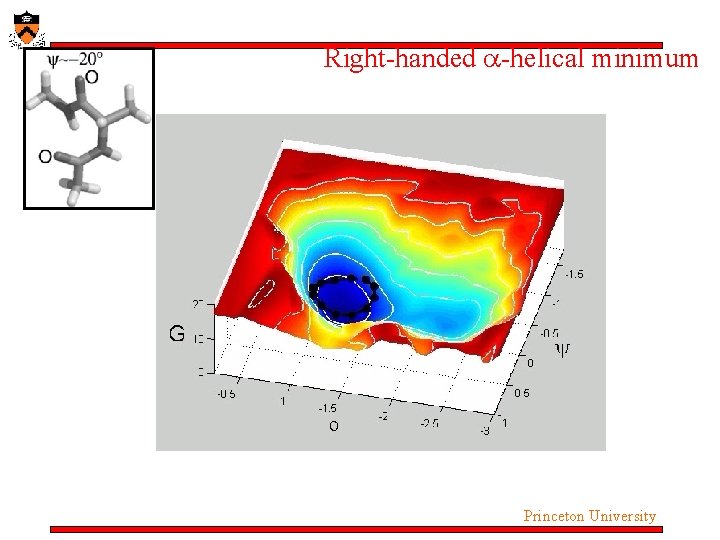
Alanine Dipeptide Energy Landscape G. Hummer, I. G. Kevrekidis. Coarse molecular dynamics of a peptide fragment: Free energy, kinetics, and long-time dynamics computations J. Chem. Phys. 118 (2003). Princeton University
Princeton University
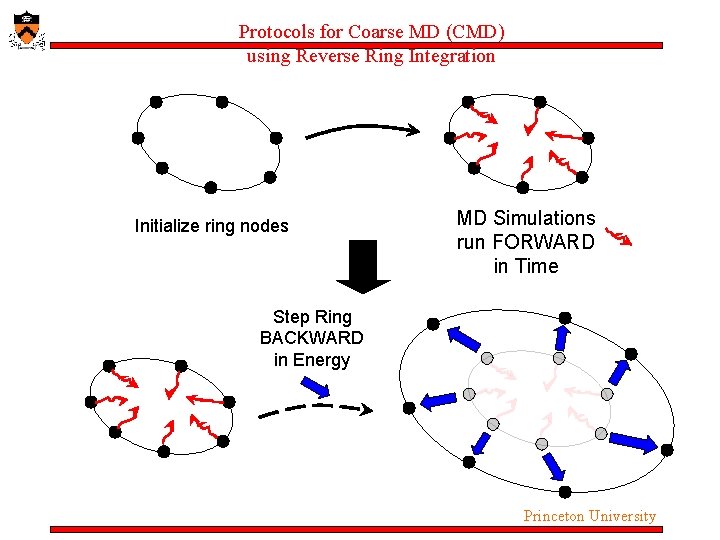
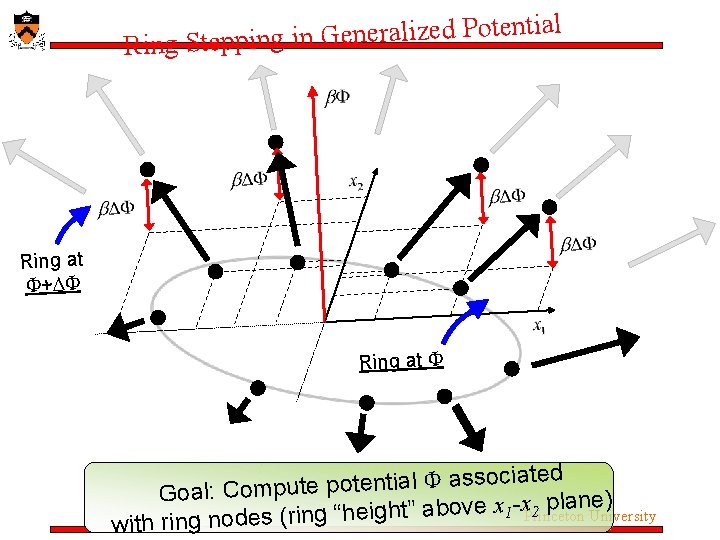
Protocols for Coarse MD (CMD) using Reverse Ring Integration Initialize ring nodes MD Simulations run FORWARD in Time Step Ring BACKWARD in Energy Princeton University
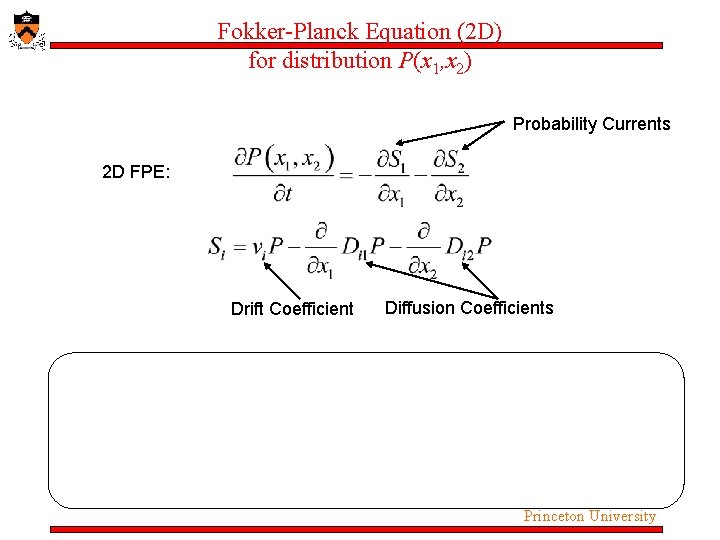
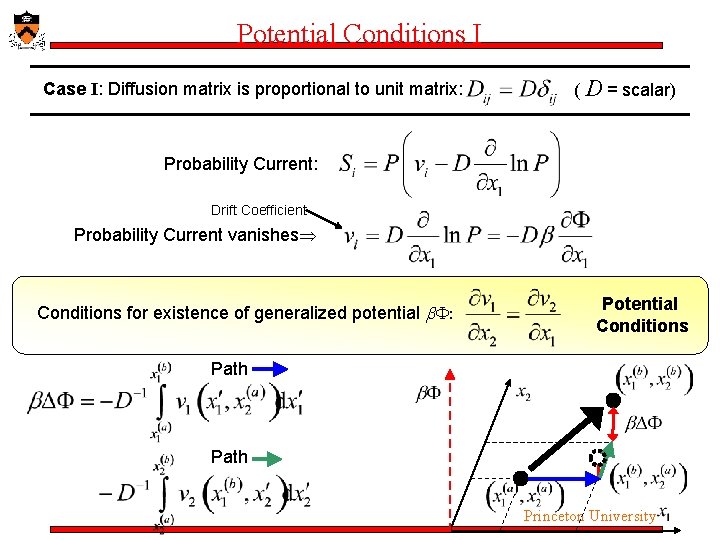
Fokker-Planck Equation (2 D) for distribution P(x 1, x 2) Probability Currents 2 D FPE: Drift Coefficient Diffusion Coefficients Princeton University
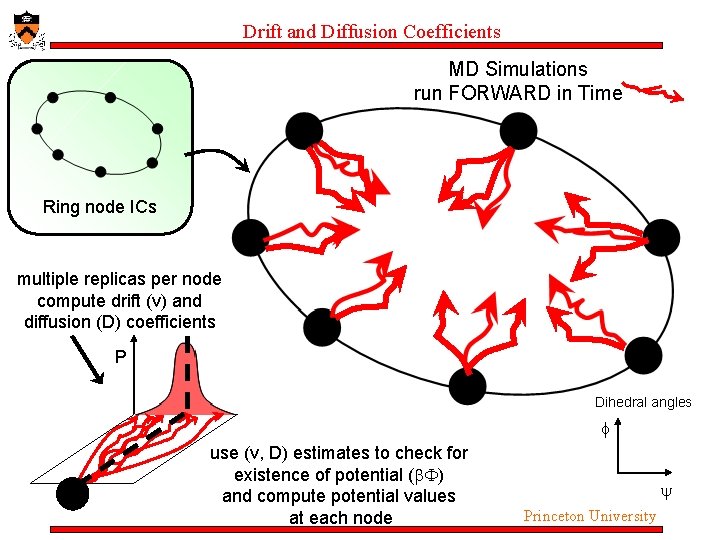
Drift and Diffusion Coefficients MD Simulations run FORWARD in Time Ring node ICs multiple replicas per node compute drift (v) and diffusion (D) coefficients P Dihedral angles use (v, D) estimates to check for existence of potential ( ) and compute potential values at each node Princeton University
tial n te o P d e z li ra e n e G in g Ring Steppin Ring at + Ring at ociated s s a l a ti n te o p te u p Goal: Com e) n la p -x x e v o b a 2 t” 1 h ig e Princeton University with ring nodes (ring “h
Right-handed -helical minimum Princeton University
Potential Conditions I Case I: Diffusion matrix is proportional to unit matrix: ( D = scalar) Probability Current: Drift Coefficient Probability Current vanishes Conditions for existence of generalized potential : Potential Conditions Path Princeton University
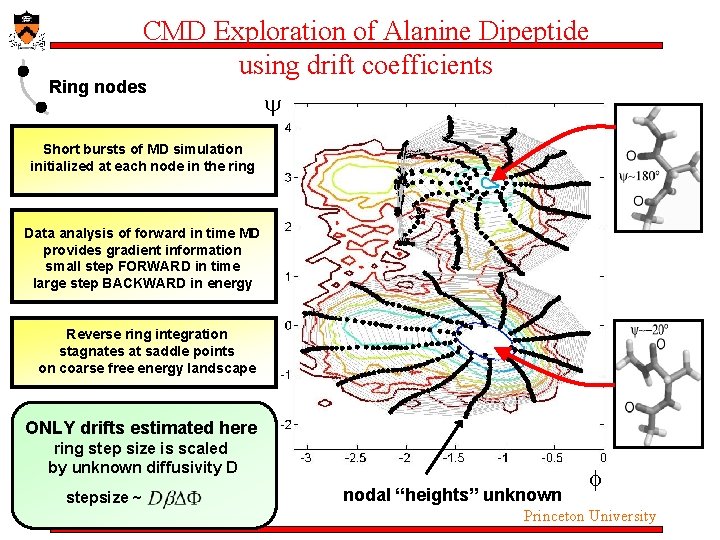
CMD Exploration of Alanine Dipeptide using drift coefficients Ring nodes Short bursts of MD simulation initialized at each node in the ring Data analysis of forward in time MD provides gradient information small step FORWARD in time large step BACKWARD in energy Reverse ring integration stagnates at saddle points on coarse free energy landscape ONLY drifts estimated here ring step size is scaled by unknown diffusivity D stepsize ~ nodal “heights” unknown Princeton University
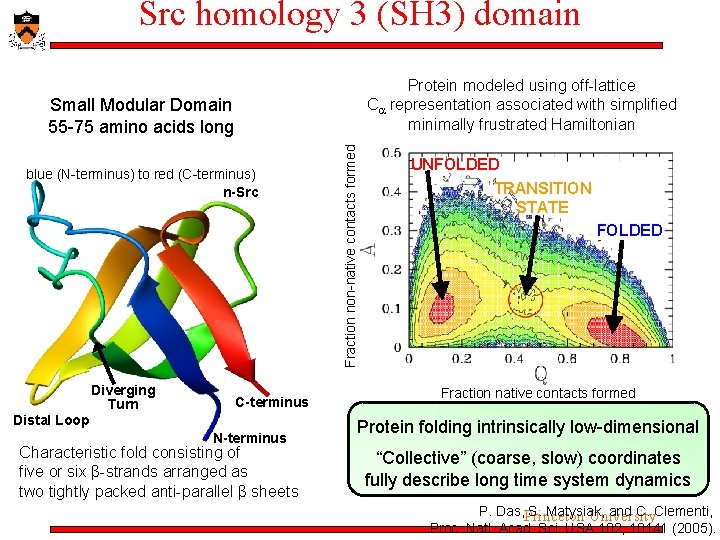
Src homology 3 (SH 3) domain Protein modeled using off-lattice C representation associated with simplified minimally frustrated Hamiltonian blue (N-terminus) to red (C-terminus) n-Src Diverging Turn C-terminus Distal Loop N-terminus Characteristic fold consisting of five or six β-strands arranged as two tightly packed anti-parallel β sheets Fraction non-native contacts formed Small Modular Domain 55 -75 amino acids long UNFOLDED TRANSITION STATE FOLDED Fraction native contacts formed Protein folding intrinsically low-dimensional “Collective” (coarse, slow) coordinates fully describe long time system dynamics P. Das, Princeton S. Matysiak, and C. Clementi, University Proc. Natl. Acad. Sci. USA 102, 10141 (2005).
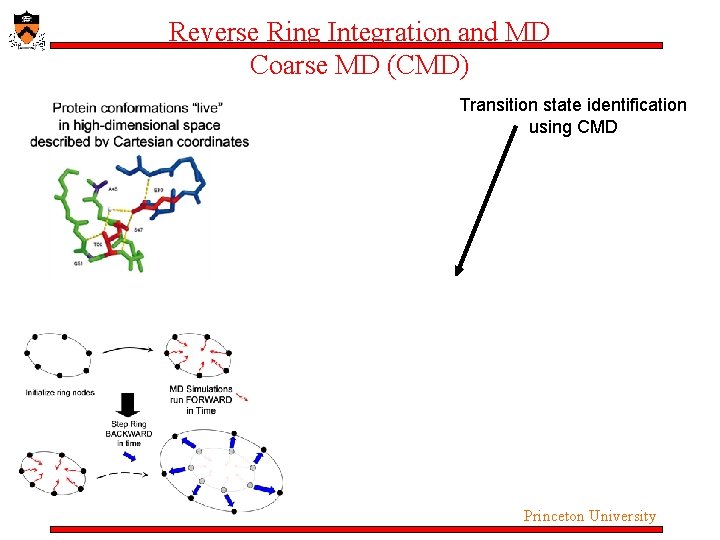
Reverse Ring Integration and MD Coarse MD (CMD) Transition state identification using CMD Princeton University
So, again, the main points • Somebody needs to tell you what the coarse variables are • And what TYPE of equation they satisfy • And then you can use this information to bias the simulations “intelligently” accelerating the extraction of information (also need hypothesis testing). Princeton University
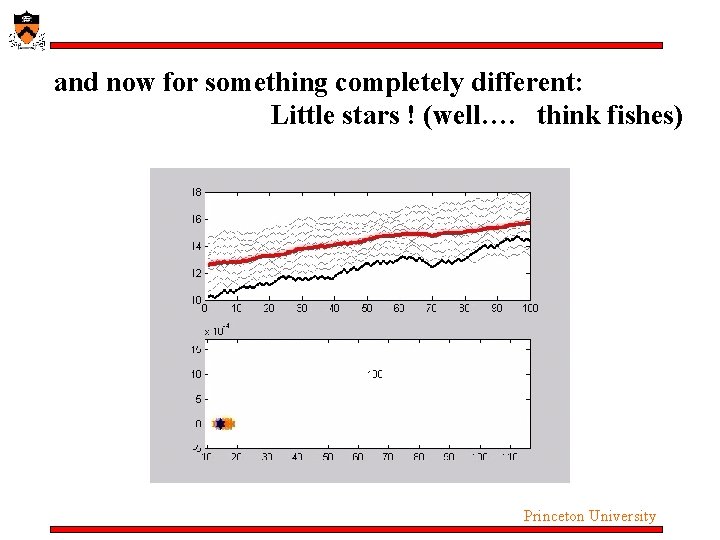
and now for something completely different: Little stars ! (well…. think fishes) Princeton University
Princeton University
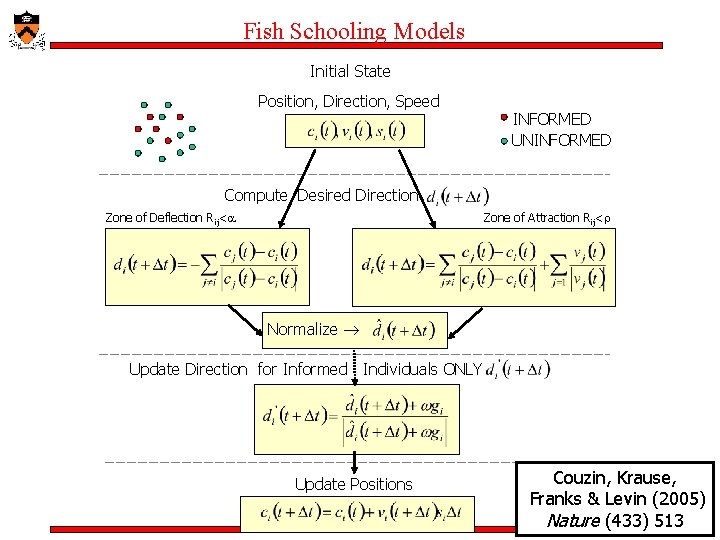
Fish Schooling Models Initial State Position, Direction, Speed INFORMED UNINFORMED Compute Desired Direction Zone of Attraction Rij< Zone of Deflection Rij< Normalize Update Direction for Informed Individuals ONLY Update Positions Couzin, Krause, Franks & Levin (2005) Princeton University Nature (433) 513
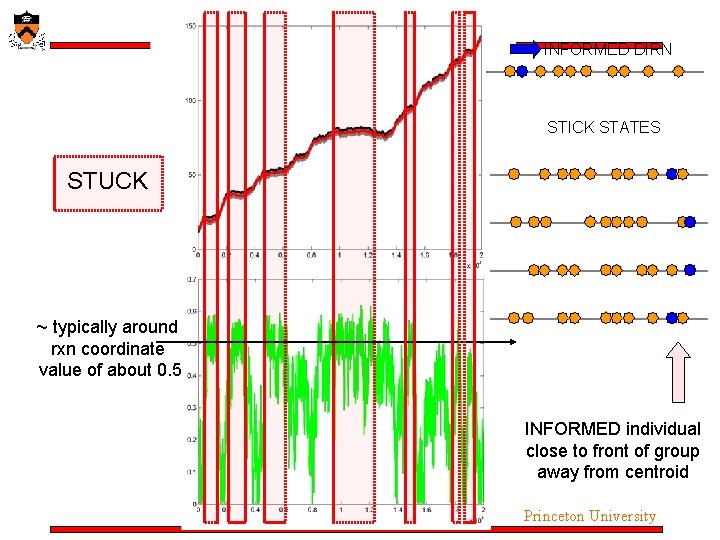
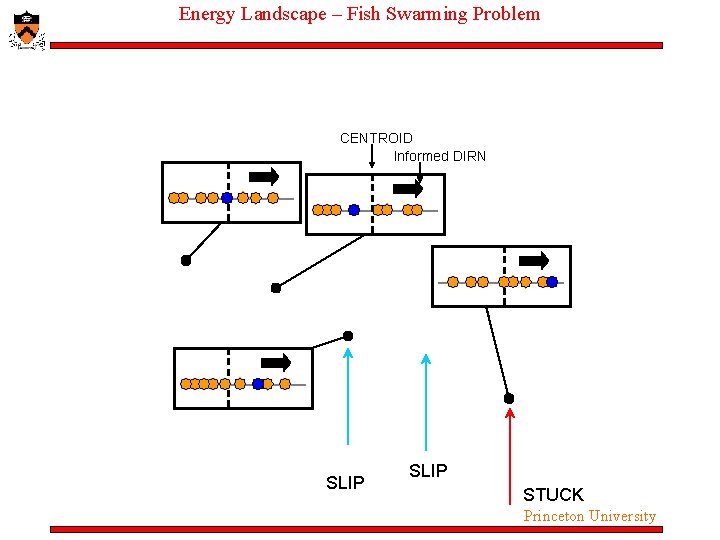
INFORMED DIRN STICK STATES STUCK ~ typically around rxn coordinate value of about 0. 5 INFORMED individual close to front of group away from centroid Princeton University
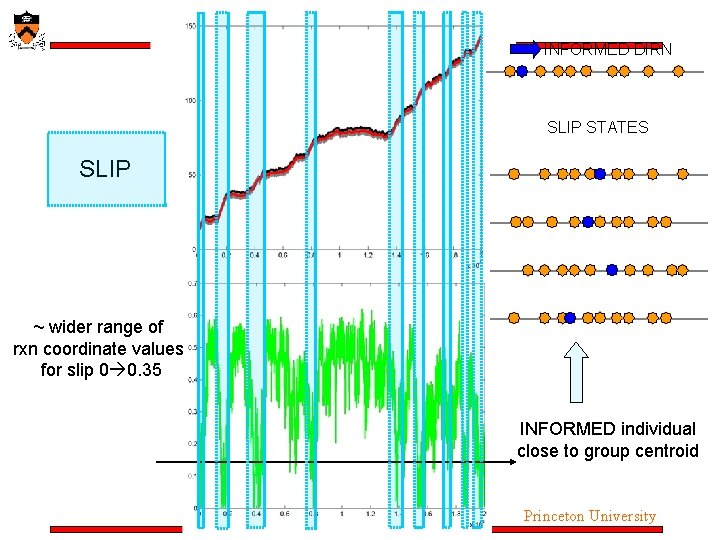
INFORMED DIRN SLIP STATES SLIP ~ wider range of rxn coordinate values for slip 0 0. 35 INFORMED individual close to group centroid Princeton University
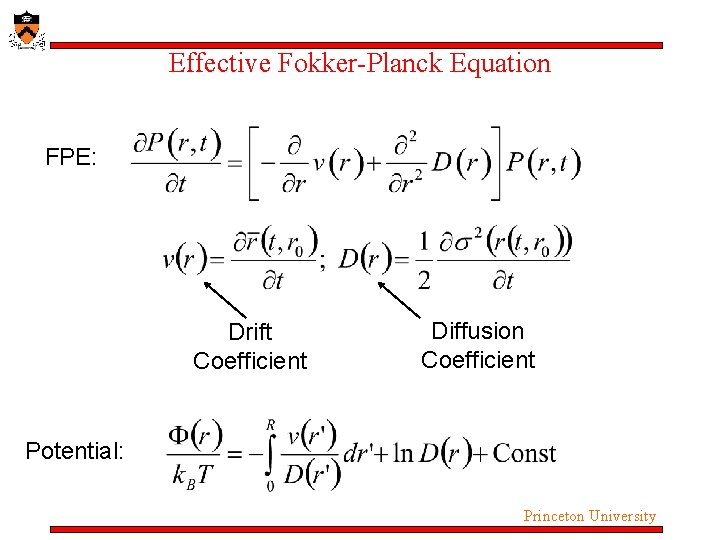
Effective Fokker-Planck Equation FPE: Drift Coefficient Diffusion Coefficient Potential: Princeton University
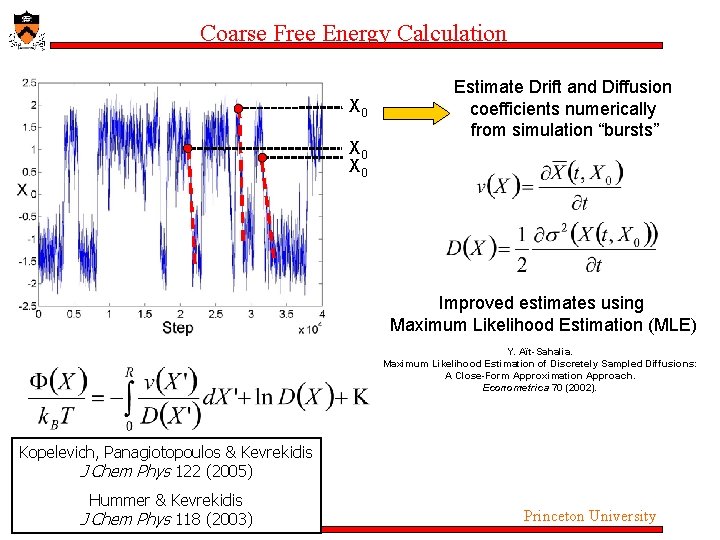
Coarse Free Energy Calculation X 0 X 0 Estimate Drift and Diffusion coefficients numerically from simulation “bursts” Improved estimates using Maximum Likelihood Estimation (MLE) Y. Aït-Sahalia. Maximum Likelihood Estimation of Discretely Sampled Diffusions: A Close-Form Approximation Approach. Econometrica 70 (2002). Kopelevich, Panagiotopoulos & Kevrekidis J Chem Phys 122 (2005) Hummer & Kevrekidis J Chem Phys 118 (2003) Princeton University
Energy Landscape – Fish Swarming Problem CENTROID Informed DIRN SLIP STUCK Princeton University
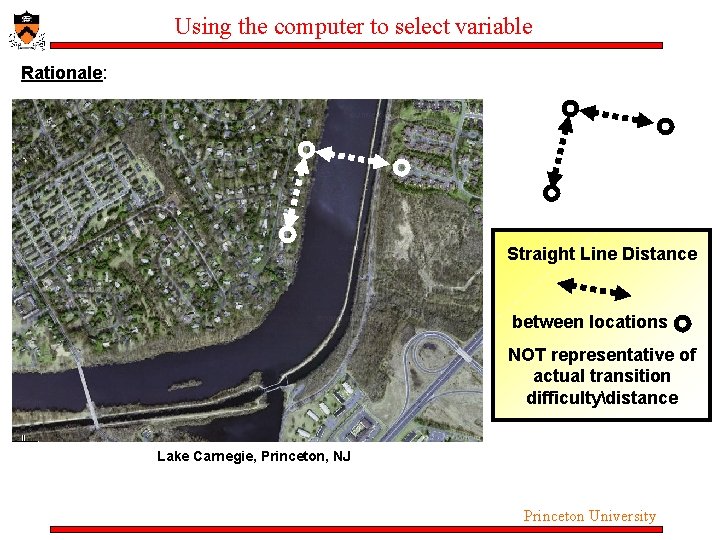
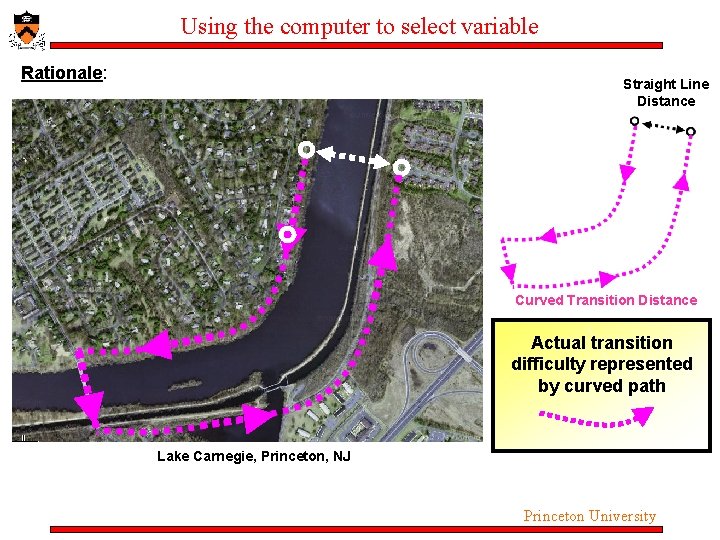
Using the computer to select variable Rationale: Straight Line Distance between locations NOT representative of actual transition difficultydistance Lake Carnegie, Princeton, NJ Princeton University
Using the computer to select variable Rationale: Straight Line Distance Curved Transition Distance Actual transition difficulty represented by curved path Lake Carnegie, Princeton, NJ Princeton University
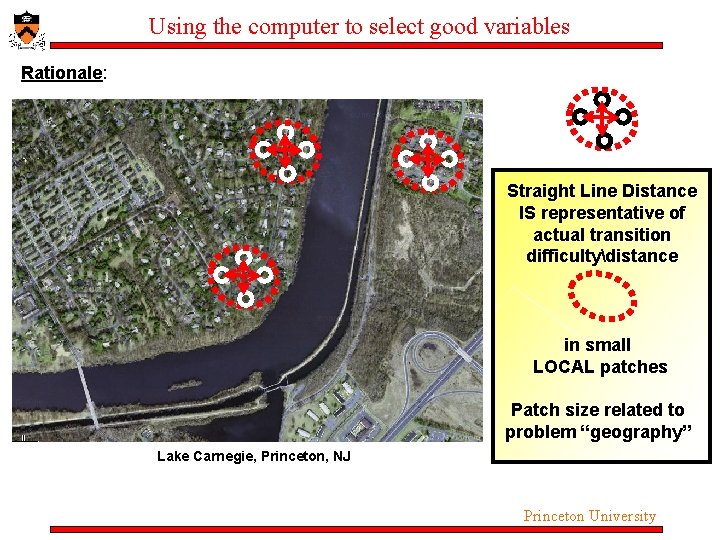
Using the computer to select good variables Rationale: Straight Line Distance IS representative of actual transition difficultydistance in small LOCAL patches Patch size related to problem “geography” Lake Carnegie, Princeton, NJ Princeton University
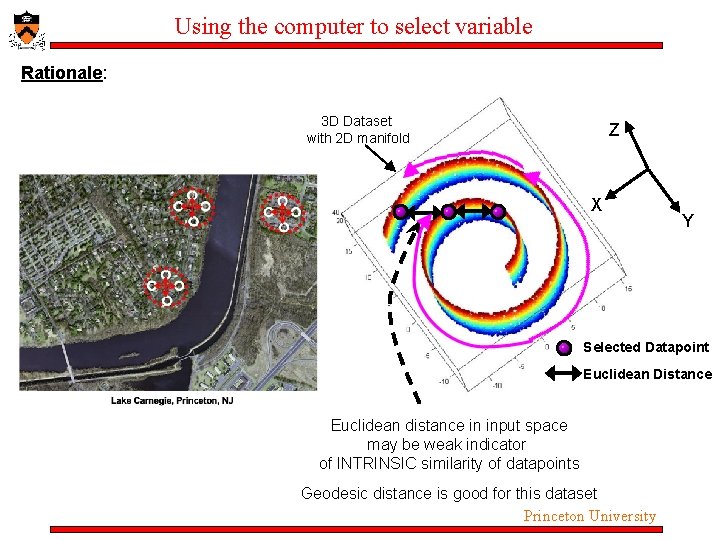
Using the computer to select variable Rationale: 3 D Dataset with 2 D manifold Z X Y Selected Datapoint Euclidean Distance Euclidean distance in input space may be weak indicator of INTRINSIC similarity of datapoints Geodesic distance is good for this dataset Princeton University
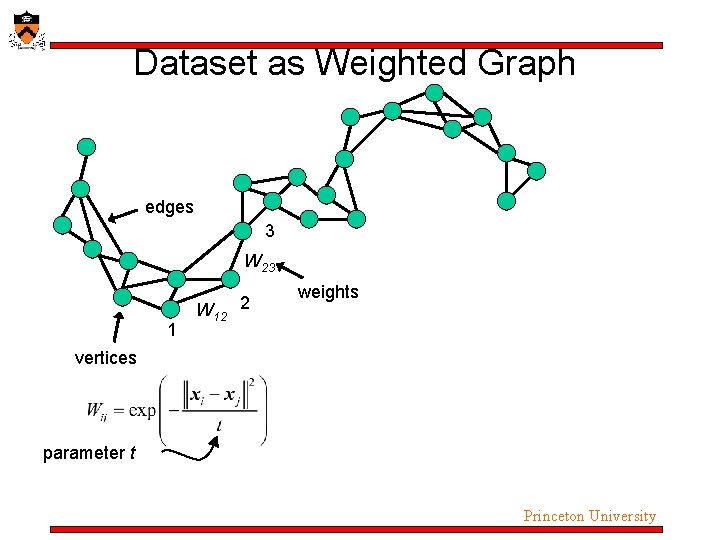
Dataset as Weighted Graph edges 3 W 23 1 W 12 2 weights vertices parameter t Princeton University
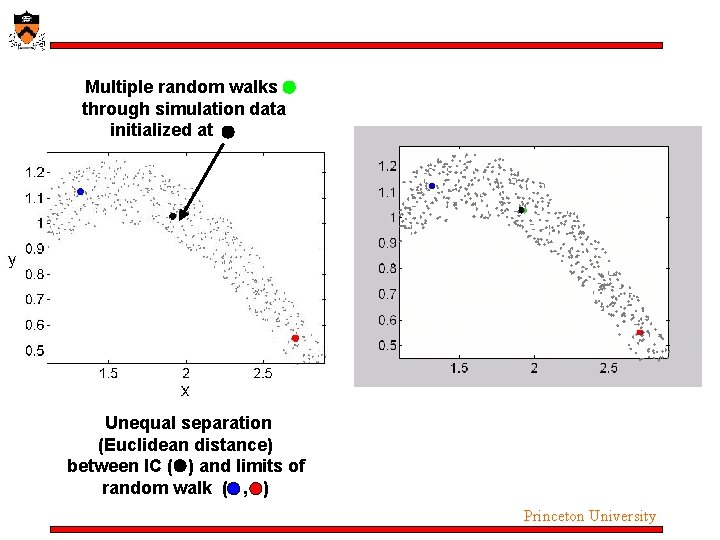
Multiple random walks through simulation data initialized at Unequal separation (Euclidean distance) between IC ( ) and limits of random walk ( , ) Princeton University
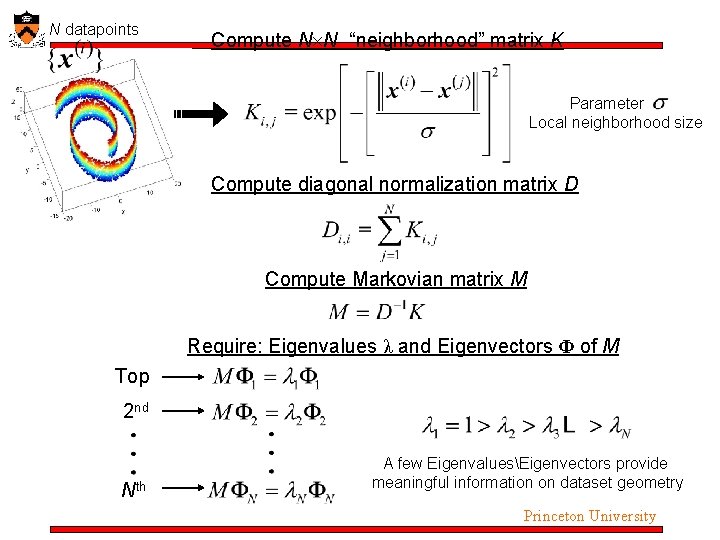
N datapoints Compute N N “neighborhood” matrix K Parameter Local neighborhood size Compute diagonal normalization matrix D Compute Markovian matrix M Require: Eigenvalues λ and Eigenvectors Φ of M Top 2 nd Nth A few EigenvaluesEigenvectors provide meaningful information on dataset geometry Princeton University
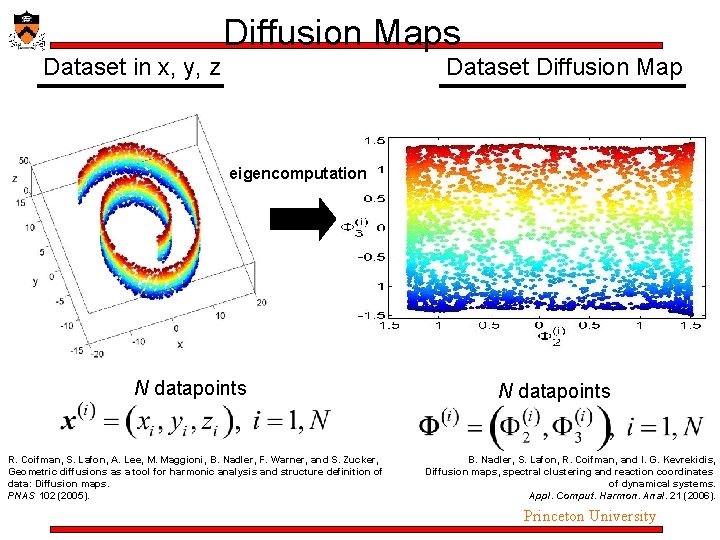
Diffusion Maps Dataset in x, y, z Dataset Diffusion Map eigencomputation N datapoints R. Coifman, S. Lafon, A. Lee, M. Maggioni, B. Nadler, F. Warner, and S. Zucker, Geometric diffusions as a tool for harmonic analysis and structure definition of data: Diffusion maps. PNAS 102 (2005). N datapoints B. Nadler, S. Lafon, R. Coifman, and I. G. Kevrekidis, Diffusion maps, spectral clustering and reaction coordinates of dynamical systems. Appl. Comput. Harmon. Anal. 21 (2006). Princeton University
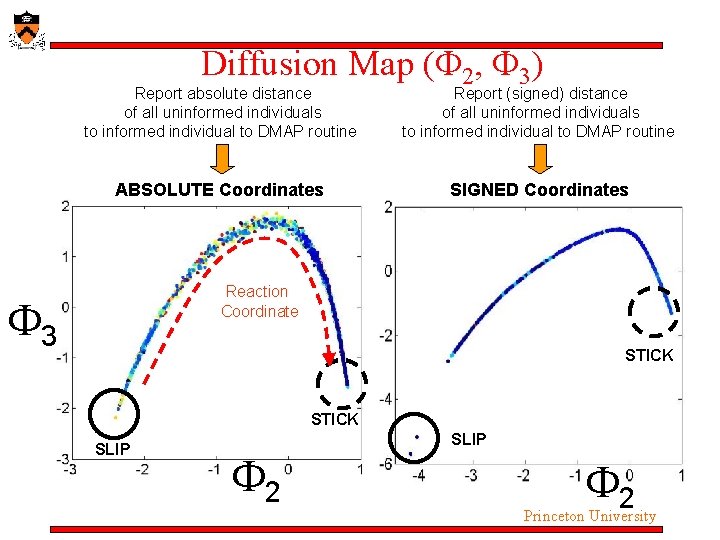
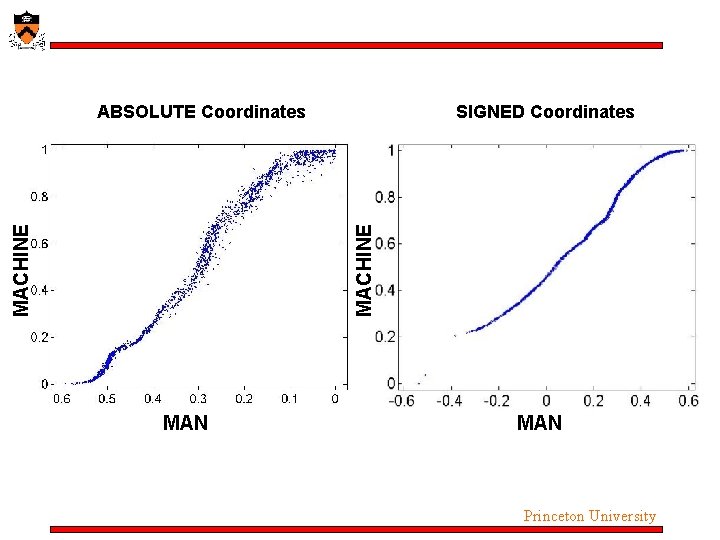
Diffusion Map ( 2, 3) Report absolute distance of all uninformed individuals to informed individual to DMAP routine Report (signed) distance of all uninformed individuals to informed individual to DMAP routine ABSOLUTE Coordinates SIGNED Coordinates Reaction Coordinate 3 STICK SLIP 2 Princeton University
SIGNED Coordinates MACHINE ABSOLUTE Coordinates MAN Princeton University
So, again, the same simple theme • If there is some reason to believe that there exist slow, effective dynamics in some smart collective variables • Then this can be used to accelerate some features of the computation • Tools for data-based detection of coarse variables… • MAIN DIFFICULTY: finding physical initial conditions consistent with desired coarse initial conditions Princeton University