
ilos By the end of this lecture you
ilos By the end of this lecture you will be able to : Ø Recognize different dose response curves ØDistinguish therapeutic utility of each of these curves Ø Classify different types of antagonism QUANTITATIVE ASPECTS OF DRUG ACTION By Prof. Omnia Nayel Assoc. Prof. Osama Yousif
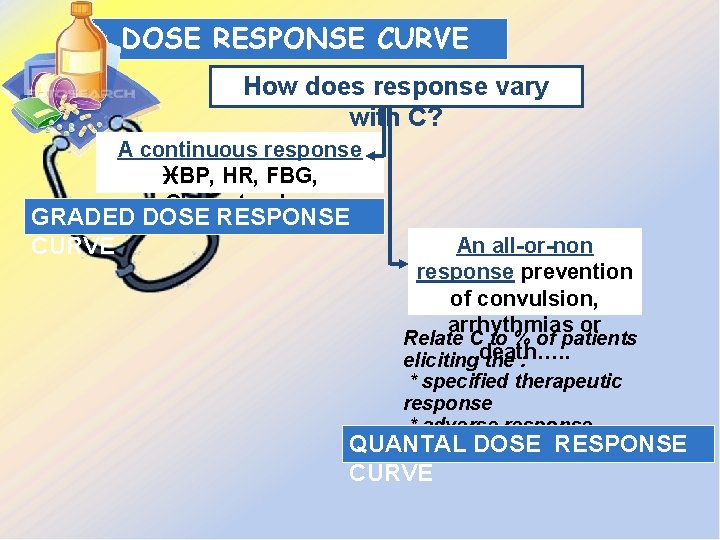
DOSE RESPONSE CURVE How does response vary with C? A continuous response BP, HR, FBG, Cholesterol, … GRADED DOSE RESPONSE CURVE An all-or-non response prevention of convulsion, arrhythmias or Relate C to % of patients elicitingdeath…. . the : * specified therapeutic response * adverse response QUANTAL * lethal. DOSE outcome. RESPONSE CURVE
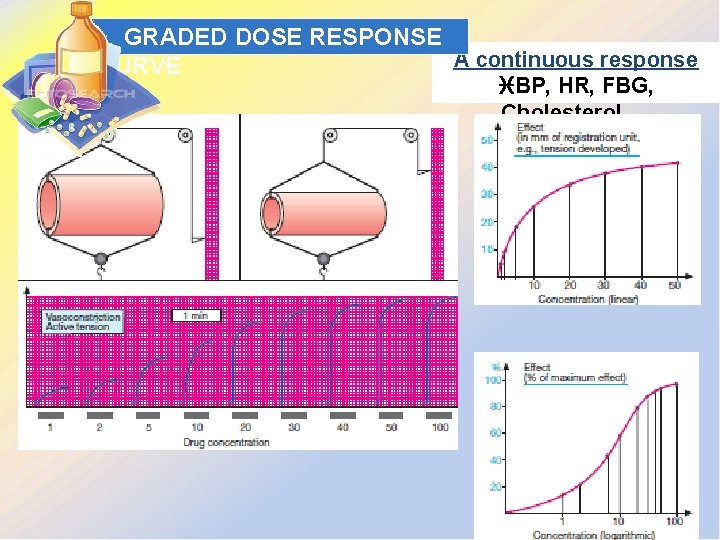
GRADED DOSE RESPONSE A continuous response CURVE BP, HR, FBG, Cholesterol, …
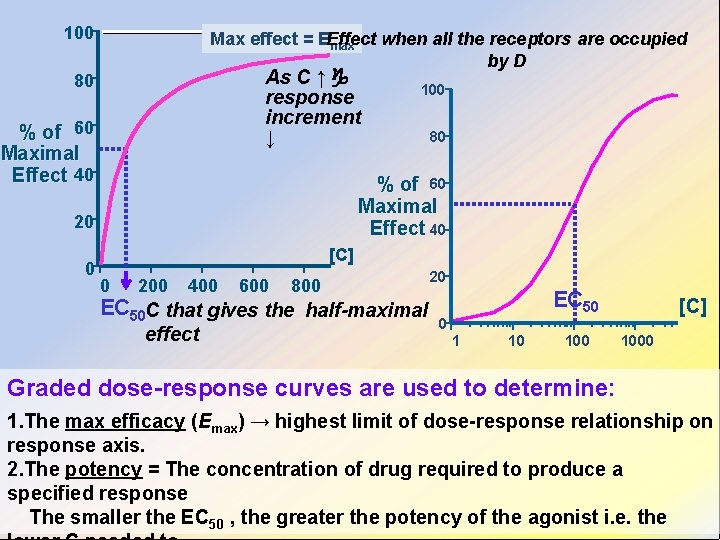
100 Max effect = EEffect when all the receptors are occupied max by D As C ↑ response increment ↓ 80 % of 60 Maximal Effect 40 20 0 100 [C] 0 200 400 600 800 EC 50 C that gives the half-maximal effect 20 0 EC 50 1 10 100 [C] 1000 Graded dose-response curves are used to determine: 1. The max efficacy (Emax) → highest limit of dose-response relationship on response axis. 2. The potency = The concentration of drug required to produce a specified response The smaller the EC 50 , the greater the potency of the agonist i. e. the
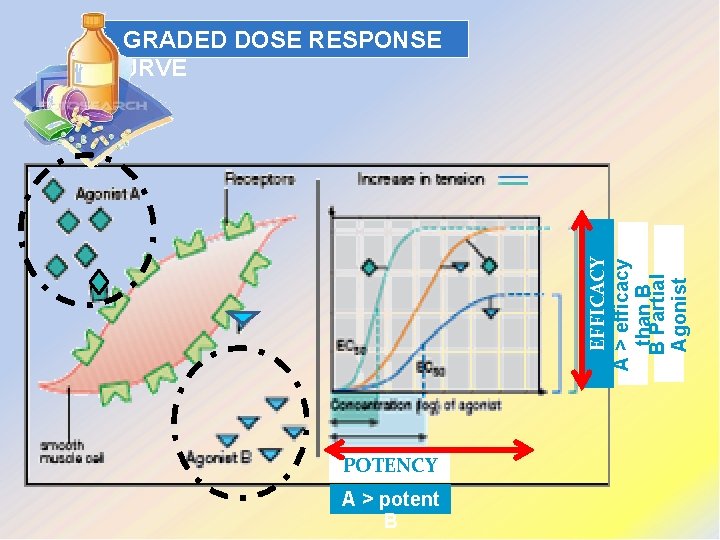
EFFICACY A > efficacy than B B Partial Agonist GRADED DOSE RESPONSE CURVE POTENCY A > potent B
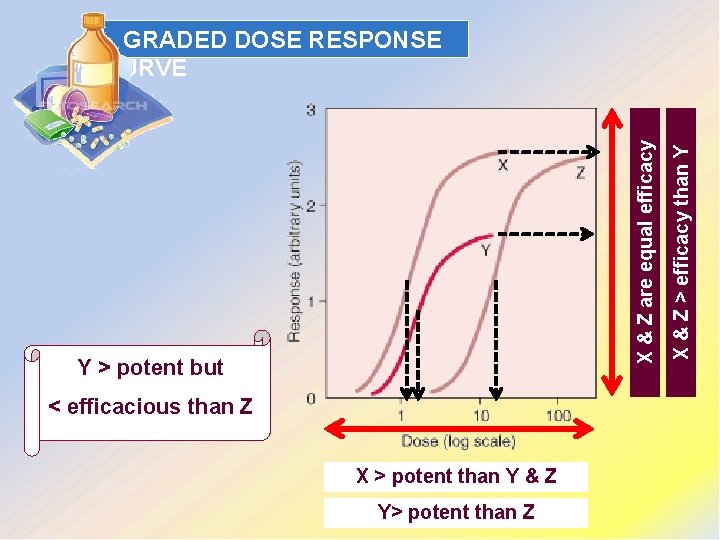
Y > potent but < efficacious than Z X > potent than Y & Z Y> potent than Z X & Z > efficacy than Y X & Z are equal efficacy GRADED DOSE RESPONSE CURVE
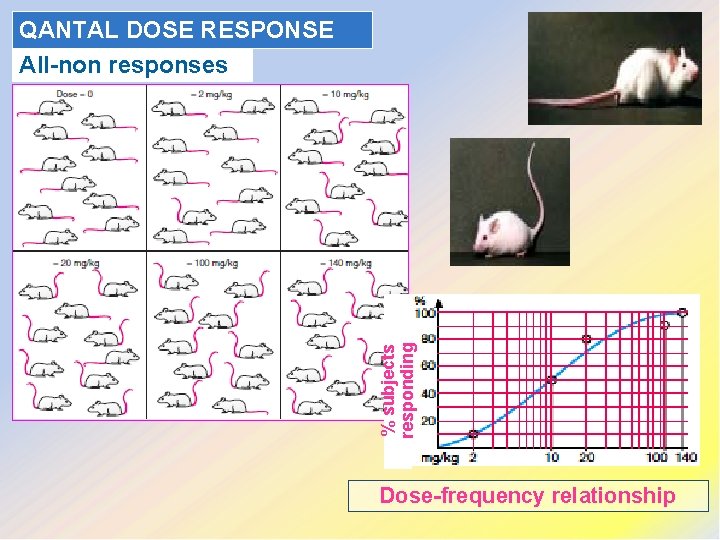
% subjects responding QANTAL DOSE RESPONSE CURVE All-non responses Dose-frequency relationship
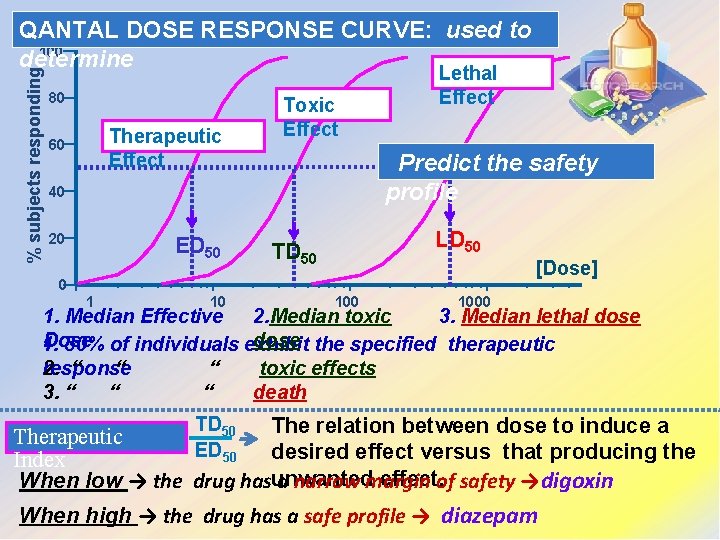
% subjects responding QANTAL DOSE RESPONSE CURVE: used to 100 determine 80 Therapeutic Effect 60 Toxic Effect Predict the safety profile 40 20 0 ED 50 1 10 Lethal Effect LD 50 TD 50 [Dose] 1000 1. Median Effective 2. Median toxic 3. Median lethal dose Dose dose the specified therapeutic 1. 50% of individuals exhibit response 2. “ “ “ toxic effects 3. “ “ “ death TD 50 ED 50 The relation between dose to induce a Therapeutic desired effect versus that producing the Index effect. of safety →digoxin When low → the drug hasunwanted a narrow margin When high → the drug has a safe profile → diazepam
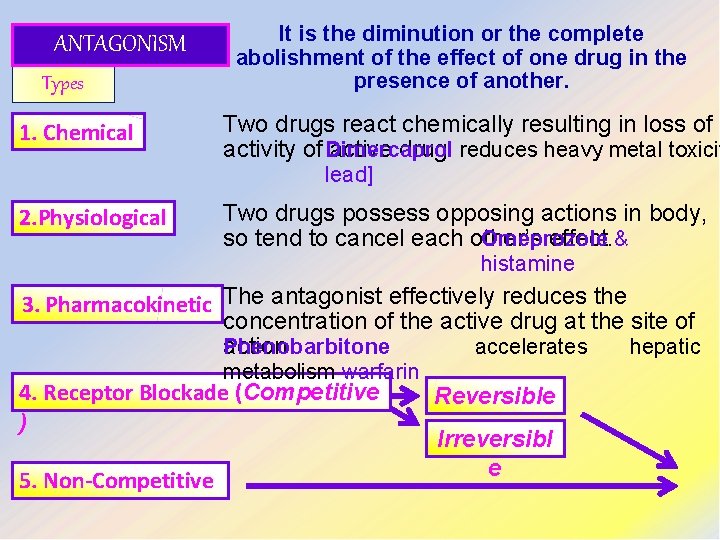
ANTAGONISM Types 1. Chemical It is the diminution or the complete abolishment of the effect of one drug in the presence of another. Two drugs react chemically resulting in loss of activity of Dimercaprol active drug. reduces heavy metal toxicit lead] 2. Physiological Two drugs possess opposing actions in body, so tend to cancel each other’s effect. & Omeprozole histamine 3. Pharmacokinetic The antagonist effectively reduces the concentration of the active drug at the site of Phenobarbitone accelerates hepatic action metabolism warfarin 4. Receptor Blockade (Competitive ) 5. Non-Competitive Reversible Irreversibl e
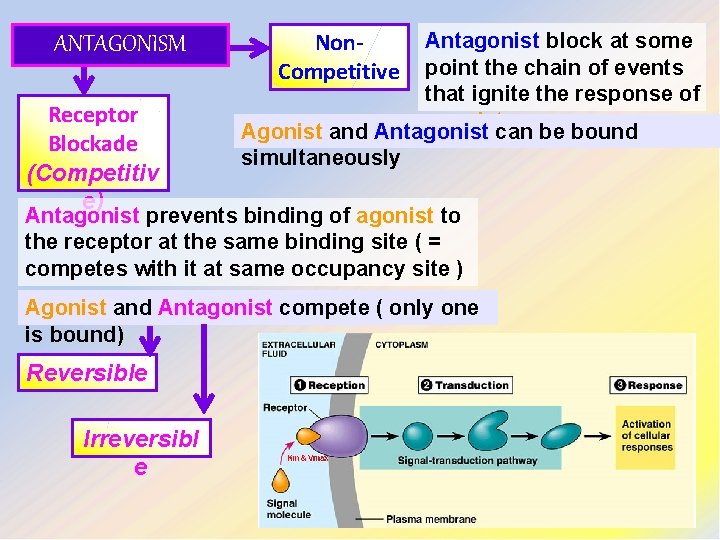
ANTAGONISM Receptor Blockade (Competitiv e) Non. Competitive Antagonist block at some point the chain of events that ignite the response of agonist Agonist and Antagonist can be bound simultaneously Antagonist prevents binding of agonist to the receptor at the same binding site ( = competes with it at same occupancy site ) Agonist and Antagonist compete ( only one is bound) Reversible Irreversibl e
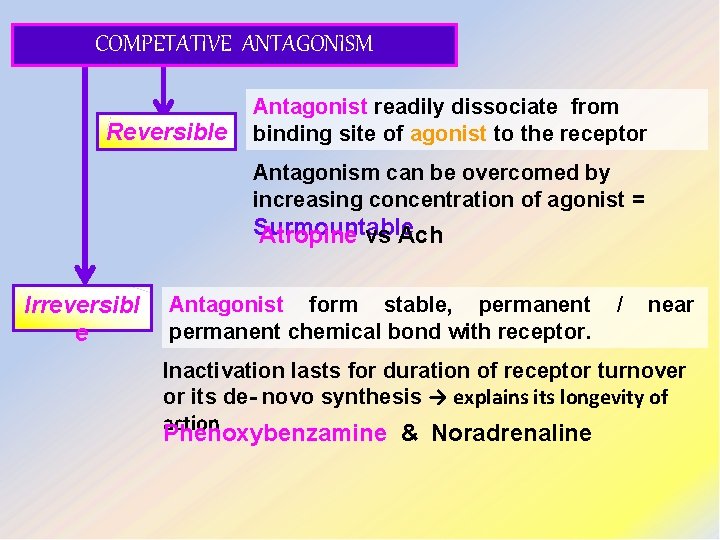
COMPETATIVE ANTAGONISM Reversible Antagonist readily dissociate from binding site of agonist to the receptor Antagonism can be overcomed by increasing concentration of agonist = Surmountable Atropine vs Ach Irreversibl e Antagonist form stable, permanent chemical bond with receptor. / near Inactivation lasts for duration of receptor turnover or its de- novo synthesis → explains its longevity of action Phenoxybenzamine & Noradrenaline
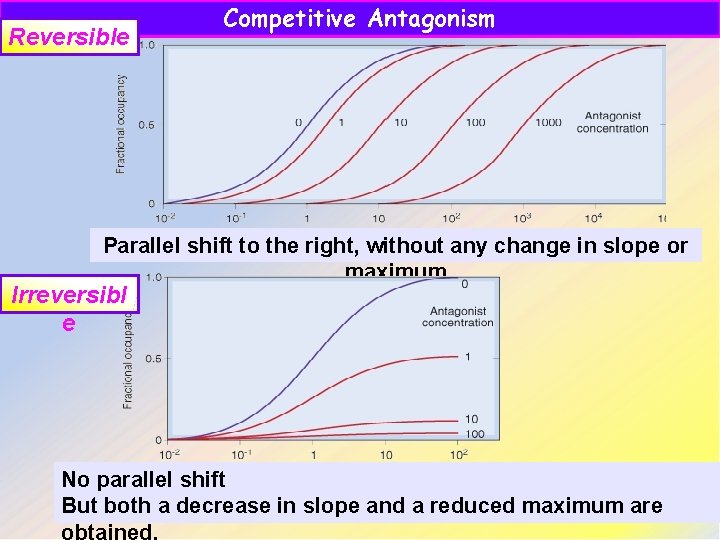
Reversible Competitive Antagonism Parallel shift to the right, without any change in slope or maximum Irreversibl e No parallel shift But both a decrease in slope and a reduced maximum are obtained.
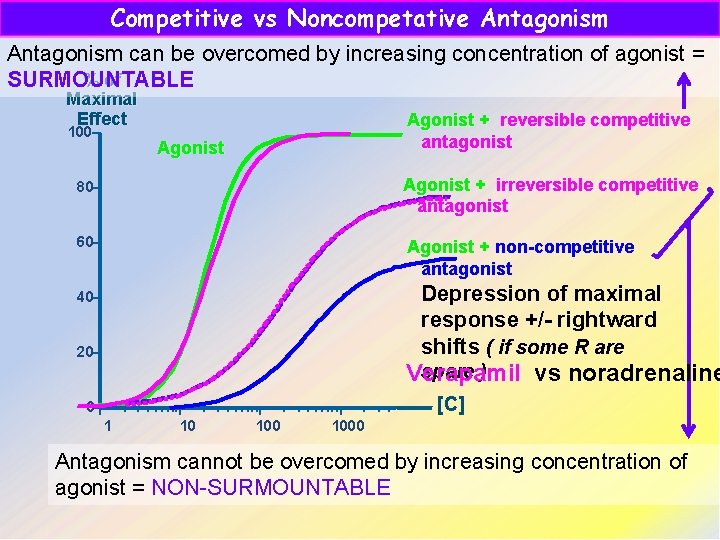
Competitive vs Noncompetative Antagonism can be overcomed by increasing concentration of agonist = % of SURMOUNTABLE Maximal Effect 100 Agonist + reversible competitive antagonist Agonist 80 Agonist + irreversible competitive antagonist 60 Agonist + non-competitive antagonist Depression of maximal response +/- rightward shifts ( if some R are 40 20 spare ) Verapamil vs noradrenaline [C] 0 1 10 1000 Antagonism cannot be overcomed by increasing concentration of agonist = NON-SURMOUNTABLE
Quiz? • Concentration-binding-curves are used to detect: A) highest limit of doseresponse relationship B) concentration of drug required to produce a specified response C) affinity of a drug for its
Quiz? • Drug A has a smaller EC 50 than drug B. This means that drug B is: • A) more potent than A B) less potent than A C) more efficacious than A D) less efficacious than A
Quiz? • An example of a reversible competitive antagonist is: • A) phenoxybenzamine to noradrenaline. B) omeprazole to histamine C) dimercaprol to lead D) atropine to acetylcholine
Quiz? • Antagonism can be overcomed by increasing concentration of agonist in: • A) irreversible competitive antagonism. B) non-competitive antagonism C) reversible competitive antagonism D) pharmacokinetic antagonism
- Slides: 17