
ILO What it is and what it does
- Slides: 36
ILO What it is and what it does? Program for Workers’ Education International Training Centre of ILO
History of the ILO n The ILO was founded in 1919. n It is the only surviving major creation of the Treaty of Versailles, which brought the League of Nations into being. n The ILO became the first specialized agency of the UN in 1946. n The only worldwide tripartite organization n The ILO has 185 Member States.
Mandate q q Seeks the promotion of social justice, internationally recognized human and labour rights and Decent Work for All. Decent Work is ILO’s key policy direction and the goal is to: - Create greater opportunities for women and men to secure decent employment and income Promote and realize international labour standards, fundamental principles and rights at work Extend coverage and effectives of social protection for all Strengthen tripartism and social dialogue
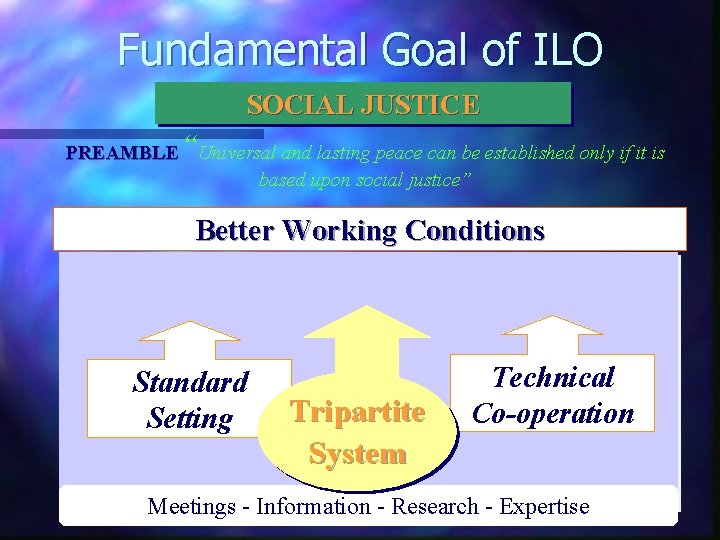
Fundamental Goal of ILO SOCIAL JUSTICE “ PREAMBLE Universal and lasting peace can be established only if it is based upon social justice” Better Working Conditions Standard Setting Tripartite System Technical Co-operation Meetings - Information - Research - Expertise
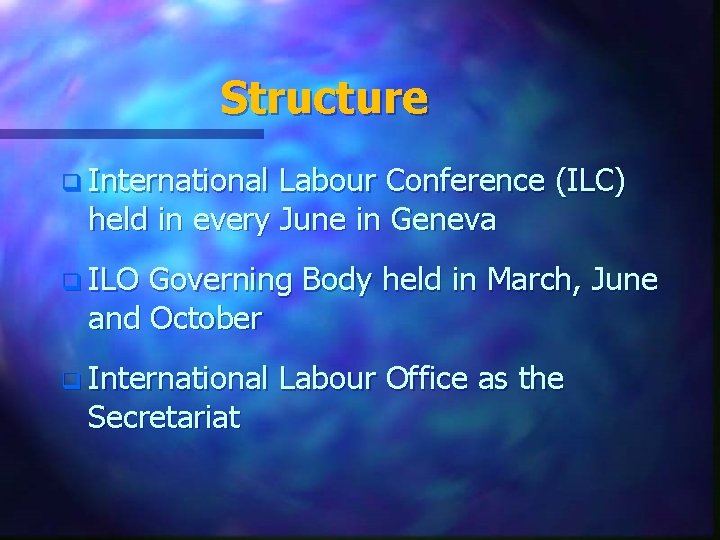
Structure q International Labour Conference (ILC) held in every June in Geneva q ILO Governing Body held in March, June and October q International Secretariat Labour Office as the
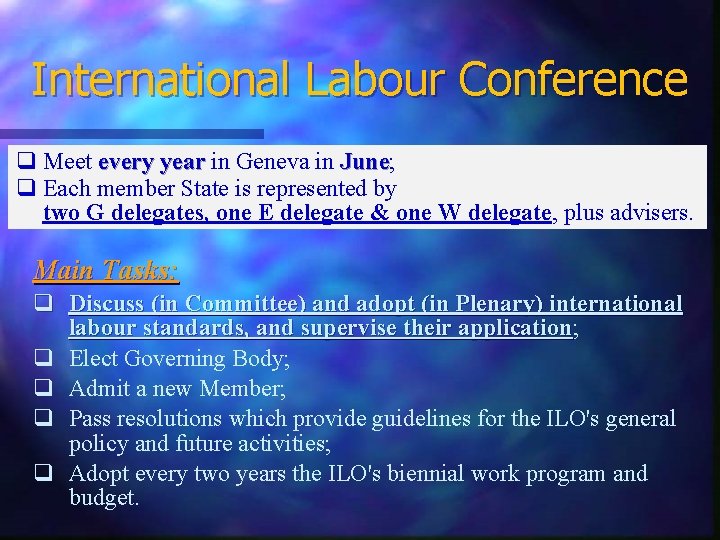
International Labour Conference q Meet every year in Geneva in June; June q Each member State is represented by two G delegates, one E delegate & one W delegate, plus advisers. Main Tasks: q Discuss (in Committee) and adopt (in Plenary) international labour standards, and supervise their application; application q Elect Governing Body; q Admit a new Member; q Pass resolutions which provide guidelines for the ILO's general policy and future activities; q Adopt every two years the ILO's biennial work program and budget.
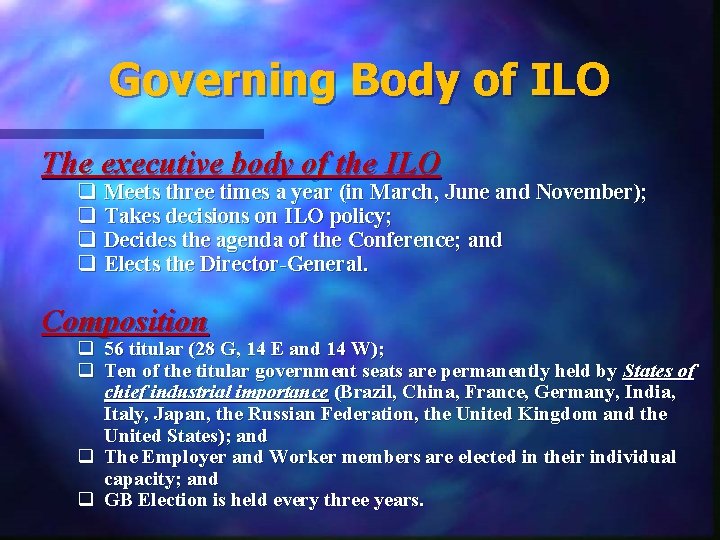
Governing Body of ILO The executive body of the ILO q Meets three times a year (in March, June and November); q Takes decisions on ILO policy; q Decides the agenda of the Conference; and q Elects the Director-General. Composition q 56 titular (28 G, 14 E and 14 W); q Ten of the titular government seats are permanently held by States of chief industrial importance (Brazil, China, France, Germany, India, Italy, Japan, the Russian Federation, the United Kingdom and the United States); and q The Employer and Worker members are elected in their individual capacity; and q GB Election is held every three years.
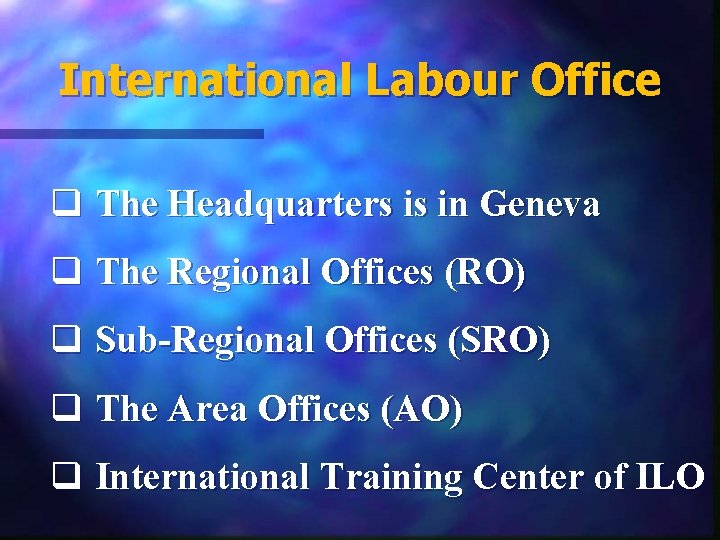
International Labour Office q The Headquarters is in Geneva q The Regional Offices (RO) q Sub-Regional Offices (SRO) q The Area Offices (AO) q International Training Center of ILO
Roles of ACTRAV q ACTRAV is the link between the International Labour Office and one of its key stakeholders: the trade union movement. q Disseminate policies and programs of the ILO and its technical units to trade unions. q Reflect interests of trade unions in programs and actions of the ILO. q Support workers’ representatives in ILO’s decision making bodies. q Educate and train trade union leaders/activists/staff.
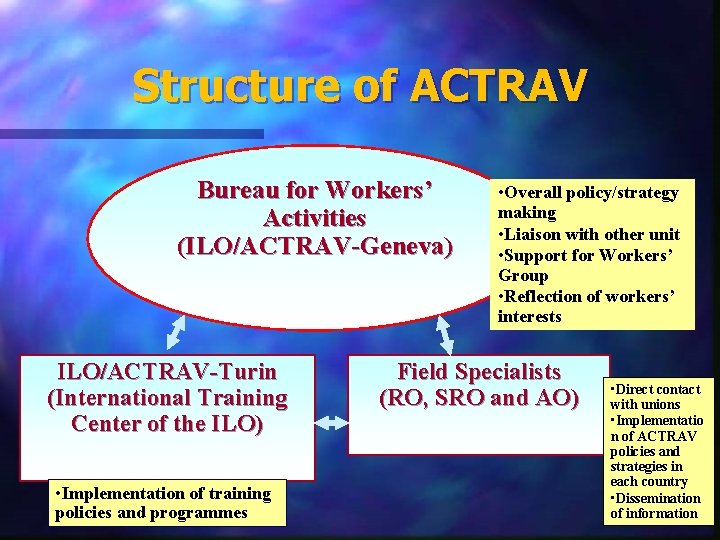
Structure of ACTRAV Bureau for Workers’ Activities (ILO/ACTRAV-Geneva) ILO/ACTRAV-Turin (International Training Center of the ILO) • Implementation of training policies and programmes • Overall policy/strategy making • Liaison with other unit • Support for Workers’ Group • Reflection of workers’ interests Field Specialists (RO, SRO and AO) • Direct contact with unions • Implementatio n of ACTRAV policies and strategies in each country • Dissemination of information
ILO’s Principles q Universal and lasting peace can be established only if it is based upon social justice; q Labour is not a commodity to be traded in the same way as goods, services or capital, and that human dignity demands equality of treatment and fairness in dealing with the workplace; q Freedom of expression and association are essential to sustained progress; q All human beings, irrespective of race, creed or sex have the right to pursue both their material well-being and their spiritual development in conditions of […] equal opportunities.
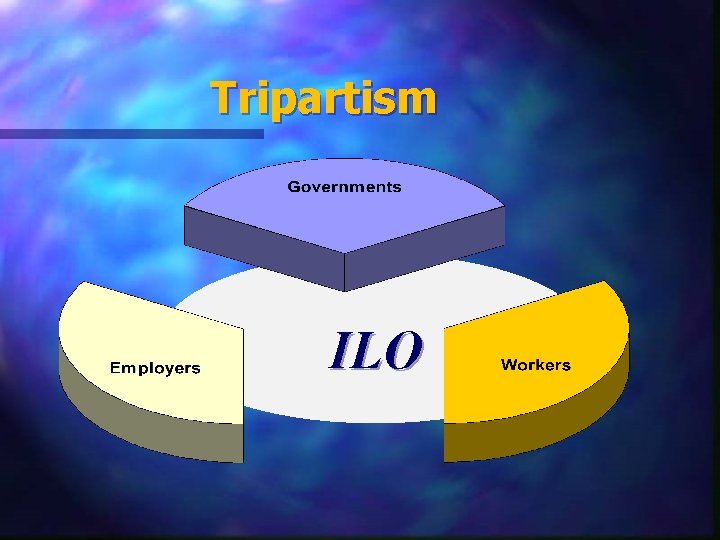
Tripartism ILO
What is Tripartism? q Tripartism is the active participation of workers and employers, together with governments, in all ILO activities; q The tripartite structure of the ILO enables the representatives of workers and employers to participate on an equal footing with those of governments in all discussion and the process of decision-making.
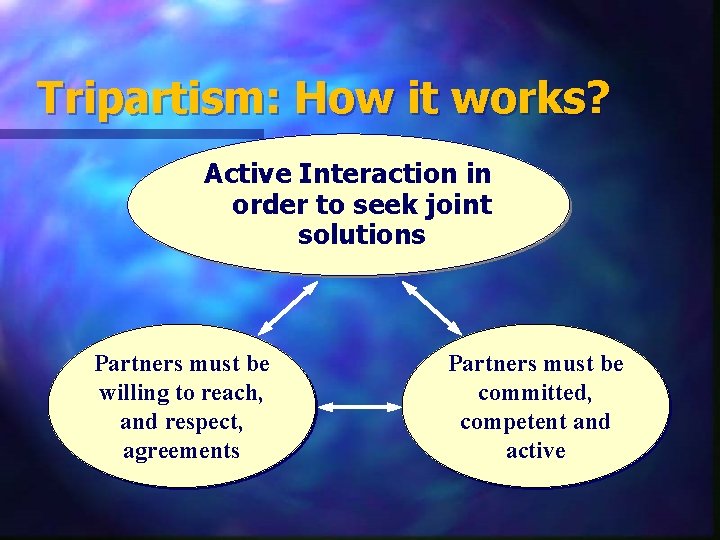
Tripartism: How it works? Active Interaction in order to seek joint solutions Partners must be willing to reach, and respect, agreements Partners must be committed, competent and active
ILO’s Means of Action Standard Setting Activities q q Elaboration & adoption of ILS Supervision of member States’ application of ILS Technical Cooperation q Promotion of the objectives established by the ILS Knowledge Development and Dissemination q Undertake a range of research activities and publish the findings Publication q Books, Manuals, Journals, Campaign Materials, etc.
What the Reasons for ILS? q Improve the living and working conditions of workers q Consolidate social peace q Equalize conditions for international competition Preamble to the ILO Constitution, 1919
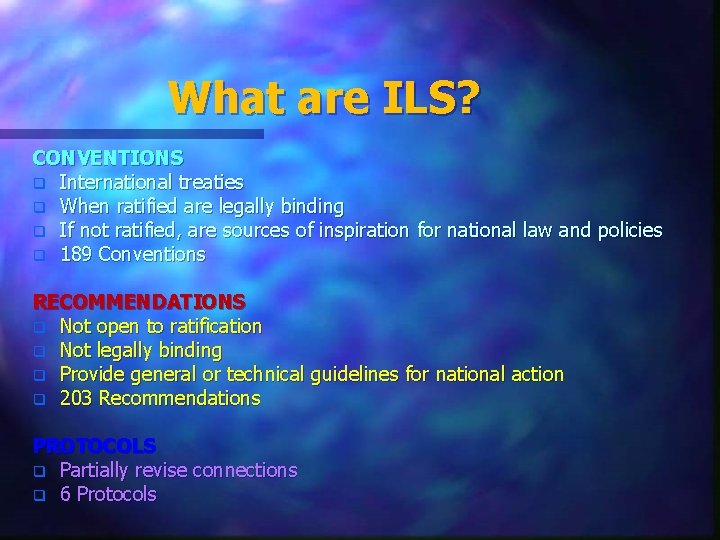
What are ILS? CONVENTIONS q International treaties q When ratified are legally binding q If not ratified, are sources of inspiration for national law and policies q 189 Conventions RECOMMENDATIONS q Not open to ratification q Not legally binding q Provide general or technical guidelines for national action q 203 Recommendations PROTOCOLS q Partially revise connections q 6 Protocols
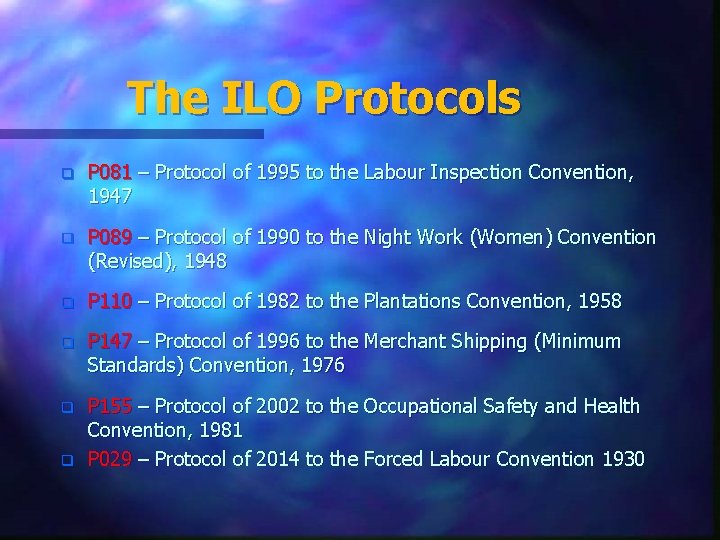
The ILO Protocols q P 081 – Protocol of 1995 to the Labour Inspection Convention, 1947 q P 089 – Protocol of 1990 to the Night Work (Women) Convention (Revised), 1948 q P 110 – Protocol of 1982 to the Plantations Convention, 1958 q P 147 – Protocol of 1996 to the Merchant Shipping (Minimum Standards) Convention, 1976 q P 155 – Protocol of 2002 to the Occupational Safety and Health Convention, 1981 P 029 – Protocol of 2014 to the Forced Labour Convention 1930 q
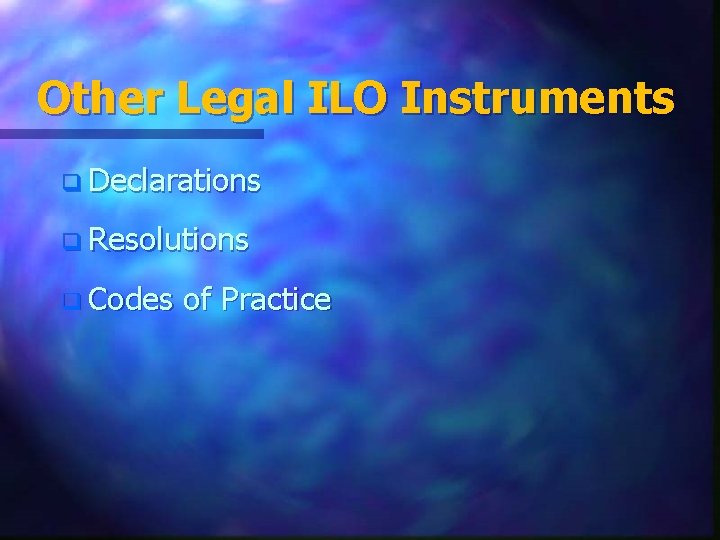
Other Legal ILO Instruments q Declarations q Resolutions q Codes of Practice
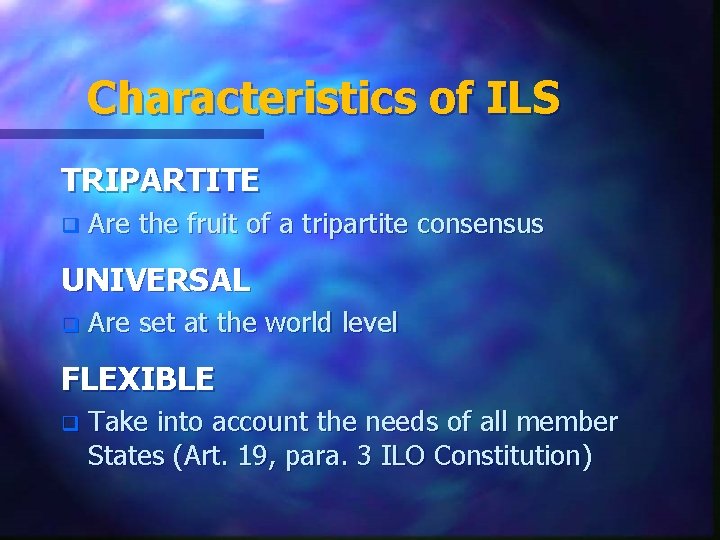
Characteristics of ILS TRIPARTITE q Are the fruit of a tripartite consensus UNIVERSAL q Are set at the world level FLEXIBLE q Take into account the needs of all member States (Art. 19, para. 3 ILO Constitution)
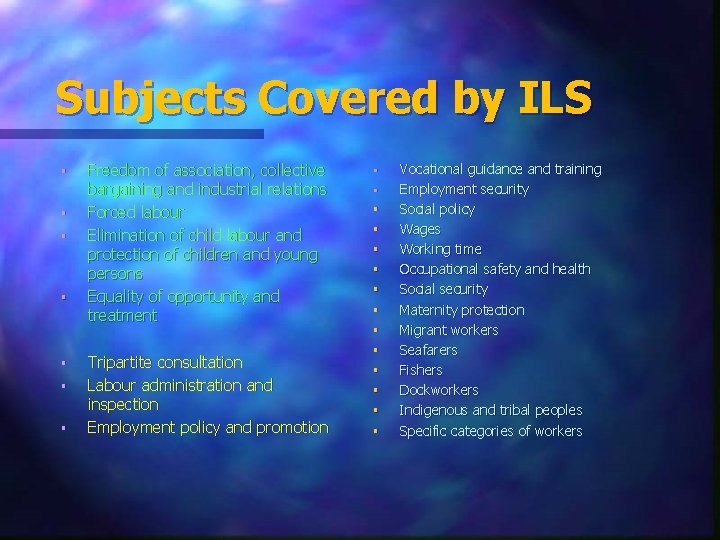
Subjects Covered by ILS § § § § Freedom of association, collective bargaining and industrial relations Forced labour Elimination of child labour and protection of children and young persons Equality of opportunity and treatment Tripartite consultation Labour administration and inspection Employment policy and promotion § § § § Vocational guidance and training Employment security Social policy Wages Working time Occupational safety and health Social security Maternity protection Migrant workers Seafarers Fishers Dockworkers Indigenous and tribal peoples Specific categories of workers
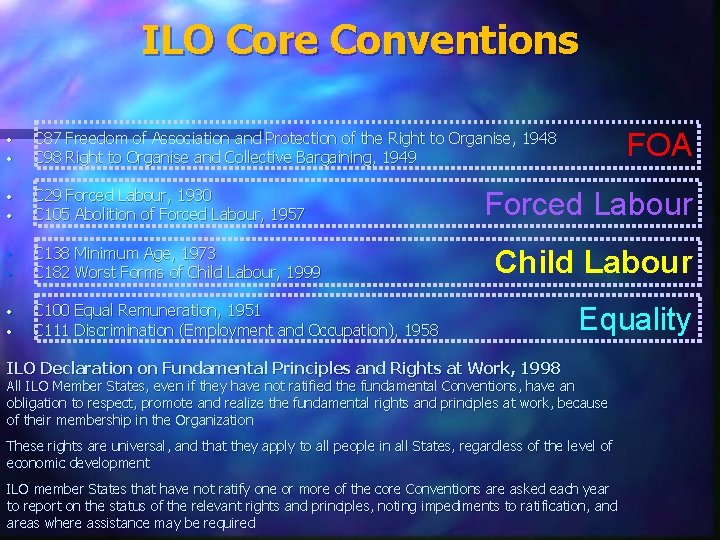
ILO Core Conventions • • C 87 Freedom of Association and Protection of the Right to Organise, 1948 C 98 Right to Organise and Collective Bargaining, 1949 • • C 29 Forced Labour, 1930 C 105 Abolition of Forced Labour, 1957 • • C 138 Minimum Age, 1973 C 182 Worst Forms of Child Labour, 1999 • • C 100 Equal Remuneration, 1951 C 111 Discrimination (Employment and Occupation), 1958 FOA Forced Labour Child Labour Equality ILO Declaration on Fundamental Principles and Rights at Work, 1998 All ILO Member States, even if they have not ratified the fundamental Conventions, have an obligation to respect, promote and realize the fundamental rights and principles at work, because of their membership in the Organization These rights are universal, and that they apply to all people in all States, regardless of the level of economic development ILO member States that have not ratify one or more of the core Conventions are asked each year to report on the status of the relevant rights and principles, noting impediments to ratification, and areas where assistance may be required
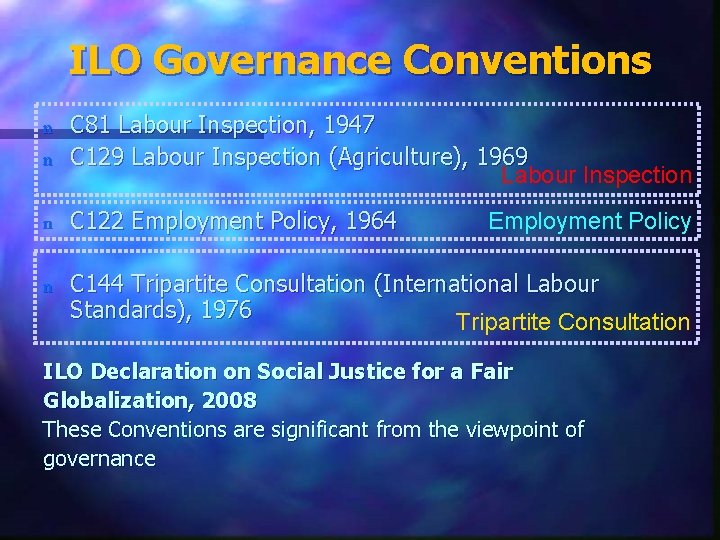
ILO Governance Conventions n n C 81 Labour Inspection, 1947 C 129 Labour Inspection (Agriculture), 1969 Labour Inspection n C 122 Employment Policy, 1964 n C 144 Tripartite Consultation (International Labour Standards), 1976 Tripartite Consultation Employment Policy ILO Declaration on Social Justice for a Fair Globalization, 2008 These Conventions are significant from the viewpoint of governance
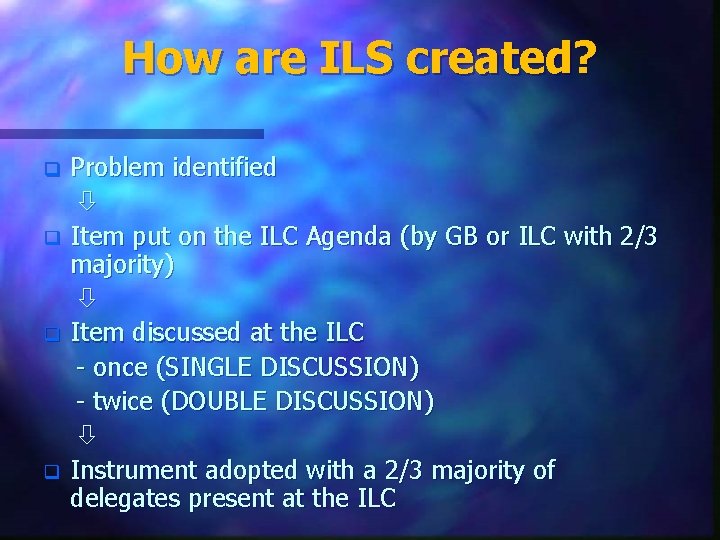
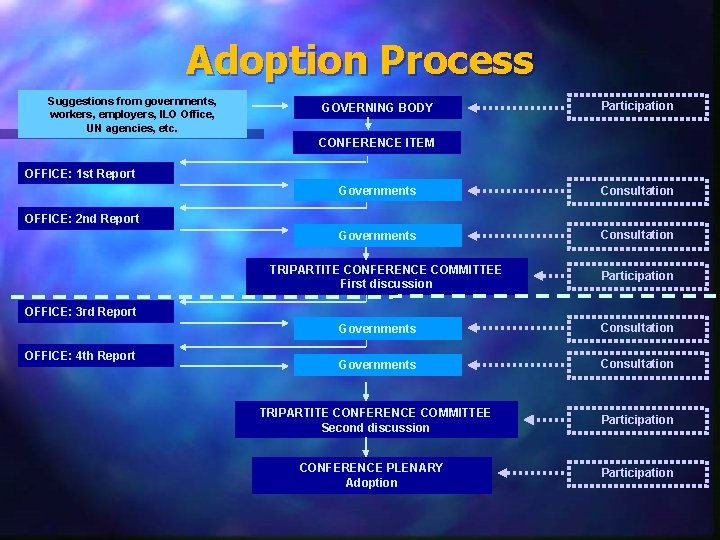
How are ILS created? q q Problem identified Item put on the ILC Agenda (by GB or ILC with 2/3 majority) Item discussed at the ILC - once (SINGLE DISCUSSION) - twice (DOUBLE DISCUSSION) Instrument adopted with a 2/3 majority of delegates present at the ILC
Adoption Process Suggestions from governments, workers, employers, ILO Office, UN agencies, etc. GOVERNING BODY Participation CONFERENCE ITEM OFFICE: 1 st Report Governments Consultation OFFICE: 2 nd Report TRIPARTITE CONFERENCE COMMITTEE First discussion Participation OFFICE: 3 rd Report OFFICE: 4 th Report Governments Consultation TRIPARTITE CONFERENCE COMMITTEE Second discussion Participation CONFERENCE PLENARY Adoption Participation
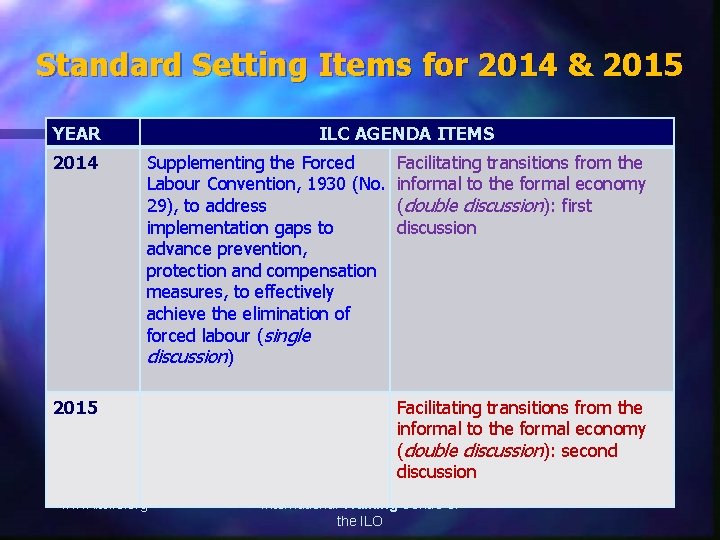
Standard Setting Items for 2014 & 2015 YEAR 2014 ILC AGENDA ITEMS Supplementing the Forced Labour Convention, 1930 (No. 29), to address implementation gaps to advance prevention, protection and compensation measures, to effectively achieve the elimination of forced labour (single discussion) 2015 www. itcilo. org Facilitating transitions from the informal to the formal economy (double discussion): first discussion Facilitating transitions from the informal to the formal economy (double discussion): second discussion International Training Centre of the ILO
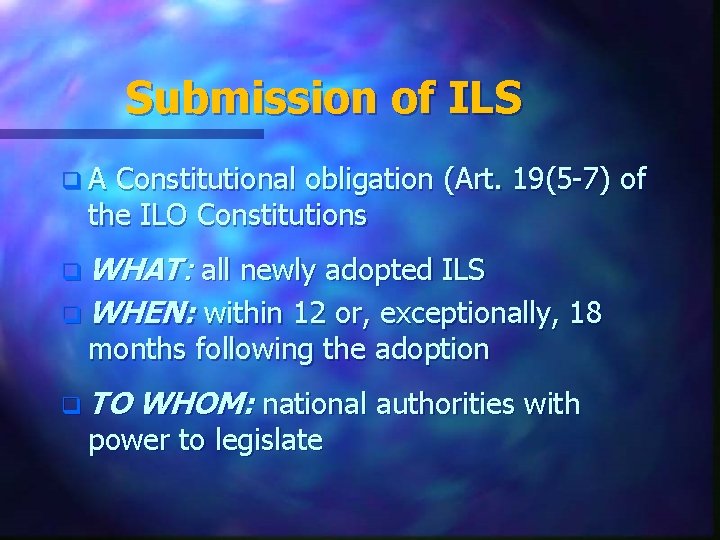
Submission of ILS q. A Constitutional obligation (Art. 19(5 -7) of the ILO Constitutions q WHAT: all newly adopted ILS q WHEN: within 12 or, exceptionally, 18 months following the adoption q TO WHOM: national authorities with power to legislate
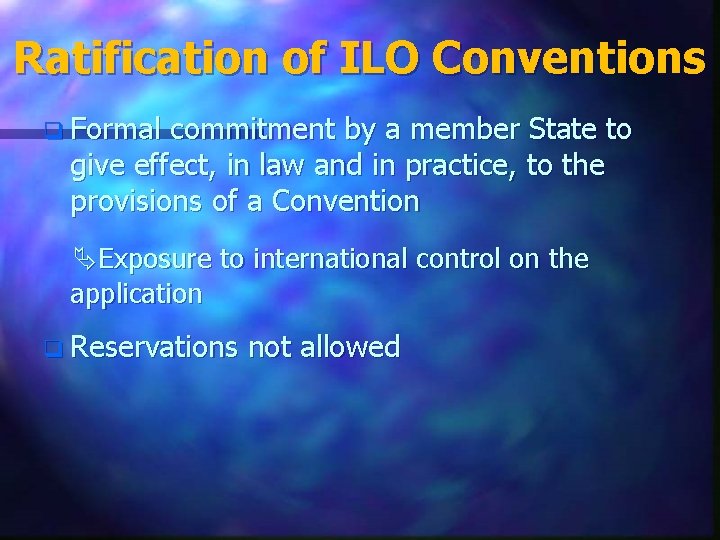
Ratification of ILO Conventions q Formal commitment by a member State to give effect, in law and in practice, to the provisions of a Convention Exposure to international control on the application q Reservations not allowed
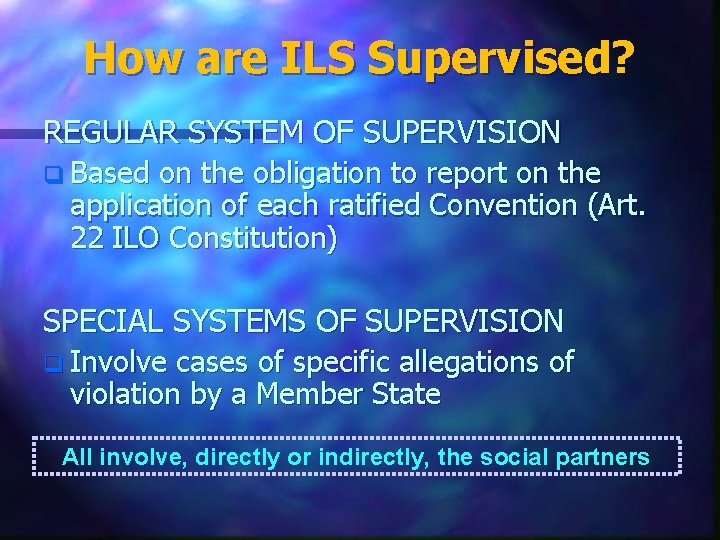
How are ILS Supervised? REGULAR SYSTEM OF SUPERVISION q Based on the obligation to report on the application of each ratified Convention (Art. 22 ILO Constitution) SPECIAL SYSTEMS OF SUPERVISION q Involve cases of specific allegations of violation by a Member State All involve, directly or indirectly, the social partners
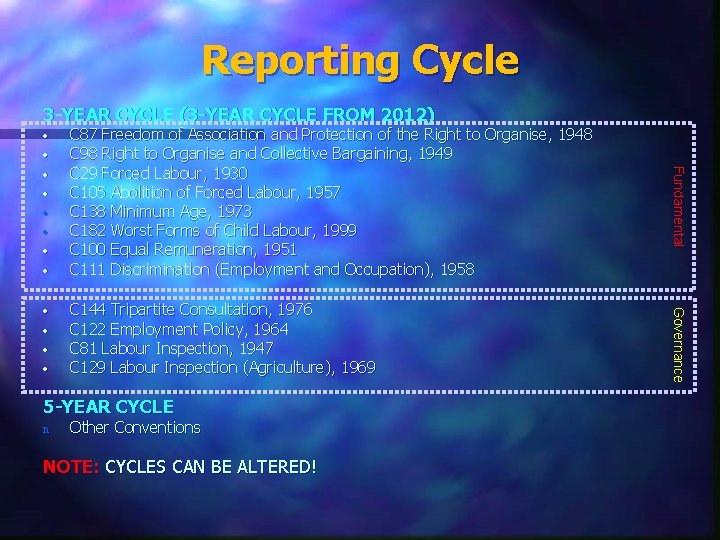
Reporting Cycle • • • C 87 Freedom of Association and Protection of the Right to Organise, 1948 C 98 Right to Organise and Collective Bargaining, 1949 C 29 Forced Labour, 1930 C 105 Abolition of Forced Labour, 1957 C 138 Minimum Age, 1973 C 182 Worst Forms of Child Labour, 1999 C 100 Equal Remuneration, 1951 C 111 Discrimination (Employment and Occupation), 1958 C 144 Tripartite Consultation, 1976 C 122 Employment Policy, 1964 C 81 Labour Inspection, 1947 C 129 Labour Inspection (Agriculture), 1969 Governance • • Fundamental 3 -YEAR CYCLE (3 -YEAR CYCLE FROM 2012) 5 -YEAR CYCLE n Other Conventions NOTE: CYCLES CAN BE ALTERED!
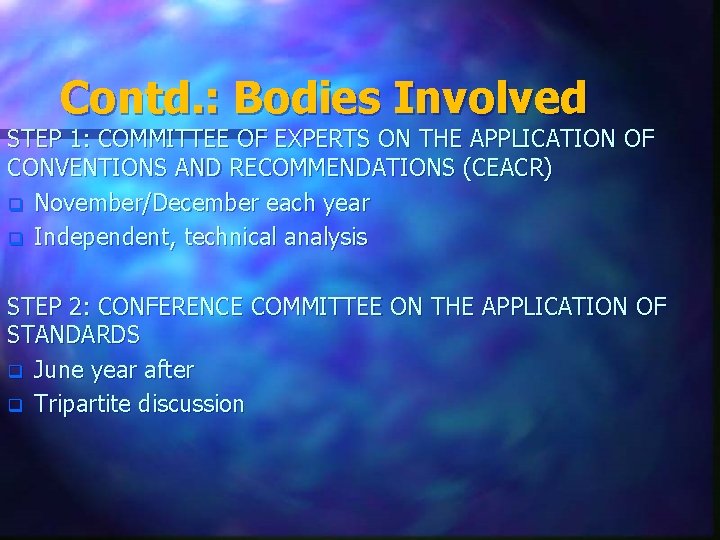
Contd. : Bodies Involved STEP 1: COMMITTEE OF EXPERTS ON THE APPLICATION OF CONVENTIONS AND RECOMMENDATIONS (CEACR) q November/December each year q Independent, technical analysis STEP 2: CONFERENCE COMMITTEE ON THE APPLICATION OF STANDARDS q June year after q Tripartite discussion
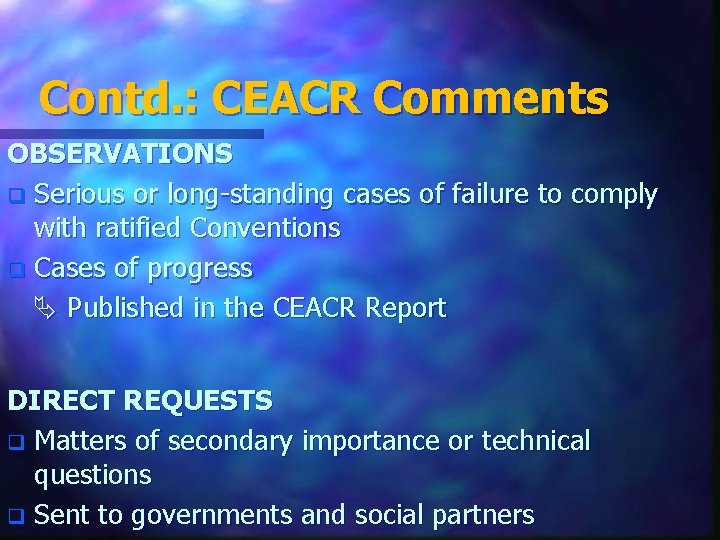
Contd. : CEACR Comments OBSERVATIONS q Serious or long-standing cases of failure to comply with ratified Conventions q Cases of progress Published in the CEACR Report DIRECT REQUESTS q Matters of secondary importance or technical questions q Sent to governments and social partners
Contd. : CEACR Report PART 1 q General Report PART 2 q Observations concerning particular countries PART 3 q General Survey (as a separate volume)
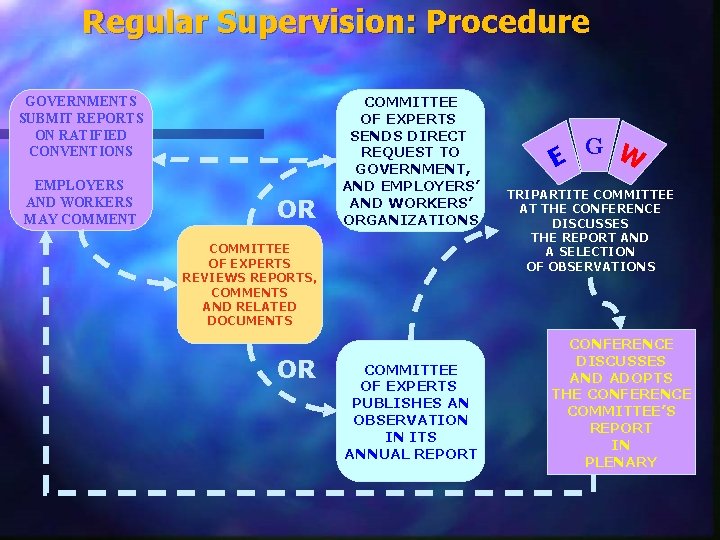
Regular Supervision: Procedure GOVERNMENTS SUBMIT REPORTS ON RATIFIED CONVENTIONS EMPLOYERS AND WORKERS MAY COMMENT OR COMMITTEE OF EXPERTS SENDS DIRECT REQUEST TO GOVERNMENT, AND EMPLOYERS’ AND WORKERS’ ORGANIZATIONS COMMITTEE OF EXPERTS REVIEWS REPORTS, COMMENTS AND RELATED DOCUMENTS OR COMMITTEE OF EXPERTS PUBLISHES AN OBSERVATION IN ITS ANNUAL REPORT E G W TRIPARTITE COMMITTEE AT THE CONFERENCE DISCUSSES THE REPORT AND A SELECTION OF OBSERVATIONS CONFERENCE DISCUSSES AND ADOPTS THE CONFERENCE COMMITTEE’S REPORT IN PLENARY
Special Procedures CONSTITUTIONAL PROCEDURES 1. Representations (Art. 24 ILO Constitution) 2. Complaints (Art. 26 ILO Constitution) q Of general application, for any ratified Convention FREEDOM OF ASSOCIATION PROCEDURES q For infringements of trade union rights www. itcilo. org International Training Centre of the ILO
THE END QUESTIONS THANK YOU!