
ILO Pilot Studies overview and main results Tite

- Slides: 27
ILO Pilot Studies – overview and main results Tite Habiyakare, Senior Statistician ILO Regional Office for Asia and the Pacific habiyakare@ilo. org
Contents • Overview of ILO pilot studies • Main findings to date • Next steps • Other countries’ experience ILO Department of Statistics 2
Overview of ILO pilot studies ILO Department of Statistics 3
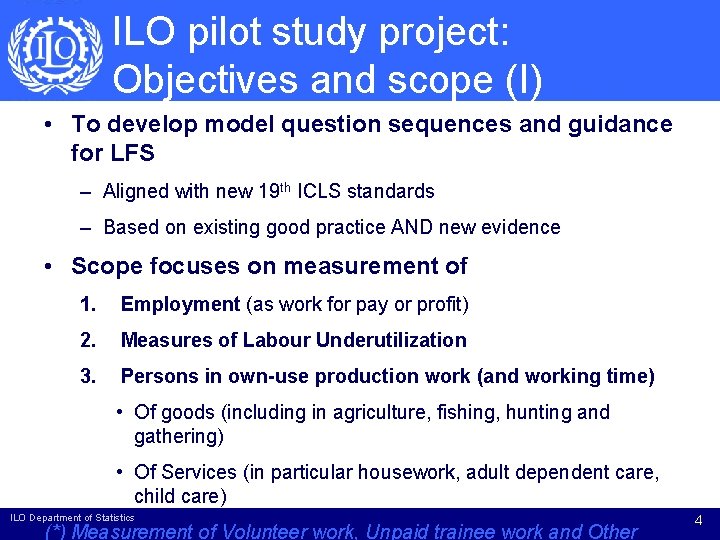
ILO pilot study project: Objectives and scope (I) • To develop model question sequences and guidance for LFS – Aligned with new 19 th ICLS standards – Based on existing good practice AND new evidence • Scope focuses on measurement of 1. Employment (as work for pay or profit) 2. Measures of Labour Underutilization 3. Persons in own-use production work (and working time) • Of goods (including in agriculture, fishing, hunting and gathering) • Of Services (in particular housework, adult dependent care, child care) ILO Department of Statistics (*) Measurement of Volunteer work, Unpaid trainee work and Other 4
ILO pilot study project: Objectives and scope (II) • Additional topics evaluated 1. Main activity • • • For future development of a classification by main activity as selfreported As possible starting point to identify persons employed As additional variable to check consistency 2. Status in employment • • As input to support current review of ICSE-93 Boundary issues – Contributing family workers / Apprentices; – Employers / Own-account workers • Identification of new (sub)-groups – Co-operators in family businesses; Dependent self. ILO Department of Statistics employed; Employees 5
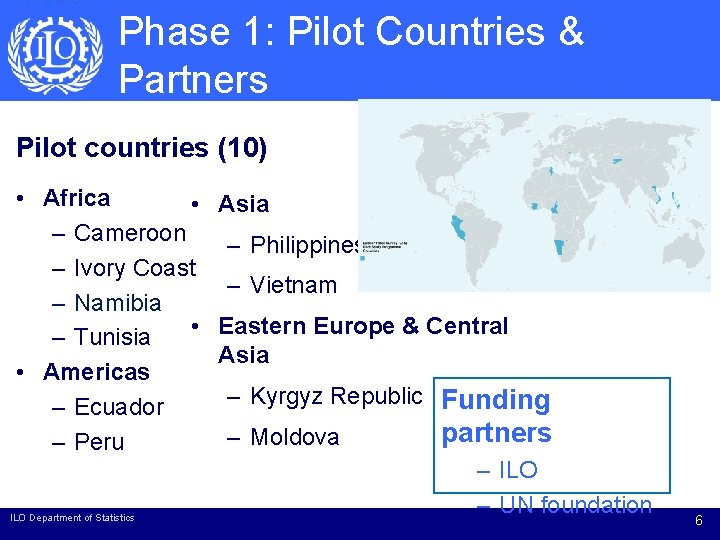
Phase 1: Pilot Countries & Partners Pilot countries (10) • Africa • Asia – Cameroon – Philippines – Ivory Coast – Vietnam – Namibia • Eastern Europe & Central – Tunisia Asia • Americas – Kyrgyz Republic Funding – Ecuador partners – Moldova – Peru – ILO – UN foundation ILO Department of Statistics 6
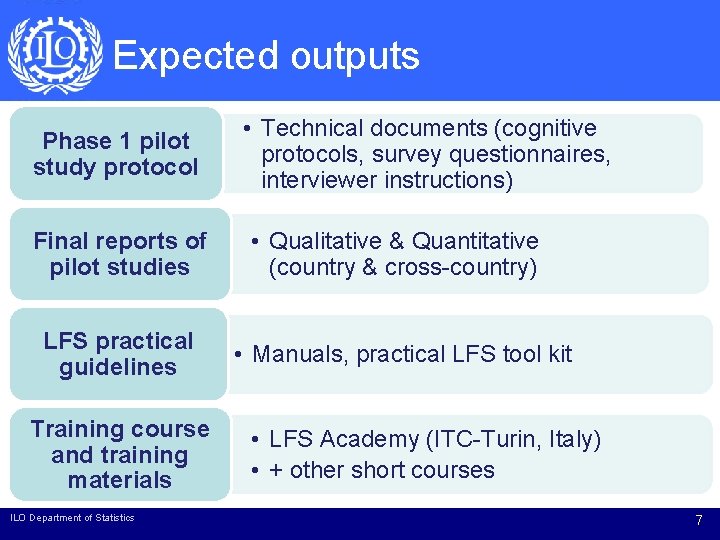
Expected outputs Phase 1 pilot study protocol Final reports of pilot studies LFS practical guidelines Training course and training materials ILO Department of Statistics • Technical documents (cognitive protocols, survey questionnaires, interviewer instructions) • Qualitative & Quantitative (country & cross-country) • Manuals, practical LFS tool kit • LFS Academy (ITC-Turin, Italy) • + other short courses 7
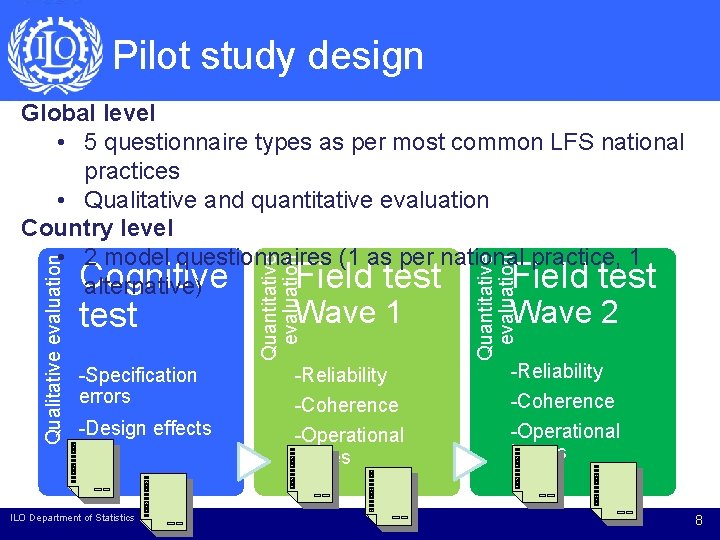
Pilot study design -Specification errors -Design effects ILO Department of Statistics Wave 1 -Reliability -Coherence -Operational issues Quantitative evaluation test Quantitative evaluation Qualitative evaluation Global level • 5 questionnaire types as per most common LFS national practices • Qualitative and quantitative evaluation Country level • 2 model questionnaires (1 as per national practice, 1 Cognitive Field test alternative) Wave 2 -Reliability -Coherence -Operational issues 8
Pilot study design: Focus of each stage • Cognitive tests: – Qualitative evaluation of selected question sequences – Evaluates problems of comprehension, recall, judgment – Identify changes to be made before the field tests • Field tests, round 1 and 2 – Quantitative and operational evaluation of the questionnaires – Evaluate possible identification and classification problems – Evaluate stability of measurement criteria for boundary between employment and own-use ILO Department of Statistics 9
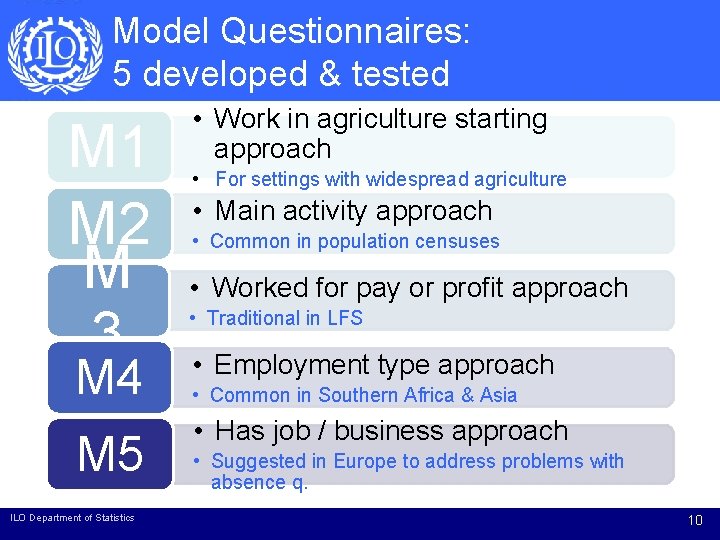
Model Questionnaires: 5 developed & tested M 1 M 2 M 3 • Work in agriculture starting approach • For settings with widespread agriculture • Main activity approach • Common in population censuses • Worked for pay or profit approach • Traditional in LFS M 4 • Employment type approach M 5 • Has job / business approach ILO Department of Statistics • Common in Southern Africa & Asia • Suggested in Europe to address problems with absence q. 10
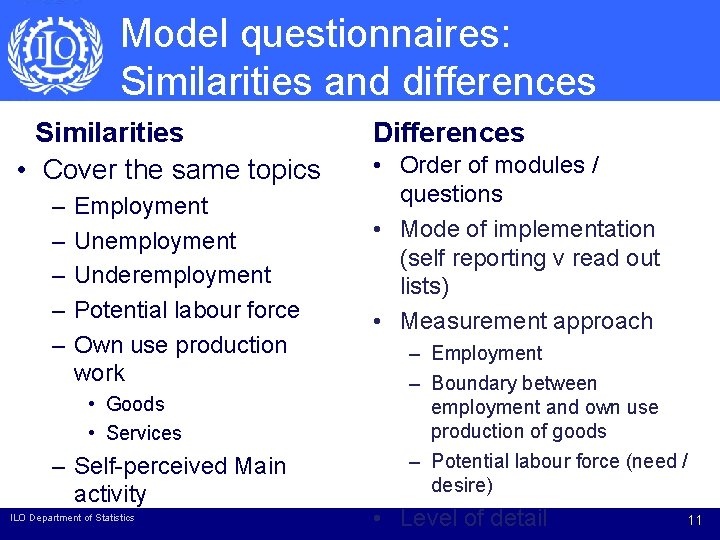
Model questionnaires: Similarities and differences Similarities • Cover the same topics – – – Employment Unemployment Underemployment Potential labour force Own use production work • Goods • Services – Self-perceived Main activity ILO Department of Statistics Differences • Order of modules / questions • Mode of implementation (self reporting v read out lists) • Measurement approach – Employment – Boundary between employment and own use production of goods – Potential labour force (need / desire) • Level of detail 11
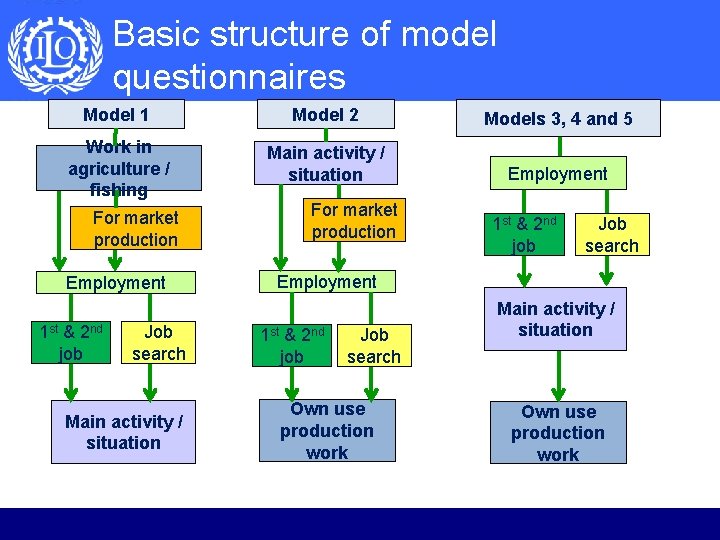
Basic structure of model questionnaires Model 1 Model 2 Models 3, 4 and 5 Work in agriculture / fishing Main activity / situation Employment For market production Employment 1 st & 2 nd job Job search Main activity / situation For market production 1 st & 2 nd job Job search Employment 1 st & 2 nd job Job search Own use production work Main activity / situation Own use production work
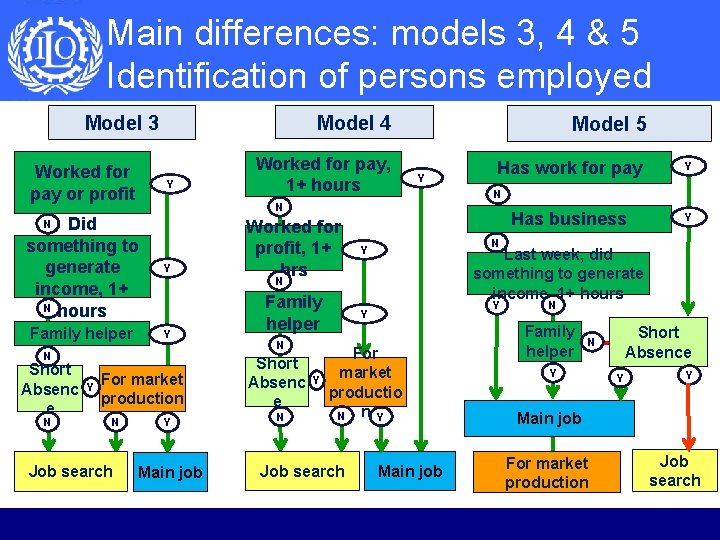
Main differences: models 3, 4 & 5 Identification of persons employed Model 4 Model 3 Worked for pay or profit Y Did something to generate income, 1+ N hours Y Family helper Y N N Y For market production N Job search Y Has work for pay Y Main job Has business Worked for profit, 1+ hrs N Y Family helper Y N Short Absenc e N Y Y N Last week, did something to generate income, 1+ hours Y For market productio N n Y Job search Y N N N Short Absenc e Worked for pay, 1+ hours Model 5 Main job N Family helper Short Absence N Y Y Y Main job For market production Job search
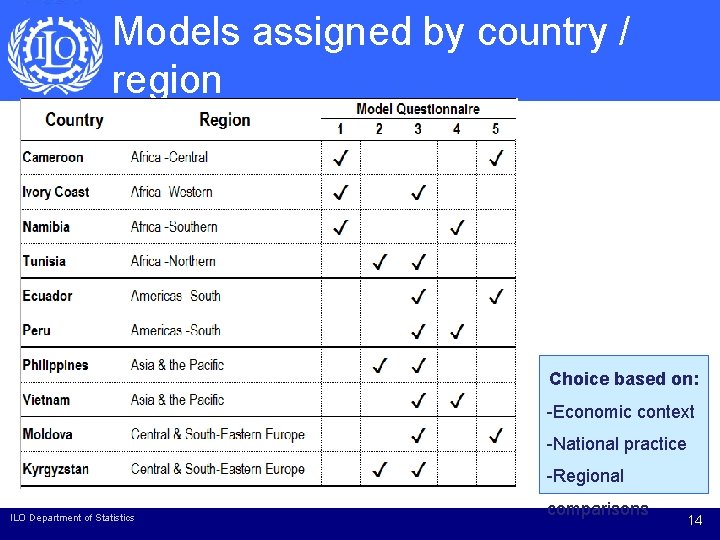
Models assigned by country / region Choice based on: -Economic context -National practice -Regional ILO Department of Statistics comparisons 14
ILO pilot study project: Progress to date • Cognitive tests completed between July and October 2015 • Field tests took place between November 2015 and October 2016. • Analysis workshop was held with pilot countries in November 2016 to discuss main conclusions ILO Department of Statistics 15
Main findings from ILO pilot studies ILO Department of Statistics 16
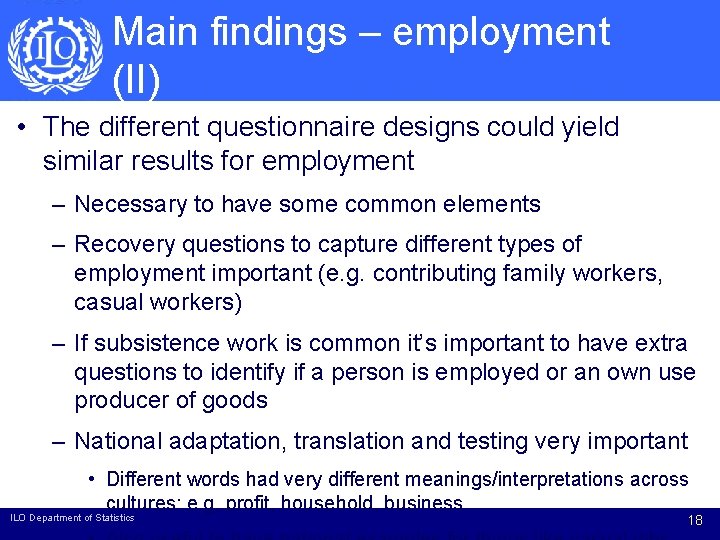
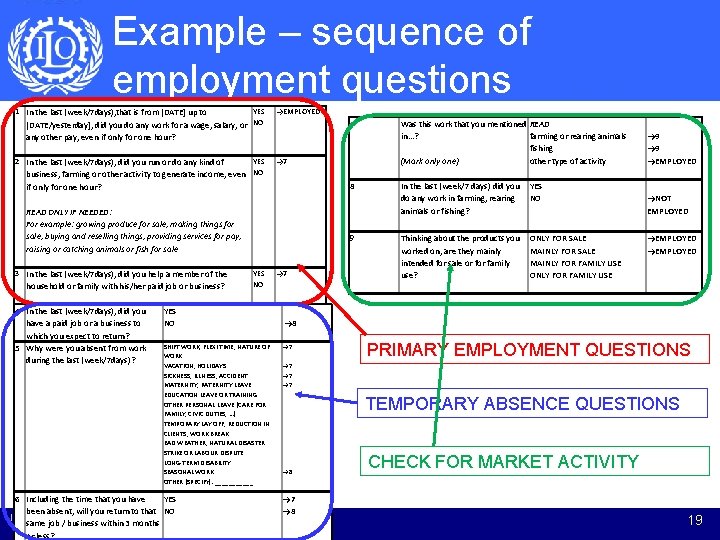
Main findings – employment (I) • Tested 5 different approaches to capturing employment • Different question wording and order ILO Department of Statistics 17
Main findings – employment (II) • The different questionnaire designs could yield similar results for employment – Necessary to have some common elements – Recovery questions to capture different types of employment important (e. g. contributing family workers, casual workers) – If subsistence work is common it’s important to have extra questions to identify if a person is employed or an own use producer of goods – National adaptation, translation and testing very important • Different words had very different meanings/interpretations across cultures: e. g. profit, household, business ILO Department of Statistics 18
Example – sequence of employment questions 1 In the last (week/7 days), that is from [DATE] up to 2 3 4 5 YES [DATE/yesterday], did you do any work for a wage, salary, or NO any other pay, even if only for one hour? YES In the last (week/7 days), did you run or do any kind of business, farming or other activity to generate income, even NO if only for one hour? READ ONLY IF NEEDED: For example: growing produce for sale, making things for sale, buying and reselling things, providing services for pay, raising or catching animals or fish for sale YES In the last (week/7 days), did you help a member of the NO household or family with his/her paid job or business? In the last (week/7 days), did you YES have a paid job or a business to NO which you expect to return? SHIFT WORK, FLEXI TIME, NATURE OF Why were you absent from work WORK during the last (week/7 days)? VACATION, HOLIDAYS SICKNESS, ILLNESS, ACCIDENT MATERNITY, PATERNITY LEAVE EDUCATION LEAVE OR TRAINING OTHER PERSONAL LEAVE (CARE FOR FAMILY, CIVIC DUTIES, …) TEMPORARY LAY OFF, REDUCTION IN CLIENTS, WORK BREAK BAD WEATHER, NATURAL DISASTER STRIKE OR LABOUR DISPUTE LONG-TERM DISABILITY SEASONAL WORK OTHER (SPECIFY): ______ 6 Including the time that you have YES been absent, will you return to that NO ILO same job / business within 3 months Department of Statistics or less? →EMPLOYED 7 → 7 8 Was this work that you mentioned READ in. . . ? farming or rearing animals fishing (Mark only one) other type of activity In the last (week/7 days) did you YES do any work in farming, rearing NO animals or fishing? 9 → 7 Thinking about the products you worked on, are they mainly intended for sale or family use? ONLY FOR SALE MAINLY FOR FAMILY USE ONLY FOR FAMILY USE → 9 →EMPLOYED →NOT EMPLOYED →EMPLOYED → 8 → 7 → 7 → 8 → 7 → 8 PRIMARY EMPLOYMENT QUESTIONS TEMPORARY ABSENCE QUESTIONS CHECK FOR MARKET ACTIVITY 19
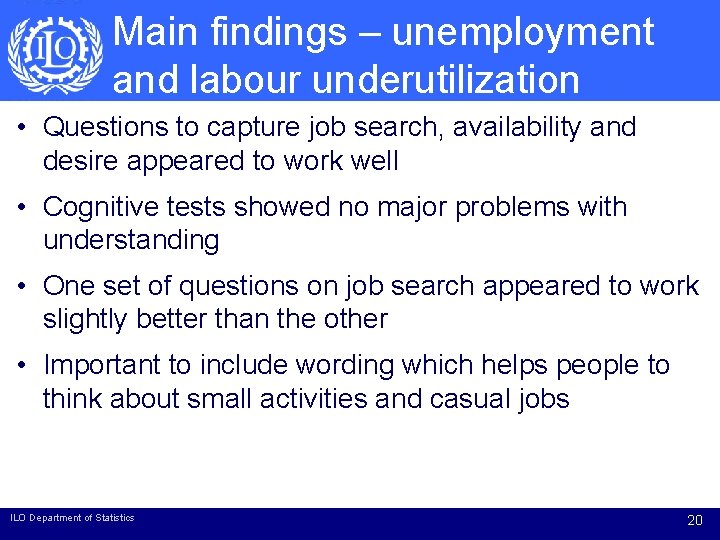
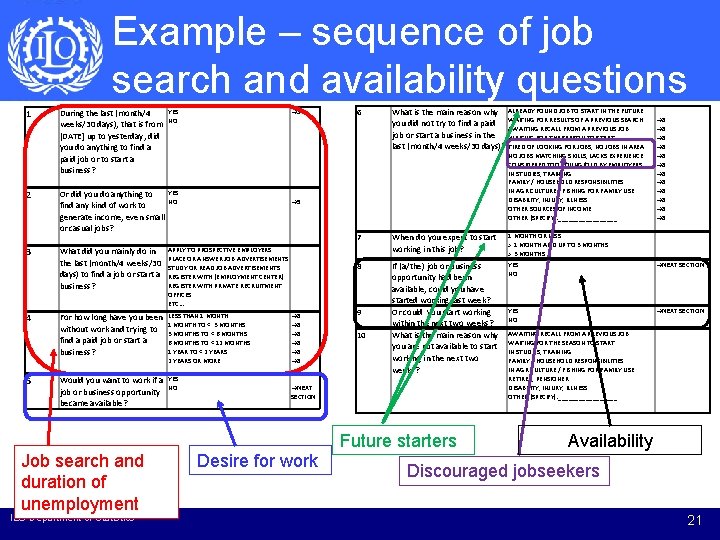
Main findings – unemployment and labour underutilization • Questions to capture job search, availability and desire appeared to work well • Cognitive tests showed no major problems with understanding • One set of questions on job search appeared to work slightly better than the other • Important to include wording which helps people to think about small activities and casual jobs ILO Department of Statistics 20
Example – sequence of job search and availability questions 1 2 3 YES → 3 During the last (month/4 NO weeks/30 days), that is from [DATE] up to yesterday, did you do anything to find a paid job or to start a business? Or did you do anything to YES NO → 5 find any kind of work to generate income, even small or casual jobs? What did you mainly do in APPLY TO PROSPECTIVE EMPLOYERS PLACE OR ANSWER JOB ADVERTISEMENTS the last (month/4 weeks/30 STUDY OR READ JOB ADVERTISEMENTS days) to find a job or start a REGISTER WITH (EMPLOYMENT CENTER) REGISTER WITH PRIVATE RECRUITMENT business? 4 For how long have you been without work and trying to find a paid job or start a business? 5 Would you want to work if a job or business opportunity became available? Job search and duration of unemployment ILO Department of Statistics OFFICES ETC… LESS THAN 1 MONTH TO < 3 MONTHS TO < 6 MONTHS TO < 12 MONTHS 1 YEAR TO < 2 YEARS OR MORE YES NO → 8 → 8 → 8 →NEXT SECTION Desire for work 6 What is the main reason why you did not try to find a paid job or start a business in the last (month/4 weeks/30 days)? 7 When do you expect to start working in this job? 8 If (a/the) job or business opportunity had been available, could you have started working last week? Or could you start working within the next two weeks? What is the main reason why you are not available to start working in the next two weeks? 9 10 Future starters ALREADY FOUND JOB TO START IN THE FUTURE WAITING FOR RESULTS OF A PREVIOUS SEARCH AWAITING RECALL FROM A PREVIOUS JOB WAITING FOR THE SEASON TO START TIRED OF LOOKING FOR JOBS, NO JOBS IN AREA NO JOBS MATCHING SKILLS, LACKS EXPERIENCE CONSIDERED TOO YOUNG/OLD BY EMPLOYERS IN STUDIES, TRAINING FAMILY / HOUSEHOLD RESPONSIBILITIES IN AGRICULTURE / FISHING FOR FAMILY USE DISABILITY, INJURY, ILLNESS OTHER SOURCES OF INCOME OTHER (SPECIFY): _________ 1 MONTH OR LESS > 1 MONTH AND UP TO 3 MONTHS > 3 MONTHS YES NO → 8 → 8 → 8 YES NO →NEXT SECTION AWAITING RECALL FROM A PREVIOUS JOB WAITING FOR THE SEASON TO START IN STUDIES, TRAINING FAMILY / HOUSEHOLD RESPONSIBILITIES IN AGRICULTURE / FISHING FOR FAMILY USE RETIRED, PENSIONER DISABILITY, INJURY, ILLNESS OTHER (SPECIFY): _________ →NEXT SECTION Availability Discouraged jobseekers 21
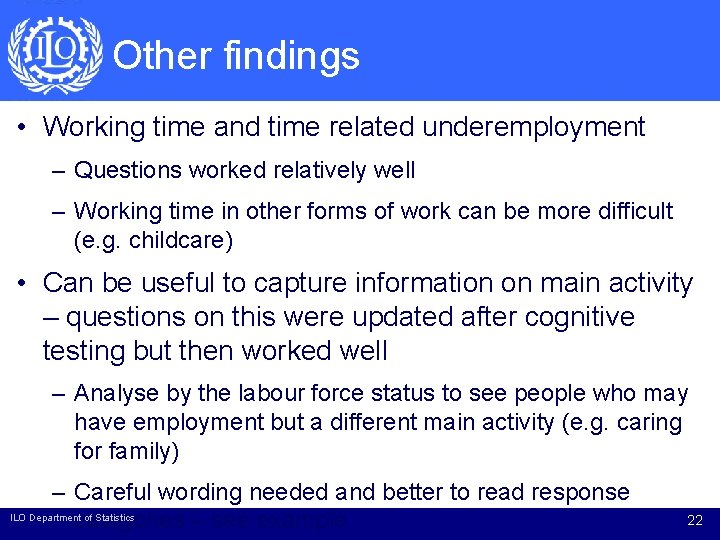
Other findings • Working time and time related underemployment – Questions worked relatively well – Working time in other forms of work can be more difficult (e. g. childcare) • Can be useful to capture information on main activity – questions on this were updated after cognitive testing but then worked well – Analyse by the labour force status to see people who may have employment but a different main activity (e. g. caring for family) – Careful wording needed and better to read response ILO Department of Statistics categories – see example 22
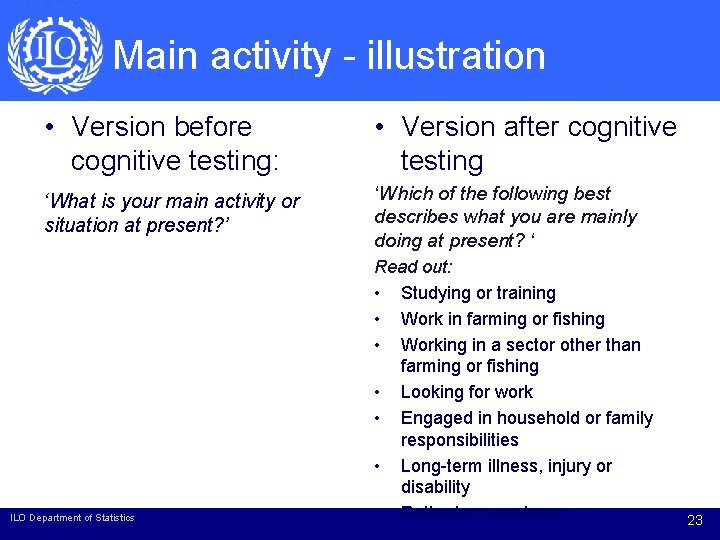
Main activity - illustration • Version before cognitive testing: • Version after cognitive testing ‘What is your main activity or situation at present? ’ ‘Which of the following best describes what you are mainly doing at present? ‘ ILO Department of Statistics Read out: • Studying or training • Work in farming or fishing • Working in a sector other than farming or fishing • Looking for work • Engaged in household or family responsibilities • Long-term illness, injury or disability • Retired or pensioner 23
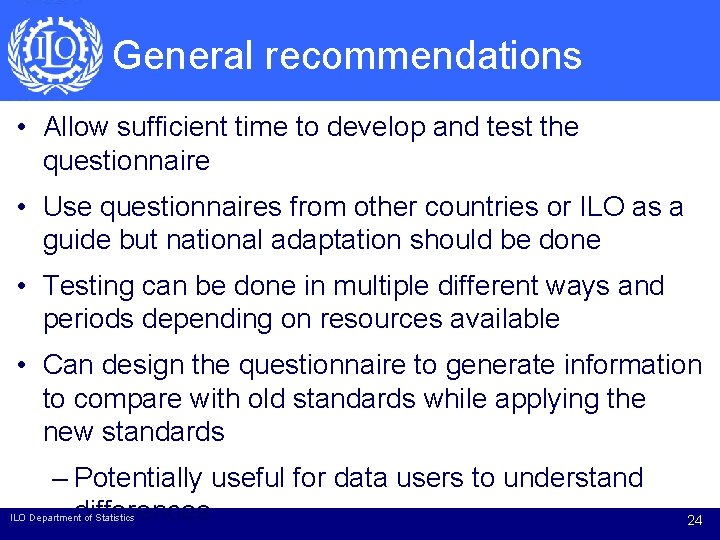
General recommendations • Allow sufficient time to develop and test the questionnaire • Use questionnaires from other countries or ILO as a guide but national adaptation should be done • Testing can be done in multiple different ways and periods depending on resources available • Can design the questionnaire to generate information to compare with old standards while applying the new standards – Potentially useful for data users to understand differences ILO Department of Statistics 24
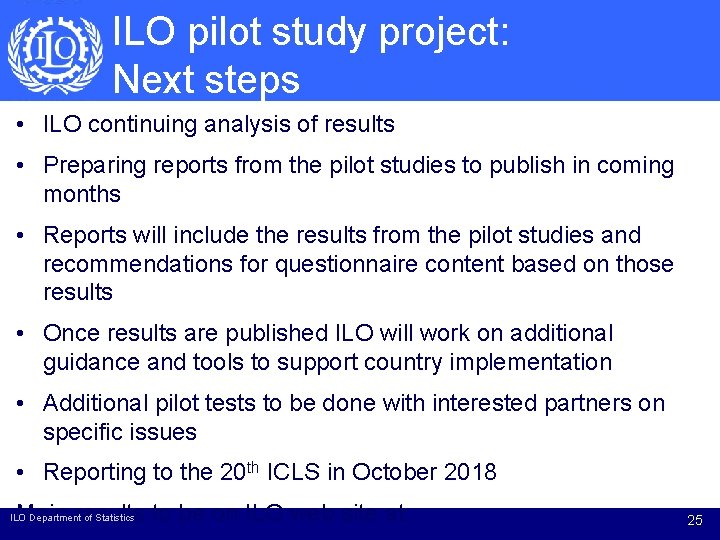
ILO pilot study project: Next steps • ILO continuing analysis of results • Preparing reports from the pilot studies to publish in coming months • Reports will include the results from the pilot studies and recommendations for questionnaire content based on those results • Once results are published ILO will work on additional guidance and tools to support country implementation • Additional pilot tests to be done with interested partners on specific issues • Reporting to the 20 th ICLS in October 2018 Main results to be on ILO web site at: ILO Department of Statistics 25
19 th ICLS: other countries’ experience • A number of countries have standards already aligned with the 19 th ICLS: – Australia, Japan, Korea, New Zealand (most of OECD countries); • Some countries were able to revise with minor changes; • Countries with no previous data series, or with irregular data collection, can implement immediately: – Brunei, Lao PDR, Myanmar, Nepal, etc; • Countries currently piloting/ planning to pilot in line with Para 92, Resol. I of the 19 th ICLS: ILO Department of Statistics 26
Thank you ILO Department of Statistics 27