
Illusory contours and cortical neuron responses Perla B
Illusory contours and cortical neuron responses Perla B. Gámez University of Chicago Sensation and Perception Autumn 2004 T. A. : Pascal Wallisch
What are Contours? n Contours n n n Object boundaries Edges Physical discontinuity in the image n Ex. due to color, luminance difference between object and background
What Are Illusory Contours? n Illusory Contours n Contours that are perceived even though they are not present in the physical world. n Ex. In the absence of discontinuity in the stimulus.

Illusory Contour Example
Question n How are Illusory Contours represented in the brain?
Alternatives n In V 1 n n Illusory contours phenomenon involves only area V 1. Other areas involved n Illusory contours phenomenon involves areas V 2 or later.
Alternatives n Single-cell phenomenon n n Single cells in area (ex. in V 1; in V 2) that respond to illusory contours. Not a single-cell phenomenon n A population of cells in particular area (ex. in V 1; in V 2) collectively respond to illusory contours
Alternatives n Property of Classical Receptive Fields n n 0. 25° to 1° (ex. in V 1) Property of Non-classical Receptive Fields n Ex. Much Bigger Receptive Fields ≈ 2 -3 X’s (ex. in V 2)
Logic n Rationale for methodology n Start with simplest method: Using a visual fixation task, observe and measure neuronal firing. n n n If firing occurs outside of V 1, then other areas are involved, not V 1. If single cell fires, then evidence for single-cell phenomenon. If firing occurs for images outside of the conventional RF, then RF are bigger.
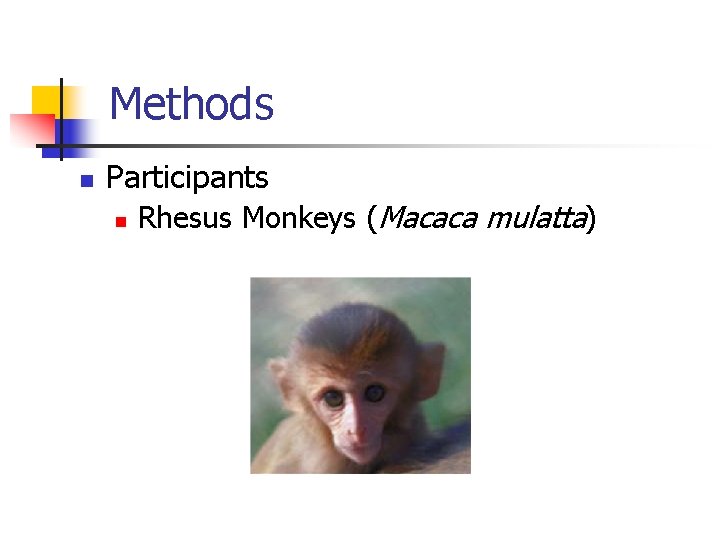
Methods n Participants n Rhesus Monkeys (Macaca mulatta)
Methods n n Monkeys were awake, NOT anesthetized. Immobilized by implanting a bolt in the skull Single units were recorded with microelectrodes inserted through the intact dura. Trained to perform a visual fixation task. n Received reward if they pulled a lever when a fixation target appeared and released it when they detected a 90° turn of the target. n Target consisted of two parallel short lines
Results
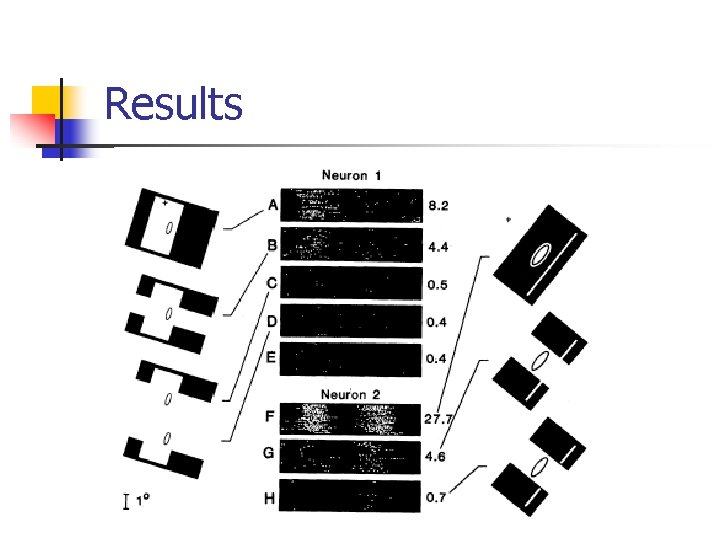
Results n Illusory contours “perceived” in area 18 (V 2/pre-striate cortex). n n Cells in area 17 did not show responses related to contour, but 13 of 38 cells in area 18 did (Fig. 2, B and G). As Fig. 2 A shows, neuron 1 responded to the lower right edge of a light bar.
Results n n A strip covering cell’s response field was blanked out and the neuron responded to the stimulus as it did to edge of bar, only less strongly (Fig. 2 B). Neither half of the stimulus excited the neuron (Fig. 2 C & D) n n Parallel with perception: Illusory contours disappear when only part of the inducing configuration is viewed. Evidence for Gestalt principles: The whole is greater than the sum of its parts.
Results n Small changes in configuration had effects on illusory contours. n Ex. Responded well to Fig. 2 F, and 2 G, but not to Fig 2 H.
Implications n n n Illusory contours phenomenon involves areas 18 (V 2/pre-striate cortex). Single cells in area V 2 responds to illusory contours: Single-cell phenomenon. Unconventional property of Receptive Fields: Bigger Receptive Fields ≈ 2 -3 X’s (ex. in V 2).
Problems n Researchers assume that monkeys can see illusory contours. n Should train monkeys to respond to contours. Ex. Press button if can see, instead of just fixating.
- Slides: 17