
Illuminated Manuscript Paint and marginalia borders History of
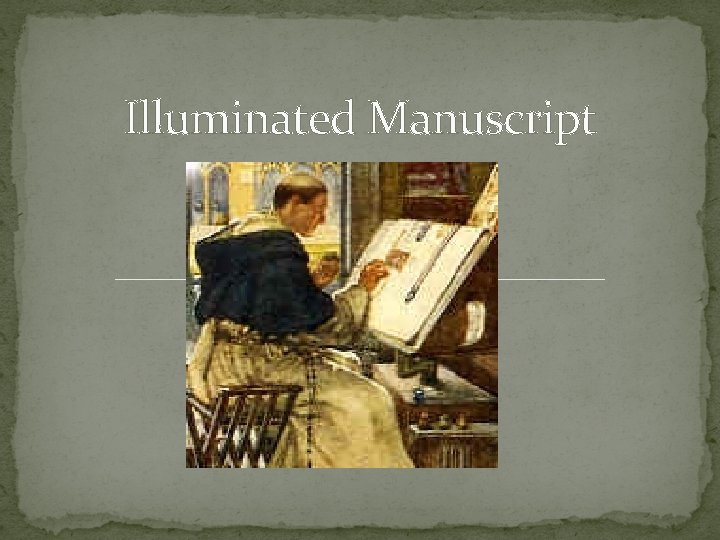
Illuminated Manuscript

Paint and marginalia (borders)
History of Illuminate � one of the primary media of the Middle Ages and Renaissance. It contain one of the most finest surviving examples of medieval painting. The art of illumination flourished in the early centuries of Christianity. Because of the close connection of medieval Catholicism with the handwritten book, the texts of many manuscripts were embellished to enrich public or private religious experience. � Insular Manuscripts (seventh to eighth century) Ireland developed the late antique practice of enlarging the first letter or initia. L. � Byzantine Manuscripts (sixth to 15 th century) In the Byzantine Empire, with the abundant use of precious metals, especially gold; the choice of bright colors; often filled devoted to narrating biblical stories. � Carolingian Manuscripts (eighth to ninth century) � The Emperor Charlemage (reigned 800– 814), whose empire extended from northern Germany to Italy, encouraged artists to emulate the naturalism of the ancient Greeks and Romans. � Ottonian Manuscripts (10 th to 11 th century) In the mid-10 th century, a line of German kings including Otto I, Otto II, and Otto III began to commission manuscripts that, were to be a visual manifestation of imperial power. � Romanesque Manuscripts (11 th to 12 th century) Romanesque art focus on initials became the central element in Romanesque. Interested in narrative. Patterned backgrounds along with abstract drapery were extremely popular.
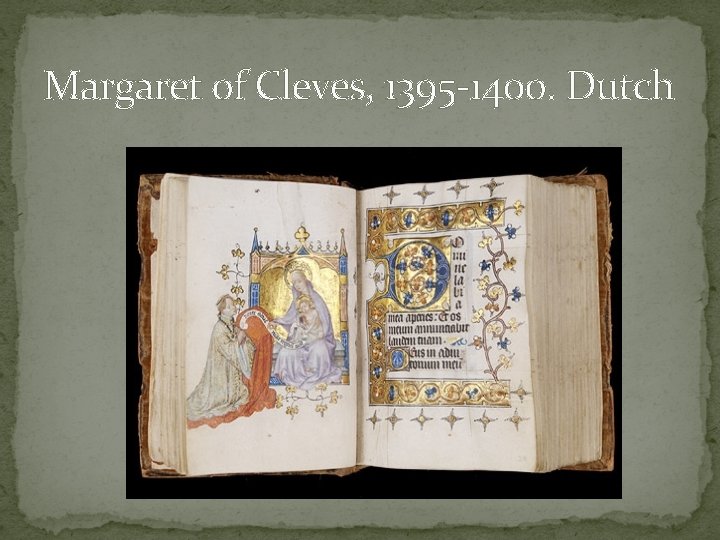
Margaret of Cleves, 1395 -1400. Dutch
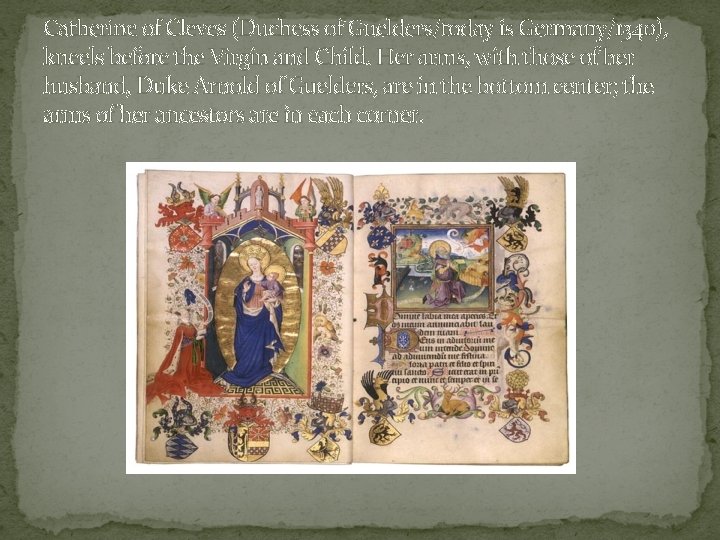
Catherine of Cleves (Duchess of Guelders/today is Germany/1340), kneels before the Virgin and Child. Her arms, with those of her husband, Duke Arnold of Guelders, are in the bottom center; the arms of her ancestors are in each corner.
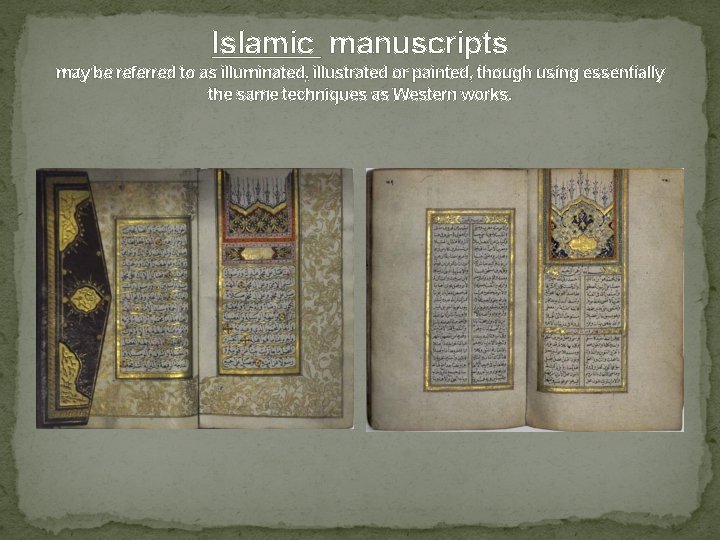
Islamic manuscripts may be referred to as illuminated, illustrated or painted, though using essentially the same techniques as Western works.
What is an Illuminated Manuscript? Illuminated manuscripts are books written by hand painted with precious pigments. Manuscripts contain most of the finest surviving examples of medieval painting. The word manuscript is derived from the Latin words manus (hand) and scriptus, from the verb scribere (to write). Today the term is used to describe any handwritten text. The word illumination comes from the Latin verb illuminare (to light up), which, in this context, describes the glow created by the radiant colors of the illustrations, especially gold and silver. Illumination took the form of decorated letters, borders, and independent painted scenes, called MINIATURES. Manuscripts were most often written on parchment paper, a high quality writing support made from the specially prepared skins of calves, sheep, or goats. Although paper could be found in Europe as early as the 14 th century, parchment continued to be used for several hundred years in spite of the greater cost involved. Its beautiful texture and translucency, its ability to withstand the wear and tear of daily handling, and its resistance to the dissolving action of acidic inks were among the qualities that made parchment so appealing.
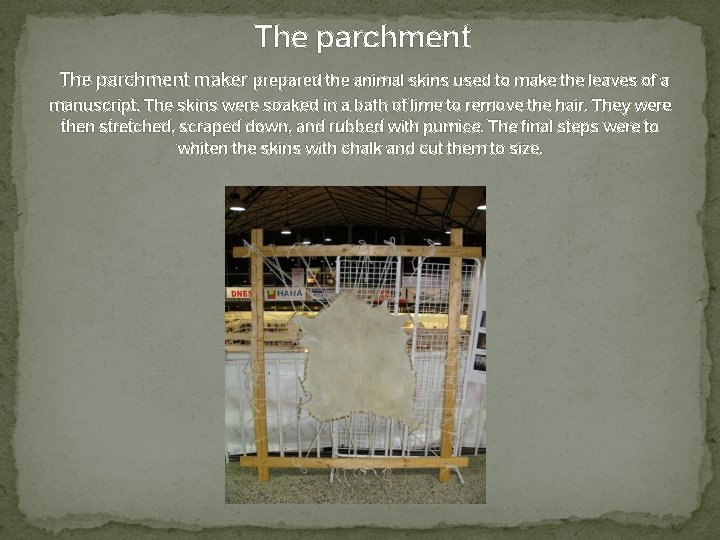
The parchment maker prepared the animal skins used to make the leaves of a manuscript. The skins were soaked in a bath of lime to remove the hair. They were then stretched, scraped down, and rubbed with pumice. The final steps were to whiten the skins with chalk and cut them to size.
What is Graphic Design? Suppose you want to announce or sell something, amuse or persuade someone, explain a complicated system or demonstrate a process. In other words, you have a message you want to communicate. How do you “send” it? You could tell people one by one or broadcast by radio or loudspeaker. That's verbal communication. But if you use any visual medium at all-if you make a poster; type a letter; create a business logo, a magazine ad, or an album cover; t-shirts, you are using a form of visual communication called graphic design. The designer works with a variety of communication tools in order to convey a message from a client to a particular audience. The main tools are image and typography.
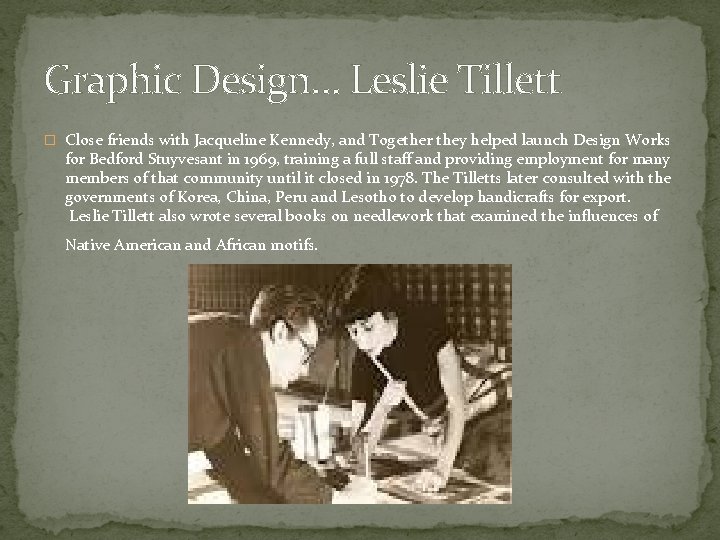
Graphic Design… Leslie Tillett � Close friends with Jacqueline Kennedy, and Together they helped launch Design Works for Bedford Stuyvesant in 1969, training a full staff and providing employment for many members of that community until it closed in 1978. The Tilletts later consulted with the governments of Korea, China, Peru and Lesotho to develop handicrafts for export. Leslie Tillett also wrote several books on needlework that examined the influences of Native American and African motifs.
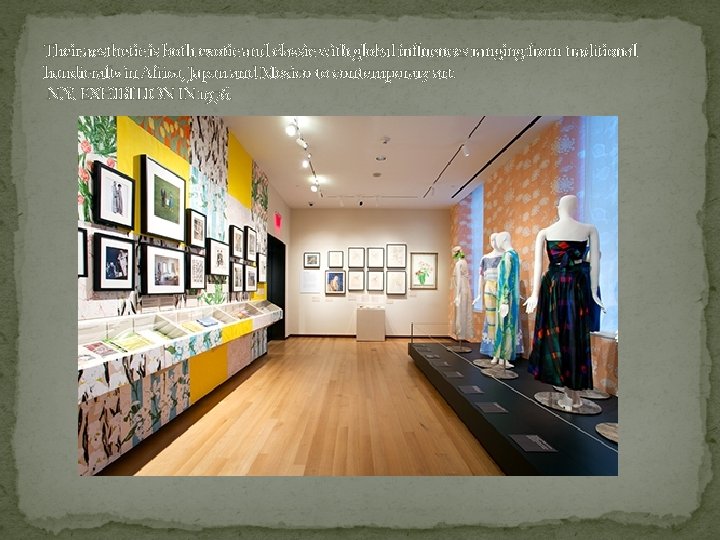
Their aesthetic is both exotic and classic with global influences ranging from traditional handicrafts in Africa, Japan and Mexico to contemporary art. N. Y. EXHIBITION IN 1976.
Quick Review: �Who wrote the books? � �What texts they contained? � �Who read them? � �How they were made? � �What purpose they served?
- Slides: 13