
Illinois Freedom of Information Act FOIA February 21
Illinois Freedom of Information Act (FOIA) February 21, 2018 Leah Bartelt, Assistant Attorney General Public Access Bureau, Illinois Attorney General’s Office
Public Access Counselor Position within the Attorney General’s Office. • Created by amendments to FOIA effective January 1, 2010. • To provide advice and education with respect to FOIA and OMA; • To resolve complaints concerning compliance with FOIA and OMA without litigation. 15 ILCS 205(7)
The Purpose of FOIA “The General Assembly hereby declares that it is the public policy of the State of Illinois that access by all persons to public records promotes the transparency and accountability of public bodies at all levels of government. It is a fundamental obligation of government to operate openly and provide public records as expediently and efficiently as possible in compliance with this Act. ” (Emphasis added. ) 5 ILCS 140/1
![Definition of “Public Records” The definition of “public records” includes: “[A]ll * * *](http://slidetodoc.com/presentation_image_h/830655fba44a1b2e901666792dd3261a/image-4.jpg "Definition of “Public Records” The definition of “public records” includes: “[A]ll * * *")
Definition of “Public Records” The definition of “public records” includes: “[A]ll * * * documentary materials pertaining to the transaction of public business, regardless of physical form or characteristics, having been prepared by or for, or having been or being used by, received by, in the possession of, possessed or under the control of any public body. ” 5 ILCS 140/2(c)
Presumption of Openness Under FOIA, there is a presumption that all public records are open to inspection or copying: “Presumption. All records in the custody or possession of a public body are presumed to be open to inspection or copying. Any public body that asserts that a record is exempt from disclosure has the burden of proving by clear and convincing evidence that it is exempt. ” 5 ILCS 140/1. 2 (added by 2010 amendments)
What is Clear and Convincing? Generally, under FOIA, "clear and convincing" evidence requires the public body to "provide a detailed justification for its claim of exemption, addressing the requested documents specifically and in a manner allowing for adequate adversary testing. " (Emphasis in original. ) Illinois Educ. Ass'n v. Illinois State Bd. of Educ. , 204 Ill. 2 d 456, 464 (2003).
What is a Public Record? If a public official sent or received communications on a personal electronic device during a public meeting, and the communications pertain to the transaction of public business, then those communications are “public records” subject to the requirements of FOIA. Ill. Att'y Gen. Pub. Acc. Op. No. 11 -006, issued November 15, 2011. City of Champaign v. Madigan, 2013 IL App (4 th)120662, 992 N. E. 2 d 629 (2013).
What is a Public Record? If public employees sent or received communications via personal e-mail accounts, and those communications pertain to the transaction of public business, then those communications are “public records” subject to the requirements of FOIA. The public body may be able to fulfill its obligations under FOIA by asking personnel to search their e-mail accounts in good faith. Ill. Att'y Gen. Pub. Acc. Op. No. 16 -006, issued August 9, 2016.
What is a Public Record? A public record must pertain to the transaction of public business. Therefore, any communications relating to strictly personal matters are not “public records” subject to disclosure under FOIA, regardless of how or where they are maintained. Content controls, not the medium.
Explaining Public Records FOIA is not intended to compel public bodies to interpret or advise requesters as to the meaning or significance of the public records. 5 ILCS 140/3. 3 • A public body may deny a “FOIA Request” that asks a question instead of asking to inspect or copy a record
Need Not Create Public Records FOIA does not require a public body to create records in order to respond to a FOIA request; rather a public body is required to make records within its possession or control available for inspection and copying. Workmann v. Illinois State Bd. of Educ. , 229 Ill. App. 3 d 459, 464 (2 d Dist. 1992).
Compiling Information Is Not Creating New Records FOIA does not require public bodies to create entirely new records consisting of information that is not in its possession or custody, but a public body may be required to compile and re-organize information that it already maintains in the ordinary course of business. Hamer v. Lentz, 132 Ill. 2 d 49, 57 (1989). Hites v. Waubonsee Community College, 2016 IL App (2 d) 150836 (2016).
Records of Funds “All records relating to the obligation, receipt, and use of public funds of the State, units of local government, and school districts are public records subject to inspection and copying by the public. ” 5 ILCS 140/2. 5
Payrolls “Certified payrolls submitted to a public body by contractors and subcontractors doing public work under Section 5(a)(2) of the Prevailing Wage Act are public records”; “except that contractors’ employees’ addresses, telephone numbers, and social security numbers must be redacted by the public body prior to disclosure. ” 5 ILCS 140/2. 10
Settlement and Severance Agreements “All settlement and severance agreements entered into by or on behalf of a public body are public records subject to inspection and copying by the public, provided that information exempt from disclosure under Section 7 of this Act may be redacted. ” 5 ILCS 140/2. 20
Record Held by Agent A public record that is not in the possession of a public body but is in the possession of a party with whom the agency has contracted to perform a governmental function on behalf of the public body, and that directly relates to the governmental function and is not otherwise exempt under this Act, shall be considered a public record of the public body, for purposes of this Act. 5 ILCS 140/7(2) See Chicago Tribune v. College of Du. Page and College of Du. Page Foundation, 2017 IL App (2 d) 160274 (2017).
FOIA Requests § § In writing, directed to the public body. Oral requests may be honored. Standard form may not be required. Public body may not require requester to specify a purpose, except to determine whether the request is for a commercial purpose. § Forward immediately to FOIA officer. See 5 ILCS 140/3(c)
Time for Responding A public body must generally respond to a FOIA request within 5 business days after receipt of a written request. The time for response may be extended by the public body for an additional 5 business days for one of seven reasons specified in the Act. See 5 ILCS 140/3(d), (e) 2010 amendments shorted response time from 7 business days
Failure to Respond Failure to respond to a request within the time permitted is considered a denial of the request. ▪ A public body that fails to respond to a request within the time permitted, but then provides copies of the requested public records may not impose a fee for those copies. ▪ A public body that fails to respond to a request received may not treat the request as unduly burdensome under section 3(g). 5 ILCS 140/3(d)
FOIA Response A FOIA request may be granted, denied, or granted in part and denied in part. If denying a request for public records the public body shall notify the requester in writing of: 1. The decision to deny the request, 2. The reasons for the denial, including a detailed factual basis for the application of any exemption claimed, and 3. The names and titles or positions of each person responsible for the denial.
FOIA Response, cont. In addition, each notice of denial by a public body shall: 1. Inform the requester of his or her right to seek review by the Public Access Counselor, 2. Provide the address and phone number of the Public Access Counselor, 3. Inform the requester of his right to judicial review under section 11 of FOIA. 5 ILCS 140/9(a)
Unduly Burdensome Requests § Before invoking this section, public bodies must extend to requester an opportunity to reduce the request to manageable proportions. § The burden of compliance on public body must outweigh public interest in the information. § Repeated requests by same person for same records identical to records previously provided or properly denied are unduly burdensome. 5 ILCS 140/3(g)
Unduly Burdensome - Examples • … manually locating and compiling large numbers of records from 93 separate facilities or systems over a 23 year time span. • … compiling all records, including financial records, school policies, and correspondence for a 12 -year period. • … only two employees to gather, review, and redact thousands of records from several sources over a sixyear span. • … creation of new reports to assemble vendor information and payments for rent-related expenses for public housing.
Copying Fees (amended in 2010) • First 50 pages (b/w, letter or legal) = FREE! • Pages 51+ = may not exceed 15 cents per page. • If a public body provides copies in color or in a size other than letter or legal, the public body may charge its actual cost for reproducing the records. 5 ILCS 140/6(a).
Requests for Electronic Copies • A public body must produce records that are maintained in an electronic format in the electronic format specified by the requester, if feasible. • If not feasible, must disclose in the electronic format in which the records are maintained or in paper, at the option of the requester.
Fees for Electronic Copies A public body may only charge the requester for the actual cost of purchasing the recording medium, whether disc, diskette, tape, or other medium. Statutory fees applicable to copies of public records when furnished in a paper format shall not be applicable to those records when furnished in an electronic format, unless the General Assembly otherwise provides. 5 ILCS 140/6(a)
Records Maintained Online A public body is not required to copy a public record that is published on the public body's website. • Public body must notify the requester that the public record is available online and direct the requester to the website. • Persons unable to reasonably access the record online may re-submit the request, public body must then respond as provided in section 3. 5 ILCS 140/8. 5
EXEMPTIONS To enable public bodies to maintain certain types of sensitive public records confidentially, FOIA provides a number of exceptions to the requirement that public records be made available for public inspection. The exemptions do not, however, prohibit the dissemination of information; rather, they merely authorize the withholding of information. Roehrborn v. Lambert, 277 Ill. App. 3 d 181, 186 (1 st Dist. 1995), appeal denied, 166 Ill. 2 d 554.
Exemptions are Narrowly Construed The exemptions to disclosure under FOIA are to be narrowly construed. Lieber v. Board of Trustees of Southern Illinois University, 176 Ill. 2 d 401, 408 (1997).
FOIA – Section 7(1) When a record contains information that is exempt under section 7 or 7. 5, but also contains information that is not exempt, the public body may elect to redact exempt information; remaining information shall be made available for inspection and copying. 5 ILCS 140/7(1) See, e. g. , Ill. Att’y Gen. PAC Rev. Ltr. 37563, issued October 20, 2016 (public body must redact exempt portions of video recordings and furnish non-exempt portions).
Section 7(1)(a) Exempts from disclosure: “Information specifically prohibited from disclosure by federal or State law or rules and regulations implementing federal or State law. ” 5 ILCS 140/7(1)(a)
Section 7(1)(a) – Information Exempt Under Other Laws Section 7(1)(a) applies only when a law or rule implementing a law specifically prohibits the public body from releasing the information in question. Better Government Ass’n v. Blagojevich, 386 Ill. App. 3 d 808, 814 (4 th Dist. 2008).
Information Exempt Under Other Laws Illinois Criminal Codes • Records under court seal that were obtained through court ordered overhears and records that reflect the contents are prohibited under 725 ILCS 5/108 A-7. • Grand jury records. See 725 ILCS 5/112 -6. • School bus audio-visual recordings. See 720 ILCS 5/14 -3(m). • Recordings of custodial interrogations. See 725 ILCS 5/103 -2. 1(g).
7(1)(b) – Private Information • Allows withholding of private information, unless required by another provision of FOIA, a State or federal law or a court order. • Private information is defined in section 2(c-5) of FOIA.
Private Information 5 ILCS 140/2(c-5) Unique identifiers, including: • Social Security Numbers • Driver's License Numbers • Employee Identification Numbers • Biometric Identifiers (DNA, retina/iris scan, fingerprint, voiceprint, scan of hand) • Personal Financial Information • Passwords or Other Access Codes • Medical Records • Home or Personal Telephone Numbers • Personal Email Addresses
Private Information 5 ILCS 140/2(c-5) Unique identifiers, including: • Home addresses • Personal license plates Ø Except when compiled without possibility of attribution to any person Other Unique identifiers • Zip codes (when coupled with identifying information like name) • Signatures
![7(1)(c) – Personal Information Exempts “[p]ersonal information contained within public records, the disclosure of](http://slidetodoc.com/presentation_image_h/830655fba44a1b2e901666792dd3261a/image-37.jpg "7(1)(c) – Personal Information Exempts “[p]ersonal information contained within public records, the disclosure of")
7(1)(c) – Personal Information Exempts “[p]ersonal information contained within public records, the disclosure of which would constitute a clearly unwarranted invasion of personal privacy, unless the disclosure is consented to in writing by the individual subjects of the information[. ]” 5 ILCS 140/7(1)(c)
Personal Information, cont. “Clearly unwarranted invasion of personal privacy” means the disclosure of information that is: ØHighly personal or objectionable to a reasonable person, and in which the ØSubject's right to privacy outweighs any legitimate public interest in obtaining the information. 7(1)(c) involves a fact-specific, case-by-case inquiry, balancing right to privacy with public interest.
Personal Information “The disclosure of information that bears on the public duties of public employees and officials shall not be considered an invasion of personal privacy. ” 5 ILCS 140/7(1)(c)
Exempt Personal Information • Dates of birth • Victim names/identifying information • Race • Specific medical information (i. e. descriptions of specific injuries and treatment) • Information related to unsuccessful candidates for employment
7(1)(c) Not Properly Asserted • Personal information concerning requester • Identifying information of an arrestee • Names of people issued a ticket, citation or notice to appear • Resumes, CVs, certificates and other employment information for public employees • Time sheets, vacation time, accrual sheets, and amount of sick time used for public employees
7(1)(f) – Deliberative Process • Allows withholding of “records in which opinions are expressed, or policies or actions are formulated” • Except when record is publicly cited by head of public body • The purpose of the deliberative process exemption is to protect the predecisional communications process and encourage frank and open discussion among agency employees.
7(1)(f) – Scope Training materials presented to budget analysts not exempt under section 7(1)(f) because they were not in draft format, predecisional or deliberative. See Ill. Att'y Gen. Pub. Acc. Op. No. 15 -015, issued December 29, 2015.
Trade Secrets – Section 7(1)(g) Trade secrets and commercial or financial information obtained from a person or business are exempt pursuant to section 7(1)(g) if provided to the public body under a claim of confidentiality • But only if disclosure of the information would cause competitive harm
Pre-Award Proposals and Bids – Section 7(1)(h) Proposals and bids for any contract, grant, or agreement are exempt pursuant to section 7(1)(h) • If disclosure would frustrate procurement or give an advantage to any person proposing to enter into a contractor agreement • Only until an award or final selection is made
7(1)(m) –Privileged Information Communications between a public body and an attorney or auditor representing the public body that would not be subject to discovery in litigation, or are prepared in anticipation of litigation, are exempt from disclosure under section 7(1)(m) of FOIA.
7(1)(m) cont. • Not all attorney/client communications are privileged. llinois Education Ass’n v. Illinois State Board of Education, 204 Ill 2 d 456 (2003). • Lists containing names and pay rate of outside counsel for State agencies not exempt. Ill. Att’y Gen. Pub. Acc. Op. No. 15 -010, issued October 21, 2015. • Invoices for legal services not exempt. Ill. Att’y Gen. Pub. Acc. Op. No. 14 -002. issued April 15, 2014.
7(1)(n) – Disciplinary Cases • Allows a public body to withhold “records relating to a public body's adjudication of employee grievances or disciplinary cases; however, this exemption shall not extend to the final outcome of cases in which discipline is imposed. ” • Investigative records (police reports, citations, etc. ) that do not relate to an actual adjudication are not exempt. Peoria Journal Star v. City of Peoria, 2016 IL App (3 d) 140838, 52 N. E. 3 d 711 (2016) (police department improperly withheld report of investigation of grievance that was created before any adjudication).
Section 7. 5 – Other IL statutes • Section 7. 5(q) – Personnel Record Review Act (exempts employee evaluations)
Special Types of Requesters and Requests • Commercial • Recurrent • Voluminous
Commercial Purpose Requests “’Commercial purpose’ means the use of any part of a public record or records, or information derived from public records, in any form for sale, resale, or solicitation or advertisement for sales or services. ” 5 ILCS 140/2(c-10) Must respond within 21 working days after receipt.
Recurrent Requester A person who, in the 12 months immediately preceding the request, has submitted to the same public body: (i) a minimum of 50 requests for records, (ii) a minimum of 15 requests for records within a 30 -day period, (iii) a minimum of 7 requests for records within a 7 -day period. 5 ILCS 140/2(g) News media and non-profit, scientific, or academic organizations are generally excluded.
Voluminous Request - Definition Section 2(h) of FOIA: "Voluminous request" means a request that: (i) includes more than 5 individual requests for more than 5 different categories of records or a combination of individual requests that total requests for more than 5 different categories of records in a period of 20 business days; or (ii) requires the compilation of more than 500 letter or legal-sized pages of public records unless a single requested record exceeds 500 pages. "Single requested record" may include, but is not limited to, one report, form, e-mail, letter, memorandum, book, map, microfilm, tape, or recording.
Review of FOIA Denials – Request for Review A Request for Review must be filed with the Public Access Counselor “not later than 60 days after the date of the final denial. ” The request must be in writing, signed by the requester and include: 1) a copy of the request for records, and 2) any responses from the public body 5 ILCS 140/9. 5(a)
Requests for Review “A person whose request to inspect or copy a public record is denied by a public body, except the General Assembly and committees, commissions, and agencies thereof, may file a request for review with the Public Access Counselor [. ]” 5 ILCS 140/9. 5
PAC Review Process • Determine whether further action is warranted. • If unfounded, advise public body and requester, no further action. • Otherwise, send to public body and request records and response; requester has opportunity to reply. • Follow up with additional questions as necessary.
Resolution of Requests for Review The Public Access Counselor may: • Issue a binding opinion, which is subject to administrative review under section 11. 5 of FOIA, or • Resolve a request for review by mediation or by a means other than the issuance of a binding opinion. 5 ILCS 140/9. 5(f) • Other means – determination letter.
Judicial Review Any person denied access to inspect or copy any public record by a public body may file suit for injunctive or declaratory relief. 5 ILCS 140/11(a) If the requester files suit under section 11 * * * the Public Access Counselor shall take no further action with respect to the request for review and shall so notify the public body. 5 ILCS 140/9. 5(g)
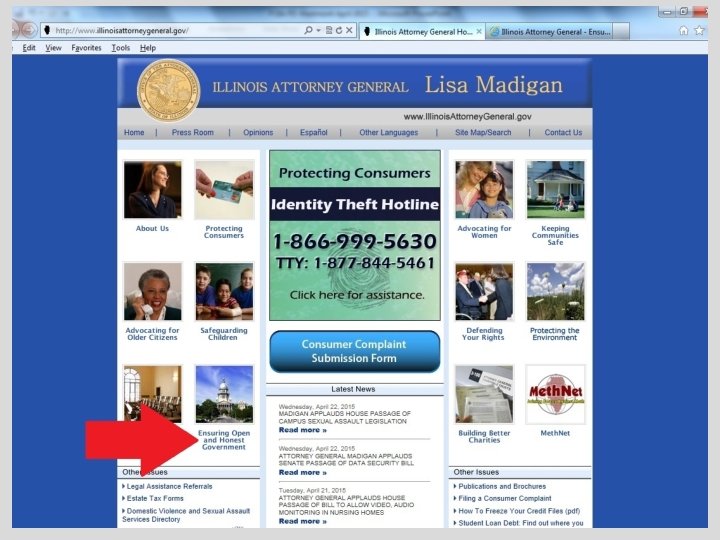

Contact Information Office of the Attorney General Public Access Counselor 500 South Second Street Springfield, Illinois 62706 877 -299 -3642 publicaccess@atg. state. il. us pactechnicalsupport@atg. state. il. us
- Slides: 60