
Illegal Batting NFHS Rule 9 7 2 Cambria
Illegal Batting NFHS Rule 9 -7 -2 Cambria County Chapter of PIAA Football Officials 2010 Rules
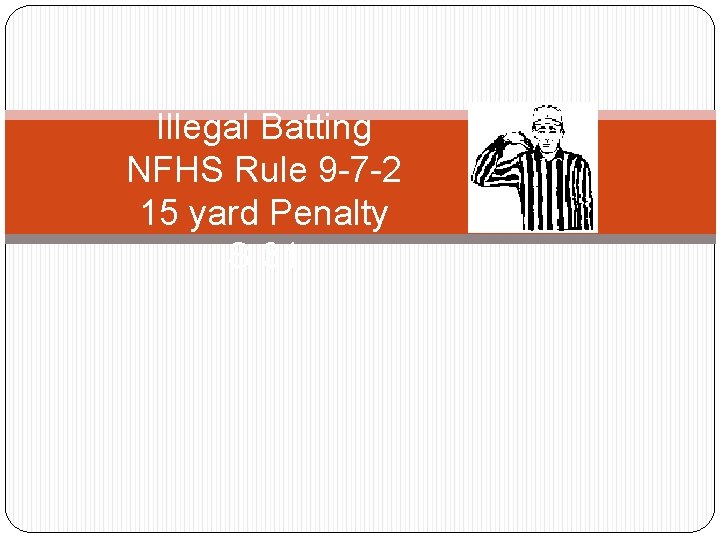
Illegal Batting NFHS Rule 9 -7 -2 15 yard Penalty S 31
Presentation Overview � 1) Illegal Batting Overview � 2) Batting in the NFHS Rules Book � 3) Batting in the NFHS Case Book � 4) Batting in the NFHS Simplified and Illustrated � 5) Discussion Scenarios � 6) Illegal Batting in NFHS football
Illegal Batting Overview � Batting is an intentional act that involves slapping or striking the ball with the arm or hand. � 9 -7 -3 -Any forward pass in flight may be batted in any direction by an eligible receiver. � Eligible offensive players may not bat a backward pass in flight forward. � 9 -7 -4 -A ball in player possession shall not be batted forward by a teammate. � All defensive players (always eligible) can bat any pass in flight in any direction.
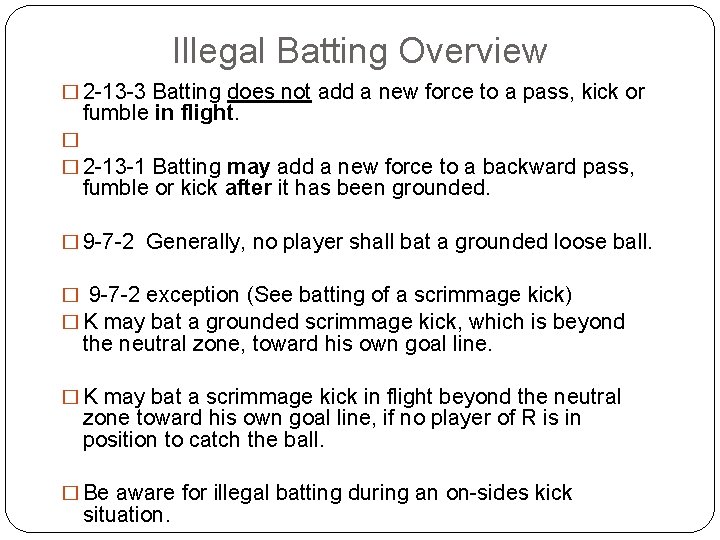
Illegal Batting Overview � 2 -13 -3 Batting does not add a new force to a pass, kick or fumble in flight. � � 2 -13 -1 Batting may add a new force to a backward pass, fumble or kick after it has been grounded. � 9 -7 -2 Generally, no player shall bat a grounded loose ball. � 9 -7 -2 exception (See batting of a scrimmage kick) � K may bat a grounded scrimmage kick, which is beyond the neutral zone, toward his own goal line. � K may bat a scrimmage kick in flight beyond the neutral zone toward his own goal line, if no player of R is in position to catch the ball. � Be aware for illegal batting during an on-sides kick situation.
Illegal Batting Overview Since batting is an intentional act, it should be considered when determining illegal touching by ineligibles 7 -5 -13. For determining pass interference on eligible receivers, treat batting like you would an attempt to catch a pass.
Illegal Batting in the NFHS Rules Book � Rule 2 -2: Batting is intentionally slapping or striking the ball with the arm or hand. � Rule 2 -13 -1: Force is the result of energy exerted by a player which provides movement of the ball. The term force is used only in connection with the goal line and in only one direction, i. e. , from the field of play into the end zone. Initial force results from a carry, fumble, kick, pass or snap. After a backward pass, fumble or kick has been grounded, a new force may result from a bat, an illegal kick or a muff. � Rule 2 -13 -3: The muffing or batting of a pass, kick or fumble in flight is not considered a new force.
Illegal Batting in the NFHS Rules Book � Rule 9 -7 -2: No player shall bat a loose ball other than a pass or a fumble in flight, or a low scrimmage kick in flight which he is attempting to block in or behind the expanded neutral zone. � Exception: A K player may bat toward his own goal line a grounded scrimmage kick which is beyond the neutral zone and may also bat toward his own goal line a scrimmage kick in flight beyond the neutral zone, if no R player is in position to catch the ball. � Rule 9 -7 -3: Any pass in flight may be batted in any direction, by an eligible receiver unless it is a backward pass batted forward by the passing team. � Rule 9 -7 -4: A ball in player possession shall not be batted forward by a player of the team in possession. � PENALTY: Illegal kicking or batting (Rule 9 -7: Arts. 1, 2, 3,
Illegal Batting in the NFHS Rules Book � Rule 6 -5 -6: While any free kick is in flight in or beyond the neutral zone to the receiver's goal line or any scrimmage kick is in flight beyond the neutral zone to the receiver's goal line, K shall not touch the ball or R, unless blocked into the ball or R or to ward off a blocker, nor obstruct R's path to the ball. This prohibition applies even when no fair-catch signal is given, but it does not apply after a free kick has been touched by a receiver, or after a scrimmage kick has been touched by a receiver who was clearly beyond the neutral zone at the time of touching. � Exception: K may catch, touch, muff or bat a scrimmage kick in flight beyond the neutral zone toward his own goal line if no player of R is in position to catch the ball.

Illegal Batting in the NFHS Rules Book � Rule 7 -5 -10 a: It is forward-pass interference if: Any player of A or B who is beyond the neutral zone interferes with an eligible opponent's opportunity to move toward, catch or bat the pass. � Rule 7 -5 -11 a: It is not forward-pass interference if: Unavoidable contact occurs when two or more eligbles are making a simultaneous, bona fide attempt to move toward, catch or bat the pass. � Rule 7 -5 -13: An ineligible A player has illegally touched a forward pass if he bats, muffs or catches a legal forward pass, unless the pass has first been touched by B.
Illegal Batting in the NFHS Rules Book � Rule 8 -5 -1: Responsibility forcing the ball from the field of play across a goal line is attributed to the player who carries, snaps, passes, fumbles or kicks the ball, unless a new force is applied to a grounded backward pass, kick or fumble. The muffing or batting of a pass, kick or fumble in flight is not considered a new force. � Rule 8 -5 -2 b: It is a safety when: A player, who is either in the field of play or in his end zone, forces a loose ball from the field of play to or across his goal line by his kick, pass, fumble, snap or by a new force to a grounded loose ball with his muff or bat or illegal kick, provided the ball becomes dead there in his team's possession (including when the ball is declared dead with no player in possession), or the ball is out of bounds when it becomes dead on or behind their goal line. This does not apply to a legal forward pass which becomes incomplete.
Illegal Batting in the NFHS Rules Book � Rule 8 -5 -3 b: It is a touchback when: Any scrimmage kick or free kick becomes dead on or behind K's goal line with the ball in possession of Team K (including when the ball is declared dead with no player in possession) and the new force is R's muff or bat of the kick after it has touched the ground. � Rule 8 -5 -3 c: It is a touchback when: A fumble is the force, or a muff or bat of a backward pass or a fumble after either has touched the ground is the new force, which sends the ball to or across the opponent's goal line and provided such opponent is in team possession or the ball is out of bounds when it becomes dead on or behind its goal line.
Illegal Batting in the NFHS Case Book � 9. 7. 2 A - Play: With fourth and 4 from R's 40 -yard line, K 1 punts. The kick is bounding near R's goal line and K 2, in an attempt to keep it from penetrating the plane of the goal line, bats the ball at the 2 -yard line back toward his own goal line. In (a) it is recovered by R 1 who advances to his 30; or (b) it is recovered by R 2 who attempts to advance, but retreats and is downed in his own end zone. � Ruling a: The bat by K 2 is legal because it occurred beyond the neutral zone. R would obviously take the results of the play and put the ball in play first and 10 from its 30. � Ruling b: Since the result of the play is a safety, R would take the ball at the 2, which is the spot of first touching where K 2 legally batted the kick. (6 -2 -5; 8 -5 -
Illegal Batting in the NFHS Case Book � 9. 7. 2 B - Play: K 1's punt is coming down over R's 10 -yard line and: (a) R 3 is in position to catch the ball; or (b) no R player is in position to catch the ball, when K 2 attempts to bat the ball toward his own goal line while it is in flight, but the batted ball goes into R's end zone. � Ruling a: It is a foul for kick-catching interference by K 2 as well as first touching, and R may chose to take the result of the play, which is a touchback, or take an awarded fair catch or the ball at the spot of first touching at the 10 -yard line, or penalize K 15 yards from the previous spot and replay the down. � Ruling b: There is no foul and the result of the play is a touchback. R will put the ball in play first and 10 from its own 20 -yard line. (6 -5 -6 Exp. ; 8 -5 -3; 9 -2 -7 Exp. )
Illegal Batting in the NFHS Case Book � 9. 7. 3 - Play: Team A is in punt formation and the ball is snapped to A 1, who turns his back to the line of scrimmage and throws a backward pass into the air. A 2 comes forward and bats the ball 20 yards downfield where: (a) A 3 recovers it 5 yards beyond the line to gain; or (b) it is caught by A 4 who advances for an additional 5 yards; or (c) it goes out of bounds in advance of the line to gain; or (d) B 1 intercepts and returns it for an apparent touchdown. � Ruling a, b and c: The batting by A 2 is illegal. It will be to B's advantage to accept the penalty of 15 yards which will be administered from the spot of the foul because the batting occurred during the loose-ball play and behind the basic spot. Remember A recovered a fumble beyond the line to gain. If B declines the penalty in a-b-c it will be a first down for A. (10 -6)
Illegal Batting in the NFHS Case Book � 9. 7. 4 - Play: On fourth and 6 from B's 10 -yard line, A 1 is about to be hit short of the line to gain. While the ball is in A 1's possession, either: (a) A 1; or (b) A 2; or (c) B 1, bats the ball forward into B's end zone where A 3 recovers. � Ruling a and b: It is an illegal bat in both. The enforcement spot is the end of A 1's run, which is where the bat occurred. (bean bag at the spot of the bat) � Ruling c: The bat is legal and results in a touchdown for A. (8 -2 -2)
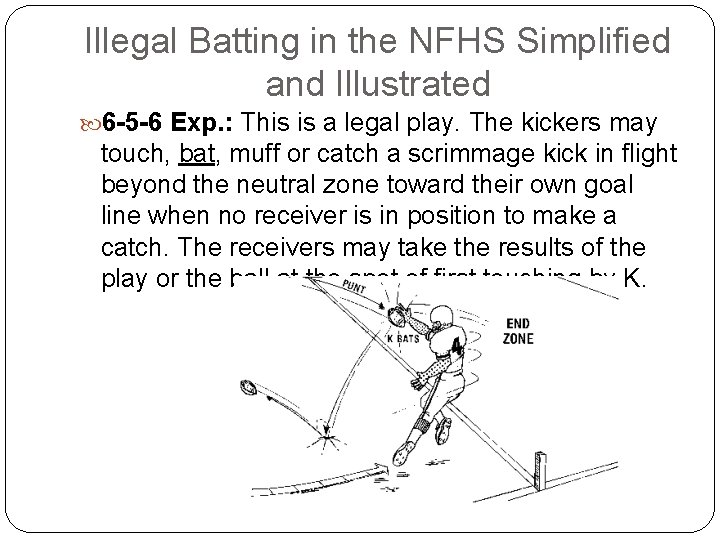
Illegal Batting in the NFHS Simplified and Illustrated 6 -5 -6 Exp. : This is a legal play. The kickers may touch, bat, muff or catch a scrimmage kick in flight beyond the neutral zone toward their own goal line when no receiver is in position to make a catch. The receivers may take the results of the play or the ball at the spot of first touching by K.
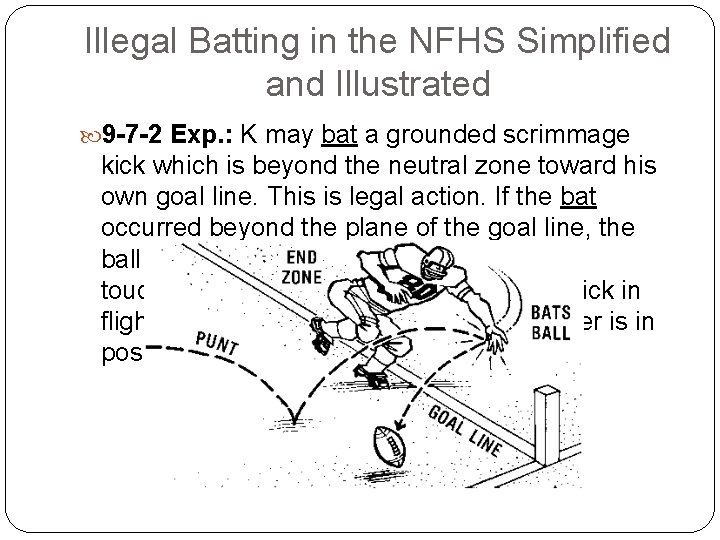
Illegal Batting in the NFHS Simplified and Illustrated 9 -7 -2 Exp. : K may bat a grounded scrimmage kick which is beyond the neutral zone toward his own goal line. This is legal action. If the bat occurred beyond the plane of the goal line, the ball was already dead causing it to be a touchback. K may also bat a scrimmage kick in flight beyond the neutral zone if no R player is in position to catch the ball.
Illegal Batting Discussion Scenarios Scenario 1: B 1 intercepts a forward pass in his end zone and then passes backward to B 2 who, startled with the pass, bats the ball backward over the end line. Ruling 1: The force which put the ball into the end zone was the pass by A 1. When B 2 batted the backward pass in flight (backwards) so that the ball went over the end line, the result is a touchback. It will be first and 10 for B from its 20 yard line. (8 -5 -3 c; 9 -7 -2)
Illegal Batting Discussion Scenarios � Scenario 2: On third and 10 from B's 20 -yard line, quarterback A 1 receives the snap and sweeps right. Setting up for a trick play he turns left and throws a lazy looping backward pass to his waiting receiver A 2 who appears to be wide open at B's 30 -yard line near the other sideline. Unfortunately, A 2 realizes that two B players were not fooled and if he catches the pass, he is going to be tacked for a 10 -yard loss. When the pass arrives, instead of catching the ball at B’s 30 he decides to bat the ball forward and out of bounds, in an attempt to minimize the loss of yardage. The bat by A 2 goes out of bounds at B’s 25 yard line. � Ruling 2: The bat by A 2 is illegal since he batted a backward pass in flight, forward. If accepted, A will be penalized 15 yards from the spot of the foul (B’s 30) because the batting occurred during the loose-ball play and behind the basic spot. The result is third and 35 from B’s 45. (9 -7 -3; 10 -6)
Illegal Batting Discussion Scenarios Scenario 3: First and 10 from A's 7 -yard line. Quarterback A 1 receives the snap and throws a quick backward pass to wide receiver A 2. Defensive end B 1, gets there first and bats the pass in flight toward A's end zone, which ultimately hits the base of the goal post. Ruling 3: Safety for B. The bat by B 1 is legal since all players of B may bat any pass in flight in any direction. Batting of a pass in flight is not considered a new force, therefore, A’s initial backward pass is the force that put the ball in the end zone. (9 -7 -3; 2 -13 -3)
Illegal Batting Discussion Scenarios Scenario 4: During a field-goal attempt, R 1, who is in the end zone, leaps up and bats the ball away from the crossbar. Ruling 4: Touchback. The touching by R 1 in the end zone causes the ball to become dead, unless the ball caroms through the goal, thus scoring a field goal for K. This is not illegal batting. Touching by R 1 in the field of play or in the end zone has no effect on the scoring of a field goal. (4 -2 -2 d; 6 -2 -6; 9 -7 -2)
REVIEW Batting is an intentional act that involves slapping or striking the ball with the arm or hand. 9 -7 -3 -Any forward pass in flight may be batted in any direction by an eligible receiver. Eligible offensive players may not bat a backward pass in flight forward. 9 -7 -4 -A ball in player possession shall not be batted forward by a teammate. All defensive players (always eligible) can bat any pass in flight in any direction. 9 -7 -2 Generally, no player shall bat a grounded loose ball. 9 -7 -2 exception: K may bat a grounded scrimmage kick, which is beyond the neutral zone, toward his own goal line.
- Slides: 23