
ILL Neutrons for Science Institut LaueLangevin founded in

- Slides: 6
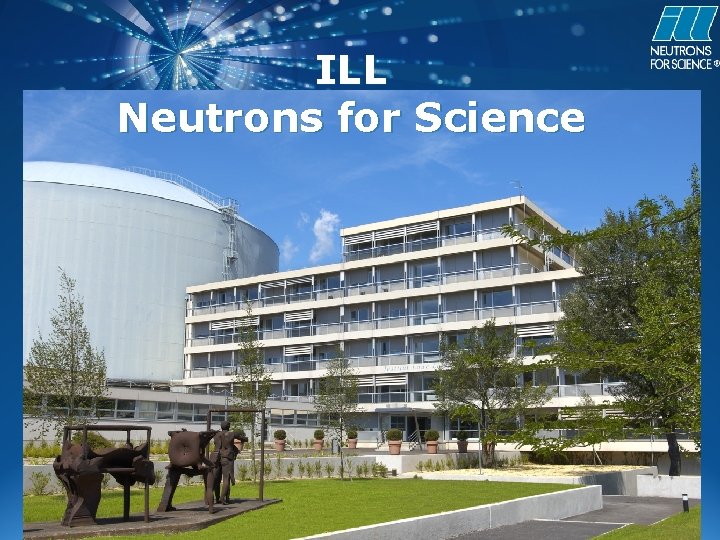
ILL Neutrons for Science
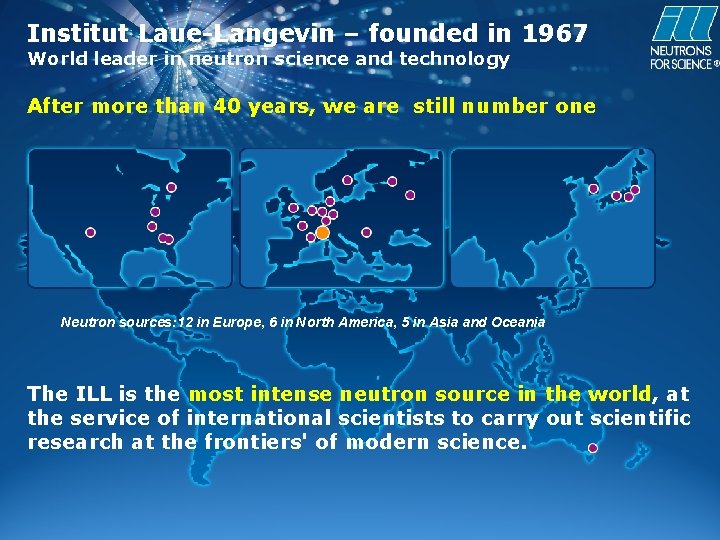
Institut Laue-Langevin – founded in 1967 World leader in neutron science and technology After more than 40 years, we are still number one Neutron sources: 12 in Europe, 6 in North America, 5 in Asia and Oceania The ILL is the most intense neutron source in the world, at the service of international scientists to carry out scientific research at the frontiers' of modern science.
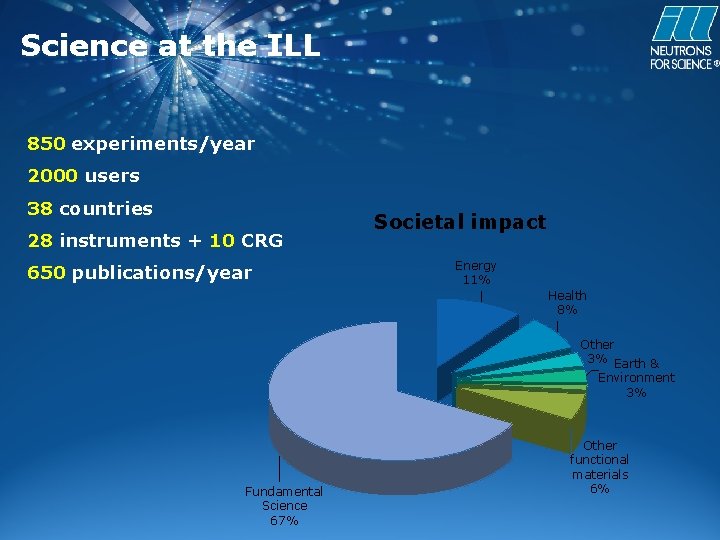
Science at the ILL 850 experiments/year 2000 users 38 countries 28 instruments + 10 CRG 650 publications/year Societal impact Energy 11% Health 8% Other 3% Earth & Environment 3% Fundamental Science 67% Other functional materials 6%
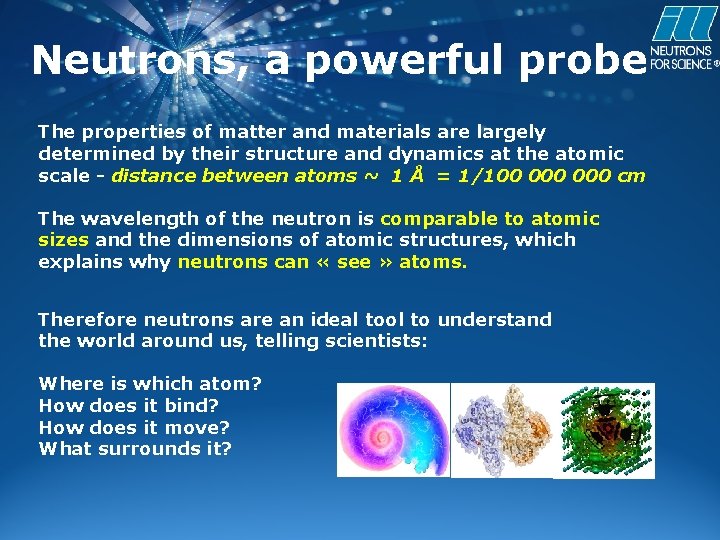
Neutrons, a powerful probe The properties of matter and materials are largely determined by their structure and dynamics at the atomic scale - distance between atoms ~ 1 Å = 1/100 000 cm The wavelength of the neutron is comparable to atomic sizes and the dimensions of atomic structures, which explains why neutrons can « see » atoms. Therefore neutrons are an ideal tool to understand the world around us, telling scientists: Where is which atom? How does it bind? How does it move? What surrounds it?
The Millenium Programme 2001 -2014 During this period we have • built or upgraded 14 instruments; • replaced or renewed a great part of our neutron guides, making them ‘twice as bright’; • improved our technical devices, from cryostats to magnets, new polarised optics and a new electronic instrument control system…
Today : the Endurance programme Today we are setting our sights on a more distant horizon, that of 2030. Our goals: • preserve our position of leadership by drawing on our strengths • offer new possibilities in the fields of magnetism, materials science, soft matter, biology and particle physics