
ILC ILD TPC Requirements of the support mechanics
![Estimated acceleration and forces Values of basic peak acceleration a 0 [m/s 2] North](https://slidetodoc.com/presentation_image_h2/346db4e2d37aa9acbb198c1335b12eaa/image-4.jpg "Estimated acceleration and forces Values of basic peak acceleration a 0 [m/s 2] North")
- Slides: 13
ILC / ILD TPC Requirements of the support mechanics Volker Prahl ILD Workshop 2013 Cracow 24. 09. 2013
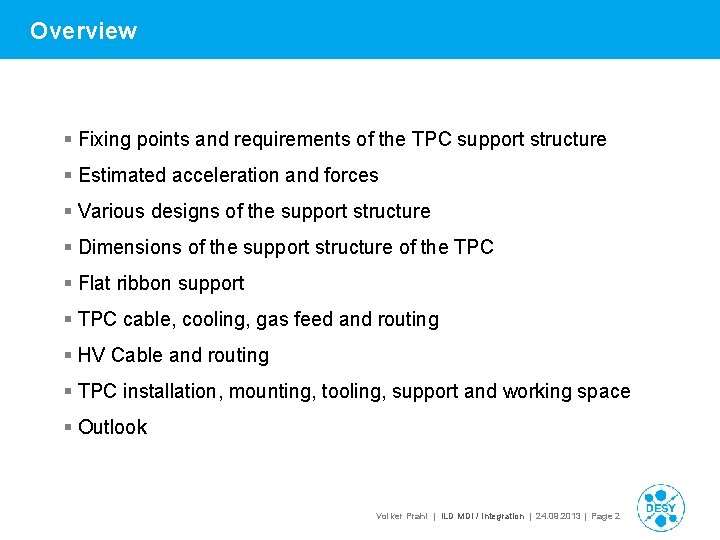
Overview § Fixing points and requirements of the TPC support structure § Estimated acceleration and forces § Various designs of the support structure § Dimensions of the support structure of the TPC § Flat ribbon support § TPC cable, cooling, gas feed and routing § HV Cable and routing § TPC installation, mounting, tooling, support and working space § Outlook Volker Prahl | ILD MDI / Integration | 24. 09. 2013 | Page 2
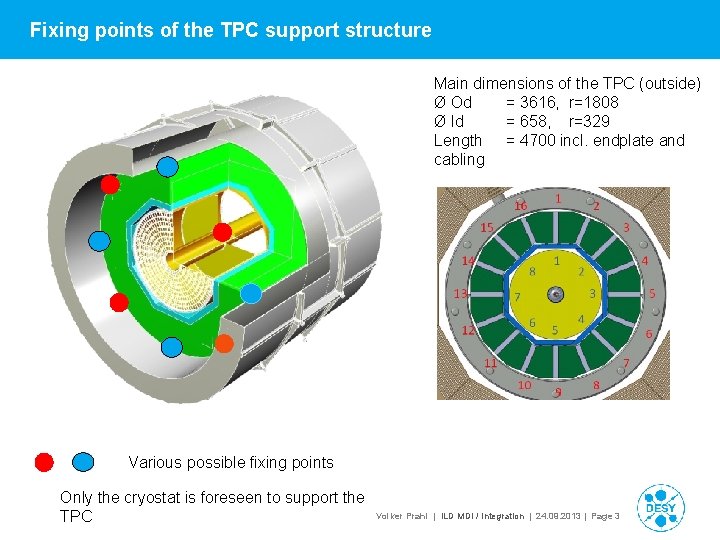
Fixing points of the TPC support structure Main dimensions of the TPC (outside) Ø Od = 3616, r=1808 Ø Id = 658, r=329 Length = 4700 incl. endplate and cabling Various possible fixing points Only the cryostat is foreseen to support the TPC Volker Prahl | ILD MDI / Integration | 24. 09. 2013 | Page 3
Estimated acceleration and forces Values of basic peak acceleration a 0 [m/s 2] North site A 0< 1. 5 m/s² South site A 0< 1. 0 m/s² For the proposed Japanese sides Please have a look at the talk from O. Ferreira, LLR Ecole Polytechnique http: //ilcagenda. linearcollider. org/conference. Display. py? confid=5524. TPC weight for calculation: 2000 kg >20000 N (Incl. FTD, SIT, Vertex) Seismic load force: 3000 N in x, y, z calculated with A 0< 1. 5 m/s² The additional force load in longitudinal direction of the bar support should not be an issue. Question: Which maximal amplitude can be accepted ? An max. deflection of 1 mm will be the aim Volker Prahl | ILD MDI / Integration | 24. 09. 2013 | Page 4
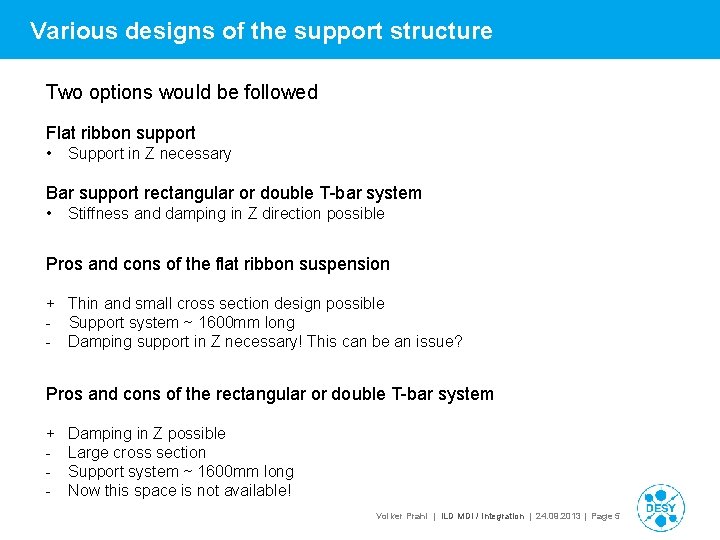
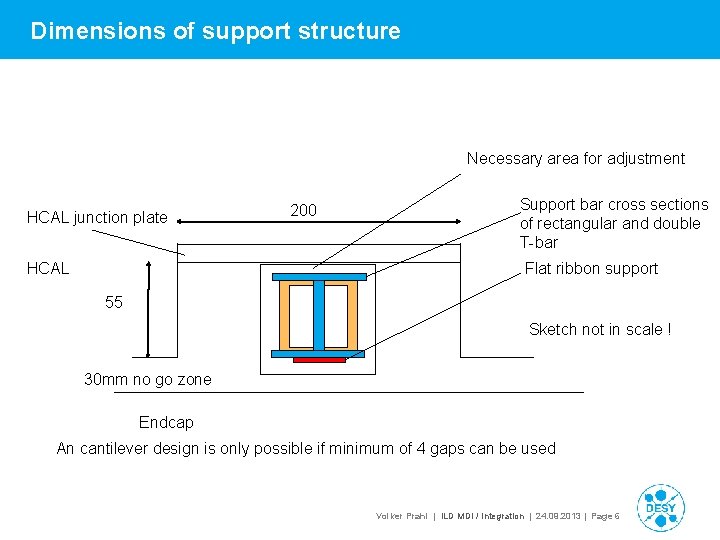
Various designs of the support structure Two options would be followed Flat ribbon support • Support in Z necessary Bar support rectangular or double T-bar system • Stiffness and damping in Z direction possible Pros and cons of the flat ribbon suspension + Thin and small cross section design possible - Support system ~ 1600 mm long - Damping support in Z necessary! This can be an issue? Pros and cons of the rectangular or double T-bar system + - Damping in Z possible Large cross section Support system ~ 1600 mm long Now this space is not available! Volker Prahl | ILD MDI / Integration | 24. 09. 2013 | Page 5
Dimensions of support structure Necessary area for adjustment HCAL junction plate HCAL 200 Support bar cross sections of rectangular and double T-bar Flat ribbon support 55 Sketch not in scale ! 30 mm no go zone Endcap An cantilever design is only possible if minimum of 4 gaps can be used Volker Prahl | ILD MDI / Integration | 24. 09. 2013 | Page 6
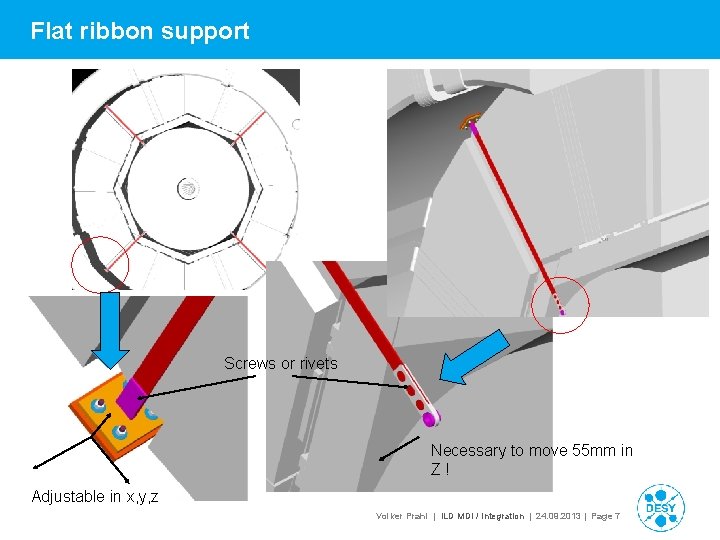
Flat ribbon support Screws or rivets Necessary to move 55 mm in Z! Adjustable in x, y, z Volker Prahl | ILD MDI / Integration | 24. 09. 2013 | Page 7
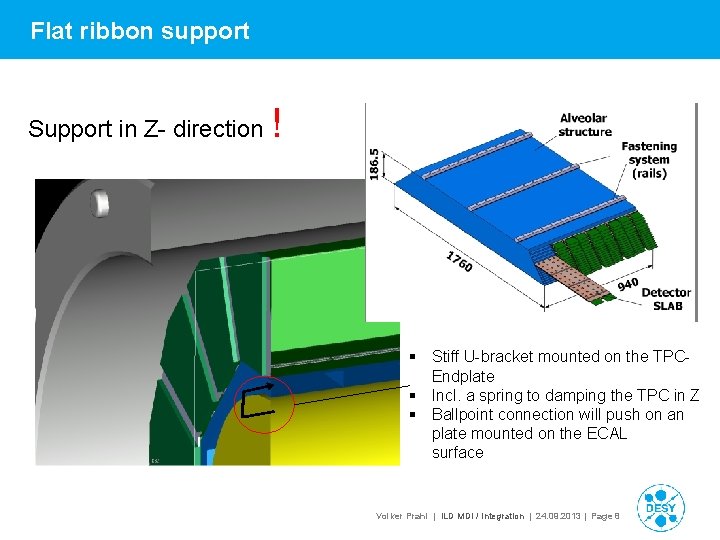
Flat ribbon support Support in Z- direction ! § Stiff U-bracket mounted on the TPCEndplate § Incl. a spring to damping the TPC in Z § Ballpoint connection will push on an plate mounted on the ECAL surface Volker Prahl | ILD MDI / Integration | 24. 09. 2013 | Page 8
TPC cable, cooling, gas feed and routing TPC infrastructure needs to be defined § Type of cable § Number of cables § Cross section and or diameter § Specification of the cables § Tubes for cooling § Gas feed Volker Prahl | ILD MDI / Integration | 24. 09. 2013 | Page 9
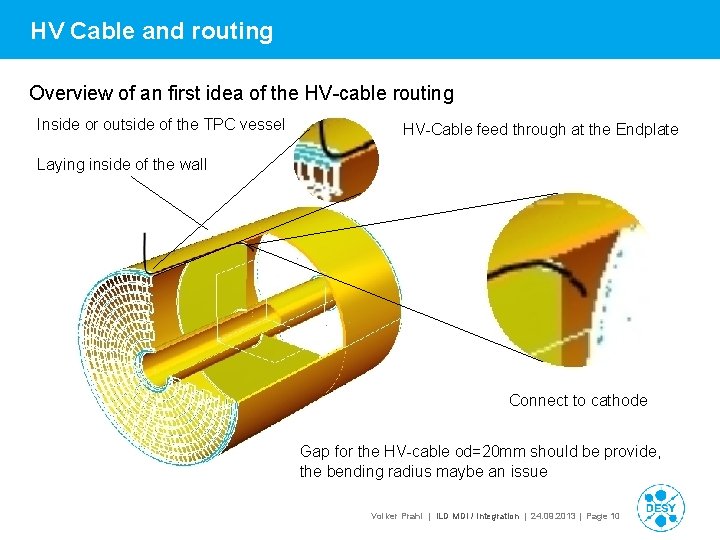
HV Cable and routing Overview of an first idea of the HV-cable routing Inside or outside of the TPC vessel HV-Cable feed through at the Endplate Laying inside of the wall Connect to cathode Gap for the HV-cable od=20 mm should be provide, the bending radius maybe an issue Volker Prahl | ILD MDI / Integration | 24. 09. 2013 | Page 10
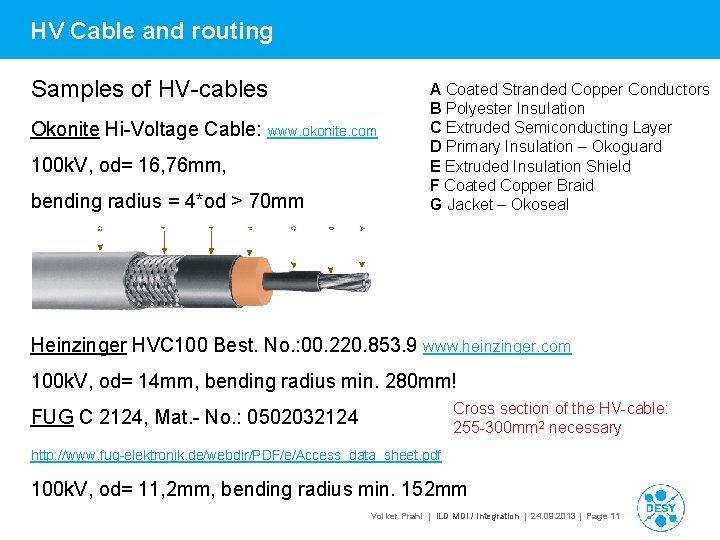
HV Cable and routing Samples of HV-cables Okonite Hi-Voltage Cable: www. okonite. com 100 k. V, od= 16, 76 mm, bending radius = 4*od > 70 mm A Coated Stranded Copper Conductors B Polyester Insulation C Extruded Semiconducting Layer D Primary Insulation – Okoguard E Extruded Insulation Shield F Coated Copper Braid G Jacket – Okoseal Heinzinger HVC 100 Best. No. : 00. 220. 853. 9 www. heinzinger. com 100 k. V, od= 14 mm, bending radius min. 280 mm! Cross section of the HV-cable: 255 -300 mm 2 necessary FUG C 2124, Mat. - No. : 0502032124 http: //www. fug-elektronik. de/webdir/PDF/e/Access_data_sheet. pdf 100 k. V, od= 11, 2 mm, bending radius min. 152 mm Volker Prahl | ILD MDI / Integration | 24. 09. 2013 | Page 11
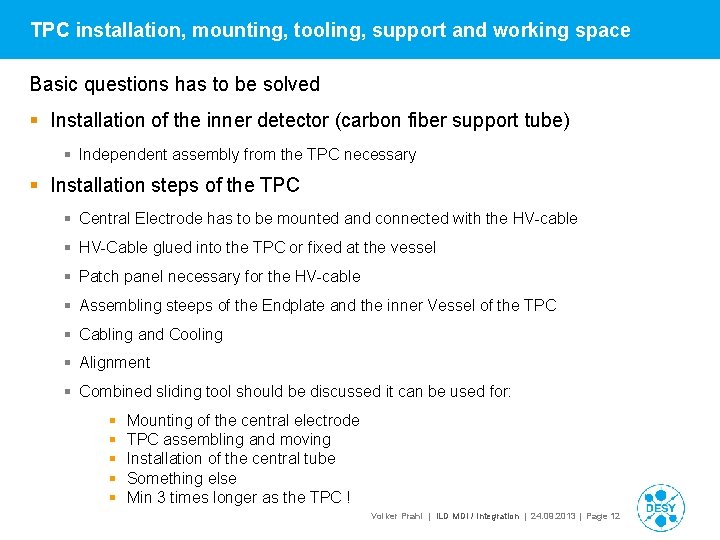
TPC installation, mounting, tooling, support and working space Basic questions has to be solved § Installation of the inner detector (carbon fiber support tube) § Independent assembly from the TPC necessary § Installation steps of the TPC § Central Electrode has to be mounted and connected with the HV-cable § HV-Cable glued into the TPC or fixed at the vessel § Patch panel necessary for the HV-cable § Assembling steeps of the Endplate and the inner Vessel of the TPC § Cabling and Cooling § Alignment § Combined sliding tool should be discussed it can be used for: § § § Mounting of the central electrode TPC assembling and moving Installation of the central tube Something else Min 3 times longer as the TPC ! Volker Prahl | ILD MDI / Integration | 24. 09. 2013 | Page 12
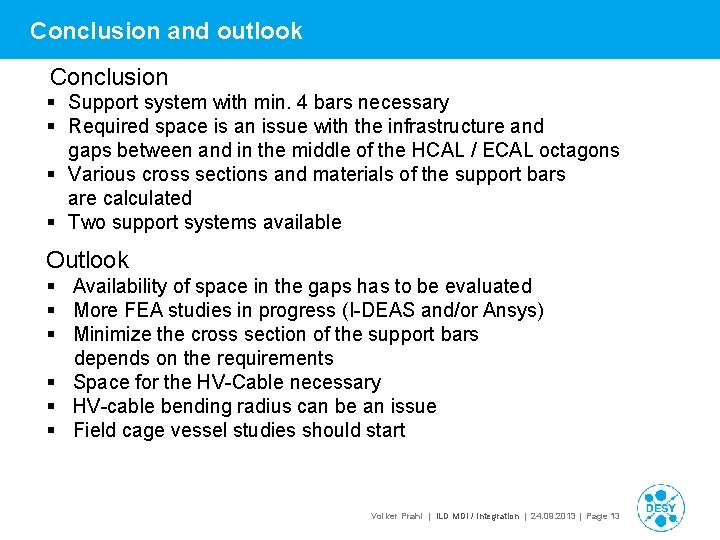
Conclusion and outlook Conclusion § Support system with min. 4 bars necessary § Required space is an issue with the infrastructure and gaps between and in the middle of the HCAL / ECAL octagons § Various cross sections and materials of the support bars are calculated § Two support systems available Outlook § Availability of space in the gaps has to be evaluated § More FEA studies in progress (I-DEAS and/or Ansys) § Minimize the cross section of the support bars depends on the requirements § Space for the HV-Cable necessary § HV-cable bending radius can be an issue § Field cage vessel studies should start Volker Prahl | ILD MDI / Integration | 24. 09. 2013 | Page 13