
ILC Controls Requirements Claude Saunders Argonne National Laboratory
ILC Controls Requirements Claude Saunders Argonne National Laboratory is managed by The University of Chicago for the U. S. Department of Energy
Official ILC Website n www. linearcollider. org (add /wiki for more technical info) 2

ILC Physical Layout (approximately) n electron-positron collider – 500 Ge. V, option for 1 Te. V 6 km circumference electron damping ring Positron damping rings e+ source e- linac e+ linac BDS 6 km 11 km 3
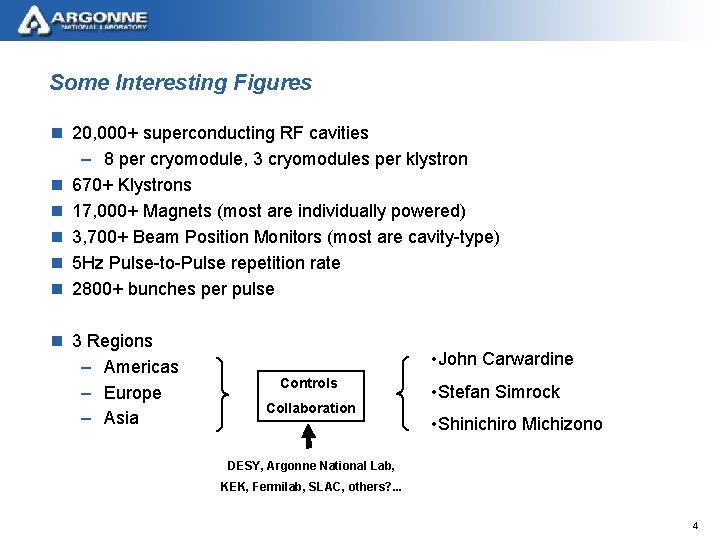
Some Interesting Figures n 20, 000+ superconducting RF cavities – 8 per cryomodule, 3 cryomodules per klystron n 670+ Klystrons n 17, 000+ Magnets (most are individually powered) n 3, 700+ Beam Position Monitors (most are cavity-type) n 5 Hz Pulse-to-Pulse repetition rate n 2800+ bunches per pulse n 3 Regions – Americas – Europe – Asia • John Carwardine Controls Collaboration • Stefan Simrock • Shinichiro Michizono DESY, Argonne National Lab, KEK, Fermilab, SLAC, others? . . . 4

ILC Activities 2005 2006 2007 2008 2009 2010 Global Design Effort Project Baseline configuration Funding Reference Design Technical Design regional coord globally coordinated sample sites ICFA / ILCSC expression of. Siting interest FALC ILC R&D Program Hosting International Mgmt 5
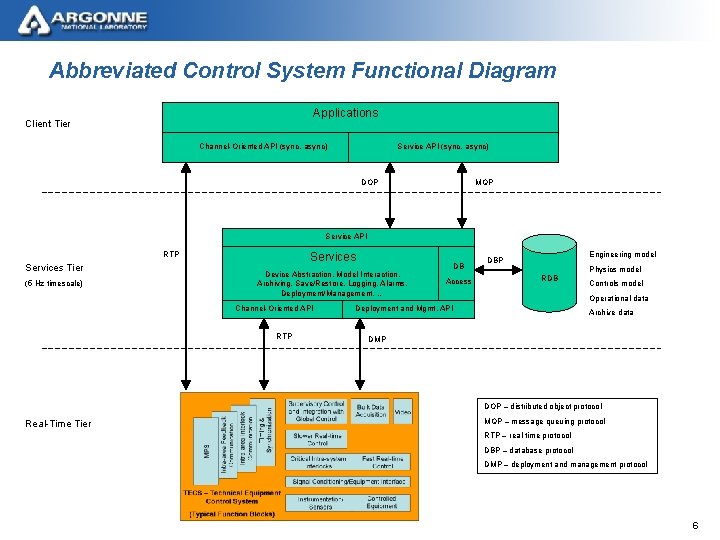
Abbreviated Control System Functional Diagram Applications Client Tier Channel-Oriented API (sync, async) Service API (sync, async) DOP MQP Service API RTP Services Tier (5 Hz timescale) Services Device Abstraction, Model Interaction, Archiving, Save/Restore, Logging, Alarms, Deployment/Management, … Channel-Oriented API RTP DB Access Engineering model DBP Physics model RDB Controls model Operational data Deployment and Mgmt. API Archive data DMP DOP – distributed object protocol Real-Time Tier MQP – message queuing protocol RTP – real-time protocol DBP – database protocol DMP – deployment and management protocol 6

ILC Availability n Existing High Energy Physics Colliders – 60% - 70% available n Light Sources – 95+ % available (APS > 97%) n Why the discrepancy? – Colliders are continually pushed for higher performance, light sources are more steady-state. • Higher power • Higher rate of software/configuration change. – Collider goal is to maximize integrated luminosity, so generally run until something breaks. Light sources have more scheduled downtime. n ILC Goal – 85+ % available – As measured by integrated luminosity 7
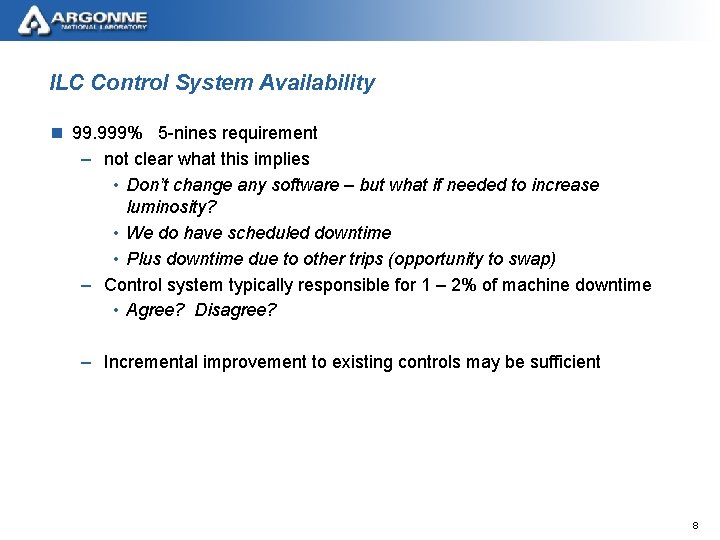
ILC Control System Availability n 99. 999% 5 -nines requirement – not clear what this implies • Don’t change any software – but what if needed to increase luminosity? • We do have scheduled downtime • Plus downtime due to other trips (opportunity to swap) – Control system typically responsible for 1 – 2% of machine downtime • Agree? Disagree? – Incremental improvement to existing controls may be sufficient 8
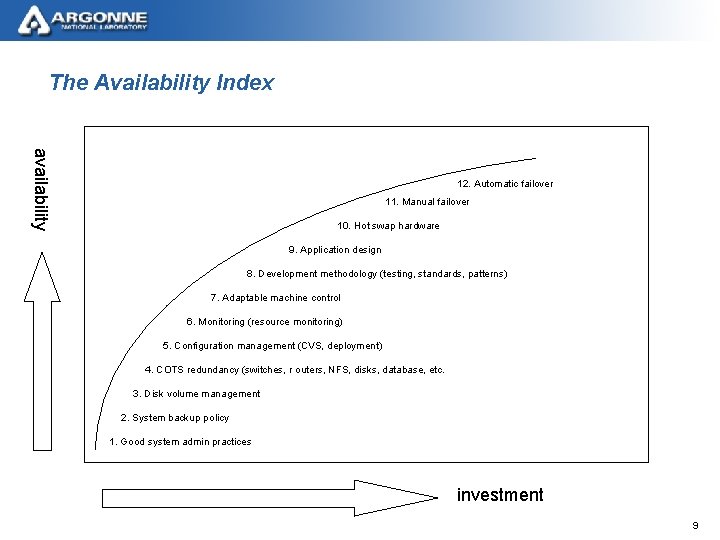
The Availability Index availability 12. Automatic failover 11. Manual failover 10. Hot swap hardware 9. Application design 8. Development methodology (testing, standards, patterns) 7. Adaptable machine control 6. Monitoring (resource monitoring) 5. Configuration management (CVS, deployment) 4. COTS redundancy (switches, r outers, NFS, disks, database, etc. 3. Disk volume management 2. System backup policy 1. Good system admin practices investment 9
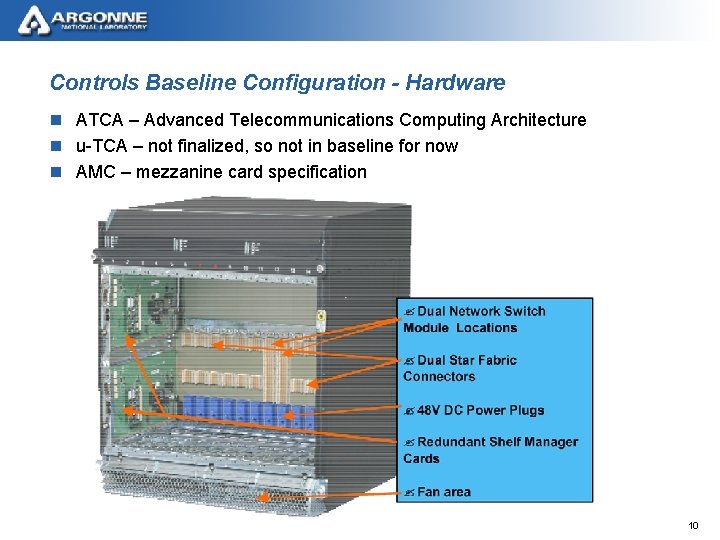
Controls Baseline Configuration - Hardware n ATCA – Advanced Telecommunications Computing Architecture n u-TCA – not finalized, so not in baseline for now n AMC – mezzanine card specification 10
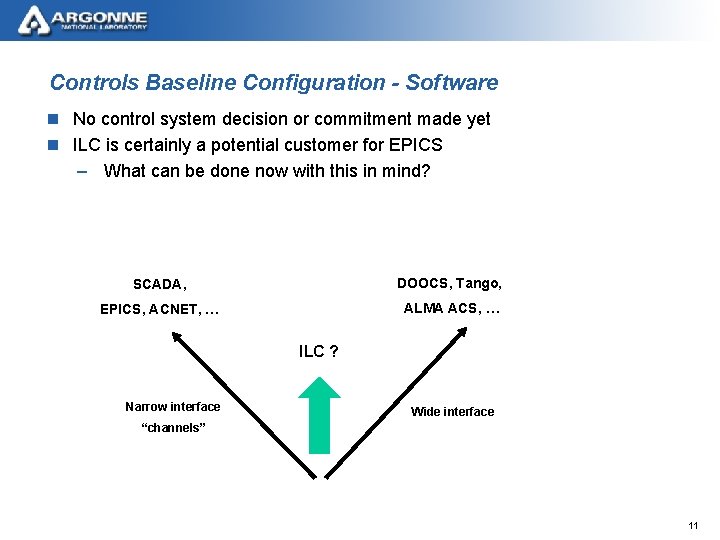
Controls Baseline Configuration - Software n No control system decision or commitment made yet n ILC is certainly a potential customer for EPICS – What can be done now with this in mind? SCADA, DOOCS, Tango, EPICS, ACNET, … ALMA ACS, … ILC ? Narrow interface Wide interface “channels” 11
Considerations n Scale – Approximately 2500 shelves (IOCs) – Control room 20 km away from either end of the machine – Overseas remote control room n Data Acquisition – Collecting circular data buffers after a trip – Steady-state LLRF and BPM data archiving n Monitoring – A view on the health of every “resource” in the system n Automated Diagnosis ( drive down MTTR ) – Both pre-emptive and post-mortem 12
Considerations - continued n Feedback – General 5 Hz feedback system (any sensor, any actuator) – Fast intra-train feedback n Configuration Management (everything) n Security n Automation – Anything that slows down machine startup, either at the beginning of a run or after a trip, impacts integrated luminosity. 13
Where does EPICS fit in at the moment? n ILCTA at Fermilab – EPICS in use at some test stands, planned for others. – Concurrently with other control systems (Geoff Savage’s talk) n Proposed ILC Research and Development Projects – Control system “gap analysis” • Select set of candidate control system frameworks. • Determine the modifications and enhancements necessary to meet ILC requirements. – ATCA evaluation • Port EPICS to ATCA CPU card – High availability research • Control system failure mode analysis (FMEA, FTA, ETA, …) • Modify EPICS driver and device support to prototype hot swap and possibly failover. 14
Some Thoughts on Where EPICS Work is Needed n Gateway n Nameserver n Channel Access – Is current version sufficient for DAQ? – Maintainable for 20+ years. – Alternative pluggable protocols? n Driver and device support architecture – Hot swap, manual failover, automatic failover n Hierarchical devices n Support for higher level requirements – Think “outside the IOC” n Auditing – Who does what and when? – Put-logging 15
- Slides: 15