
ILC and CLIC Luminosity Optimisation Studies with Intratrain
![Octave FB system scheme [Anthony Hartin] August 25, 2008 Javier Resta Lopez 9](https://slidetodoc.com/presentation_image_h2/0ede0d60ff996d6b4c44e76cf7f1c5d8/image-9.jpg "Octave FB system scheme [Anthony Hartin] August 25, 2008 Javier Resta Lopez 9")

- Slides: 27
ILC and CLIC Luminosity Optimisation Studies with Intra-train FB Javier Resta Lopez, Philip Burrows, JAI, Oxford University In collaboration with Andrea Latina and Daniel Schulte, CERN, Geneva Final EUROTe. V Scientific Workshop Uppsala, 25 -27 th August 2008 August 25, 2008 Javier Resta Lopez
Contents • • Introduction PLACET based start-to-end simulations • Octave FB system scheme • ILC start-to-end simulations • • • Linac Beam based alignment of the main linac BDS, beam-beam Fast intra-train FB system Ground motion ILC luminosity results • Different scenarios of ground motion • Statistical fluctuation of the luminosity • • • IP-intra-train position FB for CLIC Luminosity preservation over long time scales Summary and outlook August 25, 2008 Javier Resta Lopez 2
Introduction • Luminosity goal for the future linear colliders very demanding: very small transverse beam size and subnanometre level beam stability • Static and dynamics imperfections can significantly degrade the luminosity/emittance • To combat the emittance dilution the beam based alignment and tuning techniques are required • To keep the beams in collision feedback (FB) systems are required in different parts of the machine: – Slow FB systems: • Beam orbit steering • Slow ground motion compensation – Inter-pulse FB – Intra-pulse FB: • Operates at high frequency (~ 1 MHz) and acts within a bunch train • Removes the relative offset jitter at the IP steering the beams back into collision August 25, 2008 Javier Resta Lopez 3
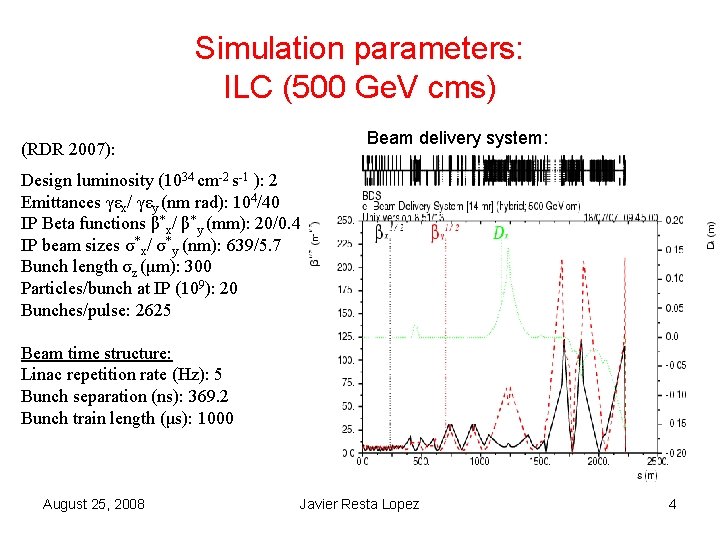
Simulation parameters: ILC (500 Ge. V cms) Beam delivery system: (RDR 2007): Design luminosity (1034 cm-2 s-1 ): 2 Emittances γεx/ γεy (nm rad): 104/40 IP Beta functions β*x/ β*y (mm): 20/0. 4 IP beam sizes σ*x/ σ*y (nm): 639/5. 7 Bunch length σz (μm): 300 Particles/bunch at IP (109): 20 Bunches/pulse: 2625 Beam time structure: Linac repetition rate (Hz): 5 Bunch separation (ns): 369. 2 Bunch train length (μs): 1000 August 25, 2008 Javier Resta Lopez 4
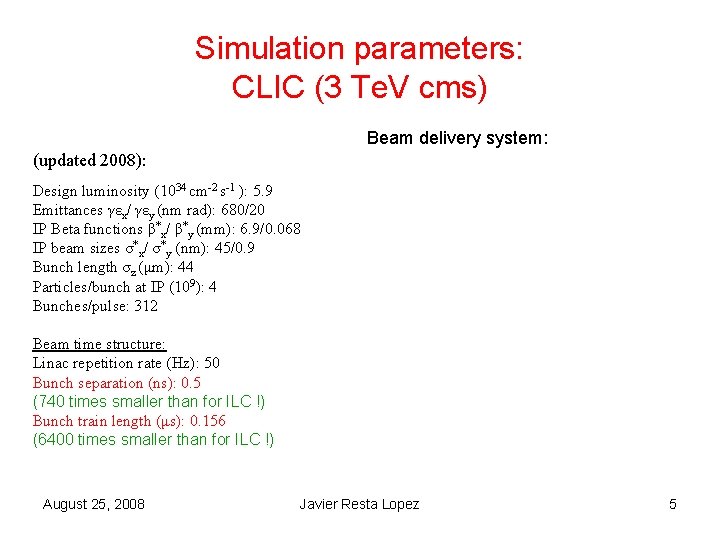
Simulation parameters: CLIC (3 Te. V cms) Beam delivery system: (updated 2008): Design luminosity (1034 cm-2 s-1 ): 5. 9 Emittances γεx/ γεy (nm rad): 680/20 IP Beta functions β*x/ β*y (mm): 6. 9/0. 068 IP beam sizes σ*x/ σ*y (nm): 45/0. 9 Bunch length σz (μm): 44 Particles/bunch at IP (109): 4 Bunches/pulse: 312 Beam time structure: Linac repetition rate (Hz): 50 Bunch separation (ns): 0. 5 (740 times smaller than for ILC !) Bunch train length (μs): 0. 156 (6400 times smaller than for ILC !) August 25, 2008 Javier Resta Lopez 5
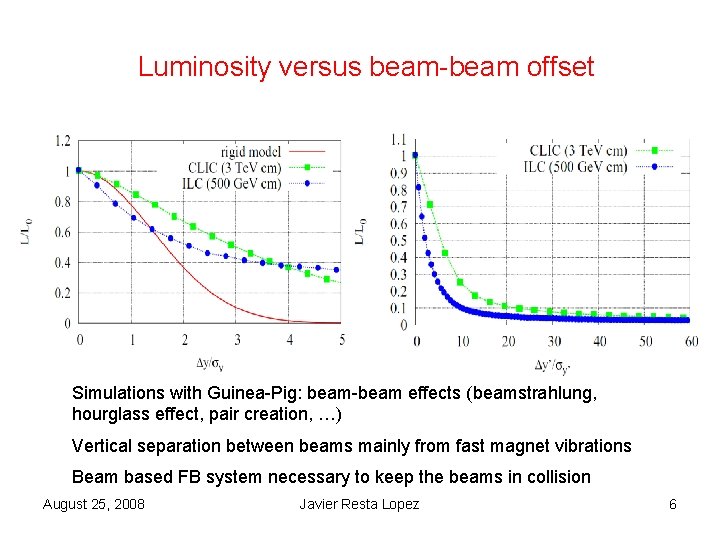
Luminosity versus beam-beam offset Simulations with Guinea-Pig: beam-beam effects (beamstrahlung, hourglass effect, pair creation, …) Vertical separation between beams mainly from fast magnet vibrations Beam based FB system necessary to keep the beams in collision August 25, 2008 Javier Resta Lopez 6
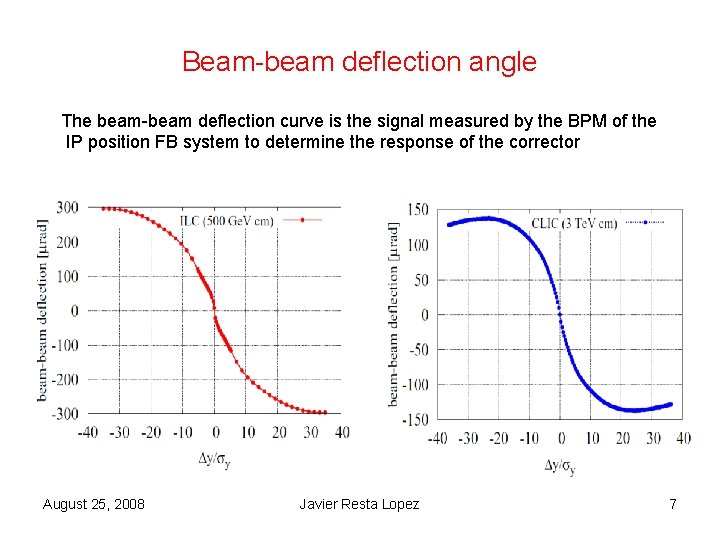
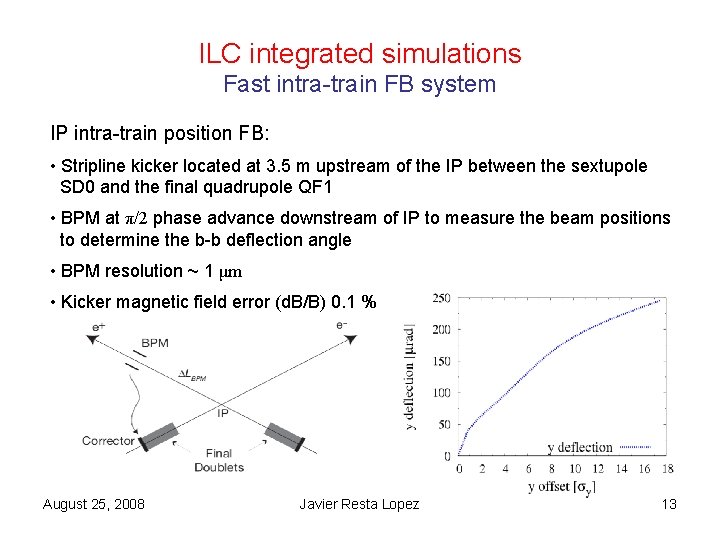
Beam-beam deflection angle The beam-beam deflection curve is the signal measured by the BPM of the IP position FB system to determine the response of the corrector August 25, 2008 Javier Resta Lopez 7
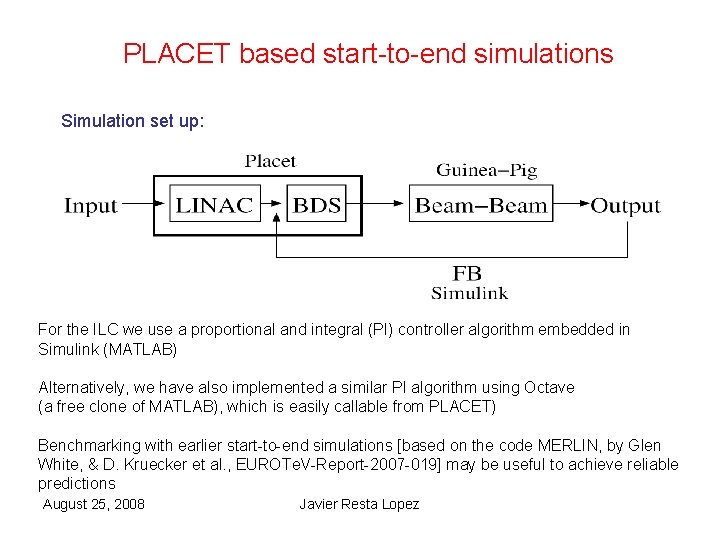
PLACET based start-to-end simulations Simulation set up: For the ILC we use a proportional and integral (PI) controller algorithm embedded in Simulink (MATLAB) Alternatively, we have also implemented a similar PI algorithm using Octave (a free clone of MATLAB), which is easily callable from PLACET) Benchmarking with earlier start-to-end simulations [based on the code MERLIN, by Glen White, & D. Kruecker et al. , EUROTe. V-Report-2007 -019] may be useful to achieve reliable predictions August 25, 2008 Javier Resta Lopez
Octave FB system scheme [Anthony Hartin] August 25, 2008 Javier Resta Lopez 9
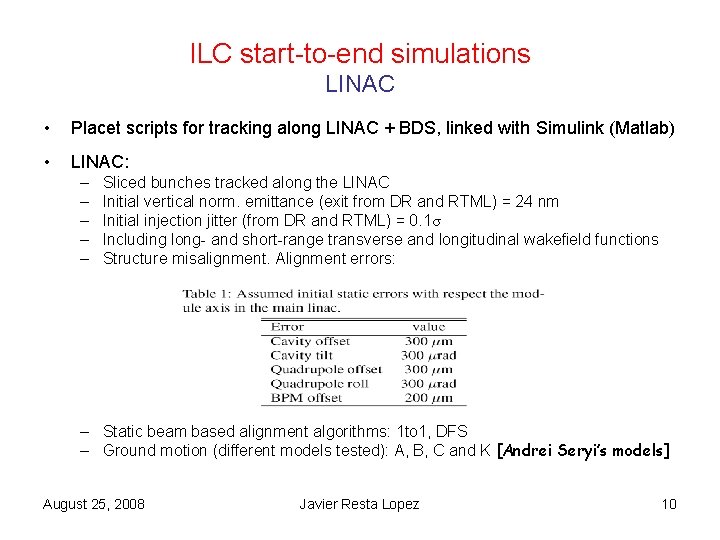
ILC start-to-end simulations LINAC • Placet scripts for tracking along LINAC + BDS, linked with Simulink (Matlab) • LINAC: – – – Sliced bunches tracked along the LINAC Initial vertical norm. emittance (exit from DR and RTML) = 24 nm Initial injection jitter (from DR and RTML) = 0. 1σ Including long- and short-range transverse and longitudinal wakefield functions Structure misalignment. Alignment errors: – Static beam based alignment algorithms: 1 to 1, DFS – Ground motion (different models tested): A, B, C and K [Andrei Seryi’s models] August 25, 2008 Javier Resta Lopez 10
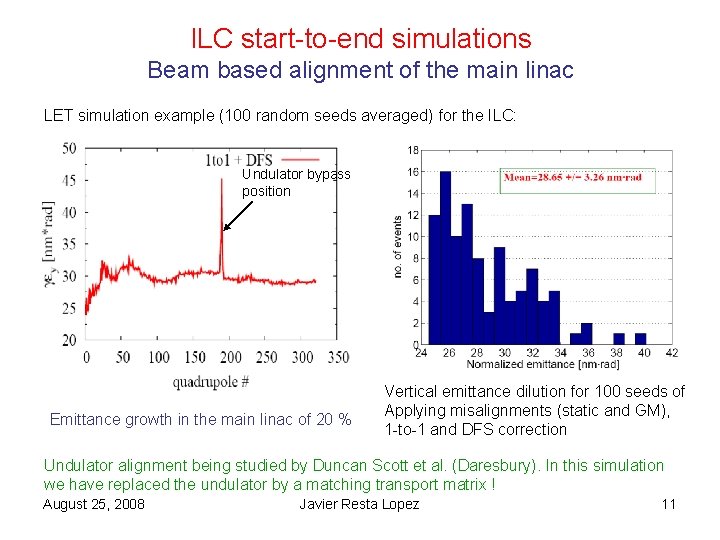
ILC start-to-end simulations Beam based alignment of the main linac LET simulation example (100 random seeds averaged) for the ILC: Undulator bypass position Emittance growth in the main linac of 20 % Vertical emittance dilution for 100 seeds of Applying misalignments (static and GM), 1 -to-1 and DFS correction Undulator alignment being studied by Duncan Scott et al. (Daresbury). In this simulation we have replaced the undulator by a matching transport matrix ! August 25, 2008 Javier Resta Lopez 11
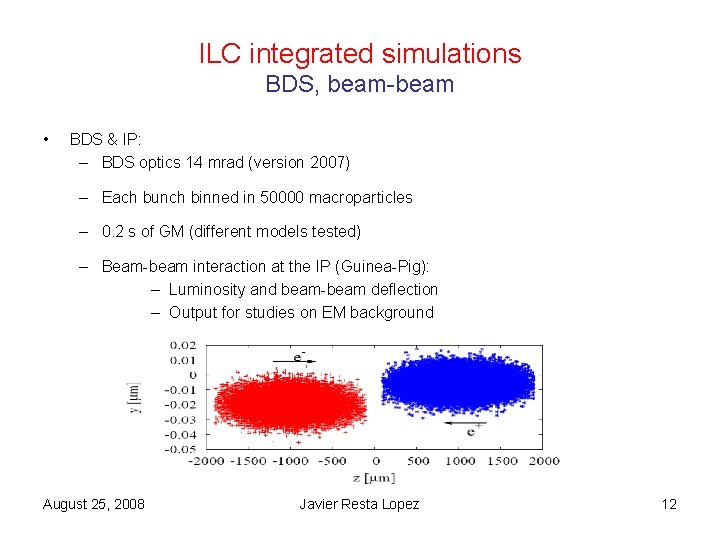
ILC integrated simulations BDS, beam-beam • BDS & IP: – BDS optics 14 mrad (version 2007) – Each bunch binned in 50000 macroparticles – 0. 2 s of GM (different models tested) – Beam-beam interaction at the IP (Guinea-Pig): – Luminosity and beam-beam deflection – Output for studies on EM background August 25, 2008 Javier Resta Lopez 12
ILC integrated simulations Fast intra-train FB system IP intra-train position FB: • Stripline kicker located at 3. 5 m upstream of the IP between the sextupole SD 0 and the final quadrupole QF 1 • BPM at π/2 phase advance downstream of IP to measure the beam positions to determine the b-b deflection angle • BPM resolution ~ 1 μm • Kicker magnetic field error (d. B/B) 0. 1 % August 25, 2008 Javier Resta Lopez 13
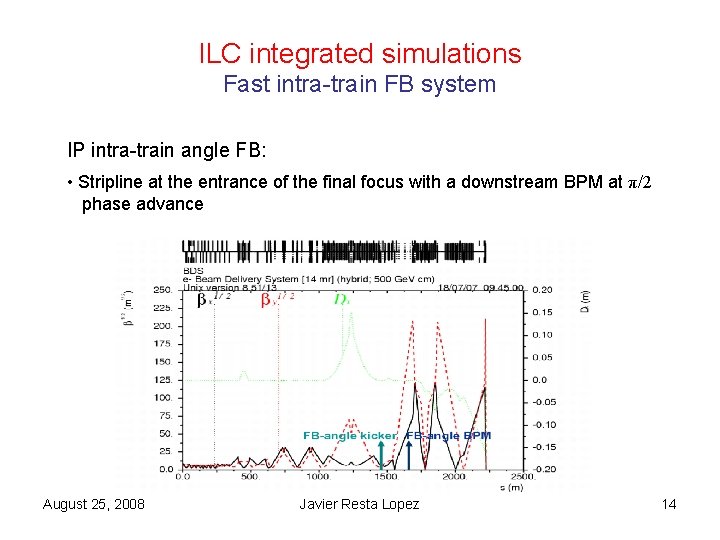
ILC integrated simulations Fast intra-train FB system IP intra-train angle FB: • Stripline at the entrance of the final focus with a downstream BPM at π/2 phase advance August 25, 2008 Javier Resta Lopez 14
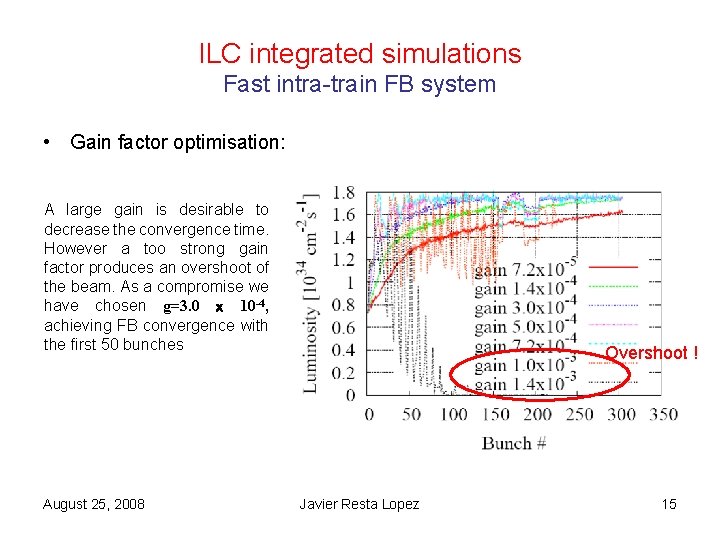
ILC integrated simulations Fast intra-train FB system • Gain factor optimisation: A large gain is desirable to decrease the convergence time. However a too strong gain factor produces an overshoot of the beam. As a compromise we have chosen g=3. 0 x 10 -4, achieving FB convergence with the first 50 bunches August 25, 2008 Overshoot ! Javier Resta Lopez 15
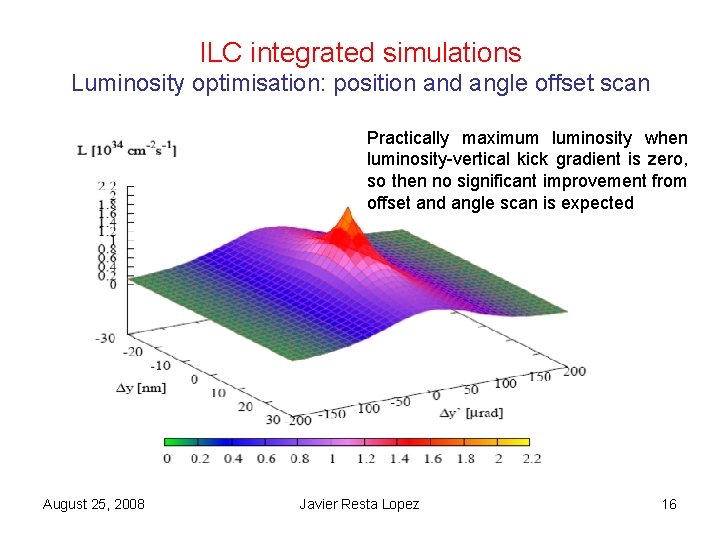
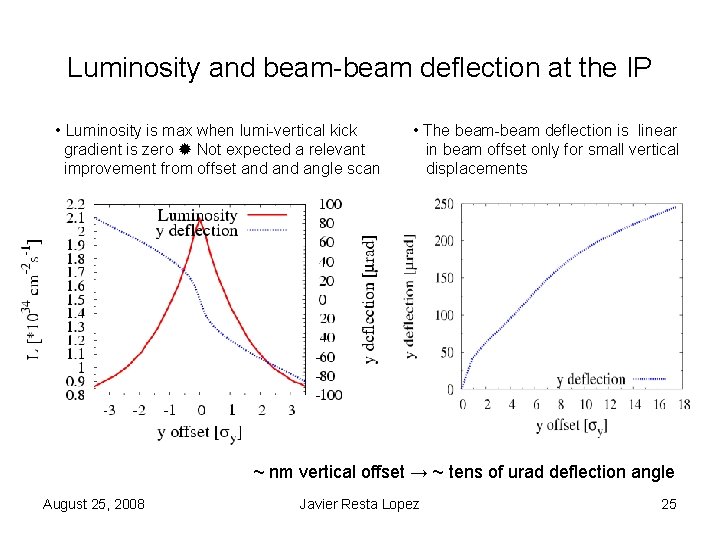
ILC integrated simulations Luminosity optimisation: position and angle offset scan Practically maximum luminosity when luminosity-vertical kick gradient is zero, so then no significant improvement from offset and angle scan is expected August 25, 2008 Javier Resta Lopez 16
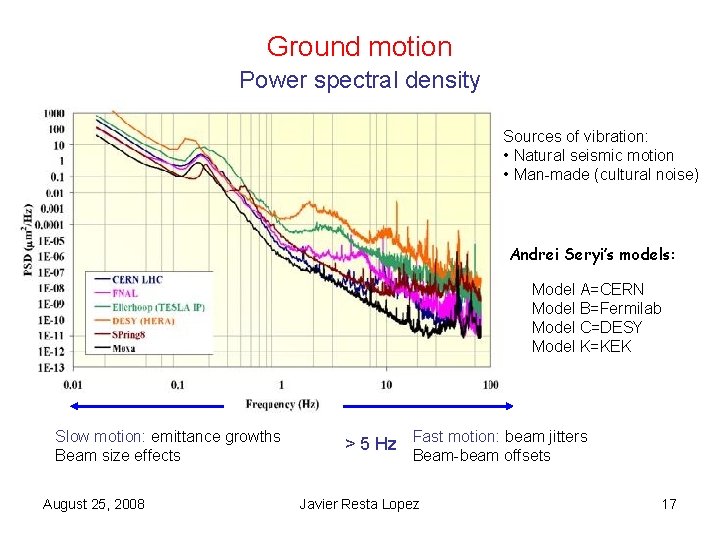
Ground motion Power spectral density Sources of vibration: • Natural seismic motion • Man-made (cultural noise) Andrei Seryi’s models: Model A=CERN Model B=Fermilab Model C=DESY Model K=KEK Slow motion: emittance growths Beam size effects August 25, 2008 > 5 Hz Fast motion: beam jitters Beam-beam offsets Javier Resta Lopez 17
ILC Luminosity results Different scenarios of ground motion Example for 1 single random seed Nominal: L=2 x 1034 cm-2 s-1 • For the noisiest site (model C), applying fast position and angle FB stabilization, a recovery of 85 % of the nominal value is obtained. • For quiet sites (model A and B) practically the 100 % of the nominal luminosity would be achievable August 25, 2008 Javier Resta Lopez 18
ILC Luminosity results Statistical fluctuation of the luminosity Example for 100 random seeds with ground motion model C Ltotal corresponds to the average over the first 300 bunches of the train, giving a mean value μ=1. 768 x 1034 cm-2 s-1 (88 % of the nominal luminosity) Lmax represents the maximum achieved luminosity with a mean value μ=1. 831 x 1034 cm-2 s-1 (92 % of the nominal luminosity) August 25, 2008 Javier Resta Lopez 19
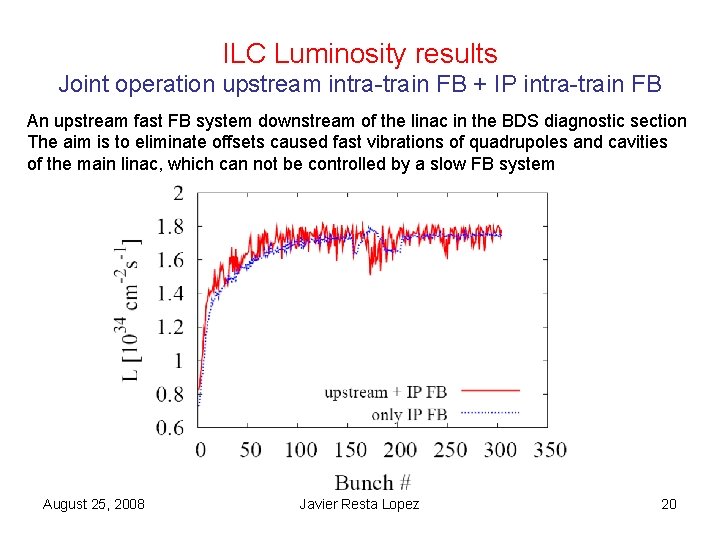
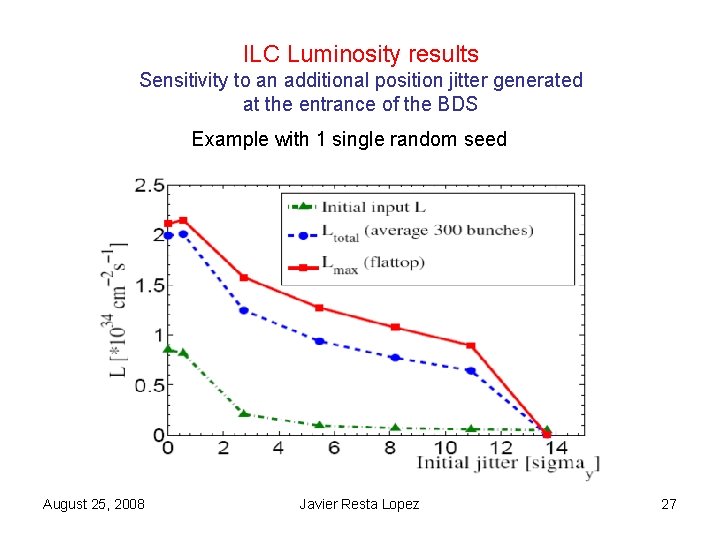
ILC Luminosity results Joint operation upstream intra-train FB + IP intra-train FB An upstream fast FB system downstream of the linac in the BDS diagnostic section The aim is to eliminate offsets caused fast vibrations of quadrupoles and cavities of the main linac, which can not be controlled by a slow FB system August 25, 2008 Javier Resta Lopez 20
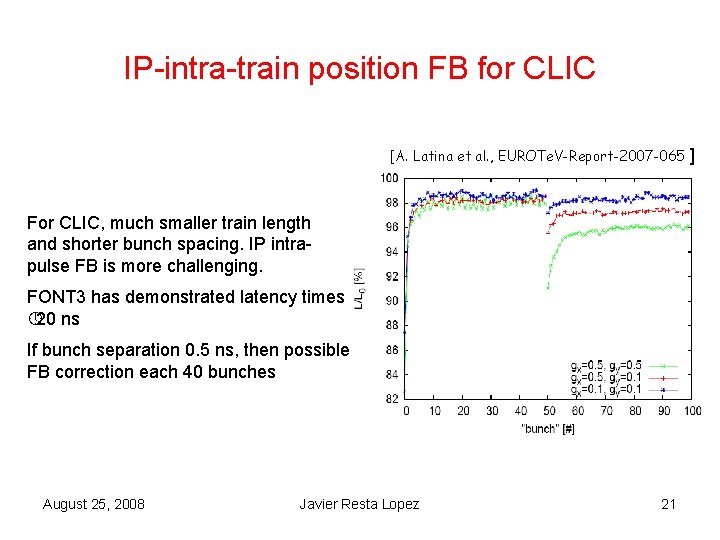
IP-intra-train position FB for CLIC [A. Latina et al. , EUROTe. V-Report-2007 -065 For CLIC, much smaller train length and shorter bunch spacing. IP intrapulse FB is more challenging. FONT 3 has demonstrated latency times » 20 ns If bunch separation 0. 5 ns, then possible FB correction each 40 bunches August 25, 2008 Javier Resta Lopez 21 ]
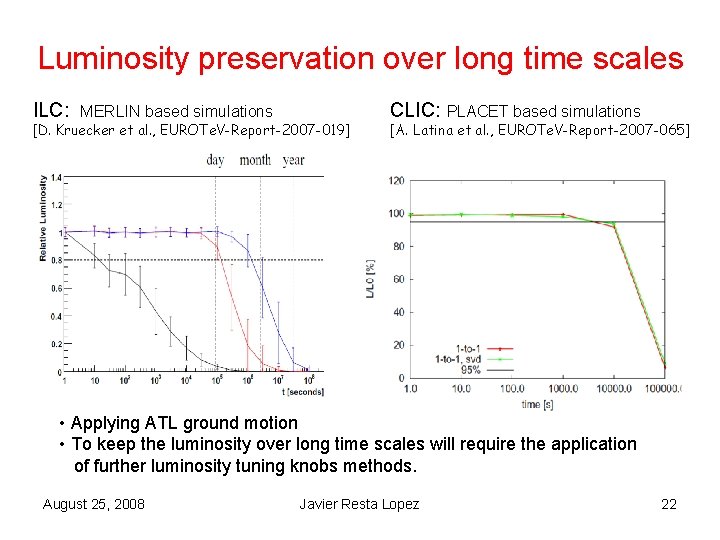
Luminosity preservation over long time scales ILC: MERLIN based simulations [D. Kruecker et al. , EUROTe. V-Report-2007 -019] CLIC: PLACET based simulations [A. Latina et al. , EUROTe. V-Report-2007 -065] • Applying ATL ground motion • To keep the luminosity over long time scales will require the application of further luminosity tuning knobs methods. August 25, 2008 Javier Resta Lopez 22
Summary and outlook • The different sources of beam jitter and contribution to the luminosity loss of the future LC should be carefully studied • The aim is to make realistic simulations including different static and dynamics errors • To achieve the required luminosity of the future LC necessary FB systems operating on different time scales • We have studied intra-train FB at IP to keep the beams in collision • Important optimisation of FB: gain factors, correctors and BPM positions • For ILC possible bunch-to-bunch correction. For CLIC more challenging (intra-train IP position correction each 40 bunches ? ) • On progress integrated simulations including effects of collimator wakefields and crab cavities • Suggestions are welcome August 25, 2008 Javier Resta Lopez 23
Extra … August 25, 2008 Javier Resta Lopez
Luminosity and beam-beam deflection at the IP • Luminosity is max when lumi-vertical kick gradient is zero Not expected a relevant improvement from offset and angle scan • The beam-beam deflection is linear in beam offset only for small vertical displacements ~ nm vertical offset → ~ tens of urad deflection angle August 25, 2008 Javier Resta Lopez 25
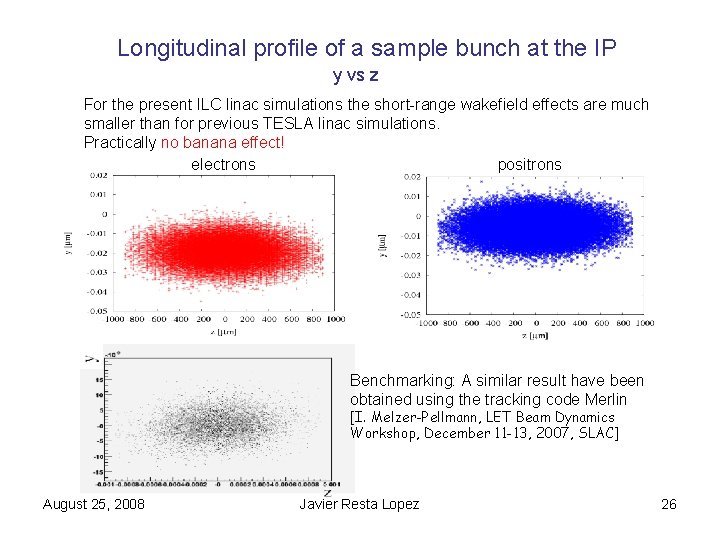
Longitudinal profile of a sample bunch at the IP y vs z For the present ILC linac simulations the short-range wakefield effects are much smaller than for previous TESLA linac simulations. Practically no banana effect! electrons positrons Benchmarking: A similar result have been obtained using the tracking code Merlin [I. Melzer-Pellmann, LET Beam Dynamics Workshop, December 11 -13, 2007, SLAC] August 25, 2008 Javier Resta Lopez 26
ILC Luminosity results Sensitivity to an additional position jitter generated at the entrance of the BDS Example with 1 single random seed August 25, 2008 Javier Resta Lopez 27