
IIT Kanpur Gas Turbine Combustion and Power Generation
IIT, Kanpur Gas Turbine Combustion and Power Generation Dr. A. Kushari Department of Aerospace Engineering PROPULSION LAB, DEPARTMENT OF AEROSPACE ENGG.
IIT, Kanpur Outline • • Introduction Advantages and Disadvantages Future Requirements Gas Turbine Combustors Ongoing Research Conclusions Acknowledgement PROPULSION LAB, DEPARTMENT OF AEROSPACE ENGG.
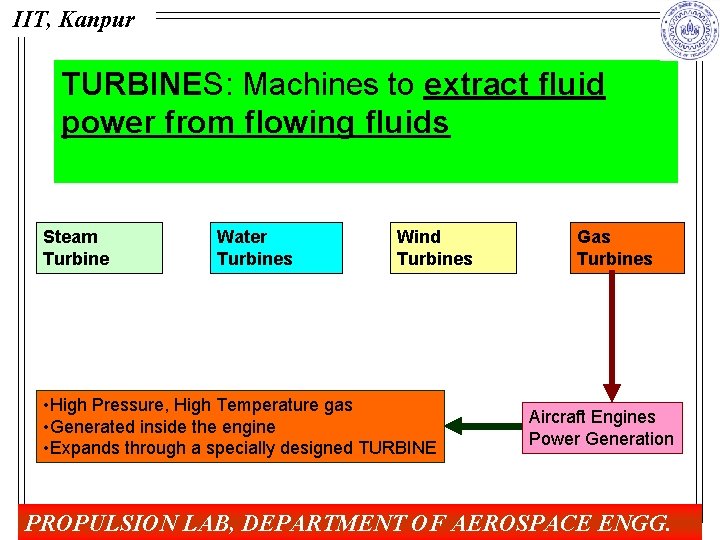
IIT, Kanpur TURBINES: Machines to extract fluid power from flowing fluids Steam Turbine Water Turbines Wind Turbines • High Pressure, High Temperature gas • Generated inside the engine • Expands through a specially designed TURBINE Gas Turbines Aircraft Engines Power Generation PROPULSION LAB, DEPARTMENT OF AEROSPACE ENGG.
IIT, Kanpur GAS TURBINES • Invented in 1930 by Frank Whittle • Patented in 1934 • First used for aircraft propulsion in 1942 on Me 262 by Germans during second world war • Currently most of the aircrafts and ships use GT engines • Used for power generation • Manufacturers: General Electric, Pratt &Whitney, SNECMA, Rolls Royce, Honeywell, Siemens – Westinghouse, Alstom • Indian take: Kaveri Engine by GTRE (DRDO) PROPULSION LAB, DEPARTMENT OF AEROSPACE ENGG.
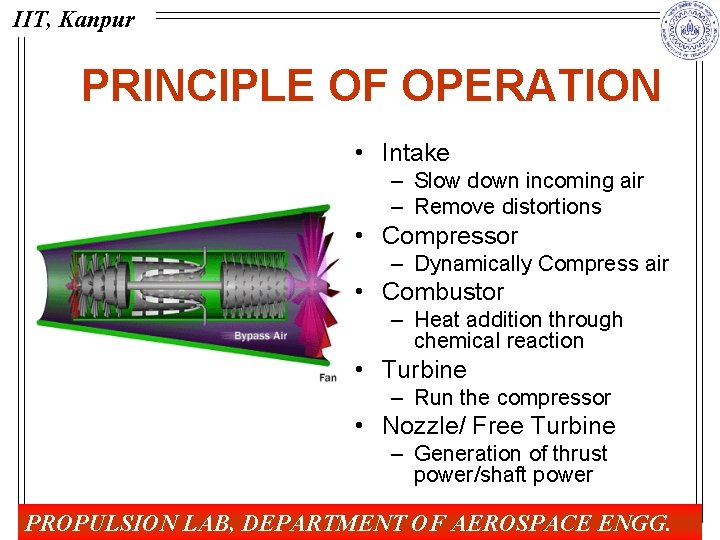
IIT, Kanpur PRINCIPLE OF OPERATION • Intake – Slow down incoming air – Remove distortions • Compressor – Dynamically Compress air • Combustor – Heat addition through chemical reaction • Turbine – Run the compressor • Nozzle/ Free Turbine – Generation of thrust power/shaft power PROPULSION LAB, DEPARTMENT OF AEROSPACE ENGG.
IIT, Kanpur Advantages and Disadvantages • Great power-toweight ratio compared to reciprocating engines. • Smaller than their reciprocating counterparts of the same power. • Lower emission levels • Expensive: – high speeds and high operating temperatures – designing and manufacturing gas turbines is a tough problem from both the engineering and materials standpoint • Tend to use more fuel when they are idling • They prefer a constant rather than a fluctuating load. That makes gas turbines great for things like transcontinental jet aircraft and power plants, but explains why we don't have one under the hood of our car. PROPULSION LAB, DEPARTMENT OF AEROSPACE ENGG.
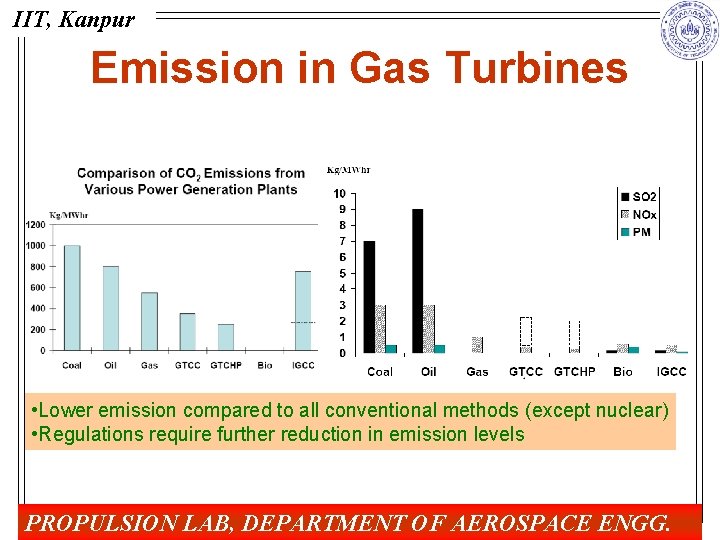
IIT, Kanpur Emission in Gas Turbines • Lower emission compared to all conventional methods (except nuclear) • Regulations require further reduction in emission levels PROPULSION LAB, DEPARTMENT OF AEROSPACE ENGG.
IIT, Kanpur Needs for Future Gas Turbines • Power Generation – Fuel Economy – Low Emissions – Alternative fuels • Military Aircrafts – High Thrust – Low Weight Half the size and twice thrust • Commercial Aircrafts – – Low emissions High Thrust Low Weight Fuel Economy Double the size of the Aircraft and double the distance traveled with 50% NOx PROPULSION LAB, DEPARTMENT OF AEROSPACE ENGG.
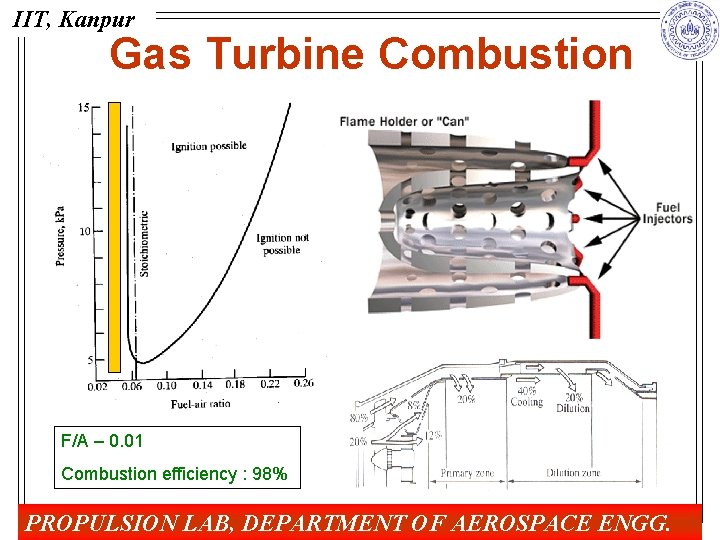
IIT, Kanpur Gas Turbine Combustion F/A – 0. 01 Combustion efficiency : 98% PROPULSION LAB, DEPARTMENT OF AEROSPACE ENGG.
IIT, Kanpur Ongoing Research • Effect of inlet disturbances • Combustion in recirculating flows • Spray Combustion PROPULSION LAB, DEPARTMENT OF AEROSPACE ENGG.
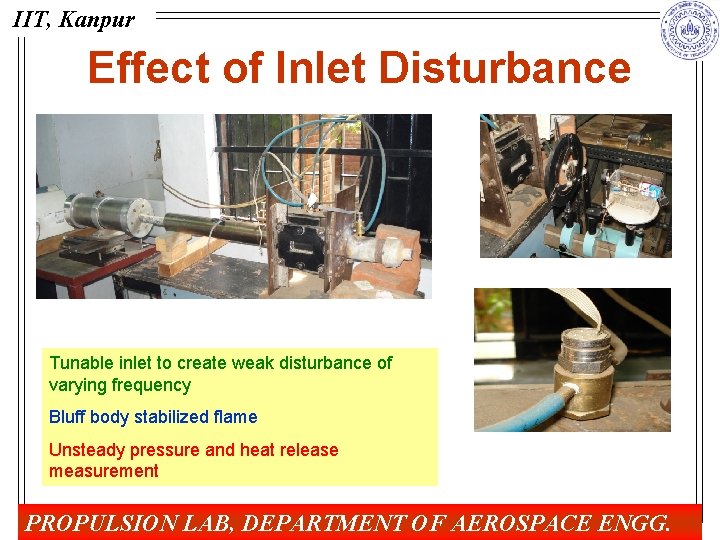
IIT, Kanpur Effect of Inlet Disturbance Tunable inlet to create weak disturbance of varying frequency Bluff body stabilized flame Unsteady pressure and heat release measurement PROPULSION LAB, DEPARTMENT OF AEROSPACE ENGG.
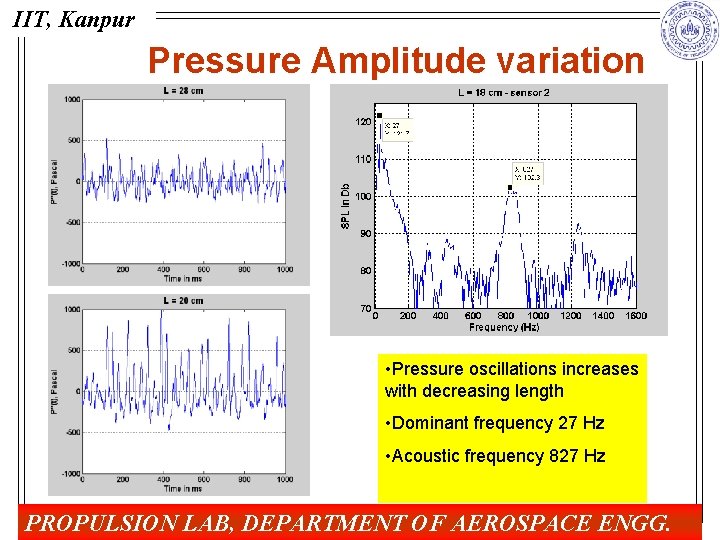
IIT, Kanpur Pressure Amplitude variation = 0. 2211 L = 20 cm • Pressure oscillations increases with decreasing length • Dominant frequency 27 Hz • Acoustic frequency 827 Hz PROPULSION LAB, DEPARTMENT OF AEROSPACE ENGG.
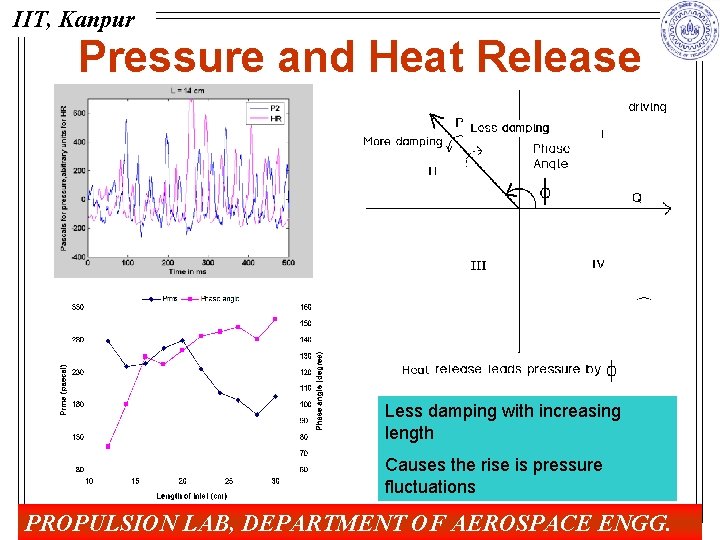
IIT, Kanpur Pressure and Heat Release Less damping with increasing length Causes the rise is pressure fluctuations PROPULSION LAB, DEPARTMENT OF AEROSPACE ENGG.
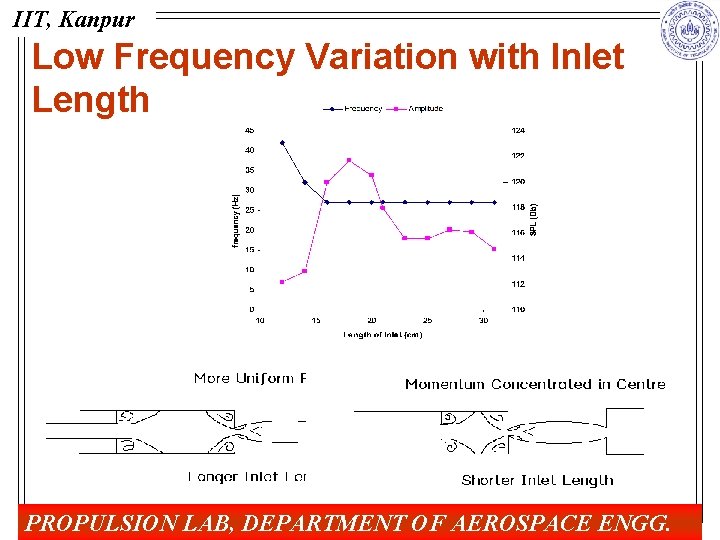
IIT, Kanpur Low Frequency Variation with Inlet Length , = 0. 3455 PROPULSION LAB, DEPARTMENT OF AEROSPACE ENGG.
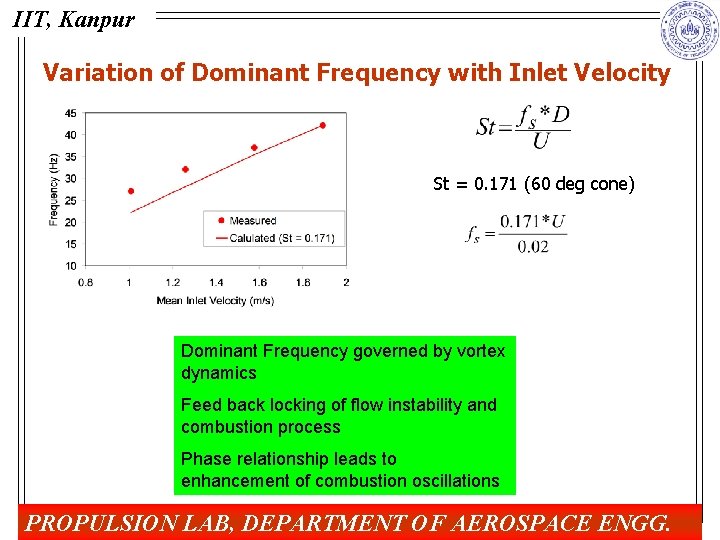
IIT, Kanpur Variation of Dominant Frequency with Inlet Velocity St = 0. 171 (60 deg cone) Dominant Frequency governed by vortex dynamics Feed back locking of flow instability and combustion process Phase relationship leads to enhancement of combustion oscillations PROPULSION LAB, DEPARTMENT OF AEROSPACE ENGG.
IIT, Kanpur Ongoing Research • Effect of inlet disturbances • Combustion in recirculating flows • Spray Combustion PROPULSION LAB, DEPARTMENT OF AEROSPACE ENGG.
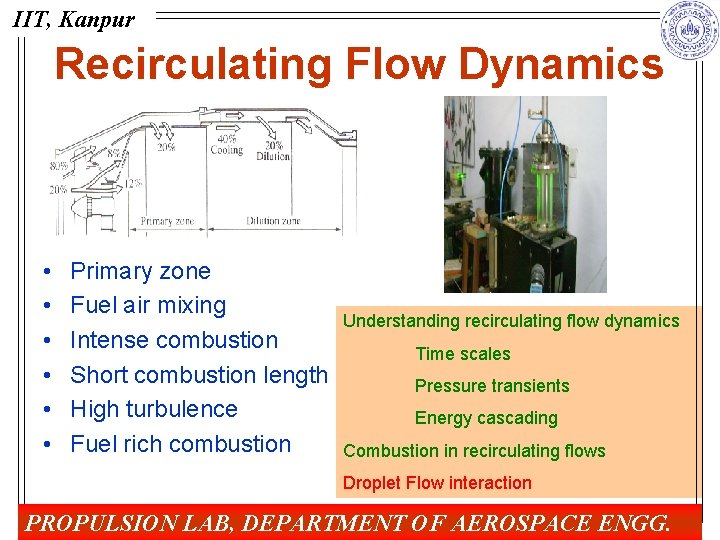
IIT, Kanpur Recirculating Flow Dynamics • • • Primary zone Fuel air mixing Intense combustion Short combustion length High turbulence Fuel rich combustion Understanding recirculating flow dynamics Time scales Pressure transients Energy cascading Combustion in recirculating flows Droplet Flow interaction PROPULSION LAB, DEPARTMENT OF AEROSPACE ENGG.
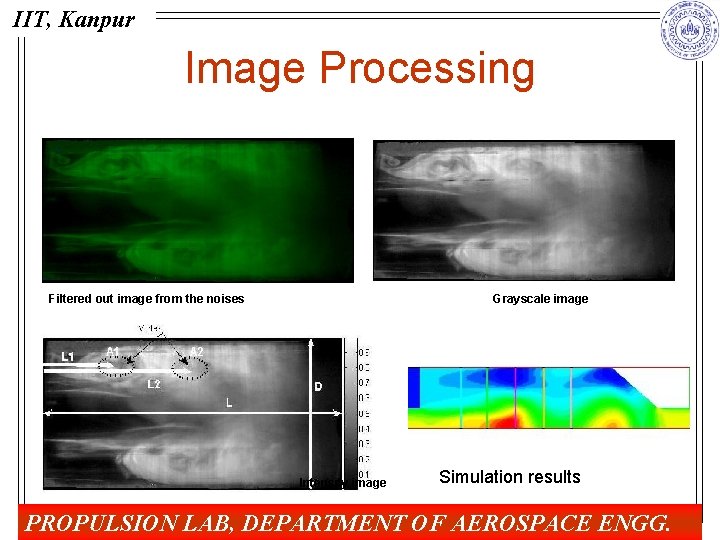
IIT, Kanpur Image Processing Filtered out image from the noises Grayscale image Intensity image Simulation results PROPULSION LAB, DEPARTMENT OF AEROSPACE ENGG.
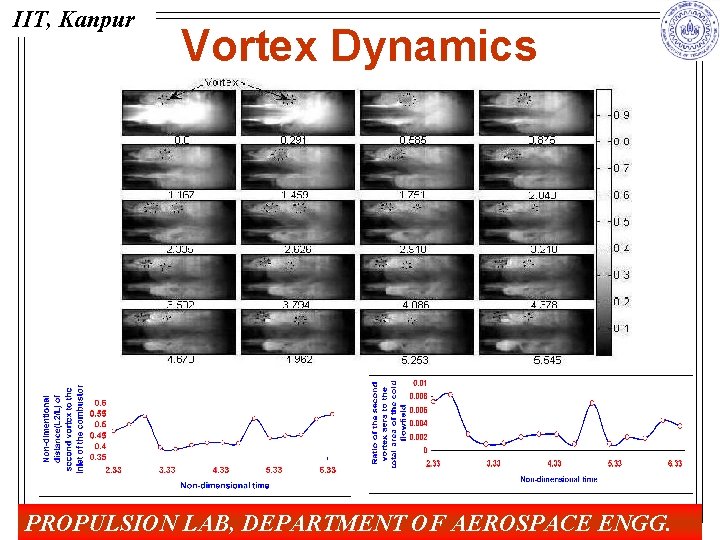
IIT, Kanpur Vortex Dynamics PROPULSION LAB, DEPARTMENT OF AEROSPACE ENGG.
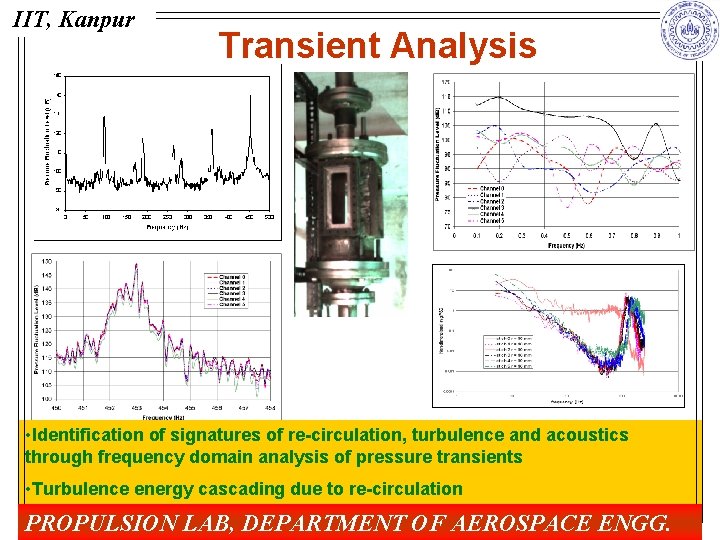
IIT, Kanpur Transient Analysis • Identification of signatures of re-circulation, turbulence and acoustics through frequency domain analysis of pressure transients • Turbulence energy cascading due to re-circulation PROPULSION LAB, DEPARTMENT OF AEROSPACE ENGG.
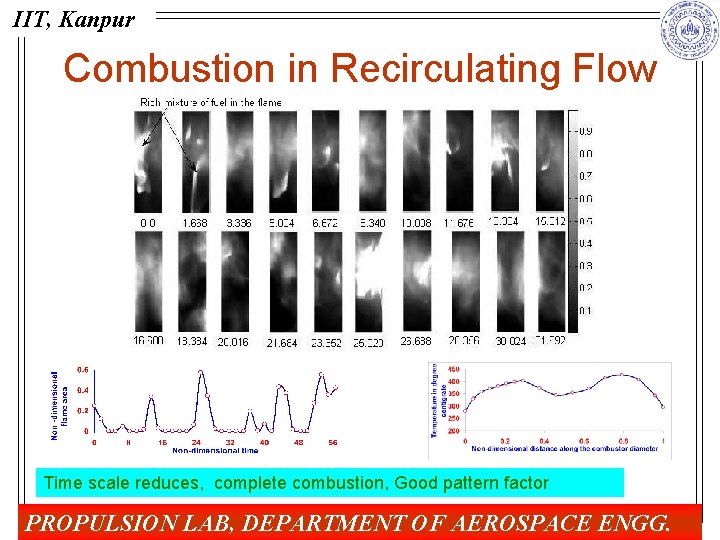
IIT, Kanpur Combustion in Recirculating Flow Time scale reduces, complete combustion, Good pattern factor PROPULSION LAB, DEPARTMENT OF AEROSPACE ENGG.
IIT, Kanpur Ongoing Research • Effect of inlet disturbances • Combustion in recirculating flows • Spray Combustion – Needs and Challenges – Controlled atomization – Emissions in spray combustion PROPULSION LAB, DEPARTMENT OF AEROSPACE ENGG.
IIT, Kanpur Spray Combustion: Issues • Non-symmetrical spray flames and hot streaks – Serious damage to combustor liner – Combustor exit temperature (pattern factor) • Flame location, shape and pattern • Emission Levels PROPULSION LAB, DEPARTMENT OF AEROSPACE ENGG.
IIT, Kanpur Need for controlled atomization – Big Drops => Longer Evaporation Time => Incomplete Combustion => Unburned Hydrocarbons & Soot, Reduced Efficiency – Small Drops => Faster Evaporation and Mixing => Elongated Combustion Zone => More NOx – Uniform size distribution for favorable pattern factor • Reduced thermal loading on liner and turbine – Reduced feedline coupling PROPULSION LAB, DEPARTMENT OF AEROSPACE ENGG.
IIT, Kanpur Ongoing Research • Effect of inlet disturbances • Combustion in recirculating flows • Spray Combustion – Needs and Challenges – Controlled atomization – Emissions in spray combustion PROPULSION LAB, DEPARTMENT OF AEROSPACE ENGG.
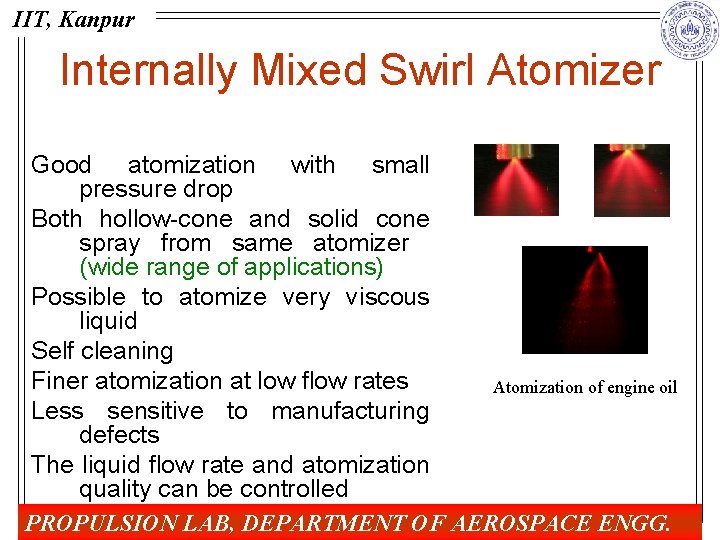
IIT, Kanpur Internally Mixed Swirl Atomizer Good atomization with small pressure drop Both hollow-cone and solid cone spray from same atomizer (wide range of applications) Possible to atomize very viscous liquid Self cleaning Finer atomization at low flow rates Atomization of engine oil Less sensitive to manufacturing defects The liquid flow rate and atomization quality can be controlled PROPULSION LAB, DEPARTMENT OF AEROSPACE ENGG.
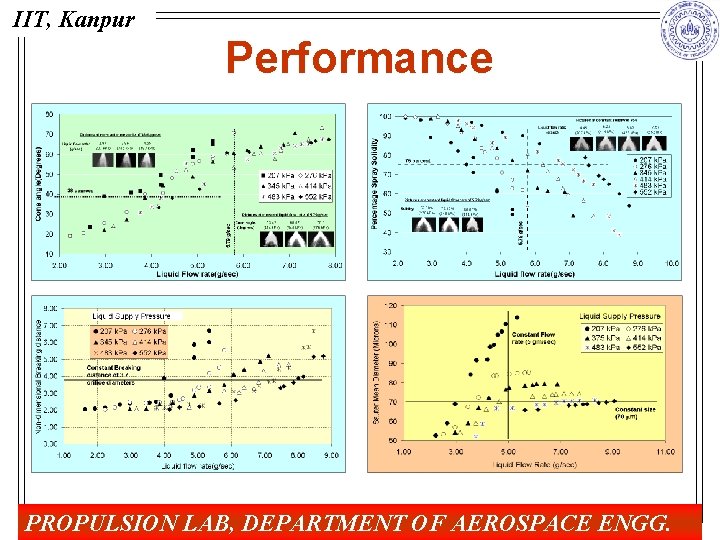
IIT, Kanpur Performance PROPULSION LAB, DEPARTMENT OF AEROSPACE ENGG.
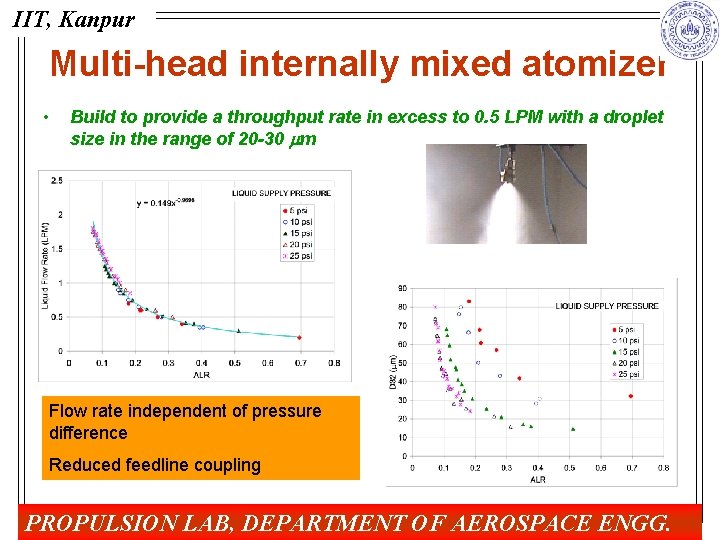
IIT, Kanpur Multi-head internally mixed atomizer • Build to provide a throughput rate in excess to 0. 5 LPM with a droplet size in the range of 20 -30 mm Flow rate independent of pressure difference Reduced feedline coupling PROPULSION LAB, DEPARTMENT OF AEROSPACE ENGG.
IIT, Kanpur Ongoing Research • Effect of inlet disturbances • Combustion in recirculating flows • Spray Combustion – Needs and Challenges – Controlled atomization – Emissions in spray combustion PROPULSION LAB, DEPARTMENT OF AEROSPACE ENGG.
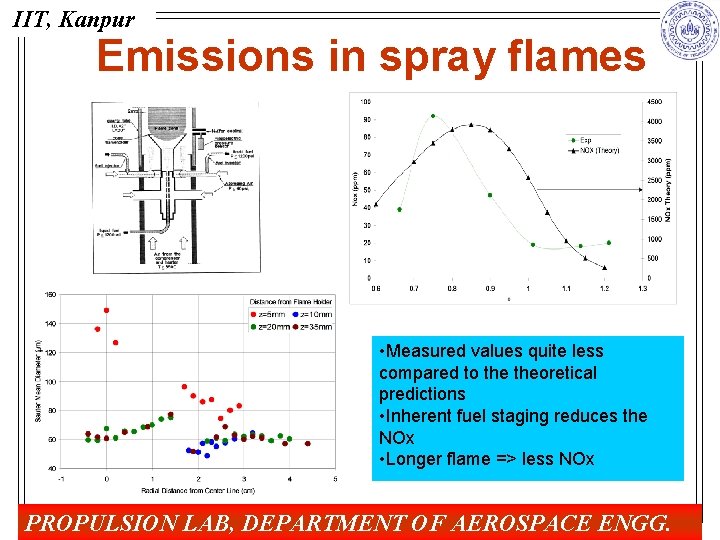
IIT, Kanpur Emissions in spray flames • Measured values quite less compared to theoretical predictions • Inherent fuel staging reduces the NOx • Longer flame => less NOx PROPULSION LAB, DEPARTMENT OF AEROSPACE ENGG.
IIT, Kanpur Conclusions • Disturbances can lead to combustion oscillations • Recirculating flow helps in reducing disturbances • Controlled Atomization can be achieved through air-assisting • Spray combustion reduces NOx emissions through fuel staging PROPULSION LAB, DEPARTMENT OF AEROSPACE ENGG.
IIT, Kanpur Acknowledgements • • • M. S. Rawat S. K. Gupta S. Pandey P. Berman J. Karnawat S. Karmakar N. P. Yadav S. Nigam R. Sailaja M. Madanmohan • Dr. K. Ramamurthi • LPSC (ISRO) • CFEES (DRDO) PROPULSION LAB, DEPARTMENT OF AEROSPACE ENGG.
IIT, Kanpur THANK YOU PROPULSION LAB, DEPARTMENT OF AEROSPACE ENGG.
- Slides: 33