
IIT Bombay DESE Solar Geometry Lecture 6 02082011
IIT Bombay DESE Solar Geometry Lecture #6 02/08/2011 EN 601: Lecture 6: Solar Geometry Slide 1
IIT Bombay Learning Objective and Outcome sheet Topic DESE Solar geometry Learning Objectives Losses of solar radiation in the atmosphere Sun position and movement of the earth around the sun Standard time and local time Angles associated with the solar geometry and plane Learning Outcome Extinction coefficient of earth surface and air mass. Equation of time Sun path in cylindrical coordinate and polar coordinate Analysis of shading Problem/Assignment Learning Resources Summary 02/08/2011 This lecture enables learner to understand the relative motion of the sun around the earth to determine the incident radiation on any plane. EN 601: Lecture 6: Solar Geometry Slide 2
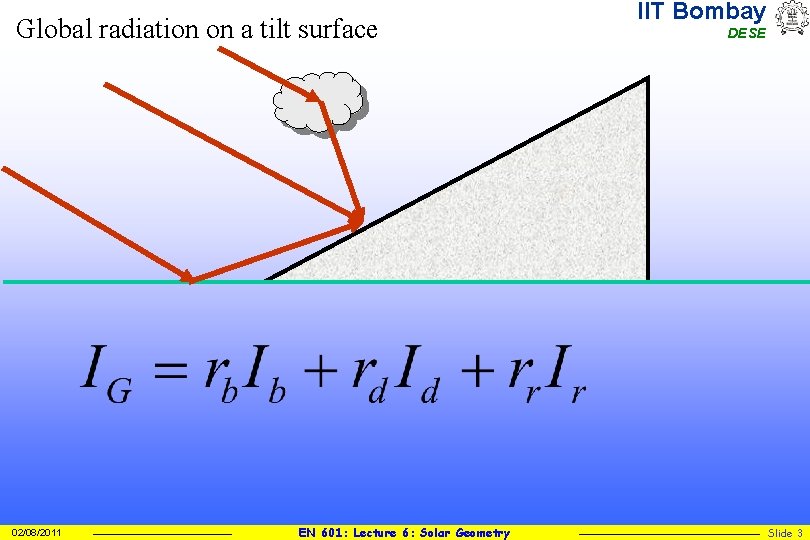
Global radiation on a tilt surface 02/08/2011 EN 601: Lecture 6: Solar Geometry IIT Bombay DESE Slide 3
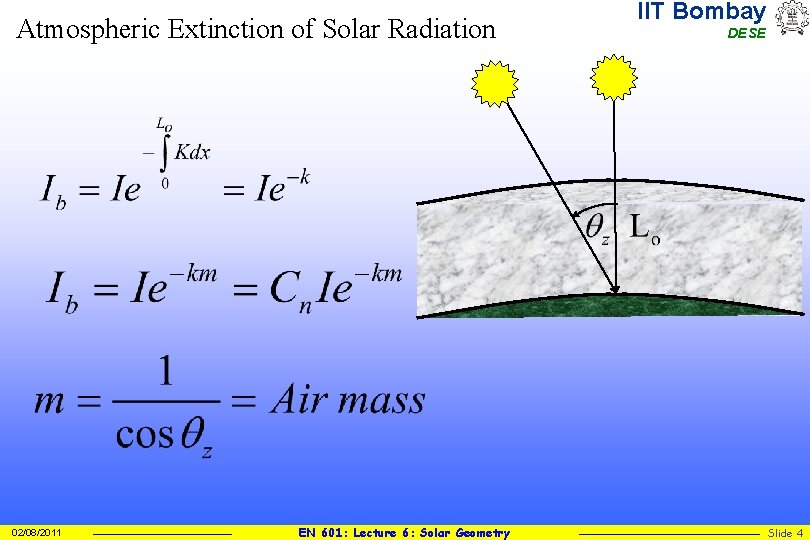
Atmospheric Extinction of Solar Radiation 02/08/2011 EN 601: Lecture 6: Solar Geometry IIT Bombay DESE Slide 4
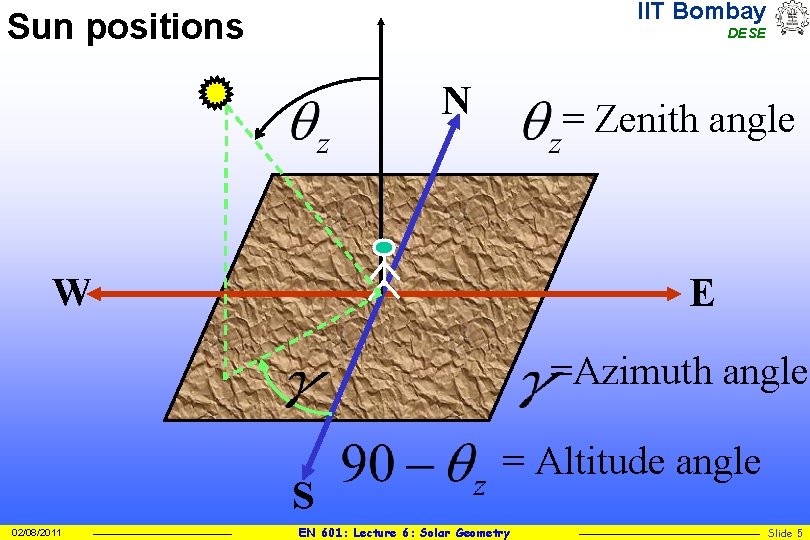
IIT Bombay Sun positions DESE N = Zenith angle W E =Azimuth angle S 02/08/2011 = Altitude angle EN 601: Lecture 6: Solar Geometry Slide 5
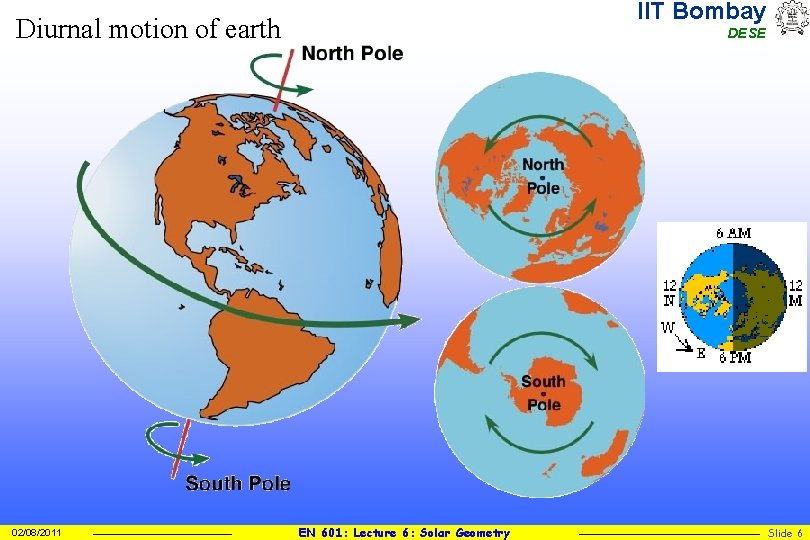
IIT Bombay Diurnal motion of earth 02/08/2011 DESE EN 601: Lecture 6: Solar Geometry Slide 6
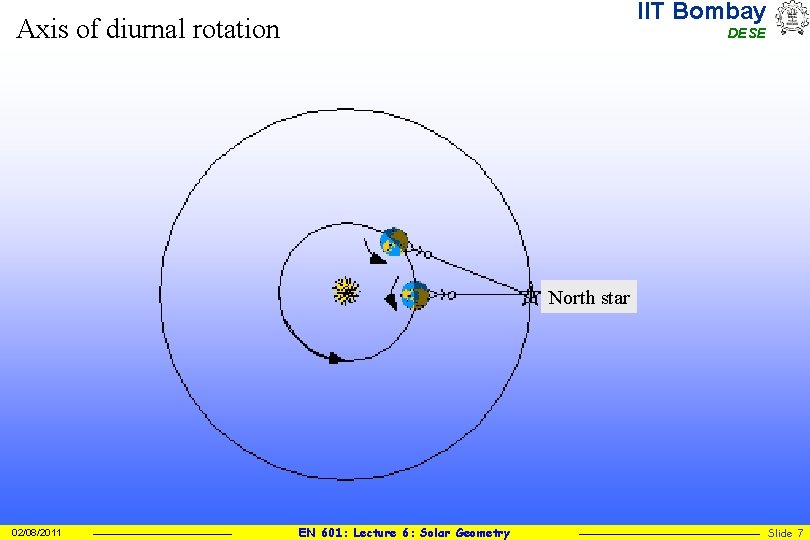
IIT Bombay Axis of diurnal rotation DESE North star 02/08/2011 EN 601: Lecture 6: Solar Geometry Slide 7
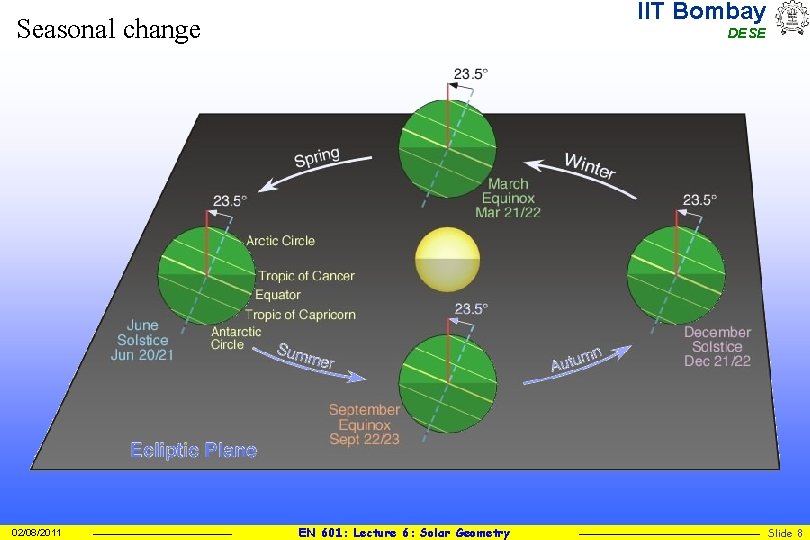
IIT Bombay Seasonal change 02/08/2011 DESE EN 601: Lecture 6: Solar Geometry Slide 8
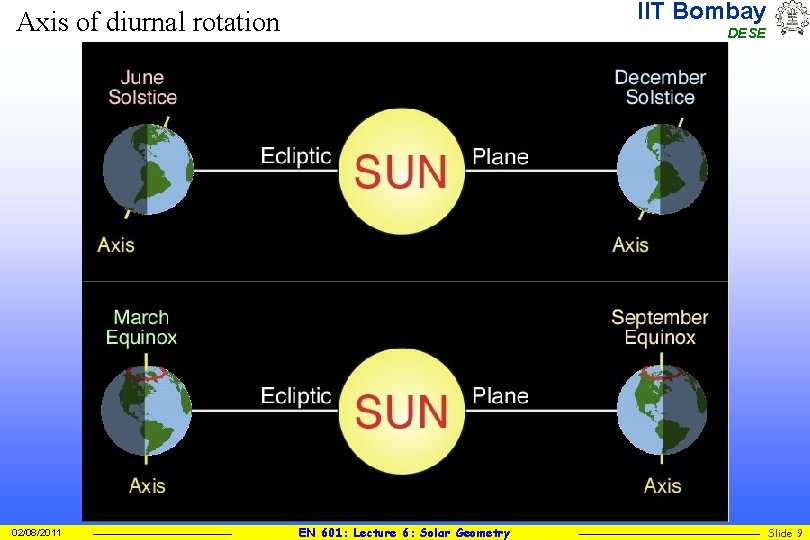
IIT Bombay Axis of diurnal rotation 02/08/2011 DESE EN 601: Lecture 6: Solar Geometry Slide 9
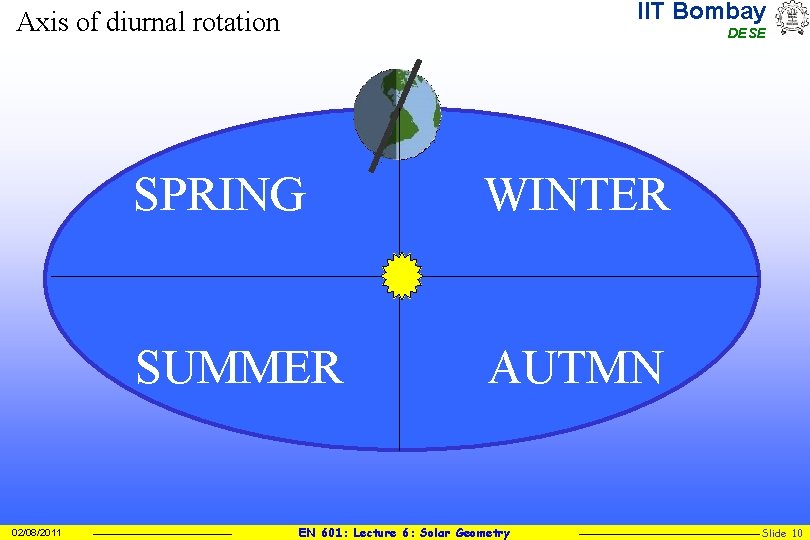
IIT Bombay Axis of diurnal rotation 02/08/2011 DESE SPRING WINTER SUMMER AUTMN EN 601: Lecture 6: Solar Geometry Slide 10
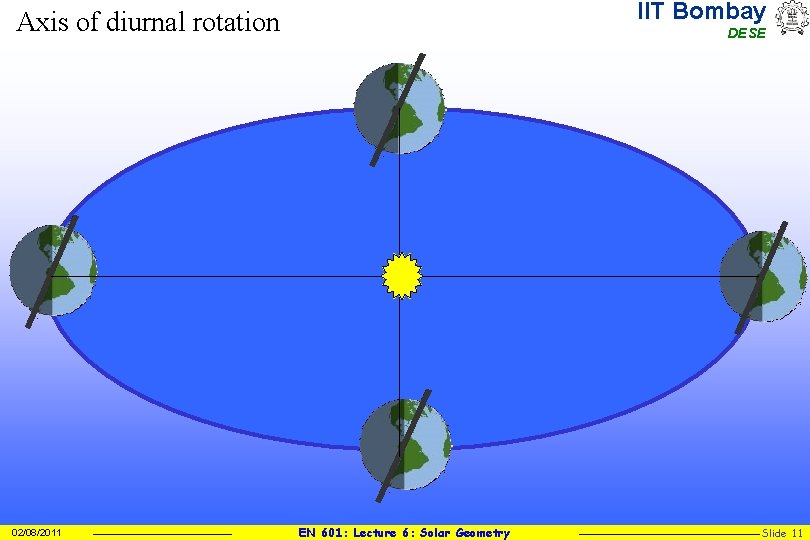
IIT Bombay Axis of diurnal rotation 02/08/2011 DESE EN 601: Lecture 6: Solar Geometry Slide 11
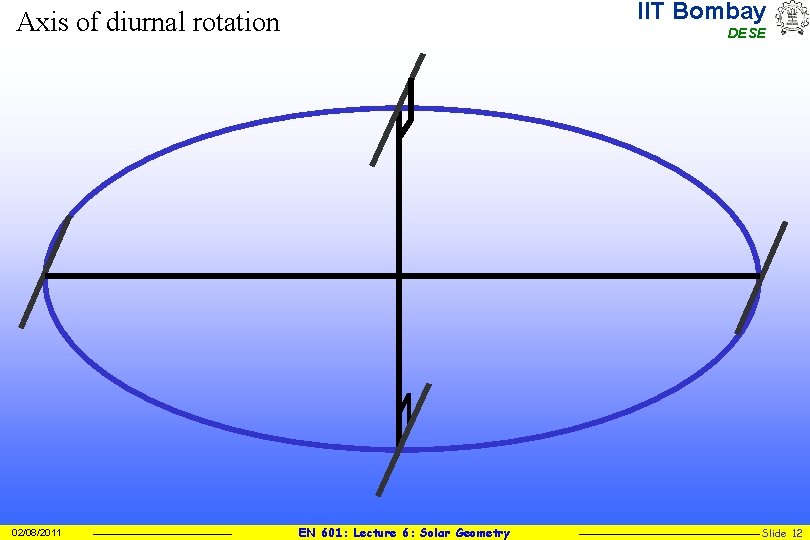
IIT Bombay Axis of diurnal rotation 02/08/2011 DESE EN 601: Lecture 6: Solar Geometry Slide 12
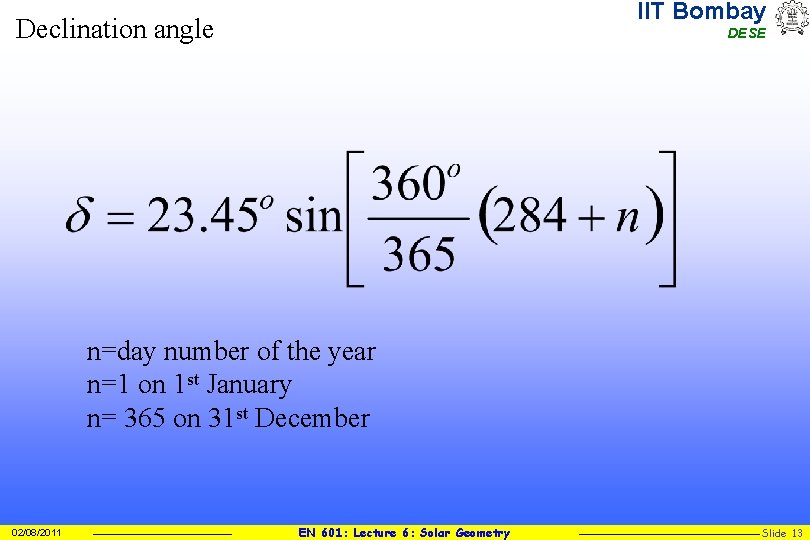
IIT Bombay Declination angle DESE n=day number of the year n=1 on 1 st January n= 365 on 31 st December 02/08/2011 EN 601: Lecture 6: Solar Geometry Slide 13
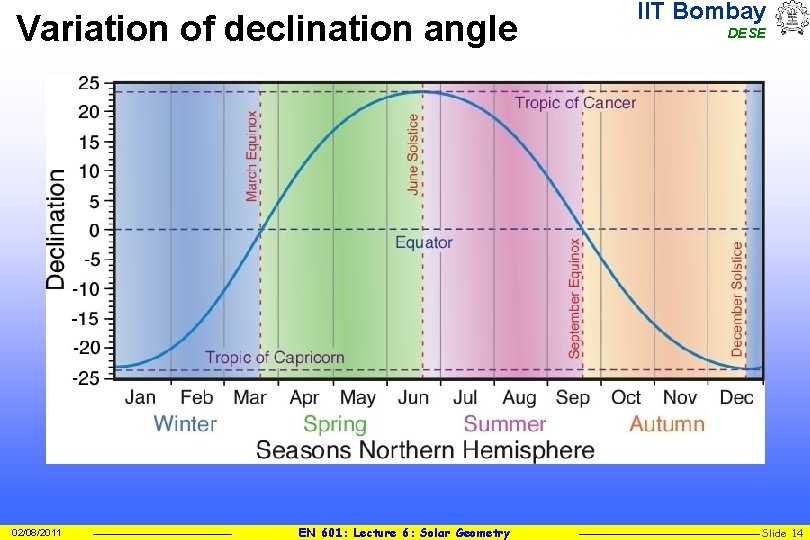
Variation of declination angle 02/08/2011 EN 601: Lecture 6: Solar Geometry IIT Bombay DESE Slide 14
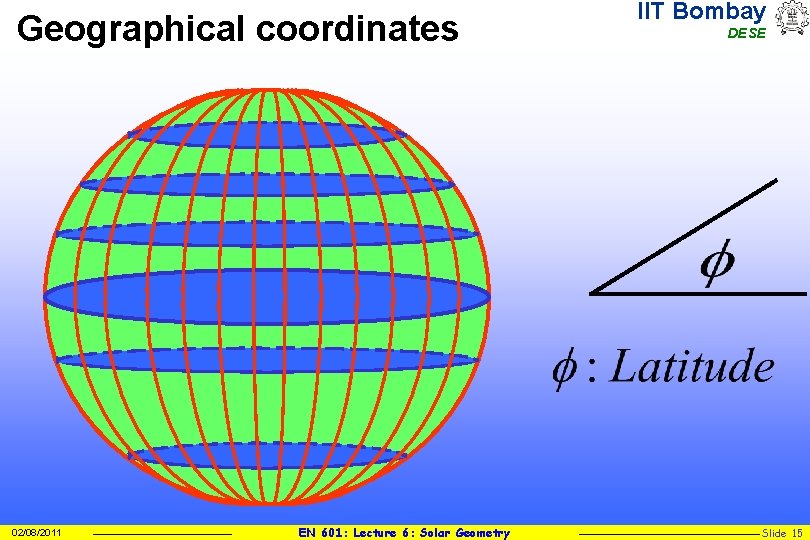
Geographical coordinates 02/08/2011 EN 601: Lecture 6: Solar Geometry IIT Bombay DESE Slide 15
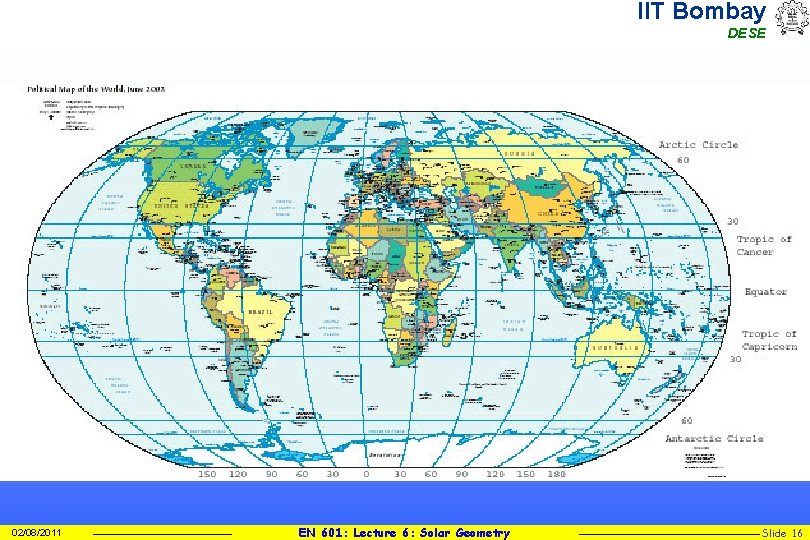
IIT Bombay DESE 02/08/2011 EN 601: Lecture 6: Solar Geometry Slide 16
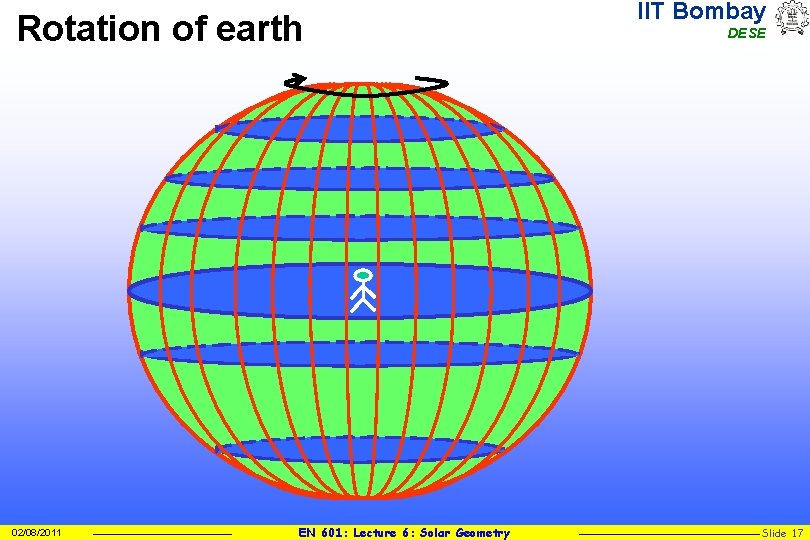
Rotation of earth 02/08/2011 EN 601: Lecture 6: Solar Geometry IIT Bombay DESE Slide 17
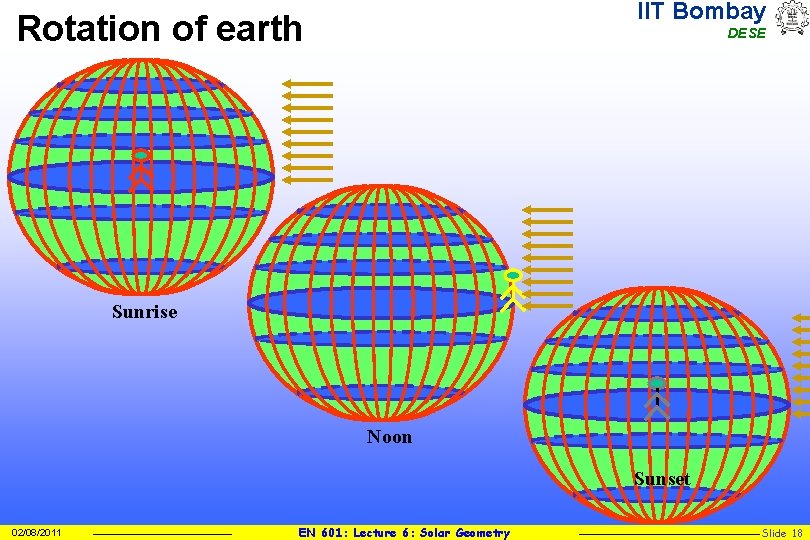
IIT Bombay Rotation of earth DESE Sunrise Noon Sunset 02/08/2011 EN 601: Lecture 6: Solar Geometry Slide 18
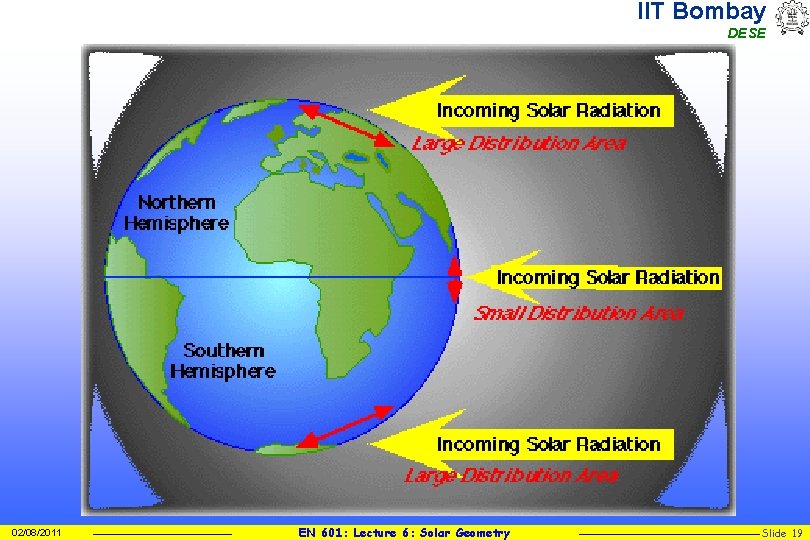
IIT Bombay DESE 02/08/2011 EN 601: Lecture 6: Solar Geometry Slide 19
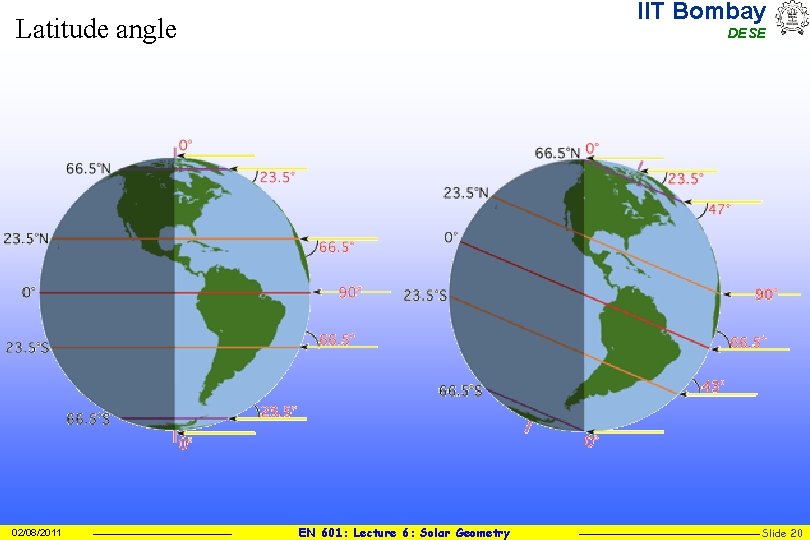
IIT Bombay Latitude angle 02/08/2011 DESE EN 601: Lecture 6: Solar Geometry Slide 20
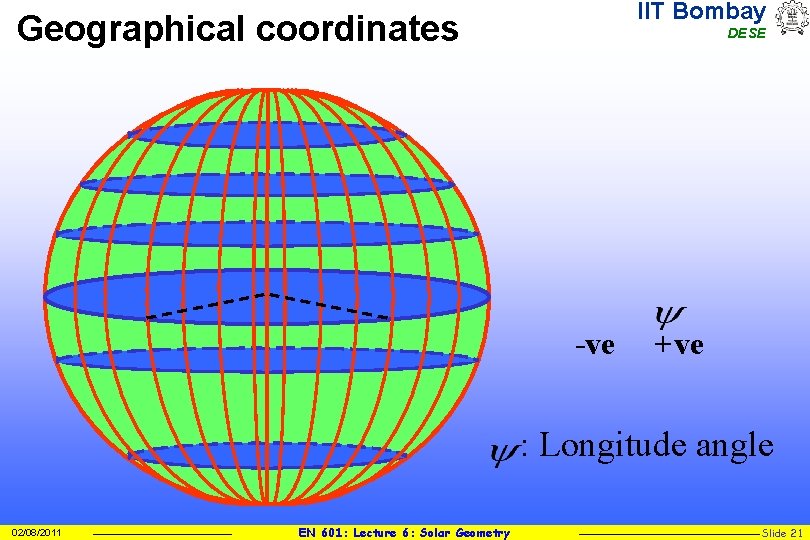
IIT Bombay Geographical coordinates DESE -ve +ve : Longitude angle 02/08/2011 EN 601: Lecture 6: Solar Geometry Slide 21
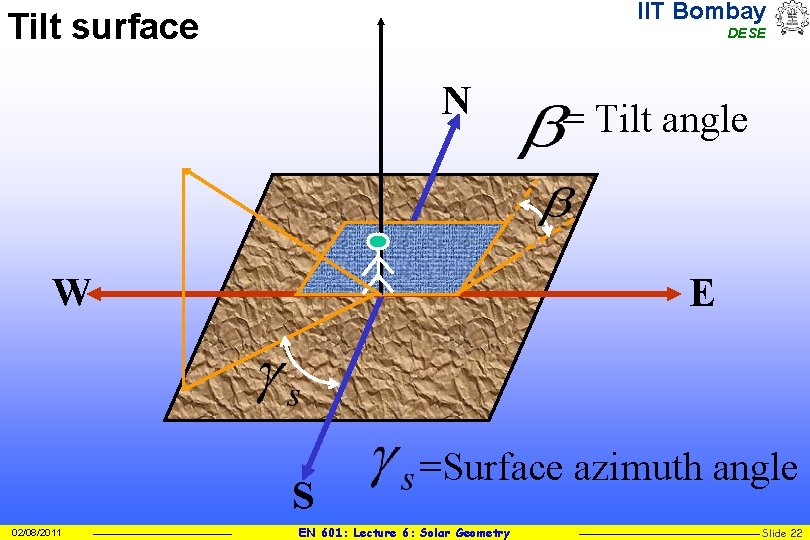
IIT Bombay Tilt surface DESE N W E S 02/08/2011 = Tilt angle =Surface azimuth angle EN 601: Lecture 6: Solar Geometry Slide 22
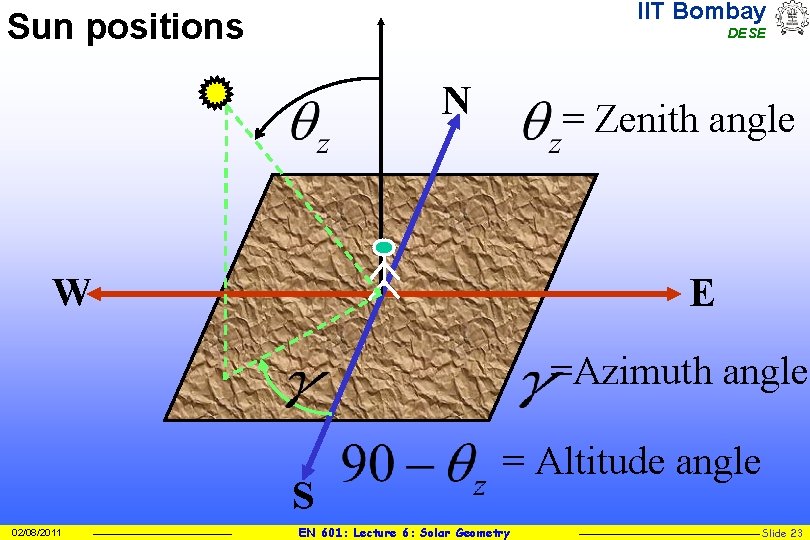
IIT Bombay Sun positions DESE N = Zenith angle W E =Azimuth angle S 02/08/2011 = Altitude angle EN 601: Lecture 6: Solar Geometry Slide 23
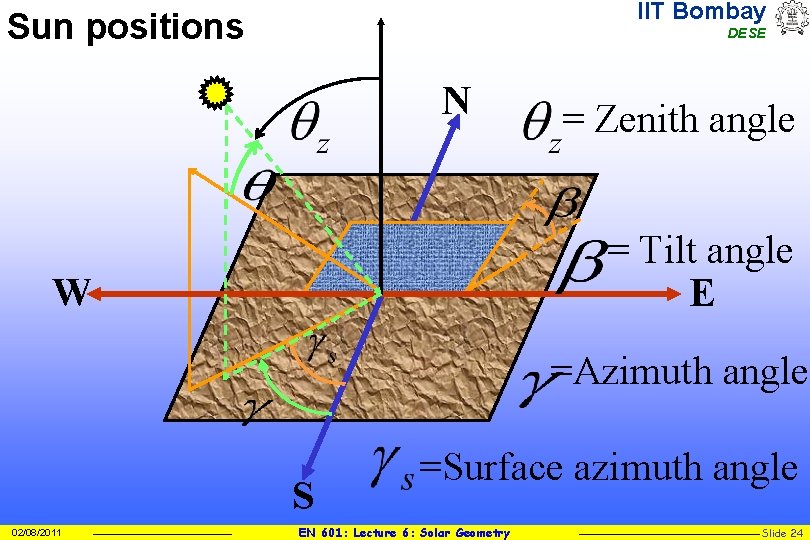
IIT Bombay Sun positions DESE N = Zenith angle = Tilt angle E W =Azimuth angle S 02/08/2011 =Surface azimuth angle EN 601: Lecture 6: Solar Geometry Slide 24
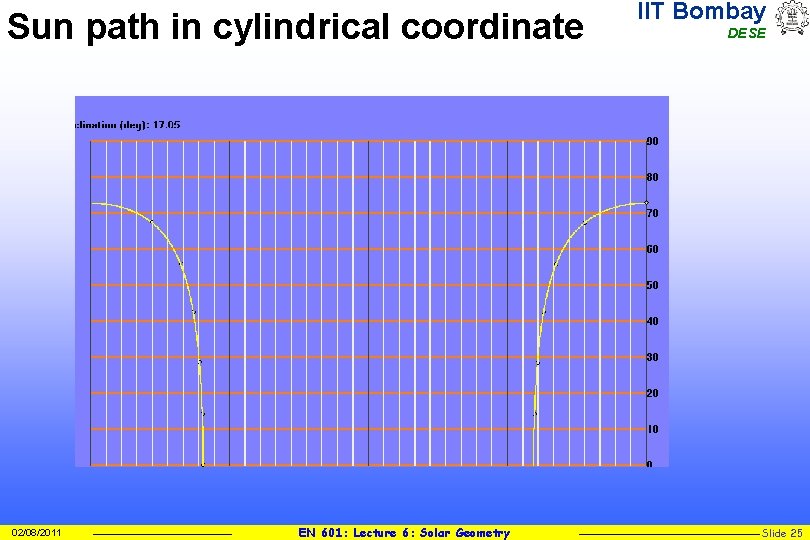
Sun path in cylindrical coordinate 02/08/2011 EN 601: Lecture 6: Solar Geometry IIT Bombay DESE Slide 25
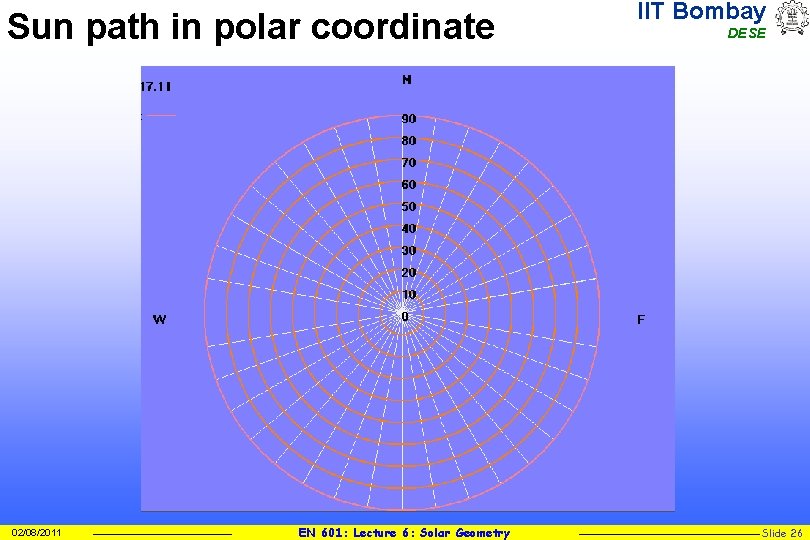
Sun path in polar coordinate 02/08/2011 EN 601: Lecture 6: Solar Geometry IIT Bombay DESE Slide 26
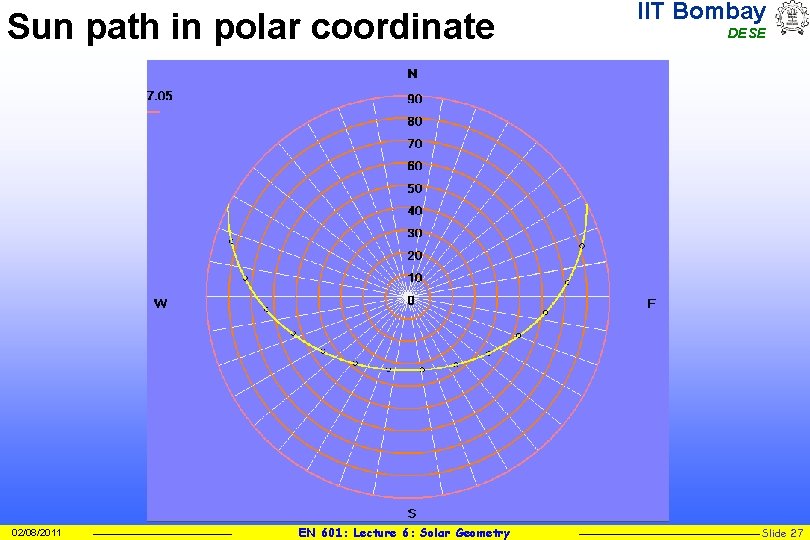
Sun path in polar coordinate 02/08/2011 EN 601: Lecture 6: Solar Geometry IIT Bombay DESE Slide 27
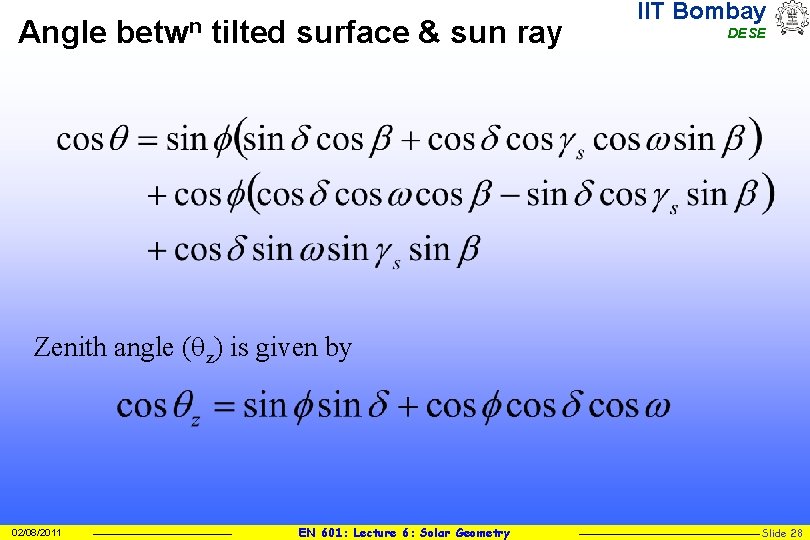
Angle betwn tilted surface & sun ray IIT Bombay DESE Zenith angle (qz) is given by 02/08/2011 EN 601: Lecture 6: Solar Geometry Slide 28
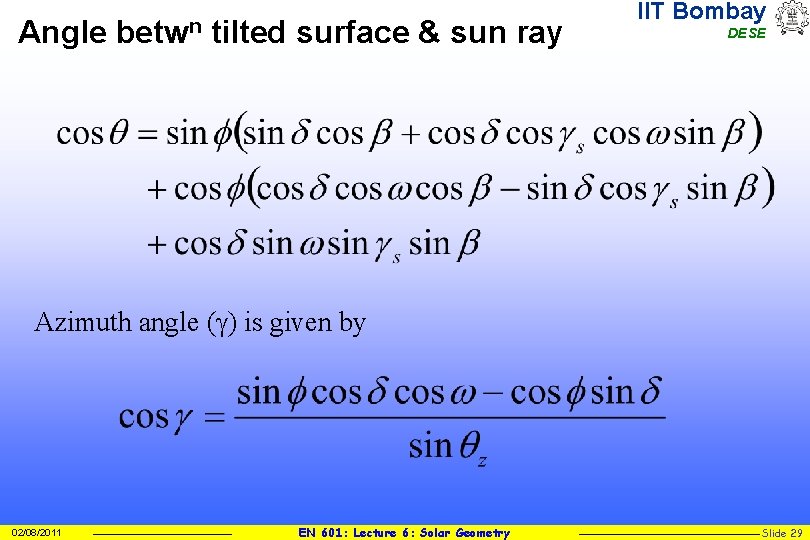
Angle betwn tilted surface & sun ray IIT Bombay DESE Azimuth angle (g) is given by 02/08/2011 EN 601: Lecture 6: Solar Geometry Slide 29
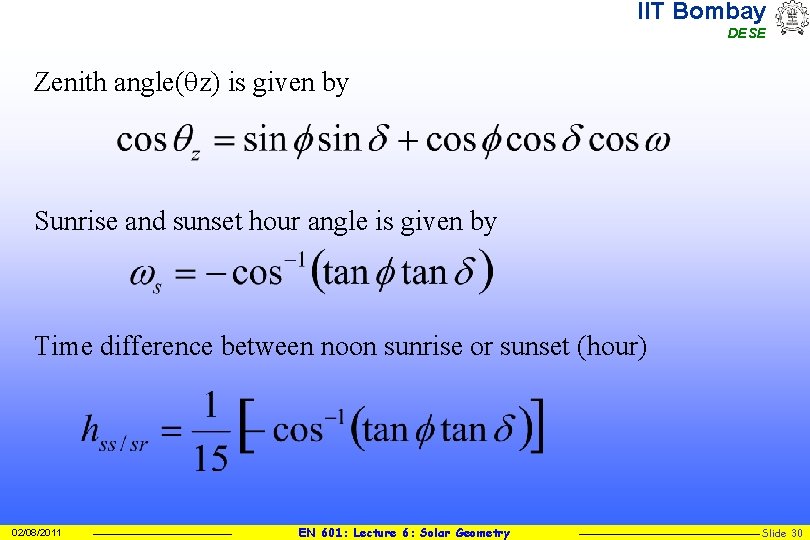
IIT Bombay DESE Zenith angle(qz) is given by Sunrise and sunset hour angle is given by Time difference between noon sunrise or sunset (hour) 02/08/2011 EN 601: Lecture 6: Solar Geometry Slide 30
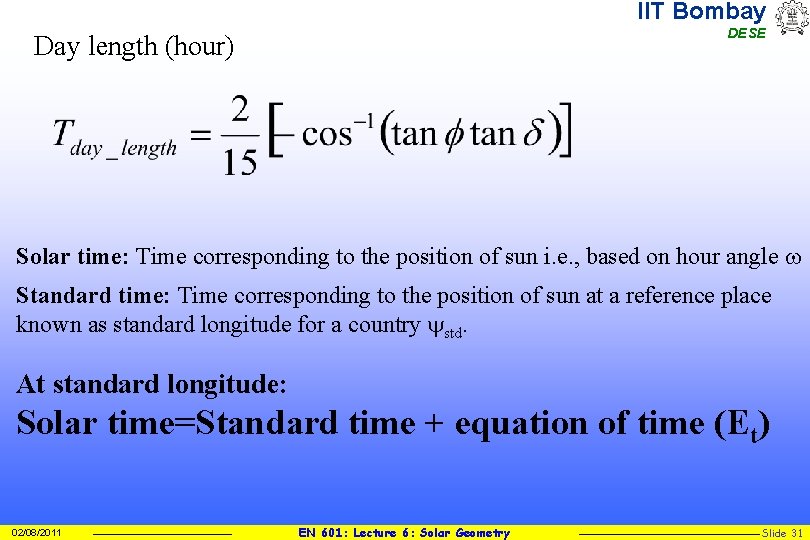
IIT Bombay DESE Day length (hour) Solar time: Time corresponding to the position of sun i. e. , based on hour angle w Standard time: Time corresponding to the position of sun at a reference place known as standard longitude for a country ystd. At standard longitude: Solar time=Standard time + equation of time (Et) 02/08/2011 EN 601: Lecture 6: Solar Geometry Slide 31
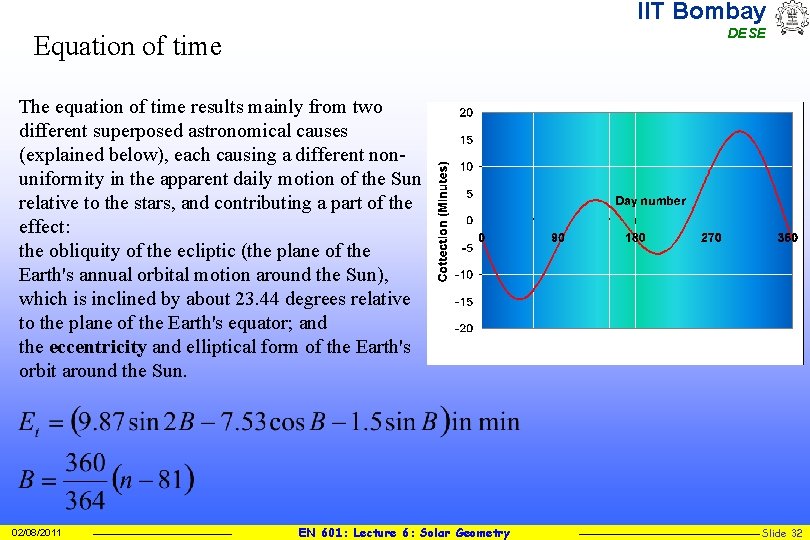
IIT Bombay DESE Equation of time The equation of time results mainly from two different superposed astronomical causes (explained below), each causing a different nonuniformity in the apparent daily motion of the Sun relative to the stars, and contributing a part of the effect: the obliquity of the ecliptic (the plane of the Earth's annual orbital motion around the Sun), which is inclined by about 23. 44 degrees relative to the plane of the Earth's equator; and the eccentricity and elliptical form of the Earth's orbit around the Sun. 02/08/2011 EN 601: Lecture 6: Solar Geometry Slide 32
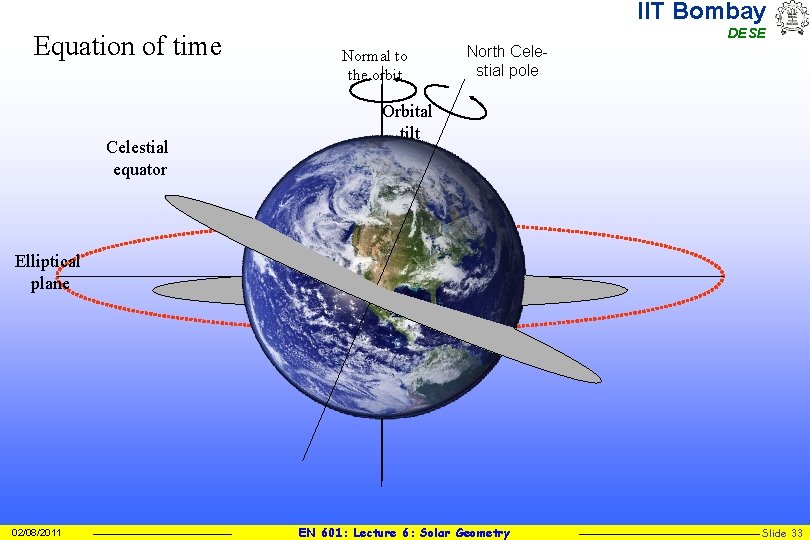
IIT Bombay Equation of time Celestial equator DESE Normal to the orbit North Celestial pole Orbital tilt Elliptical plane 02/08/2011 EN 601: Lecture 6: Solar Geometry Slide 33
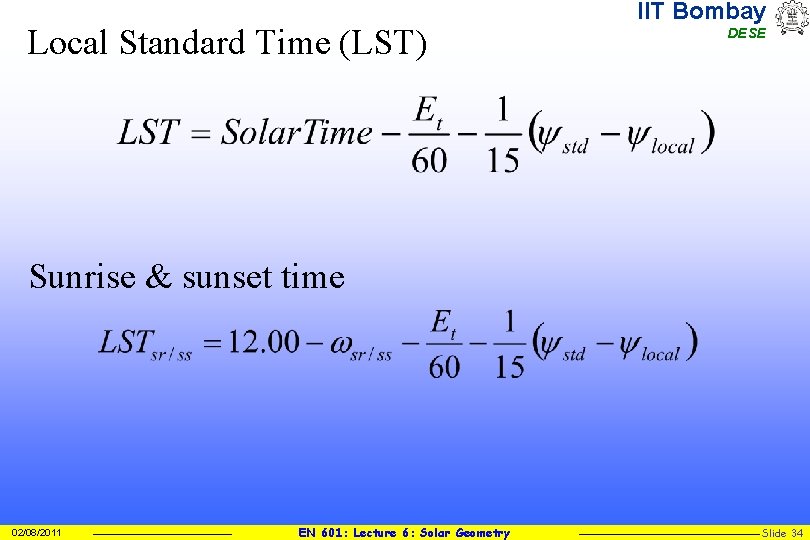
Local Standard Time (LST) IIT Bombay DESE Sunrise & sunset time 02/08/2011 EN 601: Lecture 6: Solar Geometry Slide 34
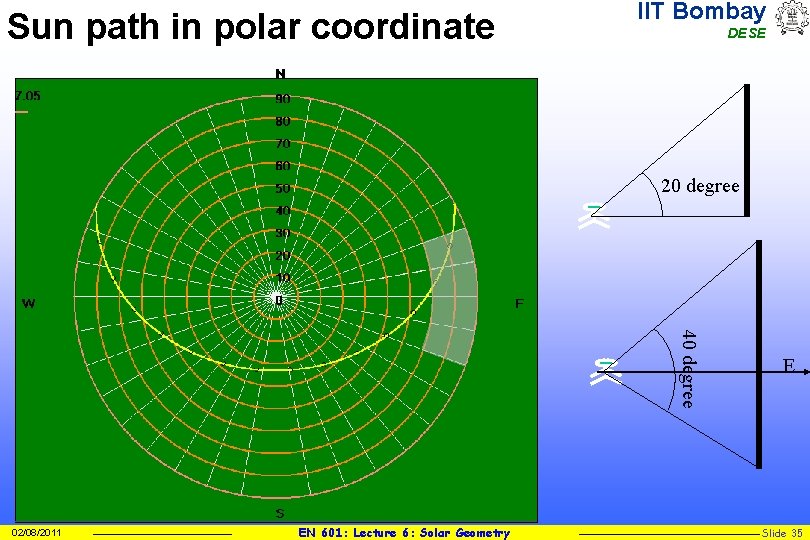
Sun path in polar coordinate IIT Bombay DESE 20 degree 40 degree 02/08/2011 EN 601: Lecture 6: Solar Geometry E Slide 35
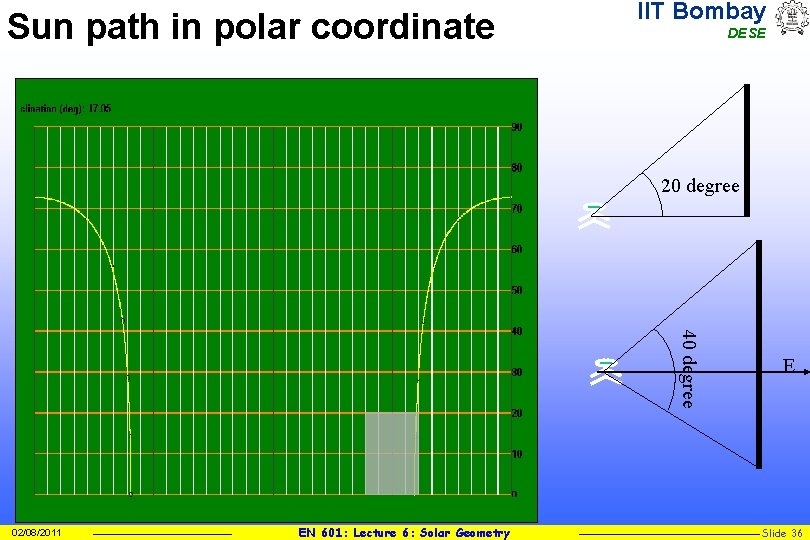
Sun path in polar coordinate IIT Bombay DESE 20 degree 40 degree 02/08/2011 EN 601: Lecture 6: Solar Geometry E Slide 36
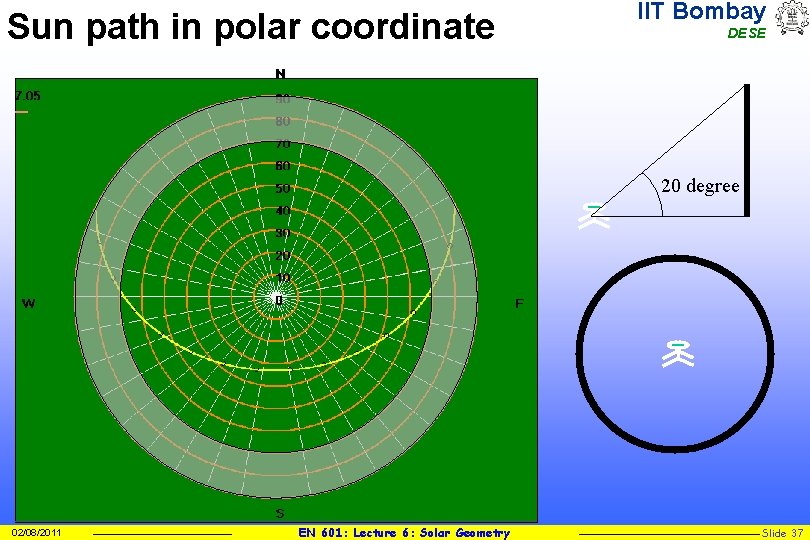
Sun path in polar coordinate IIT Bombay DESE 20 degree 02/08/2011 EN 601: Lecture 6: Solar Geometry Slide 37
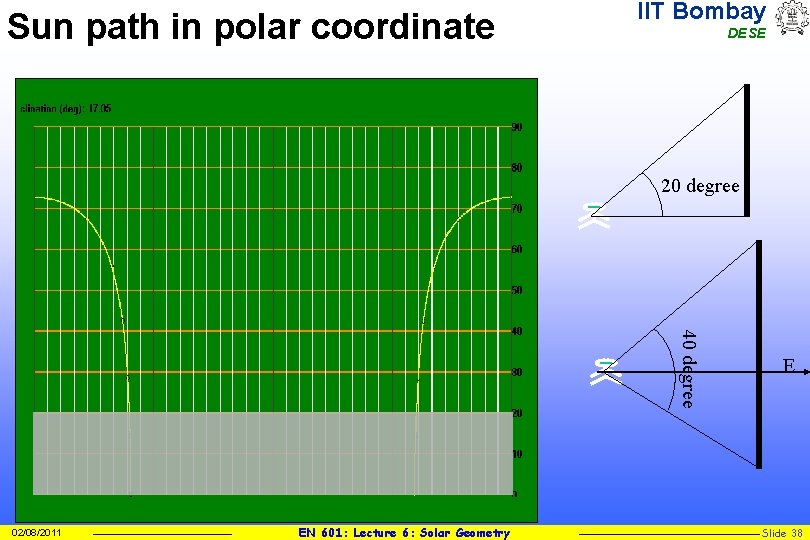
Sun path in polar coordinate IIT Bombay DESE 20 degree 40 degree 02/08/2011 EN 601: Lecture 6: Solar Geometry E Slide 38
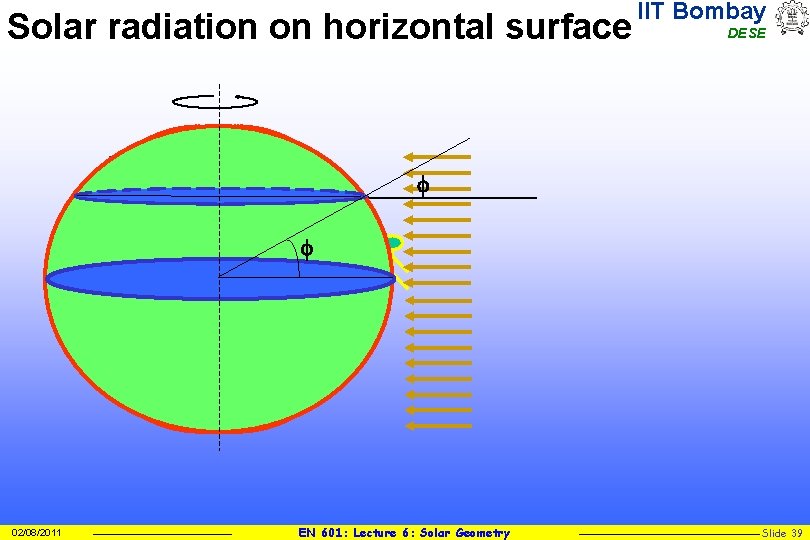
Solar radiation on horizontal surface IIT Bombay DESE f f 02/08/2011 EN 601: Lecture 6: Solar Geometry Slide 39
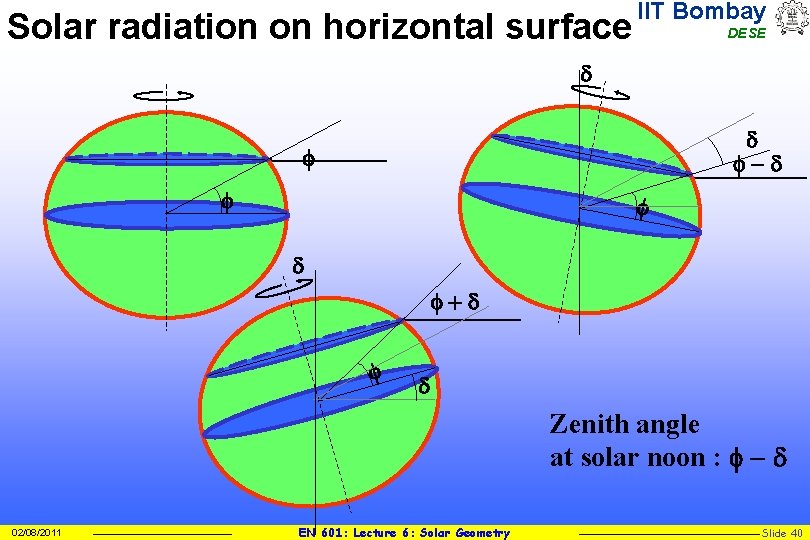
Solar radiation on horizontal surface IIT Bombay DESE d d f-d f f f d f+d f d Zenith angle at solar noon : f - d 02/08/2011 EN 601: Lecture 6: Solar Geometry Slide 40
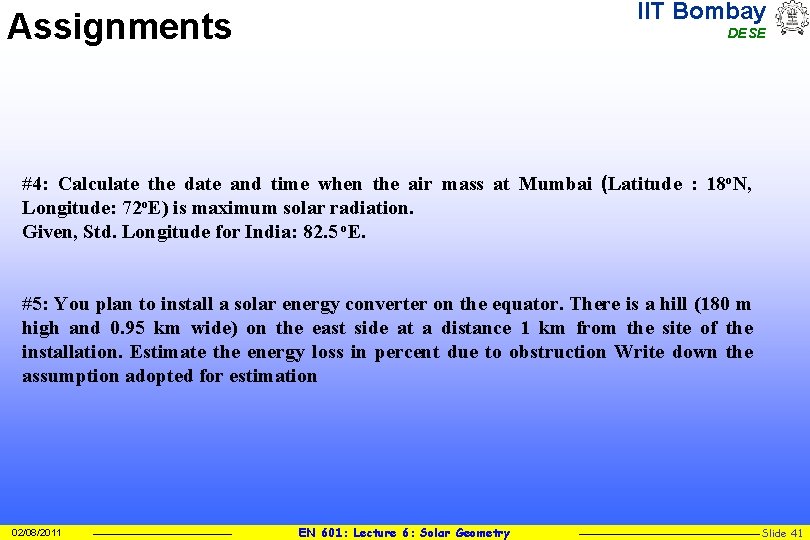
IIT Bombay Assignments DESE #4: Calculate the date and time when the air mass at Mumbai (Latitude : 18 o. N, Longitude: 72 o. E) is maximum solar radiation. Given, Std. Longitude for India: 82. 5 o. E. #5: You plan to install a solar energy converter on the equator. There is a hill (180 m high and 0. 95 km wide) on the east side at a distance 1 km from the site of the installation. Estimate the energy loss in percent due to obstruction Write down the assumption adopted for estimation 02/08/2011 EN 601: Lecture 6: Solar Geometry Slide 41
- Slides: 41