
IIT Bombay DESE Introduction to global energy crisis
IIT Bombay DESE Introduction to global energy crisis Lecture #3 26/07/2011 EN 601: Lectrue #3: Energy Scenario Slide
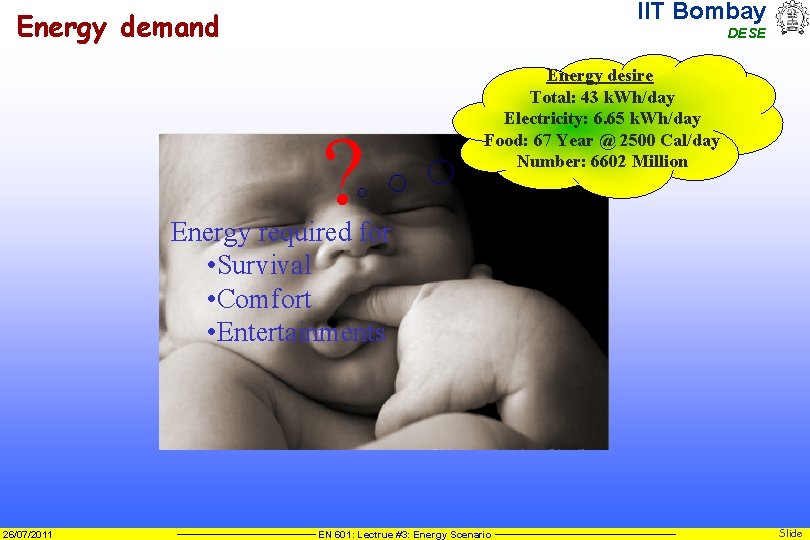
IIT Bombay Energy demand DESE ? Energy desire Total: 43 k. Wh/day Electricity: 6. 65 k. Wh/day Food: 67 Year @ 2500 Cal/day Number: 6602 Million Energy required for • Survival • Comfort • Entertainments 26/07/2011 EN 601: Lectrue #3: Energy Scenario Slide
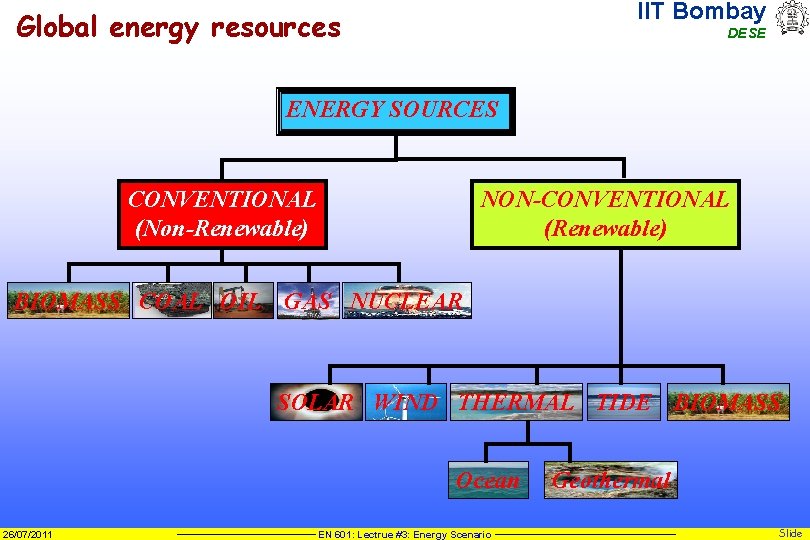
IIT Bombay Global energy resources DESE ENERGY SOURCES CONVENTIONAL (Non-Renewable) NON-CONVENTIONAL (Renewable) BIOMASS COAL OIL GAS NUCLEAR SOLAR WIND THERMAL TIDE BIOMASS Ocean 26/07/2011 EN 601: Lectrue #3: Energy Scenario Geothermal Slide

IIT Bombay Primary energy reserve PRIMARY ENERGY CRUDE OIL 26/07/2011 DESE GLOBAL 1147 billion barrels COAL 9, 84, 453 million tonnes GAS 176 trillion cubic metres INDIA 5. 4 billion barrels 84, 396 million tonnes 660 billion cubic meters EN 601: Lectrue #3: Energy Scenario Slide 4

Global primary energy reserve 26/07/2011 EN 601: Lectrue #3: Energy Scenario IIT Bombay DESE Slide 5
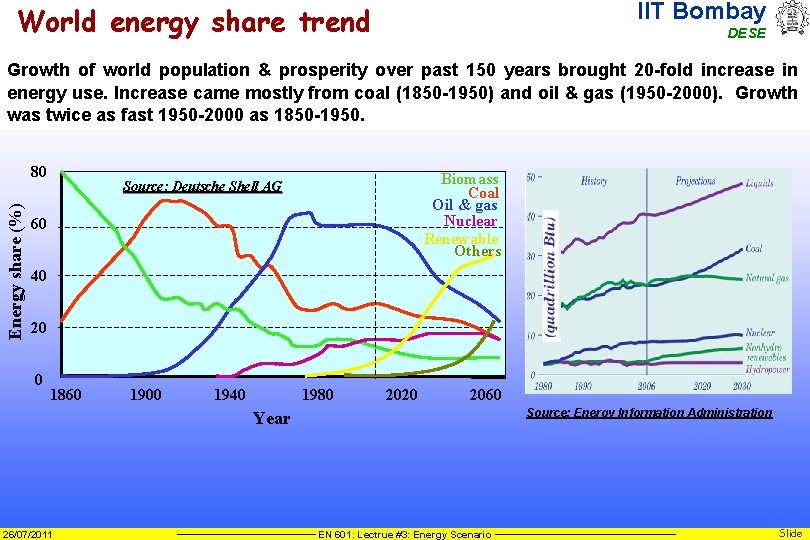
IIT Bombay World energy share trend DESE Growth of world population & prosperity over past 150 years brought 20 -fold increase in energy use. Increase came mostly from coal (1850 -1950) and oil & gas (1950 -2000). Growth was twice as fast 1950 -2000 as 1850 -1950. Energy share (%) 80 Biomass Coal Oil & gas Nuclear Renewable Others Source: Deutsche Shell AG 60 40 20 0 1860 1900 1940 1980 2020 2060 Source: Energy Information Administration Year 26/07/2011 EN 601: Lectrue #3: Energy Scenario Slide

IIT Bombay Energy flow DESE PRIMARY ENERGY END-USER SECTOR LOSSES CRUDE OIL Transport Industry COAL BIOMASS HYDRO 26/07/2011 HEAT ENERGY WASTE GAS Thermal electricity EN 601: Lectrue #3: Energy Scenario Residential Slide 7
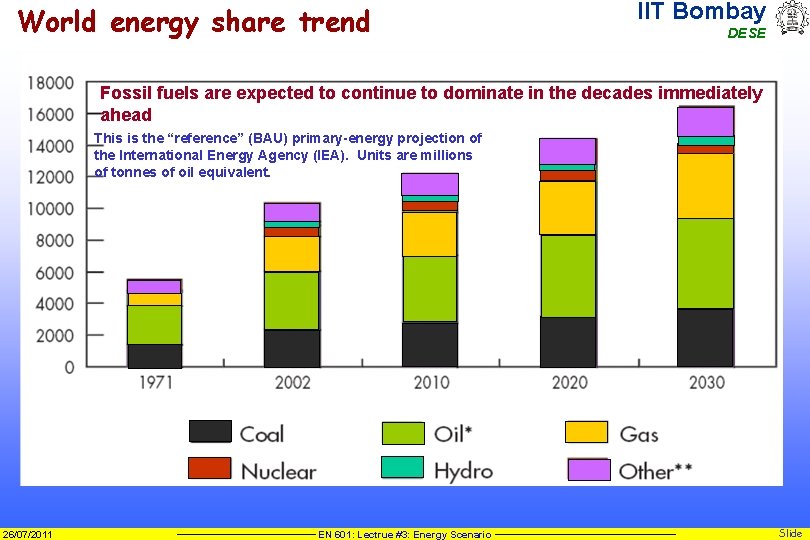
World energy share trend IIT Bombay DESE Fossil fuels are expected to continue to dominate in the decades immediately ahead This is the “reference” (BAU) primary-energy projection of the International Energy Agency (IEA). Units are millions of tonnes of oil equivalent. 26/07/2011 EN 601: Lectrue #3: Energy Scenario Slide
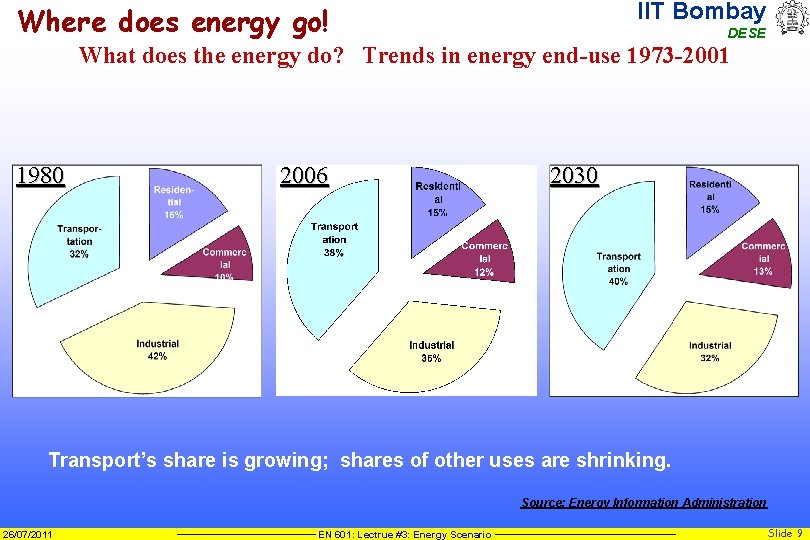
IIT Bombay Where does energy go! DESE What does the energy do? Trends in energy end-use 1973 -2001 1980 2006 2030 Transport’s share is growing; shares of other uses are shrinking. Source: Energy Information Administration 26/07/2011 EN 601: Lectrue #3: Energy Scenario Slide 9
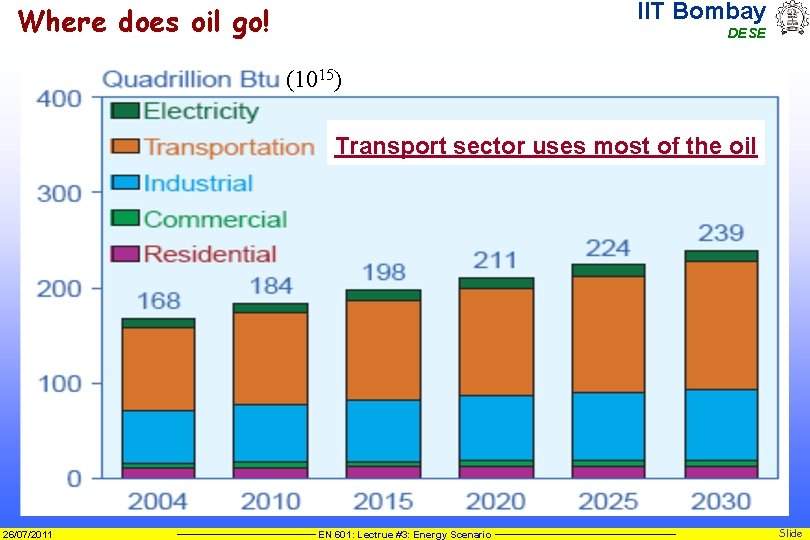
IIT Bombay Where does oil go! DESE (1015) Transport sector uses most of the oil 26/07/2011 EN 601: Lectrue #3: Energy Scenario Slide

Problems of dependency on fossil-fuels IIT Bombay DESE • Increasing dependence on imported oil & natural gas means economic vulnerability, as well as international tensions and potential for conflict over access & terms. • Coal burning for electricity and industry and oil burning in vehicles are main sources of severe urban and regional air pollution – SOx, NOx, hydrocarbons, soot – with big impacts on public health, acid precipitation. • Emissions of CO 2 from all fossil-fuel burning are largest driver of global climate disruption, already associated with increasing harm to human well-being and rapidly becoming more severe. The oil market, pollutant transport, & climate are global. Each country is affected by what other countries do. 26/07/2011 EN 601: Lectrue #3: Energy Scenario Slide 11
IIT Bombay Future challenges DESE For specialists: Its in terms of GJ, k. Wh, …. . ENERGY For public: • Reliable energy • Affordable energy • Safe energy • Clean energy Facts: The world is not running out of energy as SUN, the main source of energy on this earth is still there. The main concerns are: • Running out of cheap energy sources • Approaching environmental limit • Inadequate time for newer energy technologies 26/07/2011 EN 601: Lectrue #3: Energy Scenario Slide

IIT Bombay Other challenges DESE • Meeting the basic energy needs of the world’s 2 billion poorest people in ways that avoid the health damages from traditional energy sources and provide a foundation for sustainable development • Reducing urban & regional air pollution and the dangers of overdependence on oil despite growing demand for personal transportation • Providing the affordable energy needed to create & sustain prosperity everywhere without wrecking the global climate with carbon dioxide emitted by fossil-fuel burning 26/07/2011 EN 601: Lectrue #3: Energy Scenario Slide 13
IIT Bombay Threats & Consequences THREAT ON CONSEQUENCES BY MANKIND 26/07/2011 DESE • Reserved fossil fuel is limited • Depletion of fossil fuel • Coal: 200 Years • Petroleum: 45 Years • Gas: 65 Years • Future energy crisis EN 601: Lectrue #3: Energy Scenario Slide
IIT Bombay DESE “The Stone Age did not end because we ran out of stones and the oil age will not end because we run out of oil” Don Huberts CEO , Shell Hydrogen 26/07/2011 EN 601: Lectrue #3: Energy Scenario Slide
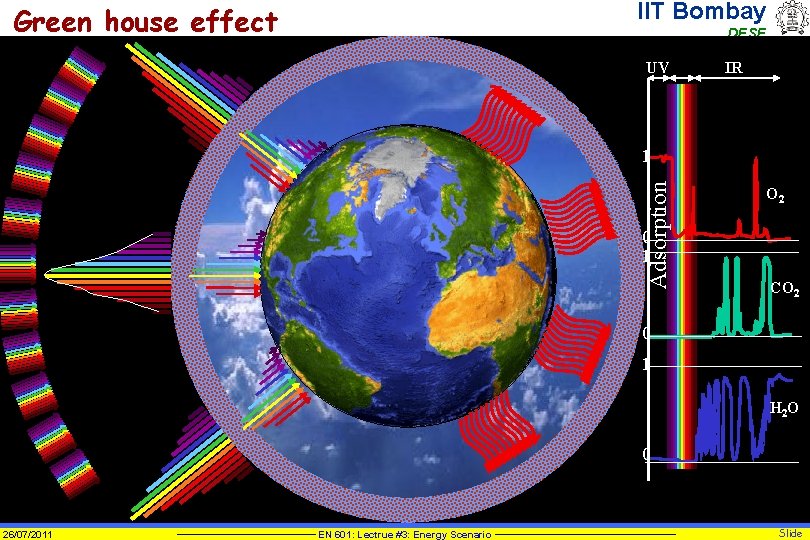
IIT Bombay Green house effect DESE UV IR Adsorption 1 O 2 0 1 CO 2 0 1 H 2 O 0 26/07/2011 EN 601: Lectrue #3: Energy Scenario Slide
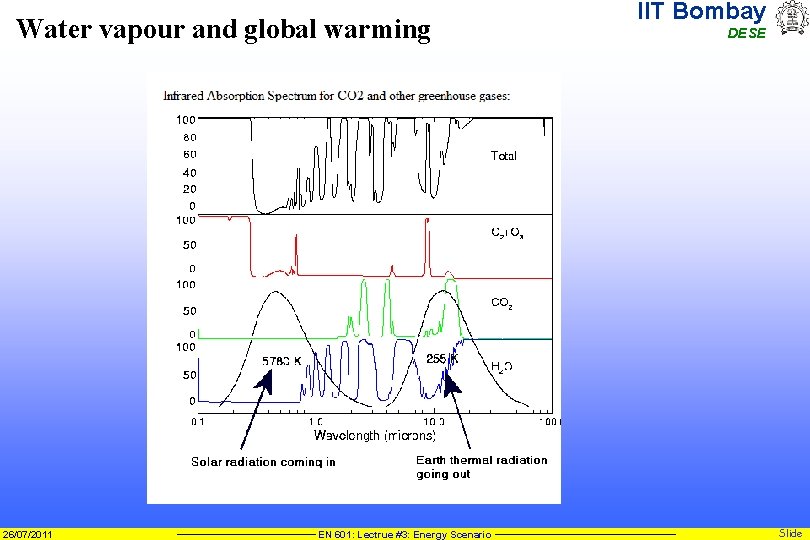
Water vapour and global warming 26/07/2011 EN 601: Lectrue #3: Energy Scenario IIT Bombay DESE Slide
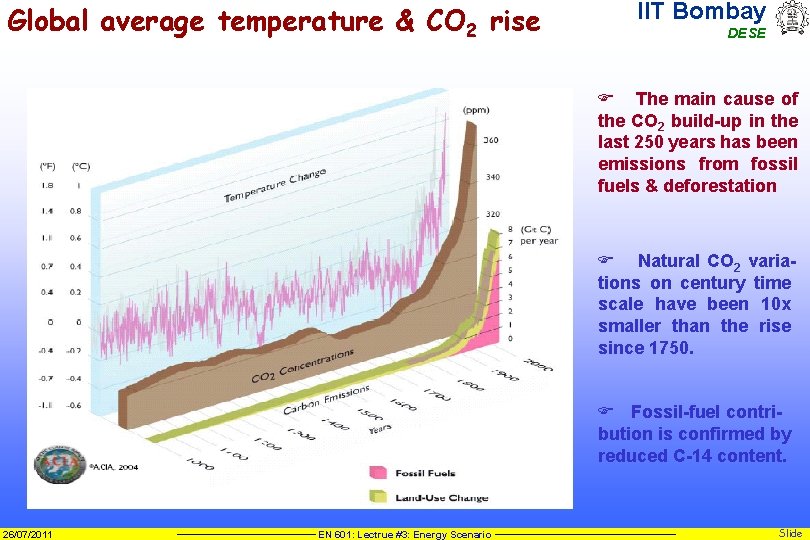
Global average temperature & CO 2 rise IIT Bombay DESE F The main cause of the CO 2 build-up in the last 250 years has been emissions from fossil fuels & deforestation F Natural CO 2 variations on century time scale have been 10 x smaller than the rise since 1750. F Fossil-fuel contribution is confirmed by reduced C-14 content. 26/07/2011 EN 601: Lectrue #3: Energy Scenario Slide
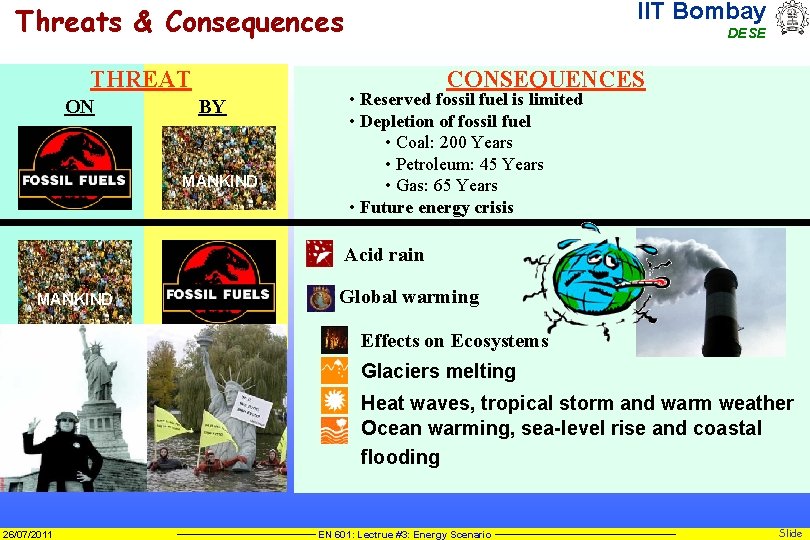
IIT Bombay Threats & Consequences THREAT ON DESE CONSEQUENCES BY MANKIND • Reserved fossil fuel is limited • Depletion of fossil fuel • Coal: 200 Years • Petroleum: 45 Years • Gas: 65 Years • Future energy crisis Acid rain MANKIND Global warming Effects on Ecosystems Glaciers melting Heat waves, tropical storm and warm weather Ocean warming, sea-level rise and coastal flooding 26/07/2011 EN 601: Lectrue #3: Energy Scenario Slide
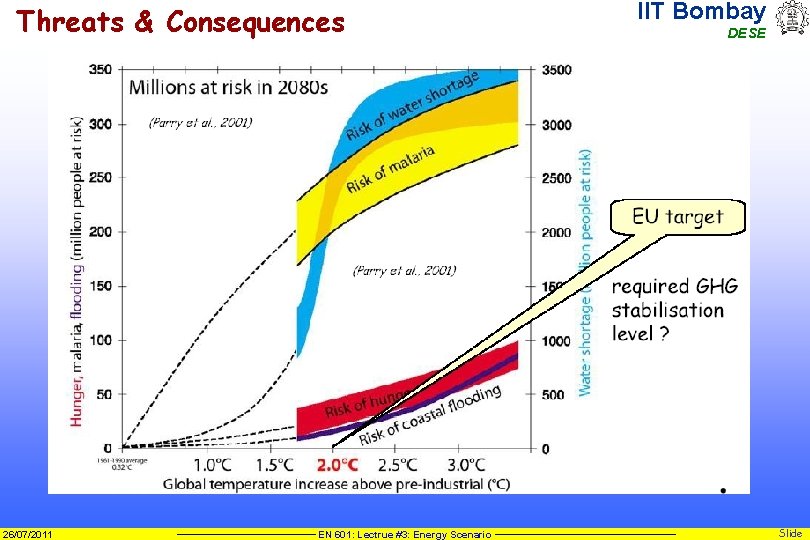
Threats & Consequences 26/07/2011 EN 601: Lectrue #3: Energy Scenario IIT Bombay DESE Slide
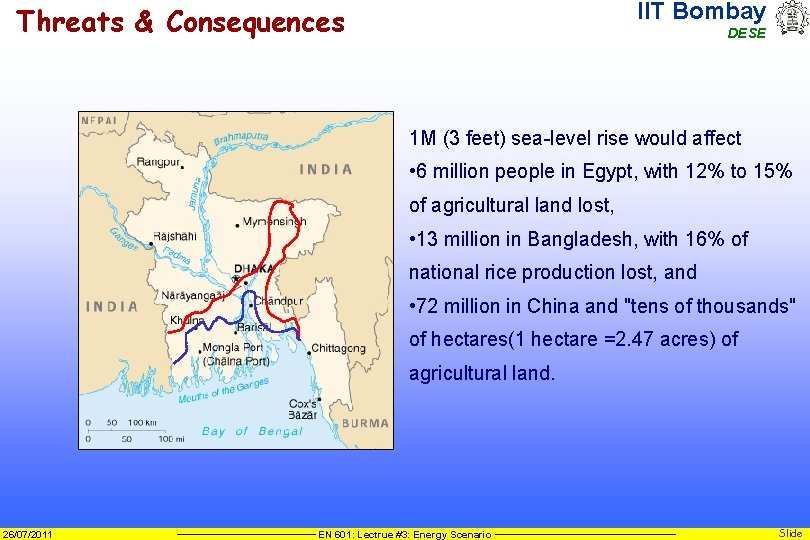
IIT Bombay Threats & Consequences DESE 1 M (3 feet) sea-level rise would affect • 6 million people in Egypt, with 12% to 15% of agricultural land lost, • 13 million in Bangladesh, with 16% of national rice production lost, and • 72 million in China and "tens of thousands" of hectares(1 hectare =2. 47 acres) of agricultural land. 26/07/2011 EN 601: Lectrue #3: Energy Scenario Slide
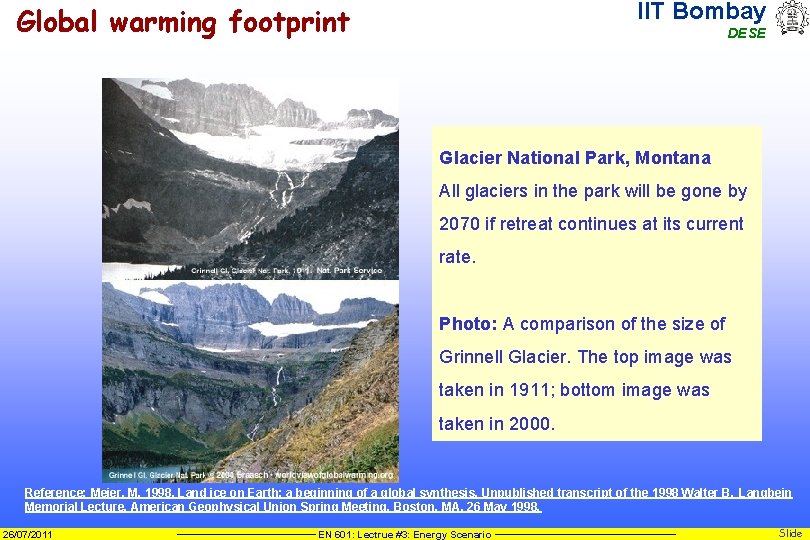
IIT Bombay Global warming footprint DESE Glacier National Park, Montana All glaciers in the park will be gone by 2070 if retreat continues at its current rate. Photo: A comparison of the size of Grinnell Glacier. The top image was taken in 1911; bottom image was taken in 2000. Reference: Meier, M. 1998. Land ice on Earth: a beginning of a global synthesis. Unpublished transcript of the 1998 Walter B. Langbein Memorial Lecture, American Geophysical Union Spring Meeting, Boston, MA, 26 May 1998. 26/07/2011 EN 601: Lectrue #3: Energy Scenario Slide
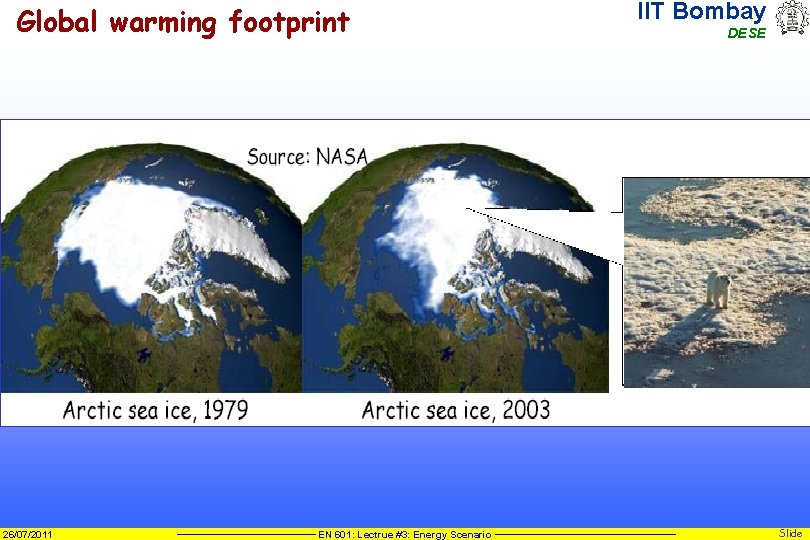
Global warming footprint 26/07/2011 EN 601: Lectrue #3: Energy Scenario IIT Bombay DESE Slide
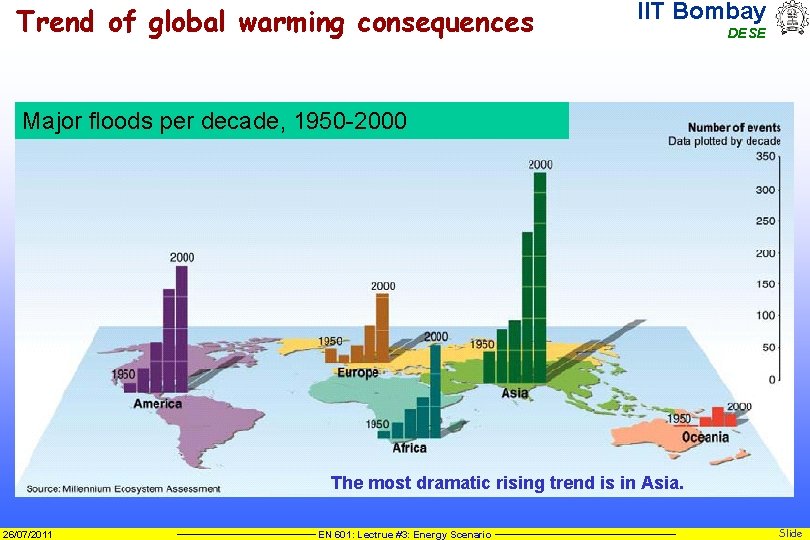
Trend of global warming consequences IIT Bombay DESE Major floods per decade, 1950 -2000 The most dramatic rising trend is in Asia. 26/07/2011 EN 601: Lectrue #3: Energy Scenario Slide
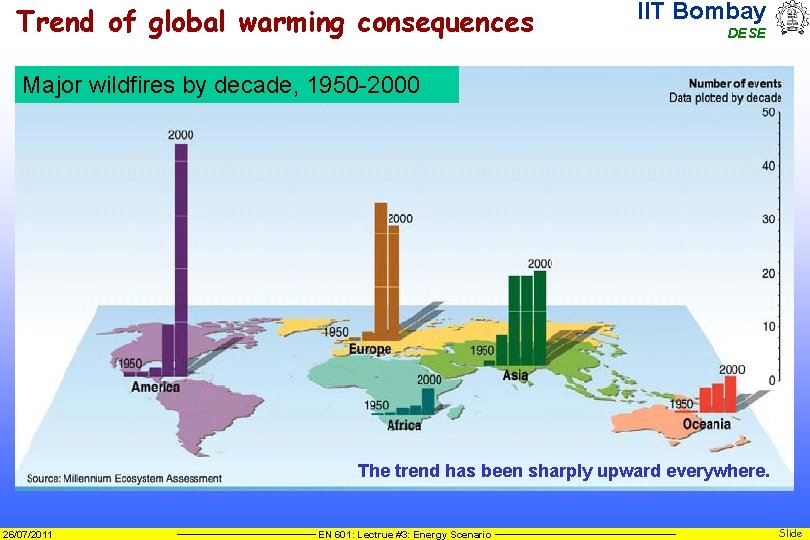
Trend of global warming consequences IIT Bombay DESE Major wildfires by decade, 1950 -2000 The trend has been sharply upward everywhere. 26/07/2011 EN 601: Lectrue #3: Energy Scenario Slide
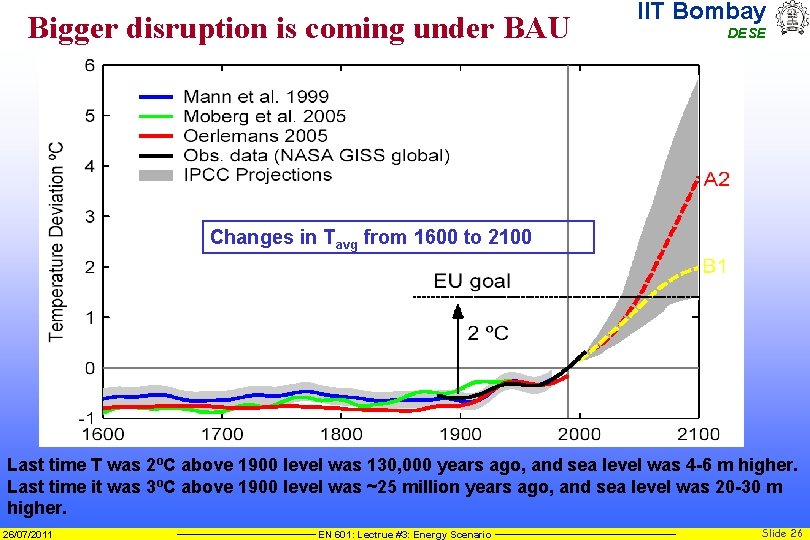
Bigger disruption is coming under BAU IIT Bombay DESE Changes in Tavg from 1600 to 2100 Last time T was 2ºC above 1900 level was 130, 000 years ago, and sea level was 4 -6 m higher. Last time it was 3ºC above 1900 level was ~25 million years ago, and sea level was 20 -30 m higher. 26/07/2011 EN 601: Lectrue #3: Energy Scenario Slide 26
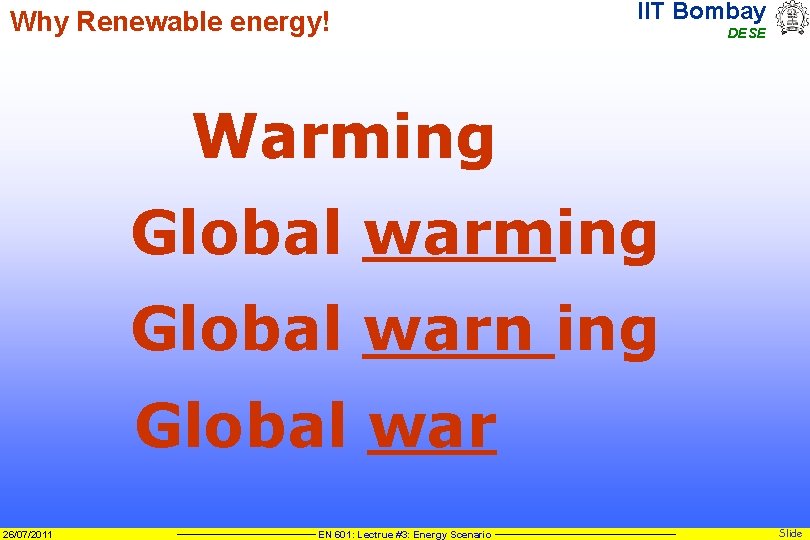
Why Renewable energy! IIT Bombay DESE Warn Warming War Global warming Global warn ing Global war 26/07/2011 EN 601: Lectrue #3: Energy Scenario Slide
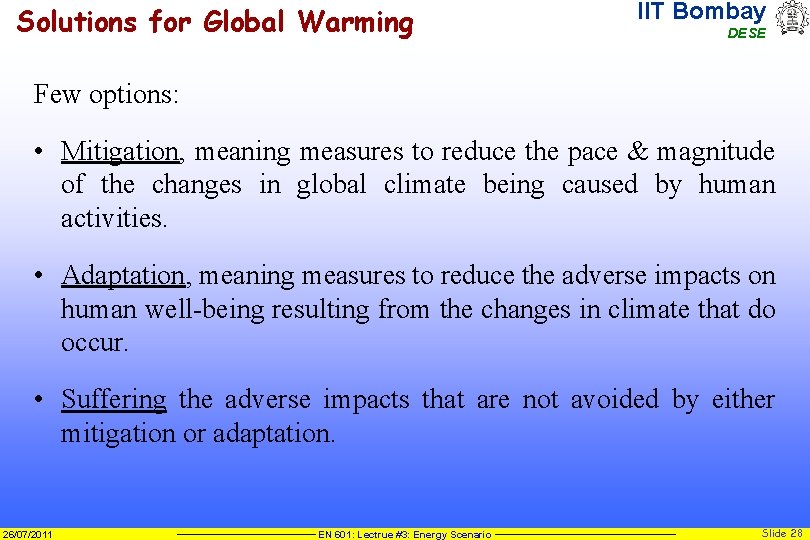
Solutions for Global Warming IIT Bombay DESE Few options: • Mitigation, meaning measures to reduce the pace & magnitude of the changes in global climate being caused by human activities. • Adaptation, meaning measures to reduce the adverse impacts on human well-being resulting from the changes in climate that do occur. • Suffering the adverse impacts that are not avoided by either mitigation or adaptation. 26/07/2011 EN 601: Lectrue #3: Energy Scenario Slide 28
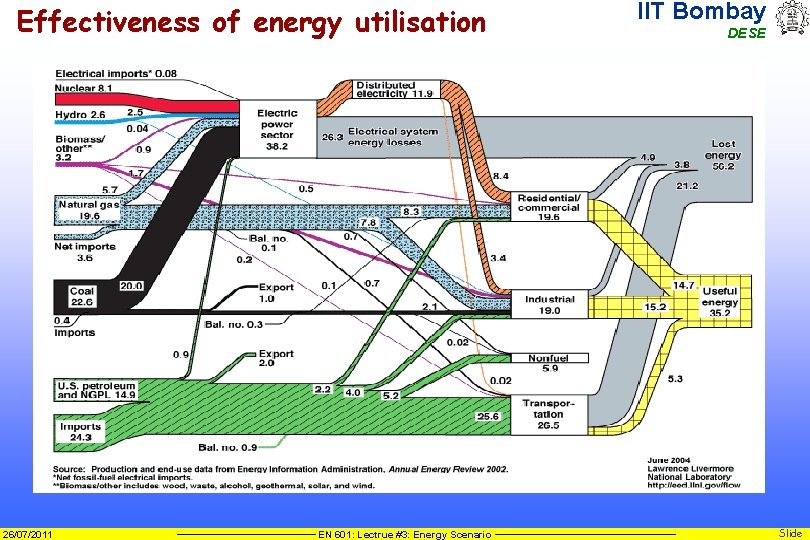
Effectiveness of energy utilisation 26/07/2011 EN 601: Lectrue #3: Energy Scenario IIT Bombay DESE Slide
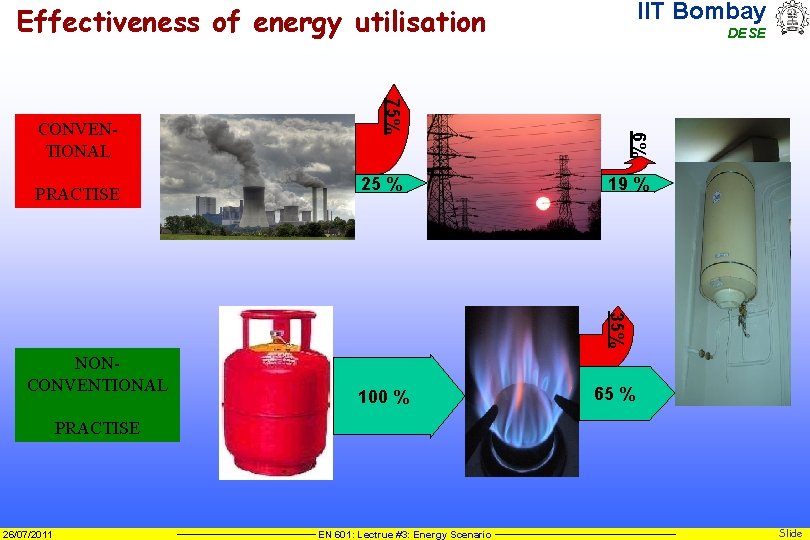
IIT Bombay Effectiveness of energy utilisation 25 % 6% PRACTISE 75% CONVENTIONAL DESE 19 % 35% NONCONVENTIONAL 100 % 65 % PRACTISE 26/07/2011 EN 601: Lectrue #3: Energy Scenario Slide
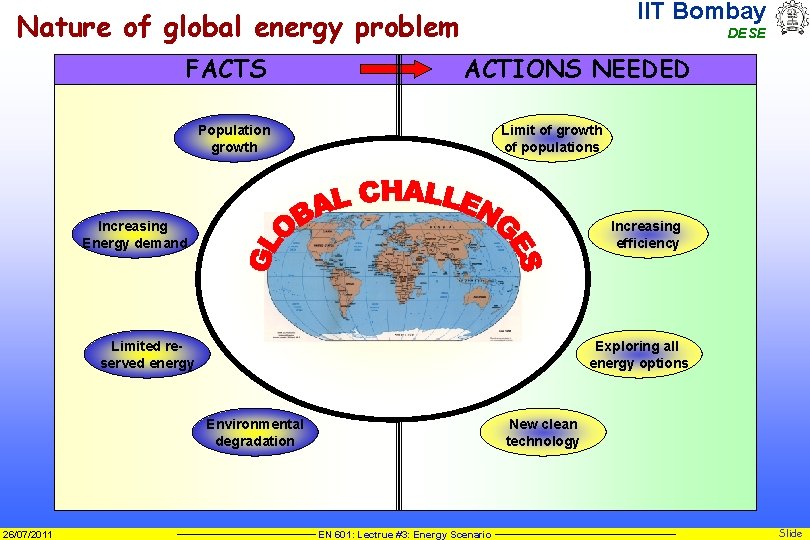
IIT Bombay Nature of global energy problem FACTS DESE ACTIONS NEEDED Population growth Limit of growth of populations Increasing Energy demand Increasing efficiency Limited reserved energy Exploring all energy options Environmental degradation 26/07/2011 New clean technology EN 601: Lectrue #3: Energy Scenario Slide
- Slides: 31