
IIT Bombay Computer Programming Dr Deepak B Phatak
IIT Bombay Computer Programming Dr. Deepak B Phatak Dr. Supratik Chakraborty Department of Computer Science and Engineering IIT Bombay Session: Access Control and Introduction to Classes Dr. Deepak B. Phatak & Dr. Supratik Chakraborty, IIT Bombay 1
Quick Recap of Relevant Topics IIT Bombay • Structures representing objects • Groups of related variables, arrays, other structures • Member functions as interfaces for interaction • Accessing members (data and functions) of structures No restrictions on accessing members of a structure from anywhere in a program 2 Dr. Deepak B. Phatak & Dr. Supratik Chakraborty, IIT Bombay
Overview of This Lecture IIT Bombay • Access control of members in structures • private and public members • Classes in C++ programs 3 Dr. Deepak B. Phatak & Dr. Supratik Chakraborty, IIT Bombay
Acknowledgment IIT Bombay • Much of this lecture is motivated by the treatment in An Introduction to Programming Through C++ by Abhiram G. Ranade Mc. Graw Hill Education 2014 Dr. Deepak B. Phatak & Dr. Supratik Chakraborty, IIT Bombay 4
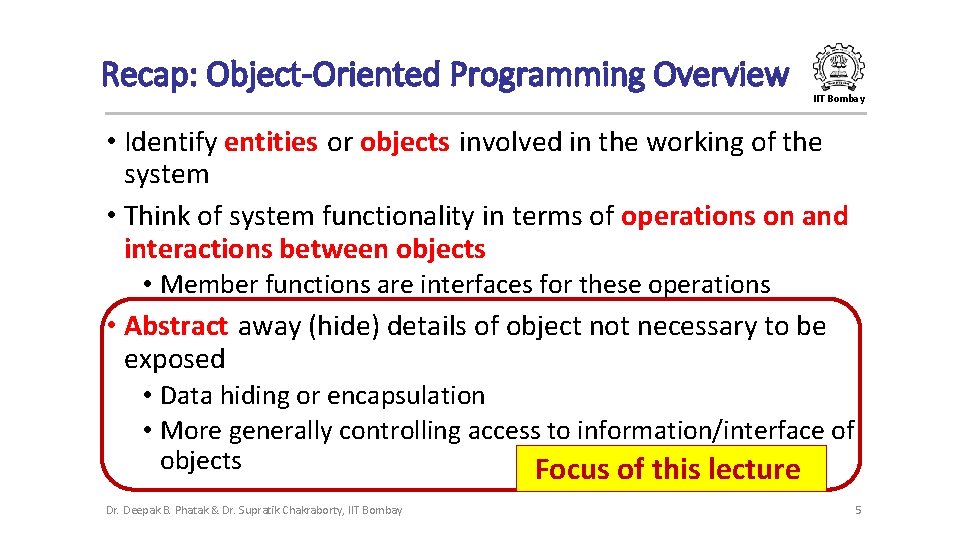
Recap: Object-Oriented Programming Overview IIT Bombay • Identify entities or objects involved in the working of the system • Think of system functionality in terms of operations on and interactions between objects • Member functions are interfaces for these operations • Abstract away (hide) details of object not necessary to be exposed • Data hiding or encapsulation • More generally controlling access to information/interface of objects Focus of this lecture Dr. Deepak B. Phatak & Dr. Supratik Chakraborty, IIT Bombay 5
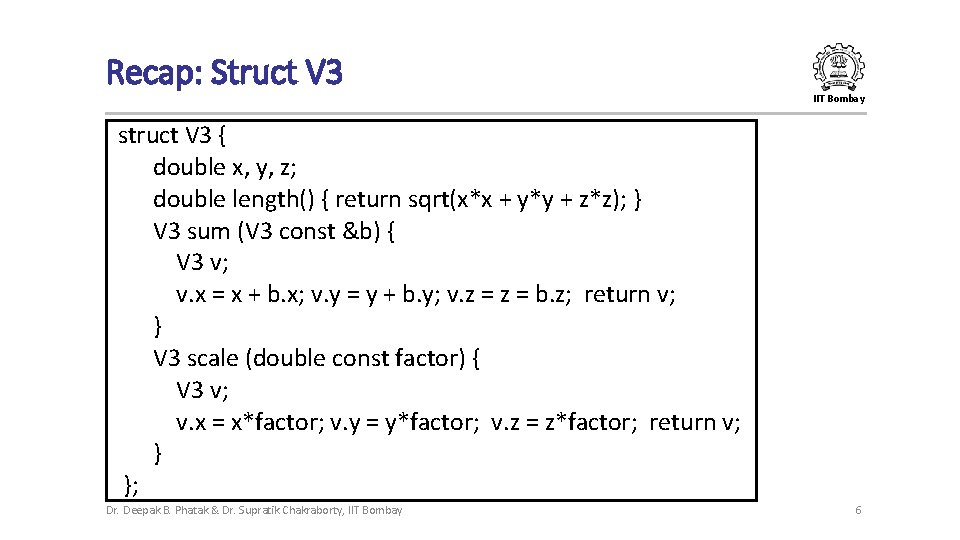
Recap: Struct V 3 IIT Bombay struct V 3 { double x, y, z; double length() { return sqrt(x*x + y*y + z*z); } V 3 sum (V 3 const &b) { V 3 v; v. x = x + b. x; v. y = y + b. y; v. z = b. z; return v; } V 3 scale (double const factor) { V 3 v; v. x = x*factor; v. y = y*factor; v. z = z*factor; return v; } }; Dr. Deepak B. Phatak & Dr. Supratik Chakraborty, IIT Bombay 6
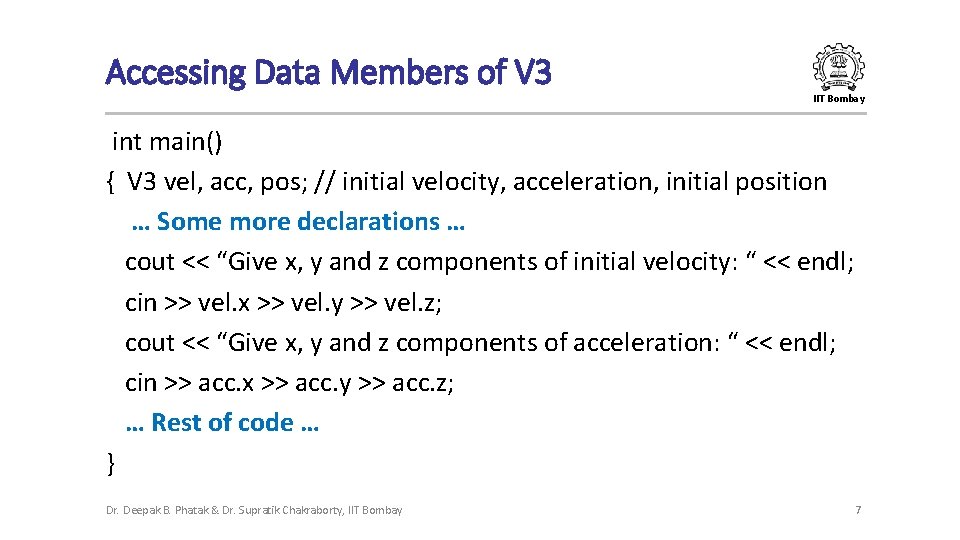
Accessing Data Members of V 3 IIT Bombay int main() { V 3 vel, acc, pos; // initial velocity, acceleration, initial position … Some more declarations … cout << “Give x, y and z components of initial velocity: “ << endl; cin >> vel. x >> vel. y >> vel. z; cout << “Give x, y and z components of acceleration: “ << endl; cin >> acc. x >> acc. y >> acc. z; … Rest of code … } Dr. Deepak B. Phatak & Dr. Supratik Chakraborty, IIT Bombay 7
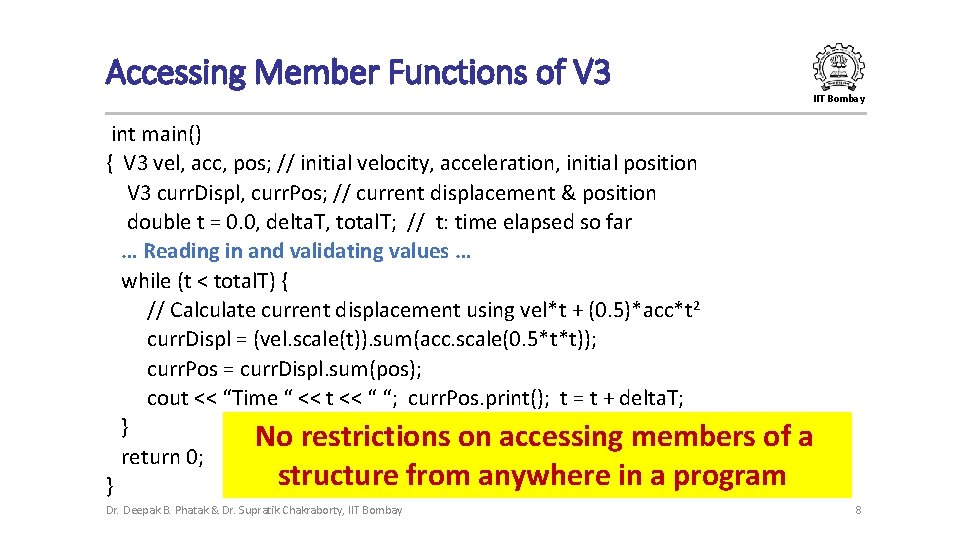
Accessing Member Functions of V 3 IIT Bombay int main() { V 3 vel, acc, pos; // initial velocity, acceleration, initial position V 3 curr. Displ, curr. Pos; // current displacement & position double t = 0. 0, delta. T, total. T; // t: time elapsed so far … Reading in and validating values … while (t < total. T) { // Calculate current displacement using vel*t + (0. 5)*acc*t 2 curr. Displ = (vel. scale(t)). sum(acc. scale(0. 5*t*t)); curr. Pos = curr. Displ. sum(pos); cout << “Time “ << t << “ “; curr. Pos. print(); t = t + delta. T; } No restrictions on accessing members of return 0; structure from anywhere in a program } Dr. Deepak B. Phatak & Dr. Supratik Chakraborty, IIT Bombay a 8
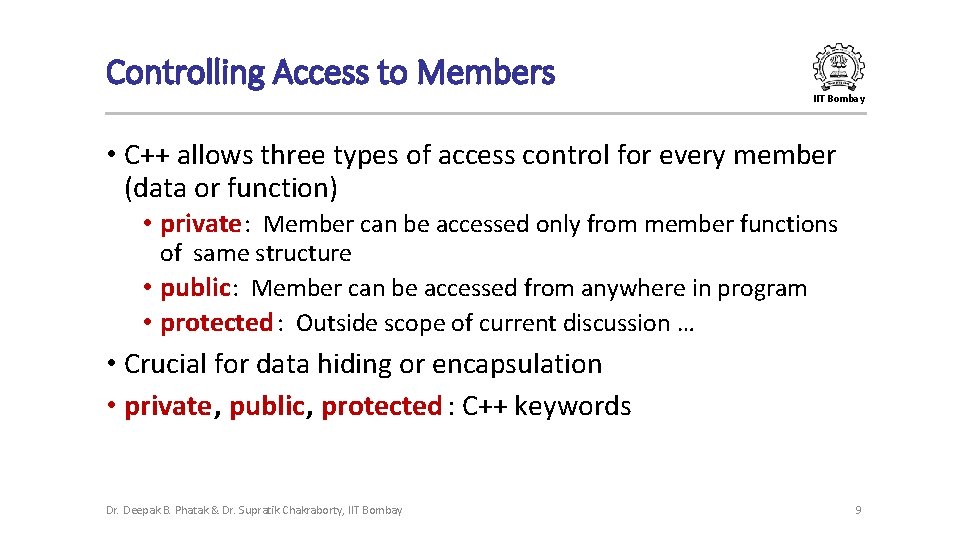
Controlling Access to Members IIT Bombay • C++ allows three types of access control for every member (data or function) • private : Member can be accessed only from member functions of same structure • public : Member can be accessed from anywhere in program • protected : Outside scope of current discussion … • Crucial for data hiding or encapsulation • private, public, protected : C++ keywords Dr. Deepak B. Phatak & Dr. Supratik Chakraborty, IIT Bombay 9
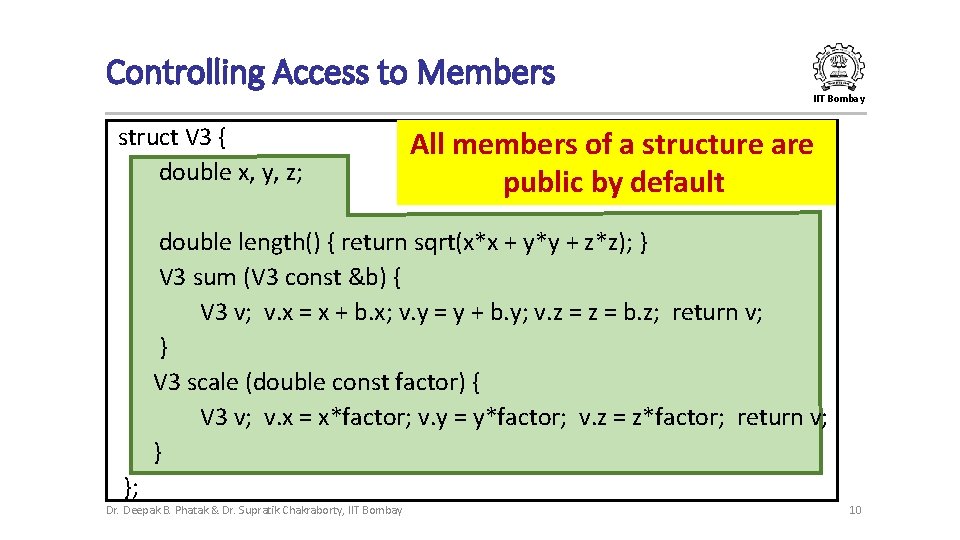
Controlling Access to Members IIT Bombay struct V 3 { double x, y, z; All members of a structure are public by default double length() { return sqrt(x*x + y*y + z*z); } V 3 sum (V 3 const &b) { V 3 v; v. x = x + b. x; v. y = y + b. y; v. z = b. z; return v; } V 3 scale (double const factor) { V 3 v; v. x = x*factor; v. y = y*factor; v. z = z*factor; return v; } }; Dr. Deepak B. Phatak & Dr. Supratik Chakraborty, IIT Bombay 10
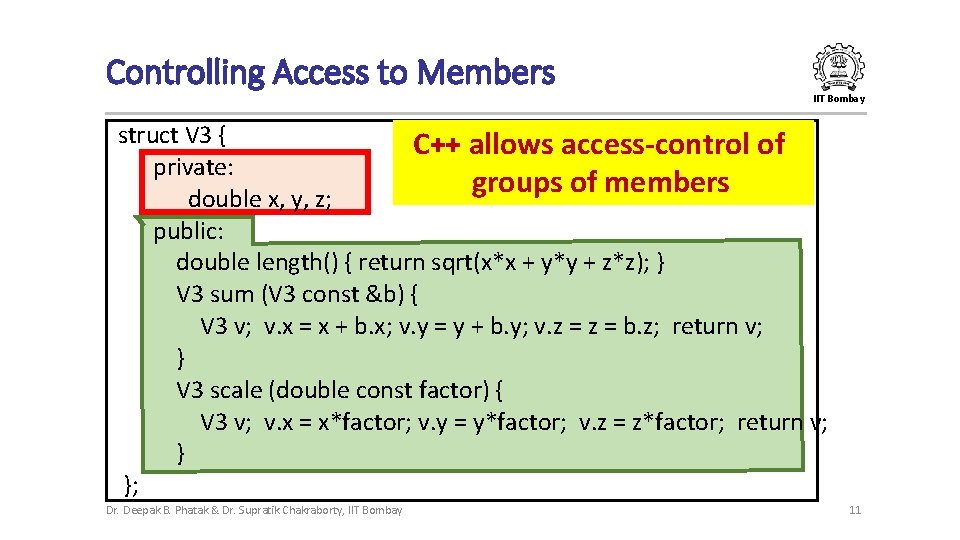
Controlling Access to Members IIT Bombay struct V 3 { C++ allows access-control of private: groups of members double x, y, z; public: double length() { return sqrt(x*x + y*y + z*z); } V 3 sum (V 3 const &b) { V 3 v; v. x = x + b. x; v. y = y + b. y; v. z = b. z; return v; } V 3 scale (double const factor) { V 3 v; v. x = x*factor; v. y = y*factor; v. z = z*factor; return v; } }; Dr. Deepak B. Phatak & Dr. Supratik Chakraborty, IIT Bombay 11
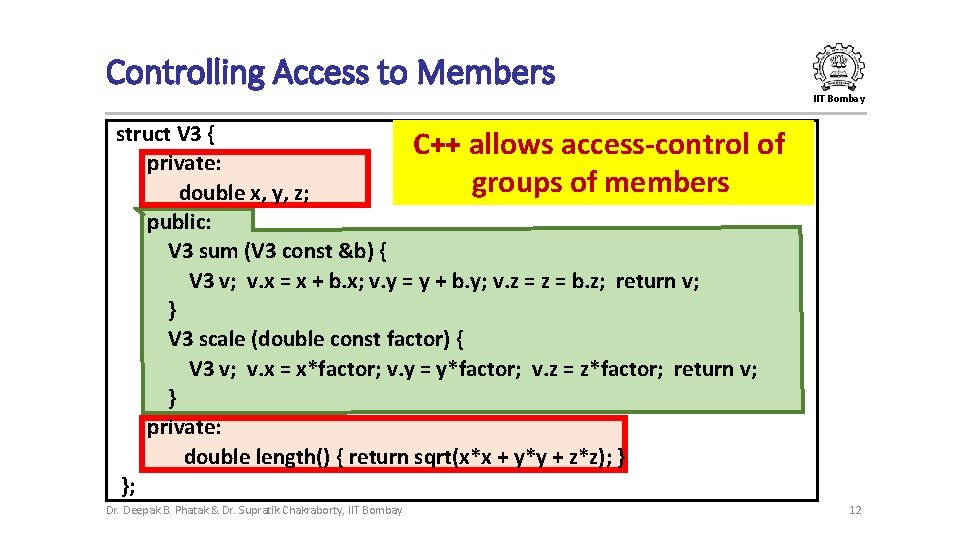
Controlling Access to Members IIT Bombay struct V 3 { C++ allows access-control of private: groups of members double x, y, z; public: V 3 sum (V 3 const &b) { V 3 v; v. x = x + b. x; v. y = y + b. y; v. z = b. z; return v; } V 3 scale (double const factor) { V 3 v; v. x = x*factor; v. y = y*factor; v. z = z*factor; return v; } private: double length() { return sqrt(x*x + y*y + z*z); } }; Dr. Deepak B. Phatak & Dr. Supratik Chakraborty, IIT Bombay 12
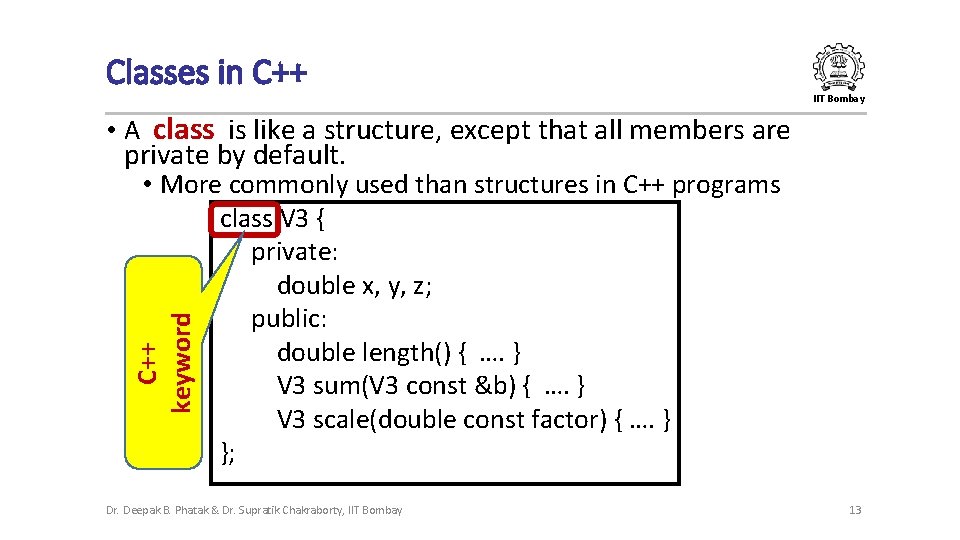
Classes in C++ IIT Bombay • A class is like a structure, except that all members are private by default. C++ keyword • More commonly used than structures in C++ programs class V 3 { private: double x, y, z; public: double length() { …. } V 3 sum(V 3 const &b) { …. } V 3 scale(double const factor) { …. } }; Dr. Deepak B. Phatak & Dr. Supratik Chakraborty, IIT Bombay 13
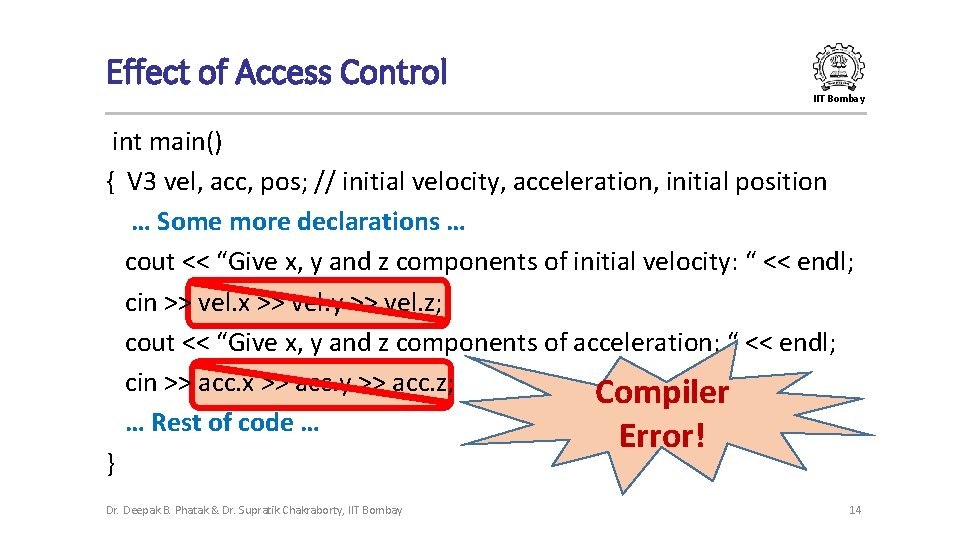
Effect of Access Control IIT Bombay int main() { V 3 vel, acc, pos; // initial velocity, acceleration, initial position … Some more declarations … cout << “Give x, y and z components of initial velocity: “ << endl; cin >> vel. x >> vel. y >> vel. z; cout << “Give x, y and z components of acceleration: “ << endl; cin >> acc. x >> acc. y >> acc. z; Compiler … Rest of code … Error! } Dr. Deepak B. Phatak & Dr. Supratik Chakraborty, IIT Bombay 14
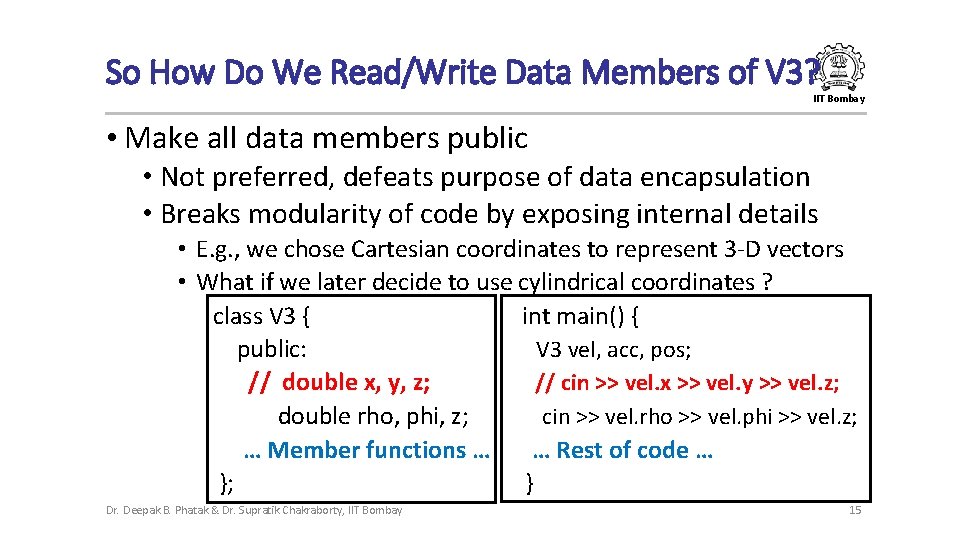
So How Do We Read/Write Data Members of V 3? IIT Bombay • Make all data members public • Not preferred, defeats purpose of data encapsulation • Breaks modularity of code by exposing internal details • E. g. , we chose Cartesian coordinates to represent 3 -D vectors • What if we later decide to use cylindrical coordinates ? class V 3 { int main() { public: V 3 vel, acc, pos; // double x, y, z; // cin >> vel. x >> vel. y >> vel. z; double rho, phi, z; cin >> vel. rho >> vel. phi >> vel. z; … Member functions … … Rest of code … }; } Dr. Deepak B. Phatak & Dr. Supratik Chakraborty, IIT Bombay 15
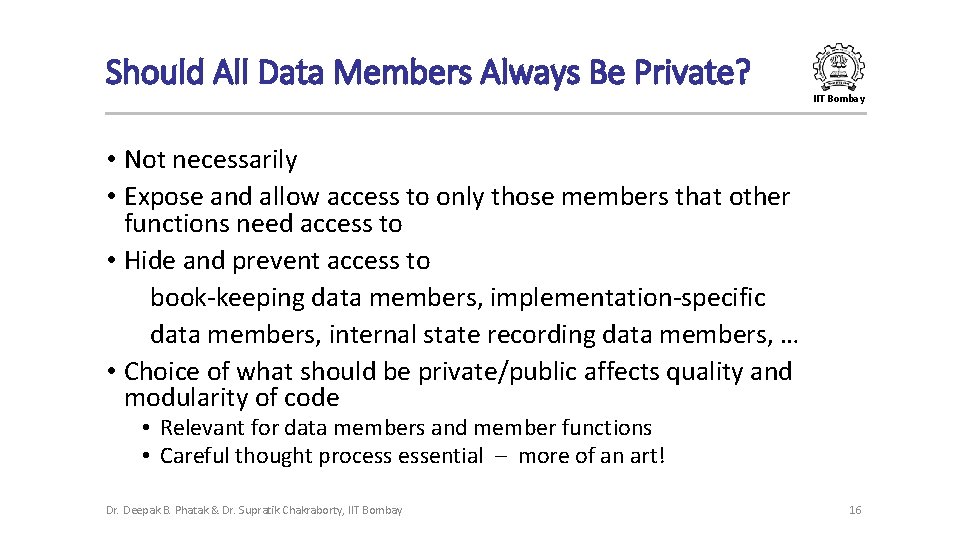
Should All Data Members Always Be Private? IIT Bombay • Not necessarily • Expose and allow access to only those members that other functions need access to • Hide and prevent access to book-keeping data members, implementation-specific data members, internal state recording data members, … • Choice of what should be private/public affects quality and modularity of code • Relevant for data members and member functions • Careful thought process essential – more of an art! Dr. Deepak B. Phatak & Dr. Supratik Chakraborty, IIT Bombay 16
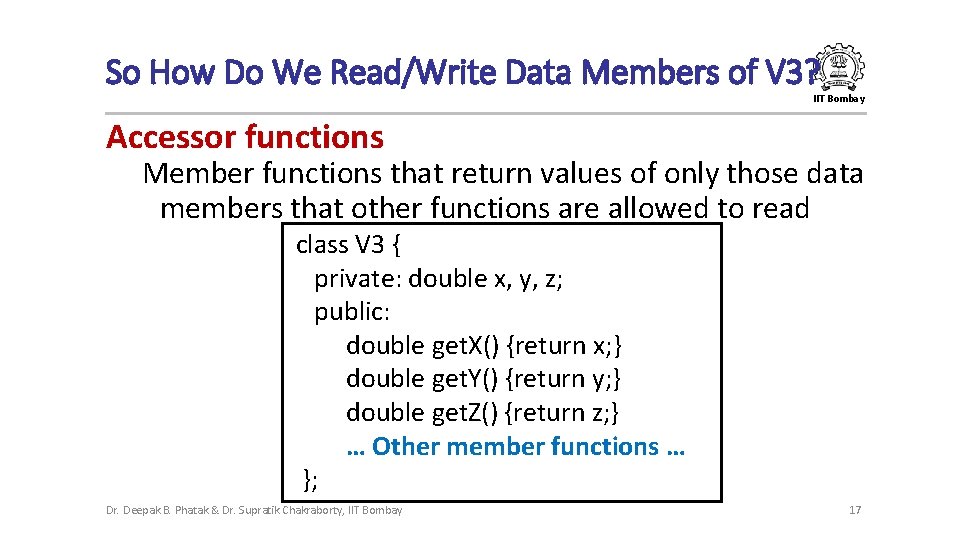
So How Do We Read/Write Data Members of V 3? IIT Bombay Accessor functions Member functions that return values of only those data members that other functions are allowed to read class V 3 { private: double x, y, z; public: double get. X() {return x; } double get. Y() {return y; } double get. Z() {return z; } … Other member functions … }; Dr. Deepak B. Phatak & Dr. Supratik Chakraborty, IIT Bombay 17
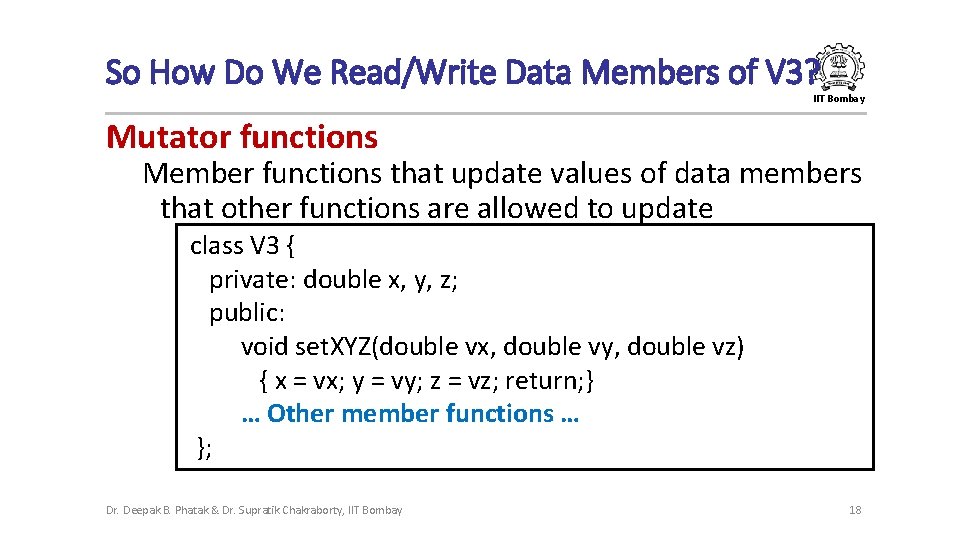
So How Do We Read/Write Data Members of V 3? IIT Bombay Mutator functions Member functions that update values of data members that other functions are allowed to update class V 3 { private: double x, y, z; public: void set. XYZ(double vx, double vy, double vz) { x = vx; y = vy; z = vz; return; } … Other member functions … }; Dr. Deepak B. Phatak & Dr. Supratik Chakraborty, IIT Bombay 18
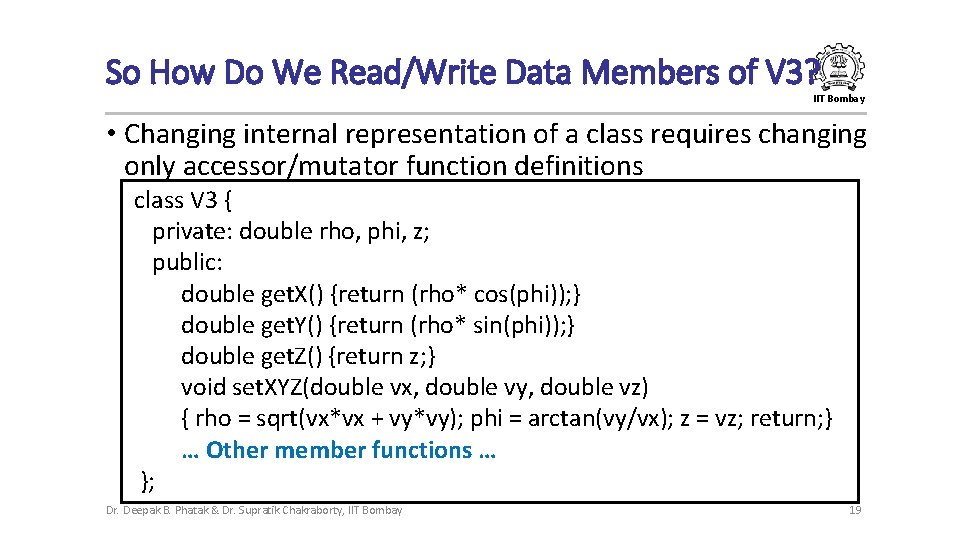
So How Do We Read/Write Data Members of V 3? IIT Bombay • Changing internal representation of a class requires changing only accessor/mutator function definitions class V 3 { private: double rho, phi, z; public: double get. X() {return (rho* cos(phi)); } double get. Y() {return (rho* sin(phi)); } double get. Z() {return z; } void set. XYZ(double vx, double vy, double vz) { rho = sqrt(vx*vx + vy*vy); phi = arctan(vy/vx); z = vz; return; } … Other member functions … }; Dr. Deepak B. Phatak & Dr. Supratik Chakraborty, IIT Bombay 19
Summary IIT Bombay • Controlling access to members in structures through “public” and “private” • A brief introduction to C++ classes Dr. Deepak B. Phatak & Dr. Supratik Chakraborty, IIT Bombay 20
- Slides: 20