
IIT Bombay Carnegie Mellon Graph structures in data
IIT Bombay Carnegie Mellon Graph structures in data mining Soumen Chakrabarti (IIT-Bombay) Christos Faloutsos (CMU) KDD 04 © 2004, S. Chakrabarti and C. Faloutsos 1
IIT Bombay Carnegie Mellon Thanks • Deepayan Chakrabarti (CMU) • Michalis Faloutsos (UCR) • George Siganos (UCR) KDD 04 © 2004, S. Chakrabarti and C. Faloutsos 2
![IIT Bombay Carnegie Mellon Introduction Internet Map [lumeta. com] Food Web [Martinez ’ 91]](http://slidetodoc.com/presentation_image/f8ed26c72b94af3eafdeae1d86f7e544/image-3.jpg "IIT Bombay Carnegie Mellon Introduction Internet Map [lumeta. com] Food Web [Martinez ’ 91]")
IIT Bombay Carnegie Mellon Introduction Internet Map [lumeta. com] Food Web [Martinez ’ 91] Protein Interactions [genomebiology. com] Graphs are everywhere! Friendship Network [Moody ’ 01] KDD 04 © 2004, S. Chakrabarti and C. Faloutsos 3
IIT Bombay Carnegie Mellon Graph structures in KDD • • Physical networks Physical Internet Telephone lines Commodity distribution networks KDD 04 © 2004, S. Chakrabarti and C. Faloutsos 4
IIT Bombay Carnegie Mellon Networks derived from "behavior" • • Telephone call patterns Email, Blogs, Web, Databases, XML Language processing Web of trust, epinions KDD 04 © 2004, S. Chakrabarti and C. Faloutsos 5
IIT Bombay Carnegie Mellon Outline Part 1: Topology, ‘laws’ and generators Part 2: Page. Rank, HITS and eigenvalues Part 3: Pairs, influence, communities Motivating questions: KDD 04 © 2004, S. Chakrabarti and C. Faloutsos 6
IIT Bombay Carnegie Mellon Part 1: Topology and generators • What do real graphs look like? • What properties of nodes, edges are important to model? • What local and global properties are important to measure? • How to model and generate realistic graphs? KDD 04 © 2004, S. Chakrabarti and C. Faloutsos 7
IIT Bombay Carnegie Mellon Part 2: Page. Rank, HITS and eigenvalues • How important is a node? • Who is the best person/computer to immunize against a virus? • Who is the best customer to advertise to? • Who originated a raging rumor? KDD 04 © 2004, S. Chakrabarti and C. Faloutsos 8
IIT Bombay Carnegie Mellon Part 3: Pairs, influence and communities • How similar are two nodes? • What does it mean to search for a node or a neighborhood? • How do nodes influence their neighbors? • Is "influence" a verb or a noun? KDD 04 © 2004, S. Chakrabarti and C. Faloutsos 9
IIT Bombay Carnegie Mellon PART 1: Topology, laws and generators KDD 04 © 2004, S. Chakrabarti and C. Faloutsos 10
IIT Bombay Carnegie Mellon Outline Part 1: Topology, ‘laws’ and generators • • • ‘Laws’ and patterns Generators Tools Part 2: Page. Rank, HITS and eigenvalues Part 3: Pairs, influence, communities KDD 04 © 2004, S. Chakrabarti and C. Faloutsos 11
IIT Bombay Carnegie Mellon Motivating questions • What do real graphs look like? – What properties of nodes, edges are important to model? – What local and global properties are important to measure? • How to generate realistic graphs? KDD 04 © 2004, S. Chakrabarti and C. Faloutsos 12
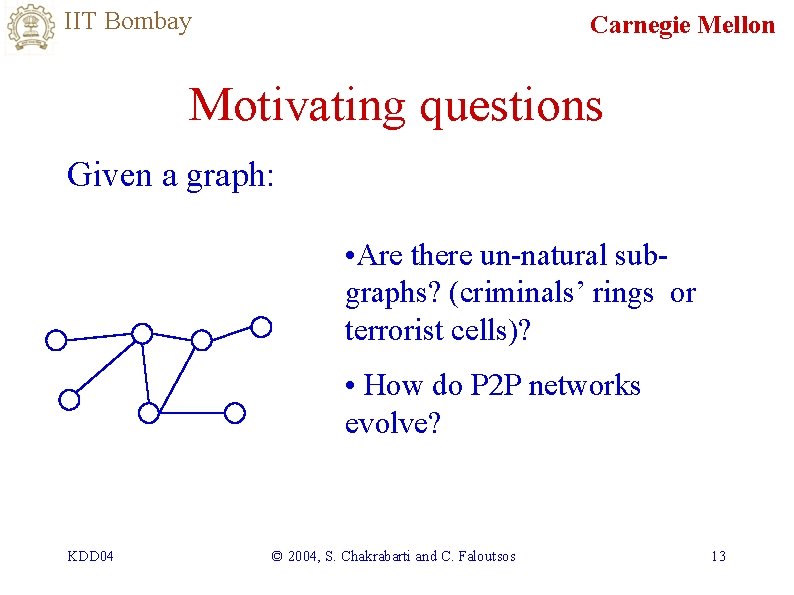
IIT Bombay Carnegie Mellon Motivating questions Given a graph: • Are there un-natural subgraphs? (criminals’ rings or terrorist cells)? • How do P 2 P networks evolve? KDD 04 © 2004, S. Chakrabarti and C. Faloutsos 13
![IIT Bombay Carnegie Mellon Why should we care? Internet Map [lumeta. com] Food Web](http://slidetodoc.com/presentation_image/f8ed26c72b94af3eafdeae1d86f7e544/image-14.jpg "IIT Bombay Carnegie Mellon Why should we care? Internet Map [lumeta. com] Food Web")
IIT Bombay Carnegie Mellon Why should we care? Internet Map [lumeta. com] Food Web [Martinez ’ 91] Protein Interactions [genomebiology. com] Friendship Network [Moody ’ 01] KDD 04 © 2004, S. Chakrabarti and C. Faloutsos 14
IIT Bombay Carnegie Mellon Why should we care? • A 1: extrapolations: how will the Internet/Web look like next year? • A 2: algorithm design: what is a realistic network topology, – to try a new routing protocol? – to study virus/rumor propagation, and immunization? KDD 04 © 2004, S. Chakrabarti and C. Faloutsos 15
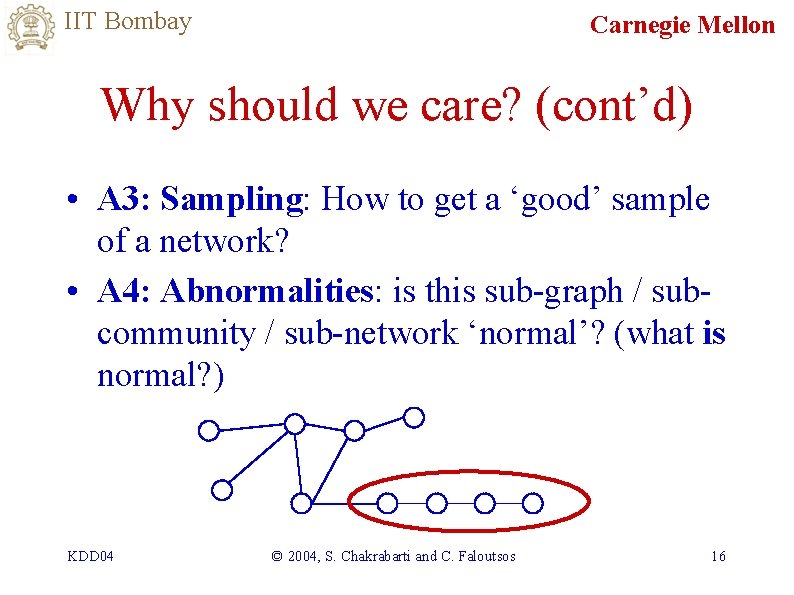
IIT Bombay Carnegie Mellon Why should we care? (cont’d) • A 3: Sampling: How to get a ‘good’ sample of a network? • A 4: Abnormalities: is this sub-graph / subcommunity / sub-network ‘normal’? (what is normal? ) KDD 04 © 2004, S. Chakrabarti and C. Faloutsos 16
IIT Bombay Carnegie Mellon Outline Part 1: Topology, ‘laws’ and generators • • • ‘Laws’ and patterns Generators Tools Part 2: Page. Rank, HITS and eigenvalues Part 3: Pairs, influence, communities KDD 04 © 2004, S. Chakrabarti and C. Faloutsos 17
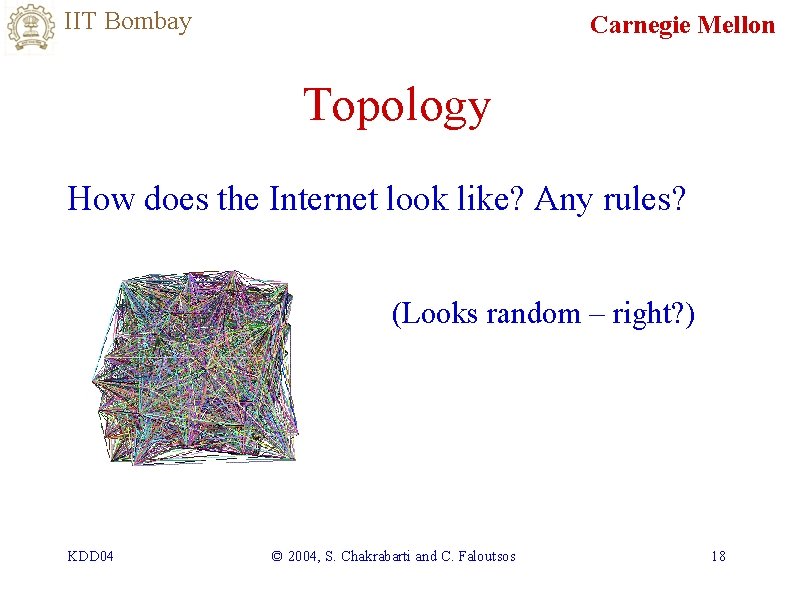
IIT Bombay Carnegie Mellon Topology How does the Internet look like? Any rules? (Looks random – right? ) KDD 04 © 2004, S. Chakrabarti and C. Faloutsos 18
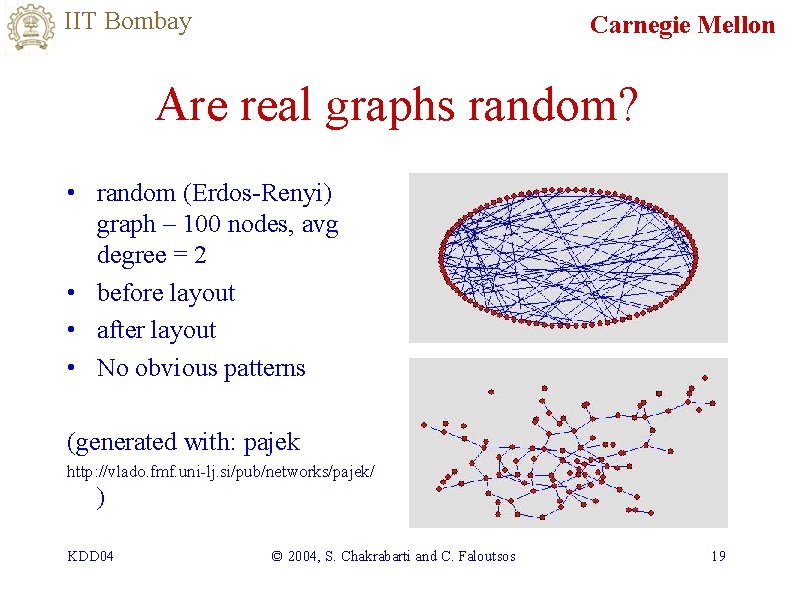
IIT Bombay Carnegie Mellon Are real graphs random? • random (Erdos-Renyi) graph – 100 nodes, avg degree = 2 • before layout • after layout • No obvious patterns (generated with: pajek http: //vlado. fmf. uni-lj. si/pub/networks/pajek/ ) KDD 04 © 2004, S. Chakrabarti and C. Faloutsos 19
IIT Bombay Carnegie Mellon Laws and patterns Real graphs are NOT random!! • Diameter • in- and out- degree distributions • other (surprising) patterns KDD 04 © 2004, S. Chakrabarti and C. Faloutsos 20
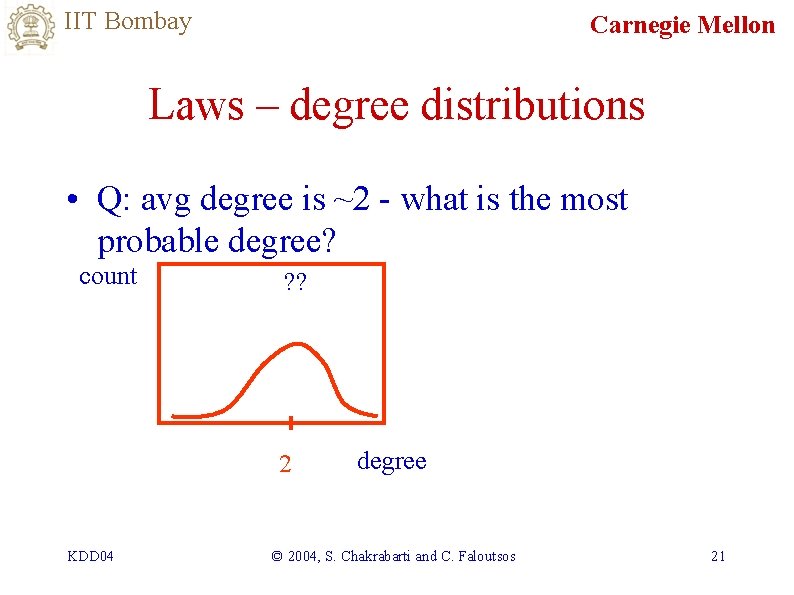
IIT Bombay Carnegie Mellon Laws – degree distributions • Q: avg degree is ~2 - what is the most probable degree? count ? ? 2 KDD 04 degree © 2004, S. Chakrabarti and C. Faloutsos 21
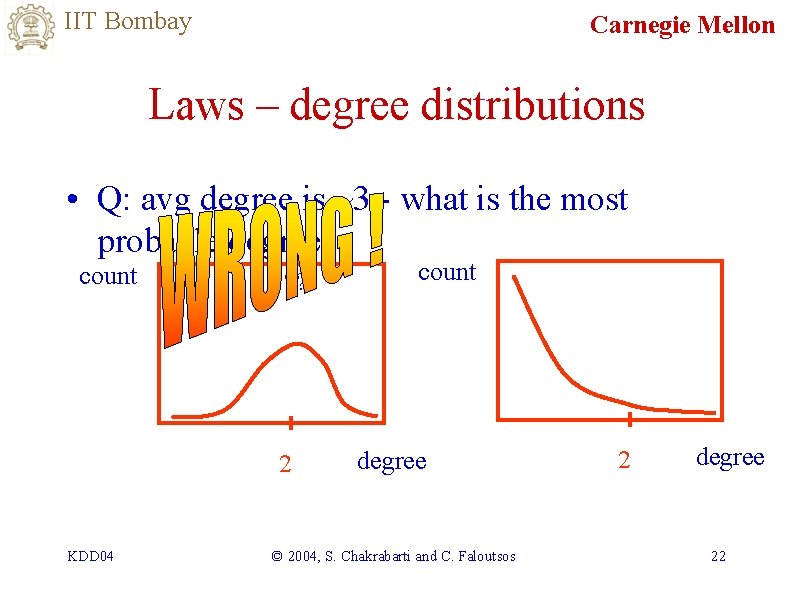
IIT Bombay Carnegie Mellon Laws – degree distributions • Q: avg degree is ~3 - what is the most probable degree? count ? ? 2 KDD 04 count degree © 2004, S. Chakrabarti and C. Faloutsos 2 degree 22
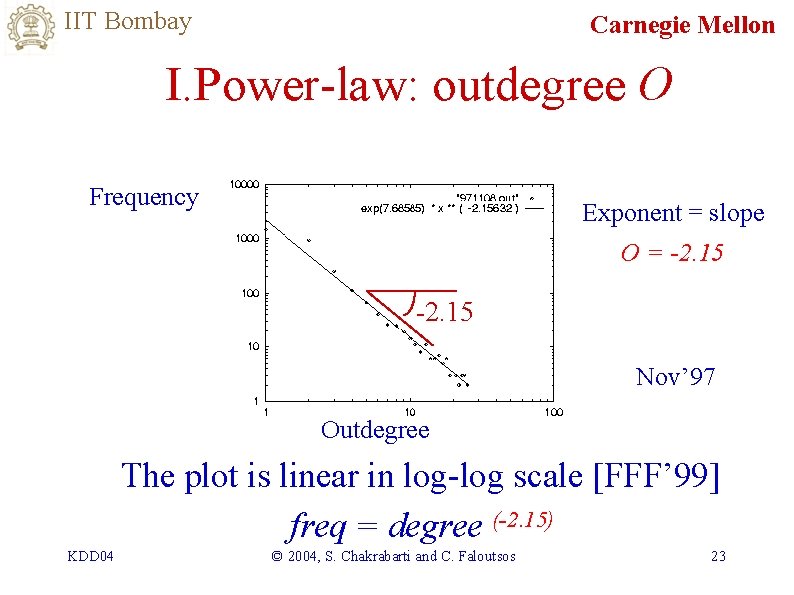
IIT Bombay Carnegie Mellon I. Power-law: outdegree O Frequency Exponent = slope O = -2. 15 Nov’ 97 Outdegree The plot is linear in log-log scale [FFF’ 99] freq = degree (-2. 15) KDD 04 © 2004, S. Chakrabarti and C. Faloutsos 23
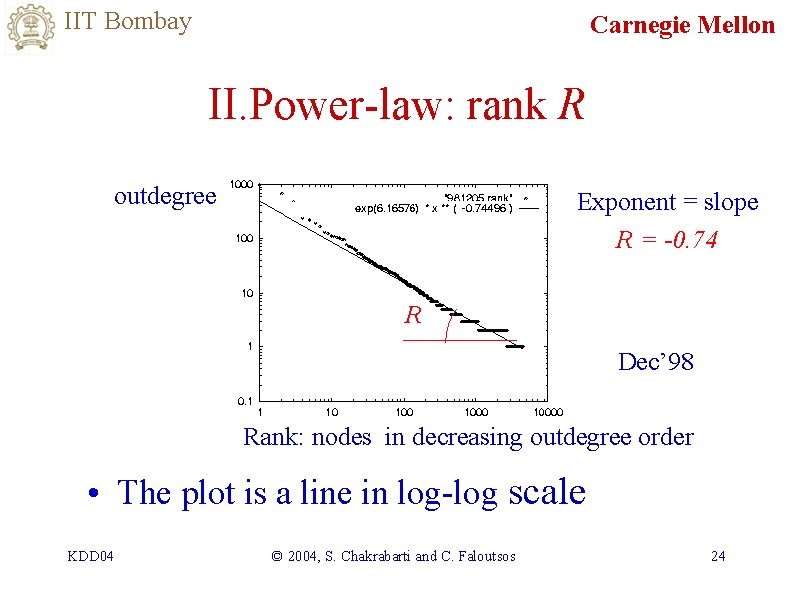
IIT Bombay Carnegie Mellon II. Power-law: rank R outdegree Exponent = slope R = -0. 74 R Dec’ 98 Rank: nodes in decreasing outdegree order • The plot is a line in log-log scale KDD 04 © 2004, S. Chakrabarti and C. Faloutsos 24
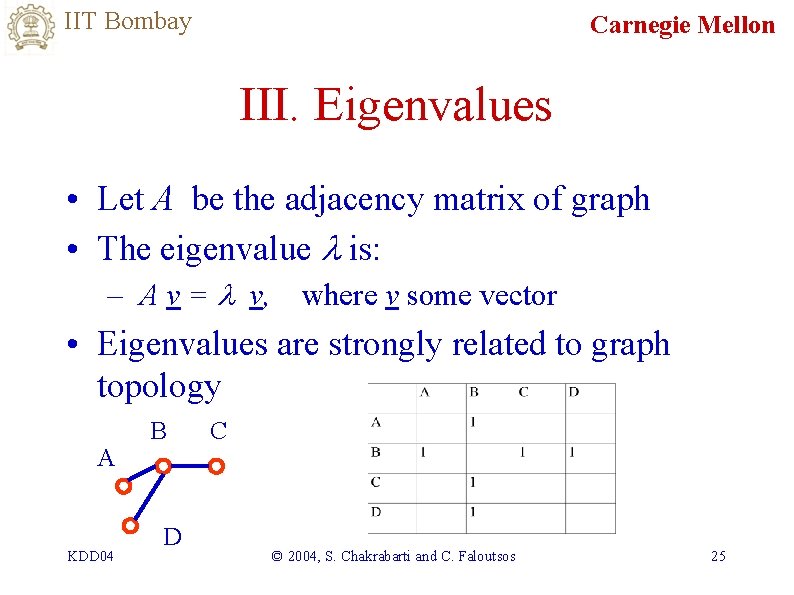
IIT Bombay Carnegie Mellon III. Eigenvalues • Let A be the adjacency matrix of graph • The eigenvalue is: – A v = v, where v some vector • Eigenvalues are strongly related to graph topology A KDD 04 B D C © 2004, S. Chakrabarti and C. Faloutsos 25
IIT Bombay Carnegie Mellon III. Eigenvalues MUCH more on eigenvalues: in Part 2 KDD 04 © 2004, S. Chakrabarti and C. Faloutsos 26
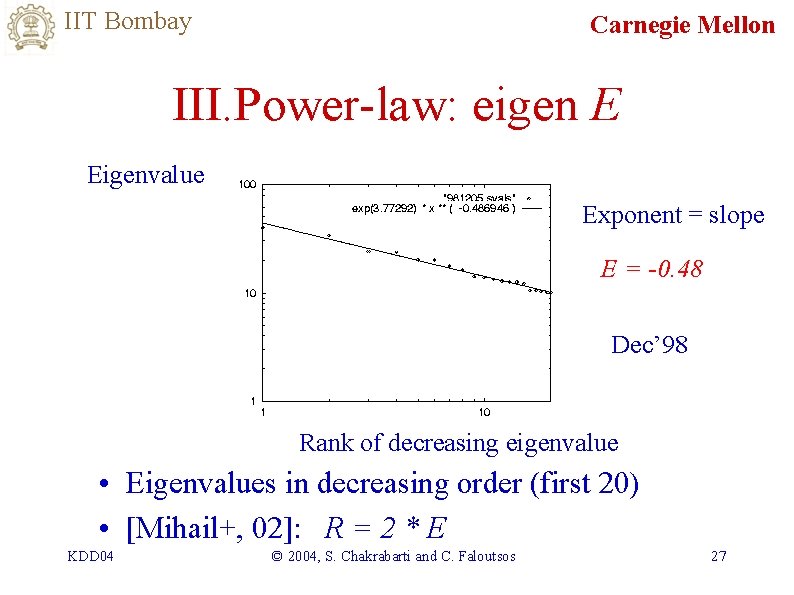
IIT Bombay Carnegie Mellon III. Power-law: eigen E Eigenvalue Exponent = slope E = -0. 48 Dec’ 98 Rank of decreasing eigenvalue • Eigenvalues in decreasing order (first 20) • [Mihail+, 02]: R = 2 * E KDD 04 © 2004, S. Chakrabarti and C. Faloutsos 27
IIT Bombay Carnegie Mellon IV. The Node Neighborhood • N(h) = # of pairs of nodes within h hops KDD 04 © 2004, S. Chakrabarti and C. Faloutsos 28
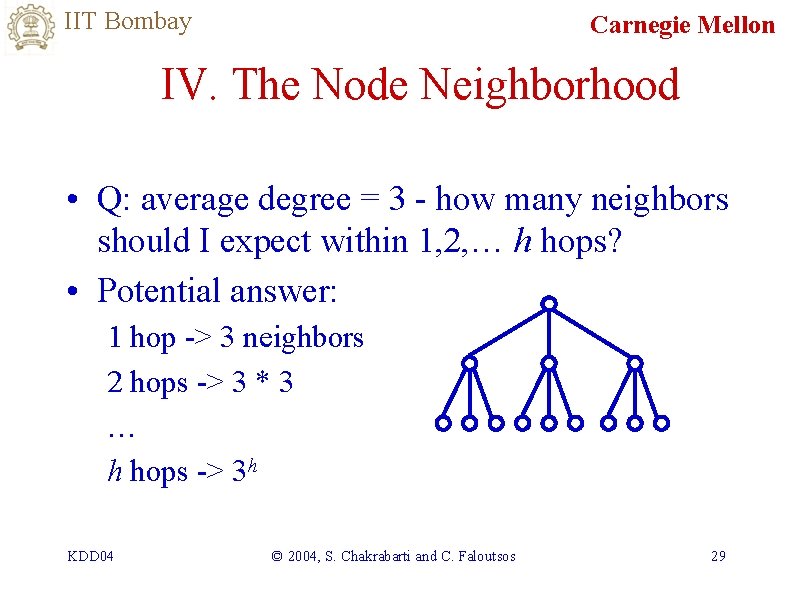
IIT Bombay Carnegie Mellon IV. The Node Neighborhood • Q: average degree = 3 - how many neighbors should I expect within 1, 2, … h hops? • Potential answer: 1 hop -> 3 neighbors 2 hops -> 3 * 3 … h hops -> 3 h KDD 04 © 2004, S. Chakrabarti and C. Faloutsos 29
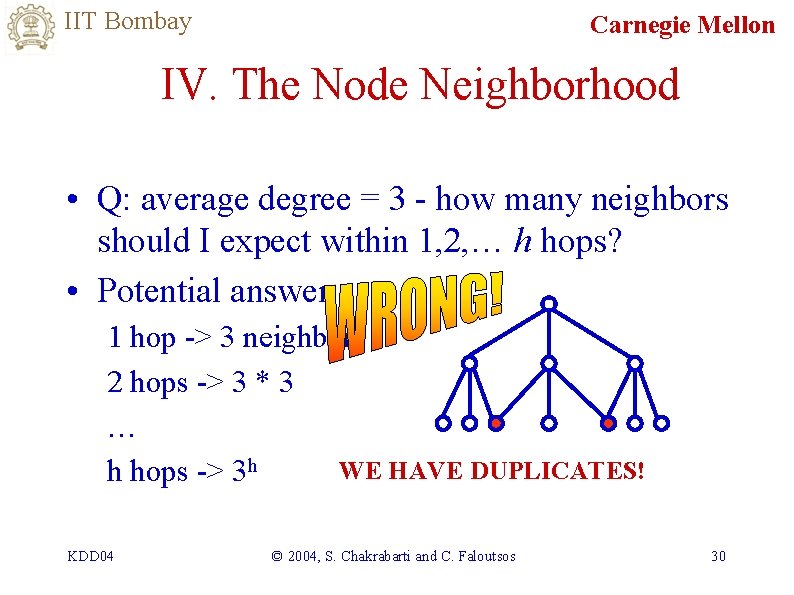
IIT Bombay Carnegie Mellon IV. The Node Neighborhood • Q: average degree = 3 - how many neighbors should I expect within 1, 2, … h hops? • Potential answer: 1 hop -> 3 neighbors 2 hops -> 3 * 3 … WE HAVE DUPLICATES! h hops -> 3 h KDD 04 © 2004, S. Chakrabarti and C. Faloutsos 30
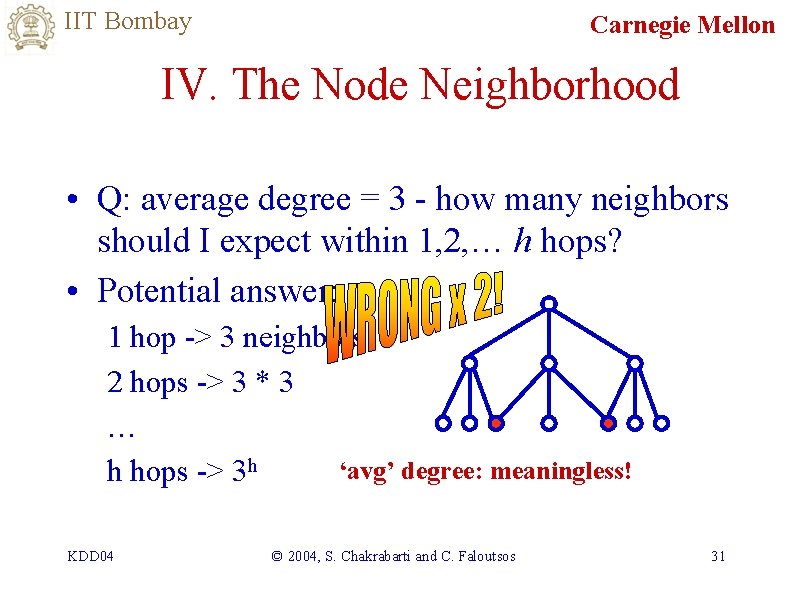
IIT Bombay Carnegie Mellon IV. The Node Neighborhood • Q: average degree = 3 - how many neighbors should I expect within 1, 2, … h hops? • Potential answer: 1 hop -> 3 neighbors 2 hops -> 3 * 3 … ‘avg’ degree: meaningless! h hops -> 3 h KDD 04 © 2004, S. Chakrabarti and C. Faloutsos 31
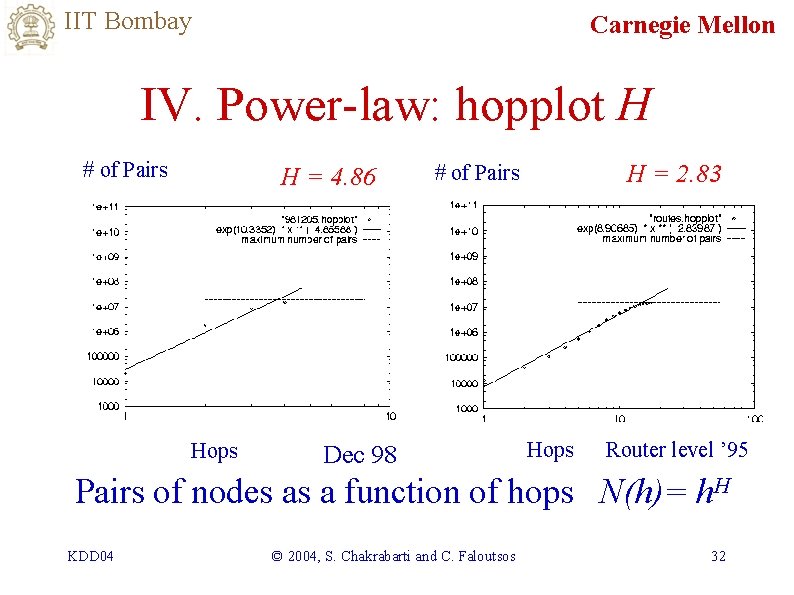
IIT Bombay Carnegie Mellon IV. Power-law: hopplot H # of Pairs H = 4. 86 Hops H = 2. 83 # of Pairs Dec 98 Hops Router level ’ 95 Pairs of nodes as a function of hops N(h)= h. H KDD 04 © 2004, S. Chakrabarti and C. Faloutsos 32
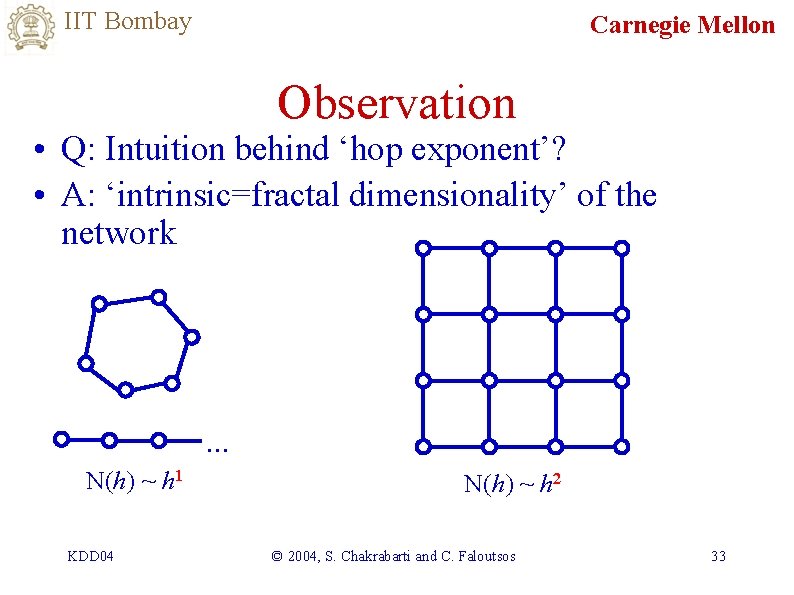
IIT Bombay Carnegie Mellon Observation • Q: Intuition behind ‘hop exponent’? • A: ‘intrinsic=fractal dimensionality’ of the network . . . N(h) ~ h 1 KDD 04 N(h) ~ h 2 © 2004, S. Chakrabarti and C. Faloutsos 33
IIT Bombay Carnegie Mellon Hop plots • More on fractal/intrinsic dimensionalities: very soon KDD 04 © 2004, S. Chakrabarti and C. Faloutsos 34
IIT Bombay Carnegie Mellon But: • Q 1: How about graphs from other domains? • Q 2: How about temporal evolution? KDD 04 © 2004, S. Chakrabarti and C. Faloutsos 35
![IIT Bombay Carnegie Mellon The Peer-to-Peer Topology [Jovanovic+] • Frequency versus degree • Number](http://slidetodoc.com/presentation_image/f8ed26c72b94af3eafdeae1d86f7e544/image-36.jpg "IIT Bombay Carnegie Mellon The Peer-to-Peer Topology [Jovanovic+] • Frequency versus degree • Number")
IIT Bombay Carnegie Mellon The Peer-to-Peer Topology [Jovanovic+] • Frequency versus degree • Number of adjacent peers follows a power-law KDD 04 © 2004, S. Chakrabarti and C. Faloutsos 36
IIT Bombay Carnegie Mellon More Power laws • Also hold for other web graphs [Barabasi+, ‘ 99], [Kumar+, ‘ 99] with additional ‘rules’ (bi-partite cores follow power laws) KDD 04 © 2004, S. Chakrabarti and C. Faloutsos 37
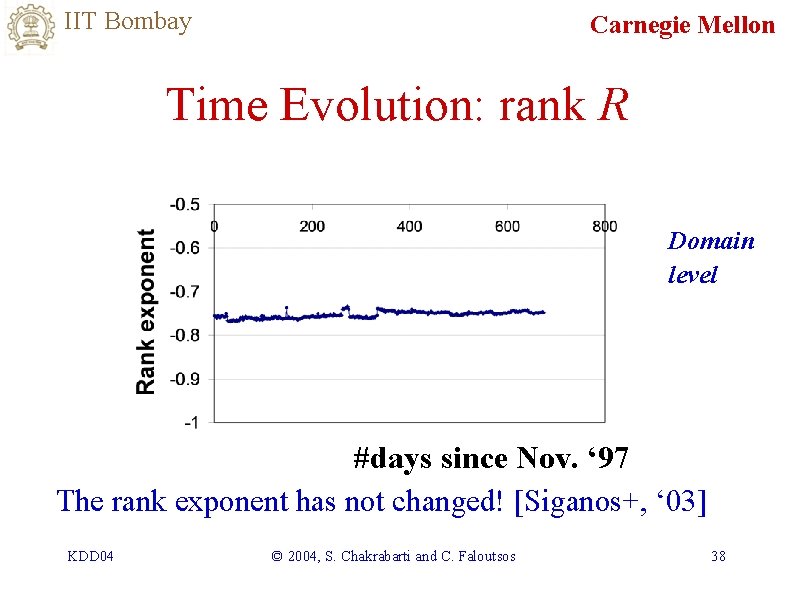
IIT Bombay Carnegie Mellon Time Evolution: rank R Domain level #days since Nov. ‘ 97 The rank exponent has not changed! [Siganos+, ‘ 03] KDD 04 © 2004, S. Chakrabarti and C. Faloutsos 38
IIT Bombay Carnegie Mellon Outline Part 1: Topology, ‘laws’ and generators • ‘Laws’ and patterns • • Power laws for degree, eigenvalues, hop-plot ? ? ? Generators Tools Part 2: Page. Rank, HITS and eigenvalues Part 3: Pairs, influence, communities KDD 04 © 2004, S. Chakrabarti and C. Faloutsos 39
IIT Bombay Carnegie Mellon Any other ‘laws’? Yes! KDD 04 © 2004, S. Chakrabarti and C. Faloutsos 40
IIT Bombay Carnegie Mellon Any other ‘laws’? Yes! • Small diameter (~ constant!) – – six degrees of separation / ‘Kevin Bacon’ – small worlds [Watts and Strogatz] KDD 04 © 2004, S. Chakrabarti and C. Faloutsos 41
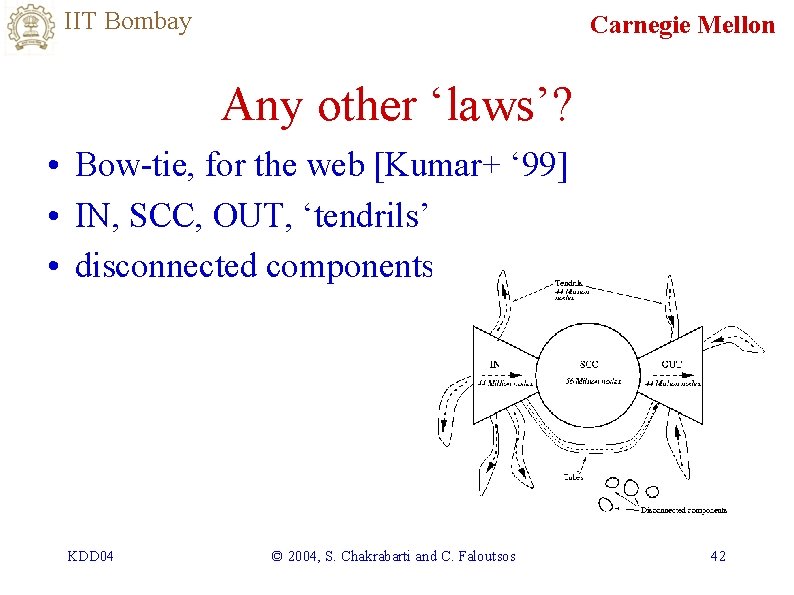
IIT Bombay Carnegie Mellon Any other ‘laws’? • Bow-tie, for the web [Kumar+ ‘ 99] • IN, SCC, OUT, ‘tendrils’ • disconnected components KDD 04 © 2004, S. Chakrabarti and C. Faloutsos 42
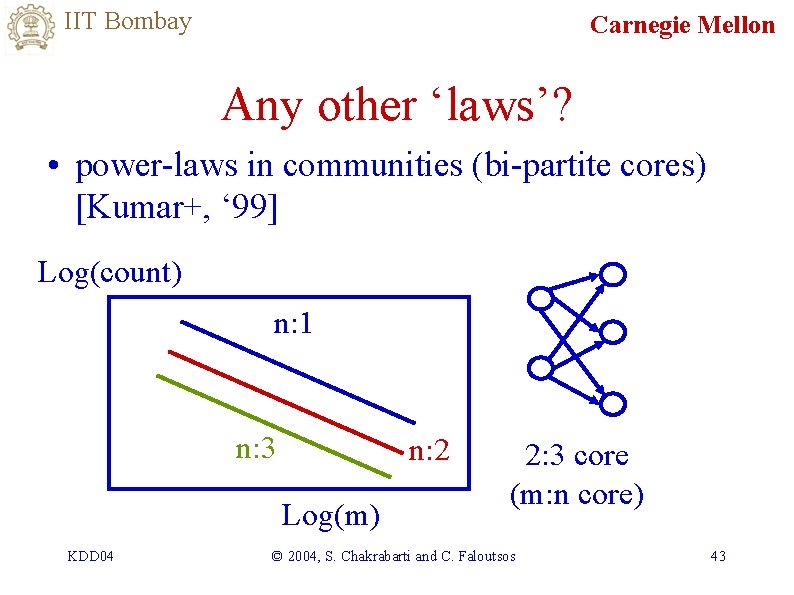
IIT Bombay Carnegie Mellon Any other ‘laws’? • power-laws in communities (bi-partite cores) [Kumar+, ‘ 99] Log(count) n: 1 n: 3 n: 2 Log(m) KDD 04 2: 3 core (m: n core) © 2004, S. Chakrabarti and C. Faloutsos 43
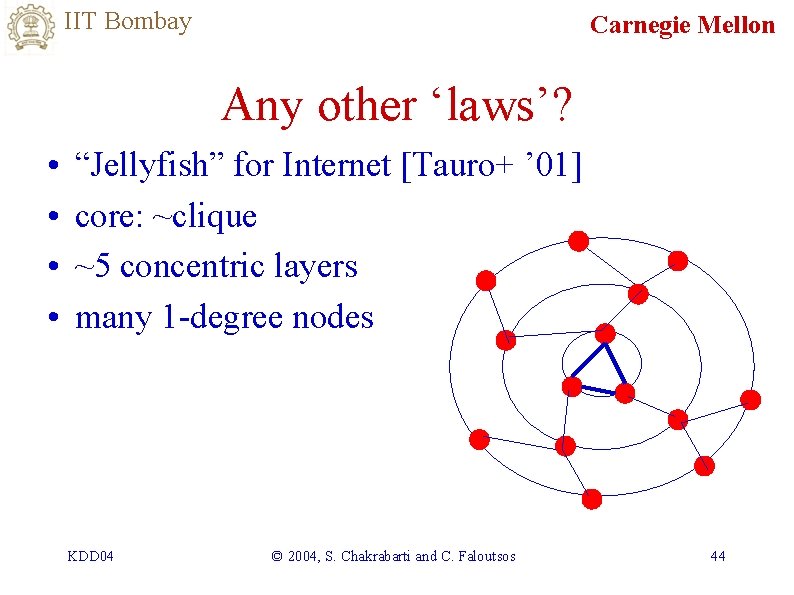
IIT Bombay Carnegie Mellon Any other ‘laws’? • • “Jellyfish” for Internet [Tauro+ ’ 01] core: ~clique ~5 concentric layers many 1 -degree nodes KDD 04 © 2004, S. Chakrabarti and C. Faloutsos 44
IIT Bombay Carnegie Mellon Summary of ‘laws’ • • Power laws for degree distributions …………. . . for eigenvalues, bi-partite cores Small diameter (‘ 6 degrees’) ‘Bow-tie’ for web; ‘jelly-fish’ for internet KDD 04 © 2004, S. Chakrabarti and C. Faloutsos 45
IIT Bombay Carnegie Mellon Outline Part 1: Topology, ‘laws’ and generators • • • ‘Laws’ and patterns Generators Tools Part 2: Page. Rank, HITS and eigenvalues Part 3: Pairs, influence, communities KDD 04 © 2004, S. Chakrabarti and C. Faloutsos 46
IIT Bombay Carnegie Mellon Generators • How to generate random, realistic graphs? – Erdos-Renyi model: beautiful, but unrealistic – degree-based generators – process-based generators KDD 04 © 2004, S. Chakrabarti and C. Faloutsos 47
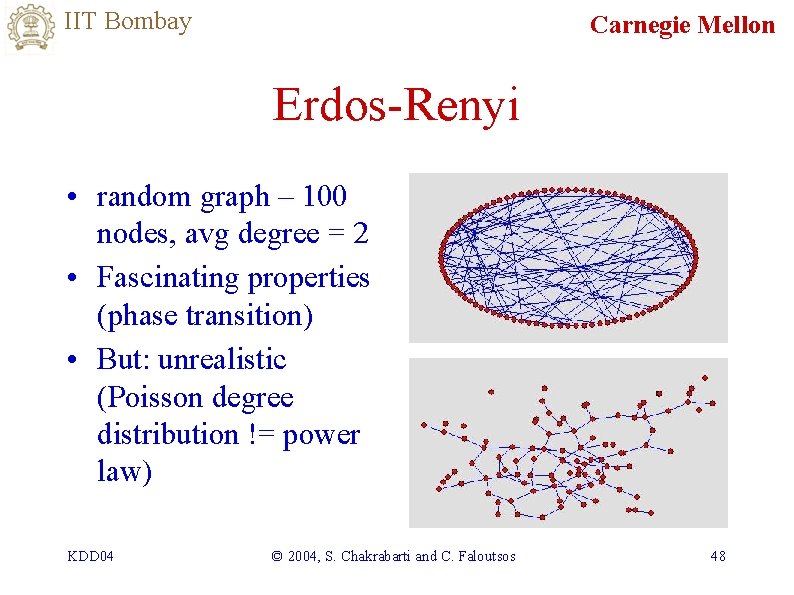
IIT Bombay Carnegie Mellon Erdos-Renyi • random graph – 100 nodes, avg degree = 2 • Fascinating properties (phase transition) • But: unrealistic (Poisson degree distribution != power law) KDD 04 © 2004, S. Chakrabarti and C. Faloutsos 48
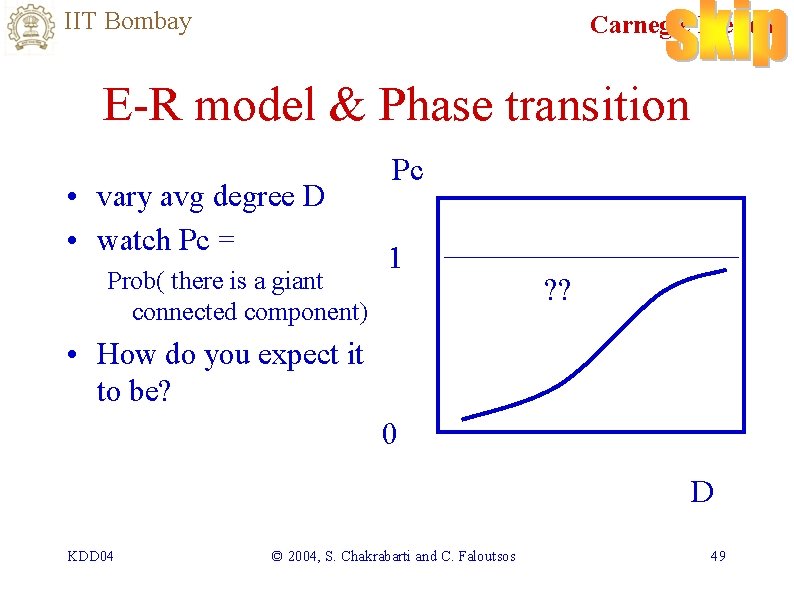
IIT Bombay Carnegie Mellon E-R model & Phase transition • vary avg degree D • watch Pc = Prob( there is a giant connected component) Pc 1 ? ? • How do you expect it to be? 0 D KDD 04 © 2004, S. Chakrabarti and C. Faloutsos 49
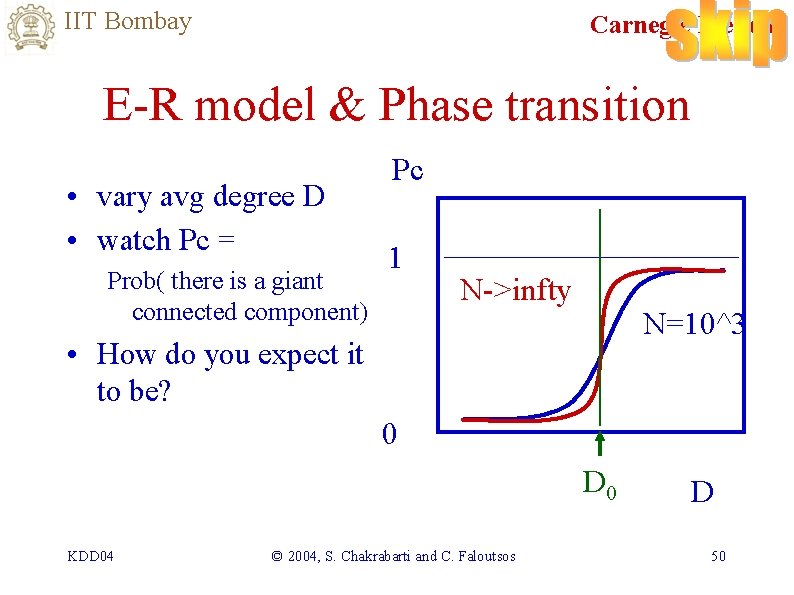
IIT Bombay Carnegie Mellon E-R model & Phase transition • vary avg degree D • watch Pc = Prob( there is a giant connected component) Pc 1 N->infty N=10^3 • How do you expect it to be? 0 D 0 KDD 04 © 2004, S. Chakrabarti and C. Faloutsos D 50
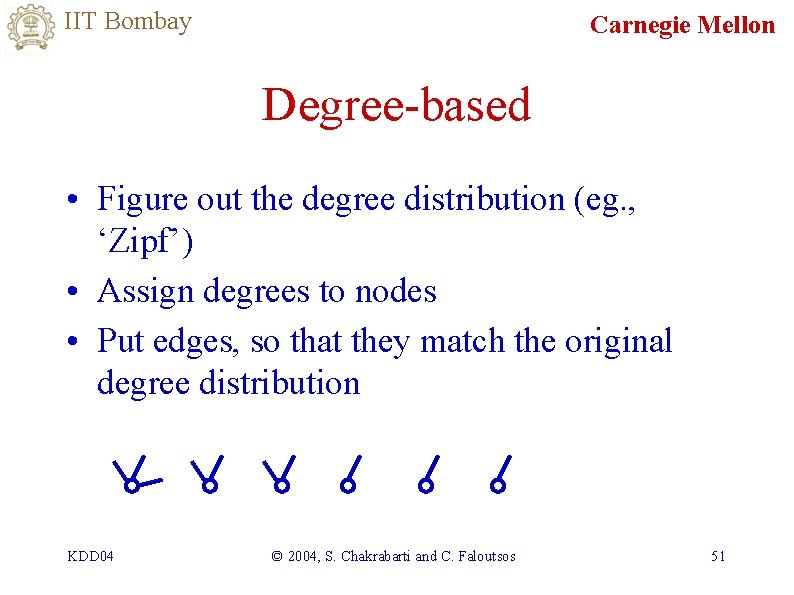
IIT Bombay Carnegie Mellon Degree-based • Figure out the degree distribution (eg. , ‘Zipf’) • Assign degrees to nodes • Put edges, so that they match the original degree distribution KDD 04 © 2004, S. Chakrabarti and C. Faloutsos 51
IIT Bombay Carnegie Mellon Process-based • Barabasi; Barabasi-Albert: Preferential attachment -> power-law tails! – ‘rich get richer’ • [Kumar+]: preferential attachment + mimick – Create ‘communities’ KDD 04 © 2004, S. Chakrabarti and C. Faloutsos 52
![IIT Bombay Carnegie Mellon Process-based (cont’d) • [Fabrikant+, ‘ 02]: H. O. T. :](http://slidetodoc.com/presentation_image/f8ed26c72b94af3eafdeae1d86f7e544/image-53.jpg "IIT Bombay Carnegie Mellon Process-based (cont’d) • [Fabrikant+, ‘ 02]: H. O. T. :")
IIT Bombay Carnegie Mellon Process-based (cont’d) • [Fabrikant+, ‘ 02]: H. O. T. : connect to closest, high connectivity neighbor • [Pennock+, ‘ 02]: Winner does NOT take all KDD 04 © 2004, S. Chakrabarti and C. Faloutsos 53
![IIT Bombay Carnegie Mellon R-MAT • Recursive MATrix generator [Chakrabarti+, ’ 04] • Goals:](http://slidetodoc.com/presentation_image/f8ed26c72b94af3eafdeae1d86f7e544/image-54.jpg "IIT Bombay Carnegie Mellon R-MAT • Recursive MATrix generator [Chakrabarti+, ’ 04] • Goals:")
IIT Bombay Carnegie Mellon R-MAT • Recursive MATrix generator [Chakrabarti+, ’ 04] • Goals: – Power-law in- and out-degrees – Power law eigenvalues – Small diameter – Few parameters KDD 04 © 2004, S. Chakrabarti and C. Faloutsos 54
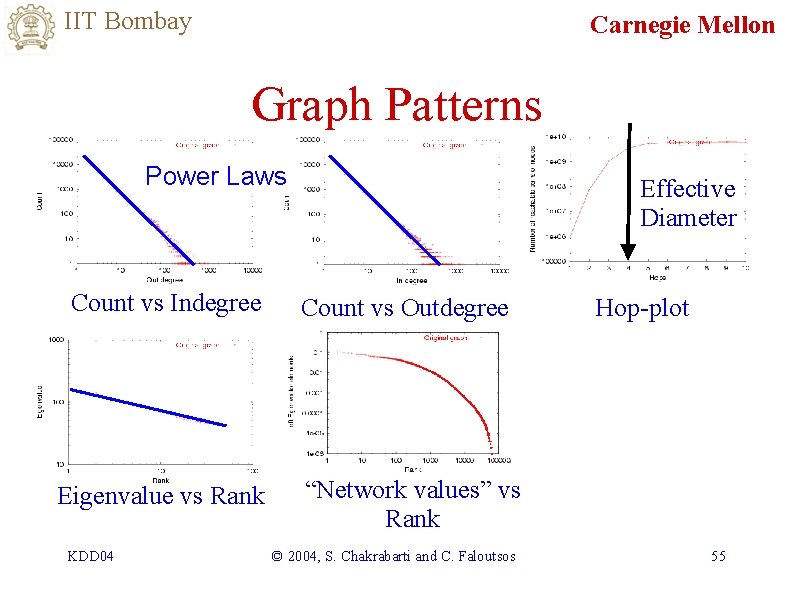
IIT Bombay Carnegie Mellon Graph Patterns Power Laws Count vs Indegree Eigenvalue vs Rank KDD 04 Effective Diameter Count vs Outdegree “Network values” vs Rank © 2004, S. Chakrabarti and C. Faloutsos Hop-plot Count vs edge-stress 55
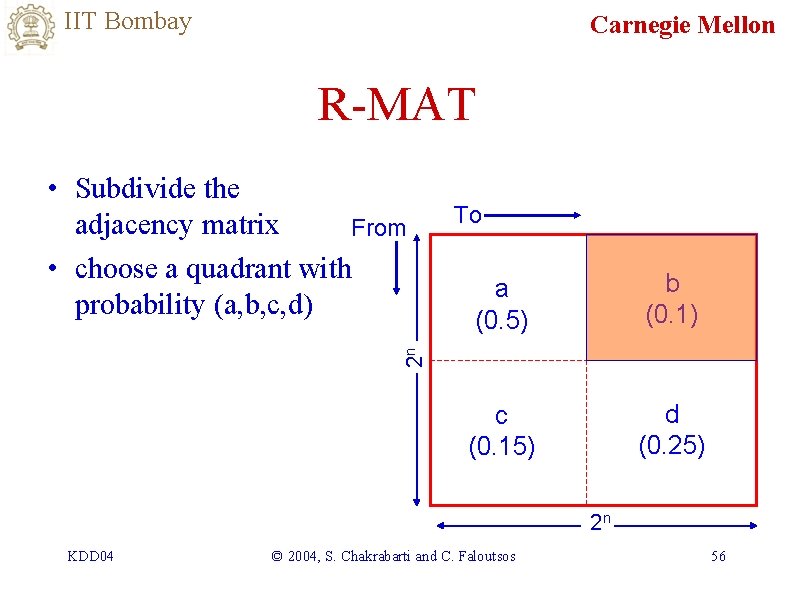
IIT Bombay Carnegie Mellon R-MAT To a (0. 5) b (0. 1) c (0. 15) d (0. 25) 2 n • Subdivide the adjacency matrix From • choose a quadrant with probability (a, b, c, d) 2 n KDD 04 © 2004, S. Chakrabarti and C. Faloutsos 56
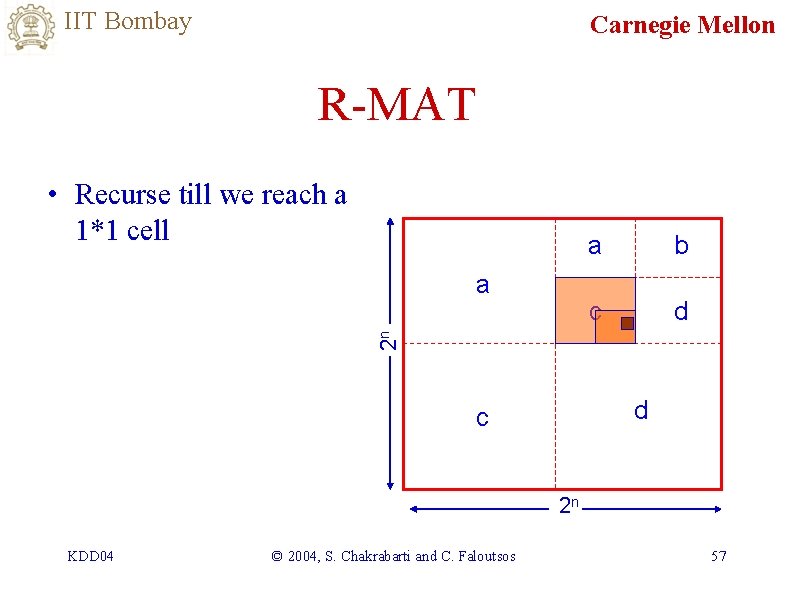
IIT Bombay Carnegie Mellon R-MAT • Recurse till we reach a 1*1 cell b c d 2 n a a d c 2 n KDD 04 © 2004, S. Chakrabarti and C. Faloutsos 57
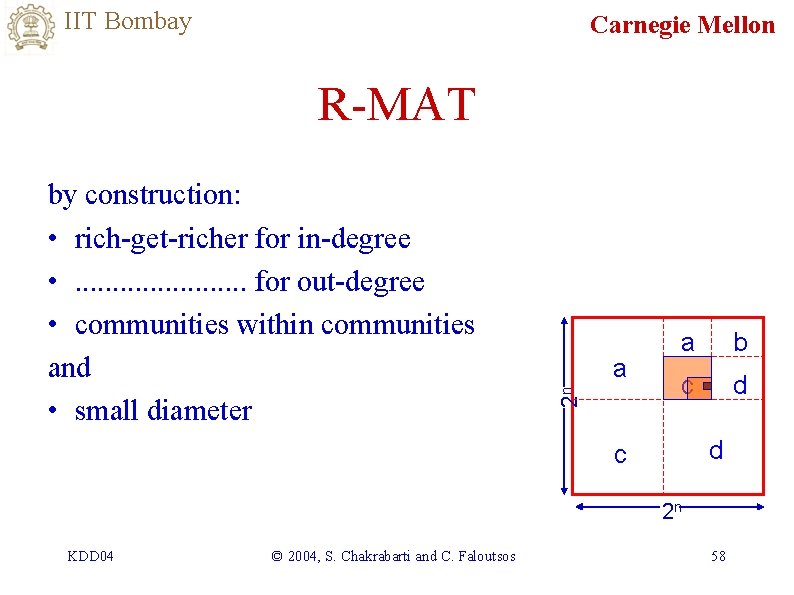
IIT Bombay Carnegie Mellon R-MAT a 2 n by construction: • rich-get-richer for in-degree • . . . for out-degree • communities within communities and • small diameter a b c d d c 2 n KDD 04 © 2004, S. Chakrabarti and C. Faloutsos 58
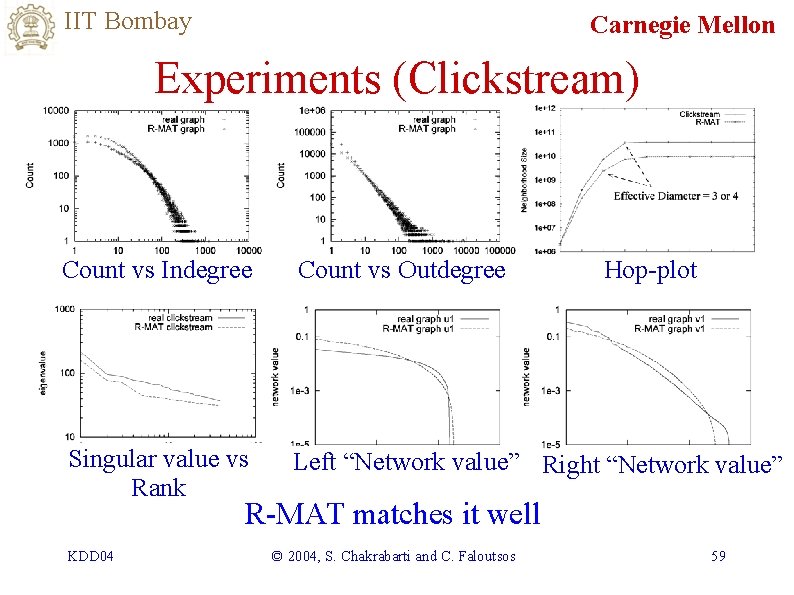
IIT Bombay Carnegie Mellon Experiments (Clickstream) Count vs Indegree Count vs Outdegree Hop-plot Singular value vs Rank Left “Network value” Right “Network value” R-MAT matches it well KDD 04 © 2004, S. Chakrabarti and C. Faloutsos 59
IIT Bombay Carnegie Mellon Conclusions ‘Laws’ and patterns: • • • KDD 04 Power laws for degrees, eigenvalues, ‘communities’/cores Small diameter Bow-tie; jelly-fish © 2004, S. Chakrabarti and C. Faloutsos 60
IIT Bombay Carnegie Mellon Conclusions, cont’d Generators • Preferential attachment (Barabasi) • Variations • Recursion – RMAT KDD 04 © 2004, S. Chakrabarti and C. Faloutsos 61
IIT Bombay Carnegie Mellon Conclusions, cont’d Tools • Power laws – rank/frequency plots • Self-similarity / recursion / fractals • ‘correlation integral’ = hop-plot KDD 04 © 2004, S. Chakrabarti and C. Faloutsos 62
IIT Bombay Carnegie Mellon Resources Generators: • RMAT (deepay@cs. cmu. edu) • BRITE http: //www. cs. bu. edu/brite/ • INET: http: //topology. eecs. umich. edu/inet KDD 04 © 2004, S. Chakrabarti and C. Faloutsos 63
IIT Bombay Carnegie Mellon Other resources Visualization - graph algo’s: • Graphviz: http: //www. graphviz. org/ • pajek: http: //vlado. fmf. unilj. si/pub/networks/pajek/ Kevin Bacon web site: http: //www. cs. virginia. edu/oracle/ KDD 04 © 2004, S. Chakrabarti and C. Faloutsos 64
IIT Bombay Carnegie Mellon Outline Part 1: Topology, ‘laws’ and generators • • • ‘Laws’ and patterns Generators Tools Part 2: Page. Rank, HITS and eigenvalues Part 3: Pairs, influence, communities KDD 04 © 2004, S. Chakrabarti and C. Faloutsos 65
IIT Bombay Carnegie Mellon Outline Part 1: Topology, ‘laws’ and generators • • • ‘Laws’ and patterns Generators Tools: power laws and fractals • • KDD 04 Why so many power laws? Self-similarity, power laws, fractal dimension © 2004, S. Chakrabarti and C. Faloutsos 66
IIT Bombay Carnegie Mellon Power laws • • Q 1: Why so many? A 1: Q 2: Are they only in graph-related settings? A 2: KDD 04 © 2004, S. Chakrabarti and C. Faloutsos 67
IIT Bombay Carnegie Mellon Power laws • • Q 1: Why so many? A 1: self-similarity; ‘rich-get-richer’ Q 2: Are they only in graph-related settings? A 2: NO! KDD 04 © 2004, S. Chakrabarti and C. Faloutsos 68
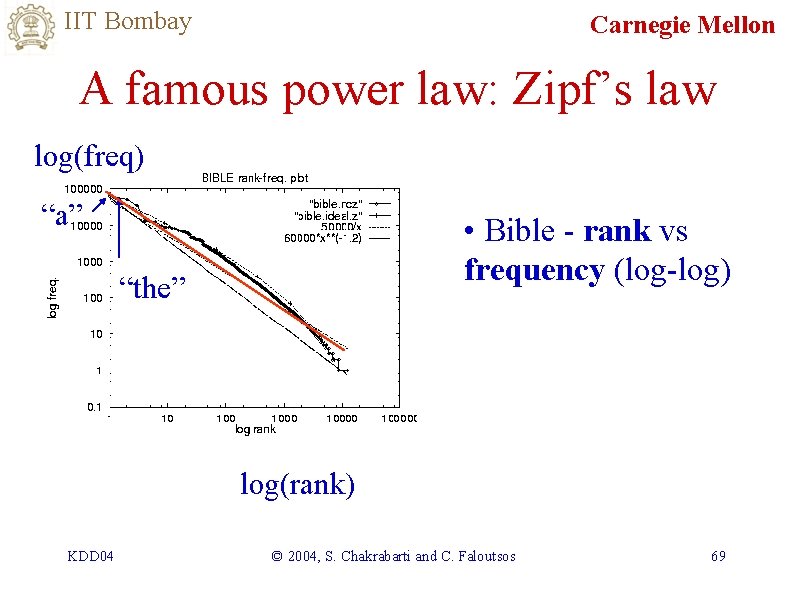
IIT Bombay Carnegie Mellon A famous power law: Zipf’s law log(freq) “a” • Bible - rank vs frequency (log-log) “the” log(rank) KDD 04 © 2004, S. Chakrabarti and C. Faloutsos 69
![IIT Bombay Carnegie Mellon Power laws, cont’ed • length of file transfers [Bestavros+] •](http://slidetodoc.com/presentation_image/f8ed26c72b94af3eafdeae1d86f7e544/image-70.jpg "IIT Bombay Carnegie Mellon Power laws, cont’ed • length of file transfers [Bestavros+] •")
IIT Bombay Carnegie Mellon Power laws, cont’ed • length of file transfers [Bestavros+] • web hit counts [Huberman] • Click-stream data [Montgomery+01] KDD 04 © 2004, S. Chakrabarti and C. Faloutsos 70
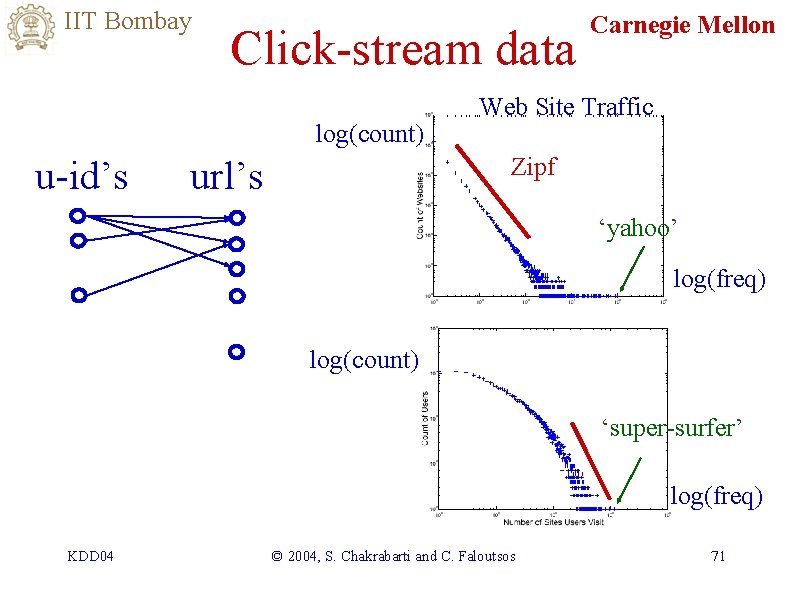
IIT Bombay Click-stream data log(count) u-id’s Carnegie Mellon Web Site Traffic Zipf url’s ‘yahoo’ log(freq) log(count) ‘super-surfer’ log(freq) KDD 04 © 2004, S. Chakrabarti and C. Faloutsos 71
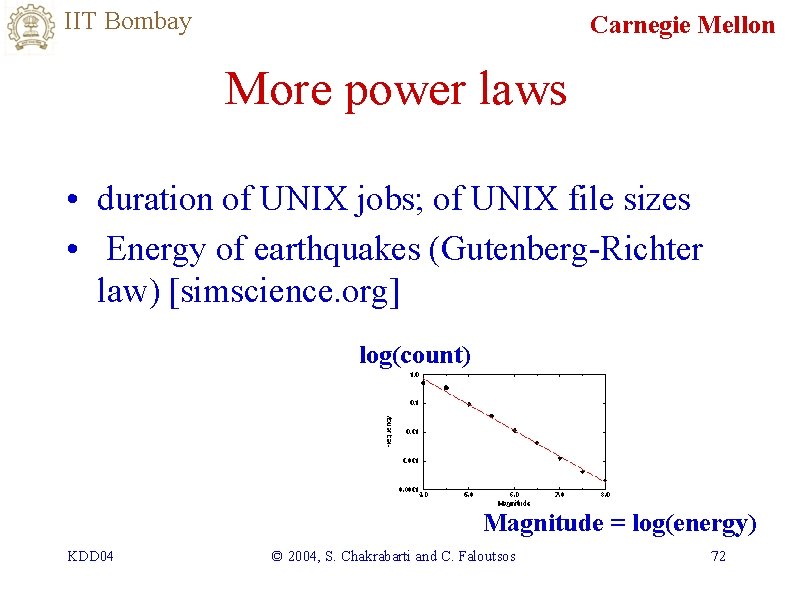
IIT Bombay Carnegie Mellon More power laws • duration of UNIX jobs; of UNIX file sizes • Energy of earthquakes (Gutenberg-Richter law) [simscience. org] Energy released log(count) day KDD 04 Magnitude = log(energy) © 2004, S. Chakrabarti and C. Faloutsos 72
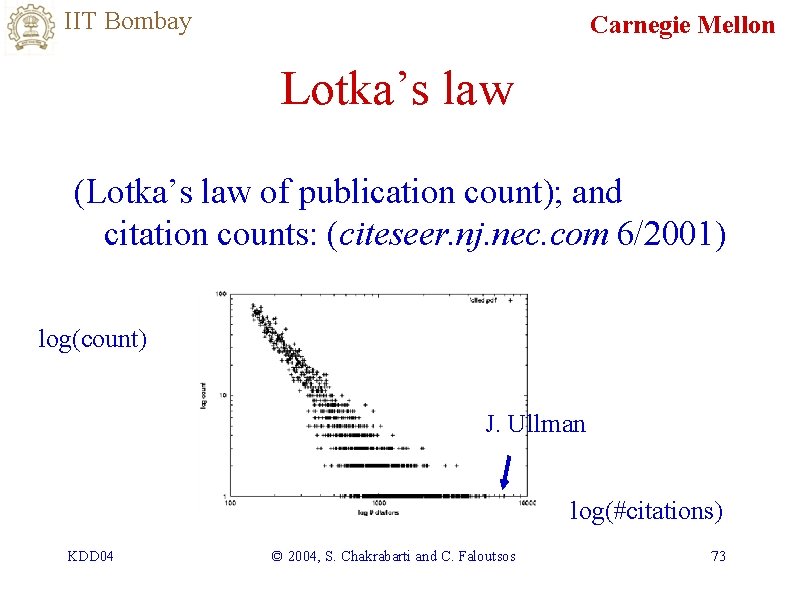
IIT Bombay Carnegie Mellon Lotka’s law (Lotka’s law of publication count); and citation counts: (citeseer. nj. nec. com 6/2001) log(count) J. Ullman log(#citations) KDD 04 © 2004, S. Chakrabarti and C. Faloutsos 73
IIT Bombay Carnegie Mellon Korcak’s law Scandinavian lakes Any pattern? KDD 04 © 2004, S. Chakrabarti and C. Faloutsos 74
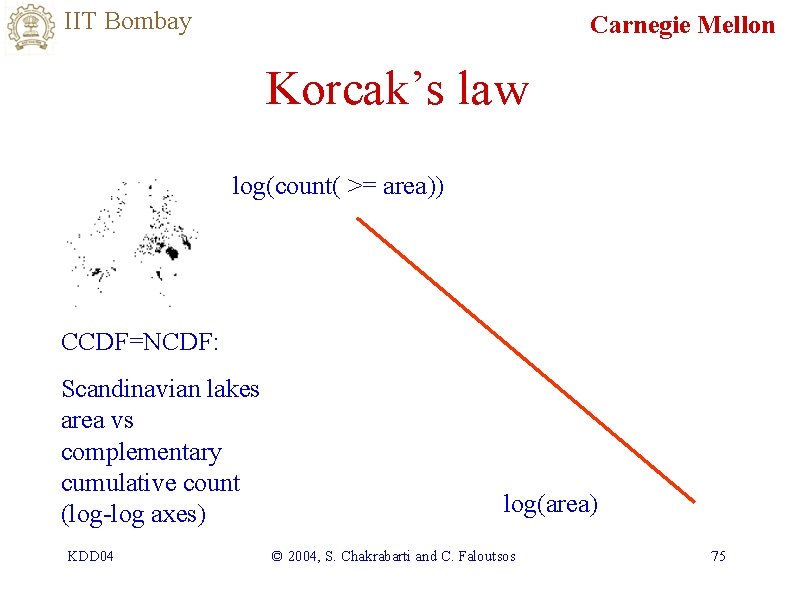
IIT Bombay Carnegie Mellon Korcak’s law log(count( >= area)) CCDF=NCDF: Scandinavian lakes area vs complementary cumulative count (log-log axes) KDD 04 log(area) © 2004, S. Chakrabarti and C. Faloutsos 75
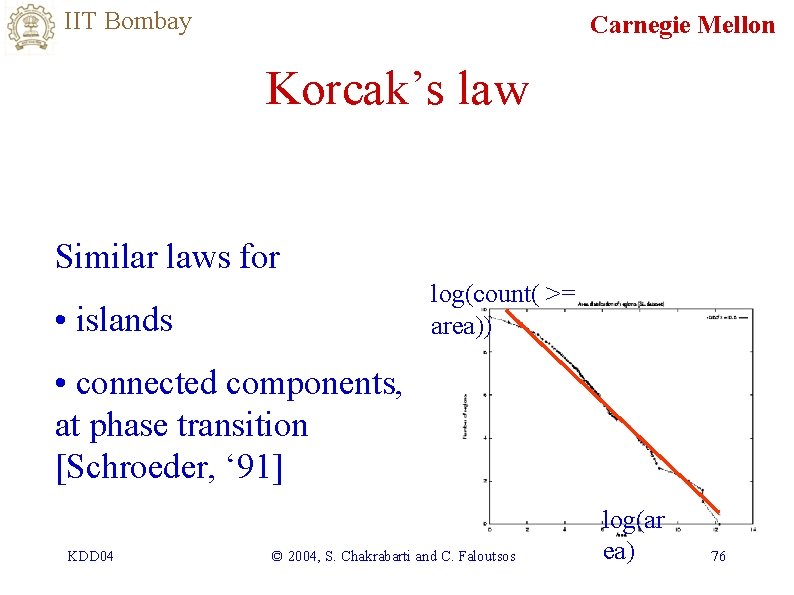
IIT Bombay Carnegie Mellon Korcak’s law Similar laws for log(count( >= area)) • islands • connected components, at phase transition [Schroeder, ‘ 91] KDD 04 © 2004, S. Chakrabarti and C. Faloutsos log(ar ea) 76
IIT Bombay Carnegie Mellon Power laws • • Q 1: Why so many? A 1: self-similarity; ‘rich-get-richer’ Q 2: Are they only in graph-related settings? A 2: NO! KDD 04 © 2004, S. Chakrabarti and C. Faloutsos 77
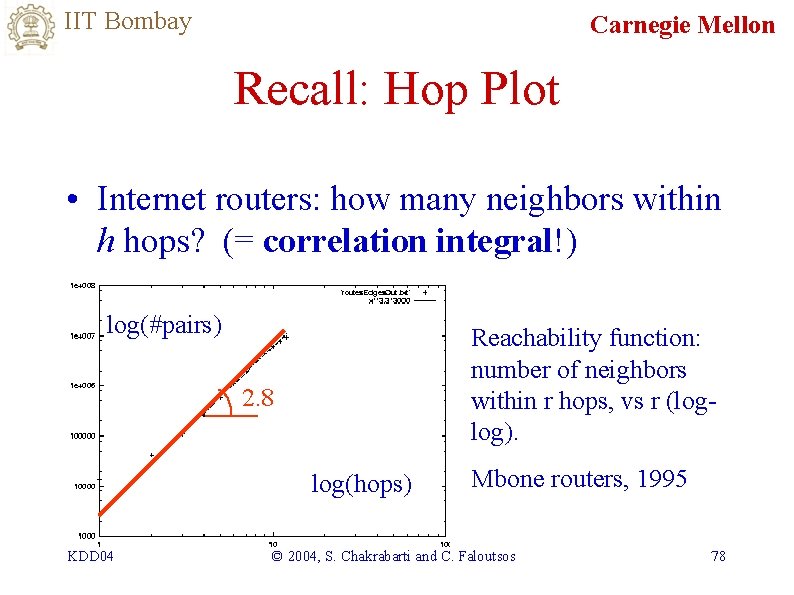
IIT Bombay Carnegie Mellon Recall: Hop Plot • Internet routers: how many neighbors within h hops? (= correlation integral!) log(#pairs) Reachability function: number of neighbors within r hops, vs r (loglog). 2. 8 log(hops) KDD 04 Mbone routers, 1995 © 2004, S. Chakrabarti and C. Faloutsos 78
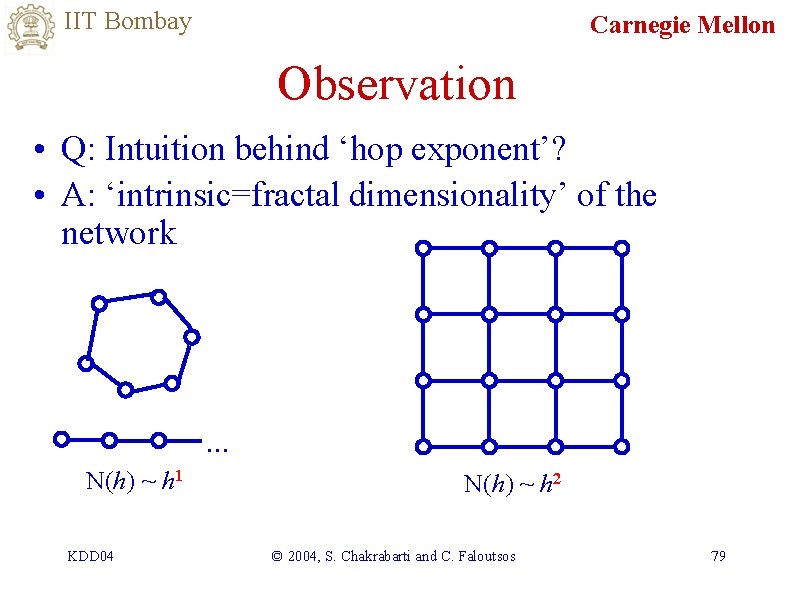
IIT Bombay Carnegie Mellon Observation • Q: Intuition behind ‘hop exponent’? • A: ‘intrinsic=fractal dimensionality’ of the network . . . N(h) ~ h 1 KDD 04 N(h) ~ h 2 © 2004, S. Chakrabarti and C. Faloutsos 79
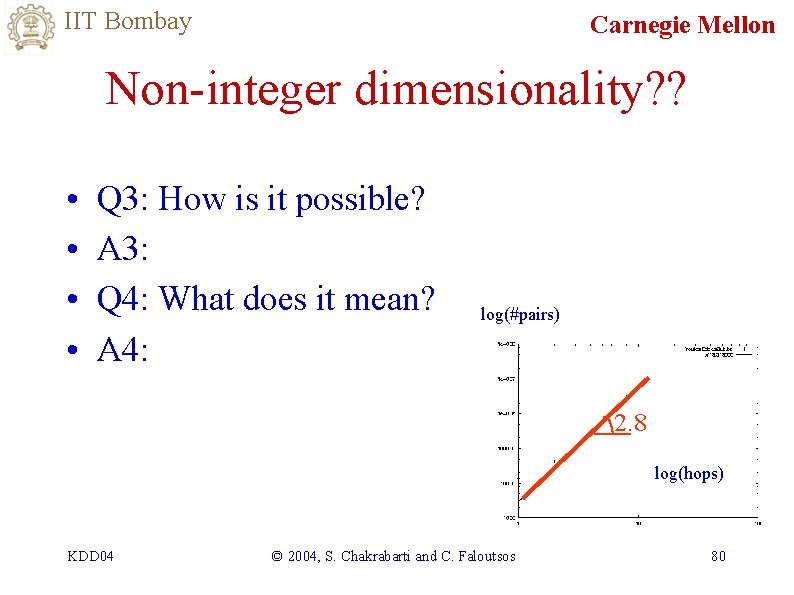
IIT Bombay Carnegie Mellon Non-integer dimensionality? ? • • Q 3: How is it possible? A 3: Q 4: What does it mean? A 4: log(#pairs) 2. 8 log(hops) KDD 04 © 2004, S. Chakrabarti and C. Faloutsos 80
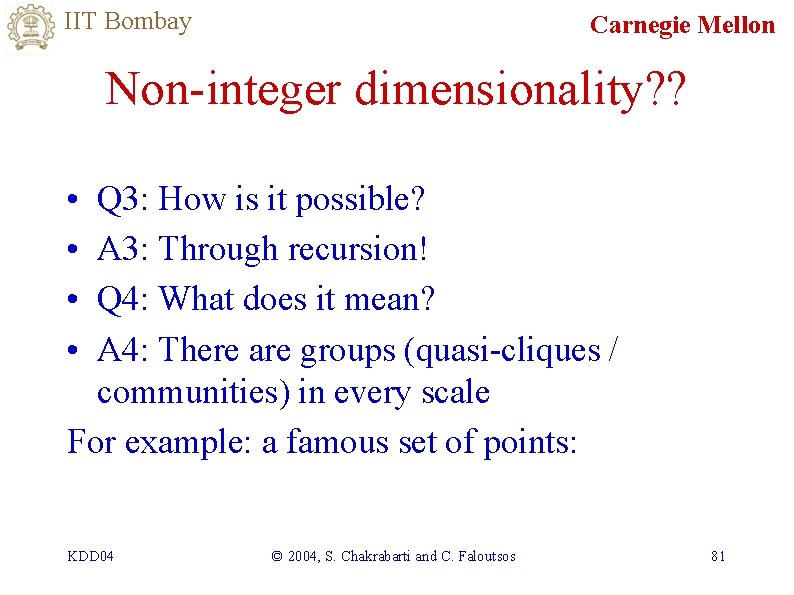
IIT Bombay Carnegie Mellon Non-integer dimensionality? ? • • Q 3: How is it possible? A 3: Through recursion! Q 4: What does it mean? A 4: There are groups (quasi-cliques / communities) in every scale For example: a famous set of points: KDD 04 © 2004, S. Chakrabarti and C. Faloutsos 81
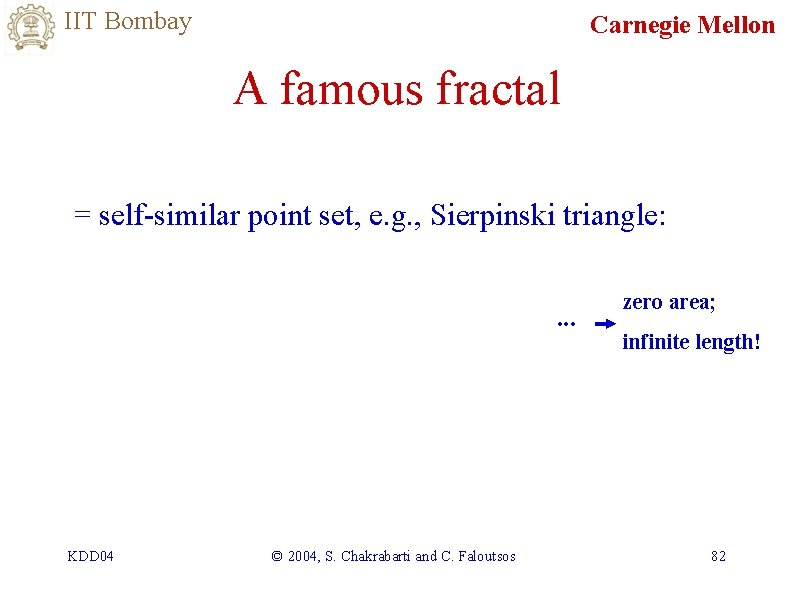
IIT Bombay Carnegie Mellon A famous fractal = self-similar point set, e. g. , Sierpinski triangle: . . . KDD 04 © 2004, S. Chakrabarti and C. Faloutsos zero area; infinite length! 82
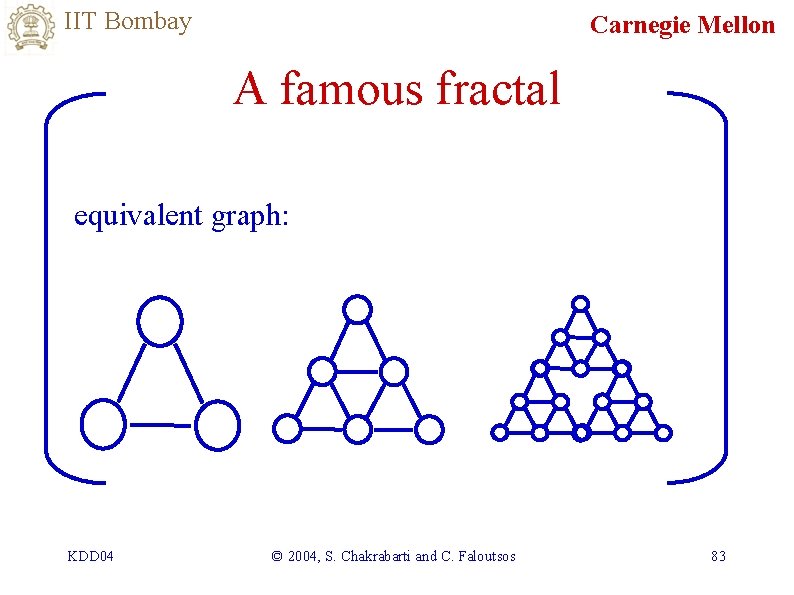
IIT Bombay Carnegie Mellon A famous fractal equivalent graph: KDD 04 © 2004, S. Chakrabarti and C. Faloutsos 83
IIT Bombay Carnegie Mellon Definitions (cont’d) • Paradox: Infinite perimeter ; Zero area! • ‘dimensionality’: between 1 and 2 • actually: Log(3)/Log(2) = 1. 58. . . KDD 04 © 2004, S. Chakrabarti and C. Faloutsos 84
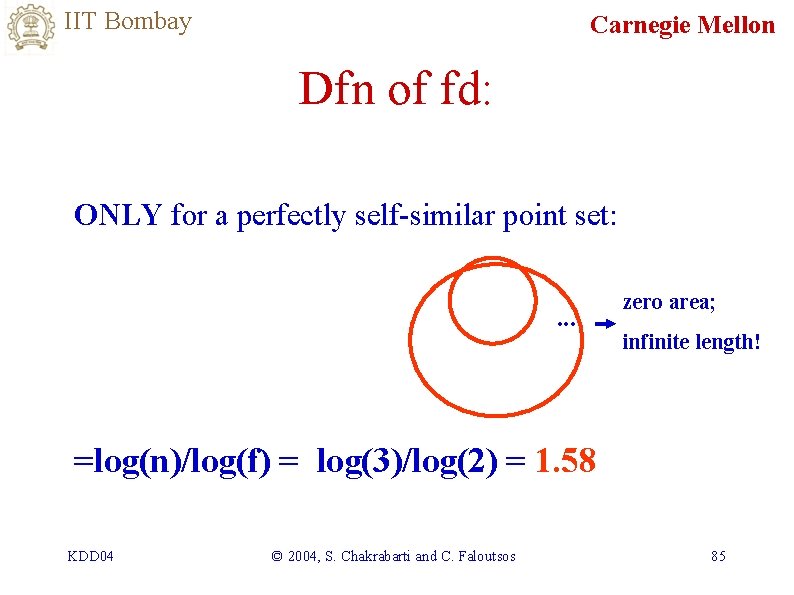
IIT Bombay Carnegie Mellon Dfn of fd: ONLY for a perfectly self-similar point set: . . . zero area; infinite length! =log(n)/log(f) = log(3)/log(2) = 1. 58 KDD 04 © 2004, S. Chakrabarti and C. Faloutsos 85
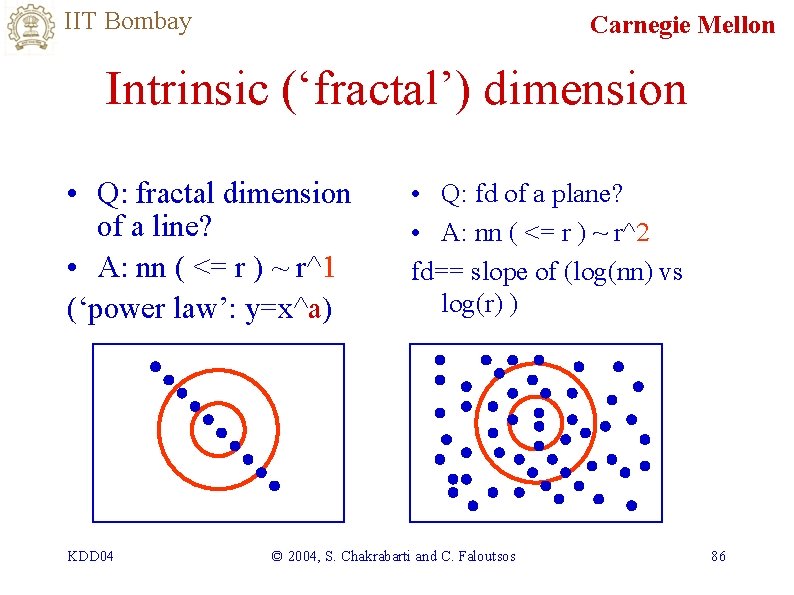
IIT Bombay Carnegie Mellon Intrinsic (‘fractal’) dimension • Q: fractal dimension of a line? • A: nn ( <= r ) ~ r^1 (‘power law’: y=x^a) KDD 04 • Q: fd of a plane? • A: nn ( <= r ) ~ r^2 fd== slope of (log(nn) vs log(r) ) © 2004, S. Chakrabarti and C. Faloutsos 86
IIT Bombay Carnegie Mellon Intrinsic (‘fractal’) dimension Algorithm, to estimate it? KDD 04 © 2004, S. Chakrabarti and C. Faloutsos 87
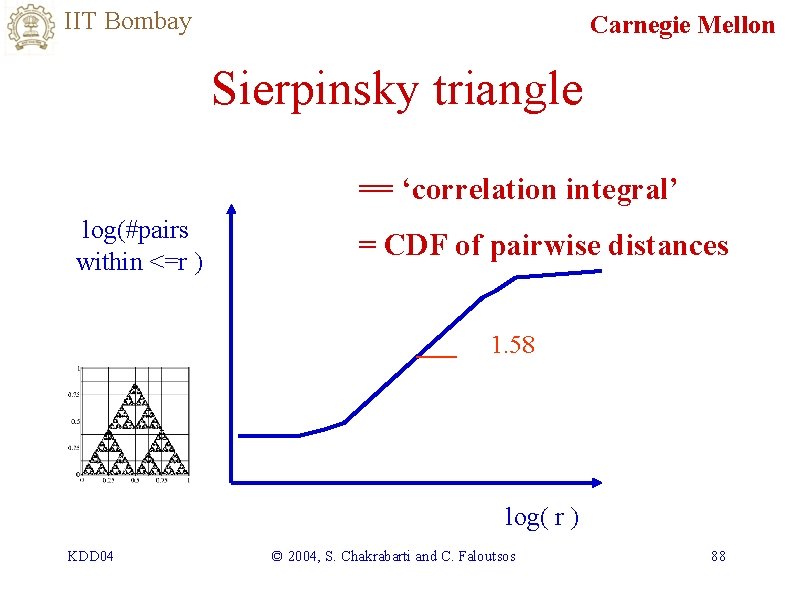
IIT Bombay Carnegie Mellon Sierpinsky triangle == ‘correlation integral’ log(#pairs within <=r ) = CDF of pairwise distances 1. 58 log( r ) KDD 04 © 2004, S. Chakrabarti and C. Faloutsos 88
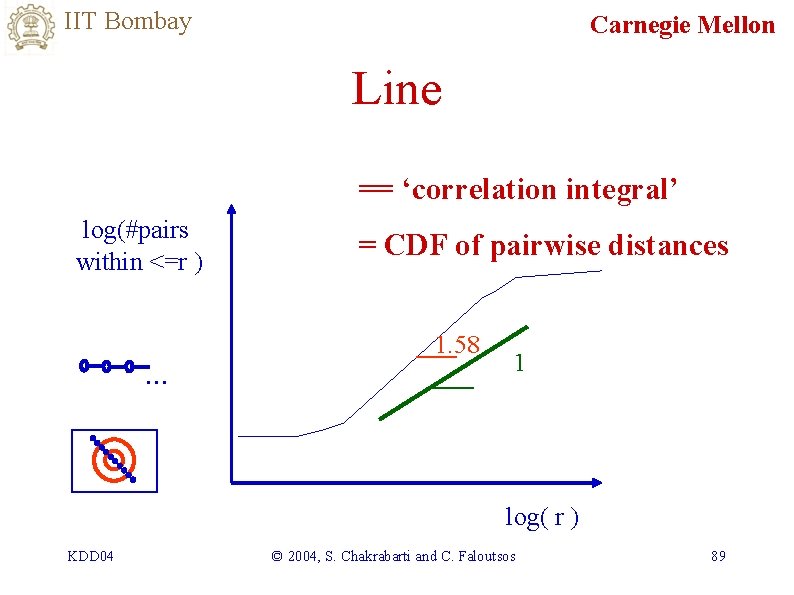
IIT Bombay Carnegie Mellon Line == ‘correlation integral’ log(#pairs within <=r ) . . . = CDF of pairwise distances 1. 58 1 log( r ) KDD 04 © 2004, S. Chakrabarti and C. Faloutsos 89
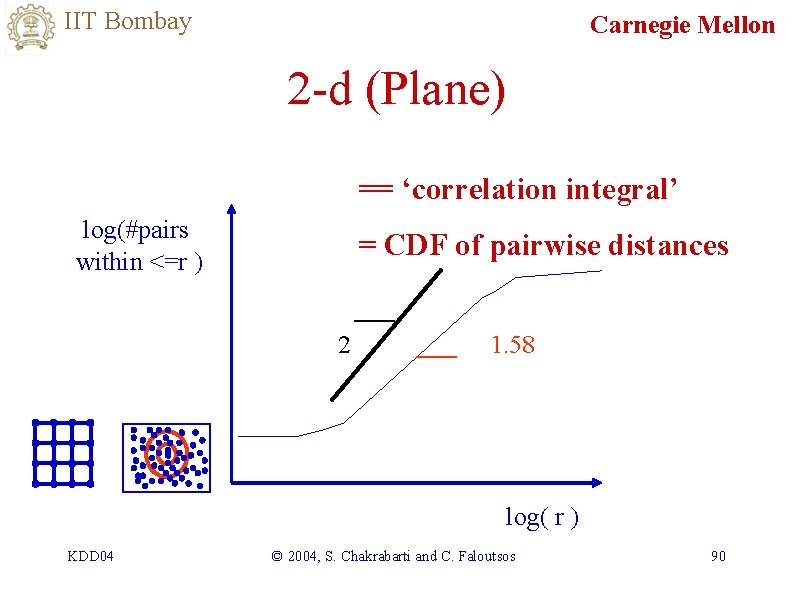
IIT Bombay Carnegie Mellon 2 -d (Plane) == ‘correlation integral’ log(#pairs within <=r ) = CDF of pairwise distances 2 1. 58 log( r ) KDD 04 © 2004, S. Chakrabarti and C. Faloutsos 90
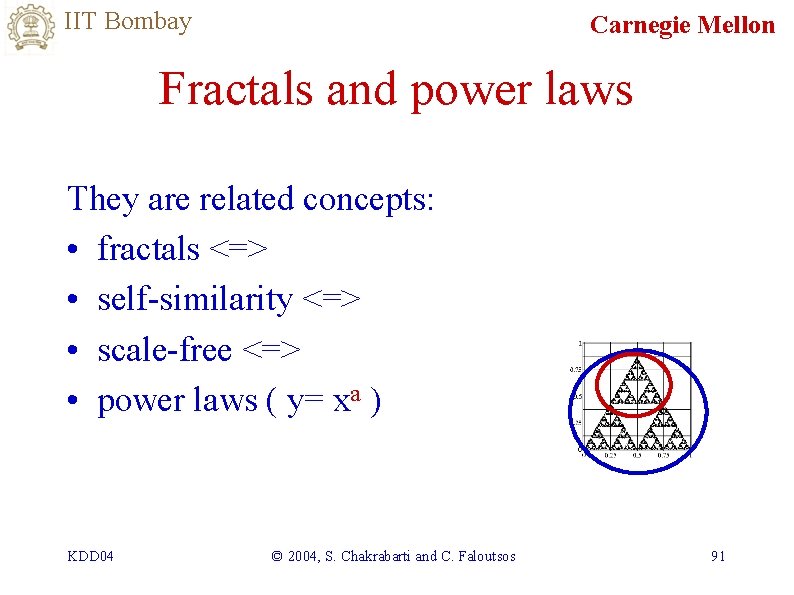
IIT Bombay Carnegie Mellon Fractals and power laws They are related concepts: • fractals <=> • self-similarity <=> • scale-free <=> • power laws ( y= xa ) KDD 04 © 2004, S. Chakrabarti and C. Faloutsos 91
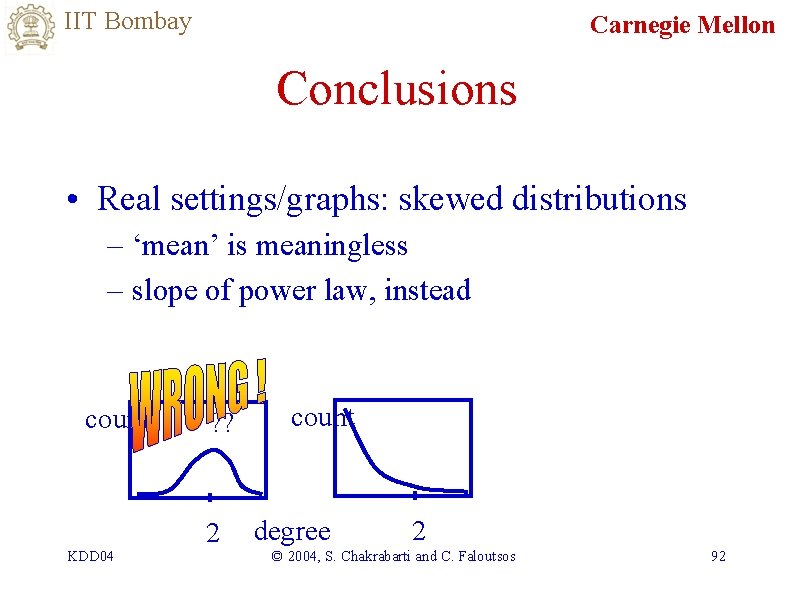
IIT Bombay Carnegie Mellon Conclusions • Real settings/graphs: skewed distributions – ‘mean’ is meaningless – slope of power law, instead count KDD 04 ? ? 2 count degree 2 © 2004, S. Chakrabarti and C. Faloutsos 92
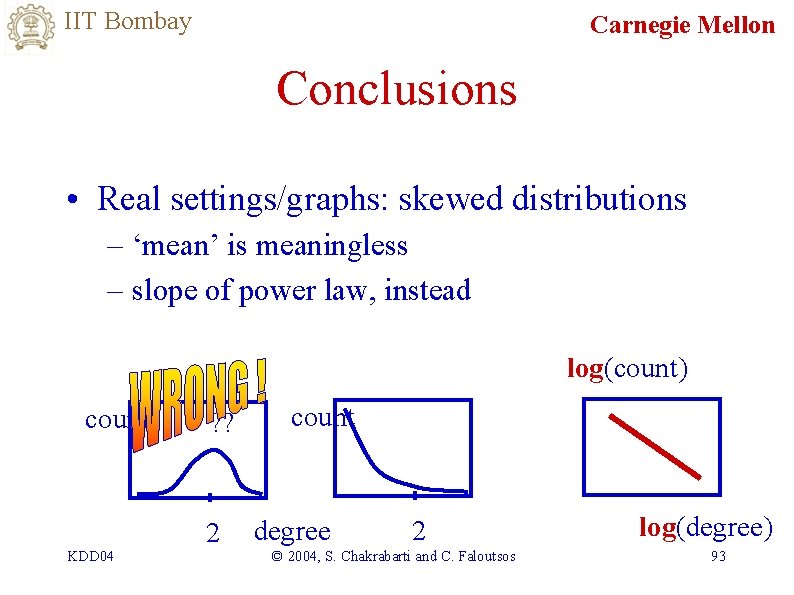
IIT Bombay Carnegie Mellon Conclusions • Real settings/graphs: skewed distributions – ‘mean’ is meaningless – slope of power law, instead log(count) count KDD 04 ? ? 2 count degree 2 © 2004, S. Chakrabarti and C. Faloutsos log(degree) 93
IIT Bombay Carnegie Mellon Conclusions: Tools: • rank-frequency plot (a’la Zipf) • NCDF, PDF in log-log • Correlation integral (= neighborhood function) KDD 04 © 2004, S. Chakrabarti and C. Faloutsos 94
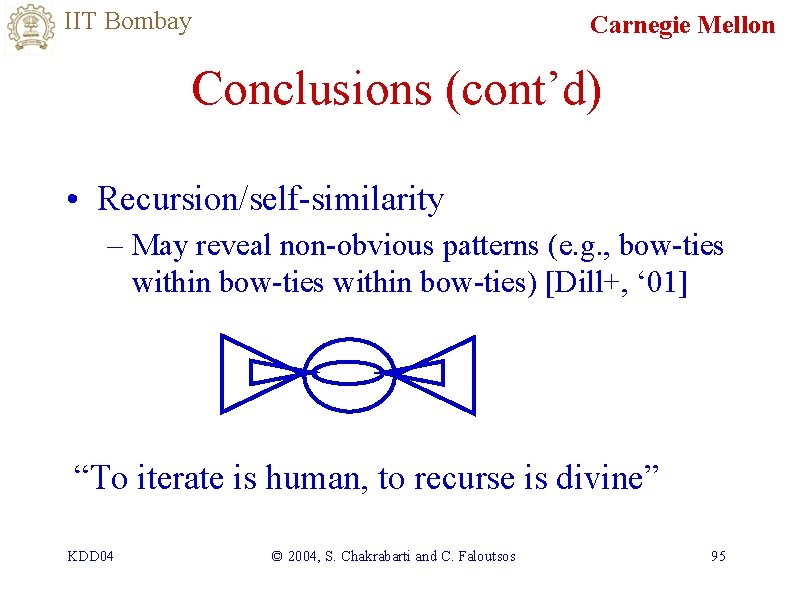
IIT Bombay Carnegie Mellon Conclusions (cont’d) • Recursion/self-similarity – May reveal non-obvious patterns (e. g. , bow-ties within bow-ties) [Dill+, ‘ 01] “To iterate is human, to recurse is divine” KDD 04 © 2004, S. Chakrabarti and C. Faloutsos 95
![IIT Bombay Carnegie Mellon References • [Aiello+, '00] William Aiello, Fan R. K. Chung,](http://slidetodoc.com/presentation_image/f8ed26c72b94af3eafdeae1d86f7e544/image-96.jpg "IIT Bombay Carnegie Mellon References • [Aiello+, '00] William Aiello, Fan R. K. Chung,")
IIT Bombay Carnegie Mellon References • [Aiello+, '00] William Aiello, Fan R. K. Chung, Linyuan Lu: A random graph model for massive graphs. STOC 2000: 171 -180 • [Albert+] Reka Albert, Hawoong Jeong, and Albert-Laszlo Barabasi: Diameter of the World Wide Web, Nature 401 130 -131 (1999) • [Barabasi, '03] Albert-Laszlo Barabasi Linked: How Everything Is Connected to Everything Else and What It Means (Plume, 2003) KDD 04 © 2004, S. Chakrabarti and C. Faloutsos 96
![IIT Bombay Carnegie Mellon References, cont’d • [Barabasi+, '99] Albert-Laszlo Barabasi and Reka Albert.](http://slidetodoc.com/presentation_image/f8ed26c72b94af3eafdeae1d86f7e544/image-97.jpg "IIT Bombay Carnegie Mellon References, cont’d • [Barabasi+, '99] Albert-Laszlo Barabasi and Reka Albert.")
IIT Bombay Carnegie Mellon References, cont’d • [Barabasi+, '99] Albert-Laszlo Barabasi and Reka Albert. Emergence of scaling in random networks. Science, 286: 509 --512, 1999 • [Broder+, '00] Andrei Broder, Ravi Kumar, Farzin Maghoul, Prabhakar Raghavan, Sridhar Rajagopalan, Raymie Stata, Andrew Tomkins, and Janet Wiener. Graph structure in the web, WWW, 2000 KDD 04 © 2004, S. Chakrabarti and C. Faloutsos 97
![IIT Bombay Carnegie Mellon References, cont’d • [Chakrabarti+, ‘ 04] RMAT: A recursive graph](http://slidetodoc.com/presentation_image/f8ed26c72b94af3eafdeae1d86f7e544/image-98.jpg "IIT Bombay Carnegie Mellon References, cont’d • [Chakrabarti+, ‘ 04] RMAT: A recursive graph")
IIT Bombay Carnegie Mellon References, cont’d • [Chakrabarti+, ‘ 04] RMAT: A recursive graph generator, D. Chakrabarti, Y. Zhan, C. Faloutsos, SIAM-DM 2004 • [Dill+, '01] Stephen Dill, Ravi Kumar, Kevin S. Mc. Curley, Sridhar Rajagopalan, D. Sivakumar, Andrew Tomkins: Selfsimilarity in the Web. VLDB 2001: 69 -78 KDD 04 © 2004, S. Chakrabarti and C. Faloutsos 98
![IIT Bombay Carnegie Mellon References, cont’d • [Fabrikant+, '02] A. Fabrikant, E. Koutsoupias, and](http://slidetodoc.com/presentation_image/f8ed26c72b94af3eafdeae1d86f7e544/image-99.jpg "IIT Bombay Carnegie Mellon References, cont’d • [Fabrikant+, '02] A. Fabrikant, E. Koutsoupias, and")
IIT Bombay Carnegie Mellon References, cont’d • [Fabrikant+, '02] A. Fabrikant, E. Koutsoupias, and C. H. Papadimitriou. Heuristically Optimized Trade-offs: A New Paradigm for Power Laws in the Internet. ICALP, Malaga, Spain, July 2002 • [FFF, 99] M. Faloutsos, P. Faloutsos, and C. Faloutsos, "On power-law relationships of the Internet topology, " in SIGCOMM, 1999. KDD 04 © 2004, S. Chakrabarti and C. Faloutsos 99
![IIT Bombay Carnegie Mellon References, cont’d • [Jovanovic+, '01] M. Jovanovic, F. S. Annexstein,](http://slidetodoc.com/presentation_image/f8ed26c72b94af3eafdeae1d86f7e544/image-100.jpg "IIT Bombay Carnegie Mellon References, cont’d • [Jovanovic+, '01] M. Jovanovic, F. S. Annexstein,")
IIT Bombay Carnegie Mellon References, cont’d • [Jovanovic+, '01] M. Jovanovic, F. S. Annexstein, and K. A. Berman. Modeling Peer-to-Peer Network Topologies through "Small-World" Models and Power Laws. In TELFOR, Belgrade, Yugoslavia, November, 2001 • [Kumar+ '99] Ravi Kumar, Prabhakar Raghavan, Sridhar Rajagopalan, Andrew Tomkins: Extracting Large-Scale Knowledge Bases from the Web. VLDB 1999: 639 -650 KDD 04 © 2004, S. Chakrabarti and C. Faloutsos 100
![IIT Bombay Carnegie Mellon References, cont’d • [Leland+, '94] W. E. Leland, M. S.](http://slidetodoc.com/presentation_image/f8ed26c72b94af3eafdeae1d86f7e544/image-101.jpg "IIT Bombay Carnegie Mellon References, cont’d • [Leland+, '94] W. E. Leland, M. S.")
IIT Bombay Carnegie Mellon References, cont’d • [Leland+, '94] W. E. Leland, M. S. Taqqu, W. Willinger, D. V. Wilson, On the Self-Similar Nature of Ethernet Traffic, IEEE Transactions on Networking, 2, 1, pp 1 -15, Feb. 1994. • [Mihail+, '02] Milena Mihail, Christos H. Papadimitriou: On the Eigenvalue Power Law. RANDOM 2002: 254 -262 KDD 04 © 2004, S. Chakrabarti and C. Faloutsos 101
![IIT Bombay Carnegie Mellon References, cont’d • [Milgram '67] Stanley Milgram: The Small World](http://slidetodoc.com/presentation_image/f8ed26c72b94af3eafdeae1d86f7e544/image-102.jpg "IIT Bombay Carnegie Mellon References, cont’d • [Milgram '67] Stanley Milgram: The Small World")
IIT Bombay Carnegie Mellon References, cont’d • [Milgram '67] Stanley Milgram: The Small World Problem, Psychology Today 1(1), 60 -67 (1967) • [Montgomery+, ‘ 01] Alan L. Montgomery, Christos Faloutsos: Identifying Web Browsing Trends and Patterns. IEEE Computer 34(7): 94 -95 (2001) KDD 04 © 2004, S. Chakrabarti and C. Faloutsos 102
![IIT Bombay Carnegie Mellon References, cont’d • [Palmer+, ‘ 01] Chris Palmer, Georgos Siganos,](http://slidetodoc.com/presentation_image/f8ed26c72b94af3eafdeae1d86f7e544/image-103.jpg "IIT Bombay Carnegie Mellon References, cont’d • [Palmer+, ‘ 01] Chris Palmer, Georgos Siganos,")
IIT Bombay Carnegie Mellon References, cont’d • [Palmer+, ‘ 01] Chris Palmer, Georgos Siganos, Michalis Faloutsos, Christos Faloutsos and Phil Gibbons The connectivity and fault-tolerance of the Internet topology (NRDM 2001), Santa Barbara, CA, May 25, 2001 • [Pennock+, '02] David M. Pennock, Gary William Flake, Steve Lawrence, Eric J. Glover, C. Lee Giles: Winners don't take all: Characterizing the competition for links on the web Proc. Natl. Acad. Sci. USA 99(8): 5207 -5211 (2002) KDD 04 © 2004, S. Chakrabarti and C. Faloutsos 103
![IIT Bombay Carnegie Mellon References, cont’d • [Schroeder, ‘ 91] Manfred Schroeder Fractals, Chaos,](http://slidetodoc.com/presentation_image/f8ed26c72b94af3eafdeae1d86f7e544/image-104.jpg "IIT Bombay Carnegie Mellon References, cont’d • [Schroeder, ‘ 91] Manfred Schroeder Fractals, Chaos,")
IIT Bombay Carnegie Mellon References, cont’d • [Schroeder, ‘ 91] Manfred Schroeder Fractals, Chaos, Power Laws: Minutes from an Infinite Paradise W H Freeman & Co. , 1991 KDD 04 © 2004, S. Chakrabarti and C. Faloutsos 104
![IIT Bombay Carnegie Mellon References, cont’d • [Siganos+, '03] G. Siganos, M. Faloutsos, P.](http://slidetodoc.com/presentation_image/f8ed26c72b94af3eafdeae1d86f7e544/image-105.jpg "IIT Bombay Carnegie Mellon References, cont’d • [Siganos+, '03] G. Siganos, M. Faloutsos, P.")
IIT Bombay Carnegie Mellon References, cont’d • [Siganos+, '03] G. Siganos, M. Faloutsos, P. Faloutsos, C. Faloutsos Power-Laws and the AS-level Internet Topology, Transactions on Networking, August 2003. • [Watts+ Strogatz, '98] D. J. Watts and S. H. Strogatz Collective dynamics of 'small-world' networks, Nature, 393: 440 -442 (1998) • [Watts, '03] Duncan J. Watts Six Degrees: The Science of a Connected Age W. W. Norton & Company; (February 2003) KDD 04 © 2004, S. Chakrabarti and C. Faloutsos 105
IIT Bombay Carnegie Mellon PART 2: Page. Rank, HITS, and eigenvalues KDD 04 © 2004, S. Chakrabarti and C. Faloutsos 106
IIT Bombay Carnegie Mellon Outline Part 1: Topology, ‘laws’ and generators Part 2: Page. Rank, HITS and eigenvalues Part 3: Pairs, influence, communities KDD 04 © 2004, S. Chakrabarti and C. Faloutsos 107
IIT Bombay Carnegie Mellon Part 2: Page. Rank, HITS and eigenvalues • How important is a node? • Who is the best person/computer to immunize against a virus? • Who is the best customer to advertise to? • Who originated a raging rumor? KDD 04 © 2004, S. Chakrabarti and C. Faloutsos 108
IIT Bombay Carnegie Mellon Outline Part 1: Topology, ‘laws’ and generators Part 2: Page. Rank, HITS and eigenvalues • Eigenvalues and Page. Rank • SVD and HITS • Virus propagation Part 3: Pairs, influence, communities KDD 04 © 2004, S. Chakrabarti and C. Faloutsos 109
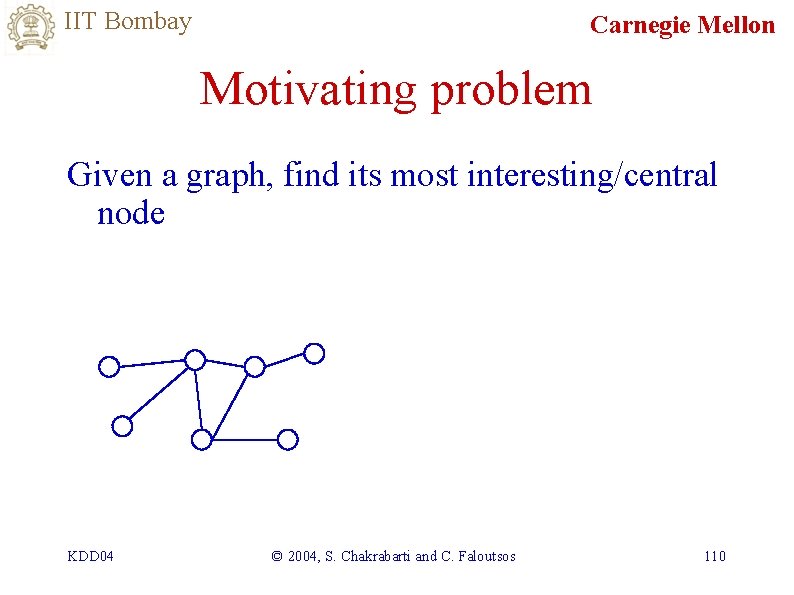
IIT Bombay Carnegie Mellon Motivating problem Given a graph, find its most interesting/central node KDD 04 © 2004, S. Chakrabarti and C. Faloutsos 110
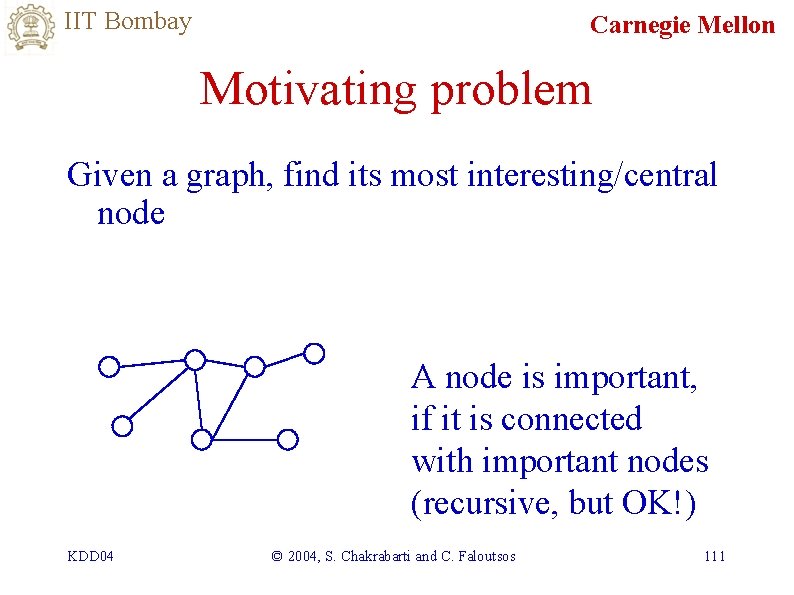
IIT Bombay Carnegie Mellon Motivating problem Given a graph, find its most interesting/central node A node is important, if it is connected with important nodes (recursive, but OK!) KDD 04 © 2004, S. Chakrabarti and C. Faloutsos 111
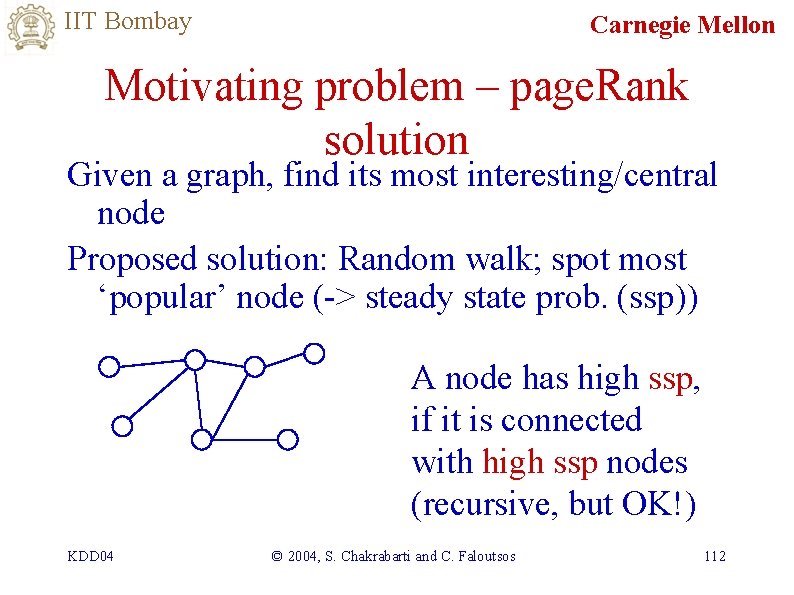
IIT Bombay Carnegie Mellon Motivating problem – page. Rank solution Given a graph, find its most interesting/central node Proposed solution: Random walk; spot most ‘popular’ node (-> steady state prob. (ssp)) A node has high ssp, if it is connected with high ssp nodes (recursive, but OK!) KDD 04 © 2004, S. Chakrabarti and C. Faloutsos 112
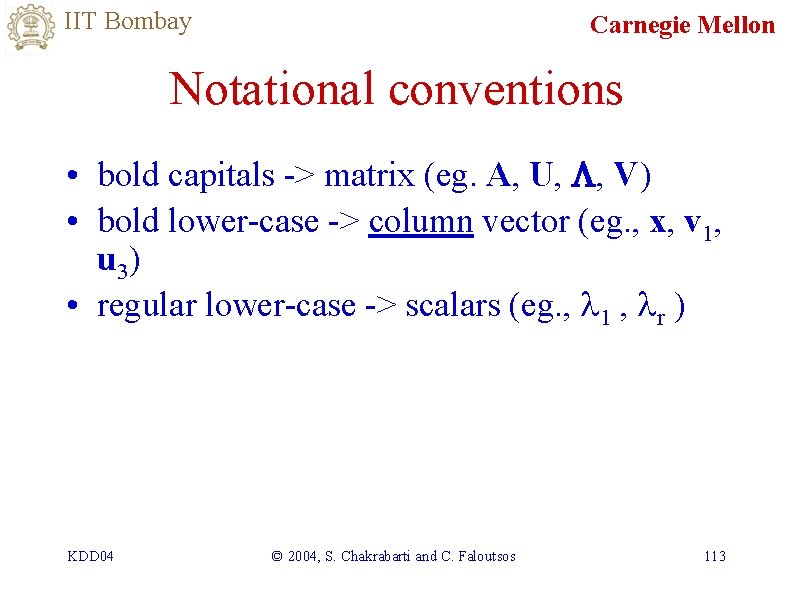
IIT Bombay Carnegie Mellon Notational conventions • bold capitals -> matrix (eg. A, U, L, V) • bold lower-case -> column vector (eg. , x, v 1, u 3) • regular lower-case -> scalars (eg. , l 1 , lr ) KDD 04 © 2004, S. Chakrabarti and C. Faloutsos 113
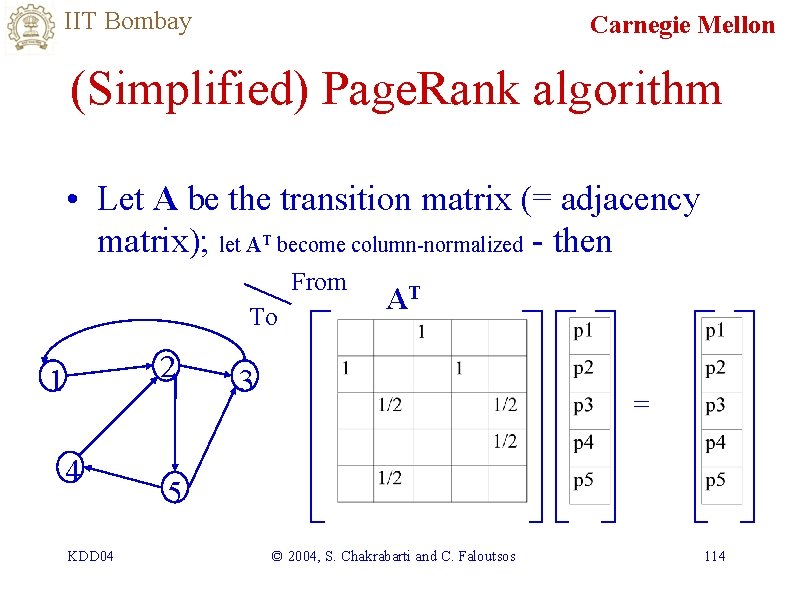
IIT Bombay Carnegie Mellon (Simplified) Page. Rank algorithm • Let A be the transition matrix (= adjacency matrix); let AT become column-normalized - then From To 2 1 4 KDD 04 AT 3 = 5 © 2004, S. Chakrabarti and C. Faloutsos 114
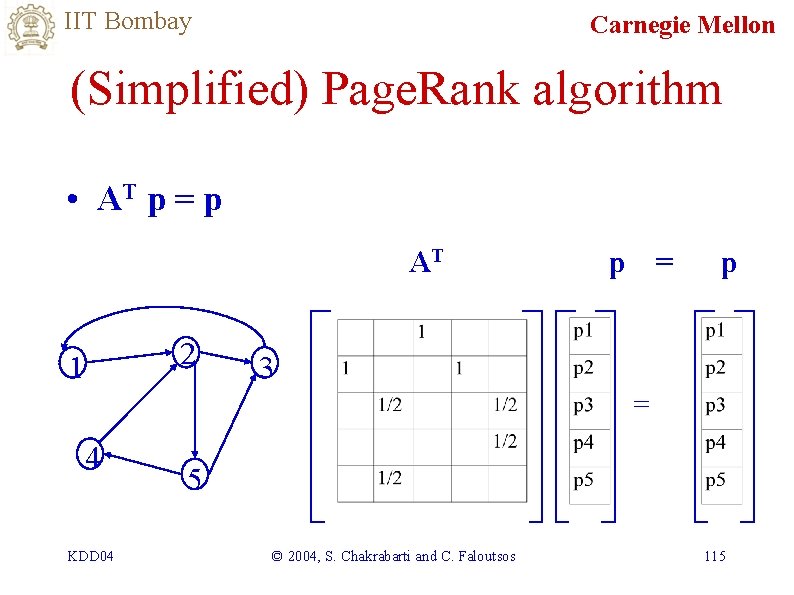
IIT Bombay Carnegie Mellon (Simplified) Page. Rank algorithm • AT p = p AT 2 1 p = p 3 = 4 KDD 04 5 © 2004, S. Chakrabarti and C. Faloutsos 115
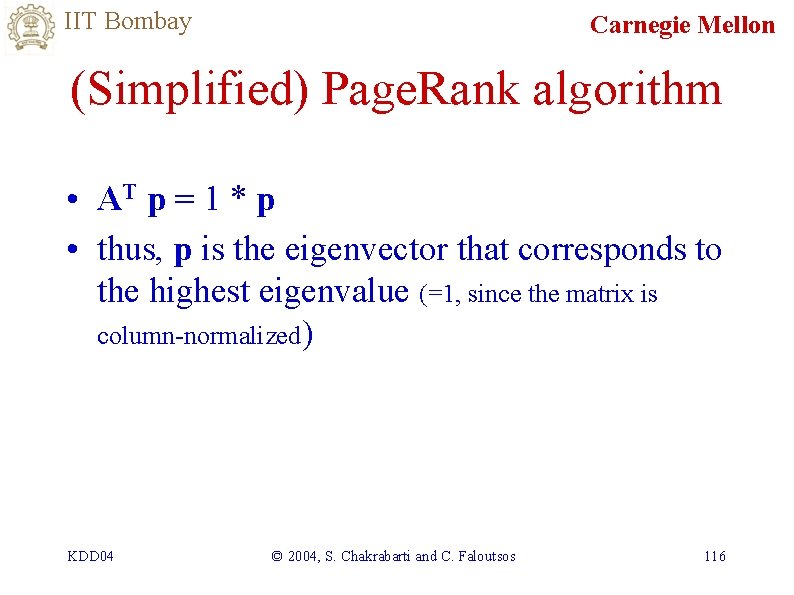
IIT Bombay Carnegie Mellon (Simplified) Page. Rank algorithm • AT p = 1 * p • thus, p is the eigenvector that corresponds to the highest eigenvalue (=1, since the matrix is column-normalized) KDD 04 © 2004, S. Chakrabarti and C. Faloutsos 116
IIT Bombay Carnegie Mellon (Simplified) Page. Rank algorithm • In short: imagine a particle randomly moving along the edges • compute its steady-state probabilities (ssp) Full version of algo: with occasional random jumps – see later KDD 04 © 2004, S. Chakrabarti and C. Faloutsos 117
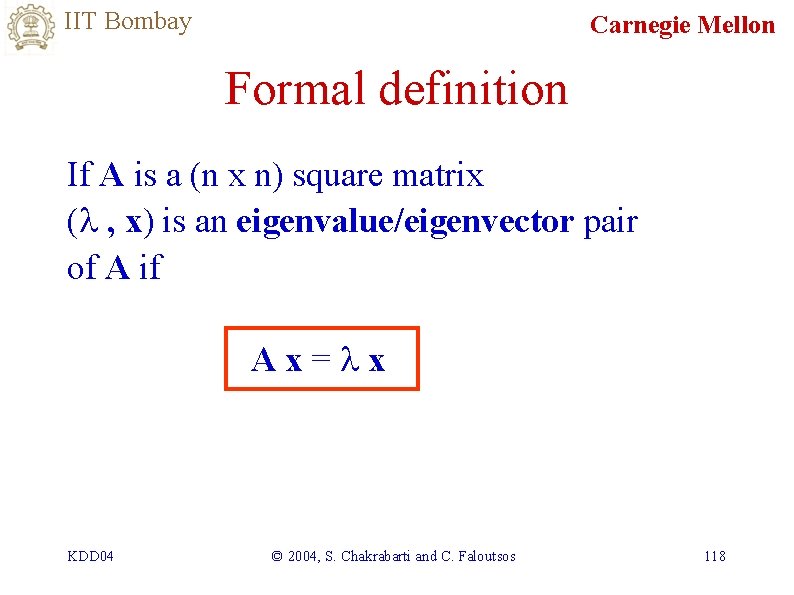
IIT Bombay Carnegie Mellon Formal definition If A is a (n x n) square matrix (l , x) is an eigenvalue/eigenvector pair of A if Ax=lx KDD 04 © 2004, S. Chakrabarti and C. Faloutsos 118
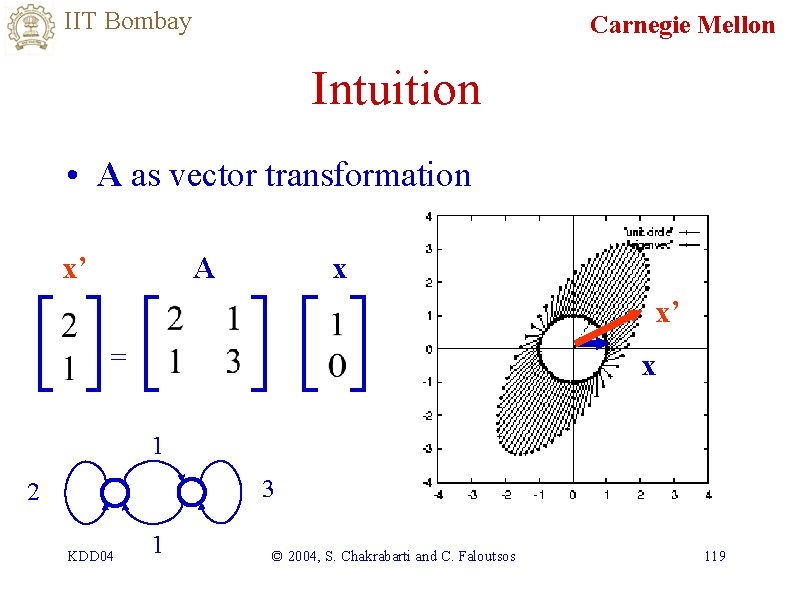
IIT Bombay Carnegie Mellon Intuition • A as vector transformation x’ x A x’ = x 1 3 2 KDD 04 1 © 2004, S. Chakrabarti and C. Faloutsos 119
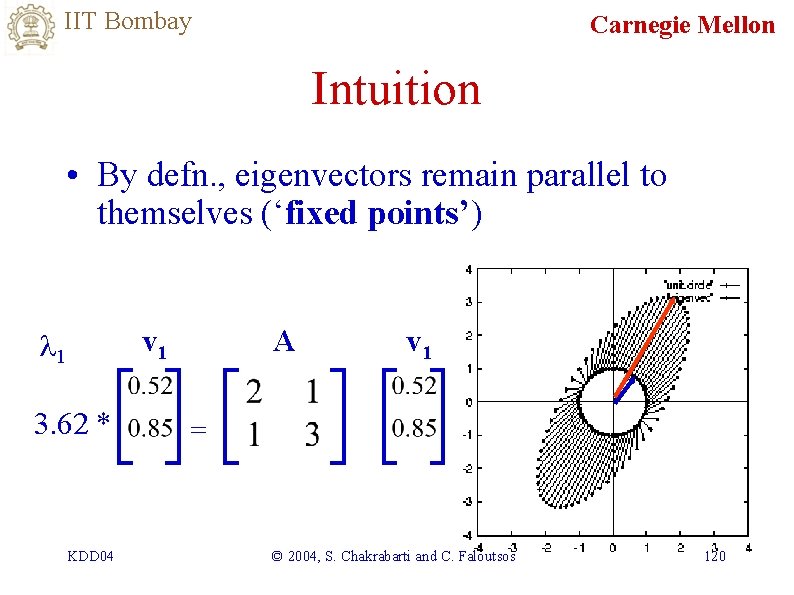
IIT Bombay Carnegie Mellon Intuition • By defn. , eigenvectors remain parallel to themselves (‘fixed points’) v 1 l 1 3. 62 * KDD 04 A v 1 = © 2004, S. Chakrabarti and C. Faloutsos 120
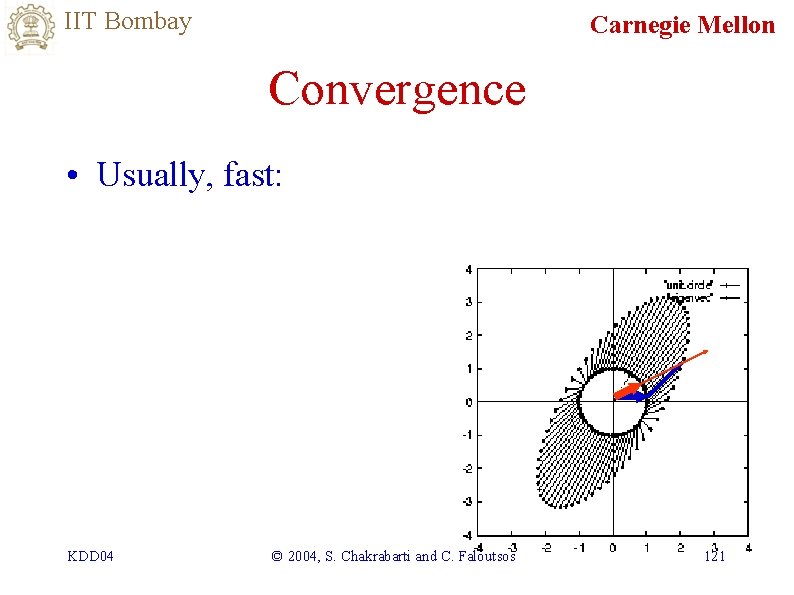
IIT Bombay Carnegie Mellon Convergence • Usually, fast: KDD 04 © 2004, S. Chakrabarti and C. Faloutsos 121
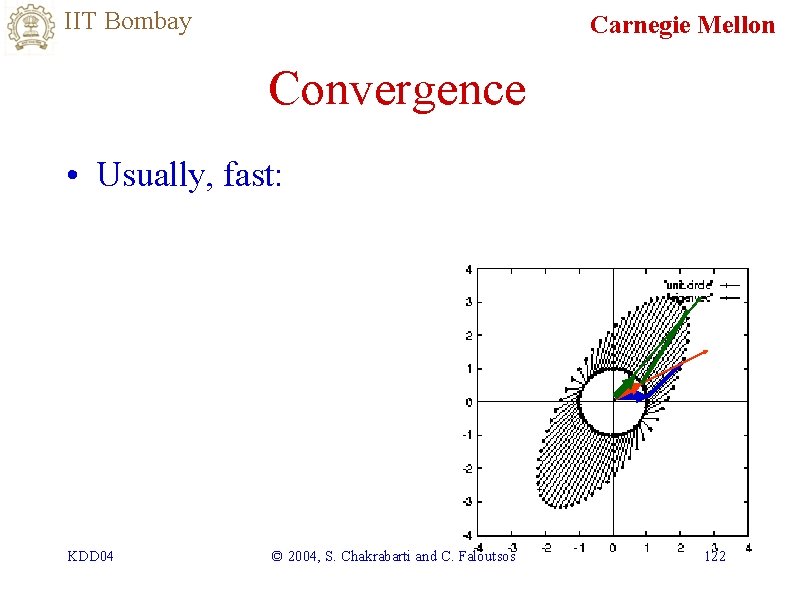
IIT Bombay Carnegie Mellon Convergence • Usually, fast: KDD 04 © 2004, S. Chakrabarti and C. Faloutsos 122
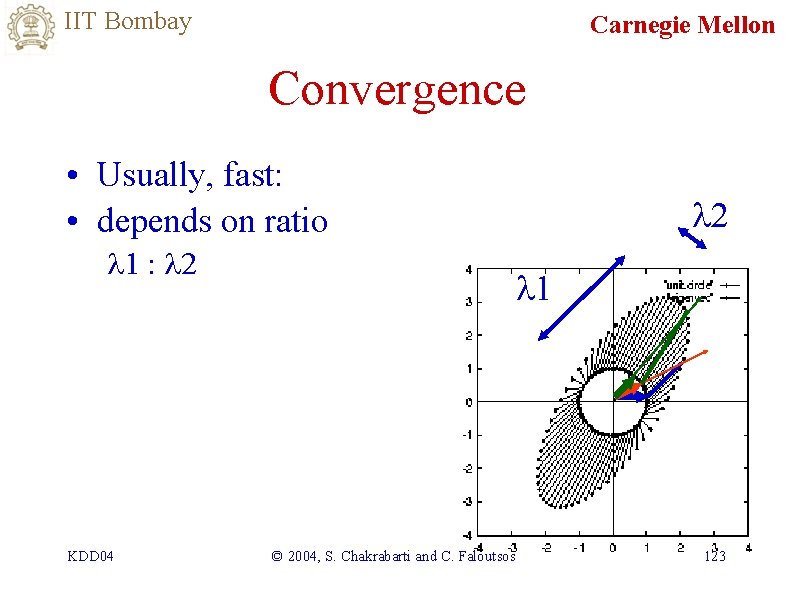
IIT Bombay Carnegie Mellon Convergence • Usually, fast: • depends on ratio l 1 : l 2 KDD 04 l 2 l 1 © 2004, S. Chakrabarti and C. Faloutsos 123
IIT Bombay Carnegie Mellon Our wish list: • How important is a node? • Who is the best person/computer to immunize against a virus? • Who is the best customer to advertise to? • Who originated a raging rumor? ssp values answer these questions KDD 04 © 2004, S. Chakrabarti and C. Faloutsos 124
IIT Bombay Carnegie Mellon Outline Part 1: Topology, ‘laws’ and generators Part 2: Page. Rank, HITS and eigenvalues • Eigenvalues and Page. Rank • SVD and HITS • Virus propagation Part 3: Pairs, influence, communities KDD 04 © 2004, S. Chakrabarti and C. Faloutsos 125
IIT Bombay Carnegie Mellon SVD vs eigenvalues • very similar, but not identical • Motivating example: HITS/Kleinberg algo: KDD 04 © 2004, S. Chakrabarti and C. Faloutsos 126
IIT Bombay Carnegie Mellon Kleinberg’s algorithm • Problem dfn: given the web and a query • find the most ‘authoritative’ web pages for this query Step 0: find all pages containing the query terms Step 1: expand by one move forward and backward KDD 04 © 2004, S. Chakrabarti and C. Faloutsos 127
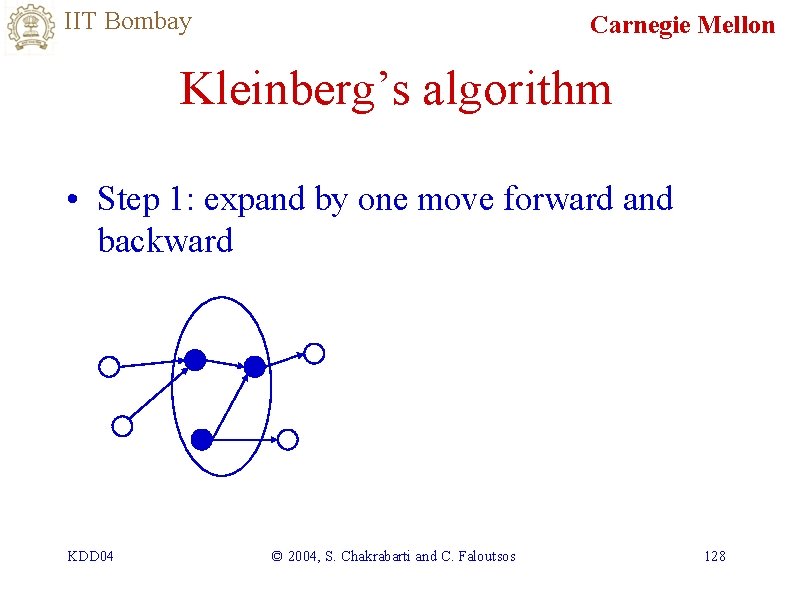
IIT Bombay Carnegie Mellon Kleinberg’s algorithm • Step 1: expand by one move forward and backward KDD 04 © 2004, S. Chakrabarti and C. Faloutsos 128
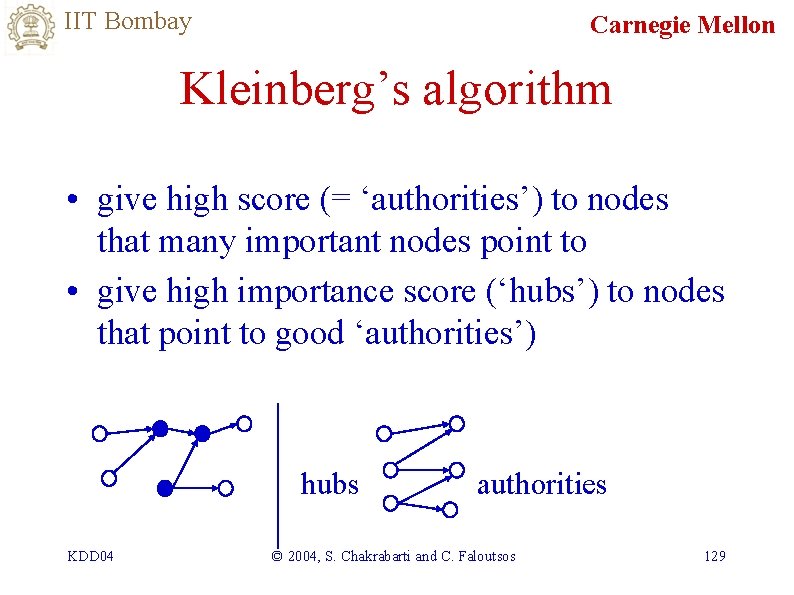
IIT Bombay Carnegie Mellon Kleinberg’s algorithm • give high score (= ‘authorities’) to nodes that many important nodes point to • give high importance score (‘hubs’) to nodes that point to good ‘authorities’) hubs KDD 04 authorities © 2004, S. Chakrabarti and C. Faloutsos 129
IIT Bombay Carnegie Mellon Kleinberg’s algorithm Observations • recursive definition! • each node (say, ‘i’-th node) has both an authoritativeness score ai and a hubness score hi KDD 04 © 2004, S. Chakrabarti and C. Faloutsos 130
IIT Bombay Carnegie Mellon Kleinberg’s algorithm Let A be the adjacency matrix: the (i, j) entry is 1 if the edge from i to j exists Let h and a be [n x 1] vectors with the ‘hubness’ and ‘authoritativiness’ scores. Then: KDD 04 © 2004, S. Chakrabarti and C. Faloutsos 131
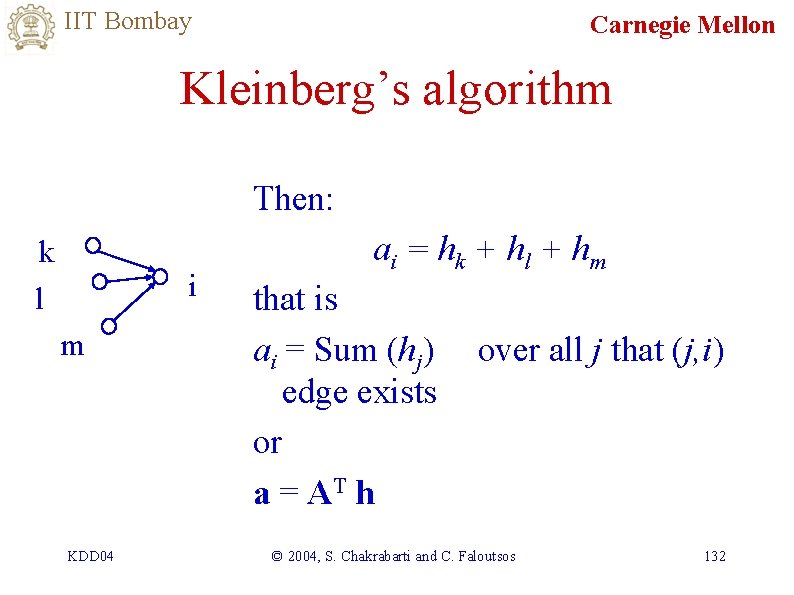
IIT Bombay Carnegie Mellon Kleinberg’s algorithm Then: k l i m KDD 04 ai = hk + hl + hm that is ai = Sum (hj) edge exists or a = AT h over all j that (j, i) © 2004, S. Chakrabarti and C. Faloutsos 132
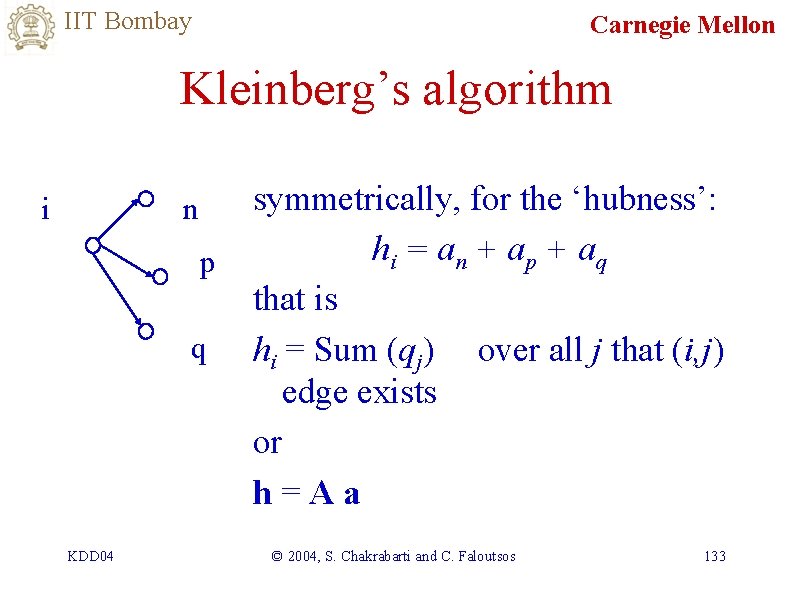
IIT Bombay Carnegie Mellon Kleinberg’s algorithm i n p q KDD 04 symmetrically, for the ‘hubness’: hi = an + ap + aq that is hi = Sum (qj) over all j that (i, j) edge exists or h=Aa © 2004, S. Chakrabarti and C. Faloutsos 133
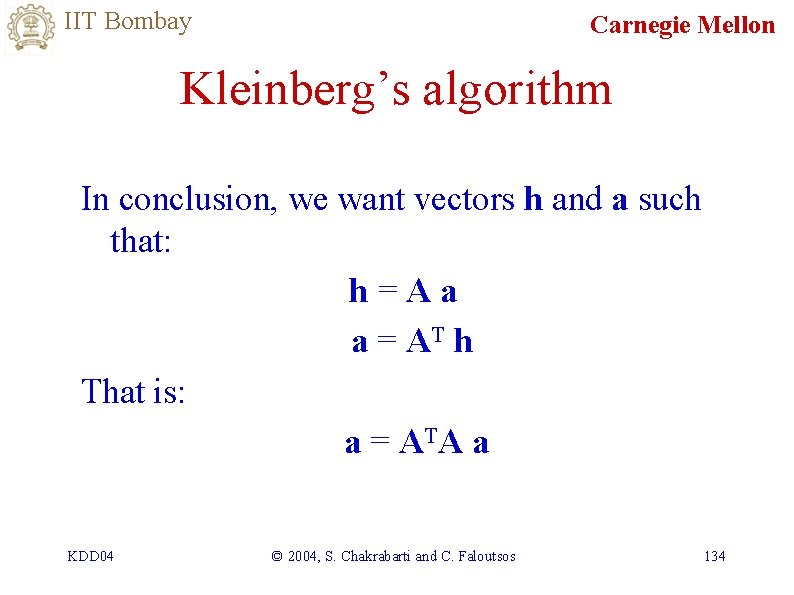
IIT Bombay Carnegie Mellon Kleinberg’s algorithm In conclusion, we want vectors h and a such that: h=Aa a = AT h That is: a = AT A a KDD 04 © 2004, S. Chakrabarti and C. Faloutsos 134
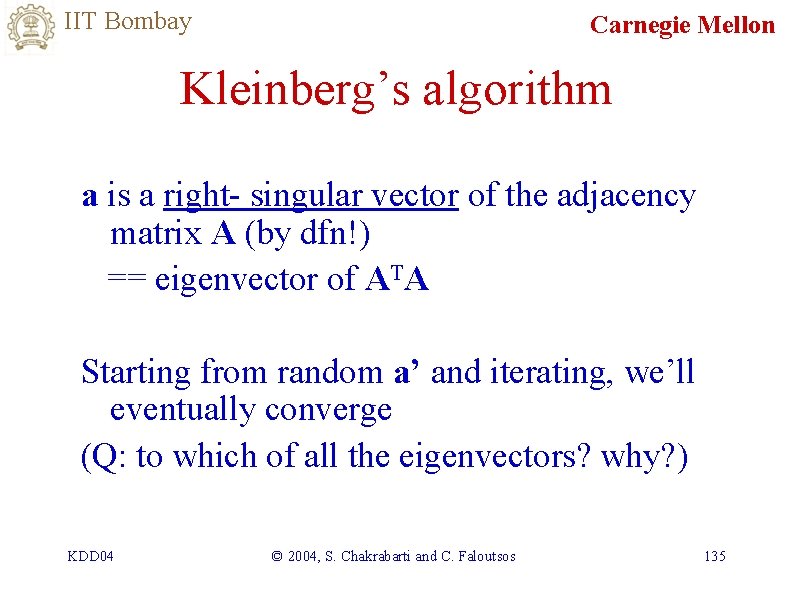
IIT Bombay Carnegie Mellon Kleinberg’s algorithm a is a right- singular vector of the adjacency matrix A (by dfn!) == eigenvector of ATA Starting from random a’ and iterating, we’ll eventually converge (Q: to which of all the eigenvectors? why? ) KDD 04 © 2004, S. Chakrabarti and C. Faloutsos 135
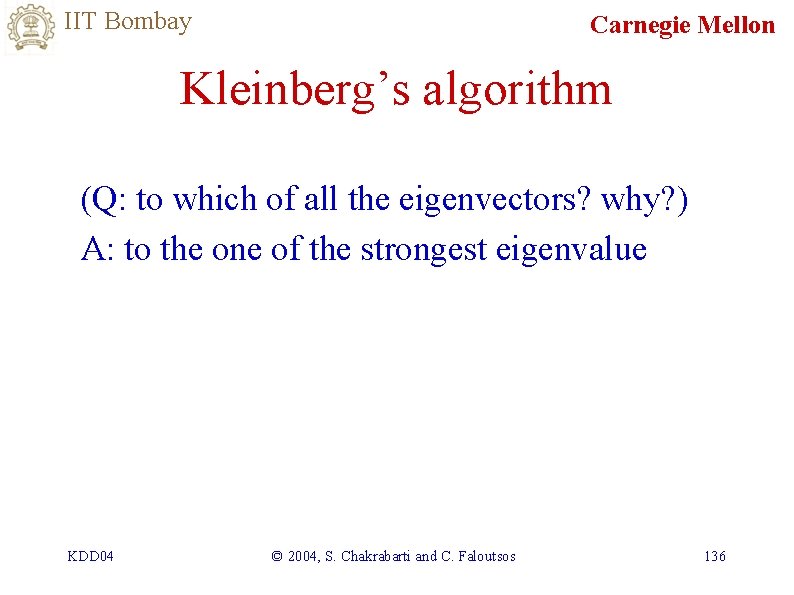
IIT Bombay Carnegie Mellon Kleinberg’s algorithm (Q: to which of all the eigenvectors? why? ) A: to the one of the strongest eigenvalue KDD 04 © 2004, S. Chakrabarti and C. Faloutsos 136
IIT Bombay Carnegie Mellon Kleinberg’s algorithm - results Eg. , for the query ‘java’: 0. 328 www. gamelan. com 0. 251 java. sun. com 0. 190 www. digitalfocus. com (“the java developer”) KDD 04 © 2004, S. Chakrabarti and C. Faloutsos 137
IIT Bombay Carnegie Mellon SVD: formal definitions • Let A be a matrix (eg. , adjacency matrix of a graph) KDD 04 © 2004, S. Chakrabarti and C. Faloutsos 138
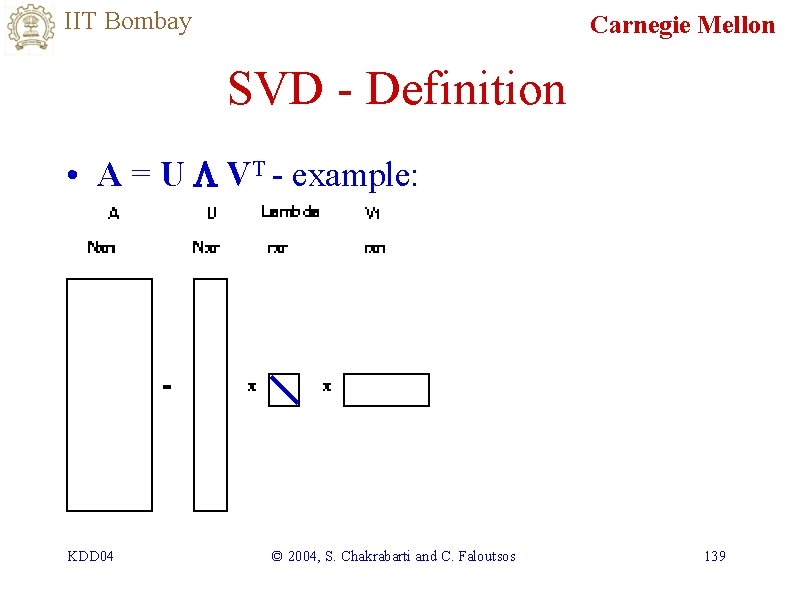
IIT Bombay Carnegie Mellon SVD - Definition • A = U L VT - example: KDD 04 © 2004, S. Chakrabarti and C. Faloutsos 139
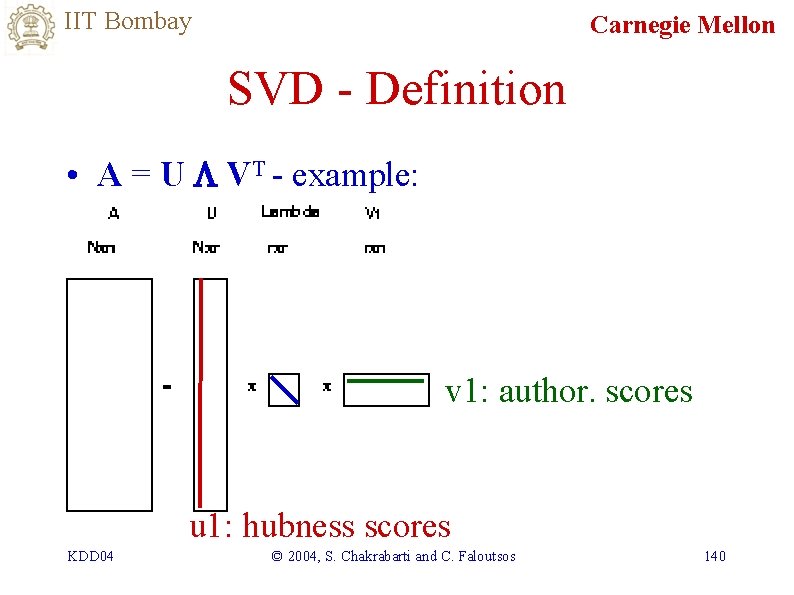
IIT Bombay Carnegie Mellon SVD - Definition • A = U L VT - example: v 1: author. scores u 1: hubness scores KDD 04 © 2004, S. Chakrabarti and C. Faloutsos 140
![IIT Bombay Carnegie Mellon SVD - Definition A[n x m] = U[n x r]](http://slidetodoc.com/presentation_image/f8ed26c72b94af3eafdeae1d86f7e544/image-141.jpg "IIT Bombay Carnegie Mellon SVD - Definition A[n x m] = U[n x r]")
IIT Bombay Carnegie Mellon SVD - Definition A[n x m] = U[n x r] L [ r x r] (V[m x r])T • A: n x m matrix (eg. , n documents, m terms) • U: n x r matrix (n documents, r concepts) • L: r x r diagonal matrix (strength of each ‘concept’) (r : rank of the matrix) • V: m x r matrix (m terms, r concepts) KDD 04 © 2004, S. Chakrabarti and C. Faloutsos 141
![IIT Bombay Carnegie Mellon SVD - Properties THEOREM [Press+92]: always possible to decompose matrix](http://slidetodoc.com/presentation_image/f8ed26c72b94af3eafdeae1d86f7e544/image-142.jpg "IIT Bombay Carnegie Mellon SVD - Properties THEOREM [Press+92]: always possible to decompose matrix")
IIT Bombay Carnegie Mellon SVD - Properties THEOREM [Press+92]: always possible to decompose matrix A into A = U L VT , where • U, L, V: unique (*) • U, V: column orthonormal (ie. , columns are unit vectors, orthogonal to each other) – UT U = I; VT V = I (I: identity matrix) • L: singular values are positive, and sorted in decreasing order KDD 04 © 2004, S. Chakrabarti and C. Faloutsos 142
![IIT Bombay Carnegie Mellon SVD – other uses: • LSI (Latent Semantic Indexing) [Deerwester+]](http://slidetodoc.com/presentation_image/f8ed26c72b94af3eafdeae1d86f7e544/image-143.jpg "IIT Bombay Carnegie Mellon SVD – other uses: • LSI (Latent Semantic Indexing) [Deerwester+]")
IIT Bombay Carnegie Mellon SVD – other uses: • LSI (Latent Semantic Indexing) [Deerwester+] • PCA (Principal Component Analysis) [Jolliffe] • Karhunen-Loeve transform [Fukunaga], [Duda+Hart] • Low-rank approximation, dim. Reduction • Over- and under-constraint linear systems KDD 04 © 2004, S. Chakrabarti and C. Faloutsos 143
IIT Bombay Carnegie Mellon SVD – other uses (cont’d): • Graph partitioning (on ‘Laplacian’) • + MANY MORE … KDD 04 © 2004, S. Chakrabarti and C. Faloutsos 144
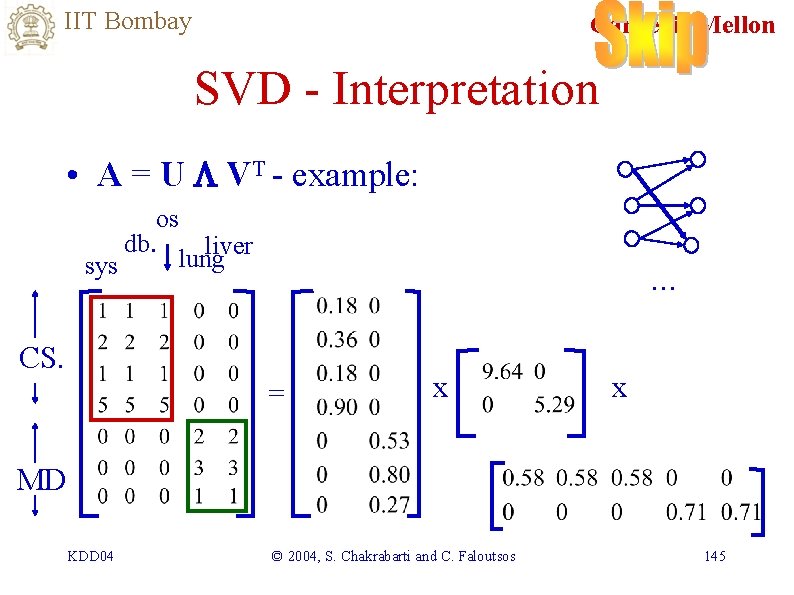
IIT Bombay Carnegie Mellon SVD - Interpretation • A = U L VT - example: os sys db. liver lung . . . CS. = x x MD KDD 04 © 2004, S. Chakrabarti and C. Faloutsos 145
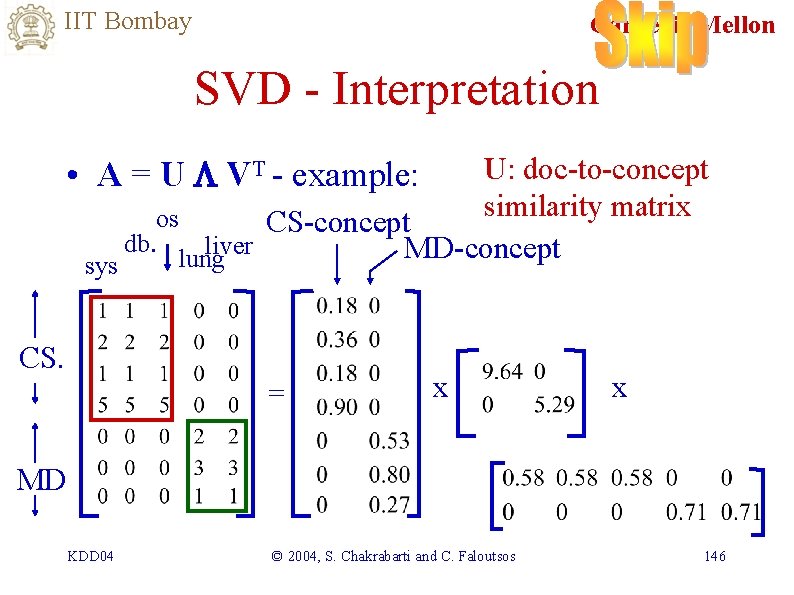
IIT Bombay Carnegie Mellon SVD - Interpretation • A = U L VT - example: U: doc-to-concept similarity matrix os CS-concept db. liver MD-concept lung sys CS. = x x MD KDD 04 © 2004, S. Chakrabarti and C. Faloutsos 146
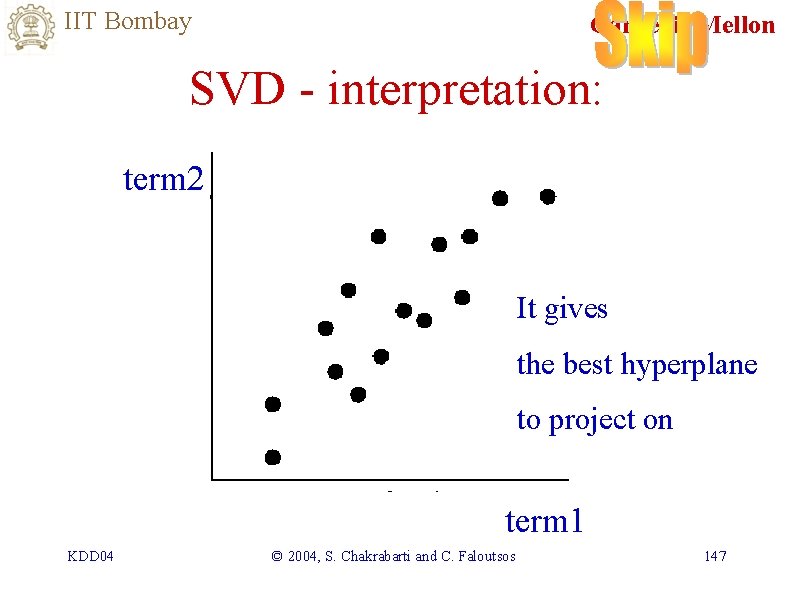
IIT Bombay Carnegie Mellon SVD - interpretation: term 2 It gives the best hyperplane to project on term 1 KDD 04 © 2004, S. Chakrabarti and C. Faloutsos 147
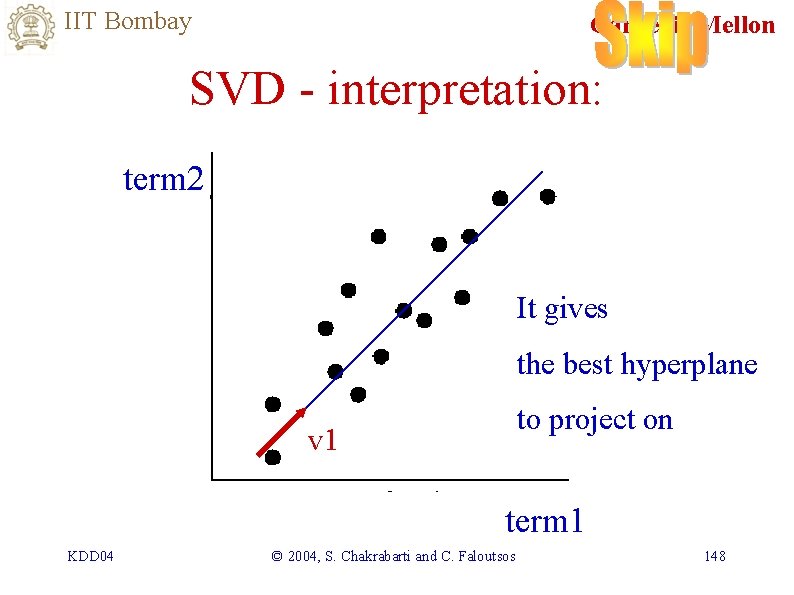
IIT Bombay Carnegie Mellon SVD - interpretation: term 2 It gives the best hyperplane to project on v 1 term 1 KDD 04 © 2004, S. Chakrabarti and C. Faloutsos 148
IIT Bombay Carnegie Mellon Outline Part 1: Topology, ‘laws’ and generators Part 2: Page. Rank, HITS and eigenvalues • Eigenvalues and Page. Rank • SVD and HITS • Virus propagation Part 3: Pairs, influence, communities KDD 04 © 2004, S. Chakrabarti and C. Faloutsos 149
IIT Bombay Carnegie Mellon Problem definition • Q 1: How does a virus spread across an arbitrary network? • Q 2: will it create an epidemic? KDD 04 © 2004, S. Chakrabarti and C. Faloutsos 150
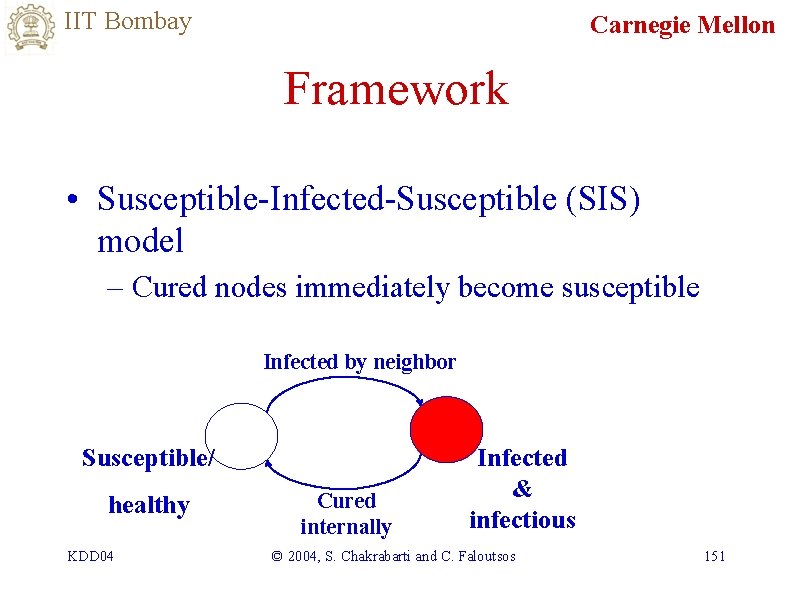
IIT Bombay Carnegie Mellon Framework • Susceptible-Infected-Susceptible (SIS) model – Cured nodes immediately become susceptible Infected by neighbor Susceptible/ healthy KDD 04 Cured internally Infected & infectious © 2004, S. Chakrabarti and C. Faloutsos 151
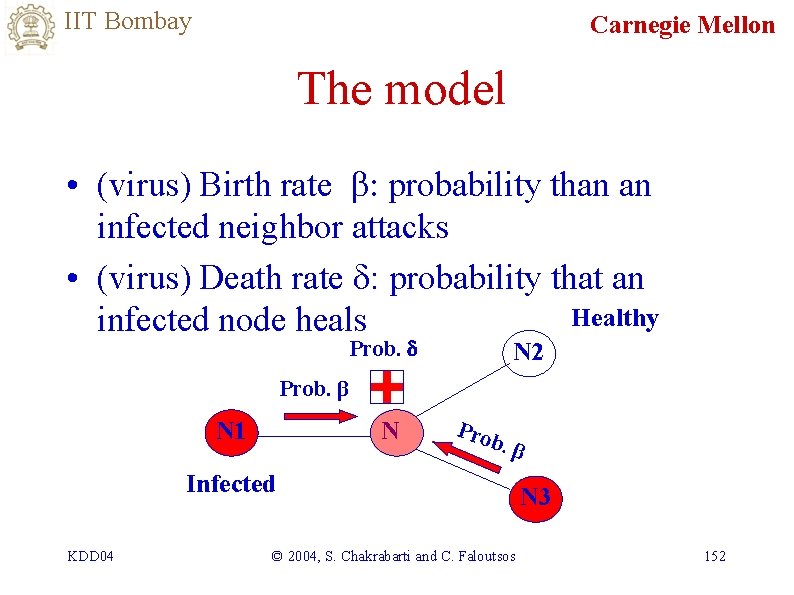
IIT Bombay Carnegie Mellon The model • (virus) Birth rate b: probability than an infected neighbor attacks • (virus) Death rate d: probability that an Healthy infected node heals Prob. d N 2 Prob. β N 1 N Pro b. β Infected KDD 04 © 2004, S. Chakrabarti and C. Faloutsos N 3 152
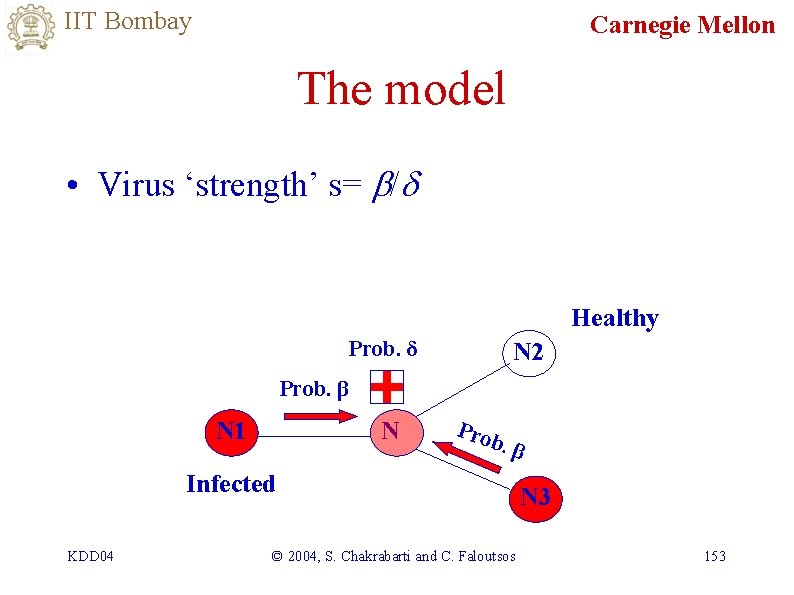
IIT Bombay Carnegie Mellon The model • Virus ‘strength’ s= b/d Healthy Prob. δ N 2 Prob. β N 1 N Pro b. β Infected KDD 04 © 2004, S. Chakrabarti and C. Faloutsos N 3 153
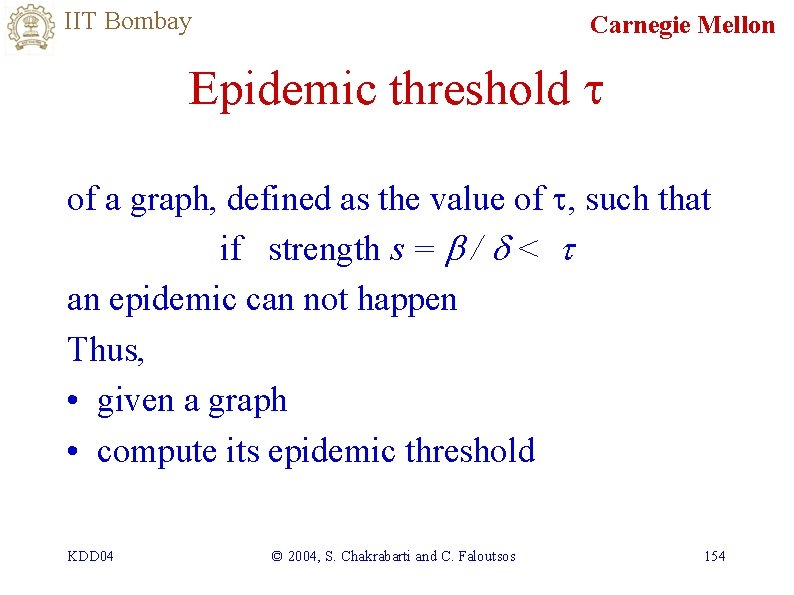
IIT Bombay Carnegie Mellon Epidemic threshold t of a graph, defined as the value of t, such that if strength s = b / d < t an epidemic can not happen Thus, • given a graph • compute its epidemic threshold KDD 04 © 2004, S. Chakrabarti and C. Faloutsos 154
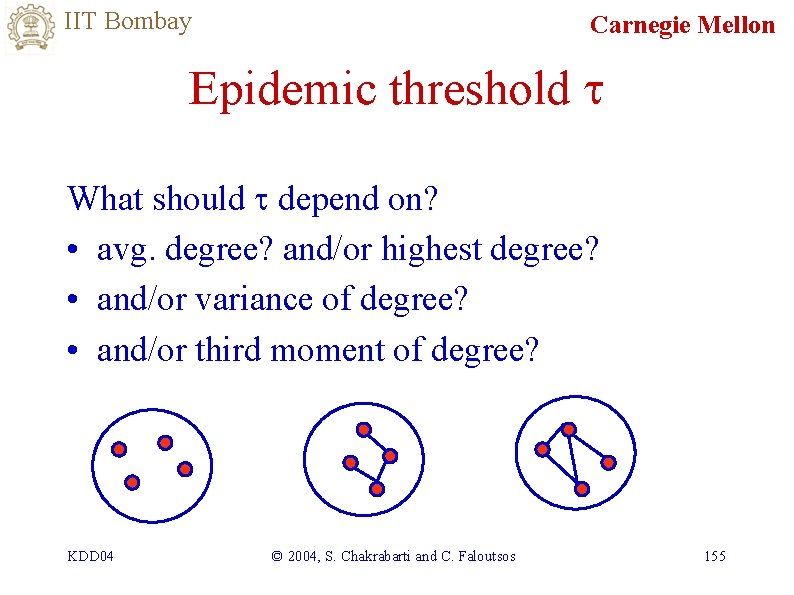
IIT Bombay Carnegie Mellon Epidemic threshold t What should t depend on? • avg. degree? and/or highest degree? • and/or variance of degree? • and/or third moment of degree? KDD 04 © 2004, S. Chakrabarti and C. Faloutsos 155
![IIT Bombay Carnegie Mellon Epidemic threshold • [Theorem] We have no epidemic, if β/δ](http://slidetodoc.com/presentation_image/f8ed26c72b94af3eafdeae1d86f7e544/image-156.jpg "IIT Bombay Carnegie Mellon Epidemic threshold • [Theorem] We have no epidemic, if β/δ")
IIT Bombay Carnegie Mellon Epidemic threshold • [Theorem] We have no epidemic, if β/δ <τ = 1/ λ 1, A KDD 04 © 2004, S. Chakrabarti and C. Faloutsos 156
![IIT Bombay Carnegie Mellon Epidemic threshold • [Theorem] We have no epidemic, if epidemic](http://slidetodoc.com/presentation_image/f8ed26c72b94af3eafdeae1d86f7e544/image-157.jpg "IIT Bombay Carnegie Mellon Epidemic threshold • [Theorem] We have no epidemic, if epidemic")
IIT Bombay Carnegie Mellon Epidemic threshold • [Theorem] We have no epidemic, if epidemic threshold recovery prob. β/δ <τ = 1/ λ 1, A attack prob. largest eigenvalue of adj. matrix A Proof: [Wang+03] KDD 04 © 2004, S. Chakrabarti and C. Faloutsos 157
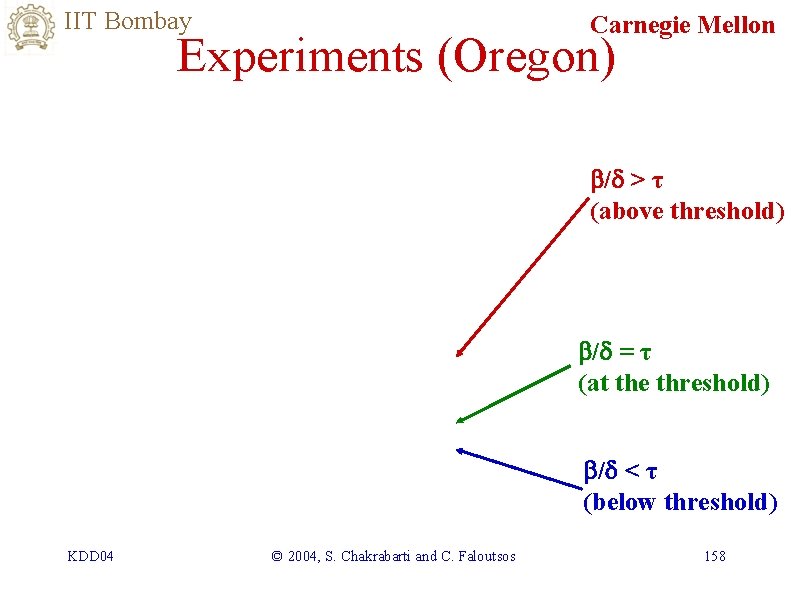
IIT Bombay Carnegie Mellon Experiments (Oregon) b/d > τ (above threshold) b/d = τ (at the threshold) b/d < τ (below threshold) KDD 04 © 2004, S. Chakrabarti and C. Faloutsos 158
IIT Bombay Carnegie Mellon Our wish list: • How important is a node? • Who is the best person/computer to immunize against a virus? • Who is the best customer to advertise to? • Who originated a raging rumor? ssp values answer these questions KDD 04 © 2004, S. Chakrabarti and C. Faloutsos 159
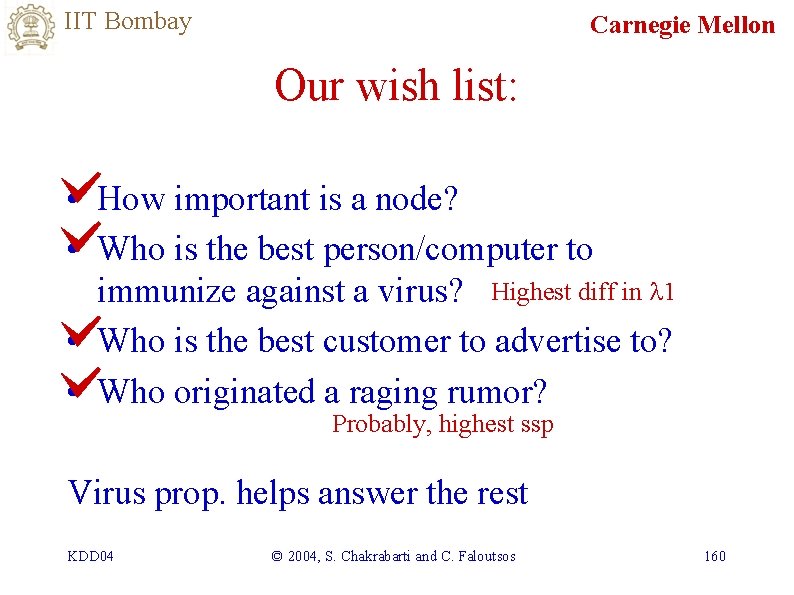
IIT Bombay Carnegie Mellon Our wish list: • How important is a node? • Who is the best person/computer to immunize against a virus? Highest diff in l 1 • Who is the best customer to advertise to? • Who originated a raging rumor? Probably, highest ssp Virus prop. helps answer the rest KDD 04 © 2004, S. Chakrabarti and C. Faloutsos 160
IIT Bombay Carnegie Mellon Conclusions eigenvalues/eigenvectors: vital for • Page. Rank, • virus propagation, • (graph partitioning) KDD 04 © 2004, S. Chakrabarti and C. Faloutsos 161
IIT Bombay Carnegie Mellon Conclusions, cont’d SVD • closely related: HITS/Kleinberg • (and also LSI, KLT, PCA, Least squares, . . . ) Both are extremely useful, well understood tools for graphs / matrices. KDD 04 © 2004, S. Chakrabarti and C. Faloutsos 162
IIT Bombay Carnegie Mellon Resources: Software and urls • SVD packages: in many systems (matlab, mathematica, LINPACK, LAPACK) • stand-alone, free code: SVDPACK from Michael Berry http: //www. cs. utk. edu/~berry/projects. html KDD 04 © 2004, S. Chakrabarti and C. Faloutsos 163
IIT Bombay Carnegie Mellon Books • Faloutsos, C. (1996). Searching Multimedia Databases by Content, Kluwer Academic Inc. • Jolliffe, I. T. (1986). Principal Component Analysis, Springer Verlag. KDD 04 © 2004, S. Chakrabarti and C. Faloutsos 164
![IIT Bombay Carnegie Mellon Books • [Press+92] William H. Press, Saul A. Teukolsky, William](http://slidetodoc.com/presentation_image/f8ed26c72b94af3eafdeae1d86f7e544/image-165.jpg "IIT Bombay Carnegie Mellon Books • [Press+92] William H. Press, Saul A. Teukolsky, William")
IIT Bombay Carnegie Mellon Books • [Press+92] William H. Press, Saul A. Teukolsky, William T. Vetterling and Brian P. Flannery: Numerical Recipes in C, Cambridge University Press, 1992, 2 nd Edition. (Great description, intuition and code for SVD) KDD 04 © 2004, S. Chakrabarti and C. Faloutsos 165
IIT Bombay Carnegie Mellon References • Berry, Michael: http: //www. cs. utk. edu/~lsi/ • Brin, S. and L. Page (1998). Anatomy of a Large. Scale Hypertextual Web Search Engine. 7 th Intl World Wide Web Conf. KDD 04 © 2004, S. Chakrabarti and C. Faloutsos 166
![IIT Bombay Carnegie Mellon References (cont’d) • [Foltz+92] Foltz, P. W. and S. T.](http://slidetodoc.com/presentation_image/f8ed26c72b94af3eafdeae1d86f7e544/image-167.jpg "IIT Bombay Carnegie Mellon References (cont’d) • [Foltz+92] Foltz, P. W. and S. T.")
IIT Bombay Carnegie Mellon References (cont’d) • [Foltz+92] Foltz, P. W. and S. T. Dumais (Dec. 1992). "Personalized Information Delivery: An Analysis of Information Filtering Methods. " Comm. of ACM (CACM) 35(12): 51 -60. KDD 04 © 2004, S. Chakrabarti and C. Faloutsos 167
IIT Bombay Carnegie Mellon References (cont’d) • Fukunaga, K. (1990). Introduction to Statistical Pattern Recognition, Academic Press. • Kleinberg, J. (1998). Authoritative sources in a hyperlinked environment. Proc. 9 th ACM-SIAM Symposium on Discrete Algorithms. KDD 04 © 2004, S. Chakrabarti and C. Faloutsos 168
![IIT Bombay Carnegie Mellon References (cont’d) • [Wang+03] Yang Wang, Deepayan Chakrabarti, Chenxi Wang](http://slidetodoc.com/presentation_image/f8ed26c72b94af3eafdeae1d86f7e544/image-169.jpg "IIT Bombay Carnegie Mellon References (cont’d) • [Wang+03] Yang Wang, Deepayan Chakrabarti, Chenxi Wang")
IIT Bombay Carnegie Mellon References (cont’d) • [Wang+03] Yang Wang, Deepayan Chakrabarti, Chenxi Wang and Christos Faloutsos: Epidemic Spreading in Real Networks: an Eigenvalue Viewpoint, SRDS 2003, Florence, Italy. KDD 04 © 2004, S. Chakrabarti and C. Faloutsos 169

IIT Bombay KDD 04 Carnegie Mellon © 2004, S. Chakrabarti and C. Faloutsos 170
- Slides: 170