
II PROTEIN BIOCHEMISTRY 2 1 Amino Acids 2
II. PROTEIN BIOCHEMISTRY § 2. 1 Amino Acids § 2. 1 a Nomenclature § 2. 1 b Ionization § 2. 1 c Chirality § 2. 1 d Modification
§ 2. 1 a Nomenclature
Synopsis 2. 1 a - Proteins (or polypeptides) are polymers made up of building blocks, or monomeric units, called “amino acids” - There are 20 naturally-occurring amino acids referred to as “standard amino acids” or “ -amino acids” - Standard amino acids share a common structure but differ in their side chains—the so-called R group - Amino acids are linked together to generate a polypeptide chain via socalled “peptide” or “amide” bonds - Amino acids are often abbreviated to “AA” or “aa”—eg the polypeptide chain is 20 -aa long
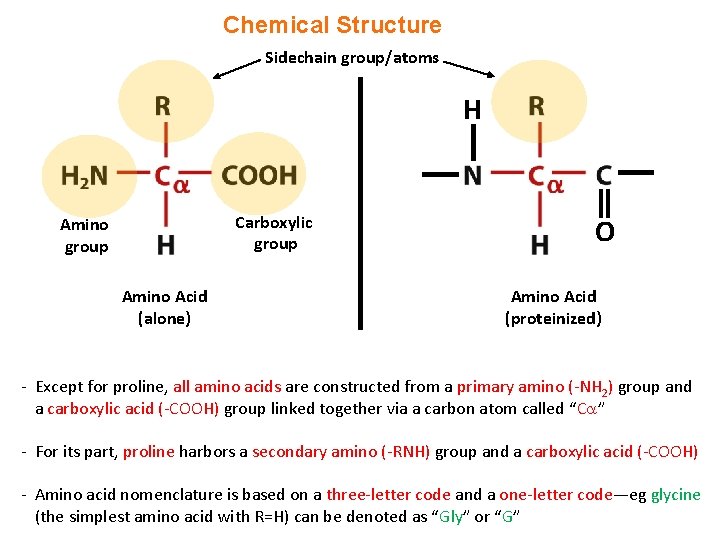
Chemical Structure Sidechain group/atoms H Carboxylic group Amino Acid (alone) O Amino Acid (proteinized) - Except for proline, all amino acids are constructed from a primary amino (-NH 2) group and a carboxylic acid (-COOH) group linked together via a carbon atom called “C ” - For its part, proline harbors a secondary amino (-RNH) group and a carboxylic acid (-COOH) - Amino acid nomenclature is based on a three-letter code and a one-letter code—eg glycine (the simplest amino acid with R=H) can be denoted as “Gly” or “G”
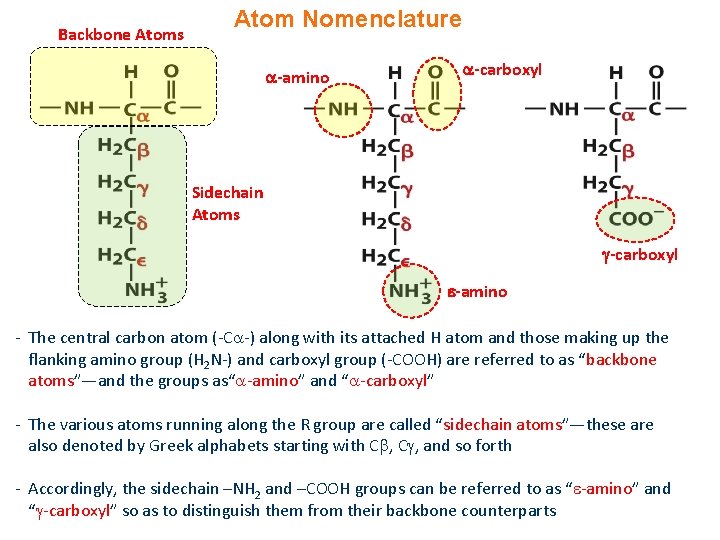
Backbone Atoms Atom Nomenclature -amino -carboxyl Sidechain Atoms -carboxyl -amino - The central carbon atom (-C -) along with its attached H atom and those making up the flanking amino group (H 2 N-) and carboxyl group (-COOH) are referred to as “backbone atoms”—and the groups as“ -amino” and “ -carboxyl” - The various atoms running along the R group are called “sidechain atoms”—these are also denoted by Greek alphabets starting with C , and so forth - Accordingly, the sidechain –NH 2 and –COOH groups can be referred to as “ -amino” and “ -carboxyl” so as to distinguish them from their backbone counterparts
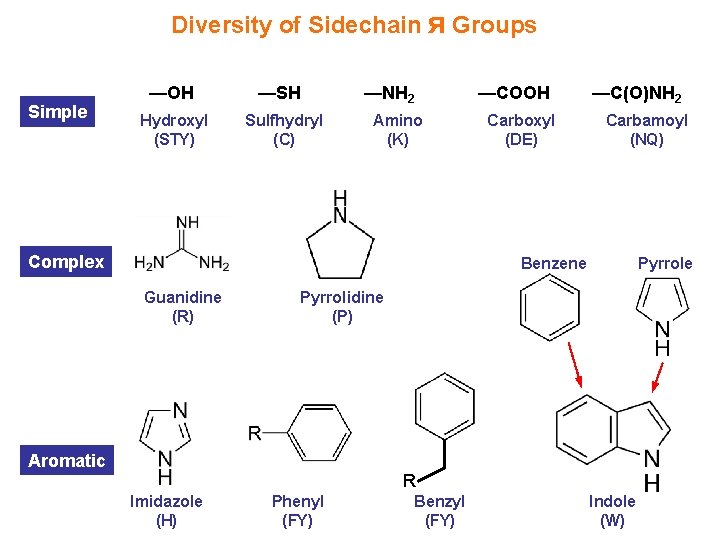
Diversity of Sidechain ᴙ Groups Simple —OH Hydroxyl (STY) —SH Sulfhydryl (C) —NH 2 Amino (K) Complex —COOH Carboxyl (DE) —C(O)NH 2 Carbamoyl (NQ) Benzene Guanidine (R) Pyrrole Pyrrolidine (P) Aromatic R Imidazole (H) Phenyl (FY) Benzyl (FY) Indole (W)
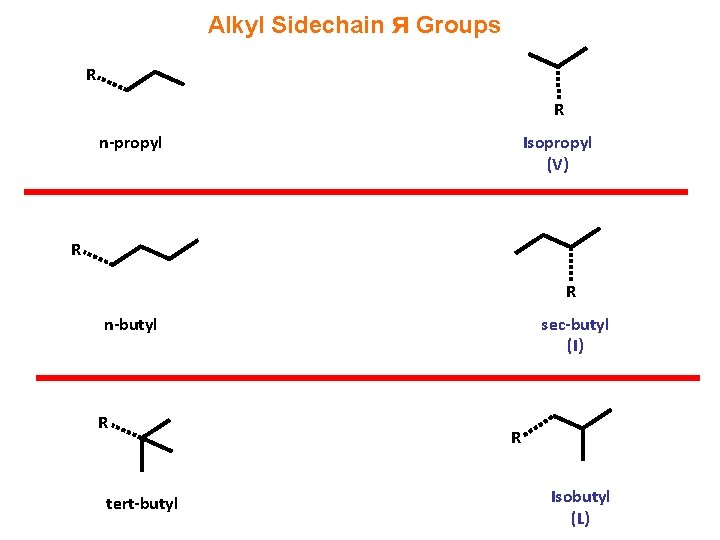
Alkyl Sidechain ᴙ Groups R R n-propyl Isopropyl (V) R R n-butyl R tert-butyl sec-butyl (I) R Isobutyl (L)
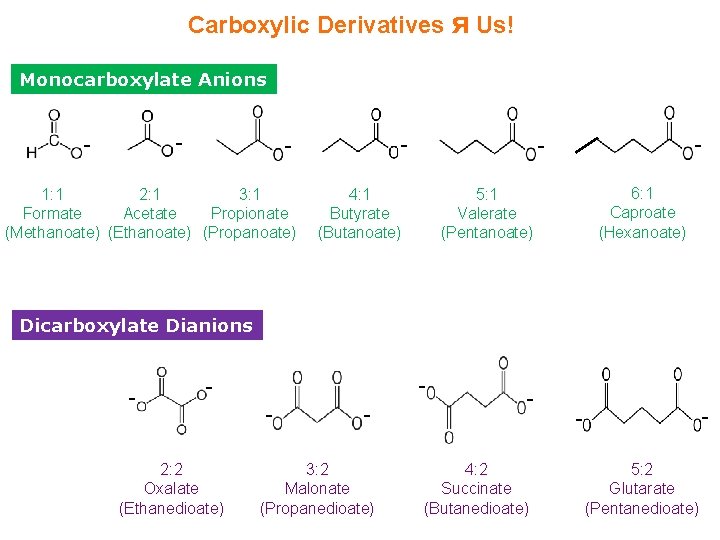
Carboxylic Derivatives ᴙ Us! Monocarboxylate Anions - - 1: 1 2: 1 3: 1 Formate Acetate Propionate (Methanoate) (Ethanoate) (Propanoate) - - 4: 1 Butyrate (Butanoate) 6: 1 Caproate (Hexanoate) 5: 1 Valerate (Pentanoate) Dicarboxylate Dianions - - - 2: 2 Oxalate (Ethanedioate) - - 3: 2 Malonate (Propanedioate) - 4: 2 Succinate (Butanedioate) - 5: 2 Glutarate (Pentanedioate)
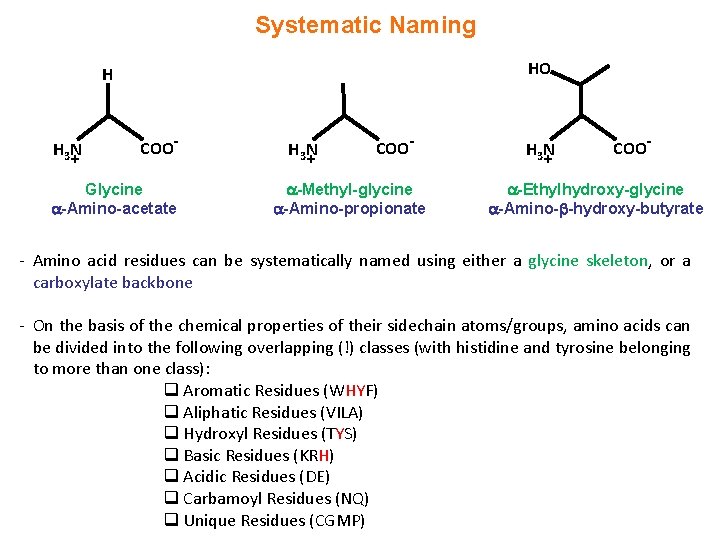
Systematic Naming HO H H 3 N + COO- Glycine -Amino-acetate H 3 N + COO- -Methyl-glycine -Amino-propionate H 3 N + COO- -Ethylhydroxy-glycine -Amino- -hydroxy-butyrate - Amino acid residues can be systematically named using either a glycine skeleton, or a carboxylate backbone - On the basis of the chemical properties of their sidechain atoms/groups, amino acids can be divided into the following overlapping (!) classes (with histidine and tyrosine belonging to more than one class): q Aromatic Residues (WHYF) q Aliphatic Residues (VILA) q Hydroxyl Residues (TYS) q Basic Residues (KRH) q Acidic Residues (DE) q Carbamoyl Residues (NQ) q Unique Residues (CGMP)
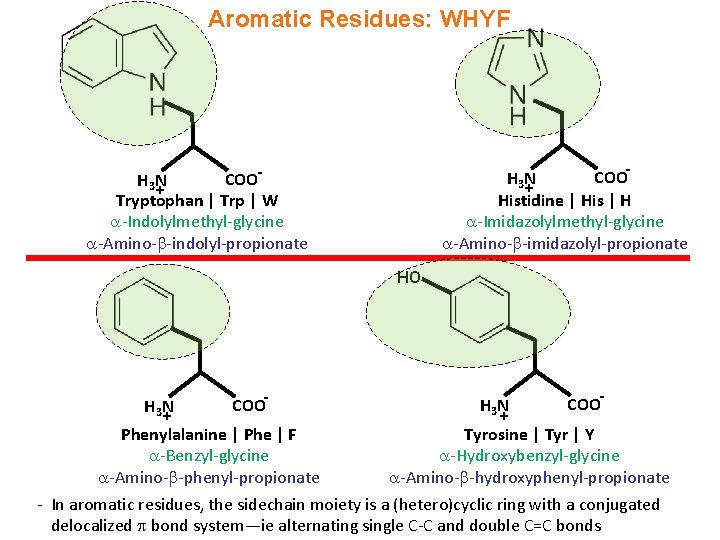
Aromatic Residues: WHYF COOH 3 N + Histidine | His | H -Imidazolylmethyl-glycine -Amino- -imidazolyl-propionate COOH 3 N + Tryptophan | Trp | W -Indolylmethyl-glycine -Amino- -indolyl-propionate HO H 3 N + - COO Phenylalanine | Phe | F Tyrosine | Tyr | Y -Benzyl-glycine -Hydroxybenzyl-glycine -Amino- -phenyl-propionate -Amino- -hydroxyphenyl-propionate - In aromatic residues, the sidechain moiety is a (hetero)cyclic ring with a conjugated delocalized bond system—ie alternating single C-C and double C=C bonds
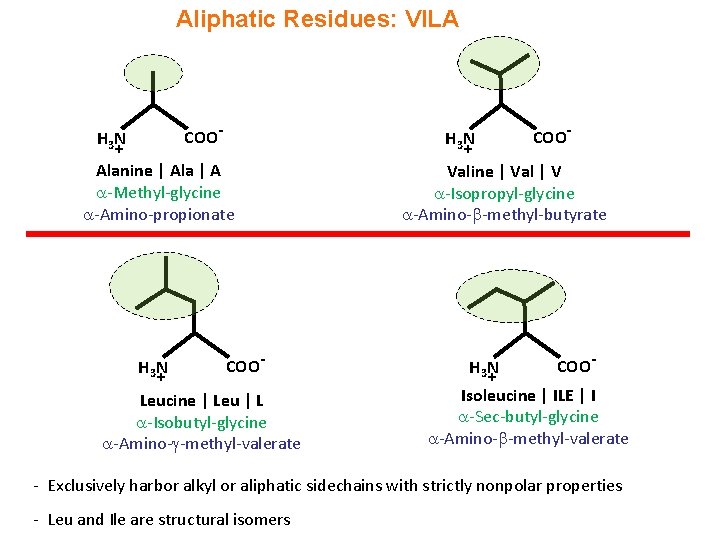
Aliphatic Residues: VILA COO- H 3 N + + Alanine | Ala | A -Methyl-glycine -Amino-propionate H 3 N + COO- H 3 N COO - Leucine | Leu | L -Isobutyl-glycine -Amino- -methyl-valerate Valine | Val | V -Isopropyl-glycine -Amino- -methyl-butyrate H 3 N + COO - Isoleucine | ILE | I -Sec-butyl-glycine -Amino- -methyl-valerate - Exclusively harbor alkyl or aliphatic sidechains with strictly nonpolar properties - Leu and Ile are structural isomers
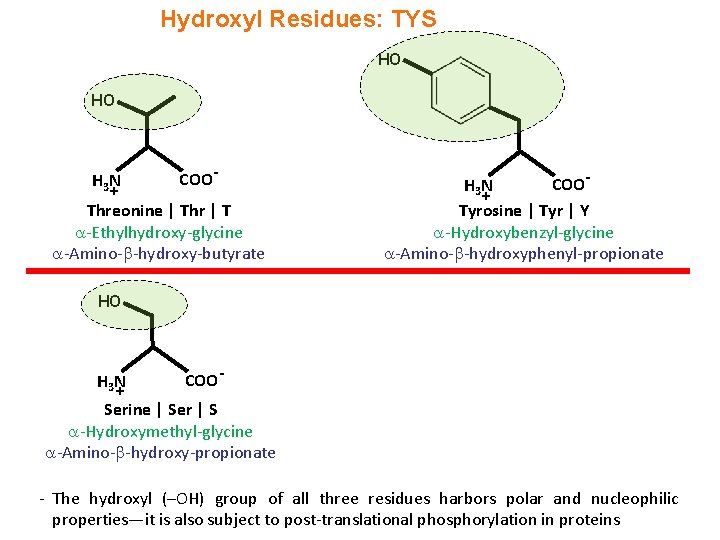
Hydroxyl Residues: TYS HO HO H 3 N + COO- Threonine | Thr | T -Ethylhydroxy-glycine -Amino- -hydroxy-butyrate COOH 3 N + Tyrosine | Tyr | Y -Hydroxybenzyl-glycine -Amino- -hydroxyphenyl-propionate HO H 3 N + COO - Serine | Ser | S -Hydroxymethyl-glycine -Amino- -hydroxy-propionate - The hydroxyl (–OH) group of all three residues harbors polar and nucleophilic properties—it is also subject to post-translational phosphorylation in proteins
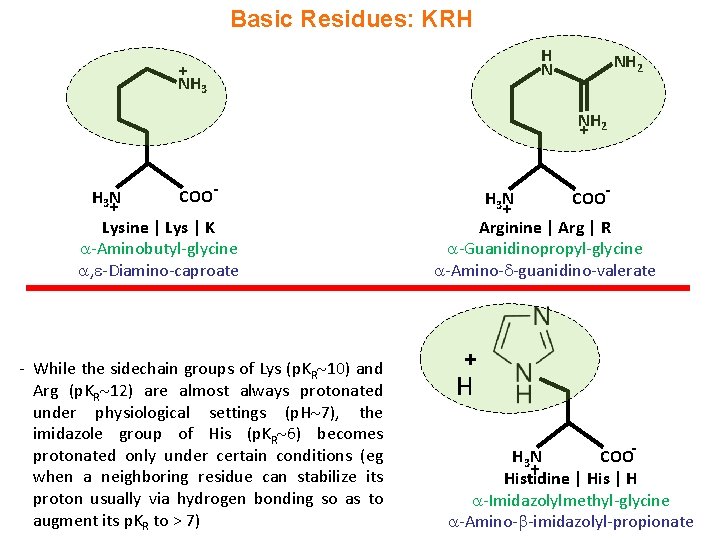
Basic Residues: KRH H N + NH 3 NH 2 + H 3 N + COO- Lysine | Lys | K -Aminobutyl-glycine , -Diamino-caproate - While the sidechain groups of Lys (p. KR 10) and Arg (p. KR 12) are almost always protonated under physiological settings (p. H 7), the imidazole group of His (p. KR 6) becomes protonated only under certain conditions (eg when a neighboring residue can stabilize its proton usually via hydrogen bonding so as to augment its p. KR to > 7) H 3 N + COO- Arginine | Arg | R -Guanidinopropyl-glycine -Amino- -guanidino-valerate + H COOH 3 N + Histidine | His | H -Imidazolylmethyl-glycine -Amino- -imidazolyl-propionate
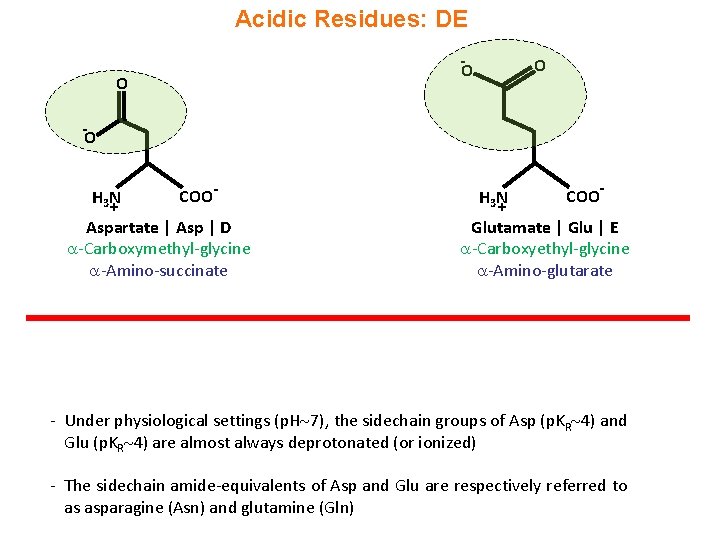
Acidic Residues: DE - O O O - O H 3 N + COO- Aspartate | Asp | D -Carboxymethyl-glycine -Amino-succinate H 3 N + COO- Glutamate | Glu | E -Carboxyethyl-glycine -Amino-glutarate - Under physiological settings (p. H 7), the sidechain groups of Asp (p. KR 4) and Glu (p. KR 4) are almost always deprotonated (or ionized) - The sidechain amide-equivalents of Asp and Glu are respectively referred to as asparagine (Asn) and glutamine (Gln)
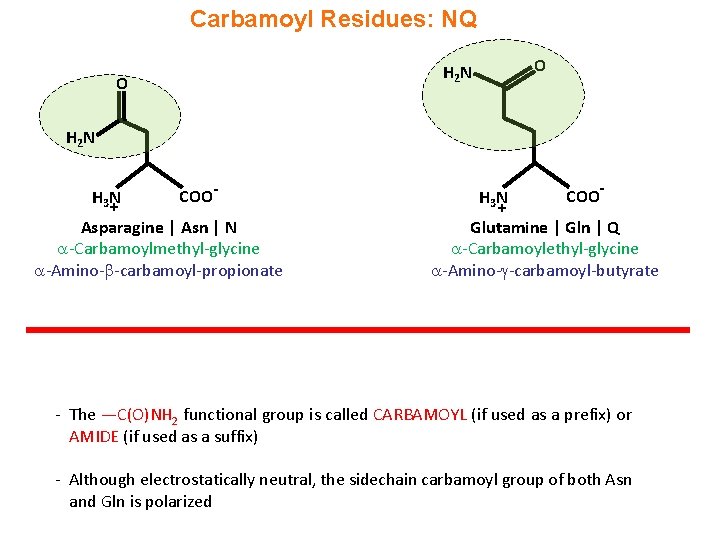
Carbamoyl Residues: NQ O H 2 N H 3 N + COO- Asparagine | Asn | N -Carbamoylmethyl-glycine -Amino- -carbamoyl-propionate H 3 N + COO- Glutamine | Gln | Q -Carbamoylethyl-glycine -Amino- -carbamoyl-butyrate - The —C(O)NH 2 functional group is called CARBAMOYL (if used as a prefix) or AMIDE (if used as a suffix) - Although electrostatically neutral, the sidechain carbamoyl group of both Asn and Gln is polarized

Unique Residues: CGMP S HS - COO H 3 N + Cysteine | Cys | C -Thiomethyl-glycine -Amino- -sulfhydryl-propionate COO- H 3 N + Methionine | Met | M -Methylthioethyl-glycine -Amino- -methylthio-butyrate H + - COO N H 2 COO H 3 N + Proline | Pro | P Glycine | Gly | G -N-Propyl-glycine Glycine , -Amino-valerate -Amino-acetate -Carboxy-pyrrolidine - So-named “unique” by Professor Farooq, because none of these residues share structural analogy among themselves or with any other amino acids—though the sidechain sulfhydryl/thio (-SH) group of Cys also harbors polar and nucleophilic properties reminiscent of the –OH sidechain group of Ser
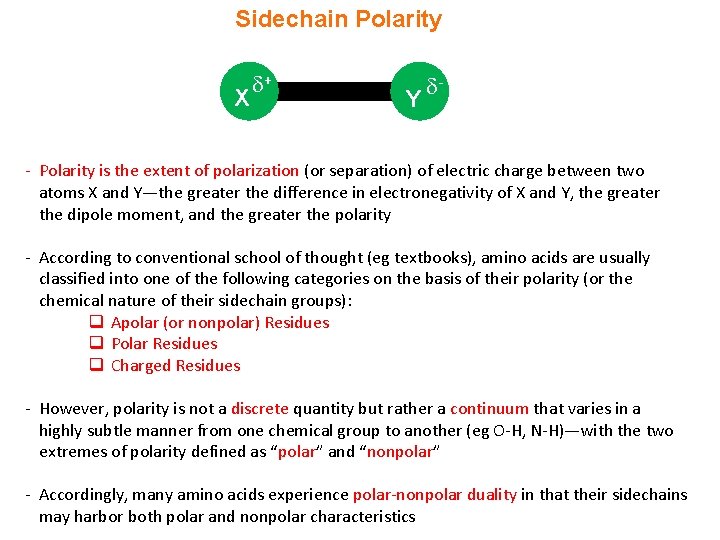
Sidechain Polarity X + Y - - Polarity is the extent of polarization (or separation) of electric charge between two atoms X and Y—the greater the difference in electronegativity of X and Y, the greater the dipole moment, and the greater the polarity - According to conventional school of thought (eg textbooks), amino acids are usually classified into one of the following categories on the basis of their polarity (or the chemical nature of their sidechain groups): q Apolar (or nonpolar) Residues q Polar Residues q Charged Residues - However, polarity is not a discrete quantity but rather a continuum that varies in a highly subtle manner from one chemical group to another (eg O-H, N-H)—with the two extremes of polarity defined as “polar” and “nonpolar” - Accordingly, many amino acids experience polar-nonpolar duality in that their sidechains may harbor both polar and nonpolar characteristics
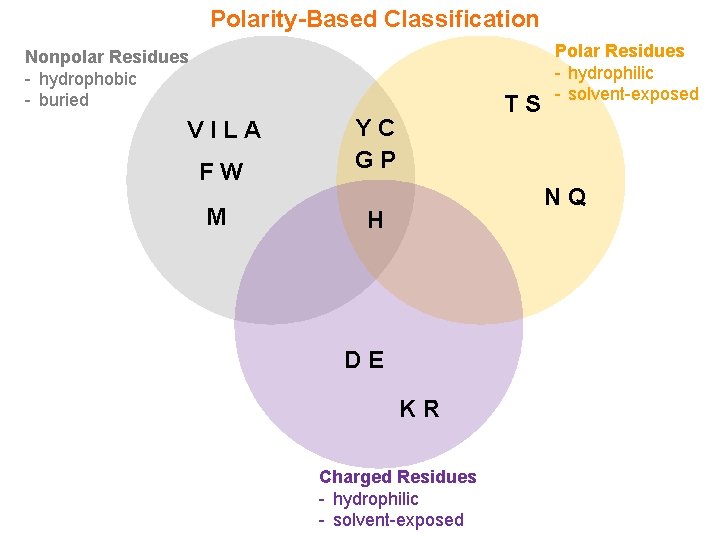
Polarity-Based Classification Nonpolar Residues - hydrophobic - buried VILA FW M TS YC GP Polar Residues - hydrophilic - solvent-exposed NQ H DE KR Charged Residues - hydrophilic - solvent-exposed
Exercise 2. 1 a - Draw a generic amino acid and identify the C atom and its substituents - Draw the structures of the 20 standard amino acids and provide their one- and three-letter abbreviations - Classify the 20 standard amino acids by polarity, structure, type of functional group, and acid–base properties
§ 2. 1 b Ionization
Synopsis 2. 1 b - p. K is a measure of the propensity of an acid (or base) to lose a proton—the lower the p. K, the higher the propensity of the proton to dissociate! - Backbone groups of free amino acids can adopt multiple ionization states depending on their p. K values and solution p. H—in the context of a protein, such groups are not ionizable - Side chain groups of many amino acids harbor ionizable groups with distinct p. KR values—p. KR specifically refers to the p. K values of sidechain groups - Such p. KR values of sidechain groups can be modulated by as much as several units by neighboring residues in the context of a protein - This discrepancy/anomaly arises due to electrostatic interactions of ionizable sidechain groups with other neighboring residues within close vicinity - The extent of ionization of amino acid groups can be rationalized in terms of Henderson-Hasselbalch equation
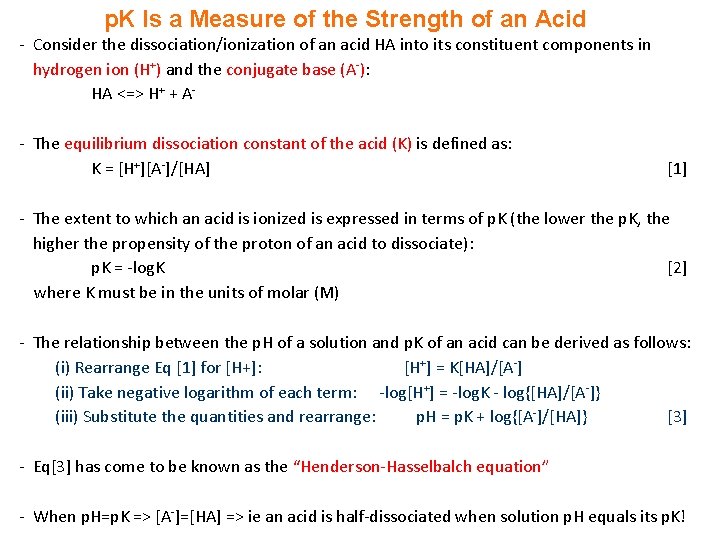
p. K Is a Measure of the Strength of an Acid - Consider the dissociation/ionization of an acid HA into its constituent components in hydrogen ion (H+) and the conjugate base (A-): HA <=> H+ + A- The equilibrium dissociation constant of the acid (K) is defined as: K = [H+][A-]/[HA] [1] - The extent to which an acid is ionized is expressed in terms of p. K (the lower the p. K, the higher the propensity of the proton of an acid to dissociate): p. K = -log. K [2] where K must be in the units of molar (M) - The relationship between the p. H of a solution and p. K of an acid can be derived as follows: (i) Rearrange Eq [1] for [H+]: [H+] = K[HA]/[A-] (ii) Take negative logarithm of each term: -log[H+] = -log. K - log{[HA]/[A-]} (iii) Substitute the quantities and rearrange: p. H = p. K + log{[A-]/[HA]} [3] - Eq[3] has come to be known as the “Henderson-Hasselbalch equation” - When p. H=p. K => [A-]=[HA] => ie an acid is half-dissociated when solution p. H equals its p. K!
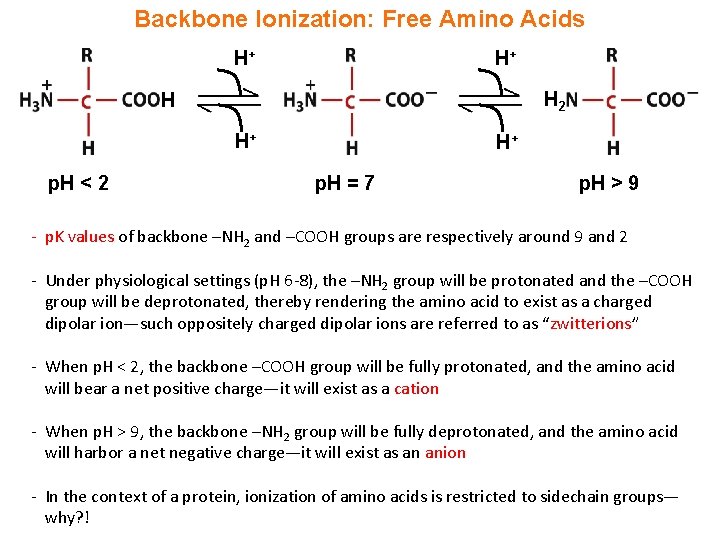
Backbone Ionization: Free Amino Acids H+ H+ H 2 H H+ p. H < 2 H+ p. H = 7 p. H > 9 - p. K values of backbone –NH 2 and –COOH groups are respectively around 9 and 2 - Under physiological settings (p. H 6 -8), the –NH 2 group will be protonated and the –COOH group will be deprotonated, thereby rendering the amino acid to exist as a charged dipolar ion—such oppositely charged dipolar ions are referred to as “zwitterions” - When p. H < 2, the backbone –COOH group will be fully protonated, and the amino acid will bear a net positive charge—it will exist as a cation - When p. H > 9, the backbone –NH 2 group will be fully deprotonated, and the amino acid will harbor a net negative charge—it will exist as an anion - In the context of a protein, ionization of amino acids is restricted to sidechain groups— why? !
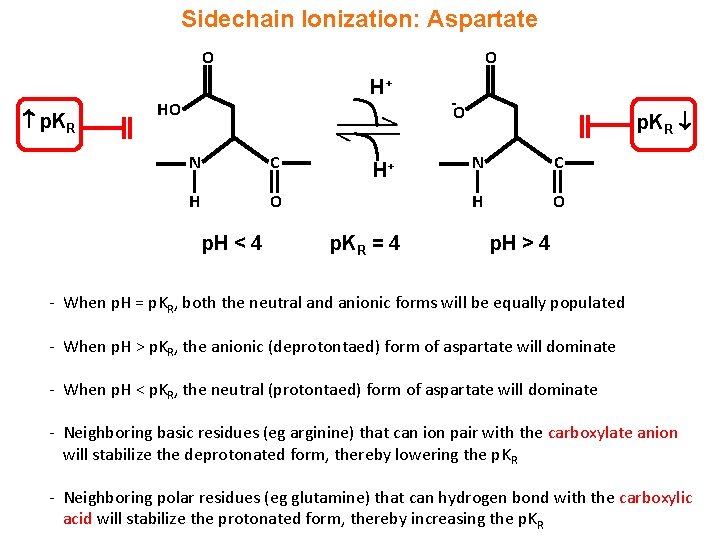
Sidechain Ionization: Aspartate O p. KR O H+ HO - O N C H O p. H < 4 H+ p. KR = 4 p. KR N C H O p. H > 4 - When p. H = p. KR, both the neutral and anionic forms will be equally populated - When p. H > p. KR, the anionic (deprotontaed) form of aspartate will dominate - When p. H < p. KR, the neutral (protontaed) form of aspartate will dominate - Neighboring basic residues (eg arginine) that can ion pair with the carboxylate anion will stabilize the deprotonated form, thereby lowering the p. KR - Neighboring polar residues (eg glutamine) that can hydrogen bond with the carboxylic acid will stabilize the protonated form, thereby increasing the p. KR
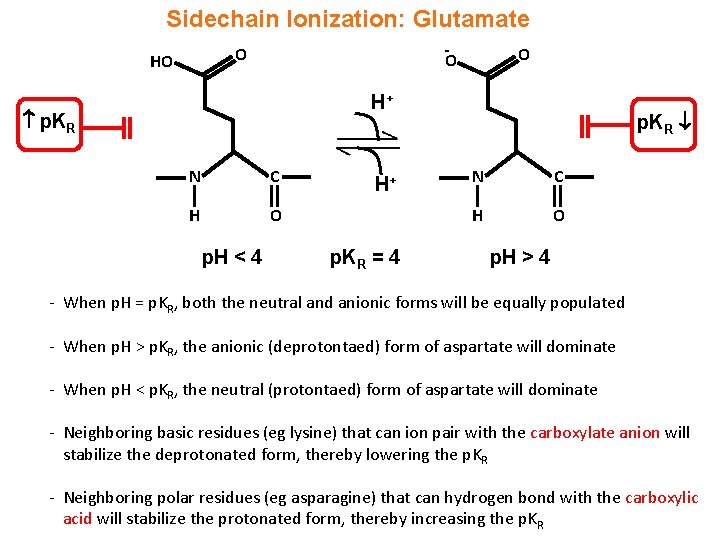
Sidechain Ionization: Glutamate - O HO O O H+ p. KR N C H O p. H < 4 H+ p. KR = 4 p. KR N C H O p. H > 4 - When p. H = p. KR, both the neutral and anionic forms will be equally populated - When p. H > p. KR, the anionic (deprotontaed) form of aspartate will dominate - When p. H < p. KR, the neutral (protontaed) form of aspartate will dominate - Neighboring basic residues (eg lysine) that can ion pair with the carboxylate anion will stabilize the deprotonated form, thereby lowering the p. KR - Neighboring polar residues (eg asparagine) that can hydrogen bond with the carboxylic acid will stabilize the protonated form, thereby increasing the p. KR
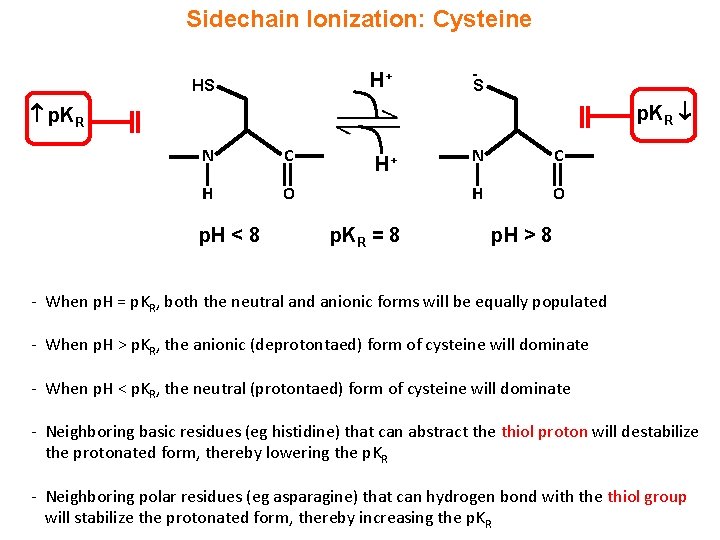
Sidechain Ionization: Cysteine H+ HS S p. KR N C H O p. H < 8 H+ p. KR = 8 N C H O p. H > 8 - When p. H = p. KR, both the neutral and anionic forms will be equally populated - When p. H > p. KR, the anionic (deprotontaed) form of cysteine will dominate - When p. H < p. KR, the neutral (protontaed) form of cysteine will dominate - Neighboring basic residues (eg histidine) that can abstract the thiol proton will destabilize the protonated form, thereby lowering the p. KR - Neighboring polar residues (eg asparagine) that can hydrogen bond with the thiol group will stabilize the protonated form, thereby increasing the p. KR
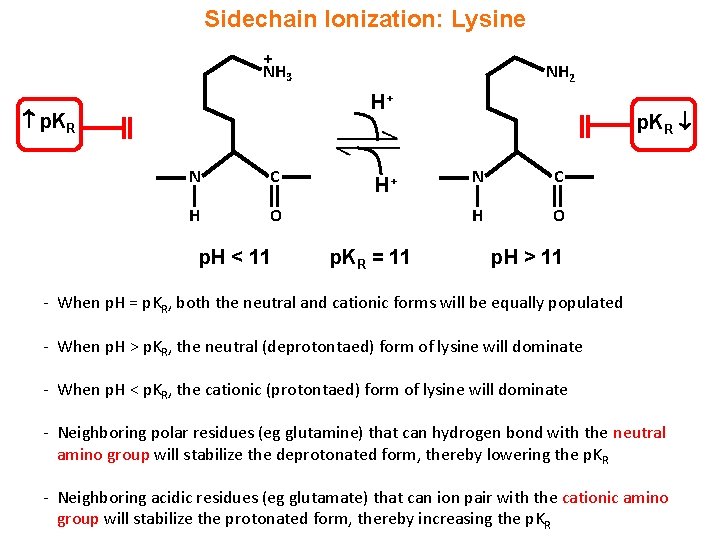
Sidechain Ionization: Lysine + NH 3 NH 2 H+ p. KR N C H O p. H < 11 H+ p. KR = 11 p. KR N C H O p. H > 11 - When p. H = p. KR, both the neutral and cationic forms will be equally populated - When p. H > p. KR, the neutral (deprotontaed) form of lysine will dominate - When p. H < p. KR, the cationic (protontaed) form of lysine will dominate - Neighboring polar residues (eg glutamine) that can hydrogen bond with the neutral amino group will stabilize the deprotonated form, thereby lowering the p. KR - Neighboring acidic residues (eg glutamate) that can ion pair with the cationic amino group will stabilize the protonated form, thereby increasing the p. KR
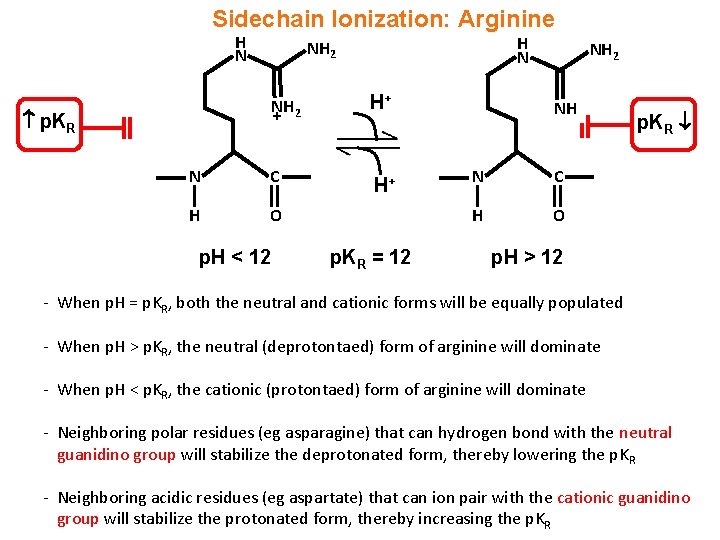
Sidechain Ionization: Arginine H N NH 2 H+ N C H+ H O p. KR + p. H < 12 p. KR = 12 NH N C H O p. KR p. H > 12 - When p. H = p. KR, both the neutral and cationic forms will be equally populated - When p. H > p. KR, the neutral (deprotontaed) form of arginine will dominate - When p. H < p. KR, the cationic (protontaed) form of arginine will dominate - Neighboring polar residues (eg asparagine) that can hydrogen bond with the neutral guanidino group will stabilize the deprotonated form, thereby lowering the p. KR - Neighboring acidic residues (eg aspartate) that can ion pair with the cationic guanidino group will stabilize the protonated form, thereby increasing the p. KR
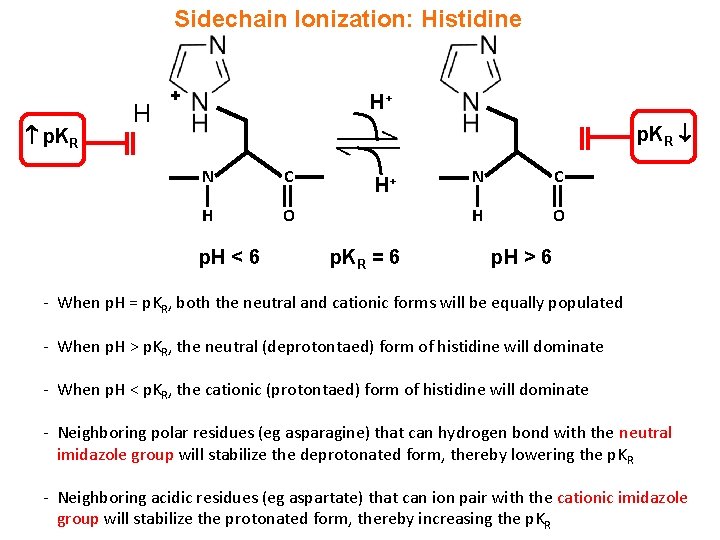
Sidechain Ionization: Histidine p. KR H + H+ p. KR N C H O p. H < 6 H+ p. KR = 6 N C H O p. H > 6 - When p. H = p. KR, both the neutral and cationic forms will be equally populated - When p. H > p. KR, the neutral (deprotontaed) form of histidine will dominate - When p. H < p. KR, the cationic (protontaed) form of histidine will dominate - Neighboring polar residues (eg asparagine) that can hydrogen bond with the neutral imidazole group will stabilize the deprotonated form, thereby lowering the p. KR - Neighboring acidic residues (eg aspartate) that can ion pair with the cationic imidazole group will stabilize the protonated form, thereby increasing the p. KR
Exercise 2. 1 b - Why do p. KR values of ionizable groups differ between free amino acids and amino acid residues in polypeptides? - With respect to their sidechain ionizable groups, which amino acid residues exist between neutral and cationic forms? - With respect to their sidechain ionizable groups, which amino acid residues exist between neutral and anionic forms? - Describe mechanisms by which the p. KR of histidine and cysteine may be modulated in the context of a globular protein?
§ 2. 1 c Chirality
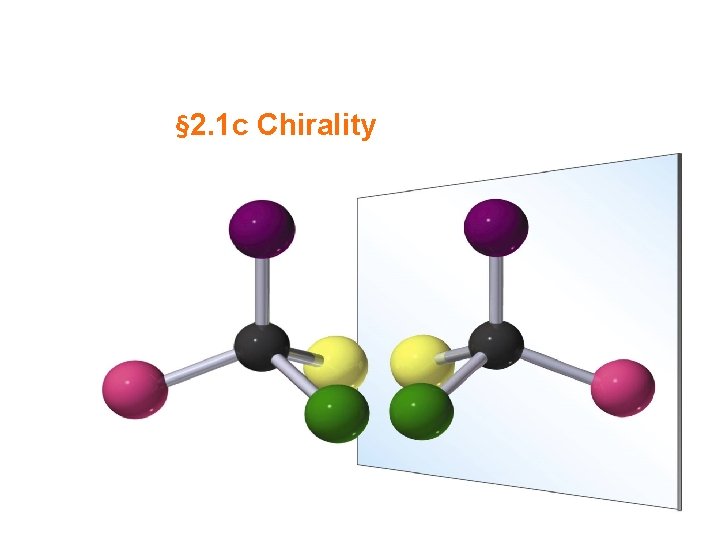
Synopsis 2. 1 c - Amino acids and many other biological compounds are chiral molecules—recall § 1. 1 - All chiral molecules have an asymmetric C atom—attached to four different substituent groups - All amino acids but glycine are chiral! - Each chiral molecule has a non-superimposable mirror image—the pair of such mirror images are termed “enantiomers” - Enantiomers are often designated D and L depending on whether they rotate the plane of polarized light right/dextrorotatory (D) or left/levorotatory (L) - Proteins are exclusively comprised of L-amino acids—even though many L-amino acids are dextrorotatory! - Biochemists employ Fischer projections to depict the D/L configuration of chiral molecules in lieu of the actual rotation of the plane of polarized light
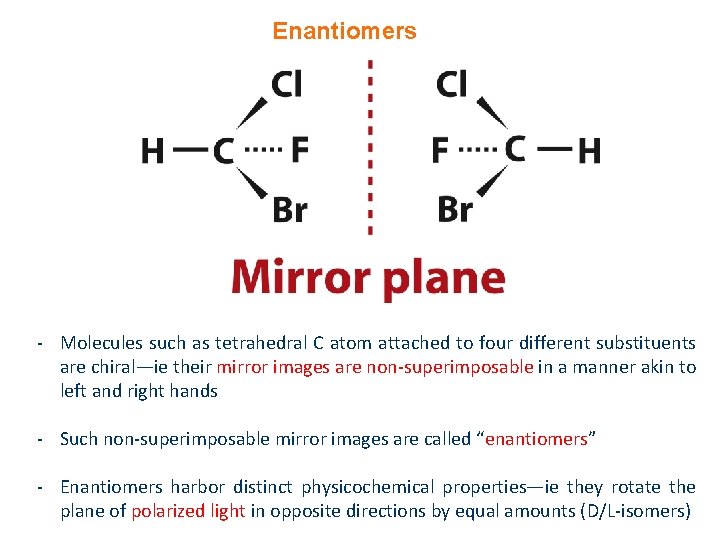
Enantiomers - Molecules such as tetrahedral C atom attached to four different substituents are chiral—ie their mirror images are non-superimposable in a manner akin to left and right hands - Such non-superimposable mirror images are called “enantiomers” - Enantiomers harbor distinct physicochemical properties—ie they rotate the plane of polarized light in opposite directions by equal amounts (D/L-isomers)
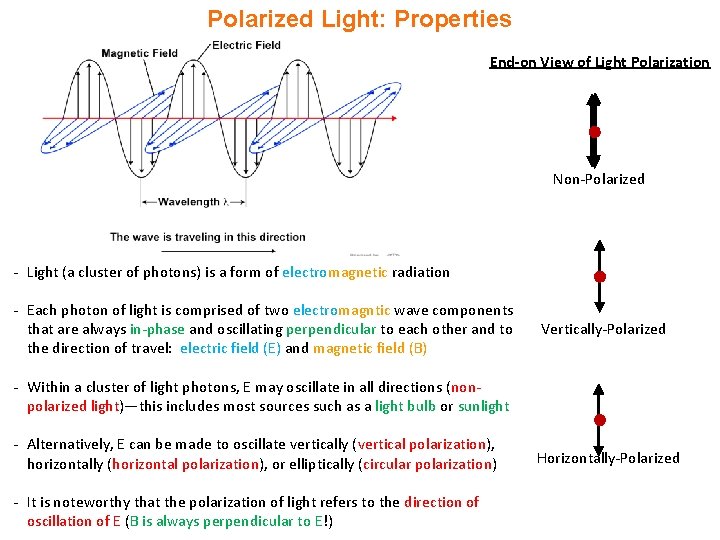
Polarized Light: Properties End-on View of Light Polarization Non-Polarized - Light (a cluster of photons) is a form of electromagnetic radiation - Each photon of light is comprised of two electromagntic wave components that are always in-phase and oscillating perpendicular to each other and to the direction of travel: electric field (E) and magnetic field (B) Vertically-Polarized - Within a cluster of light photons, E may oscillate in all directions (nonpolarized light)—this includes most sources such as a light bulb or sunlight - Alternatively, E can be made to oscillate vertically (vertical polarization), horizontally (horizontal polarization), or elliptically (circular polarization) - It is noteworthy that the polarization of light refers to the direction of oscillation of E (B is always perpendicular to E!) Horizontally-Polarized
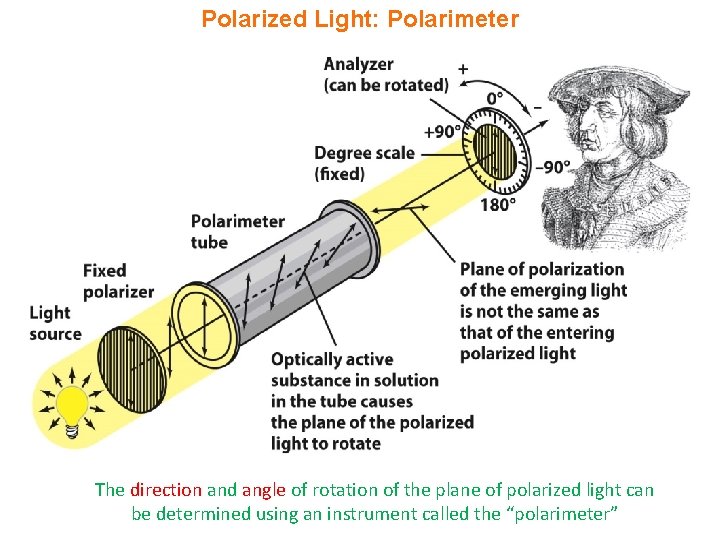
Polarized Light: Polarimeter The direction and angle of rotation of the plane of polarized light can be determined using an instrument called the “polarimeter”
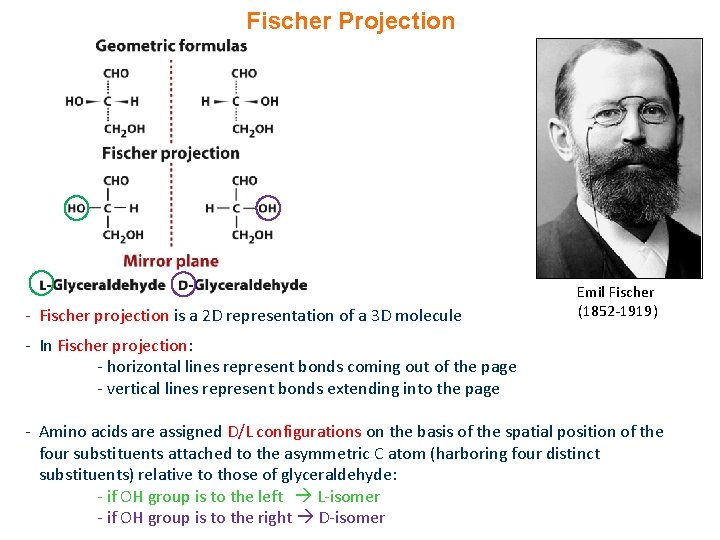
Fischer Projection - Fischer projection is a 2 D representation of a 3 D molecule Emil Fischer (1852 -1919) - In Fischer projection: - horizontal lines represent bonds coming out of the page - vertical lines represent bonds extending into the page - Amino acids are assigned D/L configurations on the basis of the spatial position of the four substituents attached to the asymmetric C atom (harboring four distinct substituents) relative to those of glyceraldehyde: - if OH group is to the left L-isomer - if OH group is to the right D-isomer
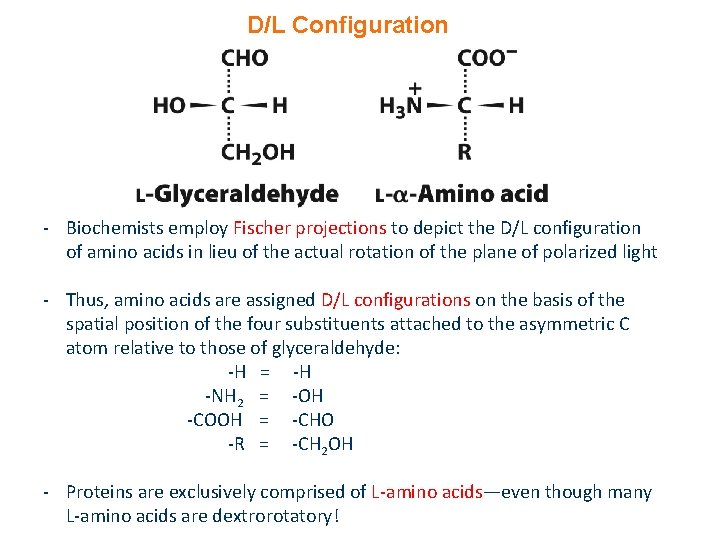
D/L Configuration - Biochemists employ Fischer projections to depict the D/L configuration of amino acids in lieu of the actual rotation of the plane of polarized light - Thus, amino acids are assigned D/L configurations on the basis of the spatial position of the four substituents attached to the asymmetric C atom relative to those of glyceraldehyde: -H = -H -NH 2 = -OH -COOH = -CHO -R = -CH 2 OH - Proteins are exclusively comprised of L-amino acids—even though many L-amino acids are dextrorotatory!
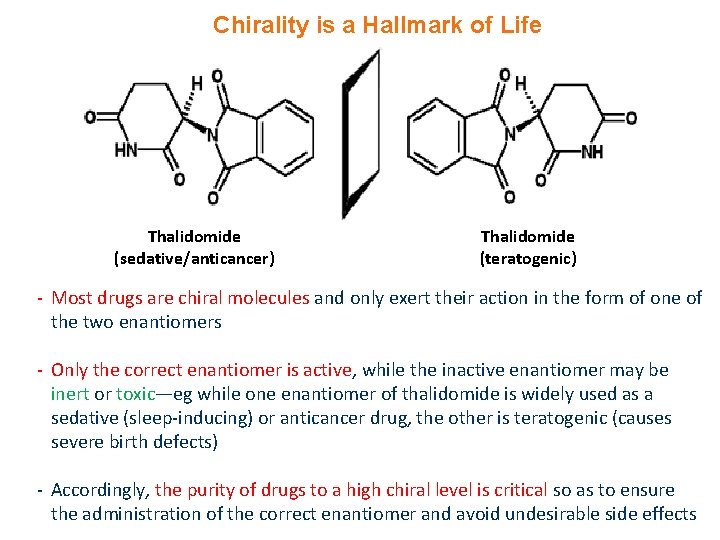
Chirality is a Hallmark of Life Thalidomide (sedative/anticancer) Thalidomide (teratogenic) - Most drugs are chiral molecules and only exert their action in the form of one of the two enantiomers - Only the correct enantiomer is active, while the inactive enantiomer may be inert or toxic—eg while one enantiomer of thalidomide is widely used as a sedative (sleep-inducing) or anticancer drug, the other is teratogenic (causes severe birth defects) - Accordingly, the purity of drugs to a high chiral level is critical so as to ensure the administration of the correct enantiomer and avoid undesirable side effects
Exercise 2. 1 c - Explain why all amino acids but glycine are chiral - Explain how the Fischer convention describes the absolute configuration of a chiral molecule - Explain why an enzyme can catalyze a chemical reaction involving just one enantiomer of a compound
§ 2. 1 d Modification
Synopsis 2. 1 d - The side chains of amino acid residues in proteins may become covalently modified in a phenomenon that has come to be known as “post-translational modification (PTM)” - Three most common PTMs include phosphorylation, methylation and acetylation—less common are carboxylation, hydroxylation and nitration - Such PTMs serve as “molecular switches” in their ability to alter and modulate protein function - Like proteins, free amino acids can also be modified—such derivatives function as chemical messengers

Common PTMs in Proteins Serine Threonine Tyrosine (Histidine) Glutamate Phosphorylation Lysine Arginine (Histidine) Methylation Proline Carboxylation Hydroxylation Lysine Acetylation (Parentheses indicate a rare event)
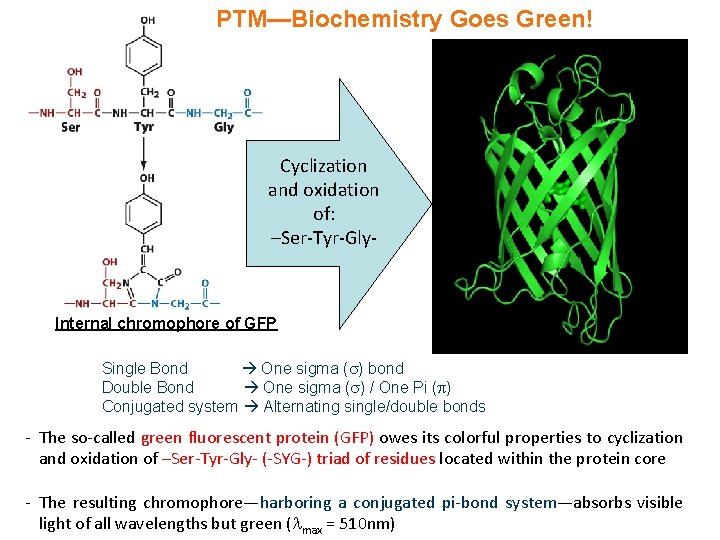
PTM—Biochemistry Goes Green! Cyclization and oxidation of: –Ser-Tyr-Gly- Internal chromophore of GFP Single Bond One sigma ( ) bond Double Bond One sigma ( ) / One Pi ( ) Conjugated system Alternating single/double bonds - The so-called green fluorescent protein (GFP) owes its colorful properties to cyclization and oxidation of –Ser-Tyr-Gly- (-SYG-) triad of residues located within the protein core - The resulting chromophore—harboring a conjugated pi-bond system—absorbs visible light of all wavelengths but green ( max = 510 nm)
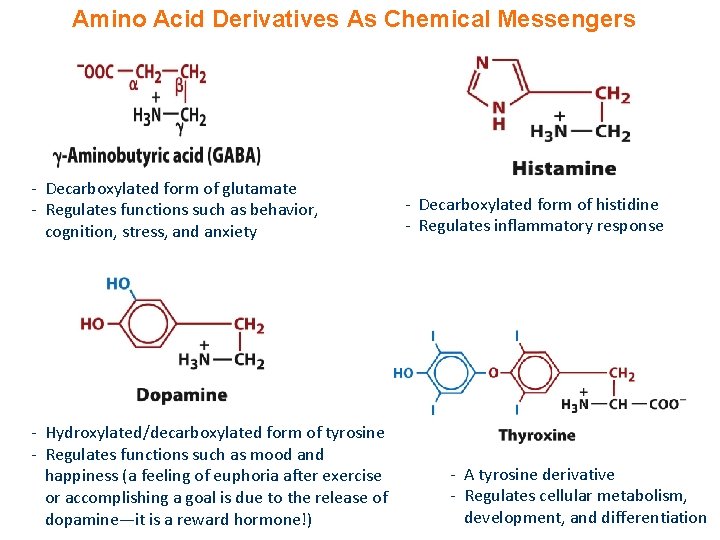
Amino Acid Derivatives As Chemical Messengers - Decarboxylated form of glutamate - Regulates functions such as behavior, cognition, stress, and anxiety - Hydroxylated/decarboxylated form of tyrosine - Regulates functions such as mood and happiness (a feeling of euphoria after exercise or accomplishing a goal is due to the release of dopamine—it is a reward hormone!) - Decarboxylated form of histidine - Regulates inflammatory response - A tyrosine derivative - Regulates cellular metabolism, development, and differentiation
Exercise 2. 1 d - List and describe major types of PTMs in proteins - List functions of amino acid derivatives
- Slides: 45