
II Ken Blanchard Patricia Zigarmi Drea Zigarmi Welcome
欢迎 情境领导II 培训 Ken Blanchard • Patricia Zigarmi • Drea Zigarmi Welcome to Situational Leadership® II © 2001 The Ken Blanchard Companies. All rights reserved. Do not duplicate • Item #14363 • V 032702 San Diego 760 489 -5005/800 728 -6000 • London 44 208 5404 • Toronto 905 568 -2678/800 665 -5023 www. kenblanchard. com © 2001 The Ken Blanchard Companies. All rights reserved. Do not duplicate • V 032702
情境领导培训目标 Purposes of Situational Leadership II • 打开沟通渠道,提高你与你的同事之间关 • 于 作成效和发展的对话之 帮助他人发展 作能力和 作意愿 • 教导他人如何为自己提供方向和支持 • 珍视并尊重差异 The Purposes of Situational Leadership® II 1. Open up communication—increase the frequency and quality of conversations about performance and development between you and the people you work with 2. Help others develop competence and commitment 3. Teach others how to provide their own direction and support 4. Value and honor differences © 2001 The Ken Blanchard Companies. All rights reserved. Do not duplicate • V 032702
情境领导的核心 作能力 1 st Core Competency - Diagnosis 1. 诊断 • 确定他人每个发展阶段的特征与需要 • 督导并诊断他人的 作绩效、 作能力, 们所需要的指导与支持 • 1. Diagnosis – To identify the Development Level characteristics and needs of others – To oversee and diagnose the effectiveness, ability, and need for direction and support of those we lead. © 2001 The Ken Blanchard Companies. All rights reserved. Do not duplicate • V 032702
情境领导的核心 作能力 2 nd Core Competency - Flexibility 灵活性 • 使用所有14个指令型和支持型领导行为 • 能够运用所有四种领导型态 • 当 作能力或 作意愿提高或下降时调整 你的领导型态 • 被视为有灵活性和卓有成效 Flexibility – Use all 14 directive and supportive leadership behaviors – Use all four styles – Adjust leadership style when competence or commitment increases or decreases – Be perceived as flexible and effective © 2001 The Ken Blanchard Companies. All rights reserved. Do not duplicate • V 032702
情境领导的核心 作能力 3 rd Core Competency - Partnering for Performance 建立伙伴关系 • 自如地使用情境领导户的常用词汇 • 熟练地使用“一对一会谈”来开展沟通 • 开展“建立伙伴关系” 的会谈 • 解决对发展阶段的认识方面的分歧 • 使用 “达标指导行动计划” Partnering for Performance • Use the common vocabulary of SLII® • Skillfully use One on Ones • Be able to Partner for Performance • Resolve disagreements about development level © 2001 The Ken Blanchard Companies. All rights reserved. Do not duplicate • V 032702
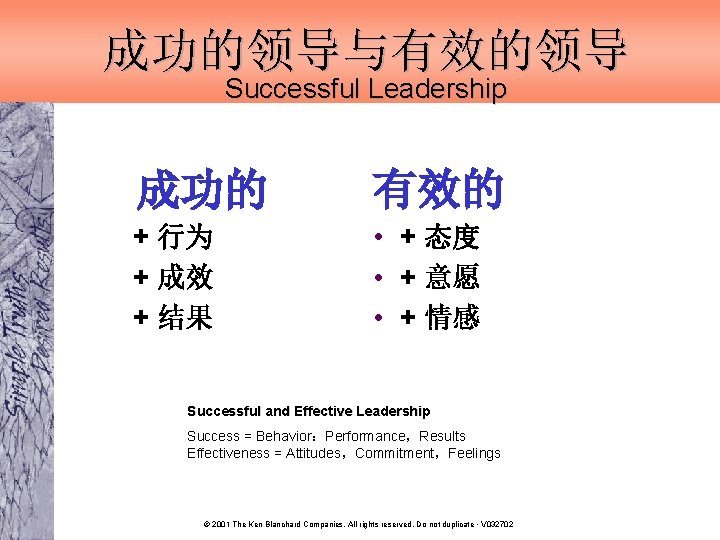
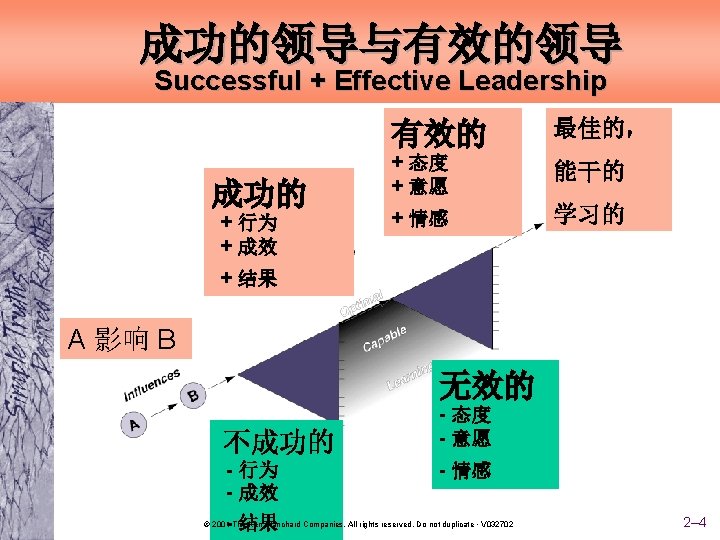
成功的领导与有效的领导 Successful Leadership 成功的 有效的 + 行为 + 成效 + 结果 • + 态度 • + 意愿 • + 情感 Successful and Effective Leadership Success = Behavior:Performance,Results Effectiveness = Attitudes,Commitment,Feelings © 2001 The Ken Blanchard Companies. All rights reserved. Do not duplicate • V 032702
领导型态 Leadership Style 领导型态是 他人认定你所长期 使用的行为模式。 Leadership Style is the pattern of behaviors you use with others, over time, as perceived by them. © 2001 The Ken Blanchard Companies. All rights reserved. Do not duplicate • V 032702
关于人的信念与价值观 SLII Beliefs and Values about People • 人们能够并且希望发展 People can and want to develop • 领导时伙伴关系 Leadership is a partnership • 人人渴望参与和沟通 People value involvement and communication © 2001 The Ken Blanchard Companies. All rights reserved. Do not duplicate • V 032702 2– 6
情境领导的三项技能 The Three Skills of a Situational Leader • 诊断 - 愿意并有能力研究某一情境并评估 他人的发展需要 • 活性 - 自如地运用多种领导型态的能力 • 结成伙伴关系 - 与他人达成共识关于他们 达到个人目标和企业目标而需要你提供的 领导型态 The Three Skills of a Situational Leader Diagnosis—assessing developmental needs Flexibility—using a variety of leadership styles comfortably Partnering for Performance—reaching agreements with others about the leadership style they need © 2001 The Ken Blanchard Companies. All rights reserved. Do not duplicate • V 032702 2– 9
目标或 作变量 Situational Variables • 目标或 作变量 • 企业变量 • 领导变量 • 个人发展阶段 Situational Variables Goal or Task Variables Organization Variables Leader Variables Development Level of the Individual © 2001 The Ken Blanchard Companies. All rights reserved. Do not duplicate • V 032702 2– 11
使用情境领导-效果研究结果 SLII Research Results 推行情境领导II的企业具有 • 更强有力的领导、 • 更好地确定目标 • 观察并督导 作绩效 反馈 • 协助解决问题并褒奖 优秀的领导 Stronger leadership skills Better at goal setting, Observing and monitoring performance, Giving feedback, Facilitating problem solving, Providing recognition • • • 更高的员 满意度 较低的人员流动 更高客户满意度 利润增长 销售增长 Higher employee satisfaction Lower turnover Higher customer satisfaction Increased profitability Increased sales © 2001 The Ken Blanchard Companies. All rights reserved. Do not duplicate • V 032702 2– 12
诊断 Diagnosis 愿意并有能力研究某一情境 井评估他人的发展需要, 以便决定哪种领导型态对当前的 目标或任务最恰当。 Diagnosis: The willingness and ability to look at a situation and assess others’ developmental needs in order to decide which leadership style is the most appropriate for the goal or task at hand. © 2001 The Ken Blanchard Companies. All rights reserved. Do not duplicate • V 032702 3– 1
发展阶段 Development Level 作能力 Competence 作意愿 Commitment © 2001 The Ken Blanchard Companies. All rights reserved. Do not duplicate • V 032702 3– 2
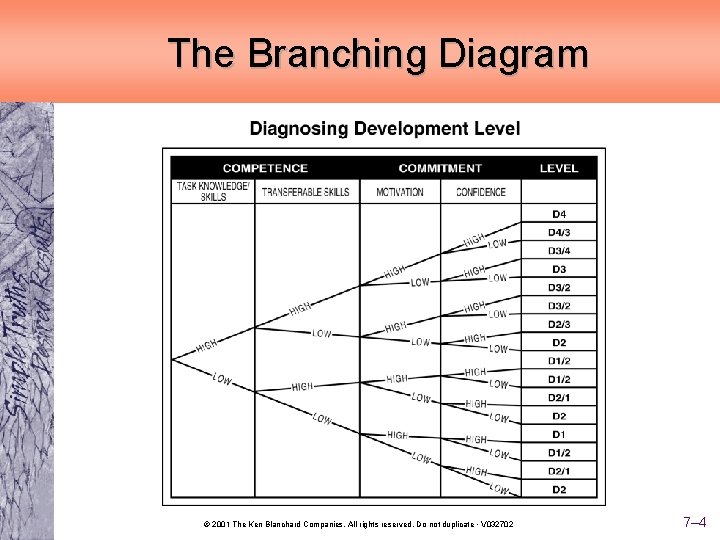
作能力 Competence 目标或任务知识与技能 Demonstrated goal- or task-specific knowledge and skills 可转移的知识与技能 Transferable knowledge and skills © 2001 The Ken Blanchard Companies. All rights reserved. Do not duplicate • V 032702 3– 3
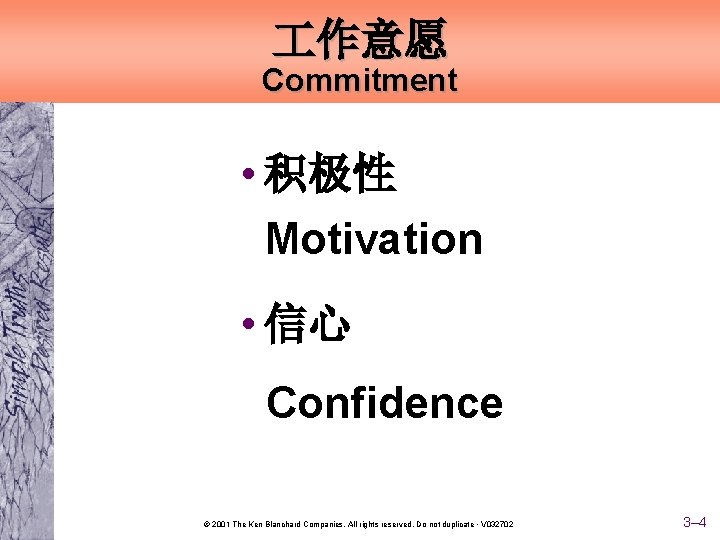
作意愿 Commitment • 积极性 Motivation • 信心 Confidence © 2001 The Ken Blanchard Companies. All rights reserved. Do not duplicate • V 032702 3– 4
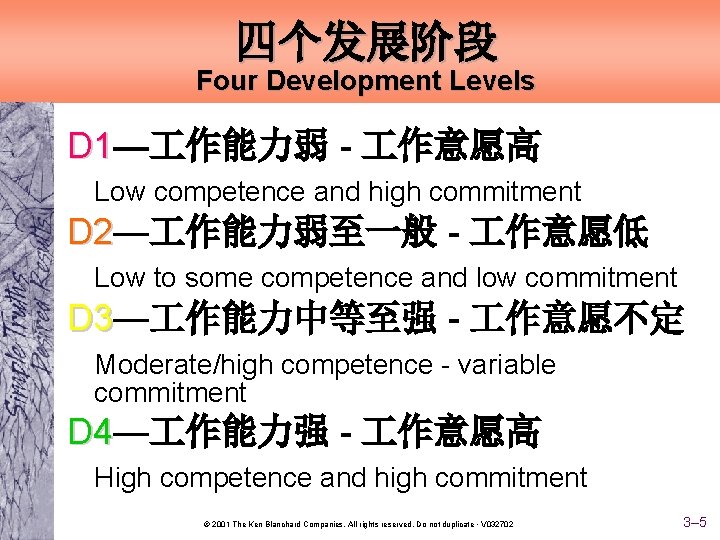
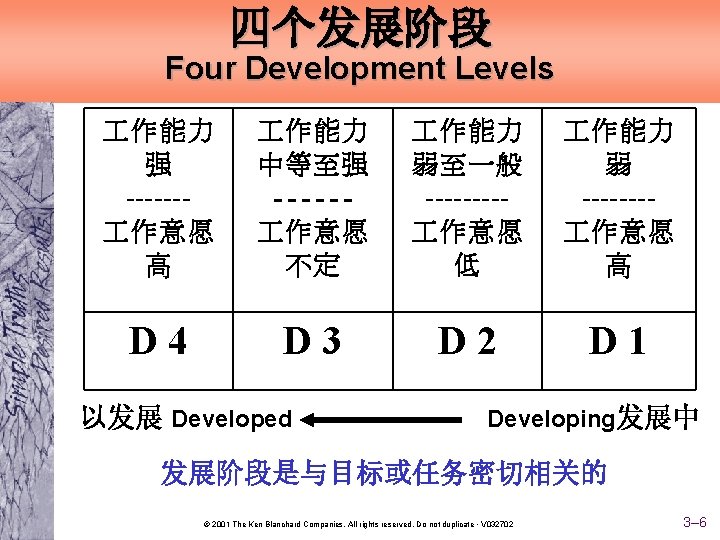
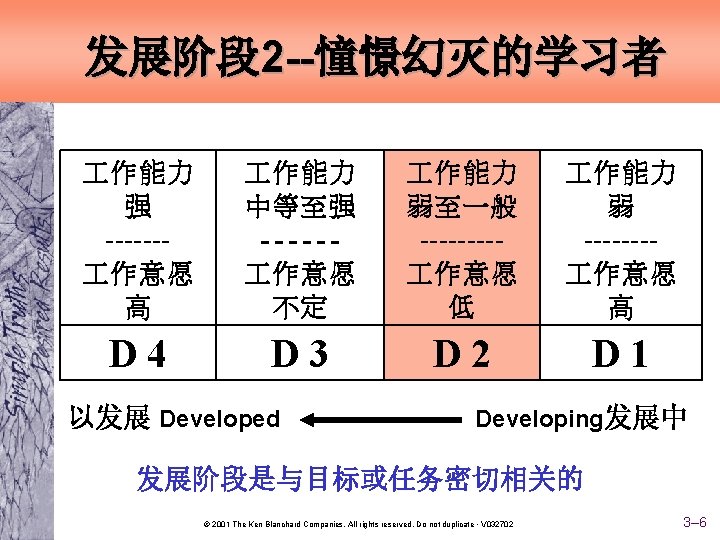
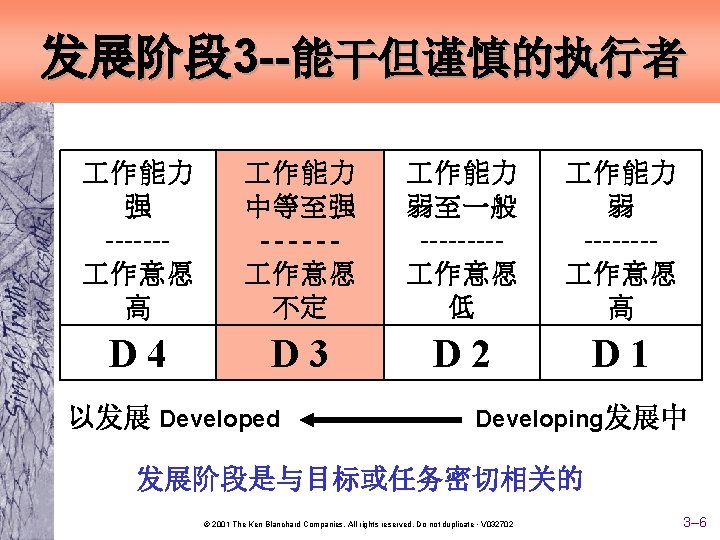
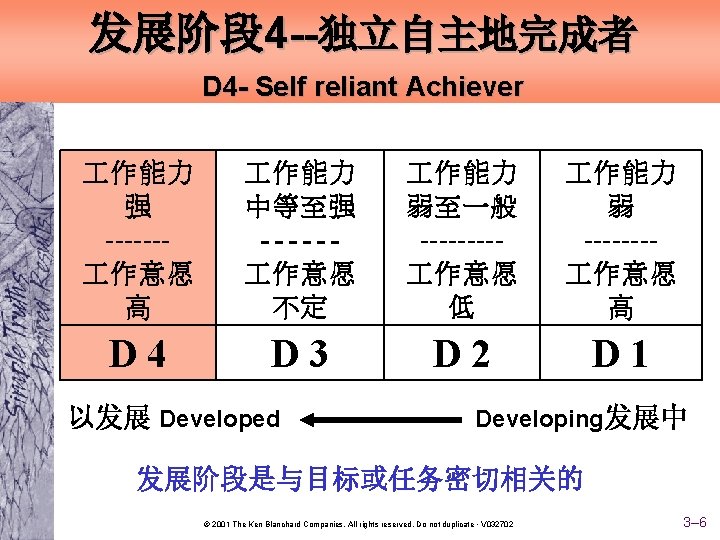
四个发展阶段 Four Development Levels D 1— 作能力弱 - 作意愿高 D 1 Low competence and high commitment D 2— 作能力弱至一般 - 作意愿低 D 2 Low to some competence and low commitment D 3— 作能力中等至强 - 作意愿不定 D 3 Moderate/high competence - variable commitment D 4— 作能力强 - 作意愿高 D 4 High competence and high commitment © 2001 The Ken Blanchard Companies. All rights reserved. Do not duplicate • V 032702 3– 5
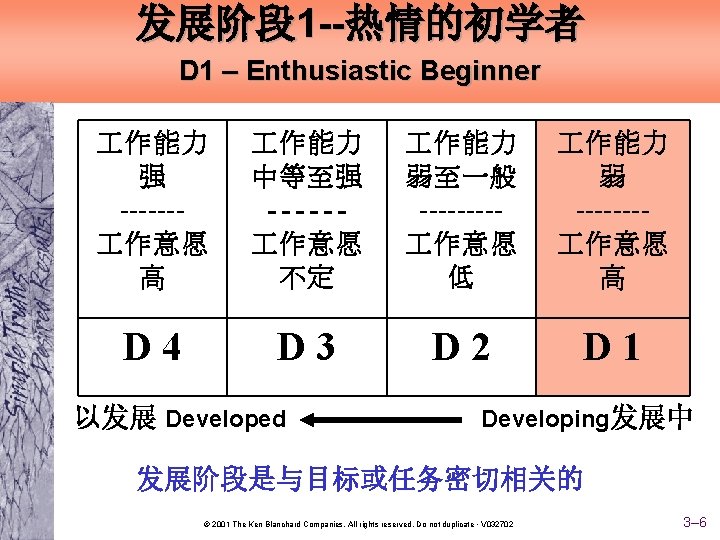
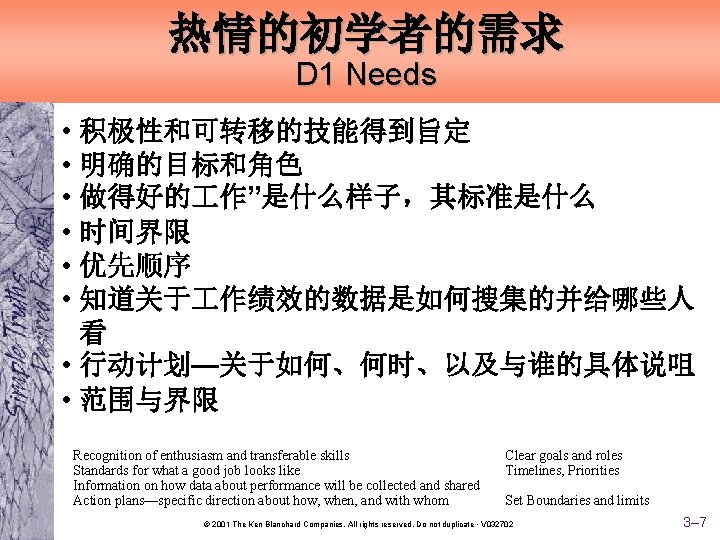
热情的初学者的需求 D 1 Needs • 积极性和可转移的技能得到旨定 • 明确的目标和角色 • 做得好的 作”是什么样子,其标准是什么 • 时间界限 • 优先顺序 • 知道关于 作绩效的数据是如何搜集的并给哪些人 看 • 行动计划—关于如何、何时、以及与谁的具体说咀 • 范围与界限 Recognition of enthusiasm and transferable skills Standards for what a good job looks like Information on how data about performance will be collected and shared Action plans—specific direction about how, when, and with whom Clear goals and roles Timelines, Priorities Set Boundaries and limits © 2001 The Ken Blanchard Companies. All rights reserved. Do not duplicate • V 032702 3– 7
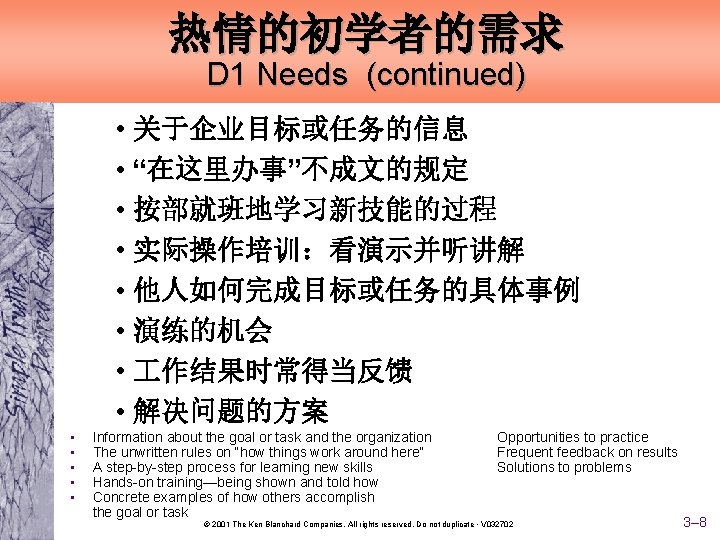
热情的初学者的需求 D 1 Needs (continued) • 关于企业目标或任务的信息 • “在这里办事”不成文的规定 • 按部就班地学习新技能的过程 • 实际操作培训:看演示并听讲解 • 他人如何完成目标或任务的具体事例 • 演练的机会 • 作结果时常得当反馈 • 解决问题的方案 • • • Information about the goal or task and the organization The unwritten rules on “how things work around here” A step-by-step process for learning new skills Hands-on training—being shown and told how Concrete examples of how others accomplish the goal or task Opportunities to practice Frequent feedback on results Solutions to problems © 2001 The Ken Blanchard Companies. All rights reserved. Do not duplicate • V 032702 3– 8
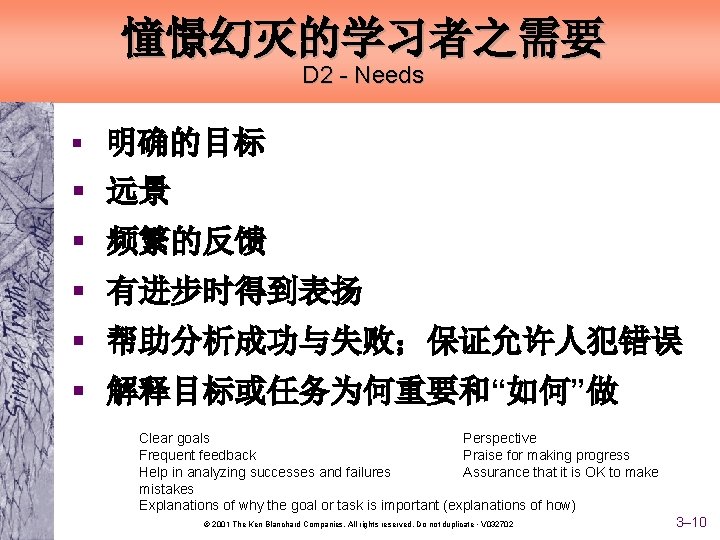
憧憬幻灭的学习者之需要 D 2 - Needs § 明确的目标 § 远景 § 频繁的反馈 § 有进步时得到表扬 § 帮助分析成功与失败;保证允许人犯错误 § 解释目标或任务为何重要和“如何”做 Clear goals Perspective Frequent feedback Praise for making progress Help in analyzing successes and failures Assurance that it is OK to make mistakes Explanations of why the goal or task is important (explanations of how) © 2001 The Ken Blanchard Companies. All rights reserved. Do not duplicate • V 032702 3– 10
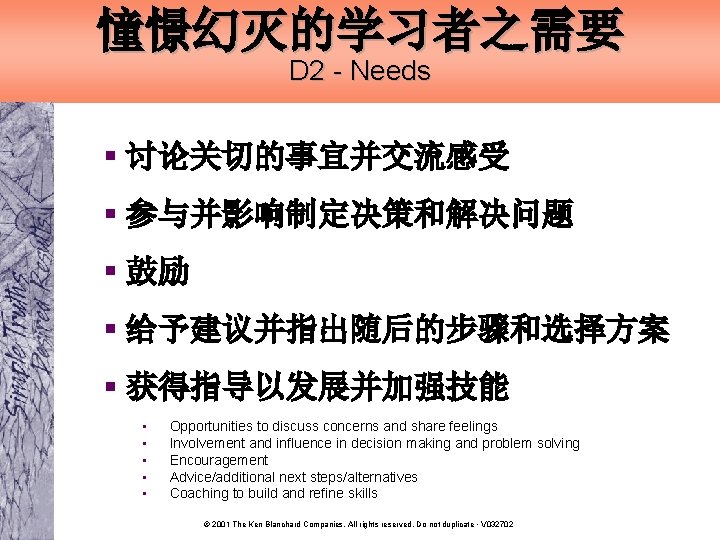
憧憬幻灭的学习者之需要 D 2 - Needs § 讨论关切的事宜并交流感受 § 参与并影响制定决策和解决问题 § 鼓励 § 给予建议并指出随后的步骤和选择方案 § 获得指导以发展并加强技能 • • • Opportunities to discuss concerns and share feelings Involvement and influence in decision making and problem solving Encouragement Advice/additional next steps/alternatives Coaching to build and refine skills © 2001 The Ken Blanchard Companies. All rights reserved. Do not duplicate • V 032702
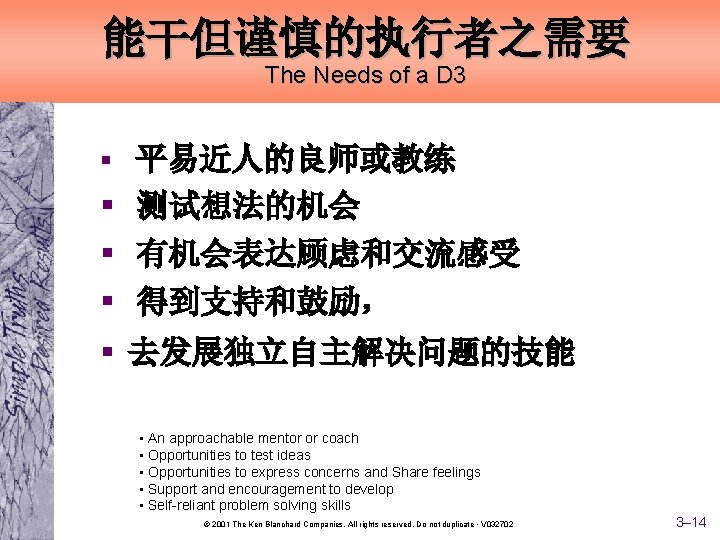
能干但谨慎的执行者之需要 The Needs of a D 3 § 平易近人的良师或教练 § 测试想法的机会 § 有机会表达顾虑和交流感受 § 得到支持和鼓励, § 去发展独立自主解决问题的技能 • An approachable mentor or coach • Opportunities to test ideas • Opportunities to express concerns and Share feelings • Support and encouragement to develop • Self-reliant problem solving skills © 2001 The Ken Blanchard Companies. All rights reserved. Do not duplicate • V 032702 3– 14
能干但谨慎的执行者之需要 The Needs of a D 3 § 帮助客观地看待经验与技能,以建立起信心 § 表扬和肯定高水平的 作能力和 作绩效 § 排除实现目标的障碍 § 协助启动 作,以避免拖延 • • Help in looking at experience and skills objectively, so confidence is built Praise and recognition for high levels of competence and performance Obstacles to goal accomplishment removed A kick-start to overcome procrastination © 2001 The Ken Blanchard Companies. All rights reserved. Do not duplicate • V 032702 3– 15
独立自主地完成者之需要 The Needs of a D 4 § 变化与挑战 § 一位良师型或同事型的领导者, 而不是老板型的领导者。 § 贡献得到表彰 § 自主与权力 § 受信赖 § 与他人分享知识与技能机会 • Variety and challenge • A leader who is more of a mentor and colleague than a manager • Acknowledgment of contributions • Autonomy and authority • Trust • Opportunities to share know ledge and skills with others © 2001 The Ken Blanchard Companies. All rights reserved. Do not duplicate • V 032702 3– 17
四个发展阶段 The Four Development Levels D 1—热情的初学者 D 1 The Enthusiastic Beginner D 2—憧憬幻灭的学习者 D 2 The Disillusioned Learner D 3—能干但谨慎的执行者 D 3 The Capable, but Cautious, Performer D 4—独立自主地完成者 D 4 The Self-Reliant Achiever © 2001 The Ken Blanchard Companies. All rights reserved. Do not duplicate • V 032702 3– 18
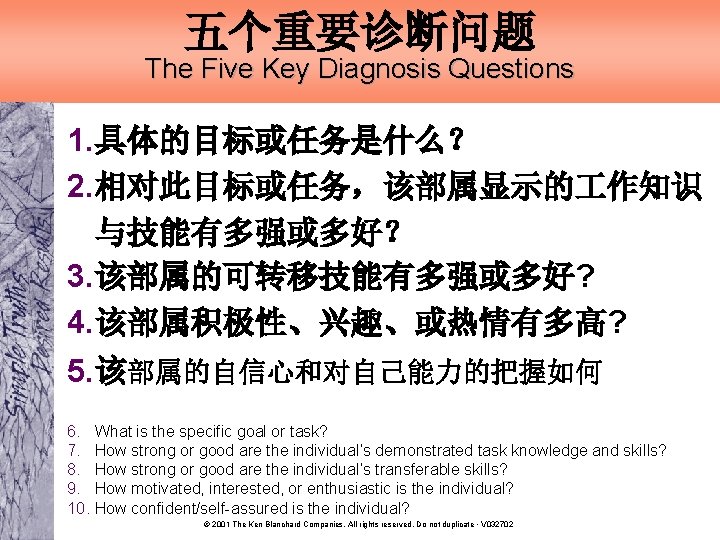
五个重要诊断问题 The Five Key Diagnosis Questions 1. 具体的目标或任务是什么? 2. 相对此目标或任务,该部属显示的 作知识 与技能有多强或多好? 3. 该部属的可转移技能有多强或多好? 4. 该部属积极性、兴趣、或热情有多高? 5. 该部属的自信心和对自己能力的把握如何 6. What is the specific goal or task? 7. How strong or good are the individual’s demonstrated task knowledge and skills? 8. How strong or good are the individual’s transferable skills? 9. How motivated, interested, or enthusiastic is the individual? 10. How confident/self-assured is the individual? © 2001 The Ken Blanchard Companies. All rights reserved. Do not duplicate • V 032702
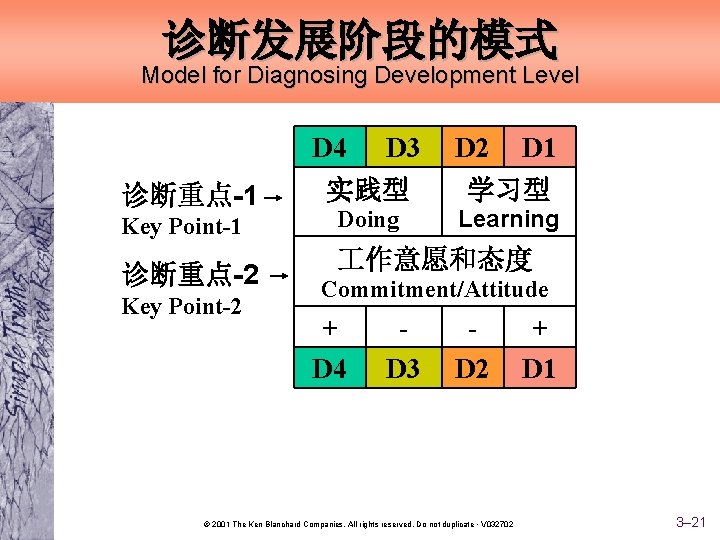
诊断发展阶段的模式 Model for Diagnosing Development Level D 4 诊断重点-1 Key Point-1 诊断重点-2 Key Point-2 D 3 D 2 D 1 实践型 学习型 Doing Learning 作意愿和态度 Commitment/Attitude + D 4 D 3 D 2 © 2001 The Ken Blanchard Companies. All rights reserved. Do not duplicate • V 032702 + D 1 3– 21
灵活性 - Flexibility 得心应手地运用 多种领导型态的能力 The ability to use a variety of leadership styles comfortably © 2001 The Ken Blanchard Companies. All rights reserved. Do not duplicate • V 032702 4– 1
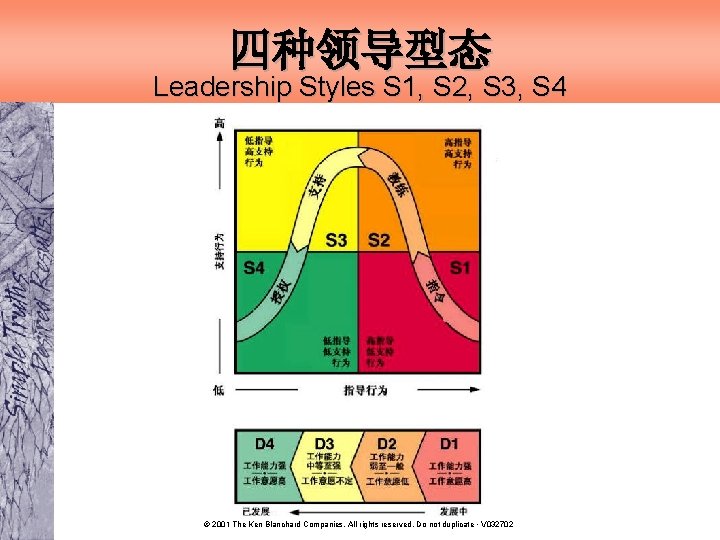
四种领导型态 Leadership Styles S 1, S 2, S 3, S 4 © 2001 The Ken Blanchard Companies. All rights reserved. Do not duplicate • V 032702
指导行为 Directive Behavior 指导行为是领导者采用下列行为 • 设定目标并说明期望 • 告诉部属要做什么、何时做、以及 如何做 • 密切督导井评估 作绩效 • The extent to which a leader – Sets goals and clarifies expectations – Tells and shows an individual what to do, when, and how to do it – Closely supervises, monitors, and evaluates performance © 2001 The Ken Blanchard Companies. All rights reserved. Do not duplicate • V 032702
指导行为的五个关键词汇 Key Directive Behaviors § 建立结构 § 组织 § 教导 §§ 督导 § 评估 Structure Organize Teach Supervise Evaluate © 2001 The Ken Blanchard Companies. All rights reserved. Do not duplicate • V 032702 4– 3
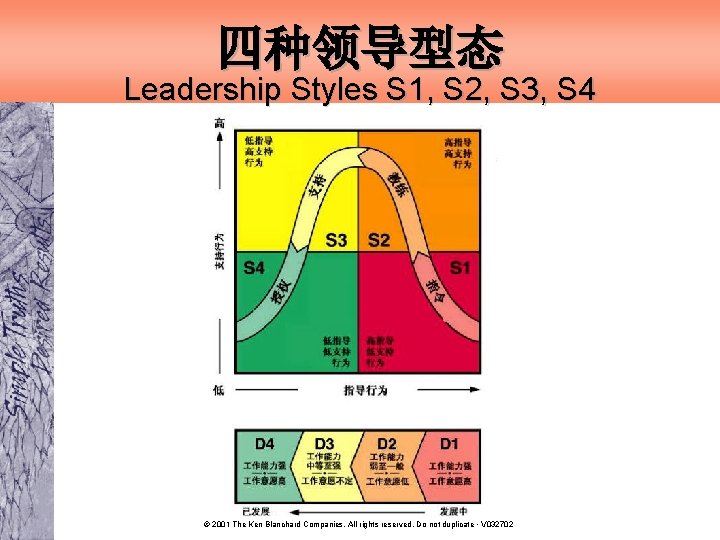
四种领导型态 Leadership Styles S 1, S 2, S 3, S 4 © 2001 The Ken Blanchard Companies. All rights reserved. Do not duplicate • V 032702
五个支持行为 Five Supportive Actions 领导者采用下列行为: 1. 尽量采用双向沟通 2. 倾听并提供支持与鼓励 3. 让部署参与制定决策 4. 鼓励并促成部署独立自主地 5. 解决问题 The extent to which a leader – Engages in more two-way communication – Listens and provides support and encouragement – Involves the other person in decision making – Encourages and facilitates self-reliant problem solving © 2001 The Ken Blanchard Companies. All rights reserved. Do not duplicate • V 032702 – Solves Problems 4– 4
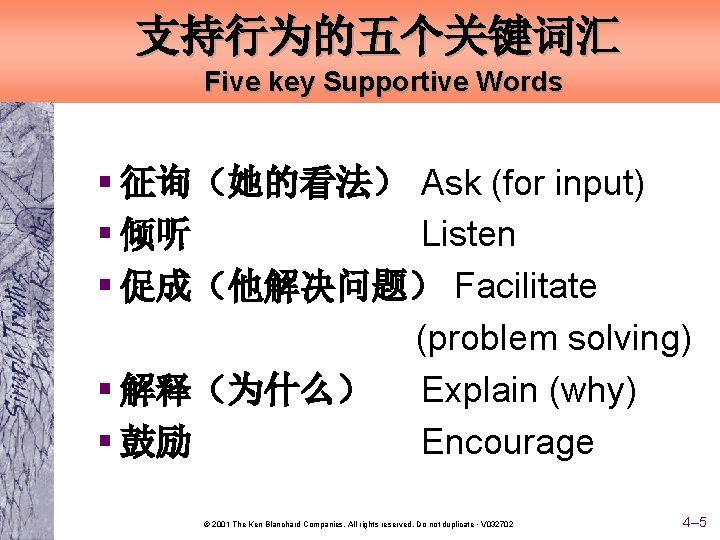
支持行为的五个关键词汇 Five key Supportive Words § 征询(她的看法) Ask (for input) § 倾听 Listen § 促成(他解决问题) Facilitate (problem solving) § 解释(为什么) Explain (why) § 鼓励 Encourage © 2001 The Ken Blanchard Companies. All rights reserved. Do not duplicate • V 032702 4– 5
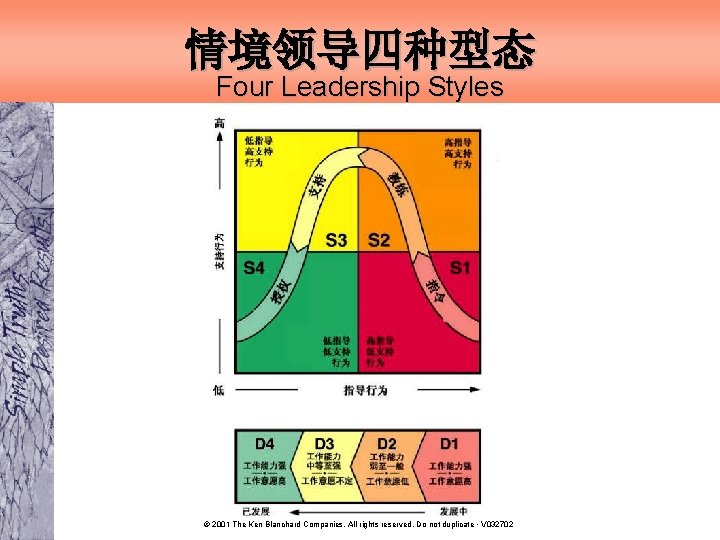
情境领导四种型态 Four Leadership Styles © 2001 The Ken Blanchard Companies. All rights reserved. Do not duplicate • V 032702
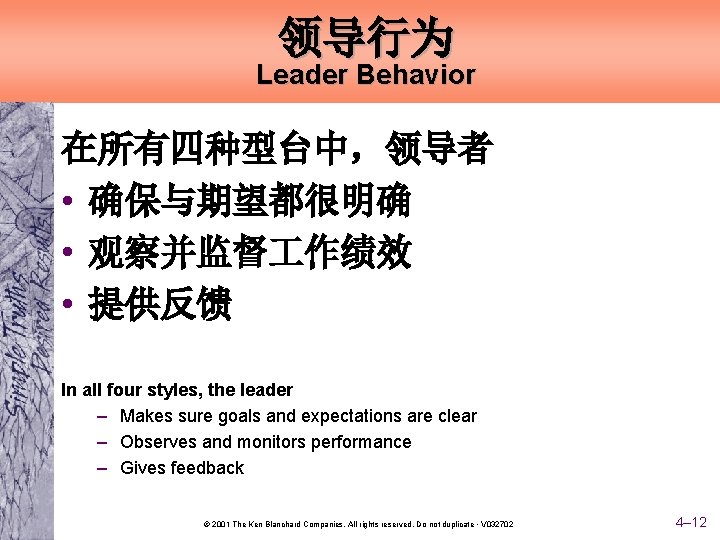
领导行为 Leader Behavior 在所有四种型台中,领导者 • 确保与期望都很明确 • 观察并监督 作绩效 • 提供反馈 In all four styles, the leader – Makes sure goals and expectations are clear – Observes and monitors performance – Gives feedback © 2001 The Ken Blanchard Companies. All rights reserved. Do not duplicate • V 032702 4– 12
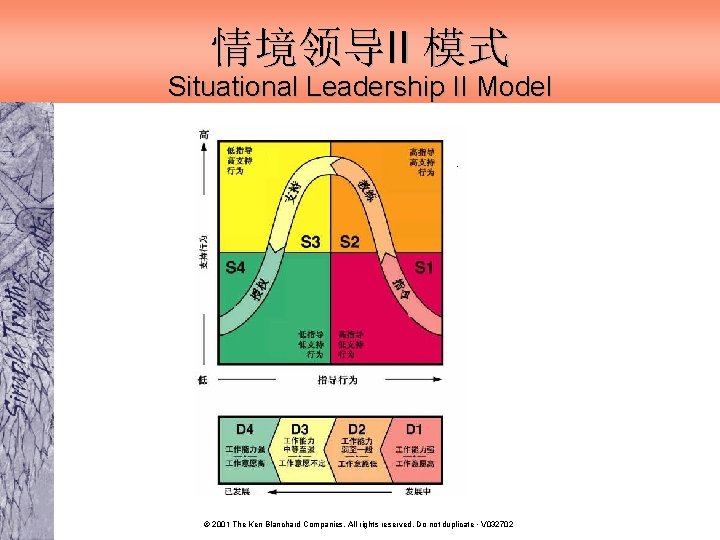
情境领导II 模式 Situational Leadership II Model © 2001 The Ken Blanchard Companies. All rights reserved. Do not duplicate • V 032702
领导者有三项选择 A Leader Has Three Choices § 配合 § 督导过渡 § 督导不足 Match Oversupervise Undersupervise © 2001 The Ken Blanchard Companies. All rights reserved. Do not duplicate • V 032702 5– 4
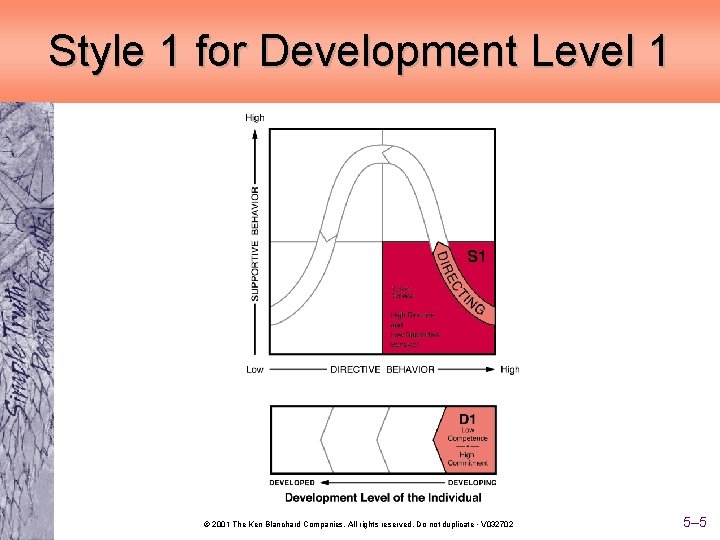
Style 1 for Development Level 1 © 2001 The Ken Blanchard Companies. All rights reserved. Do not duplicate • V 032702 5– 5
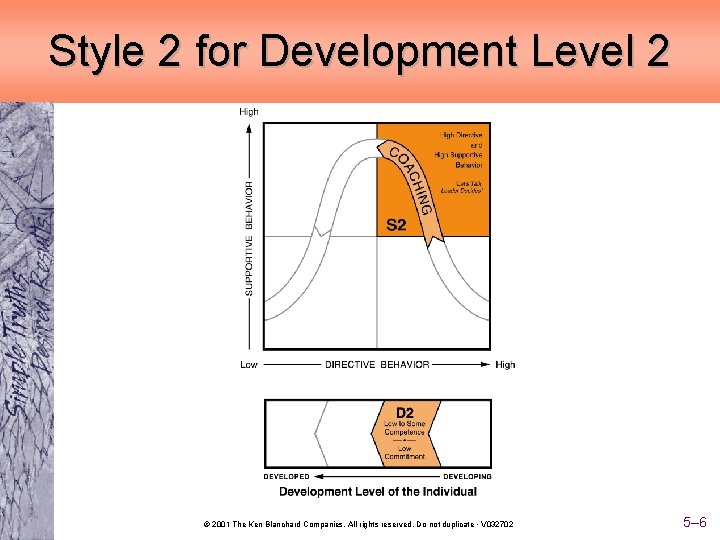
Style 2 for Development Level 2 © 2001 The Ken Blanchard Companies. All rights reserved. Do not duplicate • V 032702 5– 6
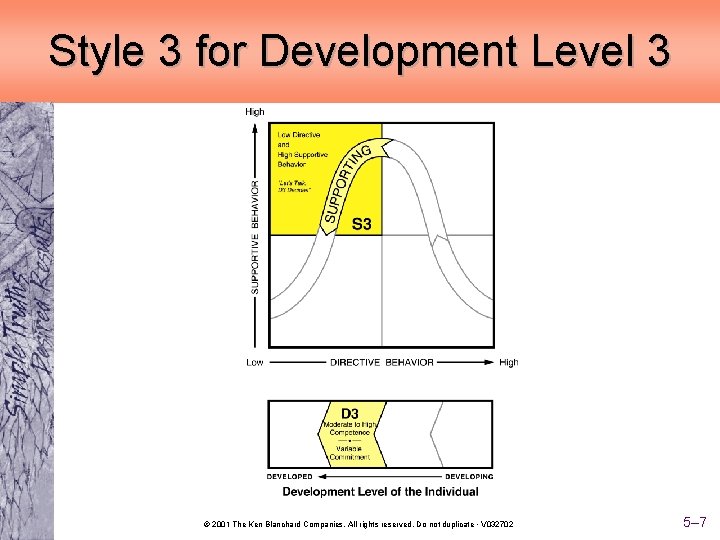
Style 3 for Development Level 3 © 2001 The Ken Blanchard Companies. All rights reserved. Do not duplicate • V 032702 5– 7
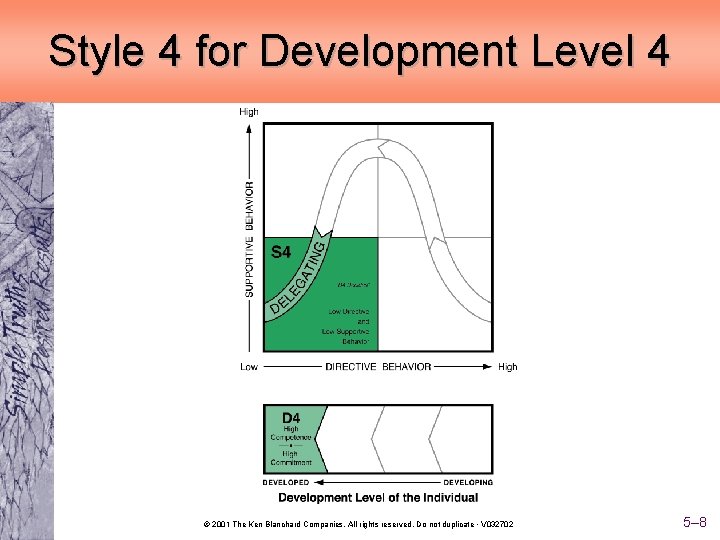
Style 4 for Development Level 4 © 2001 The Ken Blanchard Companies. All rights reserved. Do not duplicate • V 032702 5– 8
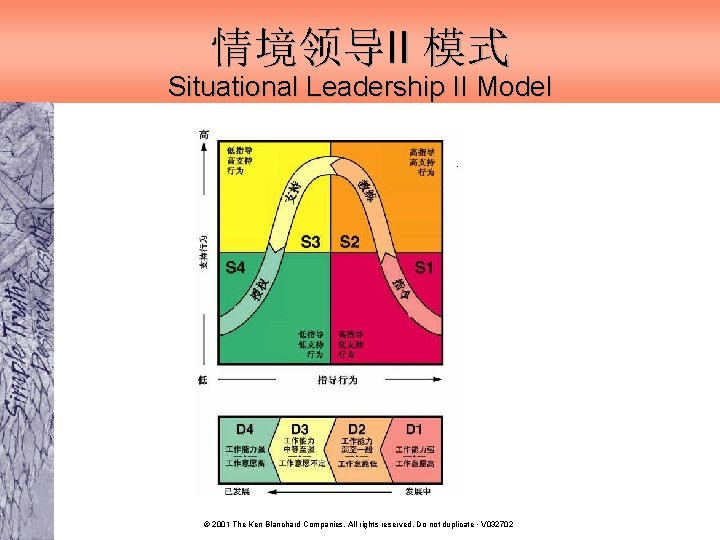
情境领导II 模式 Situational Leadership II Model © 2001 The Ken Blanchard Companies. All rights reserved. Do not duplicate • V 032702
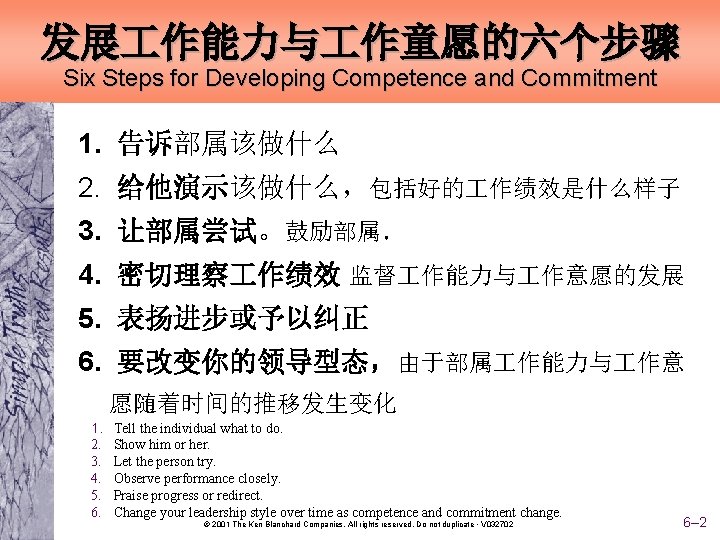
发展 作能力与 作童愿的六个步骤 Six Steps for Developing Competence and Commitment 1. 告诉部属该做什么 2. 给他演示该做什么,包括好的 作绩效是什么样子 3. 让部属尝试。鼓励部属. 4. 密切理察 作绩效 监督 作能力与 作意愿的发展 5. 表扬进步或予以纠正 6. 要改变你的领导型态,由于部属 作能力与 作意 愿随着时间的推移发生变化 1. 2. 3. 4. 5. 6. Tell the individual what to do. Show him or her. Let the person try. Observe performance closely. Praise progress or redirect. Change your leadership style over time as competence and commitment change. © 2001 The Ken Blanchard Companies. All rights reserved. Do not duplicate • V 032702 6– 2
五个重要诊断问题 The Five Key Diagnosis Questions 1. 具体的目标或任务是什么? 2. 相对此目标或任务,该部属显示的 作知识 与技能有多强或多好? 3. 该部属的可转移技能有多强或多好? 4. 该部属积极性、兴趣、或热情有多高? 5. 该部属的自信心和对自己能力的把握如何 6. What is the specific goal or task? 7. How strong or good are the individual’s demonstrated task knowledge and skills? 8. How strong or good are the individual’s transferable skills? 9. How motivated, interested, or enthusiastic is the individual? 10. How confident/self-assured is the individual? © 2001 The Ken Blanchard Companies. All rights reserved. Do not duplicate • V 032702
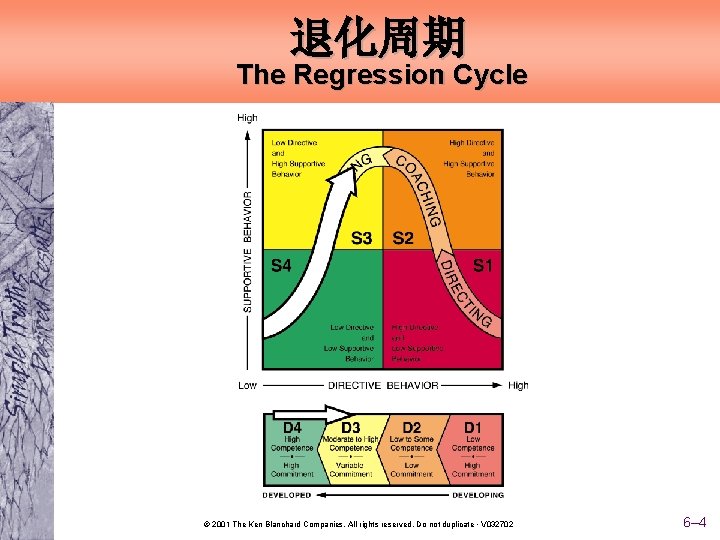
退化周期 The Regression Cycle © 2001 The Ken Blanchard Companies. All rights reserved. Do not duplicate • V 032702 6– 4
控制退化的步骤 Steps for Managing Regression 1. 做好准备 作.以型态3 开始. 2. 假如 作绩效或 作意愿问题持续回到型 态2 并重新设定目标,然后指导其调整。 3. 花更多时间观察和监督 作绩效. 务必 对 作绩效给予更频繁的反馈。 4. 如果有必要,说明持续的低 作绩效的负 面后果。 1. 2. 3. 4. Do your homework. Use Style 3 to explore what is going on. If necessary, use Style 2 to renegotiate goals or redirect. Spend more time observing and monitoring performance and giving feedback. Describe the consequences of continued low performance, if necessary. © 2001 The Ken Blanchard Companies. All rights reserved. Do not duplicate • V 032702
一对一 One On Ones ‘一对一’ 会谈提供打开沟通渠道和监督 作绩效的机制。 他们通常是简短,有规律地安排的会议, 焦点集中在部属的议程上。 To provide a structure for opening up communication and monitoring performance. One on Ones are short, regularly scheduled meetings focused on the individual’s agenda. © 2001 The Ken Blanchard Companies. All rights reserved. Do not duplicate • V 032702
建立伙伴关系 Partnering for Performance 定义:建立伙伴关系—与部属 就使用何种领导型态取不到 个人和企业日标。 Reaching agreements with people about their development level and the leadership style needed to help them achieve individual and organization goals. © 2001 The Ken Blanchard Companies. All rights reserved. Do not duplicate • V 032702
建立伙伴关系的步骤 The Steps in Partnering for Performance 在以卜方面驭得共识: • • • 目标 发展阶段 领导型态 领导行为 如何保持联系 Prework: Teach the SLII® Model; Identify overall business outcomes. 1 Get agreement on goals. 2. Get agreement on diagnosis of development level. 3. Get agreement on leadership style (current and future). 4. Get agreement on leadership behaviors. 5. Decide how and how often you will stay in touch. © 2001 The Ken Blanchard Companies. All rights reserved. Do not duplicate • V 032702
The Branching Diagram © 2001 The Ken Blanchard Companies. All rights reserved. Do not duplicate • V 032702 7– 4
Steps for Resolving a Disagreement about Development Level • • • Steps for Resolving a Disagreement about Development Level : 04 Review the Steps for Resolving a Disagreement about Development Level Large Group : 04 1. Refer to WB 7 -4 Steps for Resolving a Disagreement about Development Level. 2. Review the four steps The first step in resolving a disagreement about development level is to clarify the goal. Sometimes people disagree because the goal isn’t clear. One person sees the bar much higher than the other person. As much as possible this process should be collaborative, but in the final analysis, the leader decides. The second step is to ask for evidence of task knowledge and skills to resolve a disagreement about development level. A leader might underestimate a person’s skills and, therefore, rate his or her development level lower— especially if there isn’t information about past experience and demonstrated competence readily available. The leader should then ask, “Can you give me an example? Is there someone I could talk to? Could you teach someone to. . . ? The third step in resolving a disagreement about development level is to benchmark the individual’s performance against others. This can create cognitive dissonance and more openness to being directed. Finally if there is still disagreement, the fourth step is to go with the individual’s perception of his or her development level with a shorter than usual time frame. As a leader, you might ask, “What will you point to in a few days or week(s) that will show me that your performance is on track? ” Obviously, the person will work hard to prove they deserved your trust. © 2001 The Ken Blanchard Companies. All rights reserved. Do not duplicate • V 032702
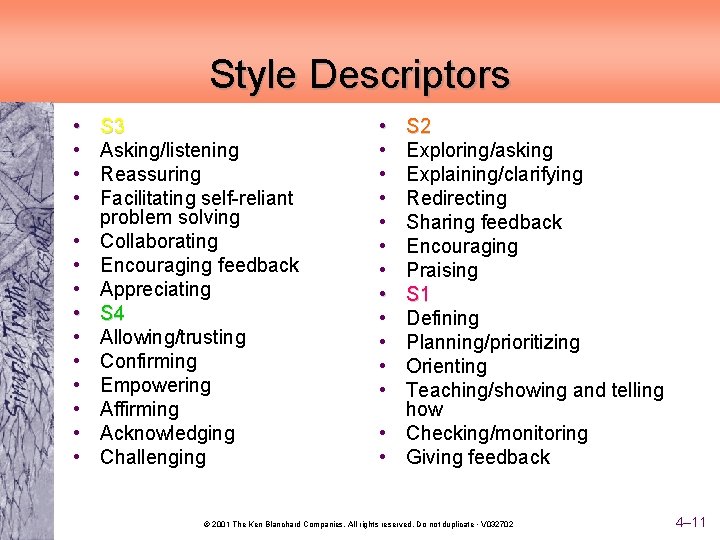
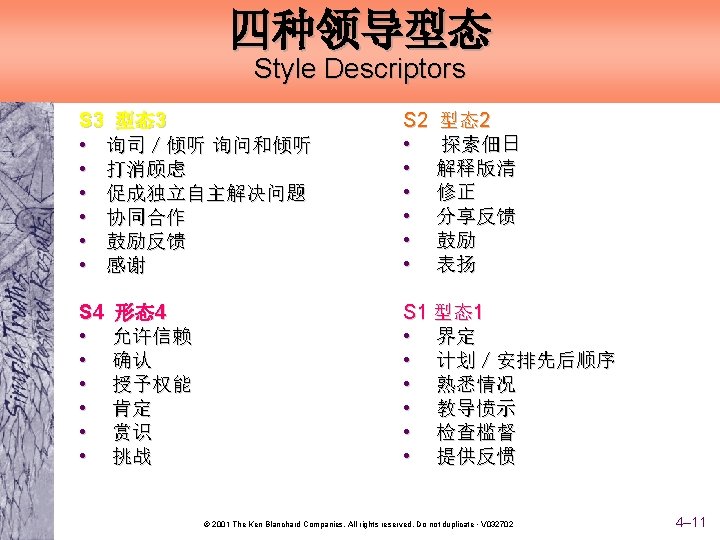
Style Descriptors • • • • S 3 Asking/listening Reassuring Facilitating self-reliant problem solving Collaborating Encouraging feedback Appreciating S 4 Allowing/trusting Confirming Empowering Affirming Acknowledging Challenging • • • S 2 Exploring/asking Explaining/clarifying Redirecting Sharing feedback Encouraging Praising S 1 Defining Planning/prioritizing Orienting Teaching/showing and telling how • Checking/monitoring • Giving feedback © 2001 The Ken Blanchard Companies. All rights reserved. Do not duplicate • V 032702 4– 11
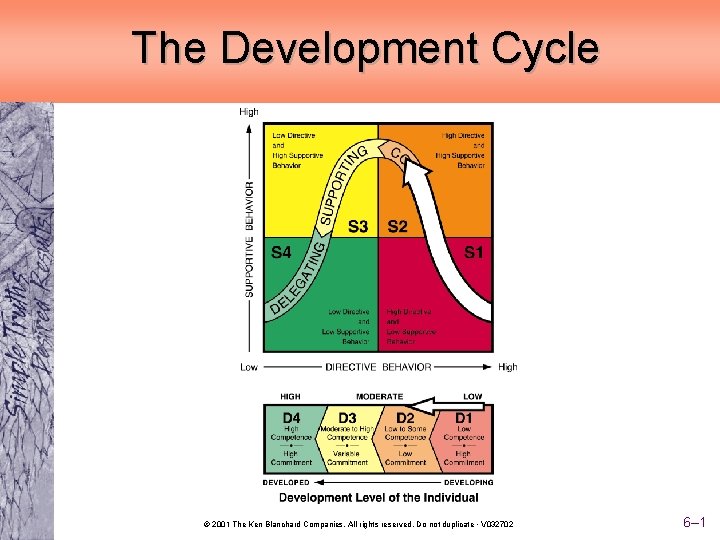
The Development Cycle © 2001 The Ken Blanchard Companies. All rights reserved. Do not duplicate • V 032702 6– 1
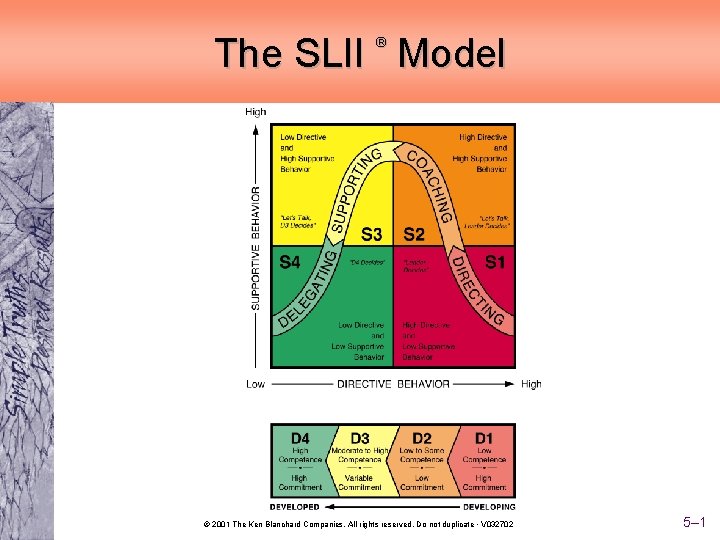
The SLII Model ® © 2001 The Ken Blanchard Companies. All rights reserved. Do not duplicate • V 032702 5– 1
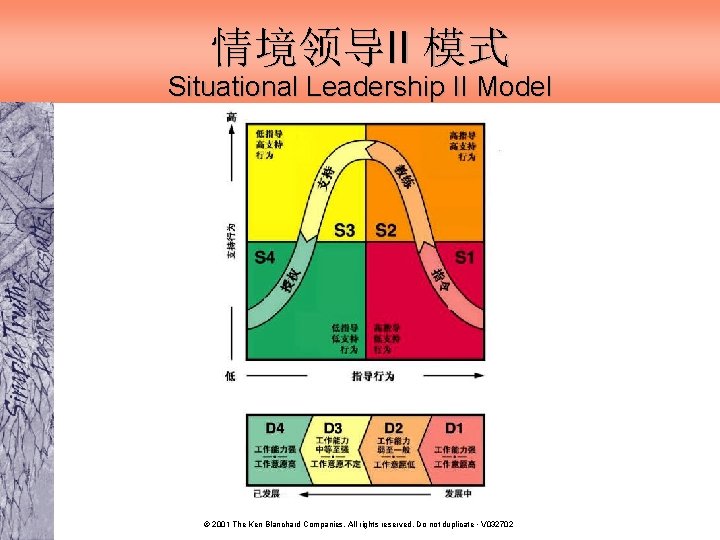
情境领导II 模式 Situational Leadership II Model © 2001 The Ken Blanchard Companies. All rights reserved. Do not duplicate • V 032702
交响乐团指挥与爵士乐队领导 1. 当你想到交响乐团指挥时脑海中会出现什么 形象呢? 2. 当你想到爵士乐队领导时脑海中会出现什么 形象呢? 3. 爵士乐队领导做什么? 4. 为什么爵士乐队可以作为未来的企业和领导 的很好的象征? Orchestra – Jazz What are your images of an orchestra leader? What are your images of a jazz band leader? (Examples) What does a jazz band leader do? Why is a jazz band (not an orchestra) a good metaphor for organizations and leaders in the future? © 2001 The Ken Blanchard Companies. All rights reserved. Do not duplicate • V 032702
做领导四个功能 Four Functions of Leadership • 确定目标、 • 观察并督导 作绩效、提供反馈 • 协助解决问题 • 褒奖优秀的领导 1. Goal Setting 3. Problem Solving 2. Feedback 4. Provide Recognition © 2001 The Ken Blanchard Companies. All rights reserved. Do not duplicate • V 032702
领导之定义 Definition of Leadership 领导是一影响过程。 当你担任领导时,你与他任协 作,帮助他们实现他们的个 人目标和组织目标。 © 2001 The Ken Blanchard Companies. All rights reserved. Do not duplicate • V 032702
领导重点 情境领导 不是你对部属做什么; 而是你和部署一起做什么。 Situational Leadership® II isn’t something you do to people; it’s something you do with people! © 2001 The Ken Blanchard Companies. All rights reserved. Do not duplicate • V 032702 2– 7
领导重点 作为领导重要的 不是你在场时发生了什么; 而是你不在场时发生了什么。 What’s important as a leader is not what happens when you’re there; it’s what happens when you’re not there! © 2001 The Ken Blanchard Companies. All rights reserved. Do not duplicate • V 032702 2– 8
因材施教 同样的人,目标或 作不同, 施教方式也不同 没有“最好”的领导型态 – 一切依情境而定! Different Strokes for Different Folks Different Strokes for the Same Folks, Depending on the Goal or Task © 2001 The Ken Blanchard Companies. All rights reserved. Do not duplicate • V 032702 2– 10
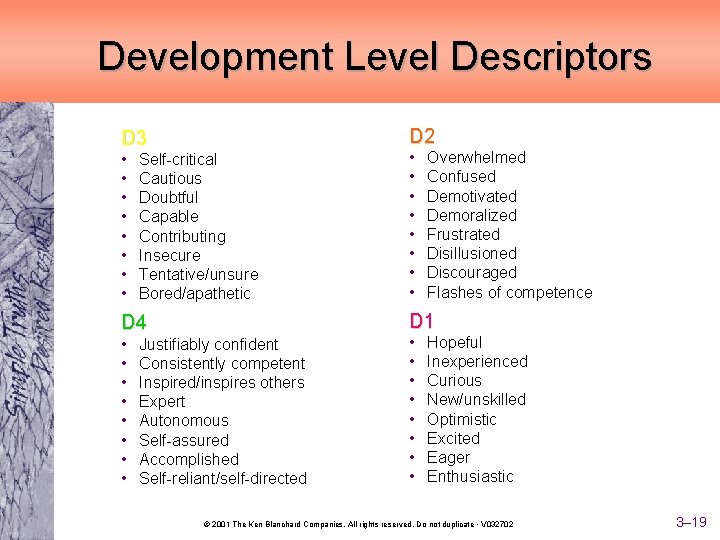
Development Level Descriptors D 2 D 3 • • Self-critical Cautious Doubtful Capable Contributing Insecure Tentative/unsure Bored/apathetic Overwhelmed Confused Demotivated Demoralized Frustrated Disillusioned Discouraged Flashes of competence D 1 D 4 • • • • Justifiably confident Consistently competent Inspired/inspires others Expert Autonomous Self-assured Accomplished Self-reliant/self-directed • • Hopeful Inexperienced Curious New/unskilled Optimistic Excited Eager Enthusiastic © 2001 The Ken Blanchard Companies. All rights reserved. Do not duplicate • V 032702 3– 19
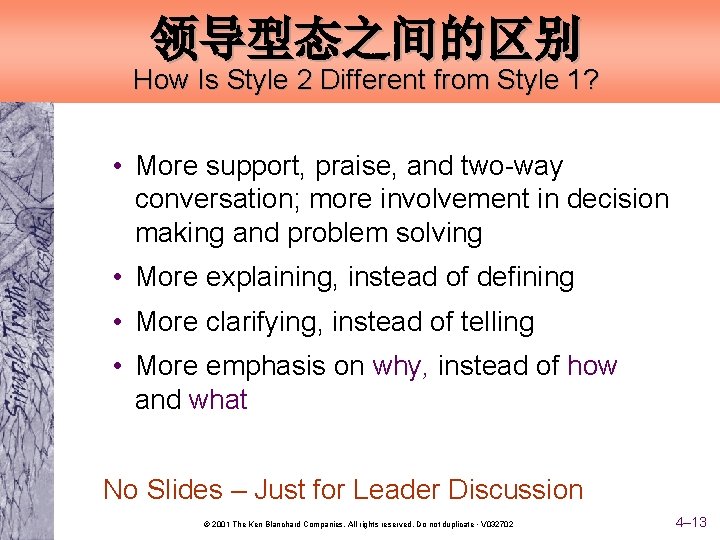
领导型态之间的区别 How Is Style 2 Different from Style 1? • More support, praise, and two-way conversation; more involvement in decision making and problem solving • More explaining, instead of defining • More clarifying, instead of telling • More emphasis on why, instead of how and what No Slides – Just for Leader Discussion © 2001 The Ken Blanchard Companies. All rights reserved. Do not duplicate • V 032702 4– 13
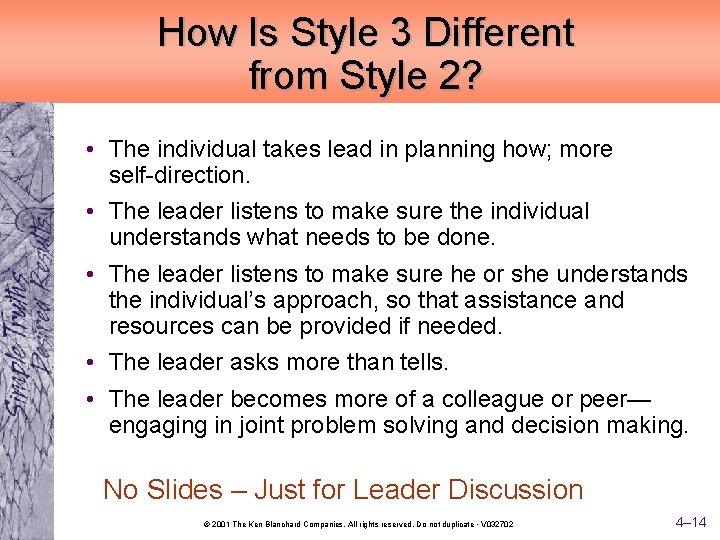
How Is Style 3 Different from Style 2? • The individual takes lead in planning how; more self-direction. • The leader listens to make sure the individual understands what needs to be done. • The leader listens to make sure he or she understands the individual’s approach, so that assistance and resources can be provided if needed. • The leader asks more than tells. • The leader becomes more of a colleague or peer— engaging in joint problem solving and decision making. No Slides – Just for Leader Discussion © 2001 The Ken Blanchard Companies. All rights reserved. Do not duplicate • V 032702 4– 14
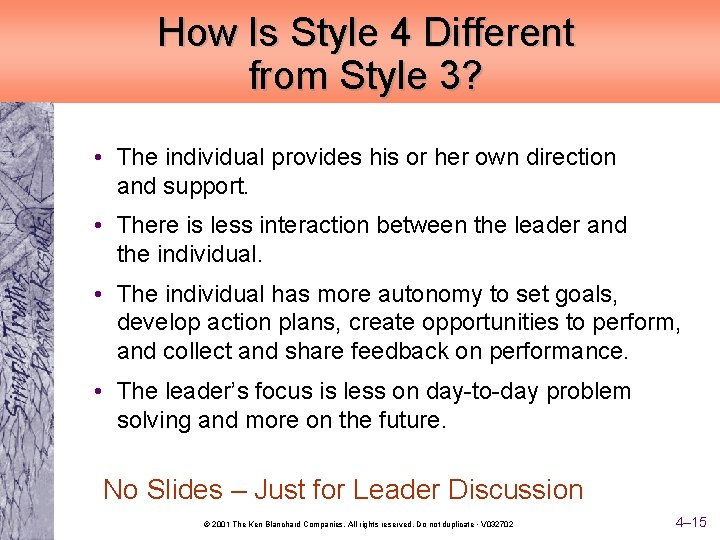
How Is Style 4 Different from Style 3? • The individual provides his or her own direction and support. • There is less interaction between the leader and the individual. • The individual has more autonomy to set goals, develop action plans, create opportunities to perform, and collect and share feedback on performance. • The leader’s focus is less on day-to-day problem solving and more on the future. No Slides – Just for Leader Discussion © 2001 The Ken Blanchard Companies. All rights reserved. Do not duplicate • V 032702 4– 15
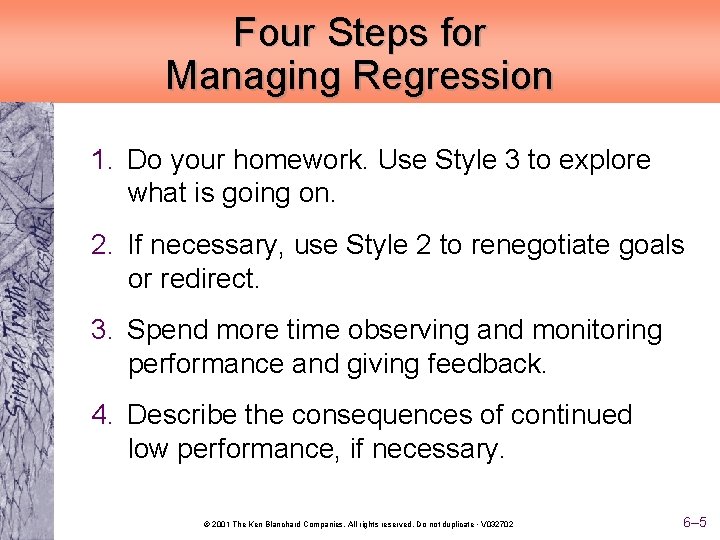
Four Steps for Managing Regression 1. Do your homework. Use Style 3 to explore what is going on. 2. If necessary, use Style 2 to renegotiate goals or redirect. 3. Spend more time observing and monitoring performance and giving feedback. 4. Describe the consequences of continued low performance, if necessary. © 2001 The Ken Blanchard Companies. All rights reserved. Do not duplicate • V 032702 6– 5
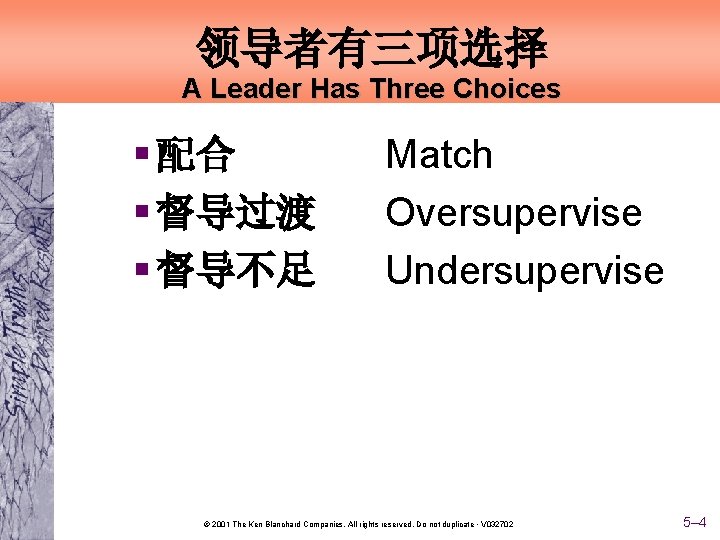
领导者有三项选择 A Leader Has Three Choices § 配合 § 督导过渡 § 督导不足 Match Oversupervise Undersupervise © 2001 The Ken Blanchard Companies. All rights reserved. Do not duplicate • V 032702 5– 4
- Slides: 78