
II Bottomup Determine secondary controlled variables and structure
II. Bottom-up • Determine secondary controlled variables and structure (configuration) of control system (pairing) • A good control configuration is insensitive to parameter changes Step 5. REGULATORY CONTROL LAYER 5. 1 Stabilization (including level control) 5. 2 Local disturbance rejection (inner cascades) What more to control? (secondary variables) Step 6. SUPERVISORY CONTROL LAYER Decentralized or multivariable control (MPC)? Pairing? Step 7. OPTIMIZATION LAYER (RTO) 1

”Advanced control” STEP 6. SUPERVISORY LAYER Objectives of supervisory layer: 1. Switch control structures (CV 1) depending on operating region • • Active constraints self-optimizing variables 2. Perform “advanced” economic/coordination control tasks. – Control primary variables CV 1 at setpoint using as degrees of freedom (MV): • • – Keep an eye on stabilizing layer • – 2 Avoid saturation in stabilizing layer Feedforward from disturbances • – – Setpoints to the regulatory layer (CV 2 s) ”unused” degrees of freedom (valves) If helpful Make use of extra inputs Make use of extra measurements Implementation: • Alternative 1: Advanced control based on ”simple elements” • Alternative 2: MPC
Control configuration elements • Control configuration. The restrictions imposed on the overall controller by decomposing it into a set of local controllers (subcontrollers, units, elements, blocks) with predetermined links and with a possibly predetermined design sequence where subcontrollers are designed locally. Some control configuration elements: • Cascade controllers • Decentralized controllers • Feedforward elements • Decoupling elements • Selectors • Split-range control 3
• • • 4 Cascade control arises when the output from one controller is the input to another. This is broader than the conventional definition of cascade control which is that the output from one controller is the reference command (setpoint) to another. In addition, in cascade control, it is usually assumed that the inner loop K 2 is much faster than the outer loop K 1. Feedforward elementslink measured disturbances to manipulated inputs. Decoupling elements link one set of manipulated inputs (“measurements”) with another set of manipulated inputs. They are used to improve the performance of decentralized control systems, and are often viewed as feedforward elements (although this is not correct when we view the control system as a whole) where the “measured disturbance” is the manipulated input computed by another decentralized controller.
Use of extra inputs Two different cases 1. Have extra dynamic inputs (degrees of freedom) Cascade implementation: “Input resetting to ideal resting value” Example: Heat exchanger with extra bypass 2. Need several inputs to cover whole range (because primary input may saturate) (steady-state) Split-range control Example 1: Control of room temperature using AC (summer), heater (winter), fireplace (winter cold) Example 2: Pressure control using purge and inert feed (distillation) 5
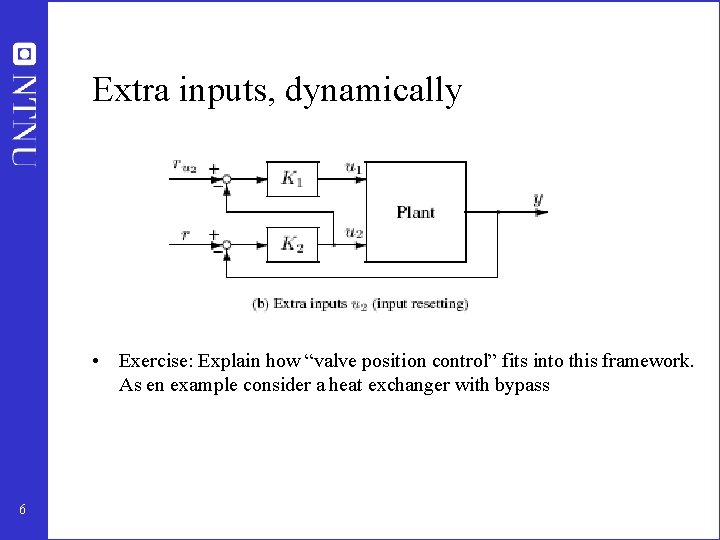
Extra inputs, dynamically • Exercise: Explain how “valve position control” fits into this framework. As en example consider a heat exchanger with bypass 6
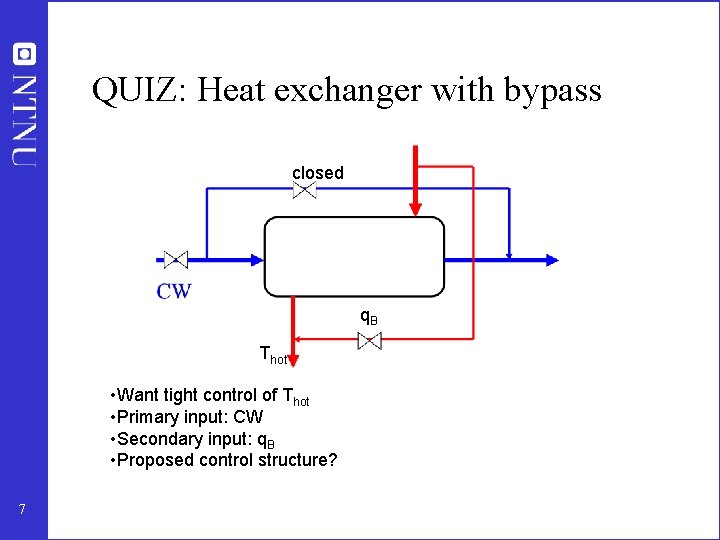
QUIZ: Heat exchanger with bypass closed q. B Thot • Want tight control of Thot • Primary input: CW • Secondary input: q. B • Proposed control structure? 7
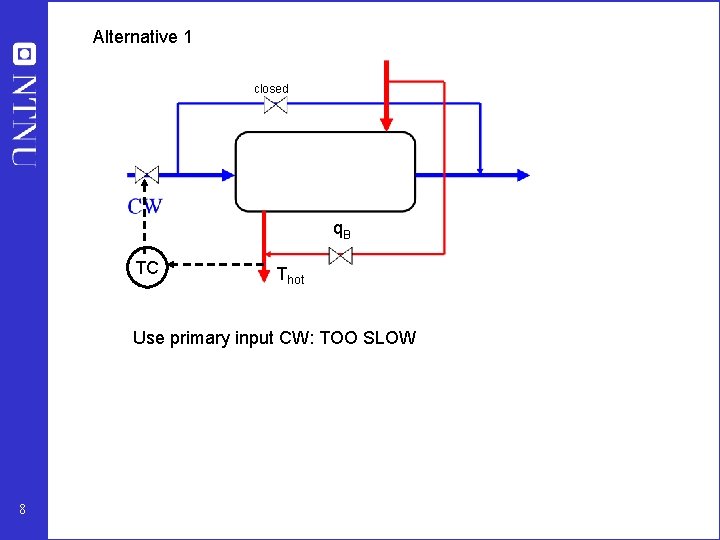
Alternative 1 closed q. B TC Thot Use primary input CW: TOO SLOW 8
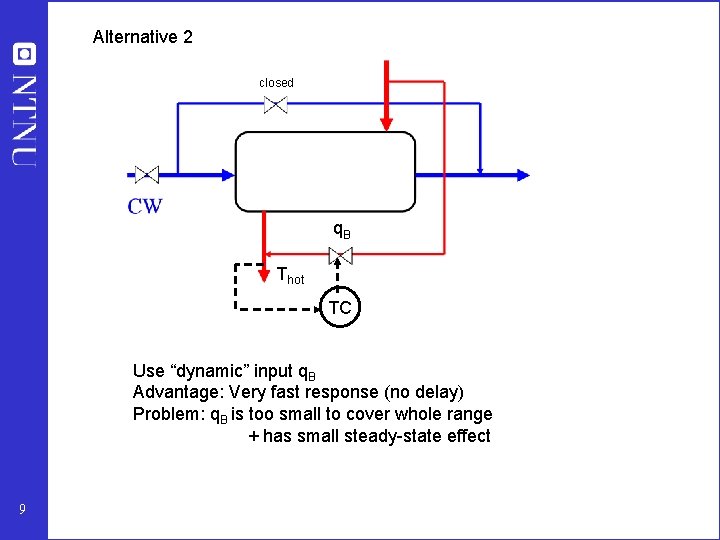
Alternative 2 closed q. B Thot TC Use “dynamic” input q. B Advantage: Very fast response (no delay) Problem: q. B is too small to cover whole range + has small steady-state effect 9
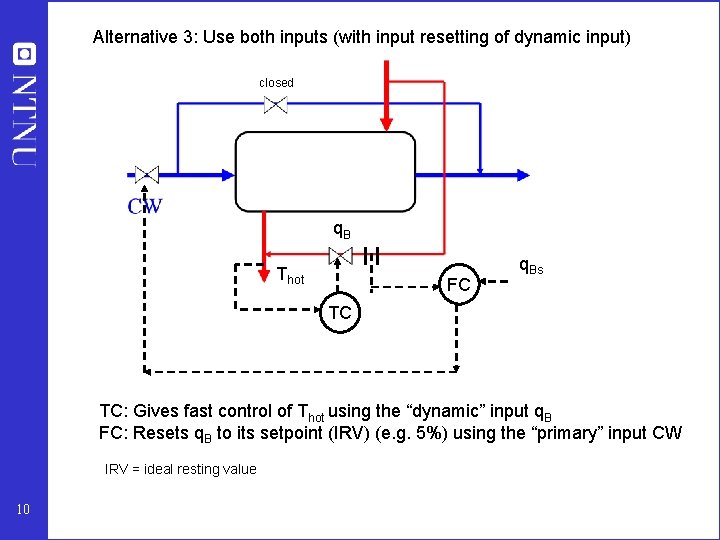
Alternative 3: Use both inputs (with input resetting of dynamic input) closed q. B Thot FC q. Bs TC TC: Gives fast control of Thot using the “dynamic” input q. B FC: Resets q. B to its setpoint (IRV) (e. g. 5%) using the “primary” input CW IRV = ideal resting value 10
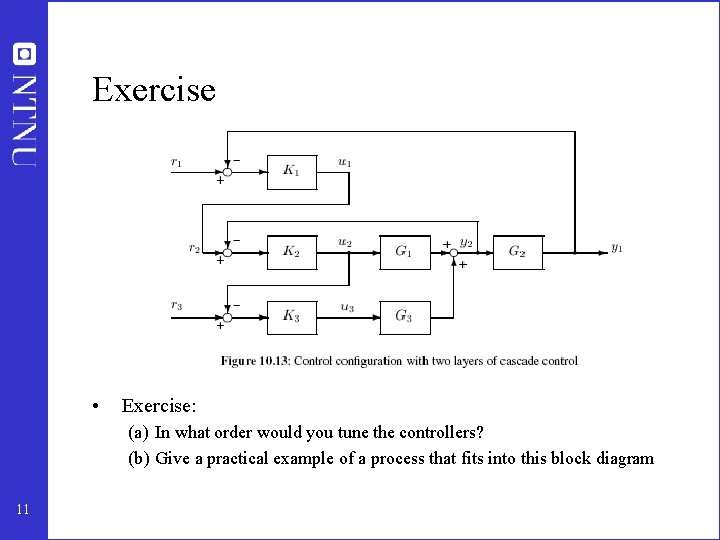
Exercise • Exercise: (a) In what order would you tune the controllers? (b) Give a practical example of a process that fits into this block diagram 11
Too few inputs • Must decide which output (CV) has the highest priority – Selectors 12
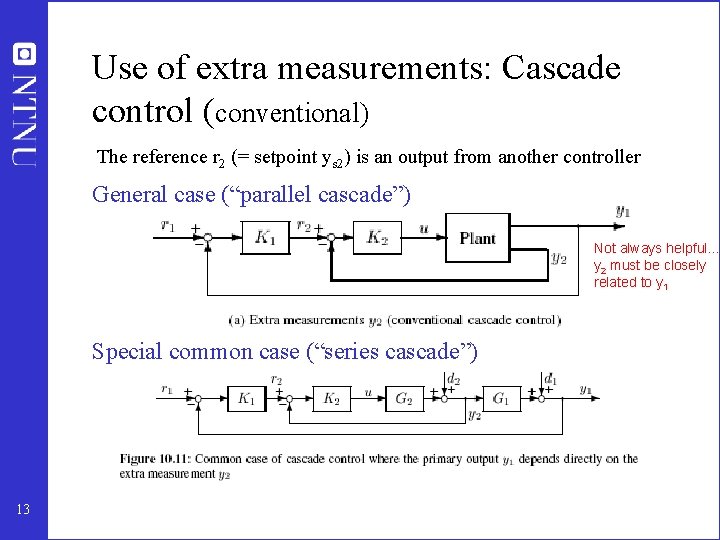
Use of extra measurements: Cascade control (conventional) The reference r 2 (= setpoint ys 2) is an output from another controller General case (“parallel cascade”) Not always helpful… y 2 must be closely related to y 1 Special common case (“series cascade”) 13
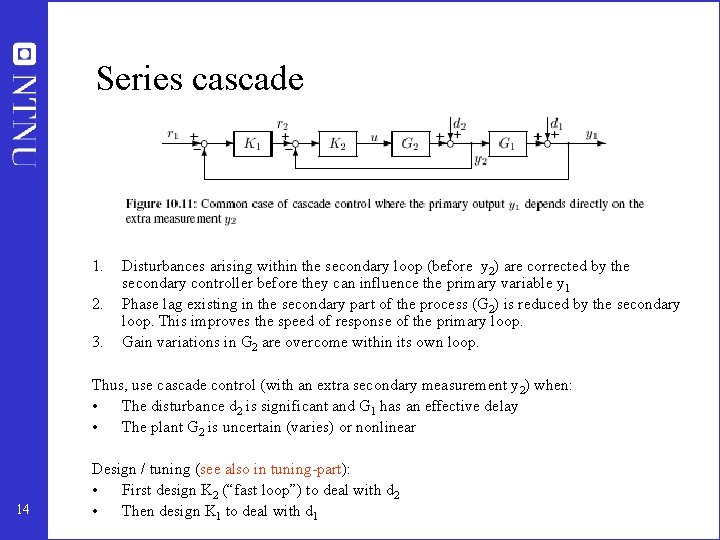
Series cascade 1. 2. 3. Disturbances arising within the secondary loop (before y 2) are corrected by the secondary controller before they can influence the primary variable y 1 Phase lag existing in the secondary part of the process (G 2) is reduced by the secondary loop. This improves the speed of response of the primary loop. Gain variations in G 2 are overcome within its own loop. Thus, use cascade control (with an extra secondary measurement y 2) when: • The disturbance d 2 is significant and G 1 has an effective delay • The plant G 2 is uncertain (varies) or nonlinear 14 Design / tuning (see also in tuning-part): • First design K 2 (“fast loop”) to deal with d 2 • Then design K 1 to deal with d 1
Control of primary variables • Purpose: Keep primary controlled outputs c=y 1 at optimal setpoints cs • Degrees of freedom: Setpoints y 2 s in reg. control layer • Main structural issue: Decentralized or multivariable? 15
Decentralized control (single-loop controllers) Use for: Noninteracting process and no change in active constraints + Tuning may be done on-line + No or minimal model requirements + Easy to fix and change - Need to determine pairing - Performance loss compared to multivariable control - Complicated logic required for reconfiguration when active constraints move 16
Multivariable control (with explicit constraint handling = MPC) Use for: Interacting process and changes in active constraints + Easy handling of feedforward control + Easy handling of changing constraints • no need for logic • smooth transition - 17 Requires multivariable dynamic model Tuning may be difficult Less transparent “Everything goes down at the same time”
Outline • Control structure design (plantwide control) • A procedure for control structure design I Top Down • • Step 1: Degrees of freedom Step 2: Operational objectives (optimal operation) Step 3: What to control ? (self-optimizing control) Step 4: Where set production rate? II Bottom Up • Step 5: Regulatory control: What more to control ? • Step 6: Supervisory control • Step 7: Real-time optimization • Case studies 18
Step 7. Optimization layer (RTO) • Purpose: Identify active constraints and compute optimal setpoints (to be implemented by supervisory control layer) • Main structural issue: Do we need RTO? (or is process selfoptimizing) • RTO not needed when – Can “easily” identify change in active constraints (operating region) – For each operating region there exists self-optimizing variables 19
Extra • For students that take Ph. D course! 20
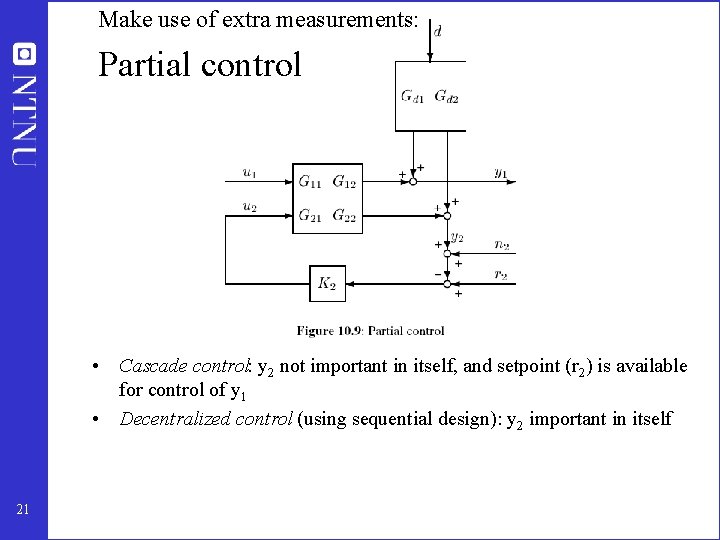
Make use of extra measurements: Partial control • Cascade control: y 2 not important in itself, and setpoint (r 2) is available for control of y 1 • Decentralized control (using sequential design): y 2 important in itself 21
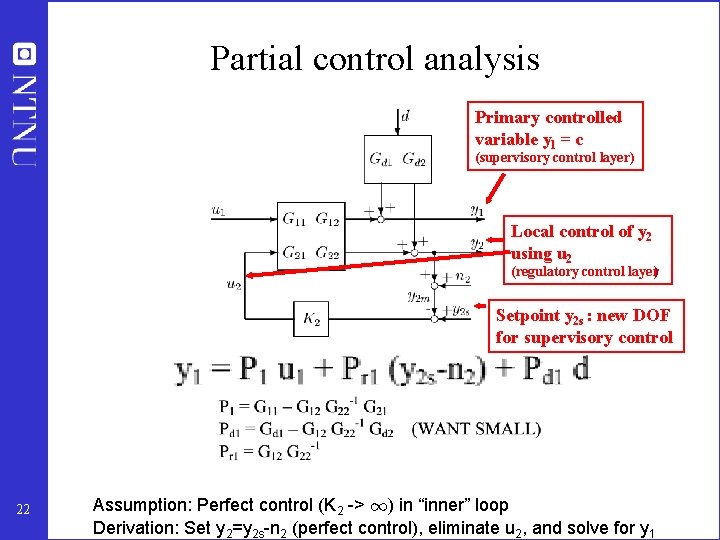
Partial control analysis Primary controlled variable y 1 = c (supervisory control layer) Local control of y 2 using u 2 (regulatory control layer) Setpoint y 2 s : new DOF for supervisory control 22 Assumption: Perfect control (K 2 -> 1) in “inner” loop Derivation: Set y 2=y 2 s-n 2 (perfect control), eliminate u 2, and solve for y 1
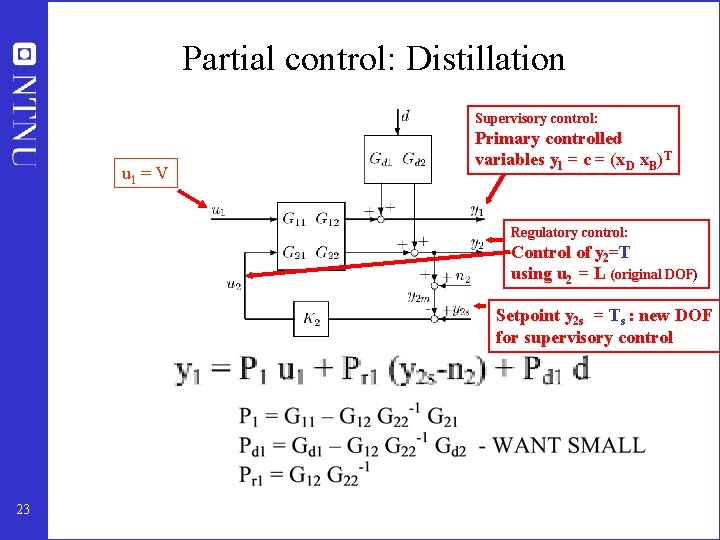
Partial control: Distillation Supervisory control: u 1 = V Primary controlled variables y 1 = c = (x D x. B)T Regulatory control: Control of y 2=T using u 2 = L (original DOF) Setpoint y 2 s = Ts : new DOF for supervisory control 23
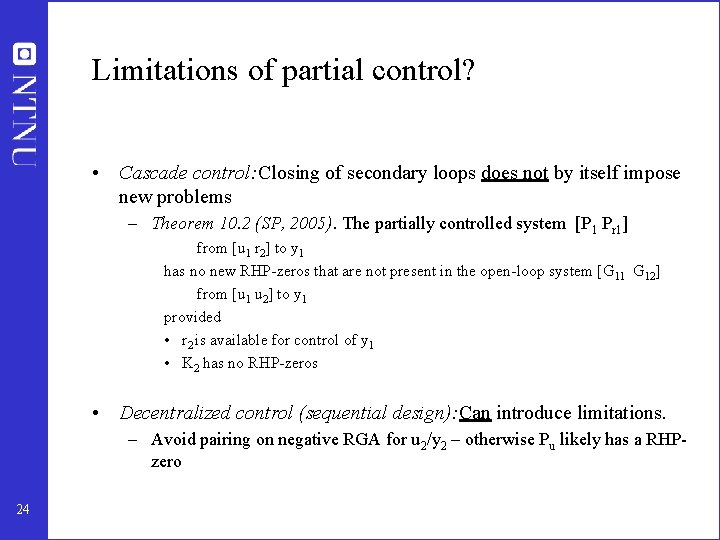
Limitations of partial control? • Cascade control: Closing of secondary loops does not by itself impose new problems – Theorem 10. 2 (SP, 2005). The partially controlled system [P 1 Pr 1] from [u 1 r 2] to y 1 has no new RHP-zeros that are not present in the open-loop system [G 11 G 12] from [u 1 u 2] to y 1 provided • r 2 is available for control of y 1 • K 2 has no RHP-zeros • Decentralized control (sequential design): Can introduce limitations. – Avoid pairing on negative RGA for u 2/y 2 – otherwise Pu likely has a RHPzero 24
- Slides: 24