
II 4 Sixteen Run Fractional Factorial Designs Introduction


- Slides: 34
II. 4 Sixteen Run Fractional Factorial Designs § § § Introduction Resolution Reviewed Design and Analysis Example: Five Factors Affecting Centerpost Gasket Clipping Time Example / Exercise: Seven Factors Affecting a Polymerization Process Discussion
II. 4 Sixteen Run Fractional Factorial Designs: Introduction n With 16 runs, up to 15 Factors may be analyzed at Resolution III. – Resolution IV is possible with 8 or fewer factors. – Resolution V is possible with 5 or fewer factors. These designs are very useful for “screening” situations: determine which factors have strong main effects n 20% rule n
II. 4 Sixteen Run Designs: Resolution Reviewed Q: What is a Resolution III design? – A: a design in which main effects are not confounded with other main effects, but at least one main effect is confounded with a 2 -way interaction n Resolution III designs are the riskiest fractional factorial designs…but the most useful for screening – “damn the interactions…. full speed ahead!” n
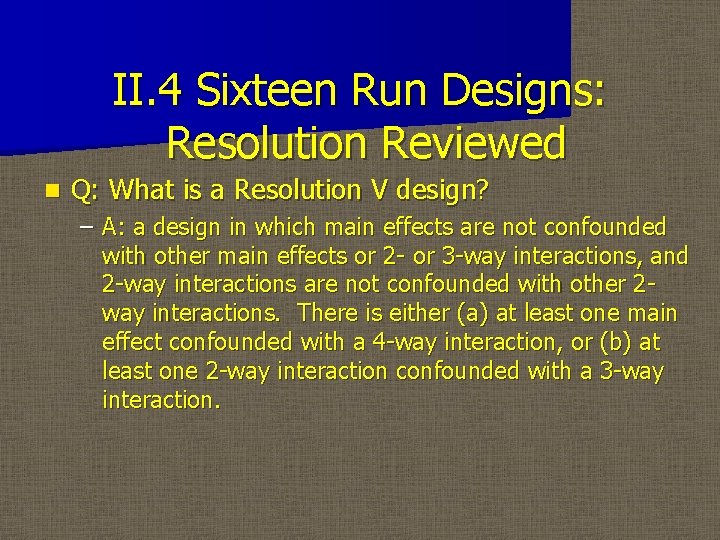
II. 4 Sixteen Run Designs: Resolution Reviewed Q: What is a Resolution IV design? – A: a design in which main effects are not confounded with other main effects or 2 -way interactions, but either (a) at least one main effect is confounded with a 3 -way interaction, or (b) at least one 2 -way interaction is confounded with another 2 -way interaction. n Hence, in a Resolution IV design, if 3 -way and higher interactions are negligible, all main effects are estimable with no confounding. n
II. 4 Sixteen Run Designs: Resolution Reviewed n Q: What is a Resolution V design? – A: a design in which main effects are not confounded with other main effects or 2 - or 3 -way interactions, and 2 -way interactions are not confounded with other 2 way interactions. There is either (a) at least one main effect confounded with a 4 -way interaction, or (b) at least one 2 -way interaction confounded with a 3 -way interaction.
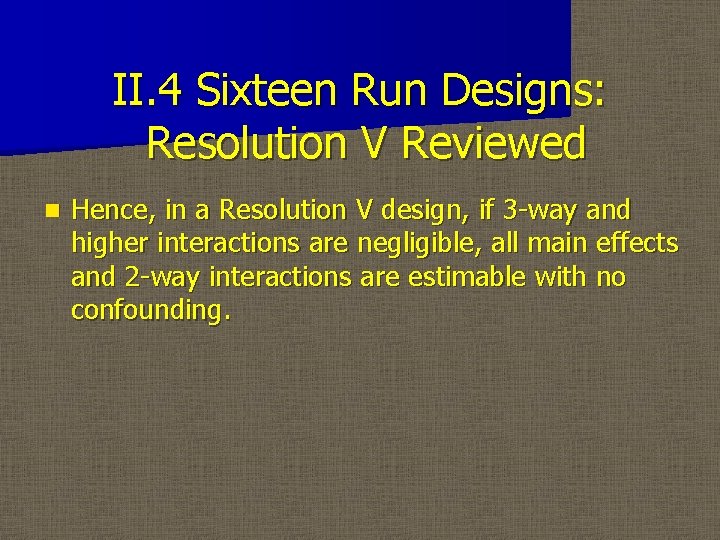
II. 4 Sixteen Run Designs: Resolution V Reviewed n Hence, in a Resolution V design, if 3 -way and higher interactions are negligible, all main effects and 2 -way interactions are estimable with no confounding.
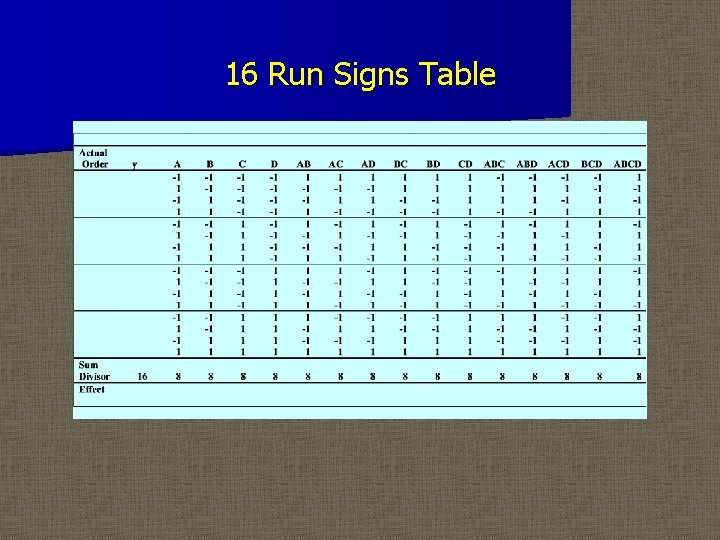
16 Run Signs Table
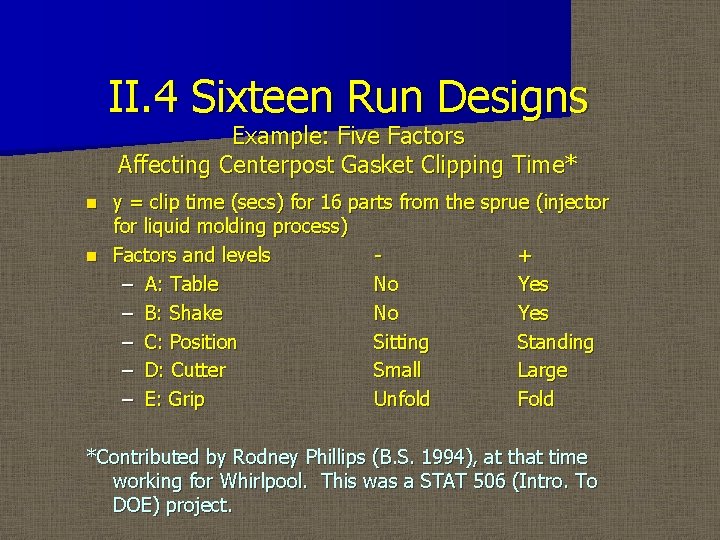
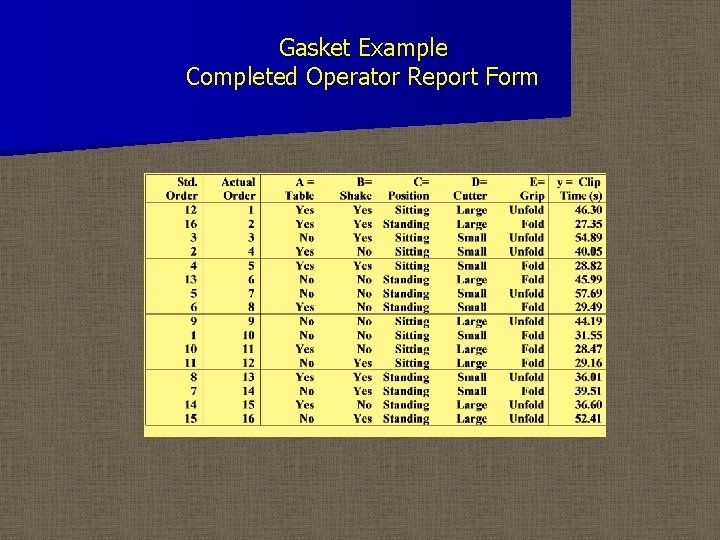
II. 4 Sixteen Run Designs Example: Five Factors Affecting Centerpost Gasket Clipping Time* y = clip time (secs) for 16 parts from the sprue (injector for liquid molding process) n Factors and levels + – A: Table No Yes – B: Shake No Yes – C: Position Sitting Standing – D: Cutter Small Large – E: Grip Unfold Fold n *Contributed by Rodney Phillips (B. S. 1994), at that time working for Whirlpool. This was a STAT 506 (Intro. To DOE) project.
Example: Five Factors Affecting Centerpost Gasket Clipping Time n Design the Experiment: associate factors with carefully chosen columns in the 16 run signs matrix to generate a design matrix – Always associate A, B, C, D with the first four columns – With five factors, E = ABCD is universally recommended (or E= ABCD)
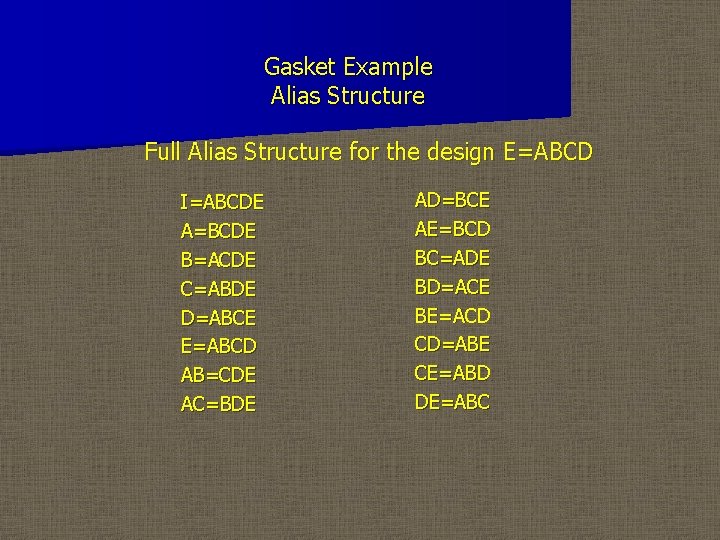
Gasket Example Alias Structure Full Alias Structure for the design E=ABCD I=ABCDE A=BCDE B=ACDE C=ABDE D=ABCE E=ABCD AB=CDE AC=BDE AD=BCE AE=BCD BC=ADE BD=ACE BE=ACD CD=ABE CE=ABD DE=ABC
Gasket Example Completed Operator Report Form
Gasket Example Effects Table
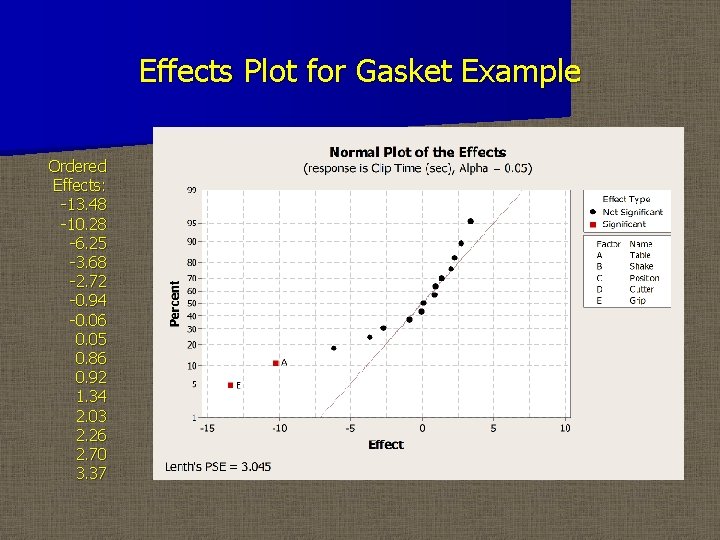
Effects Plot for Gasket Example Ordered Effects: -13. 48 -10. 28 -6. 25 -3. 68 -2. 72 -0. 94 -0. 06 0. 05 0. 86 0. 92 1. 34 2. 03 2. 26 2. 70 3. 37
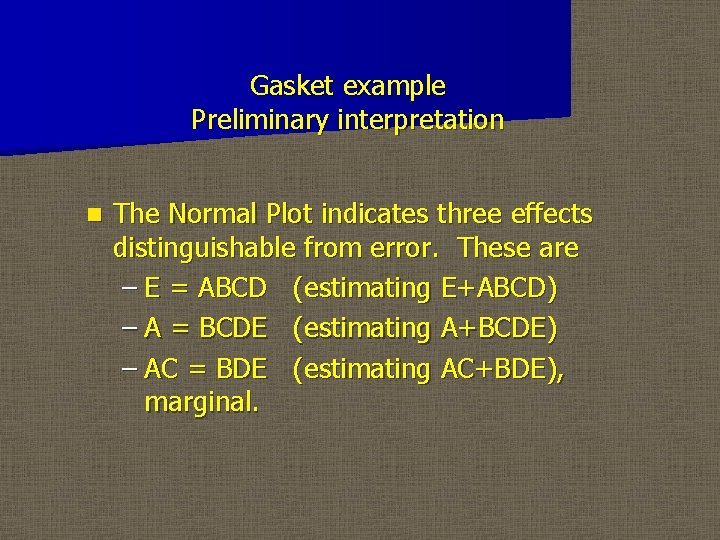
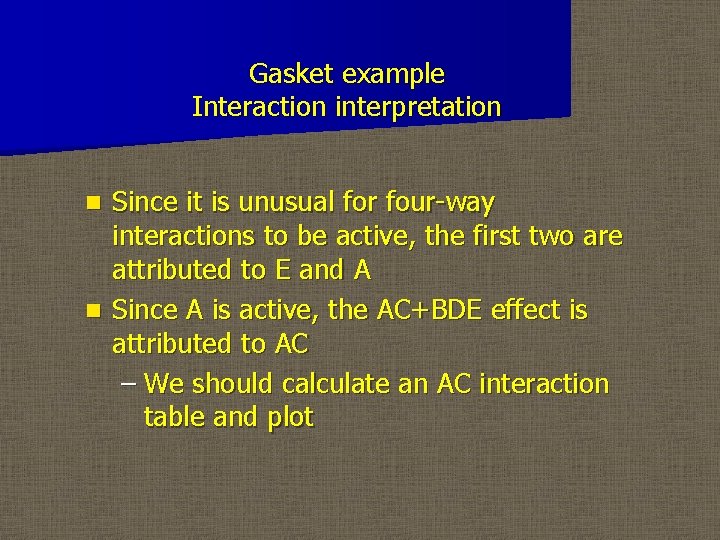
Gasket example Preliminary interpretation n The Normal Plot indicates three effects distinguishable from error. These are – E = ABCD (estimating E+ABCD) – A = BCDE (estimating A+BCDE) – AC = BDE (estimating AC+BDE), marginal.
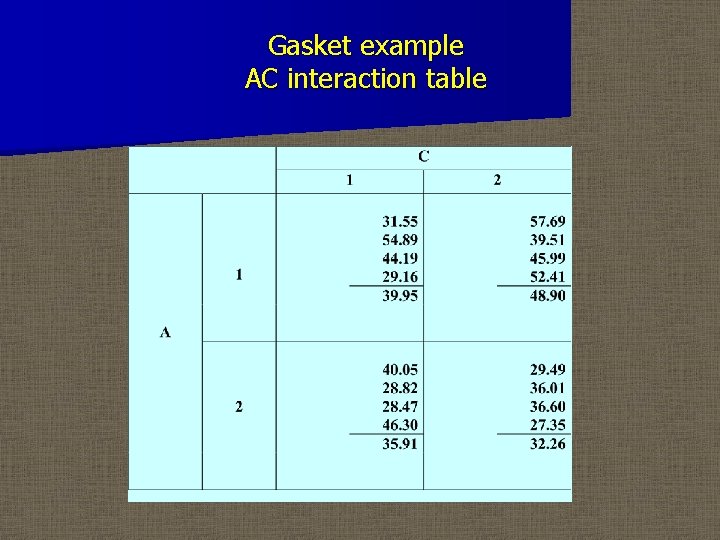
Gasket example Interaction interpretation Since it is unusual for four-way interactions to be active, the first two are attributed to E and A n Since A is active, the AC+BDE effect is attributed to AC – We should calculate an AC interaction table and plot n
Gasket example AC interaction table
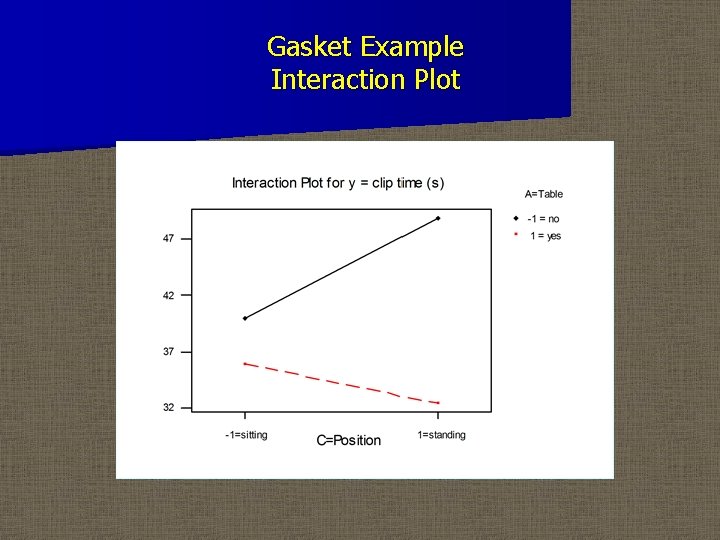
Gasket Example Interaction Plot
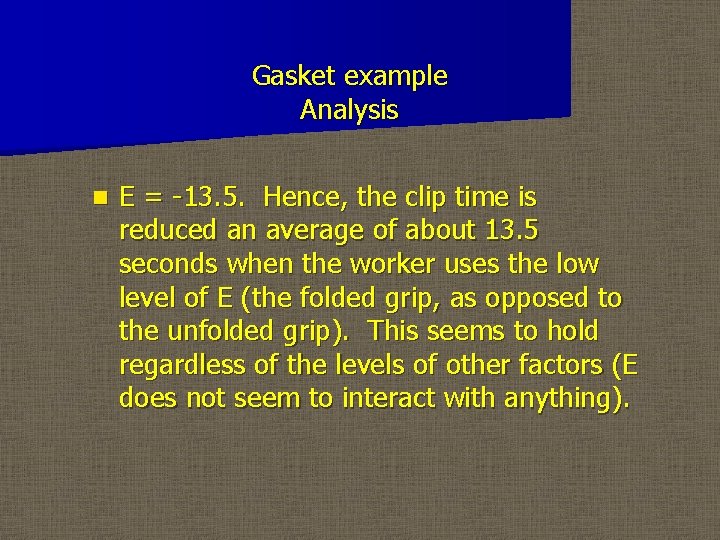
Gasket example Analysis n E = -13. 5. Hence, the clip time is reduced an average of about 13. 5 seconds when the worker uses the low level of E (the folded grip, as opposed to the unfolded grip). This seems to hold regardless of the levels of other factors (E does not seem to interact with anything).
Gasket example Interaction analysis n The effects of A (table) and C (position) seem to interact. The presence of a table reduces average clip time, but the reduction is larger (16. 6 seconds) when the worker is standing than when he/she is sitting (4. 0 seconds)
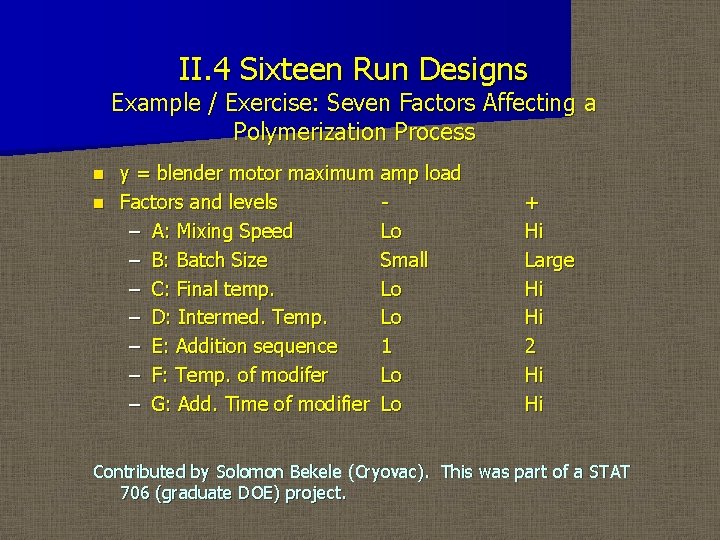
II. 4 Sixteen Run Designs Example / Exercise: Seven Factors Affecting a Polymerization Process y = blender motor maximum amp load n Factors and levels – A: Mixing Speed Lo – B: Batch Size Small – C: Final temp. Lo – D: Intermed. Temp. Lo – E: Addition sequence 1 – F: Temp. of modifer Lo – G: Add. Time of modifier Lo n + Hi Large Hi Hi 2 Hi Hi Contributed by Solomon Bekele (Cryovac). This was part of a STAT 706 (graduate DOE) project.
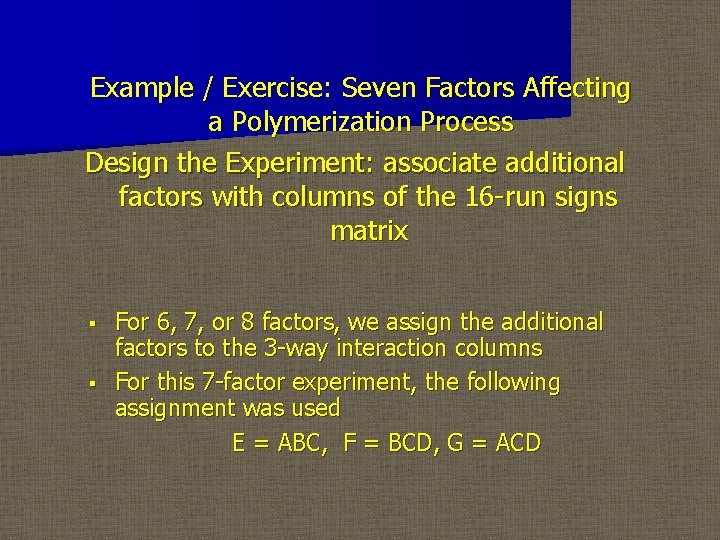
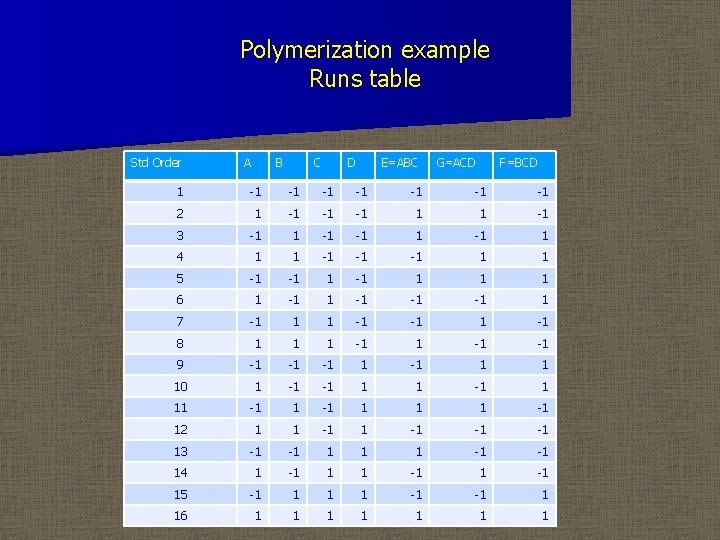
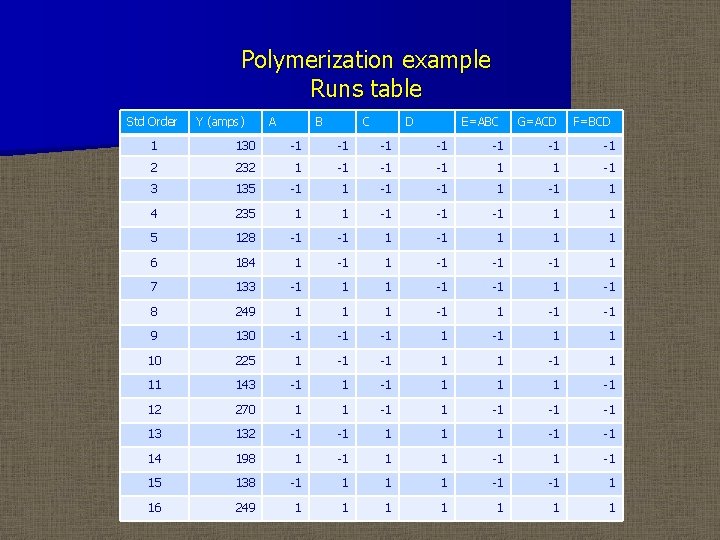
Example / Exercise: Seven Factors Affecting a Polymerization Process Design the Experiment: associate additional factors with columns of the 16 -run signs matrix § § For 6, 7, or 8 factors, we assign the additional factors to the 3 -way interaction columns For this 7 -factor experiment, the following assignment was used E = ABC, F = BCD, G = ACD
Polymerization example Runs table Std Order A B C D E=ABC G=ACD F=BCD 1 -1 -1 2 1 -1 -1 -1 1 1 -1 3 -1 1 4 1 1 -1 -1 -1 1 1 5 -1 -1 1 1 1 6 1 -1 -1 -1 1 7 -1 1 1 -1 -1 8 1 1 1 -1 -1 9 -1 -1 -1 1 1 10 1 -1 -1 1 11 -1 1 1 1 -1 12 1 1 -1 -1 -1 13 -1 -1 14 1 -1 15 -1 1 -1 -1 1 16 1 1 1 1
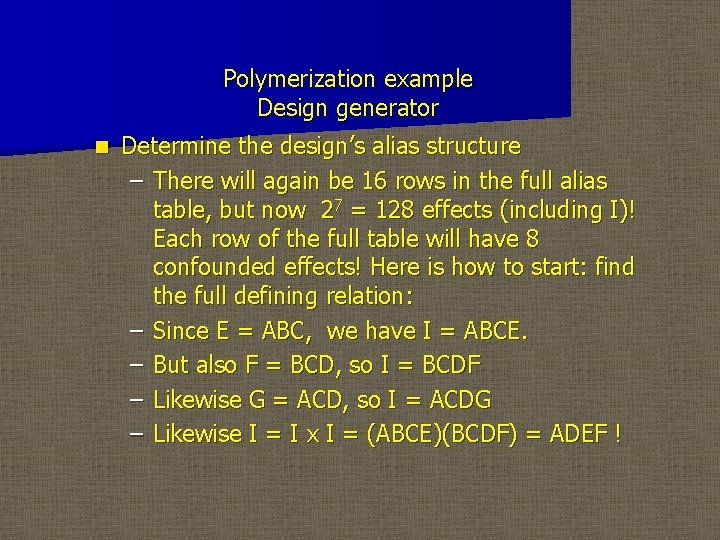
Polymerization example Design generator n Determine the design’s alias structure – There will again be 16 rows in the full alias table, but now 27 = 128 effects (including I)! Each row of the full table will have 8 confounded effects! Here is how to start: find the full defining relation: – Since E = ABC, we have I = ABCE. – But also F = BCD, so I = BCDF – Likewise G = ACD, so I = ACDG – Likewise I = I x I = (ABCE)(BCDF) = ADEF !
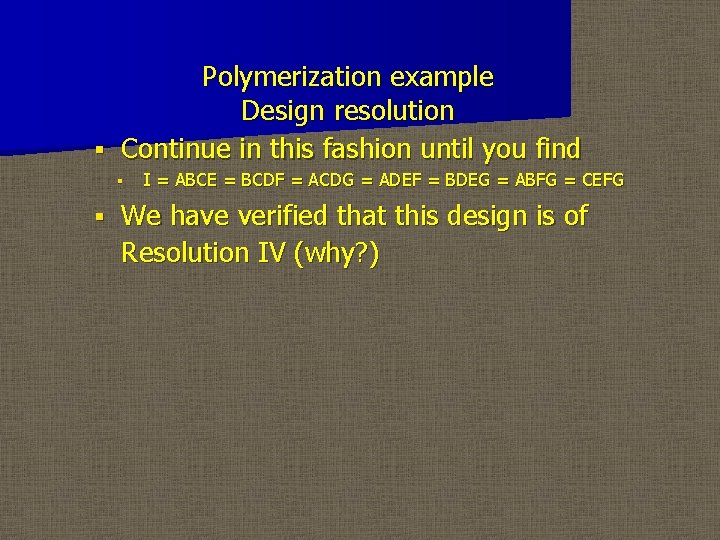
Polymerization example Design resolution § Continue in this fashion until you find § § I = ABCE = BCDF = ACDG = ADEF = BDEG = ABFG = CEFG We have verified that this design is of Resolution IV (why? )
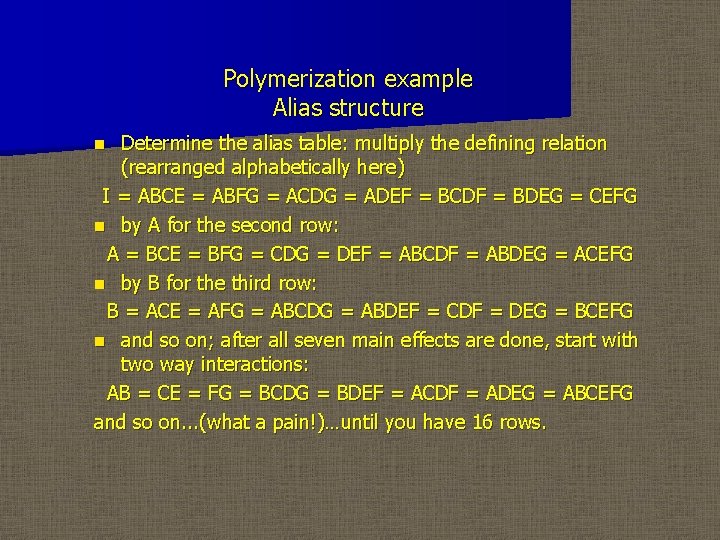
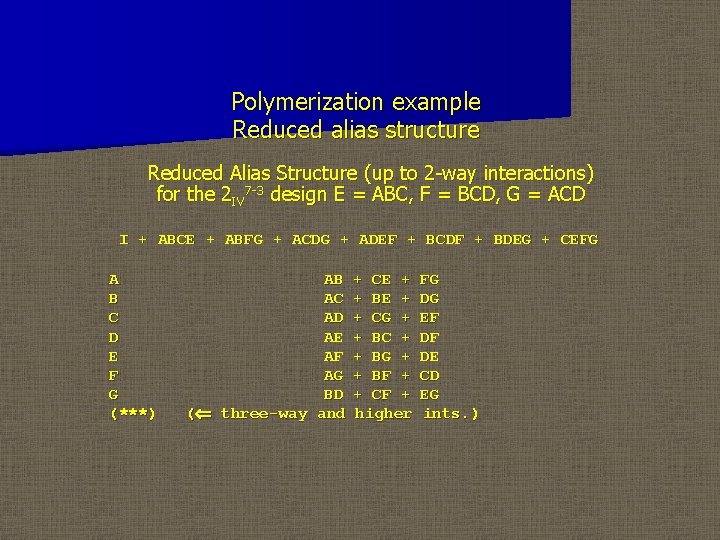
Polymerization example Alias structure Determine the alias table: multiply the defining relation (rearranged alphabetically here) I = ABCE = ABFG = ACDG = ADEF = BCDF = BDEG = CEFG n by A for the second row: A = BCE = BFG = CDG = DEF = ABCDF = ABDEG = ACEFG n by B for the third row: B = ACE = AFG = ABCDG = ABDEF = CDF = DEG = BCEFG n and so on; after all seven main effects are done, start with two way interactions: AB = CE = FG = BCDG = BDEF = ACDF = ADEG = ABCEFG and so on. . . (what a pain!)…until you have 16 rows. n
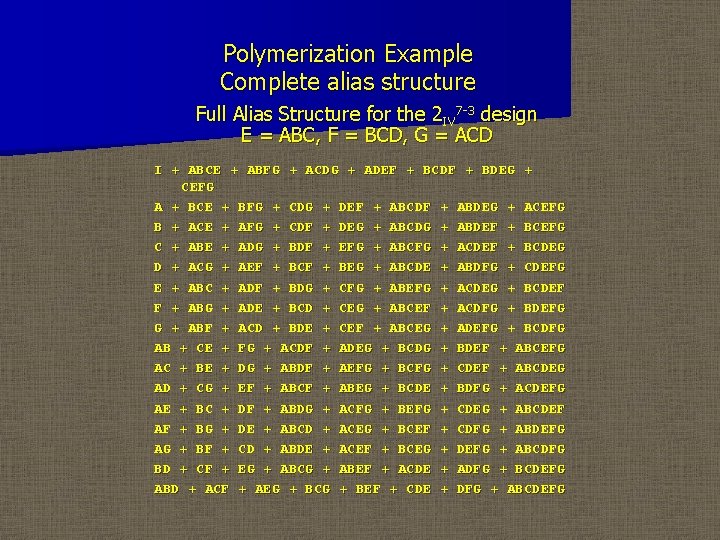
Polymerization Example Complete alias structure Full Alias Structure for the 2 IV 7 -3 design E = ABC, F = BCD, G = ACD I + ABCE + ABFG + ACDG + ADEF + BCDF + BDEG + CEFG A + BCE + BFG + CDG + DEF + ABCDF + ABDEG + ACEFG B + ACE + AFG + CDF + DEG + ABCDG + ABDEF + BCEFG C + ABE + ADG + BDF + EFG + ABCFG + ACDEF + BCDEG D + ACG + AEF + BCF + BEG + ABCDE + ABDFG + CDEFG E + ABC + ADF + BDG + CFG + ABEFG + ACDEG + BCDEF F + ABG + ADE + BCD + CEG + ABCEF + ACDFG + BDEFG G + ABF + ACD + BDE + CEF + ABCEG + ADEFG + BCDFG AB + CE + FG + ACDF + ADEG + BCDG + BDEF + ABCEFG AC + BE + DG + ABDF + AEFG + BCFG + CDEF + ABCDEG AD + CG + EF + ABCF + ABEG + BCDE + BDFG + ACDEFG AE + BC + DF + ABDG + ACFG + BEFG + CDEG + ABCDEF AF + BG + DE + ABCD + ACEG + BCEF + CDFG + ABDEFG AG + BF + CD + ABDE + ACEF + BCEG + DEFG + ABCDFG BD + CF + EG + ABCG + ABEF + ACDE + ADFG + BCDEFG ABD + ACF + AEG + BCG + BEF + CDE + DFG + ABCDEFG
Polymerization example Reduced alias structure Reduced Alias Structure (up to 2 -way interactions) for the 2 IV 7 -3 design E = ABC, F = BCD, G = ACD I + ABCE + ABFG + ACDG + ADEF + BCDF + BDEG + CEFG A B C D E F G (***) AB AC AD AE AF AG BD ( three-way and + CE + + BE + + CG + + BC + + BG + + BF + + CF + higher FG DG EF DF DE CD EG ints. )
Polymerization example Runs table Std Order Y (amps) A B C D E=ABC G=ACD F=BCD 1 130 -1 -1 2 232 1 -1 -1 -1 1 1 -1 3 135 -1 1 4 235 1 1 -1 -1 -1 1 1 5 128 -1 -1 1 1 1 6 184 1 -1 -1 -1 1 7 133 -1 1 1 -1 -1 8 249 1 1 1 -1 -1 9 130 -1 -1 -1 1 1 10 225 1 -1 -1 1 11 143 -1 1 1 1 -1 12 270 1 1 -1 -1 -1 13 132 -1 -1 14 198 1 -1 15 138 -1 1 -1 -1 1 16 249 1 1 1 1
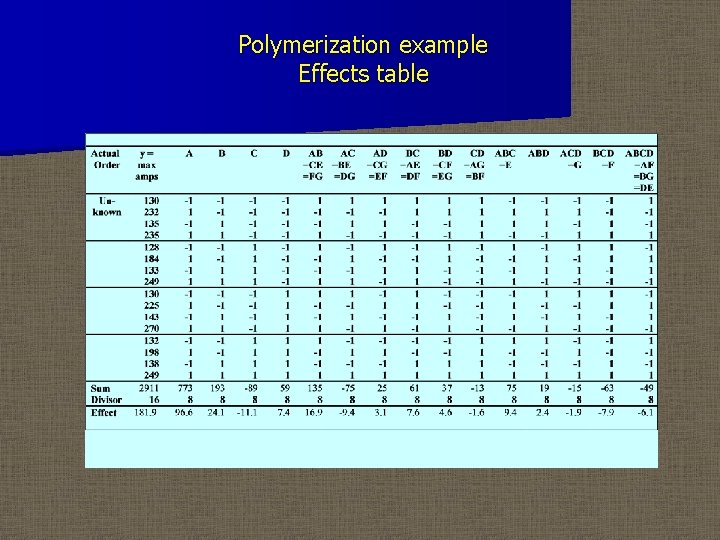
Polymerization example Effects table
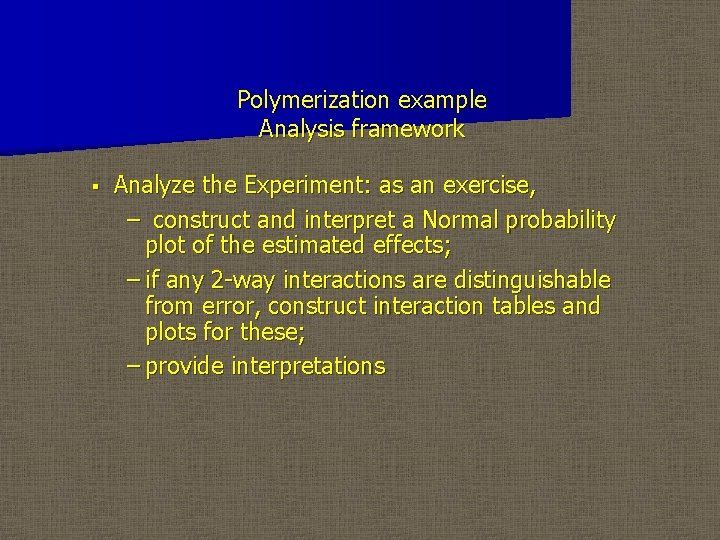
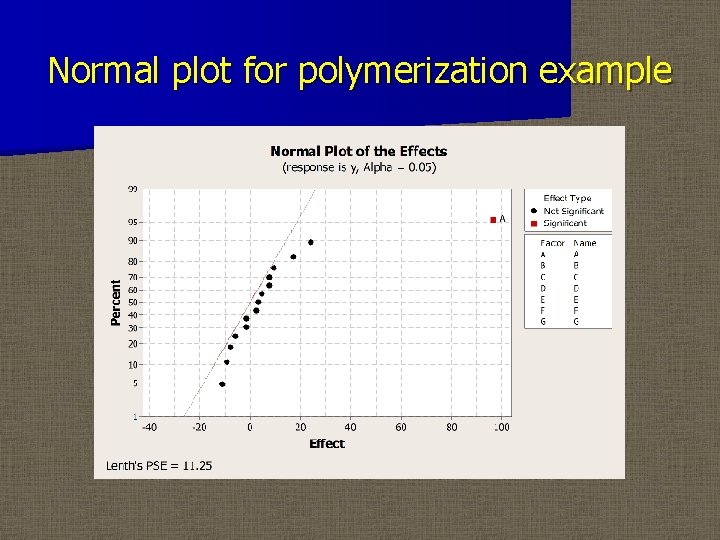
Polymerization example Analysis framework § Analyze the Experiment: as an exercise, – construct and interpret a Normal probability plot of the estimated effects; – if any 2 -way interactions are distinguishable from error, construct interaction tables and plots for these; – provide interpretations
Normal plot for polymerization example
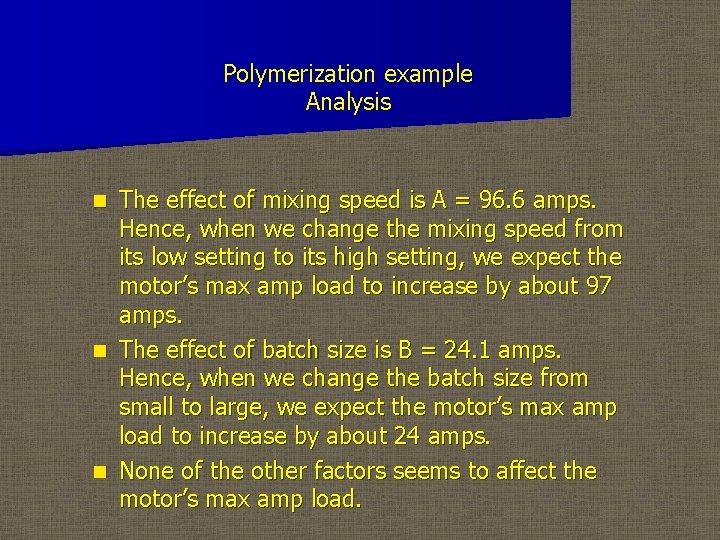
Polymerization example Analysis The effect of mixing speed is A = 96. 6 amps. Hence, when we change the mixing speed from its low setting to its high setting, we expect the motor’s max amp load to increase by about 97 amps. n The effect of batch size is B = 24. 1 amps. Hence, when we change the batch size from small to large, we expect the motor’s max amp load to increase by about 24 amps. n None of the other factors seems to affect the motor’s max amp load. n
II. 4 Discussion As in 8 -run designs, we can always “fold over” a 16 run fractional factorial design. There are several variations on this technique; in particular, for any 16 -run Resolution III design, it is always possible to add 16 runs in such a way that the pooled design is Resolution IV. n There a great many other fractional factorial designs; in particular, the Plackett-Burman designs have runs any multiple of four (4, 8, 12, 16, 20, etc. ) up to 100, and in n runs can analyze (n-1) Factors at Resolution III. n
II. 4 References Daniel, Cuthbert (1976). Applications of Statistics to Industrial Experimentation. New York: John Wiley & Sons, Inc. n Box, G. E. P. and Draper, N. R. (1987). Empirical Model-Building and Response Surfaces. New York: John Wiley & Sons, Inc. n Box, G. E. P. , Hunter, W. G. , and Hunter, J. S. (1978). Statistics for Experimenters. New York: John Wiley & Sons, Inc. n Lochner, R. H. and Matar, J. E. (1990). Designing for Quality. Milwaukee: ASQC Quality Press. n