
IHRM Chapter 5 International Human Resource Management International

- Slides: 24
IHRM Chapter 5 International Human Resource Management International training and development Managing people in a multinational context
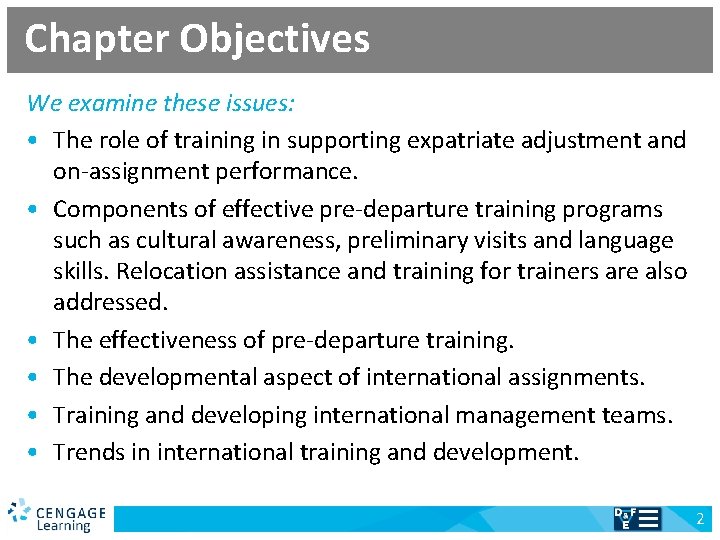
Chapter Objectives We examine these issues: • The role of training in supporting expatriate adjustment and on-assignment performance. • Components of effective pre-departure training programs such as cultural awareness, preliminary visits and language skills. Relocation assistance and training for trainers are also addressed. • The effectiveness of pre-departure training. • The developmental aspect of international assignments. • Training and developing international management teams. • Trends in international training and development. v 2
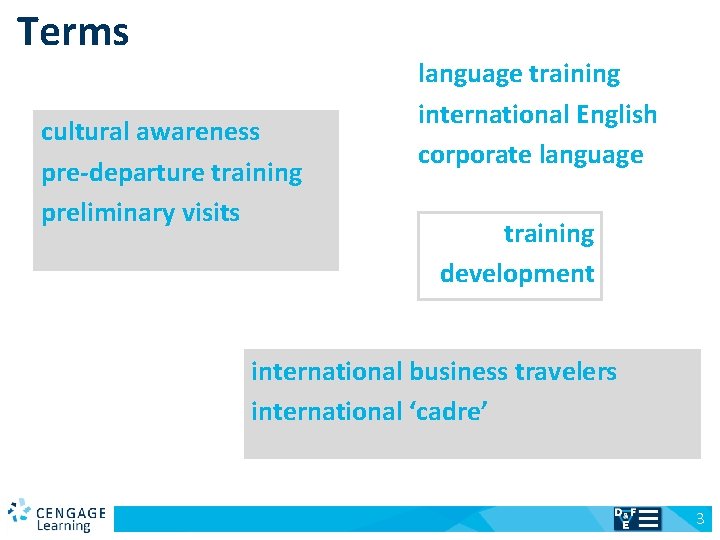
Terms cultural awareness pre-departure training preliminary visits language training international English corporate language training development international business travelers international ‘cadre’ v 3
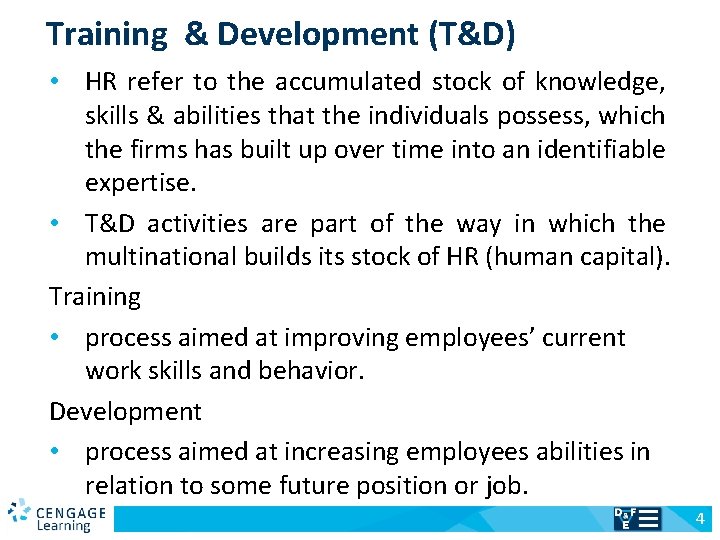
Training & Development (T&D) • HR refer to the accumulated stock of knowledge, skills & abilities that the individuals possess, which the firms has built up over time into an identifiable expertise. • T&D activities are part of the way in which the multinational builds its stock of HR (human capital). Training • process aimed at improving employees’ current work skills and behavior. Development • process aimed at increasing employees abilities in relation to some future position or job. v 4
Training & Development (T&D) • Indication of the importance of this, the increasing no. of multinationals that have established their own universities or training center. • E. g. Motorola, Mc Donalds & Disney Universities are e. g. of these in-house training centers. Several Japanese & Korean firms have similar arrangement such as the Lufthansa Business School & Ericson Mgt. Institute. v 5
Training & Development (T&D) • The international assignment (IA) in itself is an important T&D tool: • Expatriate are trainers through transfer of knowledge and competence between the various units. They are expected to assist the MNE train & develop HCNs. • Expatriate expected to ensure the systems and processes are adopted and showing how the systems and processes work as well as monitoring the effective performance of HCNs. • IA is mgt. development to gain management capabilities (e. g job rotation will broaden perspectives) v 6
Role of expatriate training • Once employee has been selected for an expatriate position, pre departure training is considered to be the next critical step in attempting to ensure the expatriate’s effectiveness & success abroad, particularly where the destination country is considered culturally tough. • Effective cultural training, assist individuals to adjust more rapidly to the new culture. • A major objective of intercultural training is to help people cope with unexpected events in a new culture. v 7
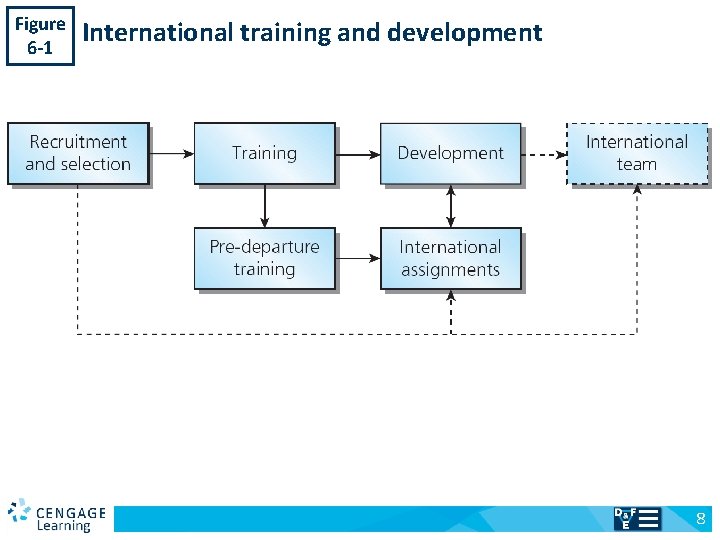
Figure 6 -1 v International training and development 8
Components of effective pre-departure training programs 1. Culture Awareness • A well designed, cultural awareness training program can be extremely beneficial as it seeks to foster an appreciation of the host country’s culture, that will make expatriate behave accordingly and may develop appropriate coping patterns. • Cultural awareness training remains the most common form of pre-departure training. • The components of cultural awareness program vary according to country of assignment, duration, purpose of transfer & provider of such program. v 9
Components of effective pre-departure training programs Recommendation on cultural awareness training programs are: • Training should be more oriented to life-long learning than ‘one –shot’ programs with an area-specific focus. • There should be more emphasis on provision of foreign language training. • There should be emphasize on the levels of communication competence not just verbal communication that enables an easier transition between one culture & another. • Cross cultural training assists in managing diversity. • The preview of expatriate position should be realistic, this facilitates effective performance. • v 10
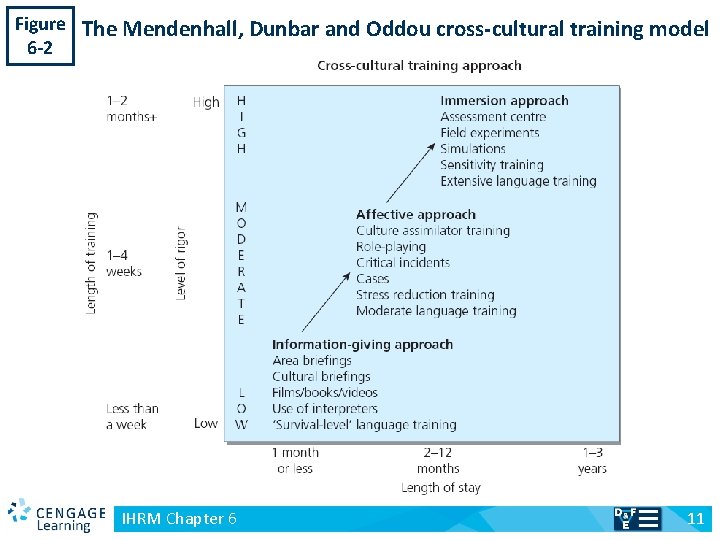
Figure The Mendenhall, Dunbar and Oddou cross-cultural training model 6 -2 v IHRM Chapter 6 11
Components of effective pre-departure training programs 2. Preliminary visits • One technique useful in orienting international employees is to send them on a preliminary trip to the host country. • Well planned trip overseas for the candidate & spouse provides a preview allow them to assess their suitability & interest in assignment. • Such trip serves to introduce expatriate candidates to the business context in the host location & helps encourage more informed pre-departure preparation. • When used as part of pre-departure training program, visit to the host location can assist in the initial adjustment process. v 12
Components of effective pre-departure training programs 3. Language training • Language training is a seemingly obvious, desirable component of a pre-departure program. • Able to speak the corporate language can give expatriates added power in the subsidiary. • Desirable component of a pre-departure program. • It is generally accepted that English is the language of world business. • Disregard the important of foreign language skill may reflect a degree of ethnocentrism. • The ability to speak a foreign language can improve the expatriate’s effectiveness & negotiation ability. v 13
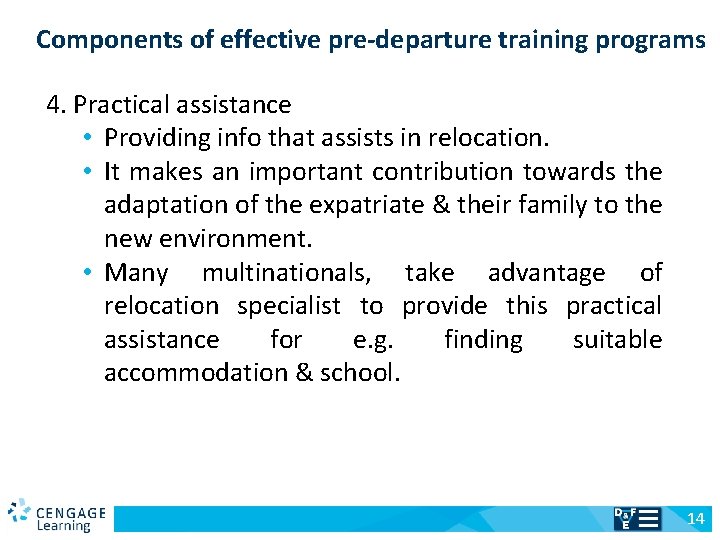
Components of effective pre-departure training programs 4. Practical assistance • Providing info that assists in relocation. • It makes an important contribution towards the adaptation of the expatriate & their family to the new environment. • Many multinationals, take advantage of relocation specialist to provide this practical assistance for e. g. finding suitable accommodation & school. v 14
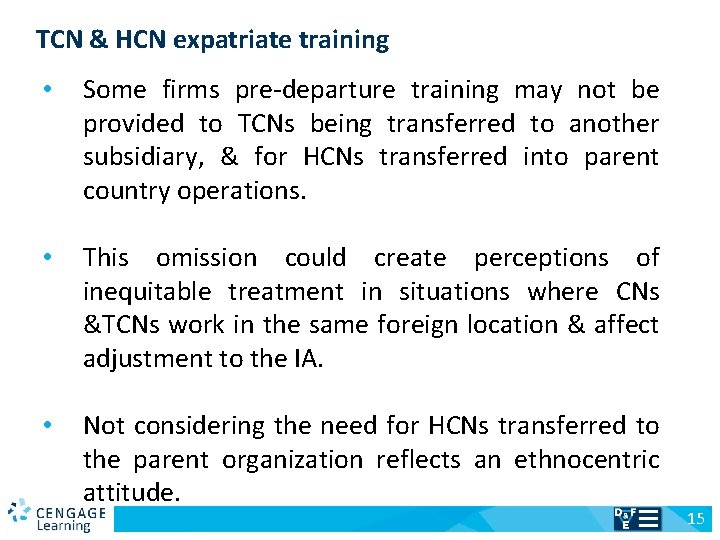
TCN & HCN expatriate training • Some firms pre-departure training may not be provided to TCNs being transferred to another subsidiary, & for HCNs transferred into parent country operations. • This omission could create perceptions of inequitable treatment in situations where CNs &TCNs work in the same foreign location & affect adjustment to the IA. • Not considering the need for HCNs transferred to the parent organization reflects an ethnocentric attitude. v 15
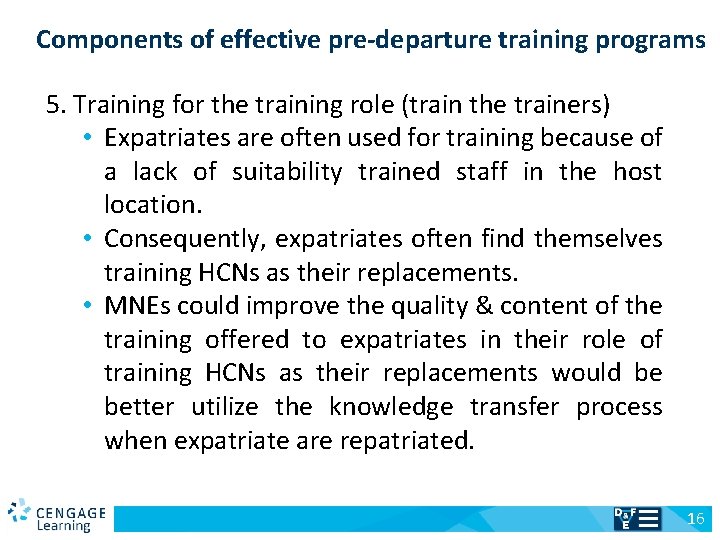
Components of effective pre-departure training programs 5. Training for the training role (train the trainers) • Expatriates are often used for training because of a lack of suitability trained staff in the host location. • Consequently, expatriates often find themselves training HCNs as their replacements. • MNEs could improve the quality & content of the training offered to expatriates in their role of training HCNs as their replacements would be better utilize the knowledge transfer process when expatriate are repatriated. v 16
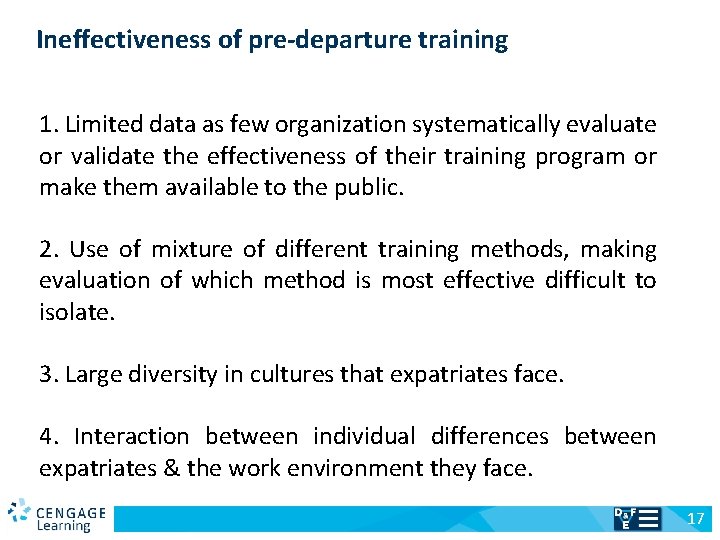
Ineffectiveness of pre-departure training 1. Limited data as few organization systematically evaluate or validate the effectiveness of their training program or make them available to the public. 2. Use of mixture of different training methods, making evaluation of which method is most effective difficult to isolate. 3. Large diversity in cultures that expatriates face. 4. Interaction between individual differences between expatriates & the work environment they face. v 17
Developing staff through international assignment International assignment important mechanism for developing international expertise. The expected outcome are: 1. Management development. • Individual gain international experience which assist in career progression while multinational gains through having a pool of experienced international operators on which to draw for future international assignment. 2. Organizational development. • IA also provide a multinational with a way of accumulating a stock of knowledge, skills and abilities for future growth. v 18
Developing staff through international assignment There are 2 viewpoints on developing staff 1. Individual development • IA can be compared to job rotation, a mgt. development tool seeks to provide certain employees with opportunities to enhance their abilities by exposing them to a range of jobs, tasks & challenges. 2. Developing international teams. • Benefits from using international teams fostering innovation, organizational learning & transfer of knowledge • Breaking down functional & national boundaries, enhancing horizontal communication & info. flow. v 19
Developing staff through international assignment • Encourage diverse inputs into decisions, problem solving & strategic assessment. • Developing global perspective and developing share values v 20
MNEs Benefit from Using International Teams • A mechanism for fostering innovation, organizational learning and knowledge transfer. • A means of breaking down functional & national boundaries, enhancing horizontal communication MNEs Benefit from Using International and information flows. Teams • A way of encouraging diverse inputs into decisions, problem solving & strategic assessments. • A way of developing a global perspective • A way of developing shared values thus assisting in the use of informal and control through socialization v 21
Trends in international T&D • • • v First, although the pressure from globalization continue to push MNEs towards a convergent approach to T&D, there is a continuing pressure from many countries (i. e. developing countries) for localization of T&D initiatives of which MNEs must be mindful. Second, there is a growing realization that although globalization is having a major impact on business processes & associated T&D & learning , it is still necessary to consider the impact & importance of the national context & institution on such effort. Third, there is increasing awareness of the important role of NGOs international T&D. 22
Trends in international T&D • • v Fourth, with the rise of China as an economic superpower, there is increasing interest in all aspects of T&D with a focus on China. Finally, there is a realization in the T&D that the field must address global, comparative & national level contexts for T&D. 23
Discussion Questions 1. What are some of the challenges faced in training expatriate managers? 2. Assume you are the HR director for a small company that has begun to use international assignments. You are considering using an external consulting firm to provide pre-departure training for employees, as you do not have the resources to provide this ‘inhouse’. What components will you need covered? How will you measure the effectiveness of the pre-departure training program provided by this external consultant? 3. How does an international assignment assist in developing a ‘cadre’ of international operators? Why is it necessary to have such a ‘cadre’? 4. Why do some MNEs appear reluctant to provide basic predeparture training? v IHRM Chapter 6 24