
IGT System Design Kevin Cleary Ph D Imaging

- Slides: 25
IGT System Design Kevin Cleary, Ph. D Imaging Science and Information Systems (ISIS Center) Department of Radiology Georgetown University Medical Center Washington, DC cleary@georgetown. edu NCIGT Workshop 19 -20 October 2006 CAIMR Georgetown University
Take Home Message • IGT is a systems engineering problem – System design / requirements is first step • Modularity is key – Component based approach – Timing is good as field is emerging – Science of image guidance • NCIGT can help – Organization, infrastructure, prototype systems, and critical mass CAIMR 2 Georgetown University
Outline • What is an IGT system? • System design – Modularity – Design processes • Components – – – Standards Software Trackers Robots Image-guided systems • Challenges • How can NCIGT help? CAIMR 3 Georgetown University
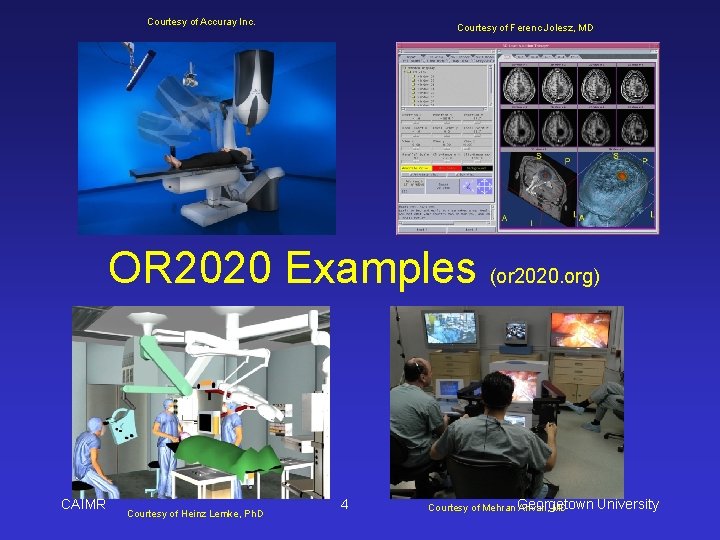
Courtesy of Accuray Inc. Courtesy of Ferenc Jolesz, MD OR 2020 Examples (or 2020. org) CAIMR Courtesy of Heinz Lemke, Ph. D 4 Courtesy of Mehran Georgetown Anvari, MD University
What is an IGT System? • From Workshop web page: IGT systems – Integrated devices for therapy delivery – Incorporate intra-operative medical imaging, navigation, or robotics • Compare this with the definition of a system – Set of interrelated components working together towards some common objective – Reference: Systems Engineering Principles and Practice, Kossiakoff and Sweet, Wiley, 2003, page 3 • Creating an IGT system – “Systems Engineering” job – Domain knowledge is critical CAIMR 5 Georgetown University
System Design Definition • The process of defining the architecture, components, interfaces, and other characteristics of a system or component (page 434) • Requirements are critical to this process • Obtaining good requirements can be difficult • Often a weak link in research projects (because of this difficulty) CAIMR 6 Georgetown University
System Design: Modularity • Essential goal of systems engineering – High degree of modularity (page 10) • Critical issue for our field – Where should we draw these interfaces? – Poor modularity makes it difficult to integrate components – Regulatory issues are important CAIMR 7 Georgetown University
Why Can’t We Have Modularity for IGT (or can we? ) • Is the domain too complex? – Many different procedures – Physician practice varies • Is the field too young? – Not enough critical mass – Science of IGT not mature • Is it a regulatory problem? • Or is the timing ripe? CAIMR 8 Georgetown University
One Possible Pathway 1. Identify clinically important problems where image-guided therapy may be useful 2. Workflow analysis of these procedures 3. Develop a requirements specification 4. Partition the systems into modules by determining where the interfaces lie 5. Implement and test system CAIMR 9 Georgetown University
System Design Processes • Many traditional life cycle approaches – These are heavyweight processes • We want an agile process – Can an agile process produce a quality product for the medical domain? – Agile does not imply unmanaged – Open source software tools may apply CAIMR 10 Georgetown University
Components of an IGT System • • • Standards Software Trackers Robotics Commercial image-guided systems with accessible APIs CAIMR 11 Georgetown University
Standards: Accuracy Measurement • ASTM Committee F 04. 05 on Computer Assisted Orthopaedic Surgical Systems • WK 5350 New Standard Practice for Accuracy Measurement in Computer-Assisted Orthopedic Surgery • Scope – Clinically relevant assessment procedures – Focus on engineering performance of a system • http: //www. astm. org CAIMR 12 Georgetown University
Standards: DICOM WG 24 • Scope: To develop DICOM objects and services related to image guided surgery • Roadmap – Representatives from surgical disciplines – Establish workflows – Propose DICOM services • White paper in progress • Chair: Heinz Lemke, Ph. D CAIMR 13 Georgetown University
Medical Device "Plug-and-Play" Interoperability Program • Goal: standardizing medical device connectivity • Based at CIMIT and Massachusetts General • Standard under development – Integrated Clinical Environment Manager – Vendor neutral laboratory “sandbox” • http: //mdpnp. org/ CAIMR 14 Georgetown University
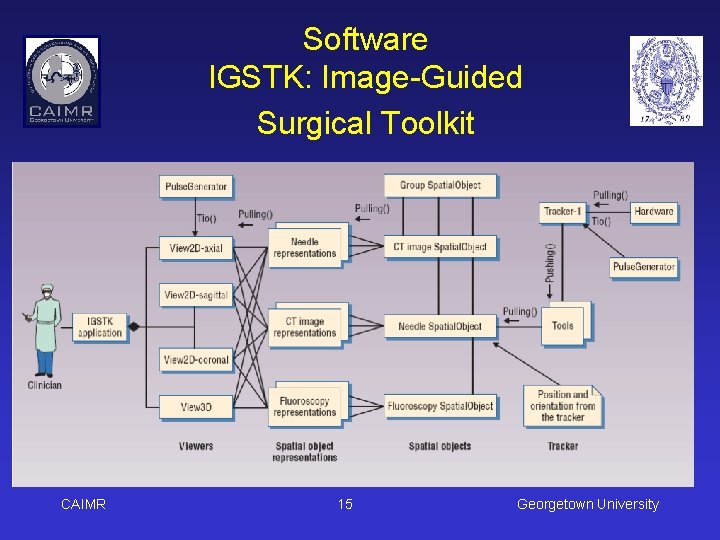
Software IGSTK: Image-Guided Surgical Toolkit CAIMR 15 Georgetown University
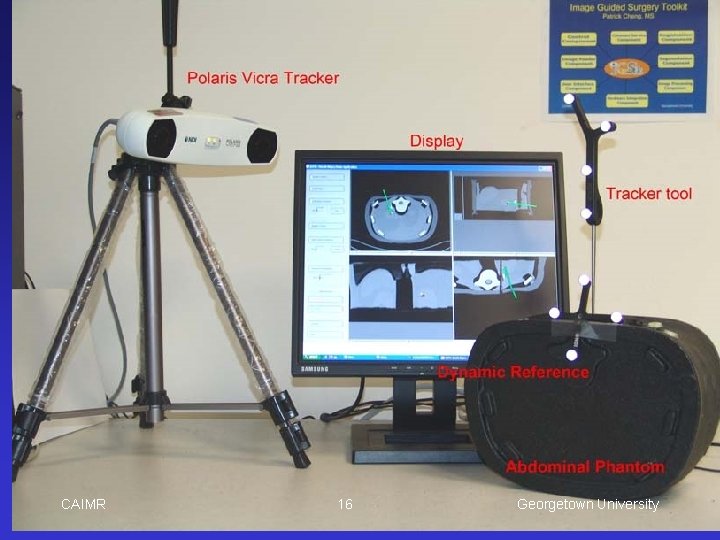
CAIMR 16 Georgetown University
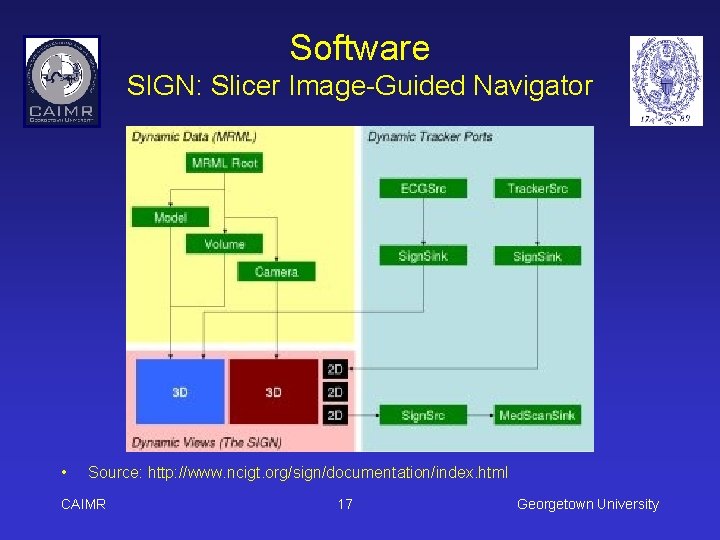
Software SIGN: Slicer Image-Guided Navigator • Source: http: //www. ncigt. org/sign/documentation/index. html CAIMR 17 Georgetown University
Trackers State of the Art • APIs are available – Optical trackers – Electromagnetic trackers • Software libraries are available – Open tracker • Can be easily integrated CAIMR 18 Georgetown University
Robots State of the Art • Situation is more complicated • No commercial robot for medical market exists with a defined API • Robotic systems tend to change clinical procedure more than image guidance • This is a challenge for the future CAIMR 19 Georgetown University
Image-Guided Systems Medtronic Stealthlink • Network interface • Allows data flow from image-guided system Stealthstation to your application in real-time • Provides an application program interface (API) • Contact: leslie. holton@medtronic. com CAIMR 20 Georgetown University
Image-Guided Systems Brainlab Vector. Vision Link • Network interface • Allows data flow • Provides an API – Based on VTK • Can create custom views and display on Vector. Vision workstation • Contact: robert. lucht@brainlab. com CAIMR 21 Georgetown University
Summary of Components • Components are becoming available • More standardization is needed • Analysis of clinical procedures would be useful to determine commonality (back to requirements definition) • Architecture and interfaces are key • This group could help! CAIMR 22 Georgetown University
Three challenges • Do a better job at defining the requirements – Image-guided systems can be complex – Should we define multiple types of systems based on difficult clinical requirements? – This should help define components and architecture • Providing a rationale to convince manufacturers that they should always provide an API (like DICOM is now standard for images) • Creating standards (can be difficult and time consuming) CAIMR 23 Georgetown University
How can NCIGT help? • By providing a forum where researchers can discuss these issues • By developing a testbed or prototype system that multiple researchers can contribute to • By developing an open architecture and modular components CAIMR 24 Georgetown University
Thank you for your attention! CAIMR 25 Georgetown University