
IGS ITRF Realization and Transformations R Ferland Jan

- Slides: 20
IGS ITRF Realization and Transformations R. Ferland Jan Kouba Geodetic Survey Div. NRCan Canada
Content • Realizations – IGS-ITRF 92, IGS-ITRF 93, IGS-ITRF 94 (13 stations) – IGS-ITRF 96 (47 stations) – IGS-ITRF 97 (51 stations) • IGS ITRF Transformations – ITRF-Geodetic Datum Transformation • IGS SINEX Combined Products – Quality control • Future developments
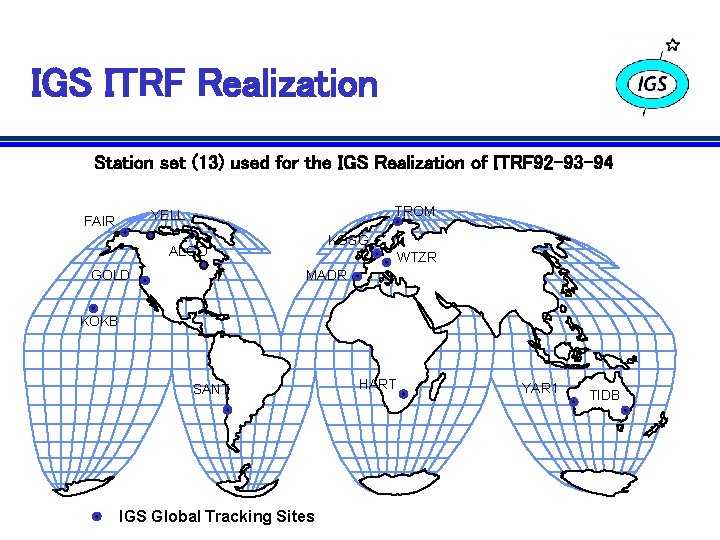
IGS ITRF Realization Station set (13) used for the IGS Realization of ITRF 92 -93 -94 TROM YELL FAIR KOSG ALGO GOLD WTZR MADR KOKB SANT IGS Global Tracking Sites HART YAR 1 TIDB
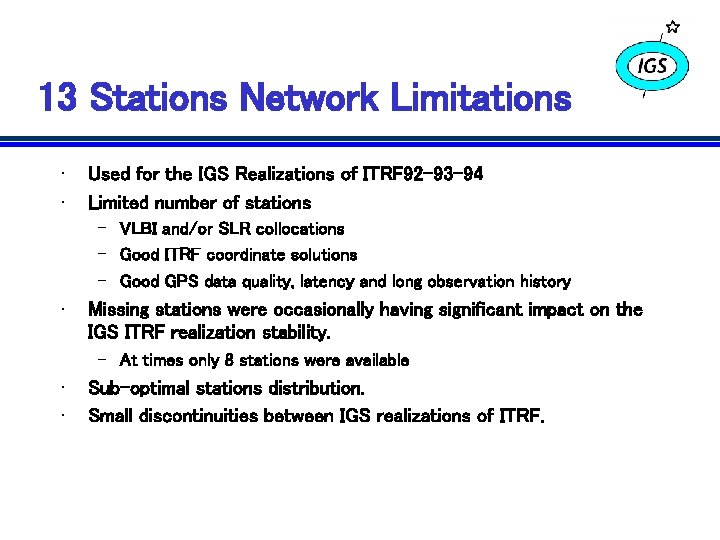
13 Stations Network Limitations • • Used for the IGS Realizations of ITRF 92 -93 -94 Limited number of stations – VLBI and/or SLR collocations – Good ITRF coordinate solutions – Good GPS data quality, latency and long observation history • Missing stations were occasionally having significant impact on the IGS ITRF realization stability. – At times only 8 stations were available • • Sub-optimal stations distribution. Small discontinuities between IGS realizations of ITRF.
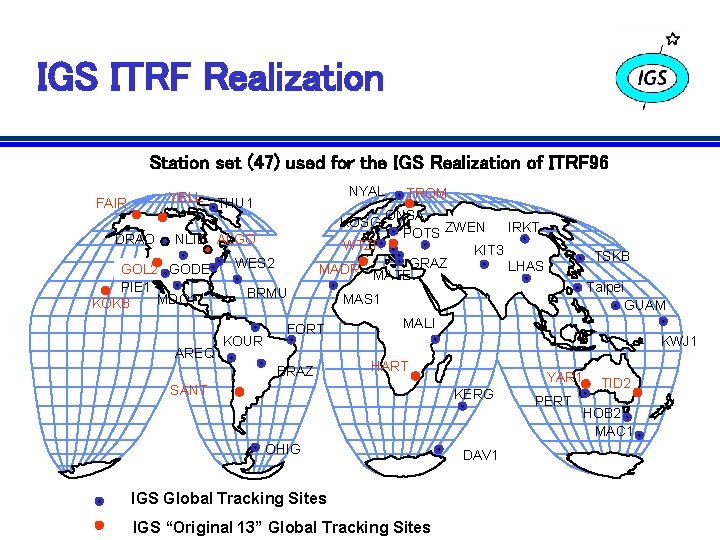
IGS ITRF Realization Station set (47) used for the IGS Realization of ITRF 96 NYAL YELL THU 1 FAIR TROM ONSA IRKT POTS ZWEN WTZR KIT 3 GRAZ LHAS MADR MATE KOSG DRAO NLIB ALGO GOL 2 GODE PIE 1 MDO 1 KOKB AREQ WES 2 BRMU KOUR FORT BRAZ TSKB Taipei GUAM MAS 1 MALI KWJ 1 HART SANT YAR 1 KERG OHIG IGS Global Tracking Sites IGS “Original 13” Global Tracking Sites DAV 1 PERT TID 2 HOB 2 MAC 1
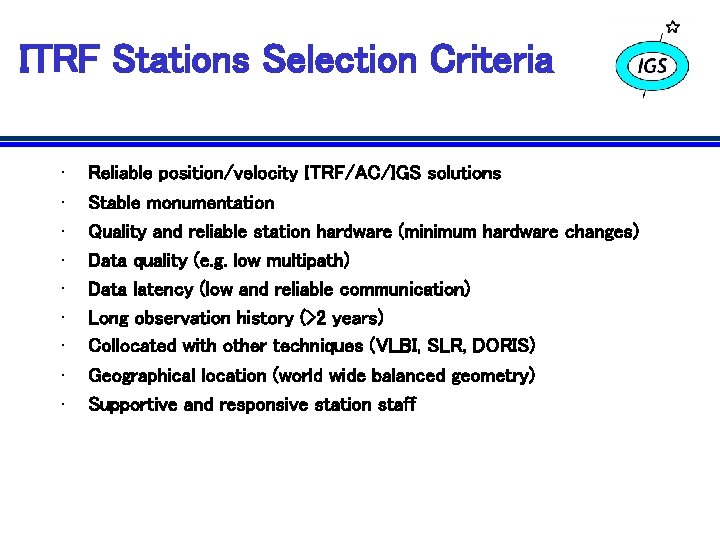
ITRF Stations Selection Criteria • • • Reliable position/velocity ITRF/AC/IGS solutions Stable monumentation Quality and reliable station hardware (minimum hardware changes) Data quality (e. g. low multipath) Data latency (low and reliable communication) Long observation history (>2 years) Collocated with other techniques (VLBI, SLR, DORIS) Geographical location (world wide balanced geometry) Supportive and responsive station staff
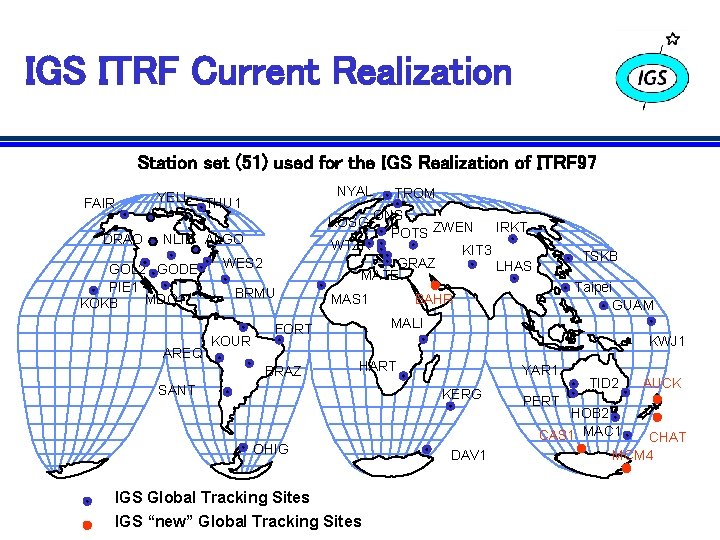
IGS ITRF Current Realization Station set (51) used for the IGS Realization of ITRF 97 FAIR NYAL YELL THU 1 TROM ONS IRKT POTS ZWEN WTZR KIT 3 GRAZ LHAS MATE KOSG DRAO NLIB ALGO GOL 2 GODE PIE 1 MDO 1 KOKB AREQ WES 2 BRMU KOUR MAS 1 Taipei GUAM BAHR MALI FORT BRAZ TSKB KWJ 1 HART SANT YAR 1 KERG OHIG IGS Global Tracking Sites IGS “new” Global Tracking Sites TID 2 PERT HOB 2 CAS 1 MAC 1 DAV 1 AUCK CHAT MCM 4
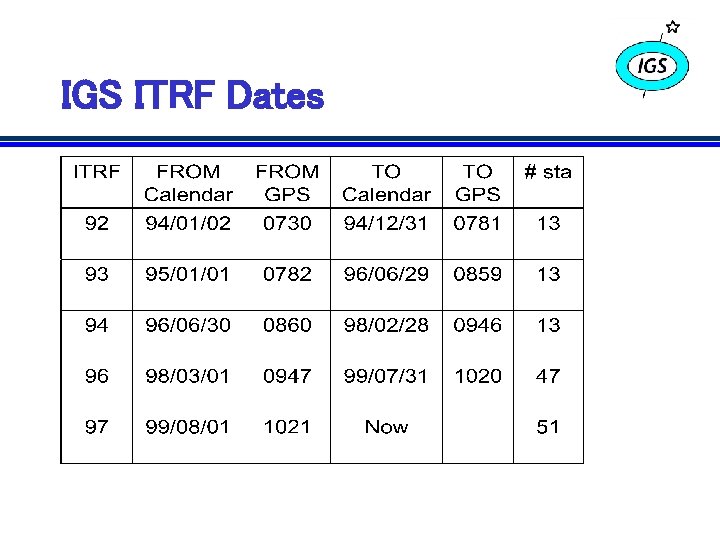
IGS ITRF Dates
IGS ITRF Realizations New ITRF 97 realization • Based on IGS SINEX Combined Solution – Cumulative combined SINEX solution over four years for the 51 ITRF 97 stations (a subset of the IGS 00 P 04. snx product) – Available from: ftp: //macs. geod. emr. ca/pub/requests/sinex/rfwg/ IGS 00 P 04_RS 51. snx • Used for IGS Final Orbits/ERP/clocks from Feb 27, 2000 ( from GPS Wk 1051; MJD 51601) – IGS Final Orbits/ERP/Clock production delay increased from 10 to 12 days – Improved IGS ITRF 97 realization/precision for the IGS Final orbits/ERP/clocks • • No noticeable changes to the IGS users (no transformation necessary, no noticeable steps!) See IGS Mail #2750 and #2751 for more details
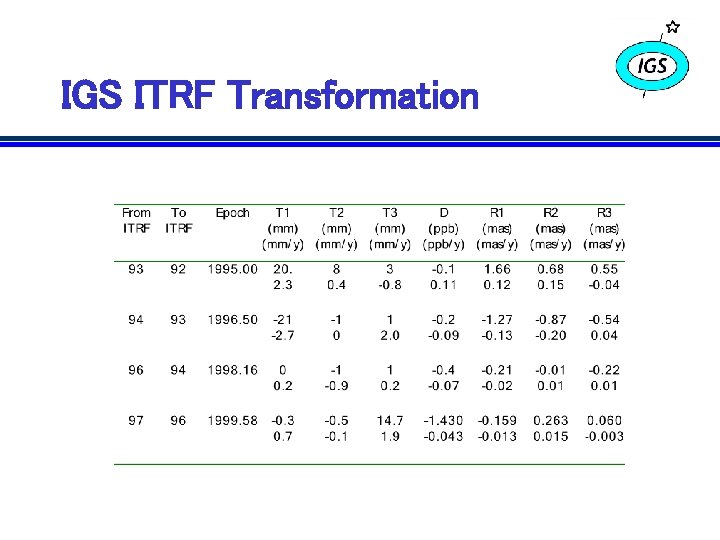
IGS ITRF Transformation
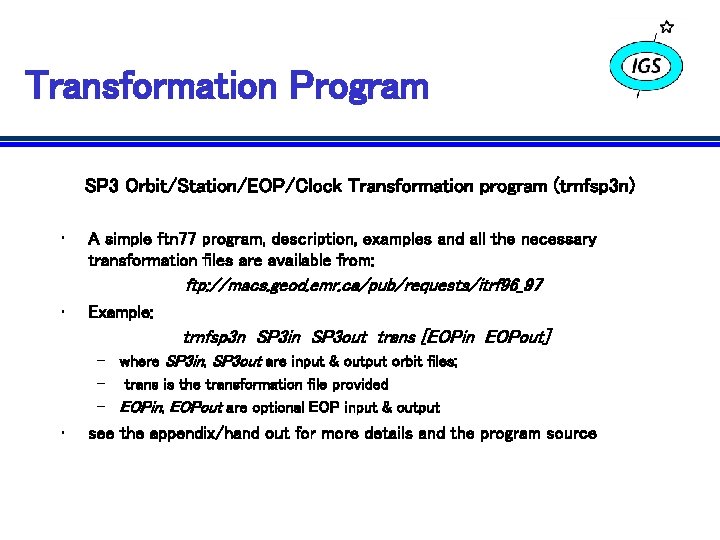
Transformation Program SP 3 Orbit/Station/EOP/Clock Transformation program (trnfsp 3 n) • A simple ftn 77 program, description, examples and all the necessary transformation files are available from: ftp: //macs. geod. emr. ca/pub/requests/itrf 96_97 • Example: trnfsp 3 n SP 3 in SP 3 out trans [EOPin EOPout] – where SP 3 in, SP 3 out are input & output orbit files; – trans is the transformation file provided – EOPin, EOPout are optional EOP input & output • see the appendix/hand out for more details and the program source
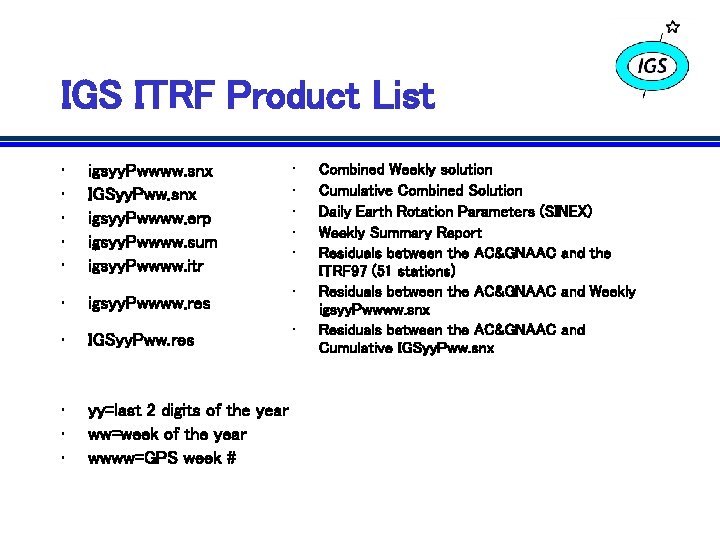
IGS ITRF Product List • • • igsyy. Pwwww. snx IGSyy. Pww. snx igsyy. Pwwww. erp igsyy. Pwwww. sum igsyy. Pwwww. itr • igsyy. Pwwww. res • IGSyy. Pww. res • • • yy=last 2 digits of the year ww=week of the year wwww=GPS week # • • Combined Weekly solution Cumulative Combined Solution Daily Earth Rotation Parameters (SINEX) Weekly Summary Report Residuals between the AC&GNAAC and the ITRF 97 (51 stations) Residuals between the AC&GNAAC and Weekly igsyy. Pwwww. snx Residuals between the AC&GNAAC and Cumulative IGSyy. Pww. snx
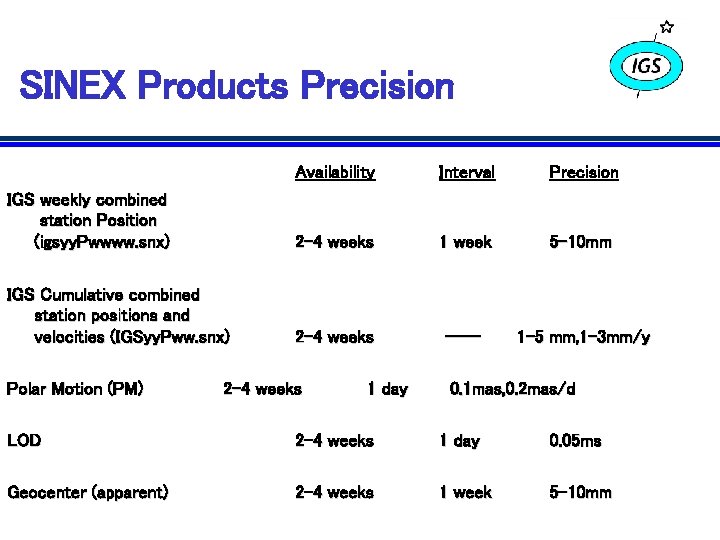
SINEX Products Precision Availability Interval Precision IGS weekly combined station Position (igsyy. Pwwww. snx) 2 -4 weeks 1 week 5 -10 mm IGS Cumulative combined station positions and velocities (IGSyy. Pww. snx) 2 -4 weeks ---- 1 -5 mm, 1 -3 mm/y Polar Motion (PM) 2 -4 weeks 1 day 0. 1 mas, 0. 2 mas/d LOD 2 -4 weeks 1 day 0. 05 ms Geocenter (apparent) 2 -4 weeks 1 week 5 -10 mm
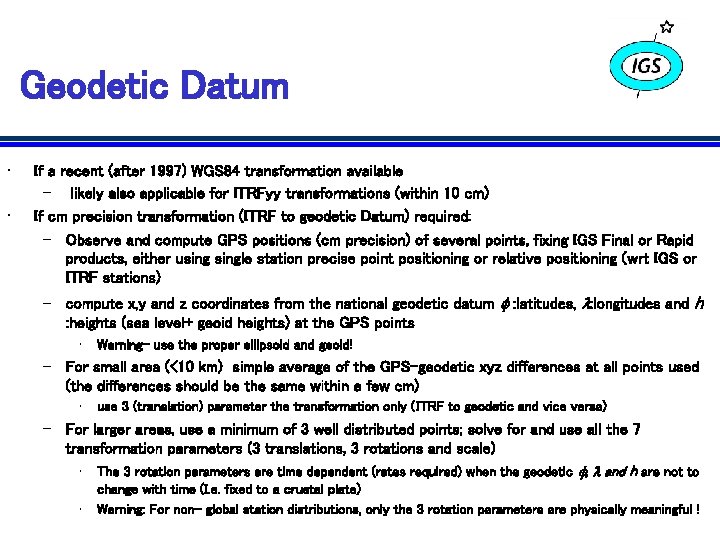
Geodetic Datum • • If a recent (after 1997) WGS 84 transformation available – likely also applicable for ITRFyy transformations (within 10 cm) If cm precision transformation (ITRF to geodetic Datum) required: – Observe and compute GPS positions (cm precision) of several points, fixing IGS Final or Rapid products, either usingle station precise point positioning or relative positioning (wrt IGS or ITRF stations) – compute x, y and z coordinates from the national geodetic datum : latitudes, : longitudes and h : heights (sea level+ geoid heights) at the GPS points • Warning- use the proper ellipsoid and geoid! – For small area (<10 km) simple average of the GPS-geodetic xyz differences at all points used (the differences should be the same within a few cm) • use 3 (translation) parameter the transformation only (ITRF to geodetic and vice versa) – For larger areas, use a minimum of 3 well distributed points; solve for and use all the 7 transformation parameters (3 translations, 3 rotations and scale) • The 3 rotation parameters are time dependent (rates required) when the geodetic , and h are not to • change with time (I. e. fixed to a crustal plate) Warning: For non- global station distributions, only the 3 rotation parameters are physically meaningful !
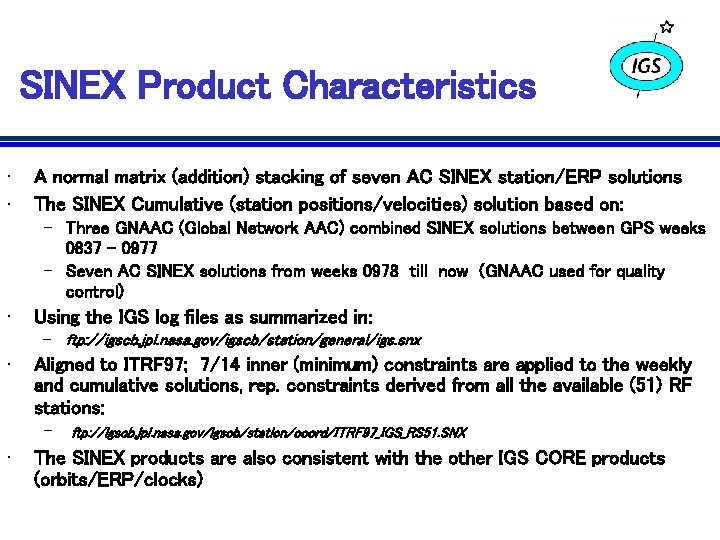
SINEX Product Characteristics • • A normal matrix (addition) stacking of seven AC SINEX station/ERP solutions The SINEX Cumulative (station positions/velocities) solution based on: – Three GNAAC (Global Network AAC) combined SINEX solutions between GPS weeks 0837 - 0977 – Seven AC SINEX solutions from weeks 0978 till now (GNAAC used for quality control) • Using the IGS log files as summarized in: – ftp: //igscb. jpl. nasa. gov/igscb/station/general/igs. snx • Aligned to ITRF 97; 7/14 inner (minimum) constraints are applied to the weekly and cumulative solutions, rep. constraints derived from all the available (51) RF stations: – • ftp: //igscb. jpl. nasa. gov/igscb/station/coord/ITRF 97_IGS_RS 51. SNX The SINEX products are also consistent with the other IGS CORE products (orbits/ERP/clocks)
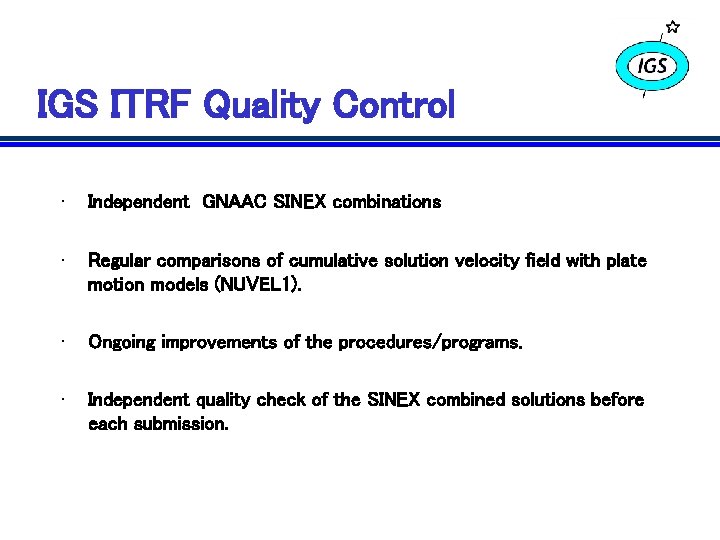
IGS ITRF Quality Control • Independent GNAAC SINEX combinations • Regular comparisons of cumulative solution velocity field with plate motion models (NUVEL 1). • Ongoing improvements of the procedures/programs. • Independent quality check of the SINEX combined solutions before each submission.
Future Developments • The IGS SINEX station/ERP combined solutions have become official since February 20, 2000 • Reprocessing of GPS weeks 0837 - 0977 (underway); Possible addition of older weekly solutions • Plate motion monitoring (not included in the IGS sum report yet) • IGS Station Polyhedron Combination (back substitution of regional solutions) for up to 200 -250 stations
QUESTIONS? Remi Ferland or Jan Kouba Geodetic Survey Division Natural Resources Canada (NRCan) 615 Booth Street Ottawa, Canada K 1 A OE 9 ferland@geod. nrcan. gc. ca kouba@geod. emr. ca
Web Address for IGSCB http: //igscb. jpl. nasa. gov