
Igor Budak LESS FORMAL TOOLS FOR ENVIRONMENTAL MANAGEMENT
Igor Budak LESS FORMAL TOOLS FOR ENVIRONMENTAL MANAGEMENT TEMPUS DEREL seminar in Novi Sad, May 30 -31, 2013
Content ØIntroduction ØEnvironmental labeling of products ØLife Cycle Assessment ØEco-design 2
Introduction The Environmental Management System (EMS) is one of the most used management tools for different types of organizations because it enables the integration of environmental protection in all activities of an organization. Experiences of small and medium-sized enterprises have shown that the introduction of EMS is a complex process, and also demanding administratively in terms of human resources, as well as from the standpoint of consulting services, which discourages its use in small organizations. For this reason, a range of other voluntary tools for the environmental improvement used in various countries and organizations in the world has been developed. These less formal tools are applied in specific circumstances, on the basis of decision within the organization or in some case in the industrial sector, or jointly with local, regional or state government.
Introduction Less formal tools (LFT) of environmental management are adapted to local conditions, and perhaps that is the reason for their efficiency. LFT can be the first step of the formal introduction of EMS. Also, LFT can be used as an effective extension of the existing EMS, for permanent environmental improvement. Some of the best known and most widely used less formal tools are: üLCA - Life Cycle Assessment, üEnvironmental Labelling of Products, üEco-design, üGreen Public Procurement, üEnvironmental Performance Evaluation, üSocial responsibility of an organization, üEnergy efficiency, üCleaner production, üEnvironmental benchmarking, üEnvironmental accounting, üetc.
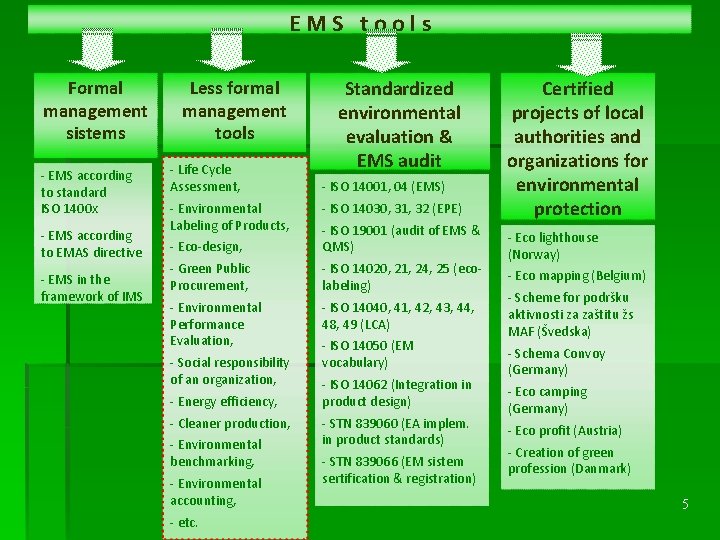
EMS tools Formal management sistems - EMS according to standard ISO 1400 x - EMS according to EMAS directive - EMS in the framework of IMS Less formal management tools - Life Cycle Assessment, - Environmental Labeling of Products, Standardized environmental evaluation & EMS audit - ISO 14001, 04 (EMS) - ISO 14030, 31, 32 (EPE) - Eco-design, - ISO 19001 (audit of EMS & QMS) - Green Public Procurement, - ISO 14020, 21, 24, 25 (ecolabeling) - Environmental Performance Evaluation, - ISO 14040, 41, 42, 43, 44, 48, 49 (LCA) - Social responsibility of an organization, - Energy efficiency, - Cleaner production, - Environmental benchmarking, - Environmental accounting, - etc. - ISO 14050 (EM vocabulary) - ISO 14062 (Integration in product design) - STN 839060 (EA implem. in product standards) - STN 839066 (EM sistem sertification & registration) Certified projects of local authorities and organizations for environmental protection - Eco lighthouse (Norway) - Eco mapping (Belgium) - Scheme for podršku aktivnosti za zaštitu žs MAF (Švedska) - Schema Convoy (Germany) - Eco camping (Germany) - Eco profit (Austria) - Creation of green profession (Danmark) 5
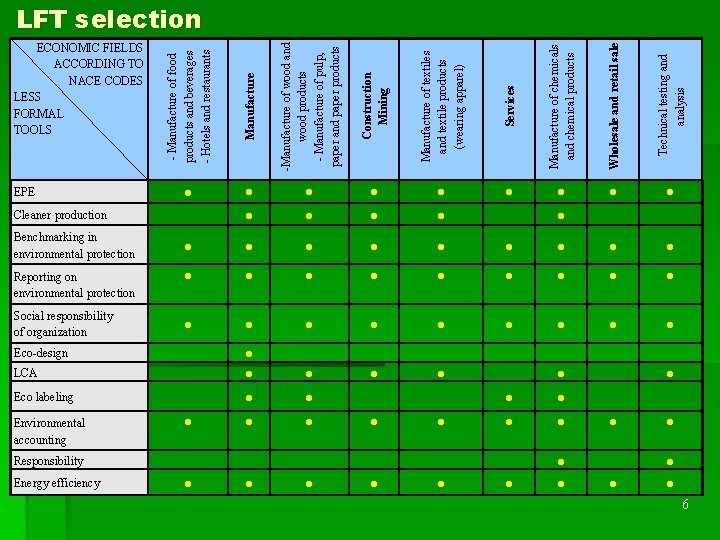
LFT selection Construction Mining Manufacture of textiles and textile products (wearing apparel) Services ● ● ● ● ● ● LCA ● ● ● Eco labeling ● ● Cleaner production Benchmarking in environmental protection Reporting on environmental protection Social responsibility of organization Eco-design Environmental accounting ● ● ● Technical testing and analysis -Manufacture of wood and wood products - Manufacture of pulp, paper and paper products ● Wholesale and retail sale Manufacture ● EPE Manufacture of chemicals and chemical products - Manufacture of food products and beverages - Hotels and restaurants ECONOMIC FIELDS ACCORDING TO NACE CODES LESS FORMAL TOOLS ● ● ● ● ● ● Responsibility Energy efficiency ● ● ● 6
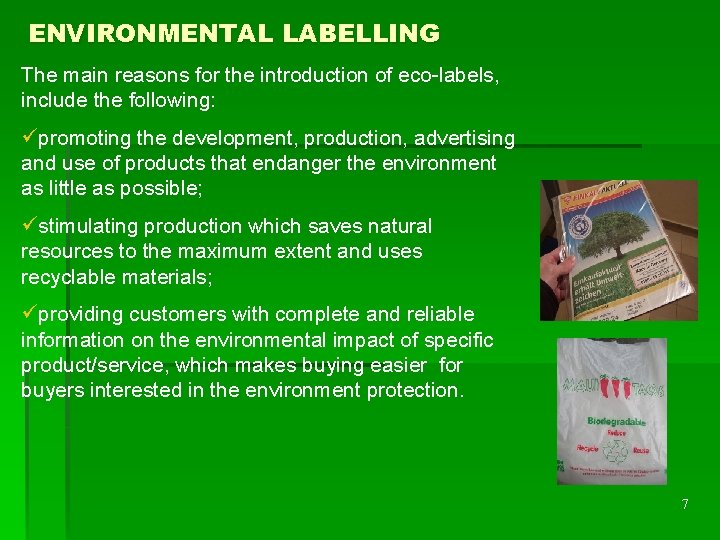
ENVIRONMENTAL LABELLING The main reasons for the introduction of eco-labels, include the following: üpromoting the development, production, advertising and use of products that endanger the environment as little as possible; üstimulating production which saves natural resources to the maximum extent and uses recyclable materials; üproviding customers with complete and reliable information on the environmental impact of specific product/service, which makes buying easier for buyers interested in the environment protection. 7
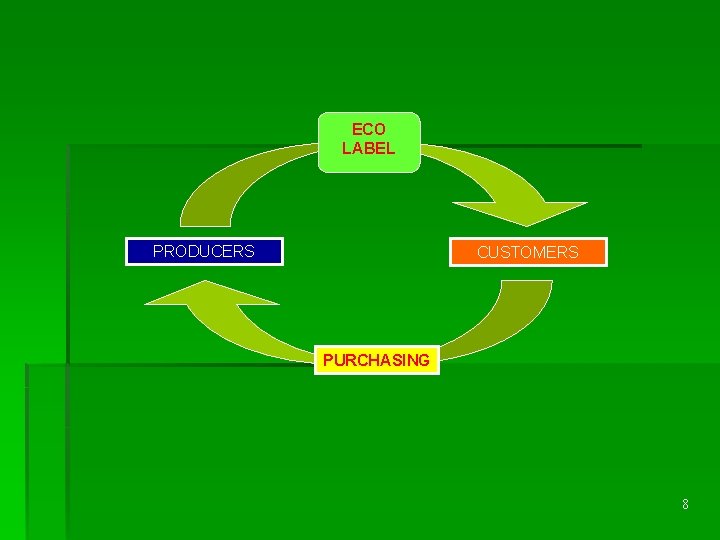
ECO LABEL PRODUCERS CUSTOMERS PURCHASING 8
ECO LABELS AND ISO STANDARDS Emergence of a large number of eco-labels, as well as the problems with their implementation, have led to a series of activities run by the International Organization for Standardization – ISO, to determine and define the firm concepts, parameters, guidelines and terminology related to the environmental labeling at the international level. The result is a series of standards ISO 14020 (in Republic of Serbia SRPS ISO 14020), which currently includes standards ISO 14020, ISO 14021, ISO 14024 and ISO 14025. This series of standards is the first published document that refers to the environmental labeling, and it was published in 1998. 9
ECO LABELS AND ISO STANDARDS Documents belonging to ISO 14020 series require, among other things, that environmental labels must: üresult in better environmental management, übe applicable in all countries, ürepresent the interests of consumers, übe scientifically based, ütake into account the product life cycle, übe accurate, verifiable and relevant to the product in question, ümust not create difficulties when exporting and übe practical and usable. 10
BASIC PRINCIPLES OF ECO LABELING ISO 14020 promotes 9 principles that should apply to all eco labels and declarations: 1. – Environmental labels and declarations must be accurate, verifiable and relevant, and should not be confusing. 2. - The procedures and requirements for environmental labels and declarations must not be prepared, adopted or applied without previous adjustment to the international market. 3. - Environmental labels and declarations must be based on scientific methodology, which is complete and comprehensive to the extent to which it supports the claims and gives results that are accurate and repeatable. 4. - Information on the procedures, methodology and any criteria for support of environmental labels and declarations must be available and accessible to all interested parties. 5. - When creating environmental labels and declarations all relevant aspects of the product life cycle must be considered. 11
BASIC PRINCIPLES OF ECO LABELING 6. - Environmental labels and declarations should not hinder innovation that could maintain or enhance environmental effect. 7. - Any administrative requirements or requirements for information on environmental labels and declarations must be limited to those necessary to establish compliance with applied criteria and standards for labels and declarations. 8. - The process of developing environmental labels and declarations should be open to consultation with interested parties. One must invest certain effort to reach the consensus in this process. 9. - Information on the environmental aspects of products or services relevant to the labels or declarations must be available to buyers and potential buyers by the subject who formed the label or declaration. 12
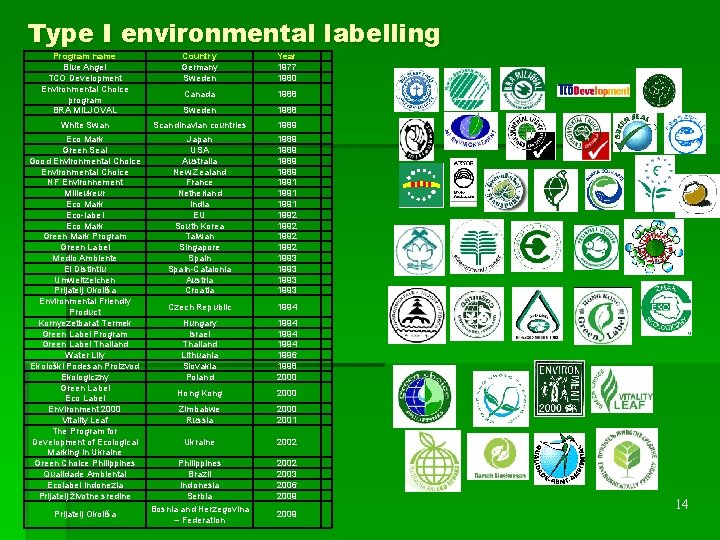
Environmental labels classification There a number of different approaches to environmental labelling. Within the ISO 14020 series of standards, so far, apart from the standard ISO 14020, standards ISO 14021, ISO 14024 and ISO 14025 were prepared, within which three types of environmental labelling were defined: • Type I - Voluntary, based on a multiple criteria third-party program, under which a license is granted which authorizes the use of the environmental labels for products, which confirms the overall fitness for the environment within certain product category, and which is based on the life cycle assessment. • Type II - Self-declaration by environmental claims - refers to the environmental labelling performed without an independent third party certification, by manufacturers, importers, distributors, retailers or anyone else who benefits from such claim. • Type III - Voluntary labelling programs based on quantifiable data about the product life cycle from the environmental aspect, provided by the manufacturer, independently verified (e. g. , by a third party) and presented as a series of categorized parameters within the sectored 13 groups.
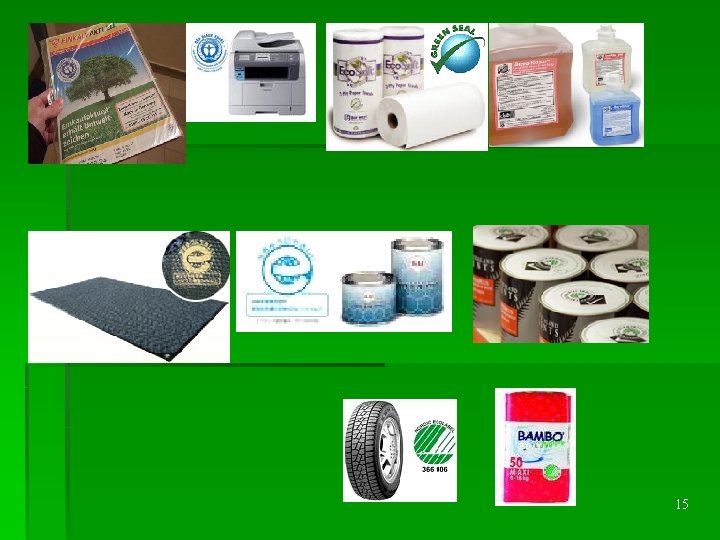
Type I environmental labelling Program name Blue Angel TCO Development Environmental Choice program BRA MILJOVAL Country Germany Sweden Year 1977 1980 Canada 1988 Sweden 1988 White Swan Scandinavian countries 1989 Eco Mark Green Seal Good Environmental Choice NF Environnement Milieukeur Eco Mark Eco-label Eco Mark Green Mark Program Green Label Medio Ambiente El Distintiu Umweltzeichen Prijatelj Okoliša Environmental Friendly Product Kornyezetbarat Termek Green Label Program Green Label Thailand Water Lily Ekološki Podesan Proizvod Ekologiczny Green Label Eco Label Environment 2000 Vitality Leaf The Program for Development of Ecological Marking in Ukraine Green Choice Philippines Qualidade Ambiental Ecolabel Indonezia Prijatelj životne sredine Japan USA Australia New Zealand France Netherland India EU South Korea Taiwan Singapore Spain-Catalonia Austria Croatia 1989 1991 1992 1993 Czech Republic 1994 Hungary Israel Thailand Lithuania Slovakia Poland 1994 1996 1998 2000 Hong Kong 2000 Zimbabwe Russia 2000 2001 Ukraine 2002 Philippines Brazil Indonesia Serbia Bosnia and Herzegovina – Federation 2002 2003 2006 2009 Prijatelj Okoliša 2009 14
15
16
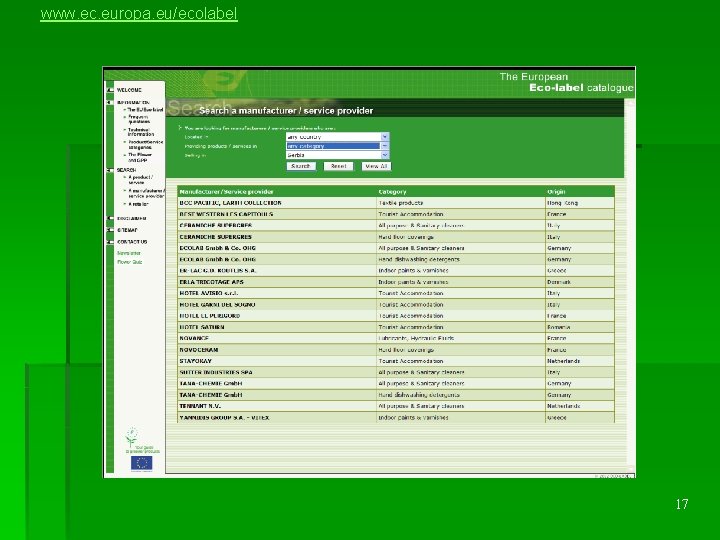
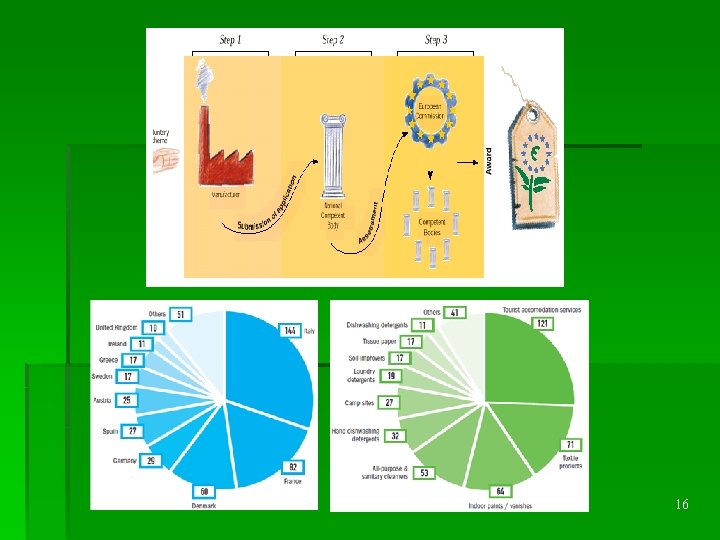
www. ec. europa. eu/ecolabel 17
Type II environmental labelling An important phase of editing this area of environmental labelling is the development of International Standard ISO 14021 - Environmental labels and declarations - Self-declared environmental claims (Type II environmental labelling), first published in 1999. According to this standard, self-declared environmental claims include the statements, labels or symbols relating a particular activity, product or service of manufacturers, which may impact the environment. This is a special type of advertising. They are placed on the product or product packaging, the accompanying product documentation, technical audit, or are referred to in advertisements in printed or electronic media such as TV and Internet. They are issued by the manufacturer, importer, distributor, dealer, or anyone who might benefit from such an announcement, but without certification by an independent third party, which is one of the main differences compared to type I. 18
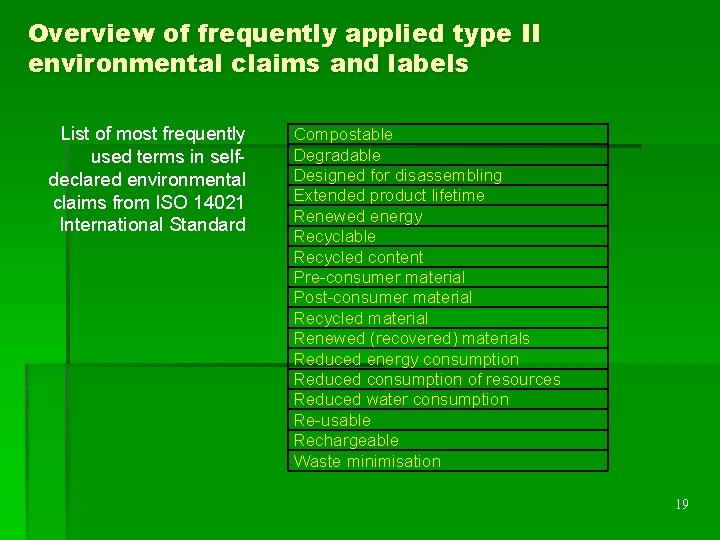
Overview of frequently applied type II environmental claims and labels List of most frequently used terms in selfdeclared environmental claims from ISO 14021 International Standard Compostable Degradable Designed for disassembling Extended product lifetime Renewed energy Recyclable Recycled content Pre-consumer material Post-consumer material Recycled material Renewed (recovered) materials Reduced energy consumption Reduced consumption of resources Reduced water consumption Re-usable Rechargeable Waste minimisation 19
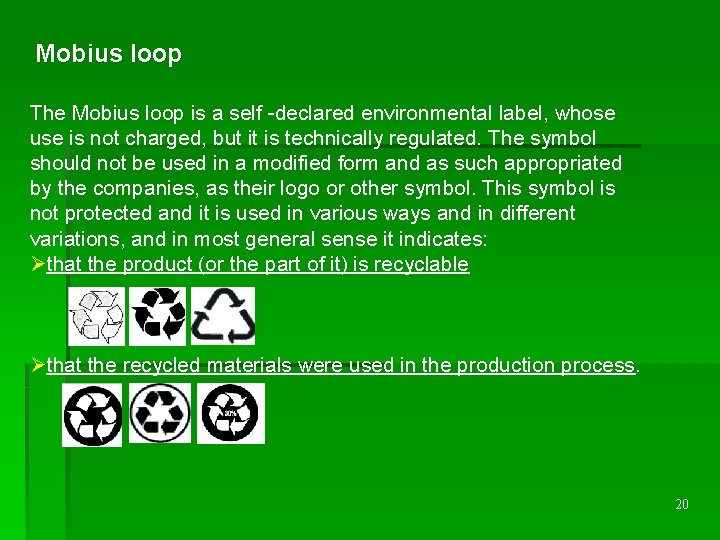
Mobius loop The Mobius loop is a self -declared environmental label, whose use is not charged, but it is technically regulated. The symbol should not be used in a modified form and as such appropriated by the companies, as their logo or other symbol. This symbol is not protected and it is used in various ways and in different variations, and in most general sense it indicates: Øthat the product (or the part of it) is recyclable Øthat the recycled materials were used in the production process. 20
Self-created self-declared labels Bearing in mind the importance of the environmental declaration in the global market, it is not surprising that an increasing number of companies their commitment towards caring for the environment are manifesting through different logos. 21
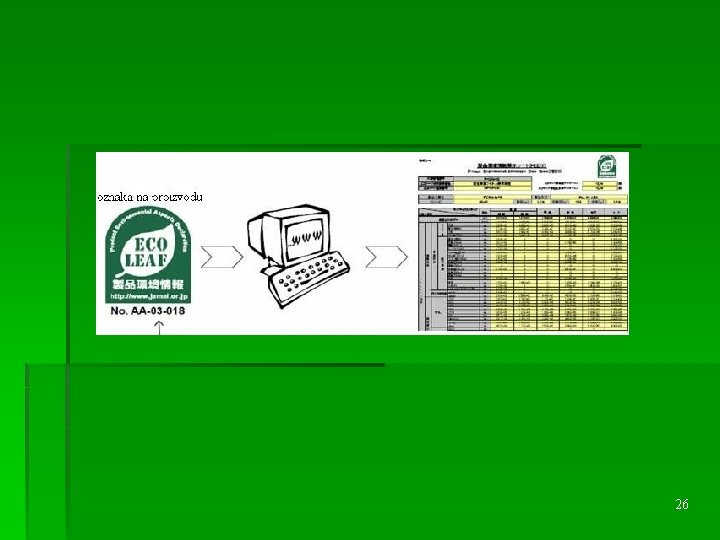
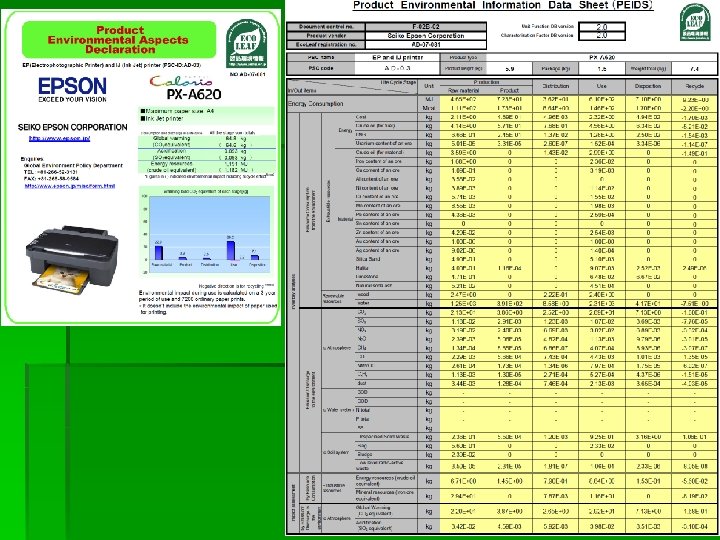
Type III environmental labelling An important ISO standards development stage related to environmental labelling is determining ISO 14025 in 2000, which defined type III environmental declaration as quantified environmental data for a product, with pre-determined parameters, based on the ISO 14040 series of standards, not excluding the additional environmental data that are in accordance with type III environmental declaration. Therefore, type III environmental labelling should provide quantified environmental information based on life cycle assessment (LCA) and pre -set categories of parameters set by a qualified third party and verified by the same or another qualified third party. The goal is to ensure communication of quantified and verifiable environmental information about the product, including the entire life cycle. 22
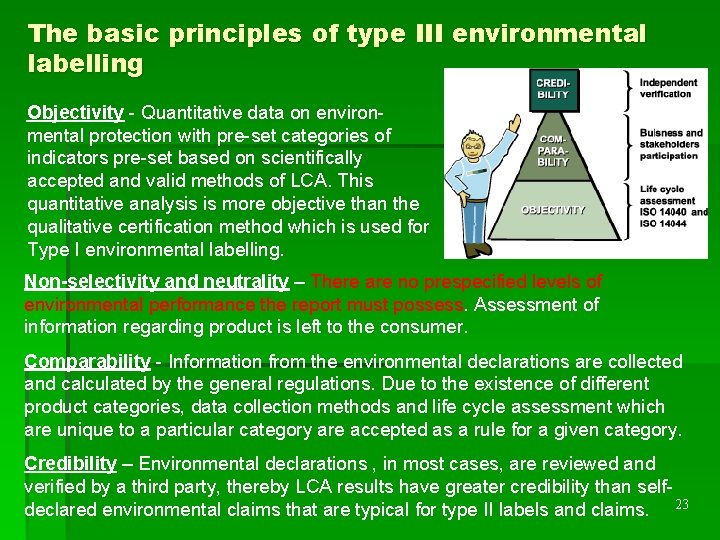
The basic principles of type III environmental labelling Objectivity - Quantitative data on environmental protection with pre-set categories of indicators pre-set based on scientifically accepted and valid methods of LCA. This quantitative analysis is more objective than the qualitative certification method which is used for Type I environmental labelling. Non-selectivity and neutrality – There are no prespecified levels of environmental performance the report must possess. Assessment of information regarding product is left to the consumer. Comparability - Information from the environmental declarations are collected and calculated by the general regulations. Due to the existence of different product categories, data collection methods and life cycle assessment which are unique to a particular category are accepted as a rule for a given category. Credibility – Environmental declarations , in most cases, are reviewed and verified by a third party, thereby LCA results have greater credibility than selfdeclared environmental claims that are typical for type II labels and claims. 23
The procedures for type III environmental labelling 1. Establishing product evaluating methods; 2. Organizing committees – which should ensure transparent monitoring and participation in consultations with stakeholders; 3. Establishing product category rules (PCR) with committees; 4. Establishing and maintaining a database of LCA parameters; 5. Managing the process of verification - LCA results followed by product evaluation applicants have been reviewed by auditors who are bound by contract or directly employed by the administrator; 6. Control of the product registration status - the administrator has also the responsibility of determining the period after which the product registration expires; 7. Managing the program website - the Internet is a very important tool for advertising environmental product declarations; 8. Program improvement and education of consumers and applicants - income is the main motive for companies to participate, and the administrator should try to reinforce that motivation emphasizing the growing environmental awareness of consumers and educating consumers on how to find and use information about the declarations; 9. Cooperation with other type III programs - GEDnet. 24
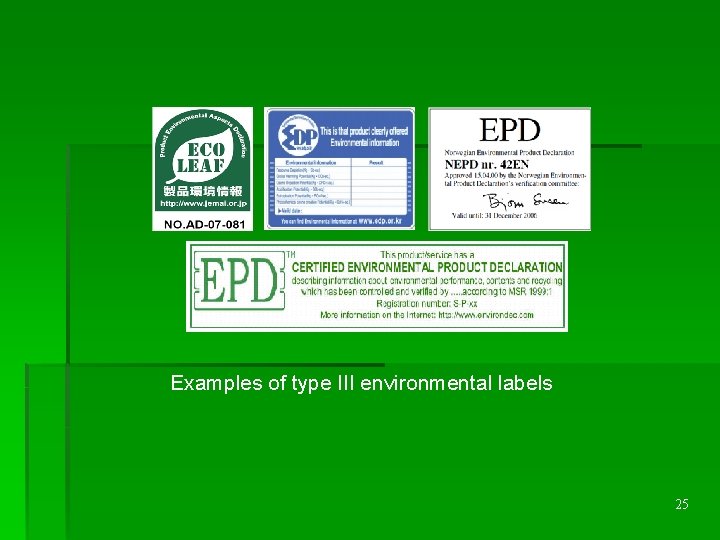
Examples of type III environmental labels 25
26
27
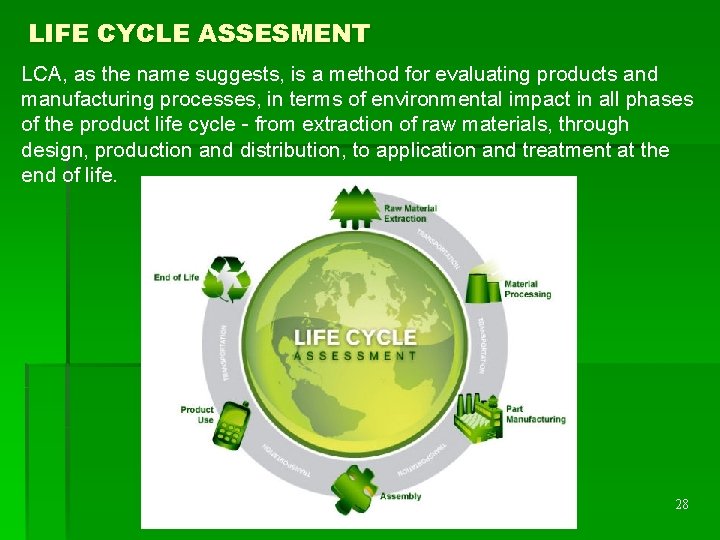
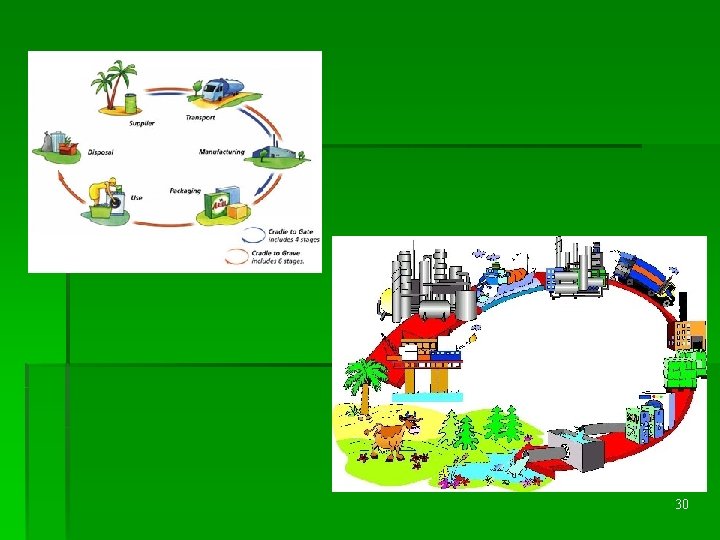
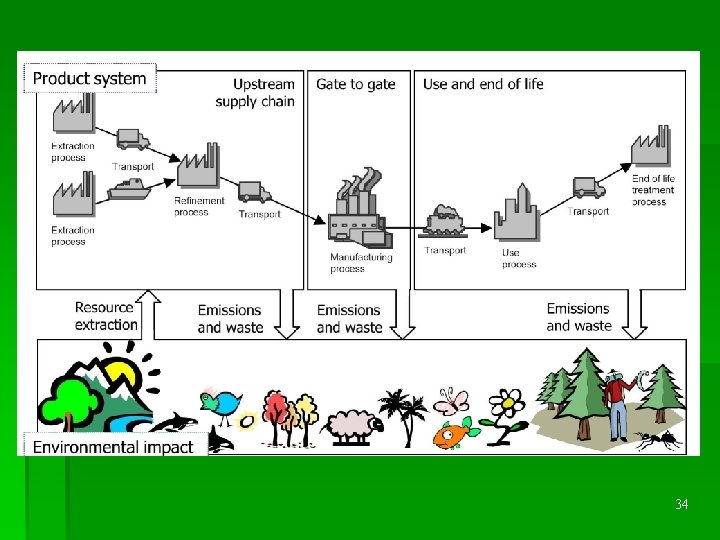
LIFE CYCLE ASSESMENT LCA, as the name suggests, is a method for evaluating products and manufacturing processes, in terms of environmental impact in all phases of the product life cycle - from extraction of raw materials, through design, production and distribution, to application and treatment at the end of life. 28
Fields of LCA application üAnalysis of possibilities to improve environmental effects of products in various stages of their life cycle; üThe decision making process in industry, government institutions and NGOs, either at the strategic level, or the current (daily) level related to planning, setting of priorities, designing and manufacturing; üIn the process of identification of significant indicators of the environmental protection efficiency; üLCA is an essential tool in the evaluation of the product in environmental labelling programs and the creating environmental statements and declarations of products; üApplication of LCA in the development of new and/or redesign of existing products (or product systems) allows the integration of environmental aspects into the design process in accordance with ISO/TR 14062. 29
30
Historical development of LCA beginnings date back to the 60 s of the 20 th century. Before 1990, this method was developed and applied mostly in unorganized manner - different actors (institutional and industrial) have applied various methods for data search, which were then expressed in different, often incompatible units. The year 1990 can be considered, due to the SETAC conference (Society of Environmental Toxicology and Chemistry), when a differently performed and until then, incomparable analysis were methodologically unified. At the next SETAC conference in 1992, the process of further harmonization of LCA methodology was carried out and, in 1997 the roof LCA standard ISO 14040 was published, and served as a base on which other standards in this group were further developed and published. In the period between 1997 and 2002, there has been intensive development of LCIA methods, and consequently, after 2002 intensified 31 development of databases to support the LCIA methods.
LCA and ISO International Standards Development of the ISO series of International Standards listed here significantly contributed to more harmonized and organized application of LCA method. International label ISO 14040: 1997 Label in R. of Serbia Name SRPS ISO 14040: 2000 Environmental management Life cycle assessment Principles and framework Status Withdrawn ISO 14041: 1998 SRPS ISO 14041: 2002 Environmental management Life cycle assessment - Goal and scope definition and inventory analysis Withdrawn ISO 14042: 2000 SRPS ISO 14042: 2005 Environmental management Life cycle assessment - Life cycle impact assessment Withdrawn ISO 14042: 2000 SRPS ISO 14043: 2005 Environmental management Life cycle assessment – Life cycle interpretation Withdrawn ISO/TR 14047: 2003 / Environmental management Life cycle impact assessment Examples of application of ISO 14042 Active ISO/TS 14048: 2002 SRPS ISO/TS 14048: 2006 Environmental management Life cycle assessment - Data documentation format Active ISO/TR 14049: 2000 SRPS ISO/TR 14049: 2005 Environmental management Life cycle assessment Examples of application of ISO 14041 to goal and scope definition and inventory analysis Active ISO 14040: 2006 SRPS ISO 14040: 2008 Environmental management Life cycle assessment Principles and framework Active ISO 14044: 2006 SRPS ISO 14044: 2009 Environmental management Life cycle assessment Requirements and guidelines Active 32
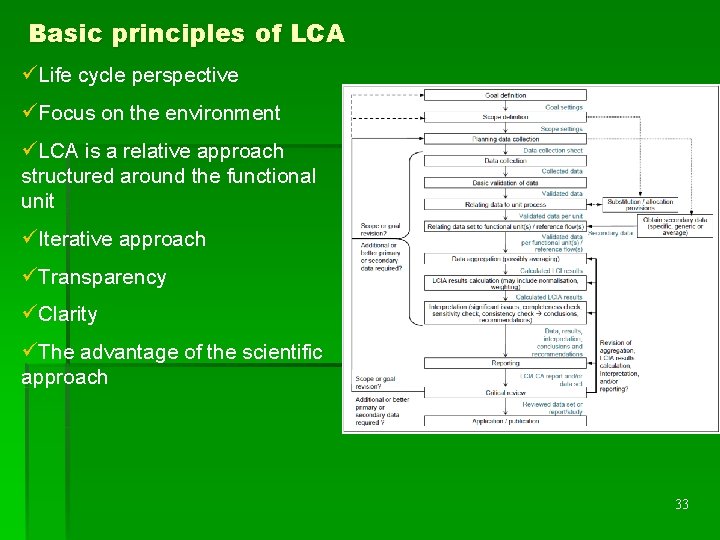
Basic principles of LCA üLife cycle perspective üFocus on the environment üLCA is a relative approach structured around the functional unit üIterative approach üTransparency üClarity üThe advantage of the scientific approach 33
34
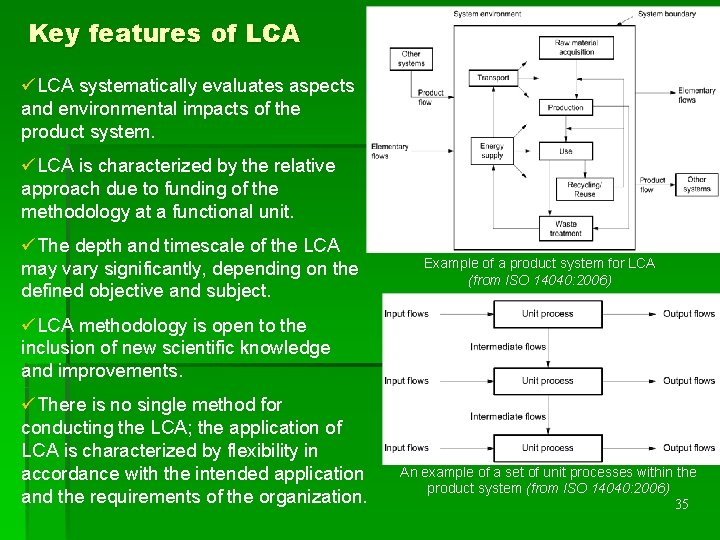
Key features of LCA üLCA systematically evaluates aspects and environmental impacts of the product system. üLCA is characterized by the relative approach due to funding of the methodology at a functional unit. üThe depth and timescale of the LCA may vary significantly, depending on the defined objective and subject. Example of a product system for LCA (from ISO 14040: 2006) üLCA methodology is open to the inclusion of new scientific knowledge and improvements. üThere is no single method for conducting the LCA; the application of LCA is characterized by flexibility in accordance with the intended application and the requirements of the organization. An example of a set of unit processes within the product system (from ISO 14040: 2006) 35
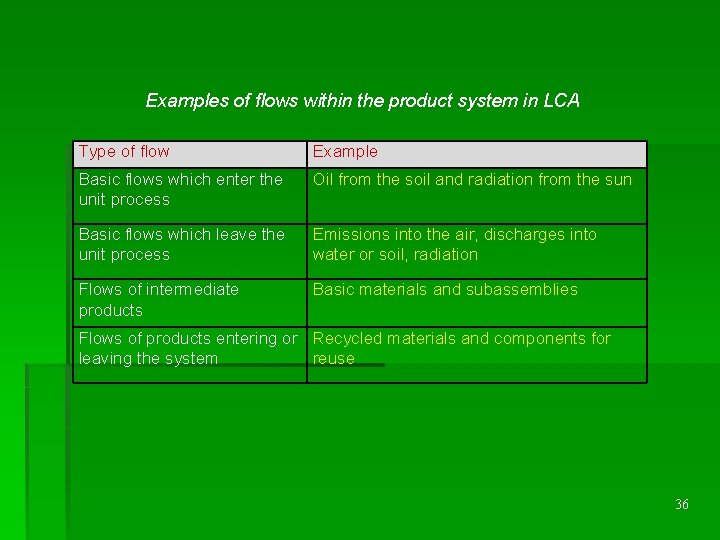
Examples of flows within the product system in LCA Type of flow Example Basic flows which enter the unit process Oil from the soil and radiation from the sun Basic flows which leave the unit process Emissions into the air, discharges into water or soil, radiation Flows of intermediate products Basic materials and subassemblies Flows of products entering or Recycled materials and components for leaving the system reuse 36
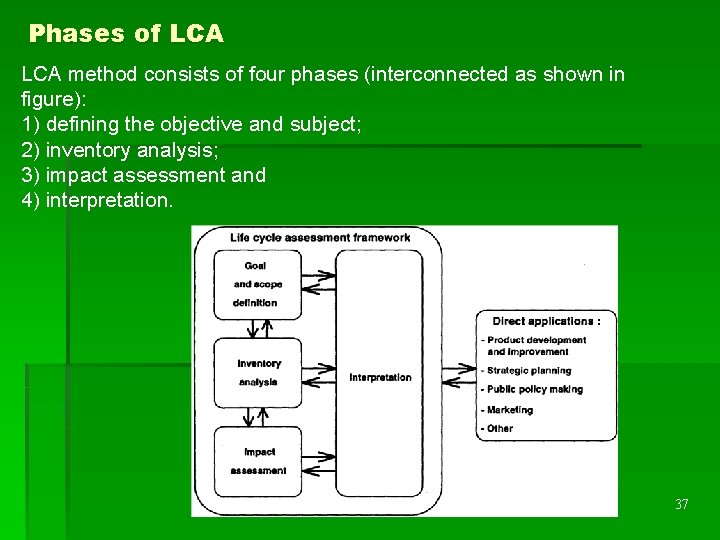
Phases of LCA method consists of four phases (interconnected as shown in figure): 1) defining the objective and subject; 2) inventory analysis; 3) impact assessment and 4) interpretation. 37
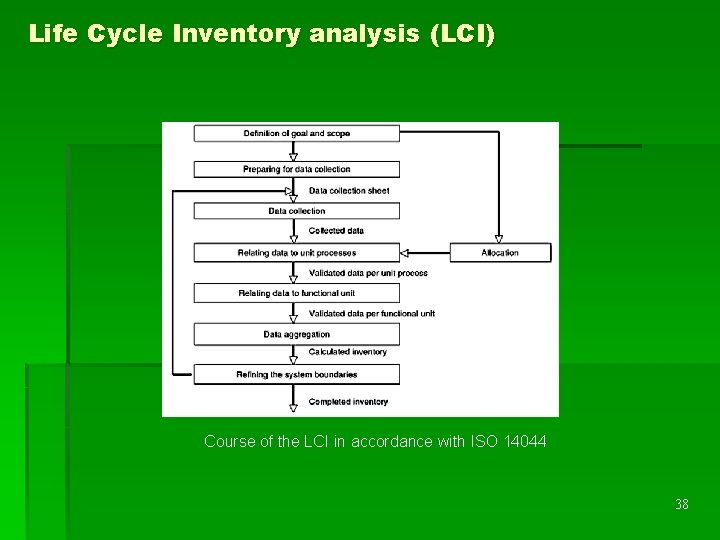
Life Cycle Inventory analysis (LCI) Course of the LCI in accordance with ISO 14044 38
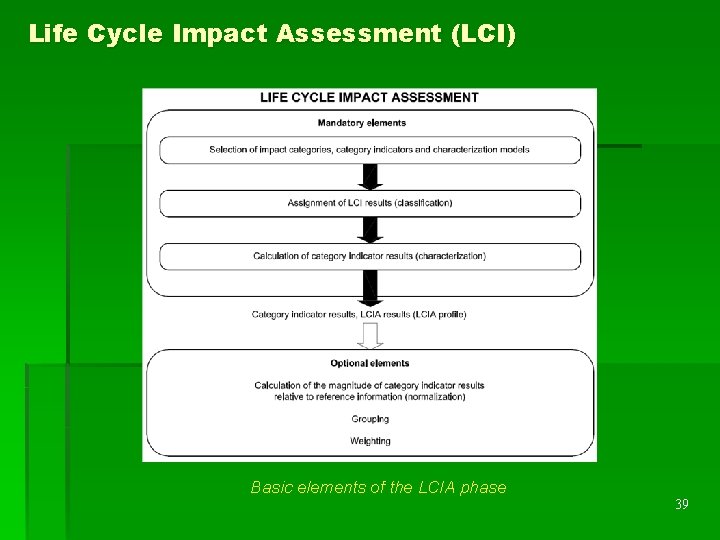
Life Cycle Impact Assessment (LCI) Basic elements of the LCIA phase 39
40
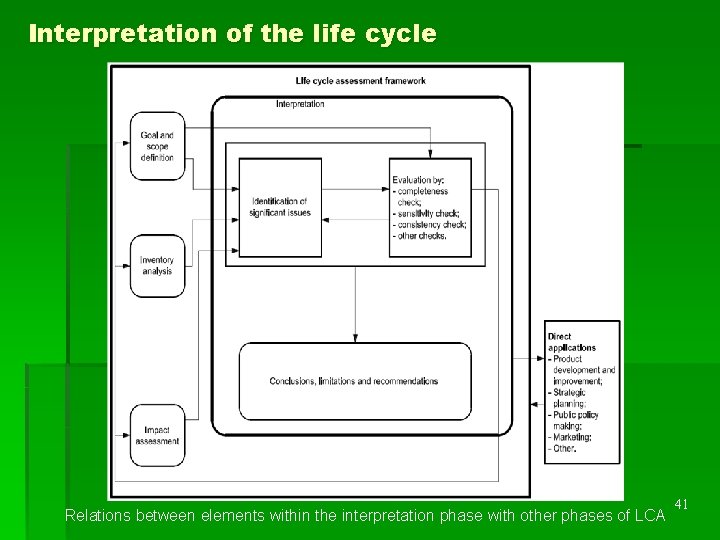
Interpretation of the life cycle Relations between elements within the interpretation phase with other phases of LCA 41
42
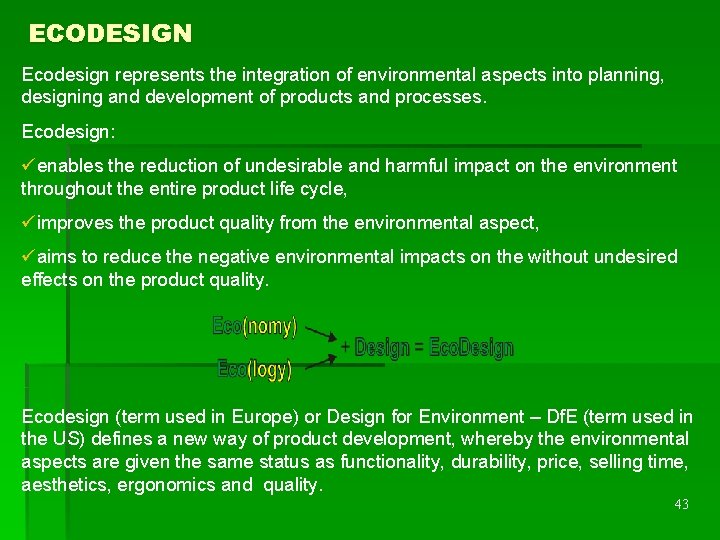
ECODESIGN Ecodesign represents the integration of environmental aspects into planning, designing and development of products and processes. Ecodesign: üenables the reduction of undesirable and harmful impact on the environment throughout the entire product life cycle, üimproves the product quality from the environmental aspect, üaims to reduce the negative environmental impacts on the without undesired effects on the product quality. Ecodesign (term used in Europe) or Design for Environment – Df. E (term used in the US) defines a new way of product development, whereby the environmental aspects are given the same status as functionality, durability, price, selling time, aesthetics, ergonomics and quality. 43
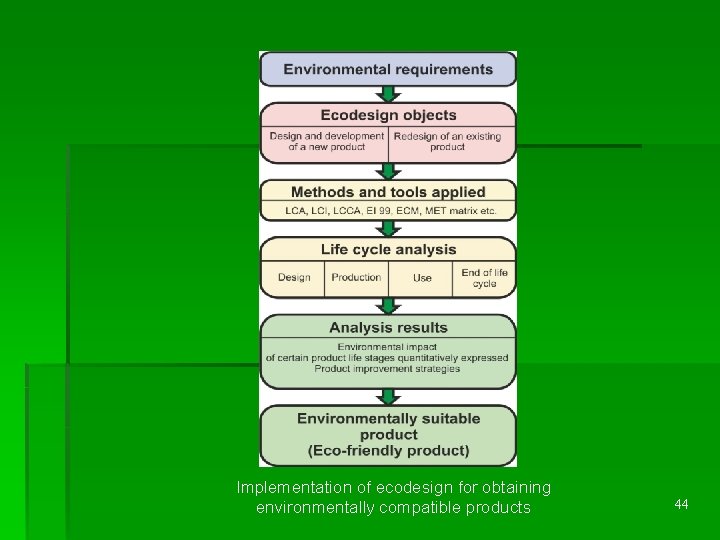
Implementation of ecodesign for obtaining environmentally compatible products 44
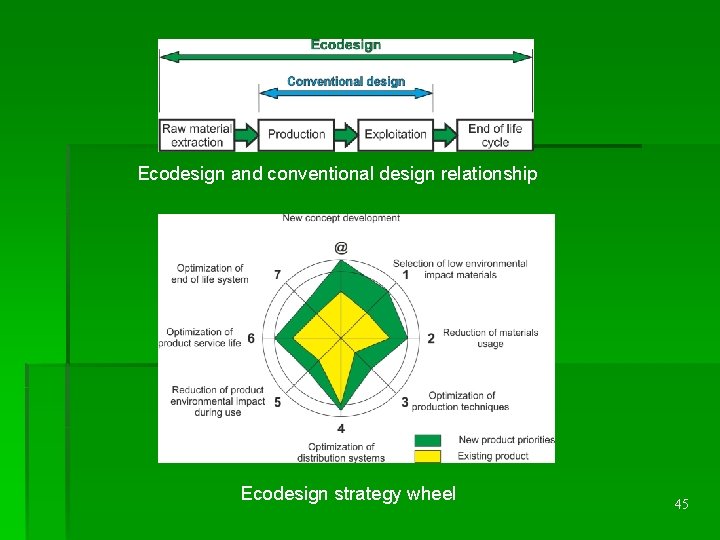
Ecodesign and conventional design relationship Ecodesign strategy wheel 45
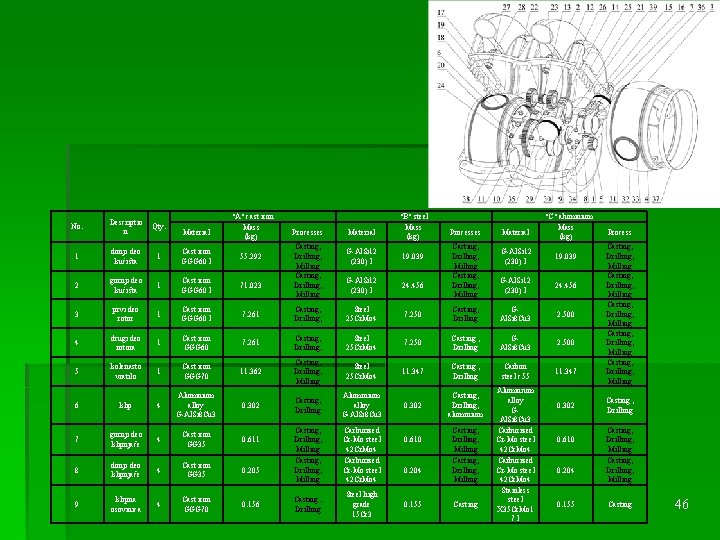
"A" cast iron Mass (kg) No. Descriptio n Qty. 1 donji deo kućišta 1 Cast iron GGG 60 I 55. 292 2 gornji deo kućišta 1 Cast iron GGG 60 I 71. 023 3 prvi deo rotor 1 Cast iron GGG 60 I 7. 261 4 drugi deo rotora 1 Cast iron GGG 60 5 kolenasto vratilo 1 6 klip 7 Material Processes Casting, Drilling, Milling Material "B" steel Mass (kg) G-Al. Si 12 (230) I 19. 039 G-Al. Si 12 (230) I 24. 456 Casting, Drilling, Steel 25 Cr. Mo 4 7. 250 7. 261 Casting, Drilling, Steel 25 Cr. Mo 4 Cast iron GGG 70 11. 362 Casting, Drilling, Milling 4 Aluminium alloy G-Al. Si 8 Cu 3 0. 302 gornji deo klipnjače 4 Cast iron GG 35 0. 611 8 donji deo klipnjače 4 Cast iron GG 35 0. 205 9 klipna osovinica 4 Cast iron GGG 70 0. 156 Processes Casting, Drilling, Milling Material "C" aluminium Mass (kg) G-Al. Si 12 (230) I 19. 039 G-Al. Si 12 (230) I 24. 456 Casting, Drilling GAl. Si 8 Cu 3 2. 500 7. 250 Casting , Drilling GAl. Si 8 Cu 3 2. 500 Steel 25 Cr. Mo 4 11. 347 Casting , Drilling Carbon steel c 55 11. 347 Casting, Drilling Aluminium alloy G-Al. Si 8 Cu 3 0. 302 Casting, Drilling, aluminium Casting, Drilling, Milling Carburized Cr-Mo steel 42 Cr. Mo 4 Casting , Drilling Steel high grade 15 Cr 3 0. 610 0. 204 0. 155 Casting, Drilling, Milling Casting Aluminium alloy GAl. Si 8 Cu 3 Carburized Cr-Mo steel 42 Cr. Mo 4 Stainless steel X 35 Cr. Mo 1 7 I 0. 302 0. 610 0. 204 0. 155 Process Casting, Drilling, Milling Casting, Drilling, Milling Casting , Drilling Casting, Drilling, Milling Casting 46
47
- Slides: 47