
Igneous Rocks What you need to know How
- Slides: 7
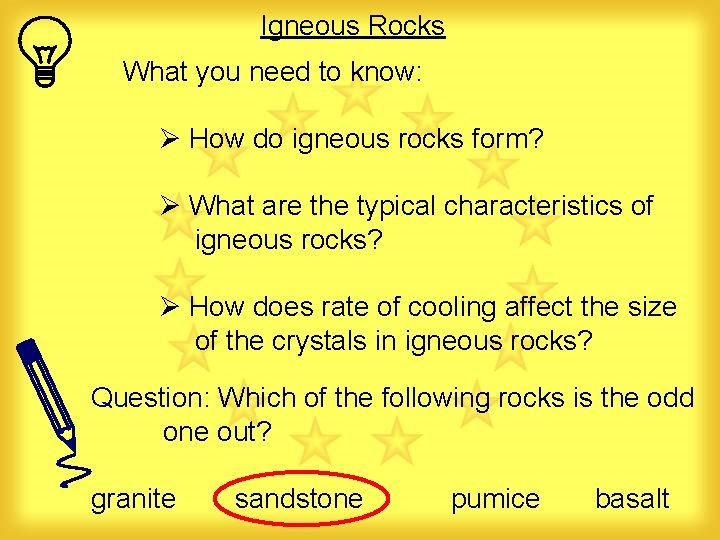
Igneous Rocks What you need to know: Ø How do igneous rocks form? Ø What are the typical characteristics of igneous rocks? Ø How does rate of cooling affect the size of the crystals in igneous rocks? Question: Which of the following rocks is the odd one out? granite sandstone pumice basalt
Copy and complete the following notes, unscrambling the jumbled-up words: § Igneous rocks are formed when LOMNET rock (VAAL or GAMMA) cools so that it becomes freezes and becomes DOLIS § Igneous rocks usually contain lots of interlocking SRYCSLAT, which makes them RAHD and NOGRTS § The word igneous come from ‘ignis’ – the Latin word for RIFE Read the Cooling Rate and Crystal Size worksheet
§ Igneous rocks are formed when molten rock (lava or magma) cools so that it becomes freezes and becomes solid § Igneous rocks usually contain lots of interlocking crystals, which makes them hard and strong § The word igneous come from ‘ignis’ – the Latin word for fire Read the Cooling Rate and Crystal Size worksheet
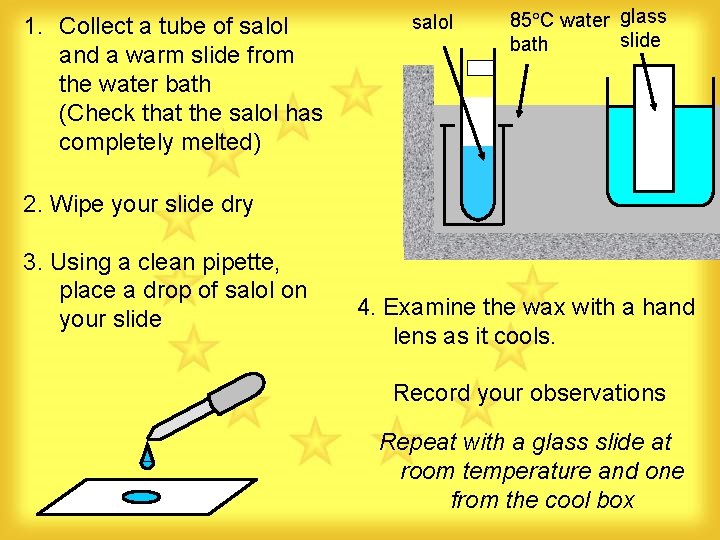
1. Collect a tube of salol and a warm slide from the water bath (Check that the salol has completely melted) salol 85 C water glass slide bath 2. Wipe your slide dry 3. Using a clean pipette, place a drop of salol on your slide 4. Examine the wax with a hand lens as it cools. Record your observations Repeat with a glass slide at room temperature and one from the cool box
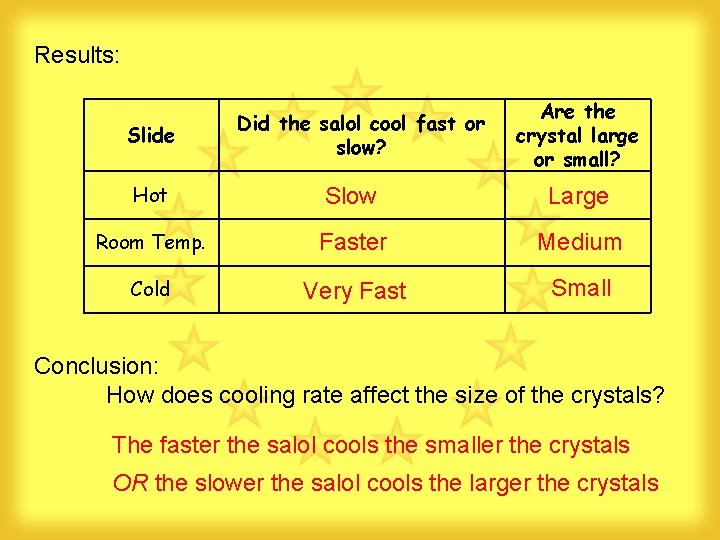
Results: Slide Did the salol cool fast or slow? Are the crystal large or small? Hot Slow Large Room Temp. Faster Medium Cold Very Fast Small Conclusion: How does cooling rate affect the size of the crystals? The faster the salol cools the smaller the crystals OR the slower the salol cools the larger the crystals
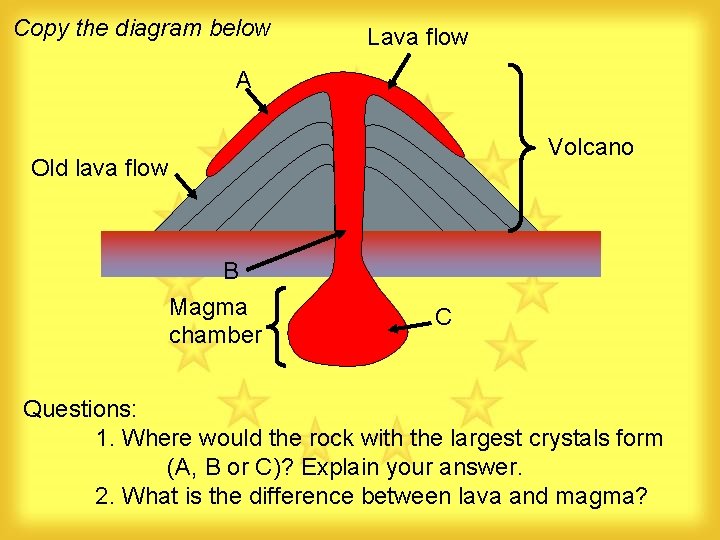
Copy the diagram below Lava flow A Volcano Old lava flow B Magma chamber C Questions: 1. Where would the rock with the largest crystals form (A, B or C)? Explain your answer. 2. What is the difference between lava and magma?
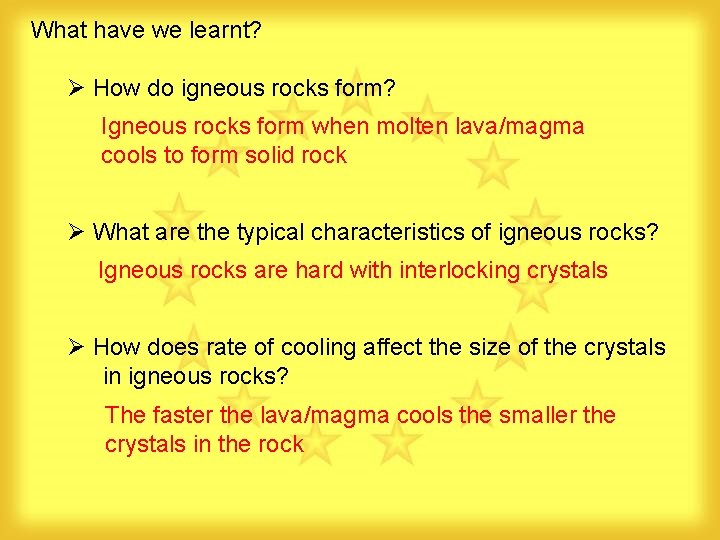
What have we learnt? Ø How do igneous rocks form? Igneous rocks form when molten lava/magma cools to form solid rock Ø What are the typical characteristics of igneous rocks? Igneous rocks are hard with interlocking crystals Ø How does rate of cooling affect the size of the crystals in igneous rocks? The faster the lava/magma cools the smaller the crystals in the rock