
IGCSE SOCIOLOGY Marriage Cohabitation and Divorce INTRODUCTION In
IGCSE SOCIOLOGY Marriage, Cohabitation and Divorce
INTRODUCTION In the past marriage was a popular religious ceremony which couples went through to show their love and commitment to each other Although today there are many threats which have been identified which will have an affect on the traditional marriage
MARRIAGE 1971 – 459, 000 marriages 1991 – 350, 000 marriages During the period of 1971 to 1991 divorce rates more than doubled.
MARRIAGE The threats to marriage can fall into two categories. These are: Threats which result from alternatives to marriage Threats which result from the breakdown of marriages Think! Can you think of any examples which would fit into either of these two categories?
MARRIAGE Threats resulting from alternatives to marriage. Marriage Rates – People are delaying marriage therefore at present there is a decline. Bernades (1997) - Points out that most people get married at some point in their life.
MARRIAGE Threats resulting from alternatives to marriage Cohabitation – This is on the increase. By 2002 over a quarter of non-married people in Britain were cohabiting Burgoyne and Clark (1984) - A significant proportion of their sample said cohabitation is a good idea. Although it is not an permanent alterative to marriage
MARRIAGE Threats resulting from alternatives to marriage Single-Person Households – Many people now live on their own, this may be because they are divorced or separated or it may just be a deliberate choice of life. Single person households are becoming more common in Britain.
MARRIAGE Threats resulting from the breakdown of marriages There are three main categories which threats from the breakdown of marriage can fall into. These are: Divorce – The legal termination of a marriage Separation – The physical separation between two spouses Empty-Shell Marriages – The spouses remain living together although their marriage exists in name only.
DIVORCE In modern societies divorce has risen steadily, although in the 1990’s the divorce rate was fairly stable. Chandler Approximately 40% of marriages will end in divorce. Remarriages are also on the rise.
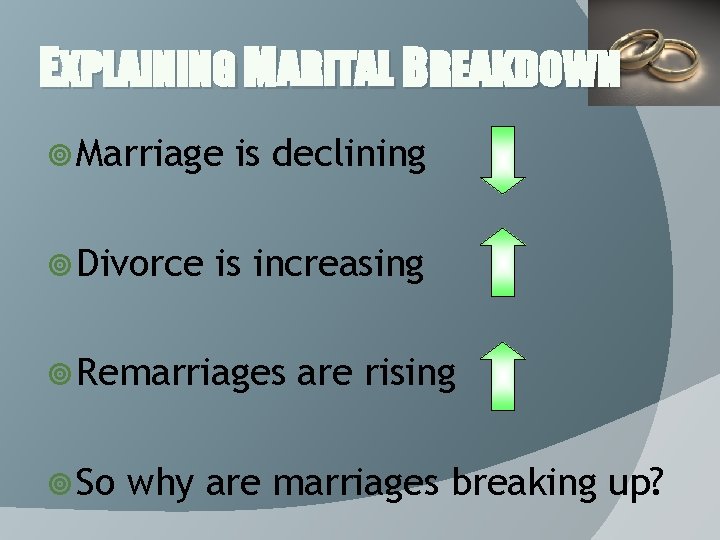
EXPLAINING MARITAL BREAKDOWN Marriage Divorce is declining is increasing Remarriages So are rising why are marriages breaking up?
EXPLAINING MARITAL BREAKDOWN The Value of Marriage Functionalists Parsons and Fletcher argue that marriage today is too valued. People expect more and demand more from marriage and this can lead to marital breakdown. The British Attitudes Survey (2001) Marriage is still largely valued although Cohabitation is also seen as a legitimate alternative .
EXPLAINING MARITAL BREAKDOWN The Value of Marriage Functionalists Parsons and Fletcher argue that marriage today is too valued. People expect more and demand more from marriage and this can lead to marital breakdown. THE British Attitudes Survey (2001) Marriage is still largely valued although Cohabitation is also seen as a legitimate alternative
EXPLAINING MARITAL BREAKDOWN Conflict Between Spouses Leach (1967) - The nuclear family suffers from an emotional overload which then increases the level of conflict between family members.
EXPLAINING MARITAL BREAKDOWN Modernity, Freedom and Choice Gibson (1994) Modernity has lead to the development of increasing individual achievement. There is no emphasis on consumer choice, this means if you don’t find satisfaction in your first partner you can seek an alternative.
EXPLAINING MARITAL BREAKDOWN The Ease of Divorce Today it is said that divorce is a much Gibson (1994) • The law has changed making -The decline in religion has • The grounds for divorce easier process to goweakened through than it has divorce easier tobelief obtain. the religious widened therefore making a which • binds a couple together In 1857 athis private act of divorce easier to obtain. was before. The reasons for are: and this. parliament in • The stigma was whichrequired used to be -Therefore makes divorcehas more order for to someone to also obtain a attached divorce Secularisation likely. divorce. considerable reduced. • People no longer see divorce as Changing attitudes such a bad, deviant thing. Changes in the law
- Slides: 15