
IGCSE Knowledge Organiser USA 1918 41 The Roaring
- Slides: 4
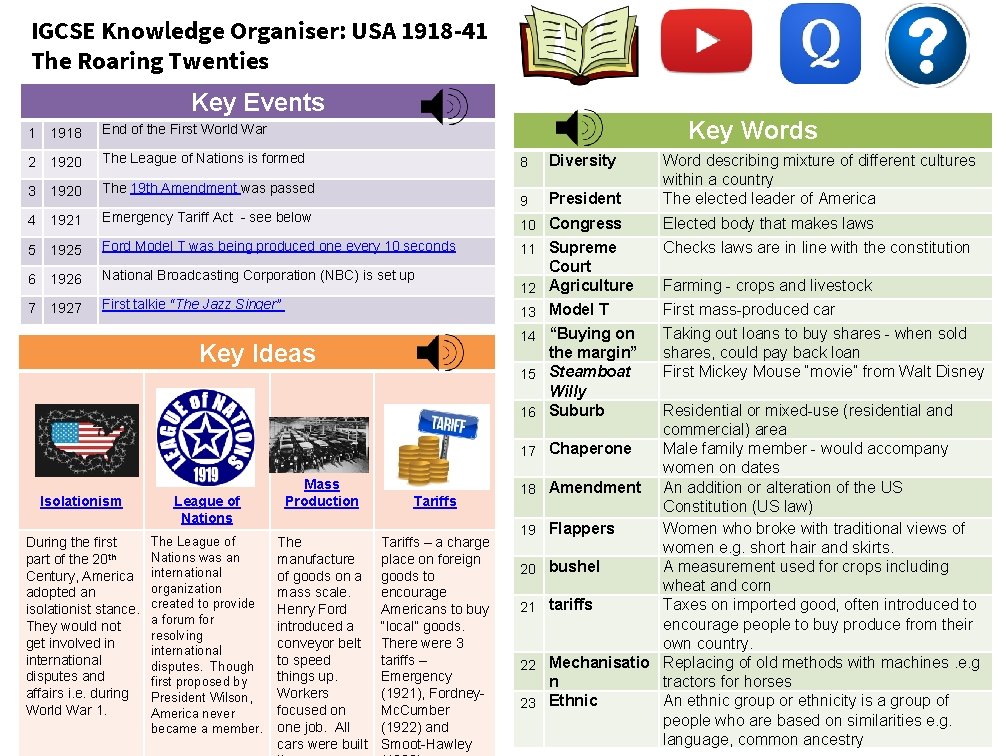
IGCSE Knowledge Organiser: USA 1918 -41 The Roaring Twenties Key Events Key Words 1 1918 End of the First World War 2 1920 The League of Nations is formed 3 1920 The 19 th Amendment was passed 4 1921 Emergency Tariff Act - see below 10 Congress Elected body that makes laws 5 1925 Ford Model T was being produced one every 10 seconds 11 Supreme Checks laws are in line with the constitution 6 1926 National Broadcasting Corporation (NBC) is set up Farming - crops and livestock 7 1927 First talkie “The Jazz Singer” Court 12 Agriculture 13 Model T League of Nations During the first part of the 20 th Century, America adopted an isolationist stance. They would not get involved in international disputes and affairs i. e. during World War 1. The League of Nations was an international organization created to provide a forum for resolving international disputes. Though first proposed by President Wilson, America never became a member. Diversity 9 President 14 “Buying on Key Ideas Isolationism 8 the margin” 15 Steamboat Willy 16 Suburb Mass Production Tariffs The manufacture of goods on a mass scale. Henry Ford introduced a conveyor belt to speed things up. Workers focused on one job. All cars were built Tariffs – a charge place on foreign goods to encourage Americans to buy “local” goods. There were 3 tariffs – Emergency (1921), Fordney. Mc. Cumber (1922) and Smoot-Hawley Word describing mixture of different cultures within a country The elected leader of America First mass-produced car Taking out loans to buy shares - when sold shares, could pay back loan First Mickey Mouse “movie” from Walt Disney Residential or mixed-use (residential and commercial) area Male family member - would accompany 17 Chaperone women on dates An addition or alteration of the US 18 Amendment Constitution (US law) Women who broke with traditional views of 19 Flappers women e. g. short hair and skirts. A measurement used for crops including 20 bushel wheat and corn Taxes on imported good, often introduced to 21 tariffs encourage people to buy produce from their own country. 22 Mechanisatio Replacing of old methods with machines. e. g n tractors for horses An ethnic group or ethnicity is a group of 23 Ethnic people who are based on similarities e. g. language, common ancestry
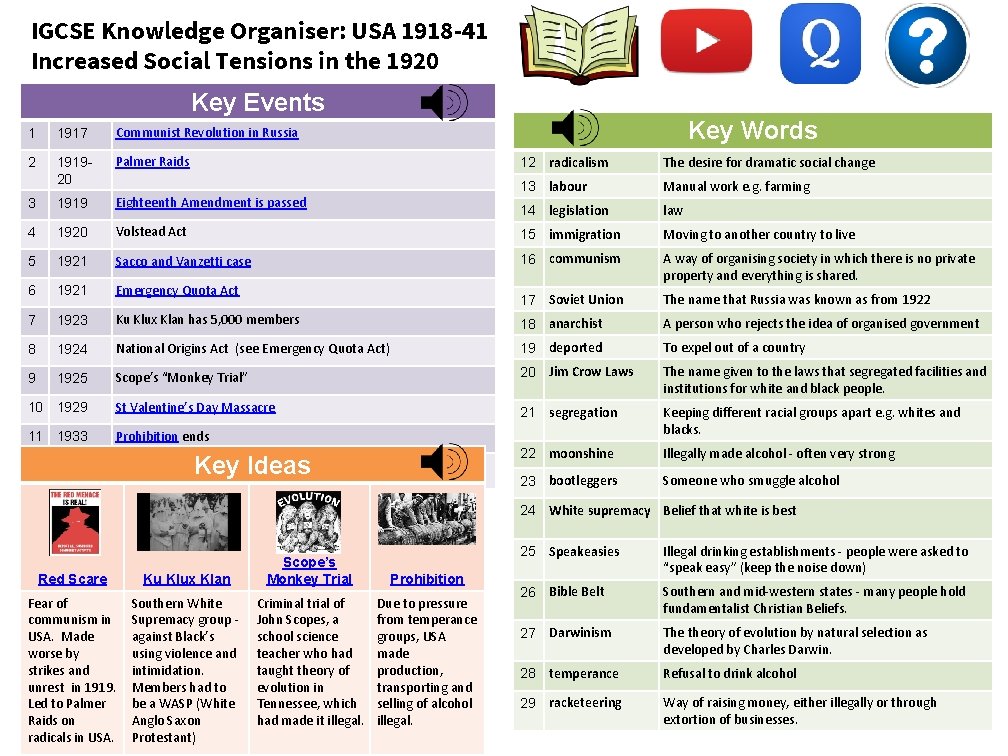
IGCSE Knowledge Organiser: USA 1918 -41 Increased Social Tensions in the 1920 Key Events 1 1917 Communist Revolution in Russia 2 191920 Palmer Raids 3 1919 Eighteenth Amendment is passed 4 1920 5 Key Words 12 radicalism The desire for dramatic social change 13 labour Manual work e. g. farming 14 legislation law Volstead Act 15 immigration Moving to another country to live 1921 Sacco and Vanzetti case 16 communism 6 1921 Emergency Quota Act A way of organising society in which there is no private property and everything is shared. 17 Soviet Union The name that Russia was known as from 1922 7 1923 Ku Klux Klan has 5, 000 members 18 anarchist A person who rejects the idea of organised government 8 1924 National Origins Act (see Emergency Quota Act) 19 deported To expel out of a country 9 1925 Scope’s “Monkey Trial” 20 Jim Crow Laws The name given to the laws that segregated facilities and institutions for white and black people. 10 1929 St Valentine’s Day Massacre 21 segregation 11 1933 Prohibition ends Keeping different racial groups apart e. g. whites and blacks. 22 moonshine Illegally made alcohol - often very strong 23 bootleggers Someone who smuggle alcohol Key Ideas 24 White supremacy Belief that white is best Red Scare Ku Klux Klan Fear of communism in USA. Made worse by strikes and unrest in 1919. Led to Palmer Raids on radicals in USA. Southern White Supremacy group against Black’s using violence and intimidation. Members had to be a WASP (White Anglo Saxon Protestant) Scope’s Monkey Trial Prohibition Criminal trial of John Scopes, a school science teacher who had taught theory of evolution in Tennessee, which had made it illegal. Due to pressure from temperance groups, USA made production, transporting and selling of alcohol illegal. 25 Speakeasies Illegal drinking establishments - people were asked to “speak easy” (keep the noise down) 26 Bible Belt Southern and mid-western states - many people hold fundamentalist Christian Beliefs. 27 Darwinism The theory of evolution by natural selection as developed by Charles Darwin. 28 temperance Refusal to drink alcohol 29 racketeering Way of raising money, either illegally or through extortion of businesses.
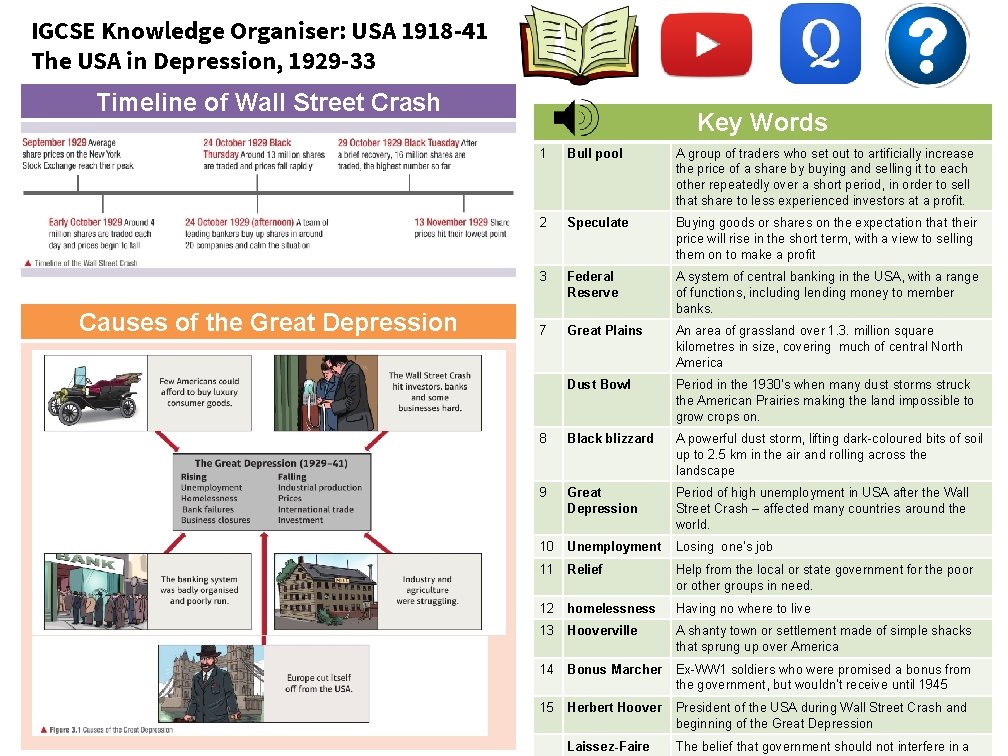
IGCSE Knowledge Organiser: USA 1918 -41 The USA in Depression, 1929 -33 Timeline of Wall Street Crash Causes of the Great Depression Key Words 1 Bull pool A group of traders who set out to artificially increase the price of a share by buying and selling it to each other repeatedly over a short period, in order to sell that share to less experienced investors at a profit. 2 Speculate Buying goods or shares on the expectation that their price will rise in the short term, with a view to selling them on to make a profit 3 Federal Reserve A system of central banking in the USA, with a range of functions, including lending money to member banks. 7 Great Plains An area of grassland over 1. 3. million square kilometres in size, covering much of central North America Dust Bowl Period in the 1930’s when many dust storms struck the American Prairies making the land impossible to grow crops on. 8 Black blizzard A powerful dust storm, lifting dark-coloured bits of soil up to 2. 5 km in the air and rolling across the landscape 9 Great Depression Period of high unemployment in USA after the Wall Street Crash – affected many countries around the world. 10 Unemployment Losing one’s job 11 Relief Help from the local or state government for the poor or other groups in need. 12 homelessness Having no where to live 13 Hooverville A shanty town or settlement made of simple shacks that sprung up over America 14 Bonus Marcher Ex-WW 1 soldiers who were promised a bonus from the government, but wouldn’t receive until 1945 15 Herbert Hoover President of the USA during Wall Street Crash and beginning of the Great Depression Laissez-Faire The belief that government should not interfere in a
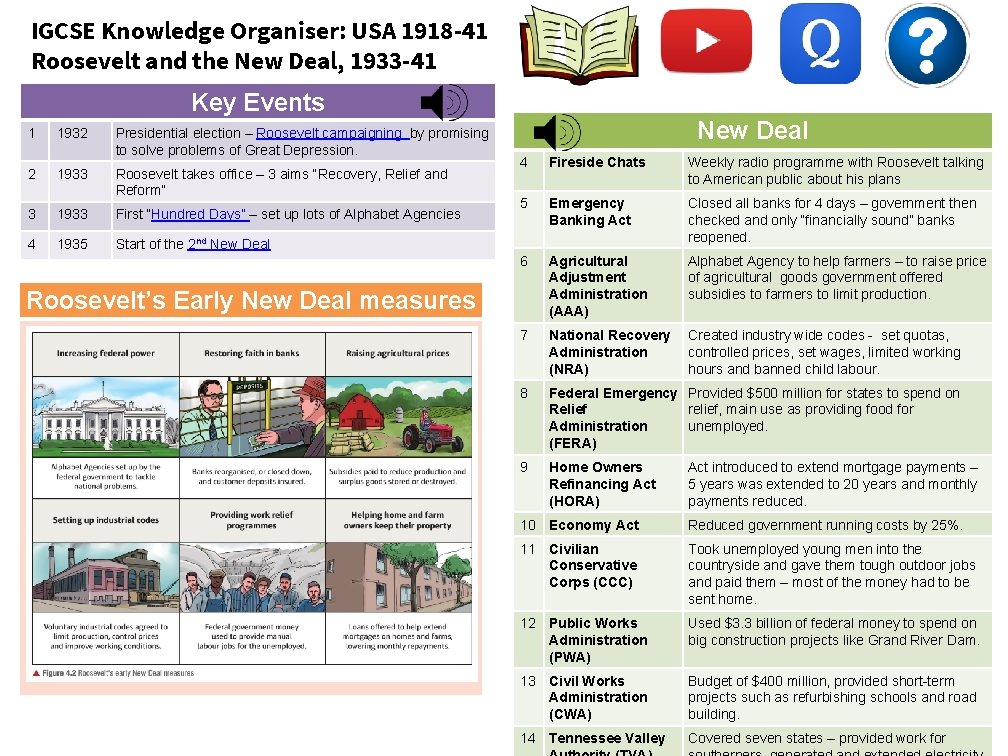
IGCSE Knowledge Organiser: USA 1918 -41 Roosevelt and the New Deal, 1933 -41 Key Events 1 1932 Presidential election – Roosevelt campaigning by promising to solve problems of Great Depression. 2 1933 Roosevelt takes office – 3 aims “Recovery, Relief and Reform” 3 1933 First “Hundred Days” – set up lots of Alphabet Agencies 4 1935 Start of the 2 nd New Deal 4 Fireside Chats Weekly radio programme with Roosevelt talking to American public about his plans 5 Emergency Banking Act Closed all banks for 4 days – government then checked and only “financially sound” banks reopened. 6 Agricultural Adjustment Administration (AAA) Alphabet Agency to help farmers – to raise price of agricultural goods government offered subsidies to farmers to limit production. 7 National Recovery Administration (NRA) Created industry wide codes - set quotas, controlled prices, set wages, limited working hours and banned child labour. 8 Federal Emergency Provided $500 million for states to spend on Relief relief, main use as providing food for Administration unemployed. (FERA) 9 Home Owners Refinancing Act (HORA) Roosevelt’s Early New Deal measures Act introduced to extend mortgage payments – 5 years was extended to 20 years and monthly payments reduced. 10 Economy Act Reduced government running costs by 25%. 11 Civilian Conservative Corps (CCC) Took unemployed young men into the countryside and gave them tough outdoor jobs and paid them – most of the money had to be sent home. 12 Public Works Administration (PWA) Used $3. 3 billion of federal money to spend on big construction projects like Grand River Dam. 13 Civil Works Administration (CWA) Budget of $400 million, provided short-term projects such as refurbishing schools and road building. 14 Tennessee Valley Covered seven states – provided work for