
IGCSE FM Matrix Transformations Dr J Frost jfrosttiffin

- Slides: 32
IGCSE FM Matrix Transformations Dr J Frost (jfrost@tiffin. kingston. sch. uk) www. drfrostmaths. com The specification: Last modified: 3 rd January 2016
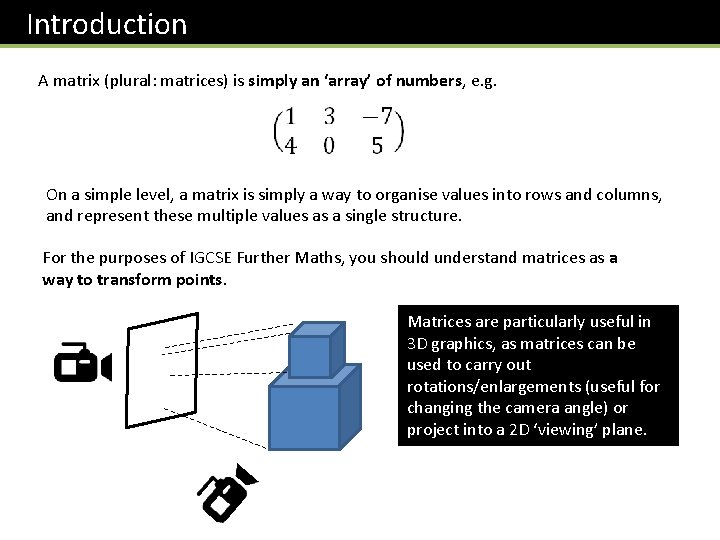
Introduction A matrix (plural: matrices) is simply an ‘array’ of numbers, e. g. On a simple level, a matrix is simply a way to organise values into rows and columns, and represent these multiple values as a single structure. For the purposes of IGCSE Further Maths, you should understand matrices as a way to transform points. Matrices are particularly useful in 3 D graphics, as matrices can be used to carry out rotations/enlargements (useful for changing the camera angle) or project into a 2 D ‘viewing’ plane.
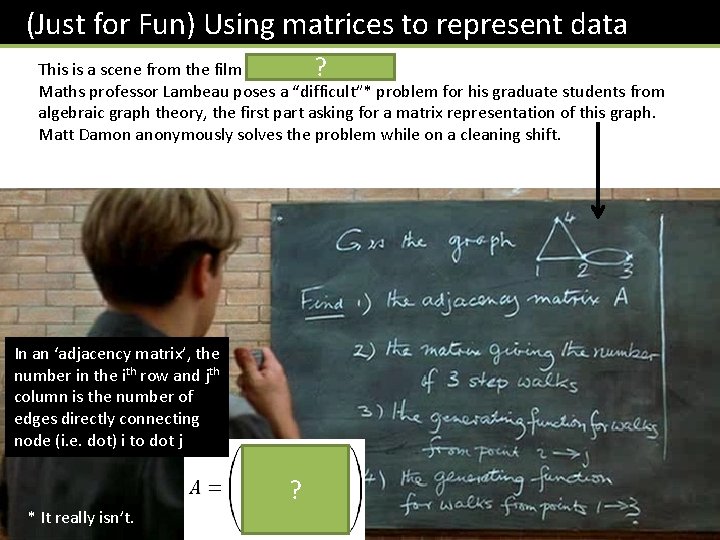
(Just for Fun) Using matrices to represent data This is a scene from the film Good Will? Hunting. Maths professor Lambeau poses a “difficult”* problem for his graduate students from algebraic graph theory, the first part asking for a matrix representation of this graph. Matt Damon anonymously solves the problem while on a cleaning shift. In an ‘adjacency matrix’, the number in the ith row and jth column is the number of edges directly connecting node (i. e. dot) i to dot j * It really isn’t. ?
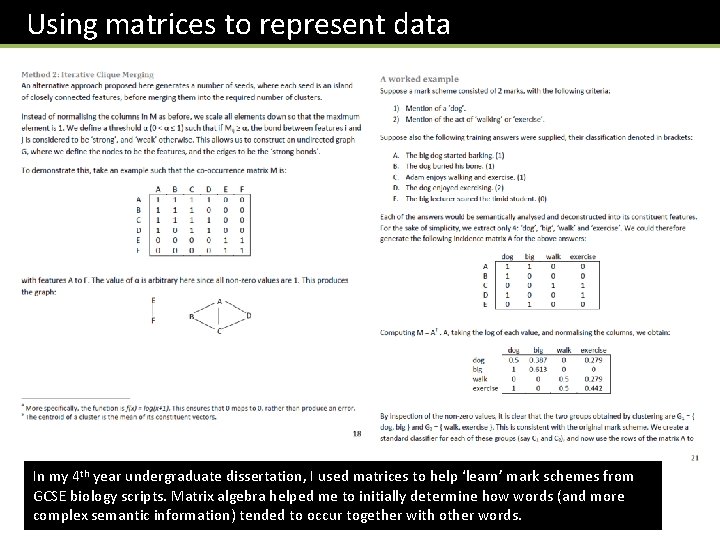
Using matrices to represent data In my 4 th year undergraduate dissertation, I used matrices to help ‘learn’ mark schemes from GCSE biology scripts. Matrix algebra helped me to initially determine how words (and more complex semantic information) tended to occur together with other words.
ζ Matrix Algebra Matrix Fundamentals Understand the dimensions of a matrix, and operations on matrices, such as addition, scalar multiplication and matrix multiplication.
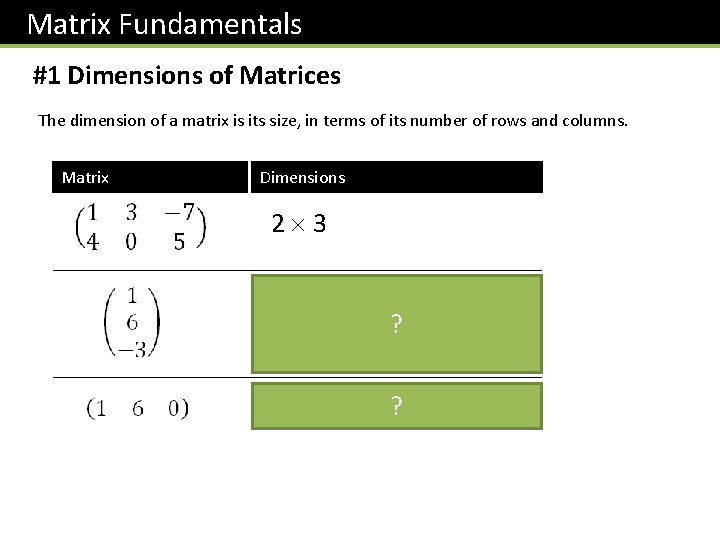
Matrix Fundamentals #1 Dimensions of Matrices The dimension of a matrix is its size, in terms of its number of rows and columns. Matrix Dimensions 2 3 3 1 ? 1 3 ?
Matrix Fundamentals #2 Notation/Names for Matrices A matrix can have square or curvy brackets*. Matrix Column Vector (The vector you know and love) Row Vector So a matrix with one column is simply a vector in the usual sense. * The textbook only uses curvy.
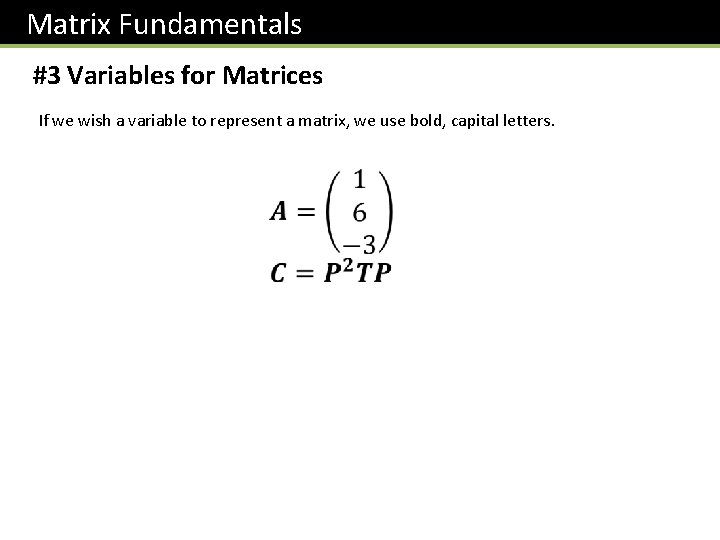
Matrix Fundamentals #3 Variables for Matrices If we wish a variable to represent a matrix, we use bold, capital letters.
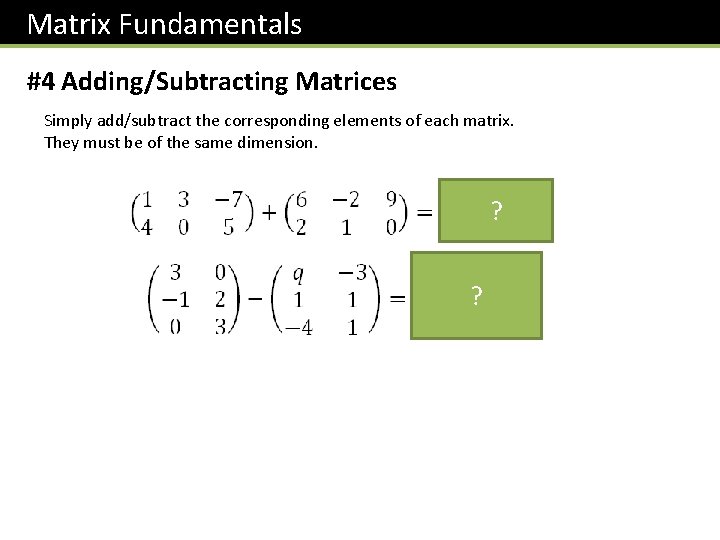
Matrix Fundamentals #4 Adding/Subtracting Matrices Simply add/subtract the corresponding elements of each matrix. They must be of the same dimension. ? ?
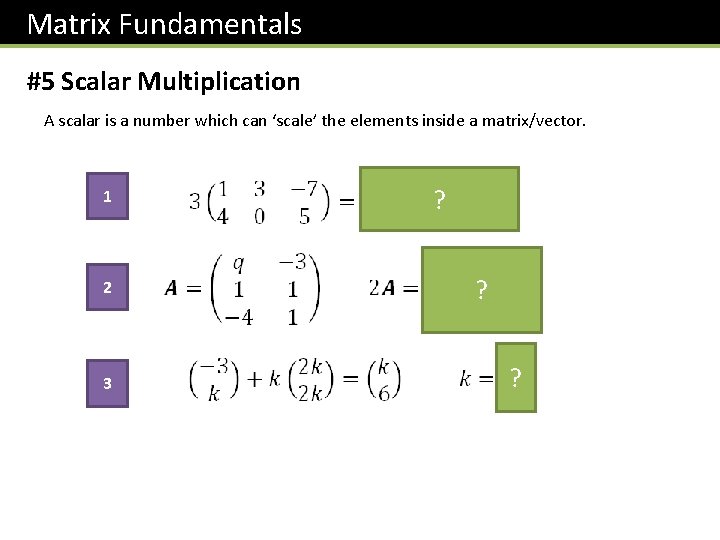
Matrix Fundamentals #5 Scalar Multiplication A scalar is a number which can ‘scale’ the elements inside a matrix/vector. 1 2 3 ? ? ?
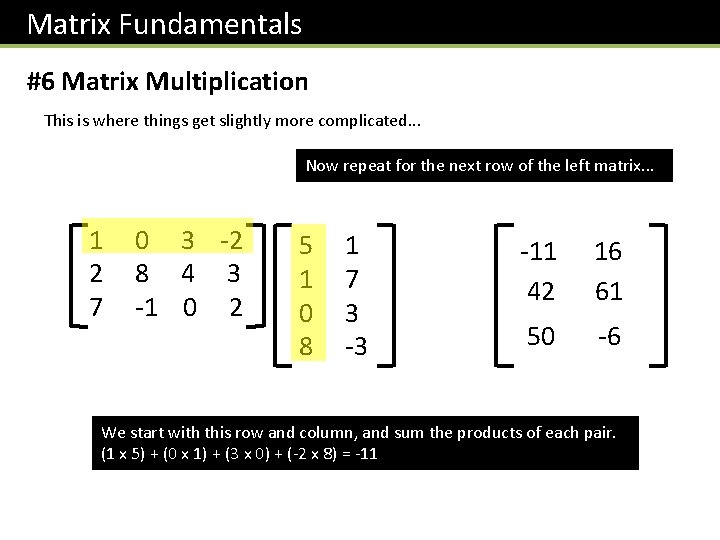
Matrix Fundamentals #6 Matrix Multiplication This is where things get slightly more complicated. . . Now repeat for the next row of the left matrix. . . 1 2 7 0 3 -2 8 4 3 -1 0 2 5 1 0 8 1 7 3 -3 -11 42 16 61 50 -6 We start with this row and column, and sum the products of each pair. (1 x 5) + (0 x 1) + (3 x 0) + (-2 x 8) = -11
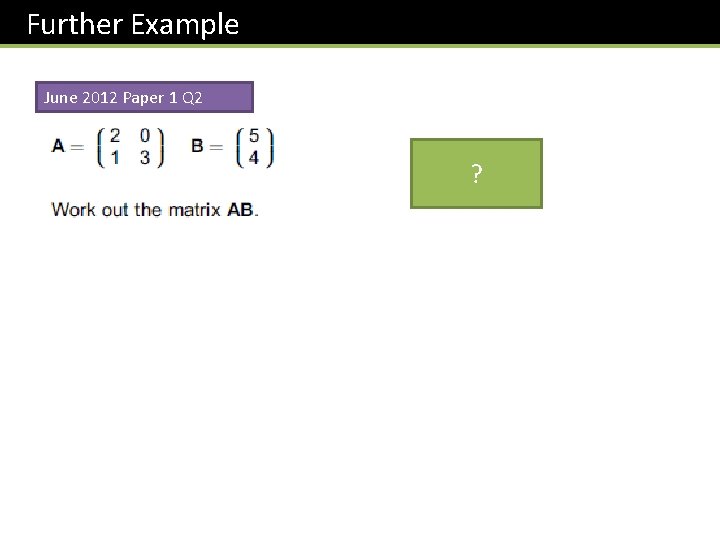
Further Example June 2012 Paper 1 Q 2 ?
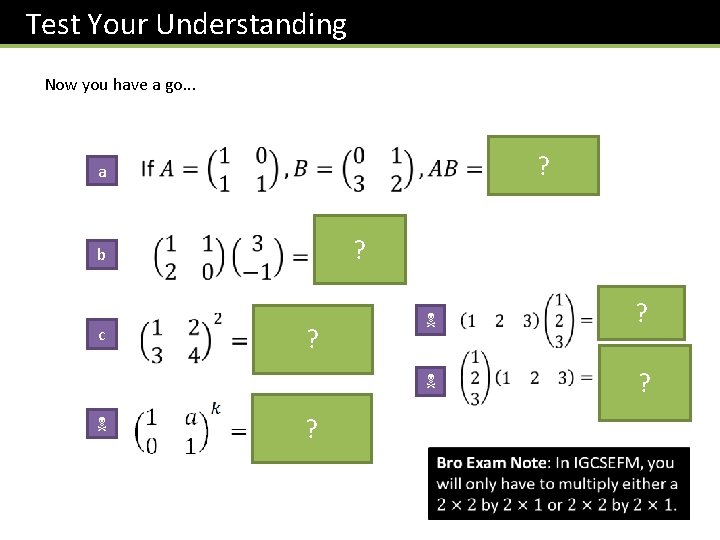
Test Your Understanding Now you have a go. . . ? a ? b c N ? ? N ?
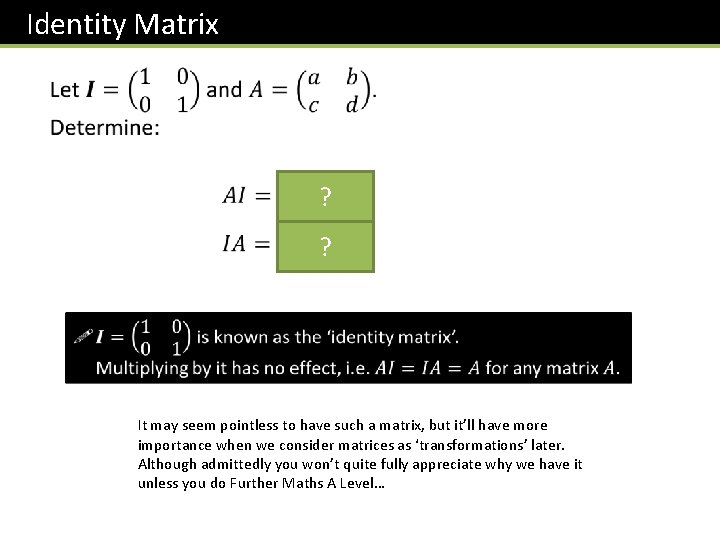
Identity Matrix ? ? It may seem pointless to have such a matrix, but it’ll have more importance when we consider matrices as ‘transformations’ later. Although admittedly you won’t quite fully appreciate why we have it unless you do Further Maths A Level…
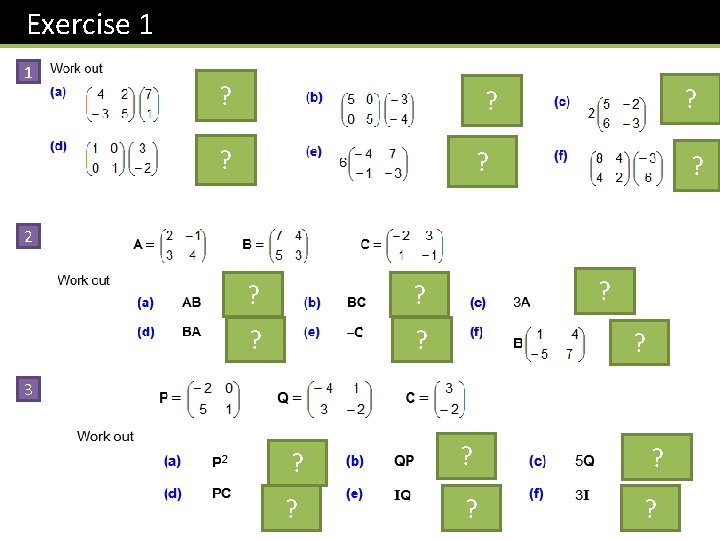
Exercise 1 1 ? ? ? 2 ? ? ? ? 3 ? ? ?
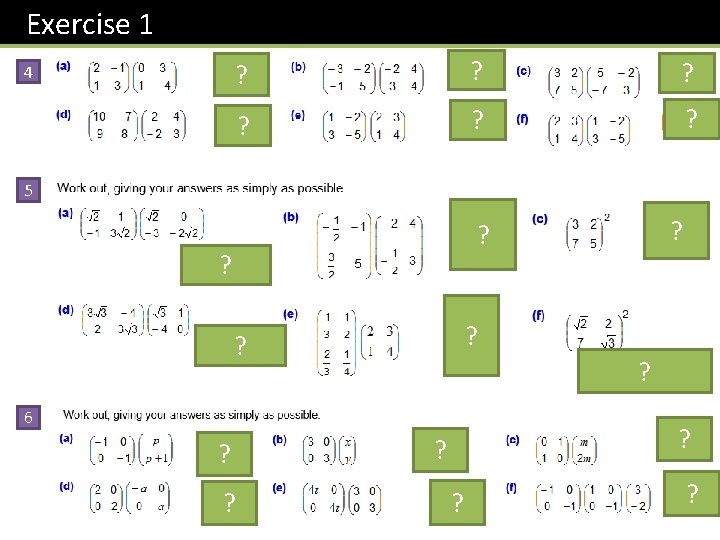
Exercise 1 4 ? ? ? 5 ? ? ? 6 ? ? ?
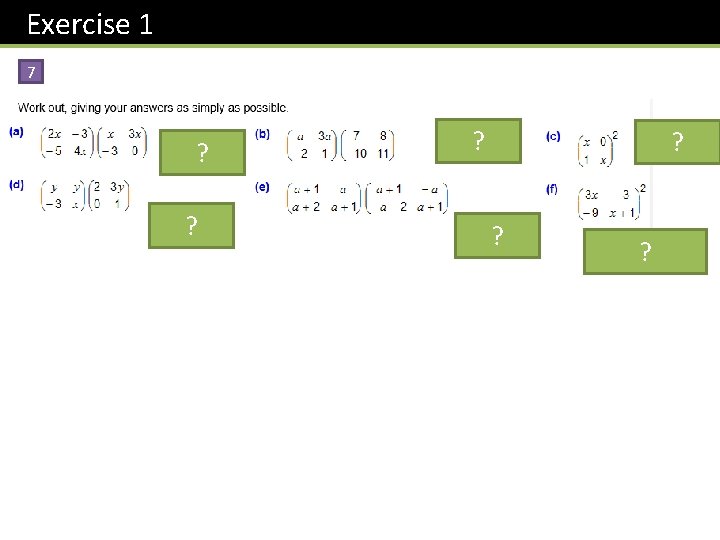
Exercise 1 7 ? ? ?
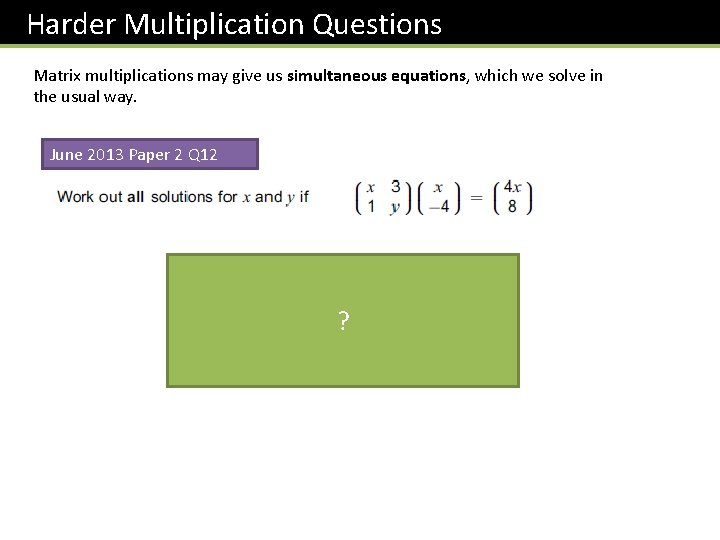
Harder Multiplication Questions Matrix multiplications may give us simultaneous equations, which we solve in the usual way. June 2013 Paper 2 Q 12 ?
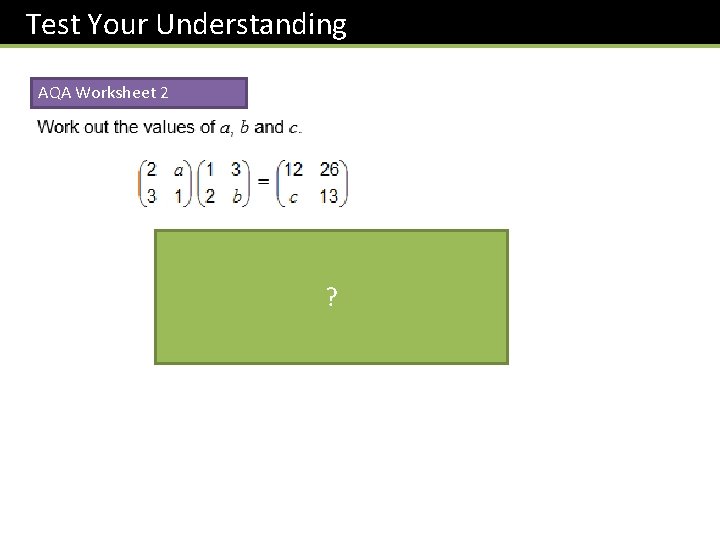
Test Your Understanding AQA Worksheet 2 ?
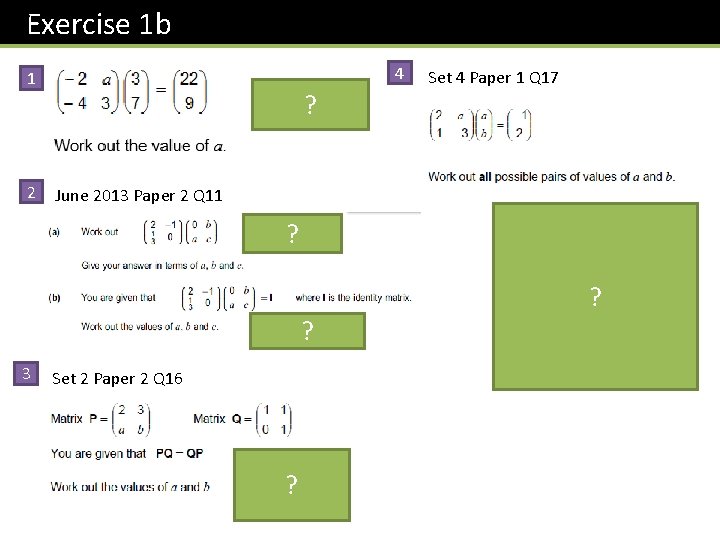
Exercise 1 b 4 1 2 ? Set 4 Paper 1 Q 17 June 2013 Paper 2 Q 11 ? ? ? 3 Set 2 Paper 2 Q 16 ?
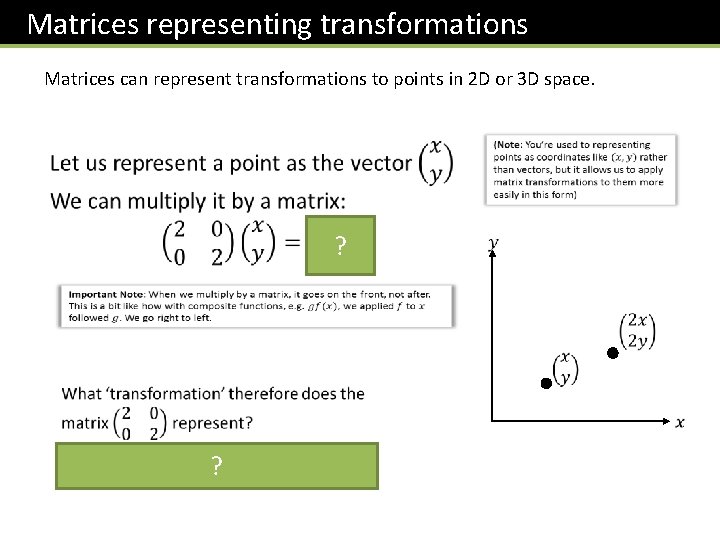
Matrices representing transformations Matrices can represent transformations to points in 2 D or 3 D space. ? ?
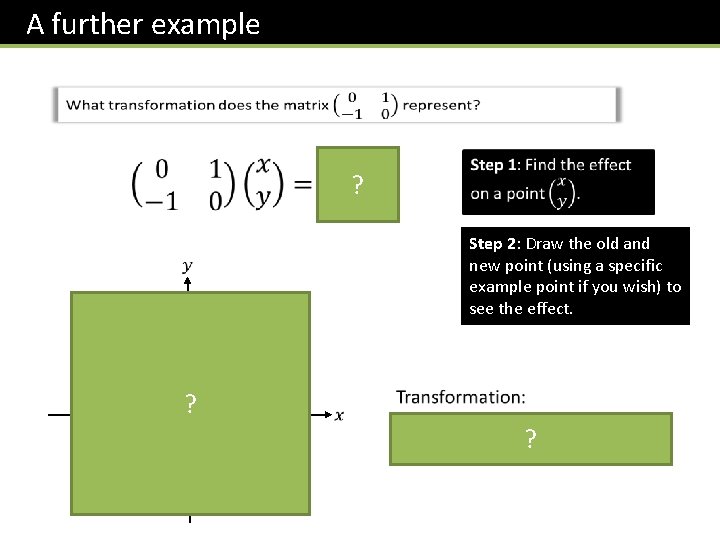
A further example ? Step 2: Draw the old and new point (using a specific example point if you wish) to see the effect. ? ?
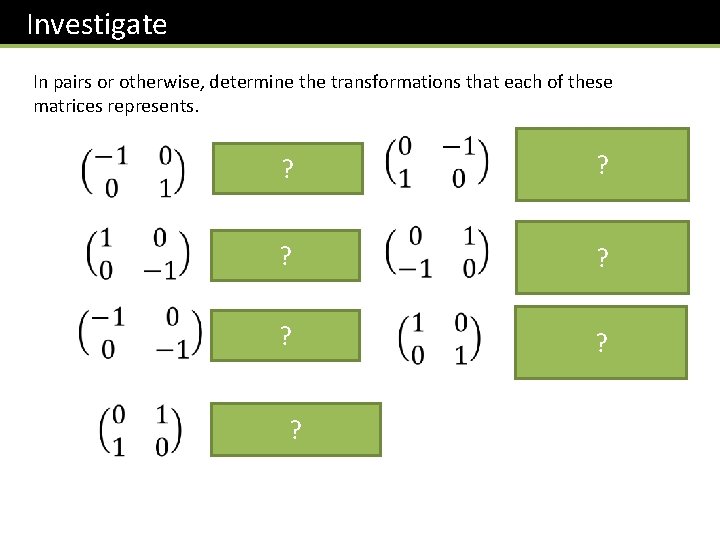
Investigate In pairs or otherwise, determine the transformations that each of these matrices represents. ? ? ? ? No effect! ?
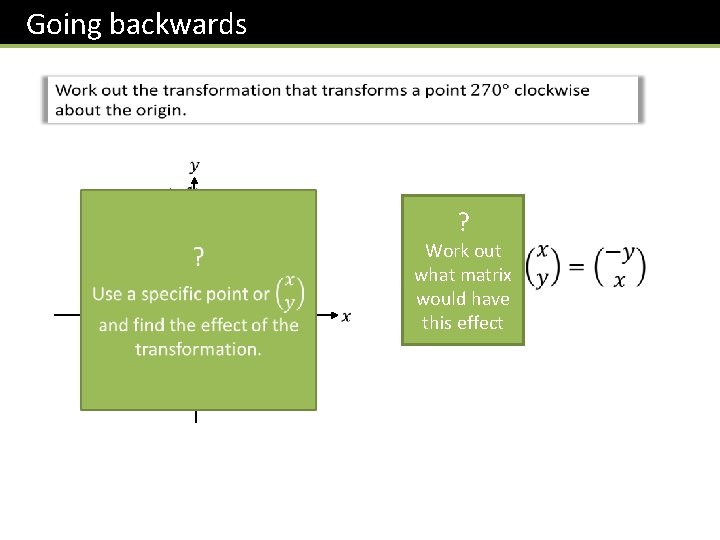
Going backwards ? Work out what matrix would have this effect
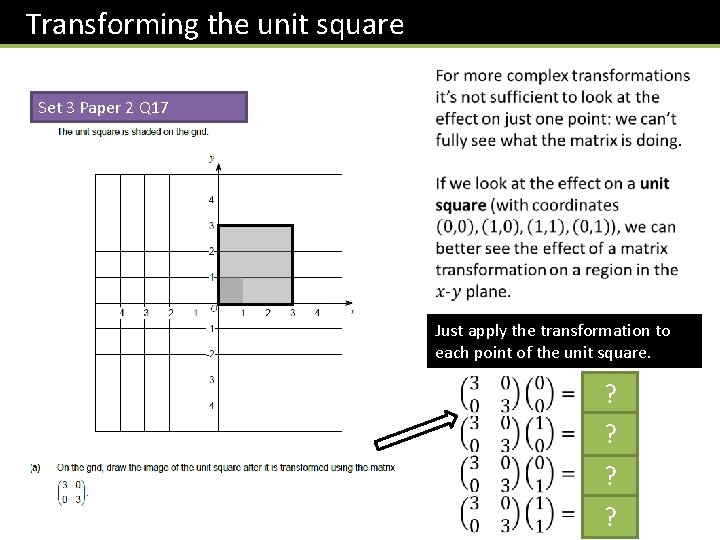
Transforming the unit square Set 3 Paper 2 Q 17 Just apply the transformation to each point of the unit square. ? ?
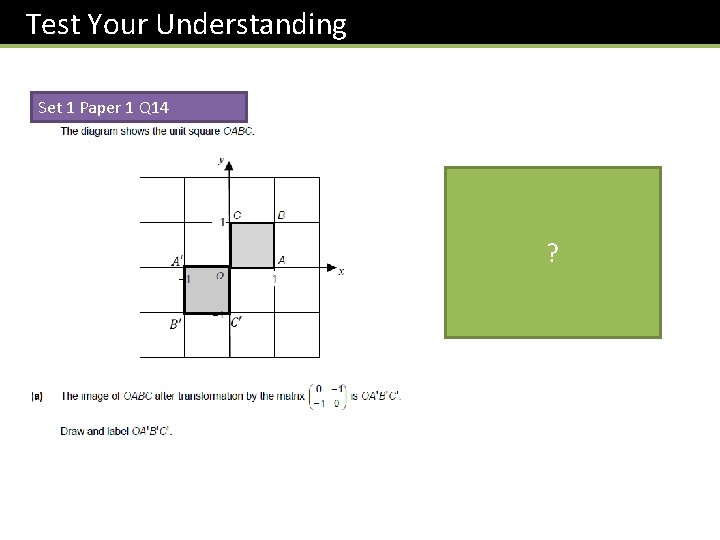
Test Your Understanding Set 1 Paper 1 Q 14 ?
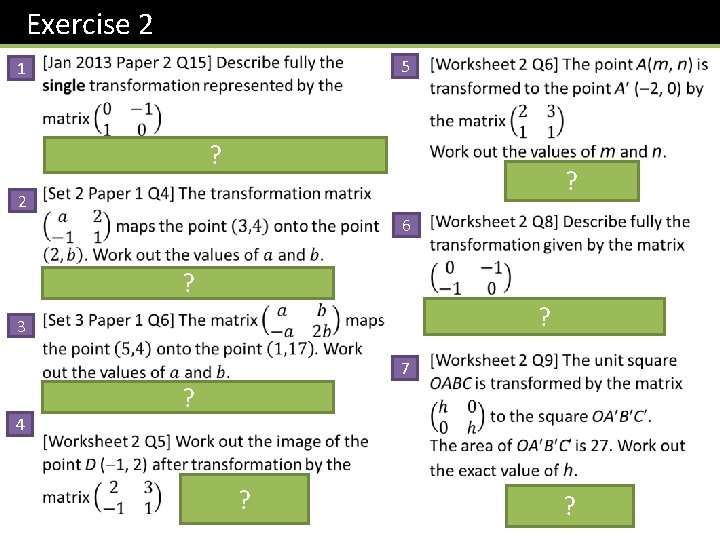
Exercise 2 5 1 ? ? 2 6 ? ? 3 7 4 ? ? ?
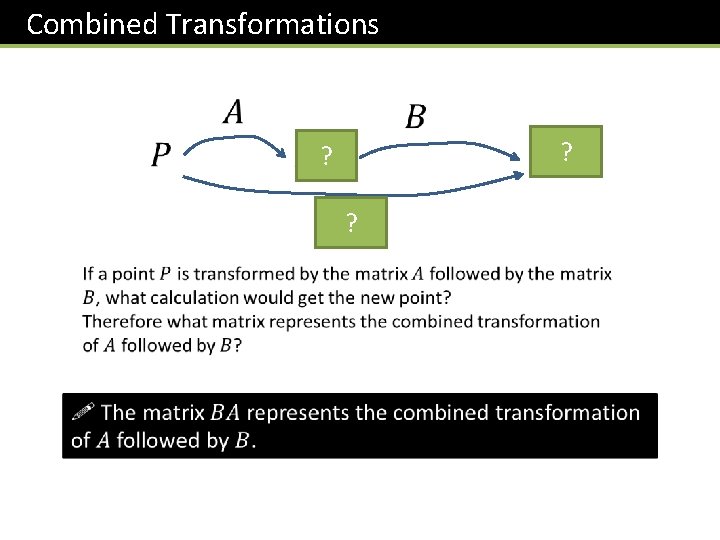
Combined Transformations ? ? ?
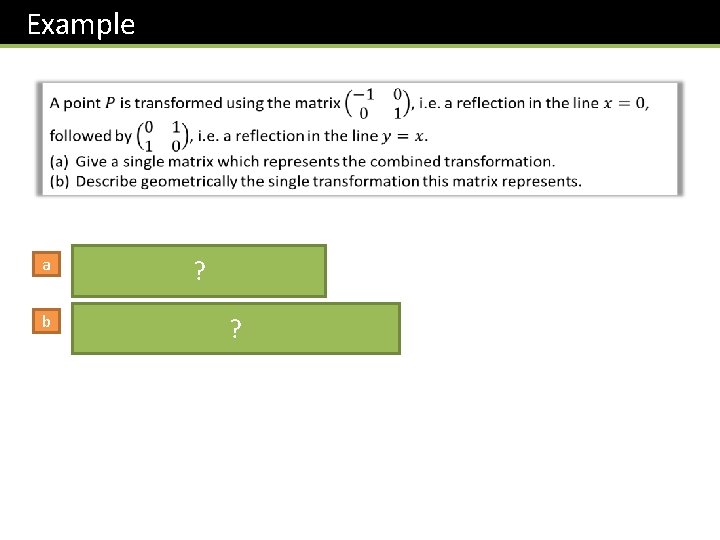
Example a b ? ?
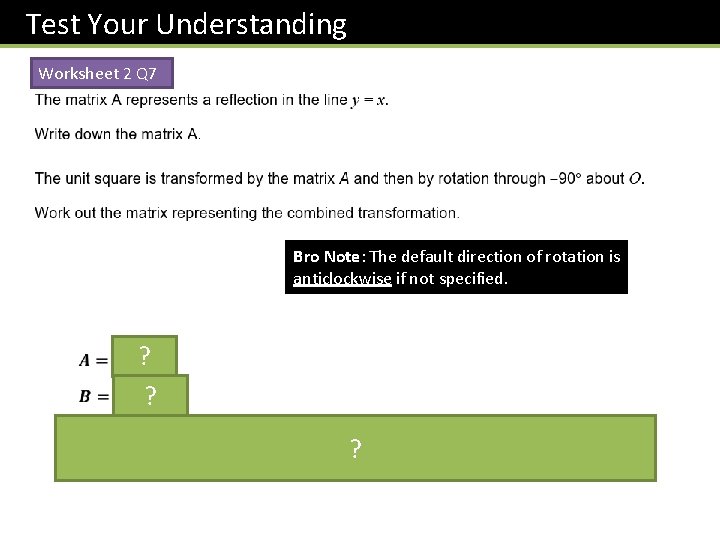
Test Your Understanding Worksheet 2 Q 7 Bro Note: The default direction of rotation is anticlockwise if not specified. ? ? ?
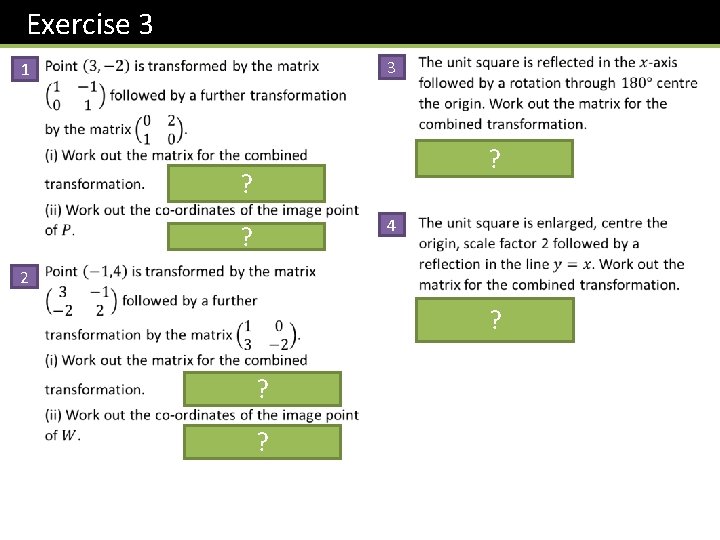
Exercise 3 3 1 ? ? 4 ? 2 ? ? ?
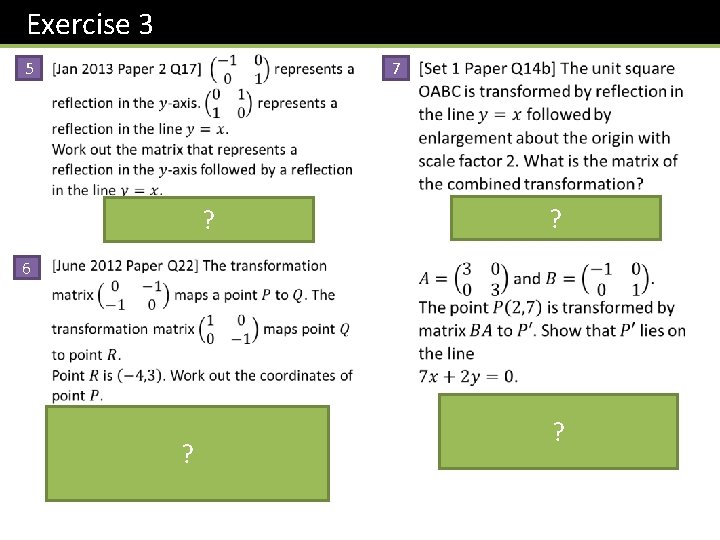
Exercise 3 5 7 ? ? 6 ? ?