
IGCSE Electricity Charge Aims Describe simple experiments using
IGCSE Electricity – Charge Aims: Describe simple experiments using electrostatic charges State that there are positive and negative charges State that unlike charges attract and that like charges repel State that charge is measured in coulombs Describe charging by induction Recall and use the simple electron model to distinguish between conductors and insulators and give examples. © Boardworks Ltd 2003
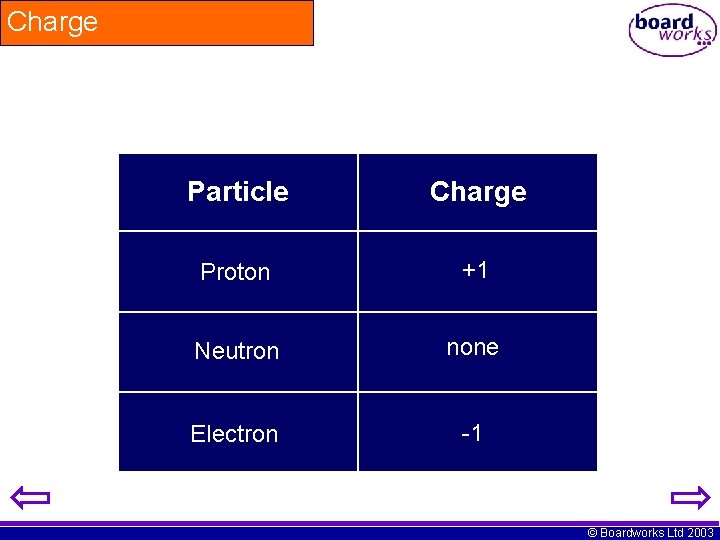
Charge Particle Charge Proton +1 Neutron none Electron -1 © Boardworks Ltd 2003
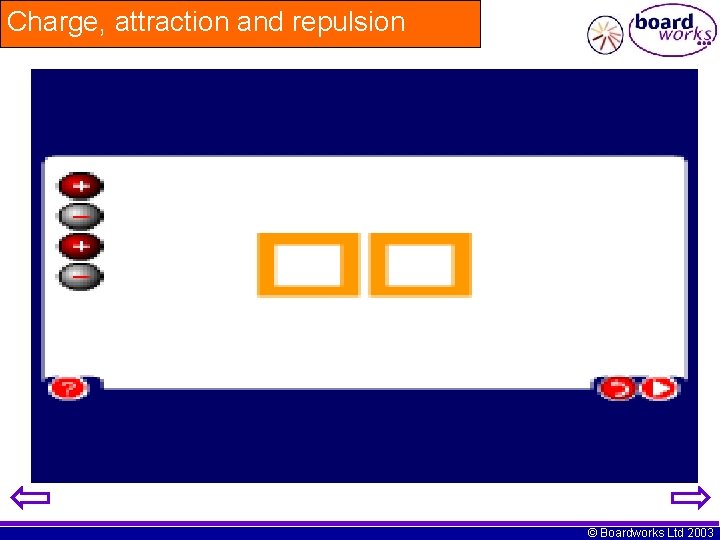
Charge, attraction and repulsion © Boardworks Ltd 2003

Attraction and repulsion Positive and positive repel ____ Negative and negative repel ____ Positive and negative attract ____ Like charges repel, unlike charges attract. © Boardworks Ltd 2003
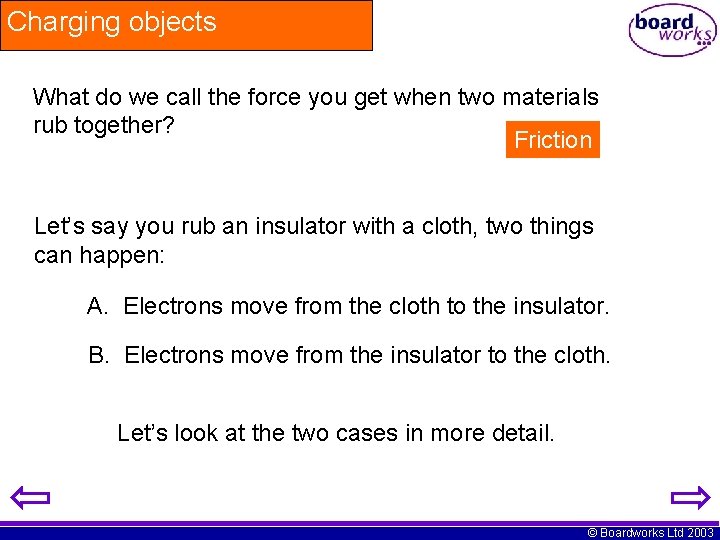
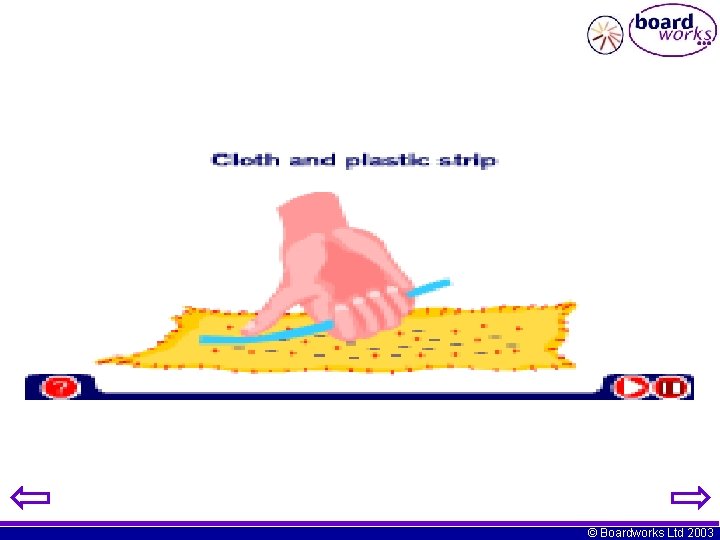
Charging objects What do we call the force you get when two materials rub together? Friction Let’s say you rub an insulator with a cloth, two things can happen: A. Electrons move from the cloth to the insulator. B. Electrons move from the insulator to the cloth. Let’s look at the two cases in more detail. © Boardworks Ltd 2003
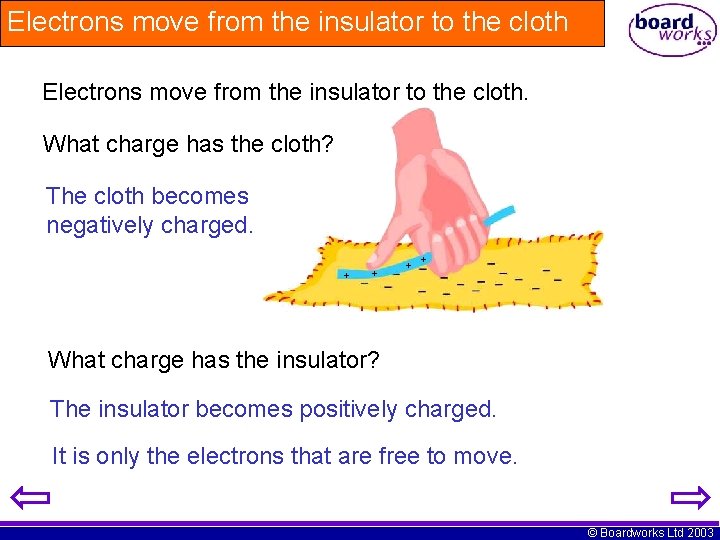
Electrons move from the insulator to the cloth. What charge has the cloth? The cloth becomes negatively charged. + + What charge has the insulator? The insulator becomes positively charged. It is only the electrons that are free to move. © Boardworks Ltd 2003
© Boardworks Ltd 2003
Electrons move from the cloth to the insulator. What charge has the cloth? The cloth becomes positively charged. What charge has the insulator? The insulator becomes negatively charged. It is only the electrons that are free to move. © Boardworks Ltd 2003
Experiment 1 • Charge up one of the plastic strips • Check the charge using the charge measuring device and the data logger • Was the charge positive or negative • Can you explain what has happened (use the word electrons) © Boardworks Ltd 2003
Experiment 2 • Charge up the same rod as in experiment 1 and attach it to the cradle • Now charge up another rod and bring it close to the first • What happens? • What charge is on the new rod? • Check with the charge measuring device © Boardworks Ltd 2003
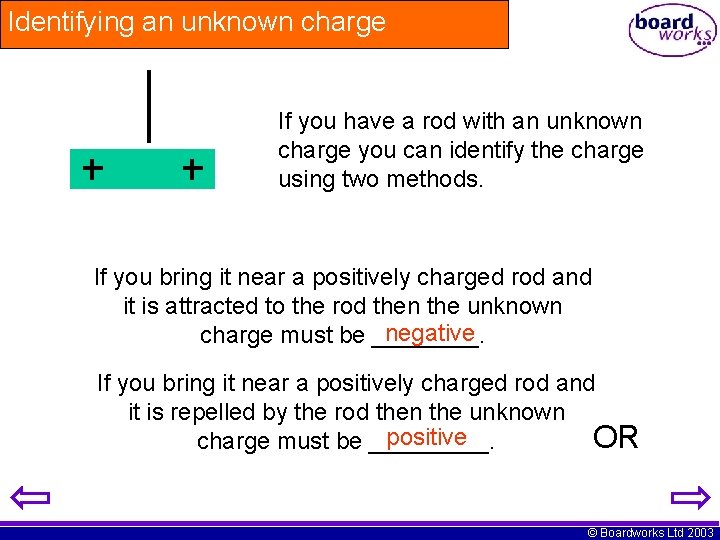
Identifying an unknown charge If you have a rod with an unknown charge you can identify the charge using two methods. If you bring it near a positively charged rod and it is attracted to the rod then the unknown negative charge must be ____. If you bring it near a positively charged rod and it is repelled by the rod then the unknown positive OR charge must be _____. © Boardworks Ltd 2003
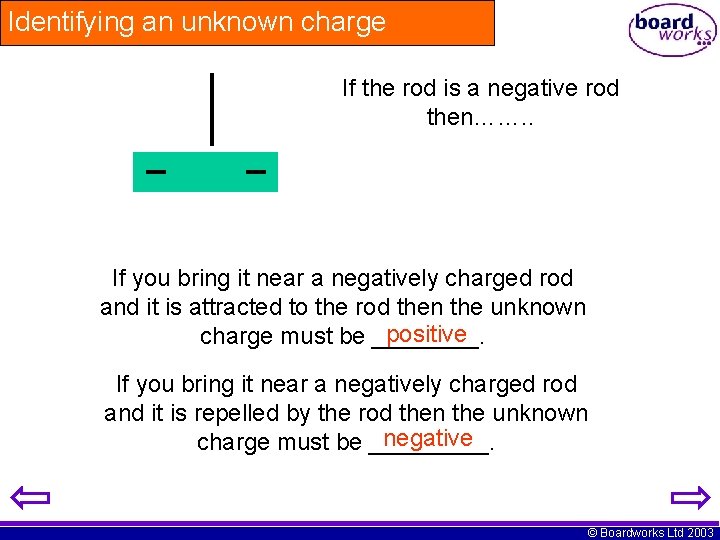
Identifying an unknown charge If the rod is a negative rod then……. . If you bring it near a negatively charged rod and it is attracted to the rod then the unknown positive charge must be ____. If you bring it near a negatively charged rod and it is repelled by the rod then the unknown negative charge must be _____. © Boardworks Ltd 2003
Experiment 3 • Charge up a rod and bring it near to some small pieces of paper • Try holding your rod near a stream of water from a tap • Rub a balloon on your sweater (or hair) place it gently against the wall • Can you explain what happens © Boardworks Ltd 2003
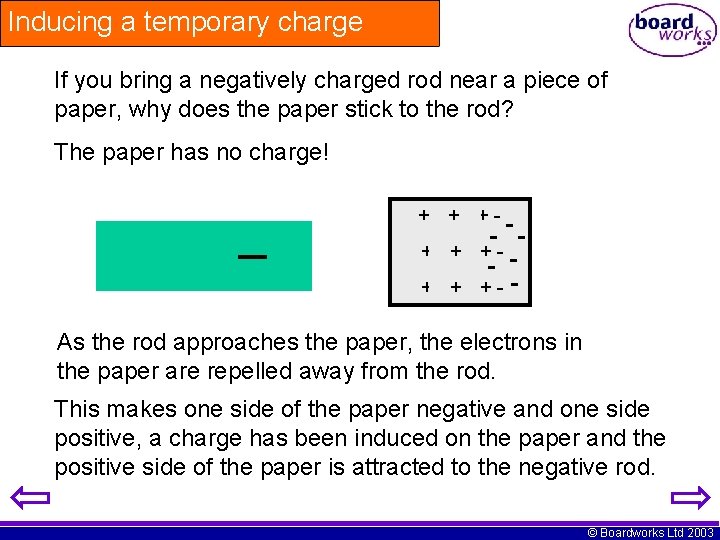
Inducing a temporary charge If you bring a negatively charged rod near a piece of paper, why does the paper stick to the rod? The paper has no charge! +-+-++-+-+- As the rod approaches the paper, the electrons in the paper are repelled away from the rod. This makes one side of the paper negative and one side positive, a charge has been induced on the paper and the positive side of the paper is attracted to the negative rod. © Boardworks Ltd 2003
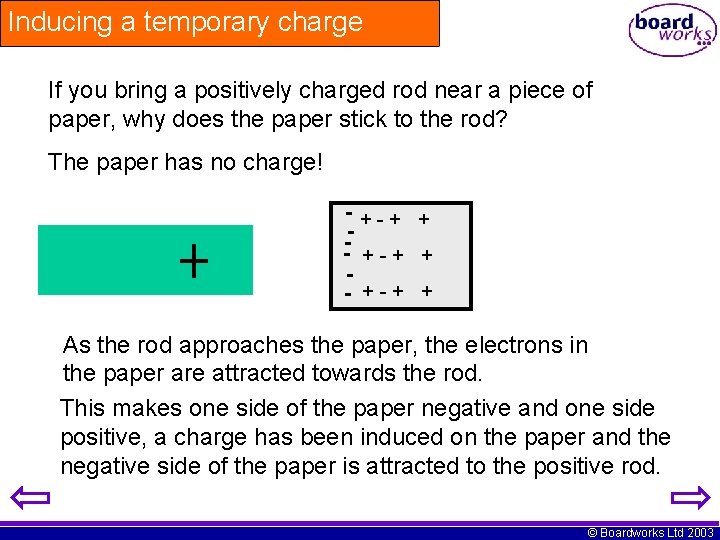
Inducing a temporary charge If you bring a positively charged rod near a piece of paper, why does the paper stick to the rod? The paper has no charge! +-+-++-+-+- As the rod approaches the paper, the electrons in the paper are attracted towards the rod. This makes one side of the paper negative and one side positive, a charge has been induced on the paper and the negative side of the paper is attracted to the positive rod. © Boardworks Ltd 2003
Conductors and Insulators • In all of the examples which particles move? • Protons do not move in materials (they are trapped away in the nucleus) • A good conductor has lots of electrons that are free to move – Free electrons • An insulator does not have free electrons. © Boardworks Ltd 2003
To do • P 171&173 Answer all questions © Boardworks Ltd 2003
What is the charge on an electron? A. Positive B. Negative C. Neutral D. Depends upon the atom © Boardworks Ltd 2003
What force can be used to charge insulators? A. Gravity B. Friction C. Weight D. Energy © Boardworks Ltd 2003
If a current of 6 A is run through a device for 6 seconds. What charge is delivered to the device? A. 1 A B. 36 A C. 1 C D. 36 C © Boardworks Ltd 2003
If a kettle has a 13 A current and is on for 2 minutes, what charge is delivered to the kettle? A. 26 C B. 6. 5 C C. 1560 C D. 0. 23 C © Boardworks Ltd 2003
If 6 C of charge is delivered at a potential difference of 5 V, how much energy is delivered? A. 1. 2 J B. 11 J C. 30 J D. 30 k. J © Boardworks Ltd 2003
• Core • Describe simple experiments to show the production and detection of electrostatic charges • State that there are positive and negative charges • State that unlike charges attract and that like charges repel • Distinguish between electrical conductors and insulators and give typical examples © Boardworks Ltd 2003
• • Supplement State that charge is measured in coulombs Give an account of charging by induction Recall and use the simple electron model to distinguish between conductors and insulators © Boardworks Ltd 2003
- Slides: 24