
IFS Intertemporal taxes consumption and savings Orazio Attanasio
- Slides: 19
IFS Intertemporal taxes, consumption and savings Orazio Attanasio (UCL and IFS) and Matthew Wakefield (IFS and UCL)
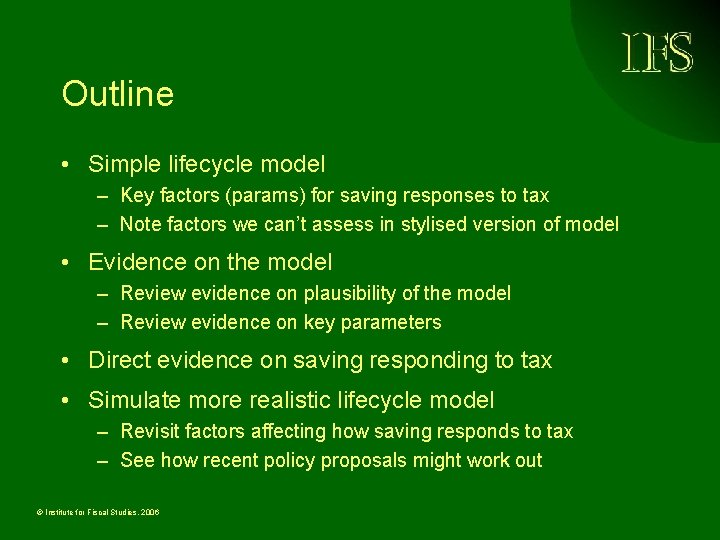
Outline • Simple lifecycle model – Key factors (params) for saving responses to tax – Note factors we can’t assess in stylised version of model • Evidence on the model – Review evidence on plausibility of the model – Review evidence on key parameters • Direct evidence on saving responding to tax • Simulate more realistic lifecycle model – Revisit factors affecting how saving responds to tax – See how recent policy proposals might work out © Institute for Fiscal Studies, 2006
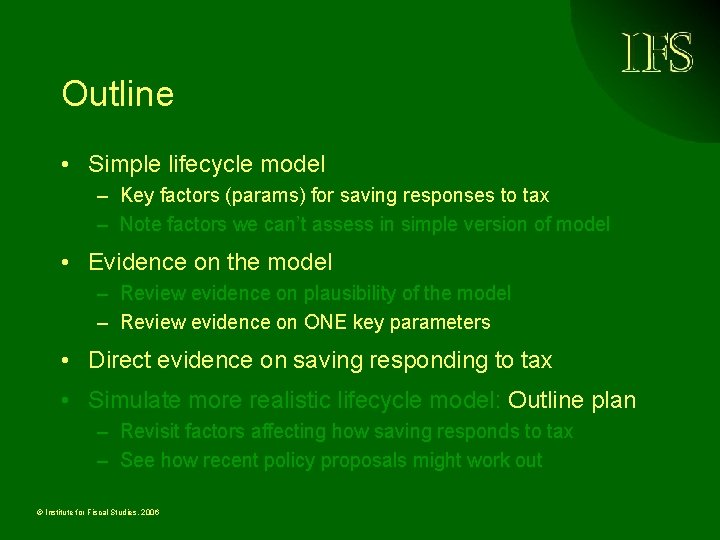
Outline • Simple lifecycle model – Key factors (params) for saving responses to tax – Note factors we can’t assess in simple version of model • Evidence on the model – Review evidence on plausibility of the model – Review evidence on ONE key parameters • Direct evidence on saving responding to tax • Simulate more realistic lifecycle model: Outline plan – Revisit factors affecting how saving responds to tax – See how recent policy proposals might work out © Institute for Fiscal Studies, 2006
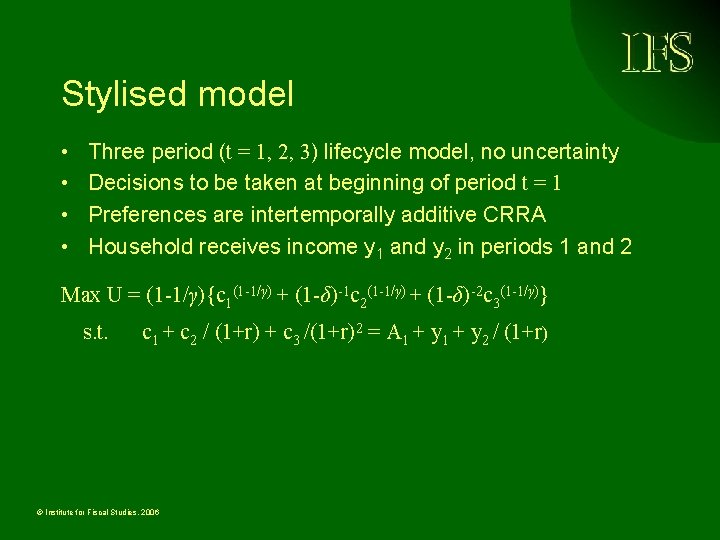
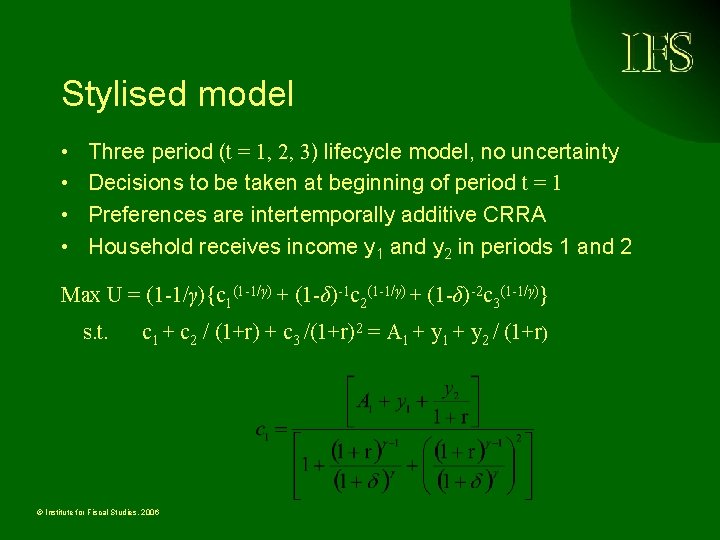
Stylised model • • Three period (t = 1, 2, 3) lifecycle model, no uncertainty Decisions to be taken at beginning of period t = 1 Preferences are intertemporally additive CRRA Household receives income y 1 and y 2 in periods 1 and 2 Max U = (1 -1/γ){c 1(1 -1/γ) + (1 -δ)-1 c 2(1 -1/γ) + (1 -δ)-2 c 3(1 -1/γ)} s. t. c 1 + c 2 / (1+r) + c 3 /(1+r)2 = A 1 + y 2 / (1+r) © Institute for Fiscal Studies, 2006
Stylised model • • Three period (t = 1, 2, 3) lifecycle model, no uncertainty Decisions to be taken at beginning of period t = 1 Preferences are intertemporally additive CRRA Household receives income y 1 and y 2 in periods 1 and 2 Max U = (1 -1/γ){c 1(1 -1/γ) + (1 -δ)-1 c 2(1 -1/γ) + (1 -δ)-2 c 3(1 -1/γ)} s. t. c 1 + c 2 / (1+r) + c 3 /(1+r)2 = A 1 + y 2 / (1+r) © Institute for Fiscal Studies, 2006
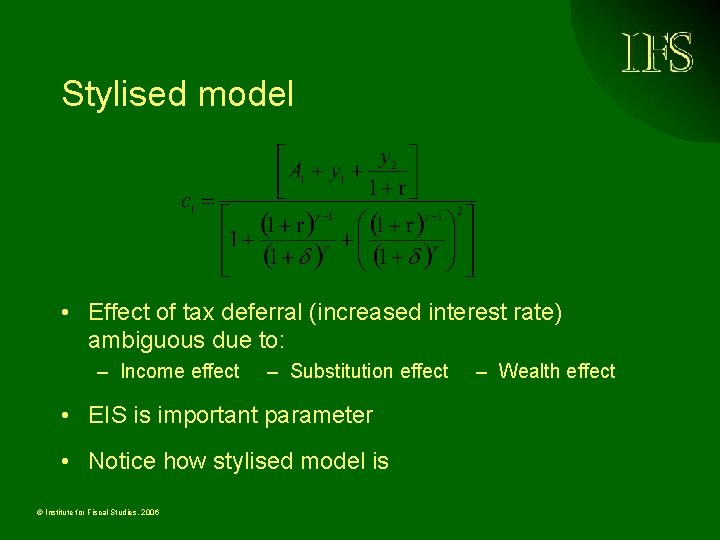
Stylised model • Effect of tax deferral (increased interest rate) ambiguous due to: – Income effect – Substitution effect • EIS is important parameter • Notice how stylised model is © Institute for Fiscal Studies, 2006 – Wealth effect
Evidence on EIS • Using microdata (pseudo-panels) to estimate log-linear euler equation – Not universally accepted that this gives consistent estimates © Institute for Fiscal Studies, 2006
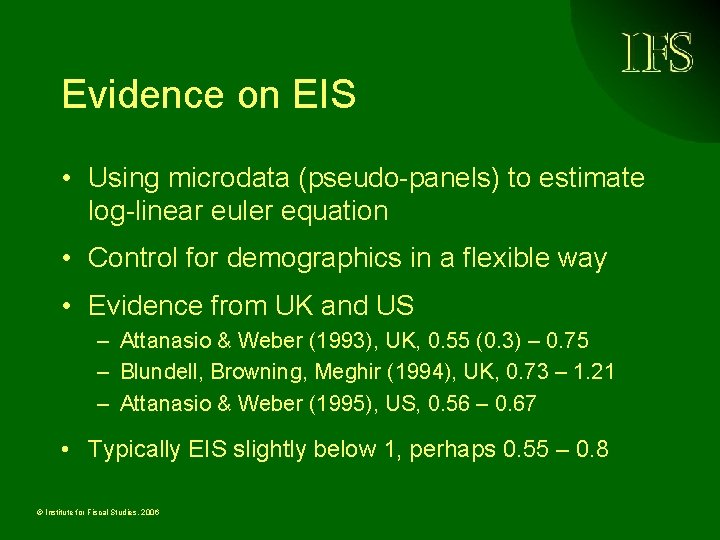
Evidence on EIS • Using microdata (pseudo-panels) to estimate log-linear euler equation • Control for demographics in a flexible way • Evidence from UK and US – Attanasio & Weber (1993), UK, 0. 55 (0. 3) – 0. 75 – Blundell, Browning, Meghir (1994), UK, 0. 73 – 1. 21 – Attanasio & Weber (1995), US, 0. 56 – 0. 67 • Typically EIS slightly below 1, perhaps 0. 55 – 0. 8 © Institute for Fiscal Studies, 2006
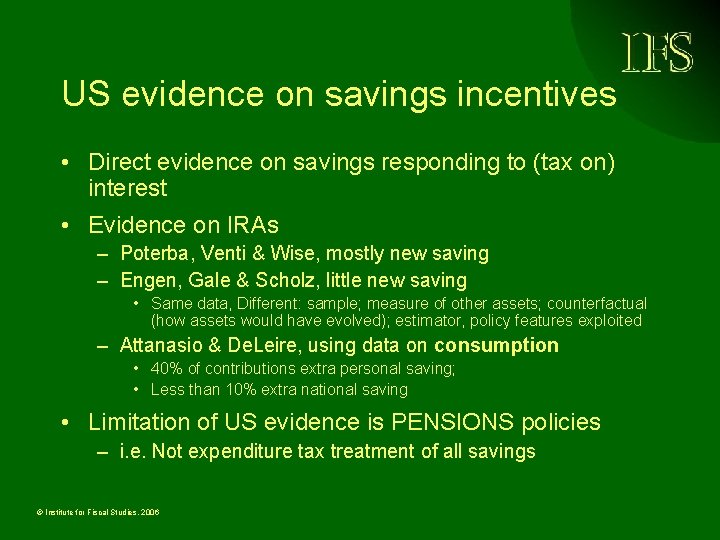
US evidence on savings incentives • Direct evidence on savings responding to (tax on) interest • Evidence on IRAs – Poterba, Venti & Wise, mostly new saving – Engen, Gale & Scholz, little new saving • Same data, Different: sample; measure of other assets; counterfactual (how assets would have evolved); estimator, policy features exploited – Attanasio & De. Leire, using data on consumption • 40% of contributions extra personal saving; • Less than 10% extra national saving • Limitation of US evidence is PENSIONS policies – i. e. Not expenditure tax treatment of all savings © Institute for Fiscal Studies, 2006
UK evidence on savings incentives • Aggregate evidence on TESSAs – Cash deposit account, 1991 - 1999 – Interest tax exempt if not withdrawn in first 5 years © Institute for Fiscal Studies, 2006
UK evidence on savings incentives • Aggregate evidence on TESSAs – Consistent with a “mainly reshuffling” hypothesis • Phase 1: Average balances jumped each year in line with annual contribution limits • Phase 2: Balances stabilise below account lifetime limits © Institute for Fiscal Studies, 2006
UK evidence on savings incentives • Aggregate evidence on TESSAs – Consistent with a “mainly reshuffling” hypothesis • Household level evidence on ISAs – Cash and/or stocks/shares account, no fixed term – No tax on interest/return – For most families ISAs potentially give expenditure tax treatment on all accessible savings © Institute for Fiscal Studies, 2006
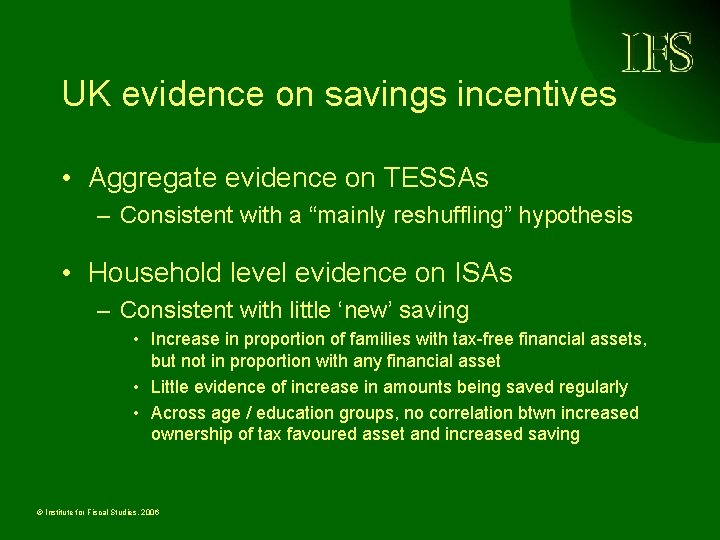
UK evidence on savings incentives • Aggregate evidence on TESSAs – Consistent with a “mainly reshuffling” hypothesis • Household level evidence on ISAs – Consistent with little ‘new’ saving • Increase in proportion of families with tax-free financial assets, but not in proportion with any financial asset • Little evidence of increase in amounts being saved regularly • Across age / education groups, no correlation btwn increased ownership of tax favoured asset and increased saving © Institute for Fiscal Studies, 2006
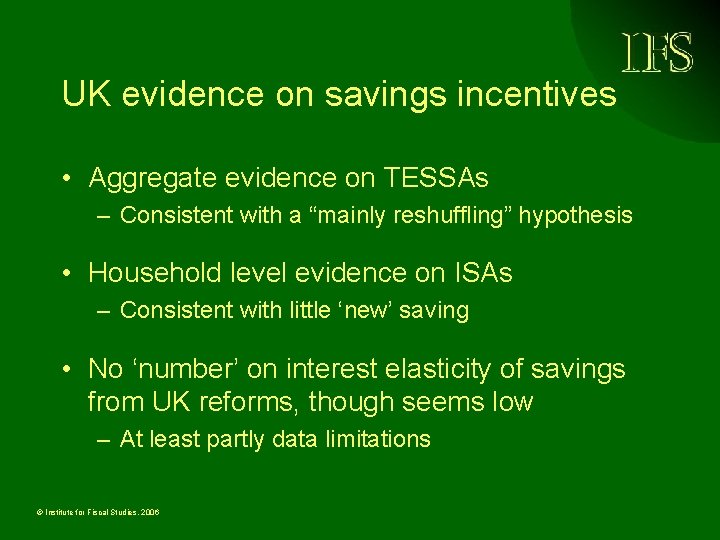
UK evidence on savings incentives • Aggregate evidence on TESSAs – Consistent with a “mainly reshuffling” hypothesis • Household level evidence on ISAs – Consistent with little ‘new’ saving • No ‘number’ on interest elasticity of savings from UK reforms, though seems low – At least partly data limitations © Institute for Fiscal Studies, 2006
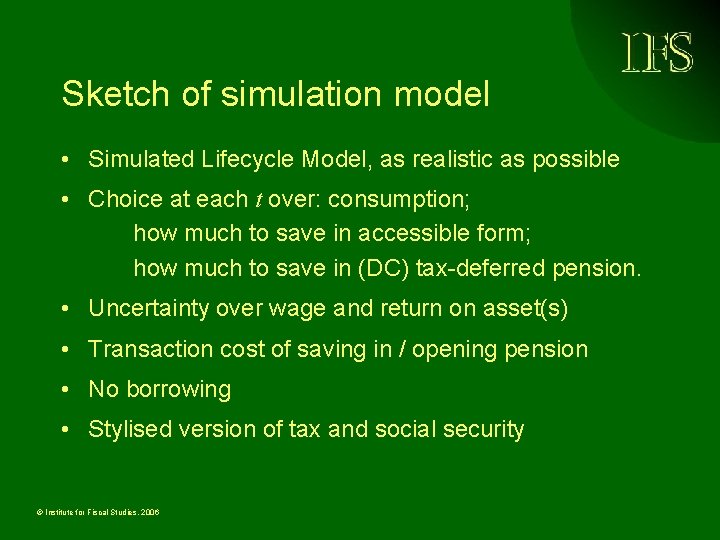
Sketch of simulation model • Simulated Lifecycle Model, as realistic as possible • Choice at each t over: consumption; how much to save in accessible form; how much to save in (DC) tax-deferred pension. • Uncertainty over wage and return on asset(s) • Transaction cost of saving in / opening pension • No borrowing • Stylised version of tax and social security © Institute for Fiscal Studies, 2006
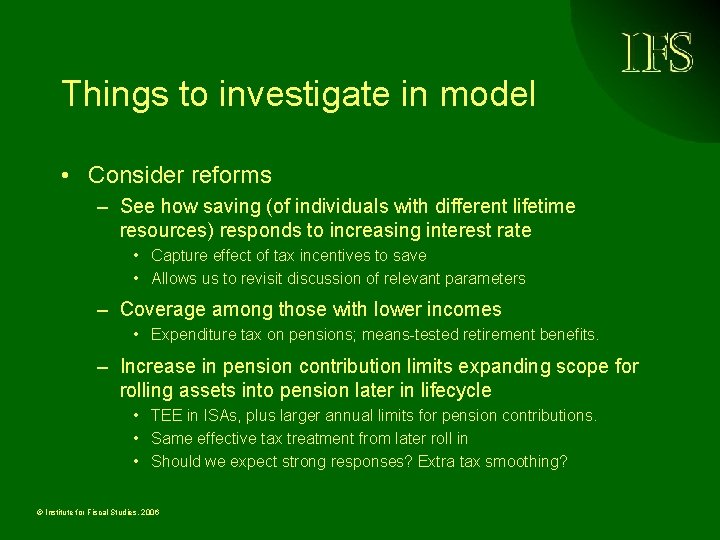
Things to investigate in model • Consider reforms – See how saving (of individuals with different lifetime resources) responds to increasing interest rate • Capture effect of tax incentives to save • Allows us to revisit discussion of relevant parameters – Coverage among those with lower incomes • Expenditure tax on pensions; means-tested retirement benefits. – Increase in pension contribution limits expanding scope for rolling assets into pension later in lifecycle • TEE in ISAs, plus larger annual limits for pension contributions. • Same effective tax treatment from later roll in • Should we expect strong responses? Extra tax smoothing? © Institute for Fiscal Studies, 2006
Summary conclusion • (Will) have discussed – Lifecycle model good starting point for thinking about saving responding to intertemporal taxes • This model not inconsistent with data – Values of some key parameters for response of saving to intertemporal tax – Direct evidence of saving responding to intertemporal tax changes – What dynamic (simulation) models can add to our knowledge in this area • … © Institute for Fiscal Studies, 2006
IFS Intertemporal taxes, consumption and savings Orazio Attanasio (UCL and IFS) and Matthew Wakefield (IFS and UCL)
Outline • Simple lifecycle model – Key factors (params) for saving responses to tax – Note factors we can’t assess in stylised version of model • Evidence on the model – Review evidence on plausibility of the model – Review evidence on key parameters • Direct evidence on saving responding to tax • Simulate more realistic lifecycle model – Revisit factors affecting how saving responds to tax – See how recent policy proposals might work out © Institute for Fiscal Studies, 2006